The profiles of all emission lines are complex and variable. A few of the H profiles show a strong, narrow absorption; but most have a flat top or a shoulder, suggesting the presence of weak absorption in the line core. In addition, some of the profiles show weak blue emission, and/or red absorption. We fitted each of the H
profiles with several Gaussian components
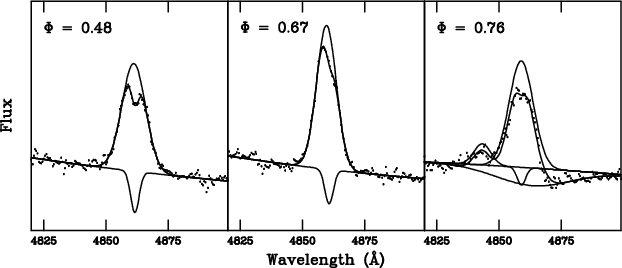
(see Fig. 9): (1) an emission component, the "main" component, (2) a narrow absorption component (assumed to be unresolved and thus assigned a fixed width of 4.0 Å FWHM), (3) a blue emission component and (4) a broad red absorption component. Due to their location in the line wings and to their relative weakness the two latter components were constrained, the first in width (fixed at 8.0 Å FWHM) and the second in width (fixed at 35 Å FWHM) and in velocity (fixed at +135 kms-1).
profiles show a strong, narrow absorption; but most have a flat top or a shoulder, suggesting the presence of weak absorption in the line core. In addition, some of the profiles show weak blue emission, and/or red absorption. We fitted each of the H
profiles with several Gaussian components
(see Fig. 9): (1) an emission component, the "main" component, (2) a narrow absorption component (assumed to be unresolved and thus assigned a fixed width of 4.0 Å FWHM), (3) a blue emission component and (4) a broad red absorption component. Due to their location in the line wings and to their relative weakness the two latter components were constrained, the first in width (fixed at 8.0 Å FWHM) and the second in width (fixed at 35 Å FWHM) and in velocity (fixed at +135 kms-1).
We find that the main component has a variable FWHM (8.0-15.0 Å), but half of the values are in the range 10.6-11.8 Å. The analysis of H and He I
  5875 gives similar results; the velocities of the main component of the three lines are well correlated. The H
and H
FWHMs are also correlated, suggesting that the observed variability is real and not the result of measurement errors. We also note that the presence, around phases
5875 gives similar results; the velocities of the main component of the three lines are well correlated. The H
and H
FWHMs are also correlated, suggesting that the observed variability is real and not the result of measurement errors. We also note that the presence, around phases
 0.8-0.2, of a blue emission and of a red absorption in H
are well correlated in the sense that, when a red absorption is present, a blue emission is always present; moreover, we never observe a red emission nor a blue absorption.
0.8-0.2, of a blue emission and of a red absorption in H
are well correlated in the sense that, when a red absorption is present, a blue emission is always present; moreover, we never observe a red emission nor a blue absorption.
The velocities of the narrow Gaussian absorption component fitted to the H
profiles (see Fig. 9) were measured to have a semi-amplitude
 kms-1 and an average velocity
 kms-1. They follow closely the main H
emission component as there is no significant phase shift (
kms-1. They follow closely the main H
emission component as there is no significant phase shift (
 ). The intensities of the main Gaussian component fitted to the data are seen to vary in phase with a minimum in the phase range 0.9-0.3 and a maximum near 0.6-0.8. The high-velocity blue emission was measured on 15 spectra and its velocities give a semi-amplitude
 kms-1 and an average velocity
 kms-1. The phase of maximum blue shift is 0.95
  0.06. There is one spectrum where the velocity was measured to be -1880 kms-1, but others lie within the interval -650 to -1200 kms-1. The curve of the H
high-velocity component shows a phase lag of 0.2 with respect to the main emission.
0.06. There is one spectrum where the velocity was measured to be -1880 kms-1, but others lie within the interval -650 to -1200 kms-1. The curve of the H
high-velocity component shows a phase lag of 0.2 with respect to the main emission.
4686
 4634, 4641 and 4642 and C III
4647, 4651 and 4652; the N III lines account for about two-thirds of the total blend intensity; the theoretical ratio
4634, 4641 and 4642 and C III
4647, 4651 and 4652; the N III lines account for about two-thirds of the total blend intensity; the theoretical ratio  4634)/
 4641,4642) is 0.71 (Schachter et al. 1989). The N III lines are produced by fluorescence, the C III lines are not (Bowen 1935; Ferland 1992).
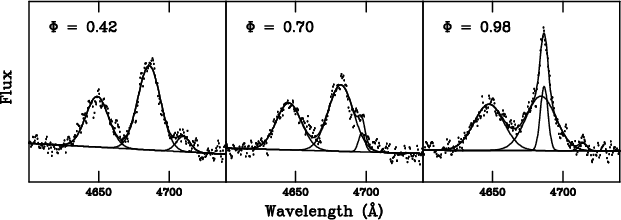
We analysed the spectral region around He II 4686, which contains the "Bowen blend", by using six Gaussian profiles: the first two, intended to represent the N III fluorescent lines, were centered at 4634.2 and 4641.0 Å respectively; they were forced to have the same width and velocity; the flux of the first was assumed to be half that of the second; the third profile, centered at 4649.0 Å, corresponded to the C III triplet; two more profiles were judged necessary to fit reasonably the He II line itself; the sixth component corresponds to He I 4713.1; we fixed its width to 12 Å (FWHM), the average width found for the Balmer main emission components. The fit yielded a very weak, insignificant N III system in emission, suggesting that, in RX J1643.7+3402, the C III triplet accounts for most of the "Bowen blend". The average FWHM of both the C III triplet at 4650 and the C IV doublet at
 5804 is about 1500 kms-1.
The Gaussian fits to the He II emission line required two different components, a "broad" component and a "narrow" component, examples of which are illustrated in Fig. 10. The velocities of the "broad" component vary between 0 and -350 kms-1. The semi-amplitude is
 kms-1 and the mean velocity is
 kms-1. The phase lag with respect to the velocities of the main H
emission component is very small (
kms-1. The phase lag with respect to the velocities of the main H
emission component is very small (
 )
and may in fact be negligeable. The "narrow" He II component shows a curve similar to the "broad" component but is shifted in velocity by
)
and may in fact be negligeable. The "narrow" He II component shows a curve similar to the "broad" component but is shifted in velocity by  +300 kms-1 (see Fig. 12); this suggests that these two components probably describe a complex single profile. Two individual spectra show a particularly striking red-shifted "narrow" component (see Figs. 10 and 12) near phase 0.75. Phase coverage for the "narrow" component is uneven since none is seen in some spectra (phase 0.42) while in others its absence may in part be due to a poor S/N ratio.
 575 period. The spectra were then smoothed in wavelength using a 3-point running average and in phase using a
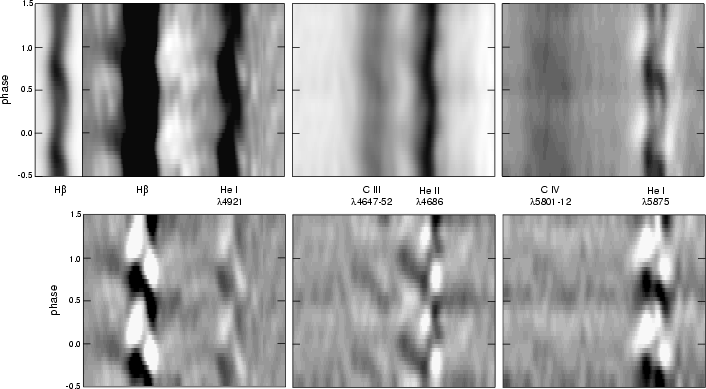
 1 Gaussian filter. The result is displayed using 20 phase bins. Figure 11(top panel) shows three sections of this spectrum (each panel is 140 Å wide) including respectively H
and He I 4921, the "Bowen blend" and He II 4686, and C IV 5804 and He I 5875; all narrow lines (H,
He I and He II) show a clear S-shape. The He I 5875 line has three main components: an emission component behaving like H,
a broad absorption component and a narrow (unresolved?) absorption component visible mainly at phases 0.3-0.6. The H
line (shown twice with different contrasts) has a strong emission core with a narrow absorption component (barely visible in the figure) which is most conspicuous at the same phases as in the He I line; in addition, a very weak broad blue emission appears during about half the period, while a broad red absorption is detected simultaneously. The He II line has a narrow core similar to the H
core, but without any trace of the narrow absorption component; in addition, there is a broad emission component.
1 Gaussian filter. The result is displayed using 20 phase bins. Figure 11(top panel) shows three sections of this spectrum (each panel is 140 Å wide) including respectively H
and He I 4921, the "Bowen blend" and He II 4686, and C IV 5804 and He I 5875; all narrow lines (H,
He I and He II) show a clear S-shape. The He I 5875 line has three main components: an emission component behaving like H,
a broad absorption component and a narrow (unresolved?) absorption component visible mainly at phases 0.3-0.6. The H
line (shown twice with different contrasts) has a strong emission core with a narrow absorption component (barely visible in the figure) which is most conspicuous at the same phases as in the He I line; in addition, a very weak broad blue emission appears during about half the period, while a broad red absorption is detected simultaneously. The He II line has a narrow core similar to the H
core, but without any trace of the narrow absorption component; in addition, there is a broad emission component.
The bottom panel of Fig. 11 shows the result of subtracting the phase-averaged profile from the "trailed" spectra shown in the top panel. This enhances the relative changes in the emission lines. Complex low-velocity modulations, which have a distinct "braided" appearance, are seen in the Balmer lines, the He I lines and the He II line. The modulations in the Balmer and He I lines are similar, although the He I 5875 line profile is complicated by the stronger central absorption. In the case of the He II 4686 line there is an additional blue-shifted high-velocity S-wave which is clearly visible for roughly one-half of the orbital cycle, from phases 0.6 to 0.2, roughly opposite to the time when the central absorption is strongest in the Balmer and He I lines. This blue-shifted He II emission S-wave also lags in phase by 0.2 with respect to the "main" profile, showing roughly the same velocity curve as the blue-shifted H
emission component.
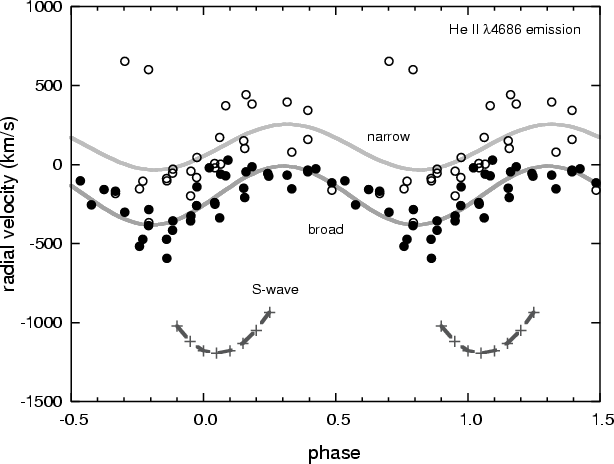 |
Figure 12:
He II 4686 radial velocities are shown for the two components of the "main" emission ("broad" and "narrow") and for the blue S-wave. The period and epoch used are the same as for Fig. 7. For the "main" components we show the least-squares sine fits. The semi-amplitudes are
 kms-1 and kms-1 and
 kms-1 and the average velocities are kms-1 and the average velocities are
 kms-1 and kms-1 and
 kms-1. For the S-wave component the velocities were measured on the residual "trailed" spectra shown in Fig. 11 (bottom panel). kms-1. For the S-wave component the velocities were measured on the residual "trailed" spectra shown in Fig. 11 (bottom panel). |
There is a weakly visible S-wave both in the "Bowen blend" and an even weaker one in the C IV blend which is seen in the phase range from 0.4 to 0.9, both moving in sympathy with the blue-shifted He II S-wave. The He I 5875 line displays blue-shifted absorption when both the H
and the He II emission show blue-shifted emission.
In Fig. 12 we have plotted the radial velocities of the He II 4686 S-wave, as measured on the residual "trailed" spectra, together with the velocities of the two components ("broad" and "narrow") of the "main" emission discussed earlier.
Copyright ESO 2002