 |
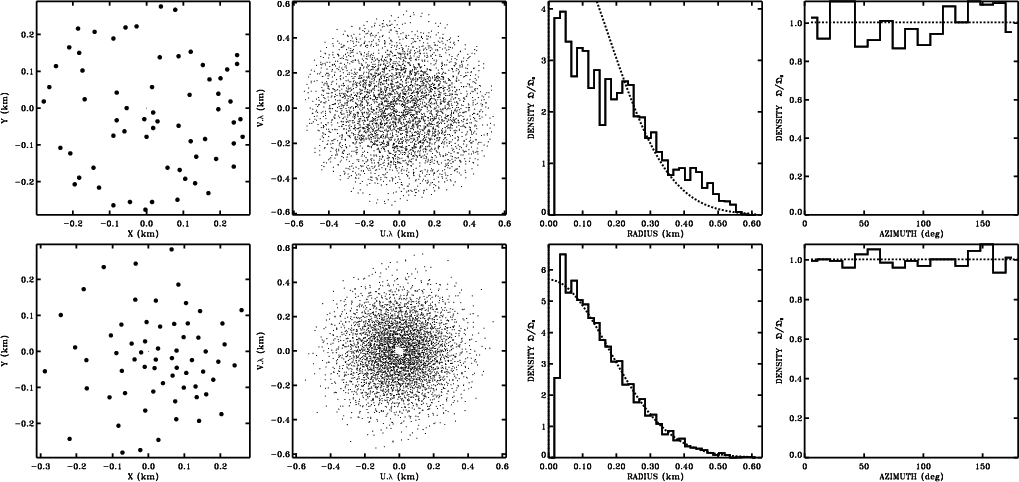
Figure 3: Example of optimization: a configuration of 64 antennas is optimized for a Gaussian distribution of Fourier samples. The first row shows the initial randomly picked configuration, its Fourier samples and the radial and azimuthal profiles of the density of Fourier samples. The second row shows the same for the optimized configuration. The model distribution is represented by the dashed lines in the radial and azimuthal profiles. The optimal distribution of antennas is expected to be Gaussian, this property is checked in Fig. 4. |
![\begin{figure}
\par\mbox{\includegraphics[width=8.1cm,clip]{H2979F7.PS} \includegraphics[width=8cm,clip]{H2979F8.PS} }
\end{figure}](/articles/aa/full/2001/37/aah2979/img27.gif) |
Figure 4: Convergence and quality of the result for the optimization illustrated in Fig. 3. On the left-hand side the variations of the standard deviation at various resolutions (for grids made of 62 to 102 cells per quadrant) show the rapid and stable convergence of the method. Each iteration lasts about 10 s in time. On the right-hand side the distribution of antennas from the optimized configuration fits quite well a Gaussian distribution. This is indeed the result expected for a Gaussian distribution of Fourier samples. |
Mainly two methods are currently used by the community to solve the configuration problem: one was developed by Keto (1997) in the frame of the SMA project and the other by Kogan (1997) in the frame of the ALMA project.
In the first method, randomly picked positions in the uv-plane pull the nearest Fourier samples by moving the corresponding antennas in the same direction. The random positions are picked with a probability distribution equal to the final wanted distribution of Fourier samples. With a large number of iterations, and thanks to a neural network, the algorithm converges to a solution. Although this method allows one to get some interesting results it is still computationally expensive and can only handle a small number of antennas for snapshot observations only. It was argued in Keto (1997) that the effect of Earth rotation synthesis on the instrumental response could be easily derived and compensated as the coordinates of the samples result from rotations and projections of a zenithal snapshot observation. It was also suggested to optimize an array for zenithal observations only, considering it as the average source position. The point of view supported here is quite different. First, as will be shown in Sect. 4 with some examples, the dependency of the configurations on the source position for long track observations is obvious and its prediction from a zenithal snapshot observation is not trivial. Second, sources at low elevations require a substantial elongation of the array in the north-south direction (as well as a rearrangement of the antennas different for the northern and southern sources). Therefore, if several configurations are possible (i.e. the number of pads is greater than the number of antennas) it is better to optimize at least 3 different configurations corresponding to zenithal, northern and southern observations. For that purpose it is necessary to include the earth rotation synthesis in the algorithm.
Another approach of the problem was proposed in Kogan (1997). From the relationship relating the synthesized beam to the antenna positions, an analytical solution for the displacements of the antennas lowering the side lobe level at a given position on the synthesized beam was derived. If this method can improve a configuration from the side lobe level point of view it is not able to find an optimal configuration for any arbitrary distribution of Fourier samples and thus is not able to answer the configuration problem in the general sense. Furthermore, it is shown in Paper II that even for imaging purposes the target distribution of samples should not always be the one that minimizes side lobes. If this method can be useful in some particular cases (e.g. when it is wanted to optimize the imaging quality of a predefined configuration shape known to provide the required sampling for snapshot observations), it is argued the configuration problem should be treated exclusively from the Fourier plane point of view, i.e. for a wanted distribution of Fourier samples. Again, what an interferometer actually measures is a set of angular spatial frequencies and to each scientific goal an optimal distribution of samples should be defined. This distribution may not necessarily yield low side lobes but should allow to recover the relevant information with the highest possible sensitivity (see Paper II).
The method proposed here is based on the fact that while it is usually not possible to get a direct solution for the antenna positions it is easy for any configuration to figure out how the Fourier samples should be moved to "improve'' the distribution, or make it more similar to the model. For instance, if there is a hole in the distribution where it should not be, some of the nearby Fourier samples should be moved to fill-in this hole. The question is then: how should the antennas move in order to allow such an improvement?
There is a direct geometrical relationship between each sample coordinates and the positions of two antennas, but moving one antenna implies moving
 Fourier samples and it would not necessarily be an improvement to move one antenna according to only one sample. The approach suggested here is to move each antenna according to the
Fourier samples in which it is involved, i.e. according to the average of the
displacements these Fourier samples should undergo to improve the distribution.
The way a sample should be moved is numerically derived by computing the local "excess-density'' gradient,
Fourier samples and it would not necessarily be an improvement to move one antenna according to only one sample. The approach suggested here is to move each antenna according to the
Fourier samples in which it is involved, i.e. according to the average of the
displacements these Fourier samples should undergo to improve the distribution.
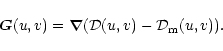
The way a sample should be moved is numerically derived by computing the local "excess-density'' gradient,  .
By excess-density is meant the difference between the actual density,
.
By excess-density is meant the difference between the actual density,
 and the model density,
 :
:
 |
(1) |
 may be interpreted as a pressure force undergone by the Fourier samples, either pulled out overcrowded regions, or sucked into insufficiently covered regions.
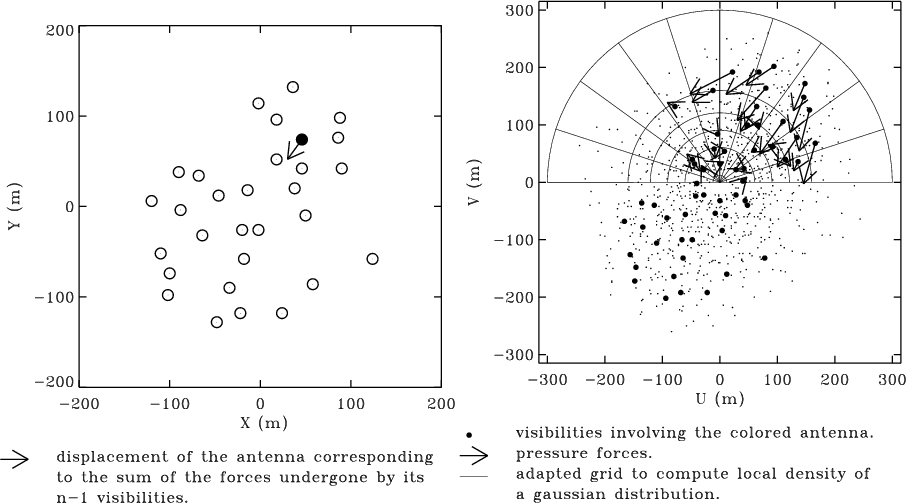
The method is illustrated in Fig. 2. For each antenna the
gradient vectors corresponding to the
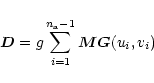
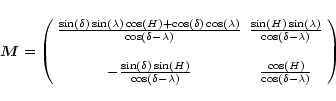
Fourier samples are computed, transformed according to the geometrical transformation relating the Fourier plane to the ground plane and the antenna moved according to the average of these vectors. The displacement  for one antenna is given by:
 is the transformation matrix from the uv-plane to the ground plane:
 |
(3) |
 the source declination,
  the site latitude and H the hour angle.
By repeating this operation for each antenna and iterating, the configuration should converge to an optimal solution. Ideally, once the optimal configuration is reached, the forces should equal zero everywhere meaning that the distribution obtained is equal to the model distribution. In practice, as the model distribution is not necessarily an autocorrelation function it may not be possible to exactly fit it with the distribution of Fourier samples. In addition, a continuous distribution can not be perfectly fitted by the density of a limited number of points. Hence, the forces of the final configuration are never null.
Without going into a full convergence analysis, it seems reasonable to think that, if there is still some discrepancies between the model and the actual distribution, at least for one antenna the sum of the pressure forces on its Fourier samples will not cancel out and it will be moved to improve (if it can be improved) the distribution. If the distribution can not be improved the configuration will oscillate around the optimal one and by decreasing g along iterations it should converge. In other words the method seems capable of avoiding local minima and it was therefore decided to stop the optimization process when the standard deviation between the actual distribution and the model reaches a stable minimum. If there is no rigorous proof that this configuration is indeed the best one, one can hope that it is close to it and at least that it fits satisfactorily the requirements on the distribution of Fourier samples.
This method offers several advantages. First, the convergence is self-driven: there is no need to optimize blindly any quantity in a space of parameters nor to use random picking (like in Keto 1997). At each step the distribution contains in itself the way the configuration should evolve. The risk of getting caught in resonant oscillations is avoided by allowing only small displacements for the antennas i.e. by setting g to a small value. Second, the main computational cost is in the calculation of the pressure force which is a simple operation. Finally, it is very flexible and may be used for any 2d model distribution, with ground constraints, and can handle Earth rotation synthesis, multi-configuration observations and mosaicing.
Incidentally, it can be noted that this method is a variant of the steepest descent method. Indeed,
as given in Eq. (2) represents the local downhill gradient of the integral of the excess density.
Copyright ESO 2001