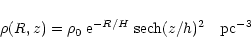
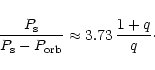
We used the population synthesis program SeBa, as described in detail in Portegies Zwart & Verbunt (1996), Portegies Zwart & Yungelson (1998) and Nelemans et al. (2001b to model the progenitor populations. We follow model A of Nelemans et al. (2001b), which has an IMF after Miller & Scalo (1979) and flat initial distributions over the mass ratio of the components and the logarithm of the orbital separation and a thermal eccentricity distribution. We assume an initial binary fraction of 50% and that the star formation decreases exponentially with time, which is different from other studies of close double white dwarfs that assume a constant star formation rate. The mass transfer between a giant and a main-sequence star of comparable mass is treated with an "angular momentum formalism'' which does not result in a strong spiral-in (Nelemans et al. 2000).
We generate the population of close double white dwarfs and helium stars with white dwarf companions and select the AM CVn star progenitors according to the criteria for the formation of the AM CVn stars as described above. We calculate the birthrate of AM CVn stars, and evolve every system according to the recipe described in Sect. 2, to obtain the total number of systems currently present in the Galaxy (Table 1) and their distribution over orbital periods and mass loss rates (Fig. 5).
The absence of an effective coupling between the accretor spin and the
orbital motion (model I) reduces the current birth rate AM CVn stars
from the white dwarf family by two orders of magnitude as compared to
the case of effective coupling (model II). The fraction of close
double white dwarfs which fill their Roche lobes and continue their
evolution as AM CVn stars is 21% in model II but only 0.2% in model
I (see also Fig. 1).
In model I the population of AM CVn stars is totally dominated by the
helium star family. In model II where tidal coupling is efficient both
families have a comparable contribution to the population. Increasing
the mass of the critical layer for ELD from 0.15
 to
0.3
almost doubles the current birth rate of the systems which
are able to enter the semi-degenerate branch of the evolution. In the
latter case almost all helium star binaries that transfer matter to a
white dwarf in a stable way eventually become AM CVn systems (see
Fig. 3).
to
0.3
almost doubles the current birth rate of the systems which
are able to enter the semi-degenerate branch of the evolution. In the
latter case almost all helium star binaries that transfer matter to a
white dwarf in a stable way eventually become AM CVn systems (see
Fig. 3).
In Fig. 5 we show the total current population of AM CVn systems in the Galaxy in our model. The evolutionary paths of both families are indicated with the curves (see also Fig. 4). Table 1 gives the total number of systems currently present in the Galaxy. The evolution of the systems decelerates with time and as a result the vast majority of the systems has orbital periods larger than one hour. The evolutionary tracks for the two families do not converge, since the mass loss of the helium stars prevents their descendants from recovering thermal equilibrium in the lifetime of the Galactic disk (see Sect. 3.3).
The minimum donor mass attainable within the lifetime of the
Galactic disk is 
 for the descendants of the
helium white dwarfs and
for the descendants of the
helium white dwarfs and
 for the descendants of
the helium stars. This is still far from the limit of
for the descendants of
the helium stars. This is still far from the limit of
 where the electrostatic forces in their interiors will
start to dominate the gravitational force, the mass-radius relation
will become
where the electrostatic forces in their interiors will
start to dominate the gravitational force, the mass-radius relation
will become
 (Zapolsky & Salpeter 1969), and the mass transfer
will cease.
(Zapolsky & Salpeter 1969), and the mass transfer
will cease.
In Table 1 we give the local space density of AM CVn systems estimated from their total number and the Galactic
distribution of stars, for which we adopt
| white dwarf family | He-star family | ||||||
| Mod. |  |
# | # obs | |
# | # obs |  |
| 10-3 | 107 | 10-3 | 107 | 10-4 | |||
| I | 0.04 | 0.02 | 1 | 0.9 | 1.8 | 32 | 0.4 |
| II | 4.7 | 4.9 | 54 | 1.6 | 3.1 | 62 | 1.7 |
The known systems are typically discovered as faint blue stars (and identified with DB white dwarfs), as high proper motion stars, or as highly variable stars (see for the history of detection of most of these stars Ulla 1994; Warner 1995). The observed systems thus do not have the statistical properties of a magnitude limited sample.
Moreover, the luminosity of AM CVn stars comes mainly from the disk in most cases. Despite the fact that several helium disk models are available (e.g. Smak 1983; Cannizzo 1984; Tsugawa & Osaki 1997; El-Khoury & Wickramasinghe 2000) there is no easy way to estimate magnitude of the disk. Therefore, we compute the visual magnitude of the systems from very simple assumptions, to get a notion of the effect of observational selection upon the sample of interacting white dwarfs.
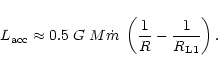
The luminosity provided by accretion is
 |
(10) |
 is the
distance of the first Lagrangian point to the centre of mass of the
accretor. We use an "average'' temperature of the disk (see Wade 1984),
which may be then obtained from
is the
distance of the first Lagrangian point to the centre of mass of the
accretor. We use an "average'' temperature of the disk (see Wade 1984),
which may be then obtained from
 ,
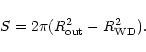
where S is the
total surface of the disk:
,
where S is the
total surface of the disk:
 |
(11) |
 .
The visual magnitude of the
binary is then computed from the effective temperature and the
bolometric correction (taken from Kuiper 1938), assuming that the
disk is a black body. This allows us to construct a magnitude limited
sample by estimating the fraction of the Galactic volume in which any
system in our theoretical sample may be observed as it evolves.
.
The visual magnitude of the
binary is then computed from the effective temperature and the
bolometric correction (taken from Kuiper 1938), assuming that the
disk is a black body. This allows us to construct a magnitude limited
sample by estimating the fraction of the Galactic volume in which any
system in our theoretical sample may be observed as it evolves.
| Name | Period | mv | m | m | Ref. |
 |
(ZS) | (TF) | |||
| AM CVn | 1028.7 | 14.1-14.2 | 0.033 | 0.114 | 1 |
| HP Lib | 1119 | 13.6 | 0.030 | 0.099 | 2 |
| CR Boo | 1471.3 | 13.0-18.0 | 0.021 | 0.062 | 3 |
| V803 Cen | 1611 | 13.2-17.4 | 0.019 | 0.054 | 2 |
| CP Eri | 1724 | 16.5-19.7 | 0.017 | 0.048 | 2 |
| GP Com | 2970 | 15.7-16.0 | 0.008 | 0.019 | 2 |
| RX J1914+24 | 569 | >19.7 | 0.068 | - | 4 |
| KL Dra | 16.8-20 | 5 |
)
obtained from Eq. (5)
are labelled by ZS, estimates from Eq. (8) by TF.
![\begin{figure}
\par\includegraphics[angle=-90,width=8.8cm,clip]{H2552f07.ps}\hspace*{0.5mm}
\includegraphics[angle=-90,width=8.8cm,clip]{H2552f08.ps}\end{figure}](/articles/aa/full/2001/12/aah2552/img66.gif) |
Figure 6:
Magnitude limited sample (
 )
of the theoretical
population of AM CVn stars for model I (left) and model II (right).
The grey scale gives the number of systems, like in
Fig. 5 but now on a linear scale (upper branch
for the helium star family; lower branch for the white dwarf
family). The selection criteria are described in
Sect. 4.2. The periods of the observed systems
(Table 2) are indicated with the vertical dotted lines. The
stability limits for the helium accretion disk according to
Tsugawa & Osaki (1997) are plotted as the solid slanted and dashed
horizontal lines. Between these lines the disk is expected to be
unstable. The upper dashed line is for an accretor mass of 0.5
,
the lower for a
1.0
accretor. The rulers at the top
indicate the theoretical relation between the period and the mass
for the mass-radius relations of the two AM CVn star families given
by Eqs. (5) and (8) )
of the theoretical
population of AM CVn stars for model I (left) and model II (right).
The grey scale gives the number of systems, like in
Fig. 5 but now on a linear scale (upper branch
for the helium star family; lower branch for the white dwarf
family). The selection criteria are described in
Sect. 4.2. The periods of the observed systems
(Table 2) are indicated with the vertical dotted lines. The
stability limits for the helium accretion disk according to
Tsugawa & Osaki (1997) are plotted as the solid slanted and dashed
horizontal lines. Between these lines the disk is expected to be
unstable. The upper dashed line is for an accretor mass of 0.5
,
the lower for a
1.0
accretor. The rulers at the top
indicate the theoretical relation between the period and the mass
for the mass-radius relations of the two AM CVn star families given
by Eqs. (5) and (8) |
We derive
 diagrams for both models, similar to the ones
for the total population, but now for the "observable'' population,
which we limit by V = 15. Changing
diagrams for both models, similar to the ones
for the total population, but now for the "observable'' population,
which we limit by V = 15. Changing
 doesn't change the
character of graphs, since only the nearby systems are visible. The
expected number of observable systems for the two families of
progenitors is given in Table 1 and shown in
Fig. 6. The observable sample comprises only one star
for every million AM CVn stars that exists in the Galaxy. A large
number of AM CVn stars may be found among very faint white dwarfs
which are expected to be of the non-DA variety due to the fact, that
the accreted material is helium or a carbon-oxygen mixture.
doesn't change the
character of graphs, since only the nearby systems are visible. The
expected number of observable systems for the two families of
progenitors is given in Table 1 and shown in
Fig. 6. The observable sample comprises only one star
for every million AM CVn stars that exists in the Galaxy. A large
number of AM CVn stars may be found among very faint white dwarfs
which are expected to be of the non-DA variety due to the fact, that
the accreted material is helium or a carbon-oxygen mixture.
In the "inefficient'' model I about one in 30 observed systems is
from the white dwarf family. This is a considerably higher fraction
than in the total AM CVn population where it is only one out of 100
systems. In the "efficient'' model II, the white dwarf family
comprises 60% of the total population and 50% of the
"observable'' one. The ratio of the total number of systems of the
white dwarf family in models I and II is not proportional to the ratio
of their current birthrates. This reflects the star formation history
and the fact that the progenitors of the donors in model I are low
mass stars that live long before they form a white dwarf. In model I
the fraction of the observable systems which belong to the white dwarf
family is higher than the fraction of the total number of systems that
belong to this family. This is caused by the fact that the accretors
in these systems are more massive (see Fig. 1), thus
smaller, giving rise to higher accretion luminosities.
To compare our model with the observations, we list the orbital
periods and the observed magnitude ranges for the known and candidate
AM CVn stars in Table 2. For AM CVn we give
 as
inferred by Patterson et al. (1993) and confirmed as a result of a large
photometry campaign ( Skilman et al. 1999) and a spectroscopic study
(Nelemans et al. 2001a). For the remaining systems we follow the original
determinations or Warner (1995). Most AM CVn stars show multiple
periods, but these are close together and do not influence our
qualitative analysis. KL Dra is identified as an AM CVn type star by
its spectrum (Jha et al. 1998), but still awaits determination of its
period. The periods of the observed AM CVn stars are shown in
Fig. 6 as the vertical dotted lines. The period of
RX J1914+24 is not plotted because this system was discovered as an
X-ray source and it is optically much fainter than the limit used
here.
as
inferred by Patterson et al. (1993) and confirmed as a result of a large
photometry campaign ( Skilman et al. 1999) and a spectroscopic study
(Nelemans et al. 2001a). For the remaining systems we follow the original
determinations or Warner (1995). Most AM CVn stars show multiple
periods, but these are close together and do not influence our
qualitative analysis. KL Dra is identified as an AM CVn type star by
its spectrum (Jha et al. 1998), but still awaits determination of its
period. The periods of the observed AM CVn stars are shown in
Fig. 6 as the vertical dotted lines. The period of
RX J1914+24 is not plotted because this system was discovered as an
X-ray source and it is optically much fainter than the limit used
here.
Figures 5 and 6 show that the uncertainty in both models and observational selection effects make it hard to argue which systems belong to which family. According to model I the descendants of close double white dwarfs are very rare. However, in that case one might not expect two observed systems at short periods (AM CVn and HP Lib). In both models I and II, systems with long periods (like GP Com) are more likely to descend from the helium star family. In the spectrum of GP Com, however, Marsh et al. (1991) found evidence for hydrogen burning ashes in the disk, but no traces of helium burning, viz. very low carbon and oxygen abundances. It is not likely that any progenitor of the helium star family completely skipped helium burning. More probably, this system belongs to the white dwarf family.
Most systems in the "observable'' model population have orbital periods similar to the periods of the observed AM CVn stars that show large brightness variations; thus most modelled systems are expected to be variable. These brightness variations have been interpreted as a result of a thermal instability of helium disks (Smak 1983). In Fig. 6 we show the thermal stability limits for helium accretion disks as derived by Tsugawa & Osaki (1997): above the solid line the disks are expected to be hot and stable; below the horizontal dashed lines the disks are cool and stable and in between the disks are unstable. Note that the vast majority of the total Galactic model population (Fig. 5) is expected to have cool stable disks according to the thermal instability model, preventing them from being detected by their variability.
The period distributions of the "observable'' population in our models agree quite well with the observed population of AM CVn stars. Better modelling of the selection effects is, however, necessary.
Table 2 gives theoretical estimates of the masses of the donor stars in the observed AM CVn stars, derived from the relation between the orbital period and the mass of the donor (see Sect. 3.4 and Fig. 6).
AM CVn stars may be subject to tidal instability due to which the disk becomes eccentric and starts precessing. Such instabilities are used to explain the superhump phenomenon in dwarf novae (Whitehurst 1988).
For AM CVn and CR Boo the observed 1051.2 s (Provencal et al. 1998) and 1492.8 s
( Provencal et al. 1997) periodicities are interpreted as superhump periods.
Following Warner (1995) we compute the mass ratio of the binary system
using the orbital period (
)
and the superhump period
( )
via:
)
via:
 and
and
 .
These values are at the lower end of the predicted distribution. If we
apply the semi-degenerate mass-radius relation, the estimated masses
of the accretors are high, even close to the Chandrasekhar
mass for AM CV. The formation of systems with high-mass accretors
has a low probability (see Fig. 3), which suggests that
either Eq. (12) is not applicable for helium disks or
alternatively that these binaries do not belong to the helium star
family.
.
These values are at the lower end of the predicted distribution. If we
apply the semi-degenerate mass-radius relation, the estimated masses
of the accretors are high, even close to the Chandrasekhar
mass for AM CV. The formation of systems with high-mass accretors
has a low probability (see Fig. 3), which suggests that
either Eq. (12) is not applicable for helium disks or
alternatively that these binaries do not belong to the helium star
family.
Maybe the most intriguing system is RX J1914.4+245; detected by ROSAT (Moch et al. 1996) and classified as an intermediate polar,
because its X-ray flux is modulated with a 569 s period, typical for
the spin periods of the white dwarfs in intermediate polars.
Cropper et al. (1998) and Ramsay et al. (2000) suggest that it is a double
degenerate polar with an orbital period equal to the spin period of
the accreting white dwarf. The mass transfer rate in this system,
inferred from its period (
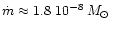 yr-1) is consistent with the value deduced from the ROSAT PSPC data (Cropper et al. 1998) if the distance is 100 pc.
Even though polars have no disk, the coupling between the accretor and donor is efficient due to the strong magnetic field of the accretor. We therefore anticipate that Eq. (4) applies without the correction introduced by Eq. (7). It may well be that magnetic systems in which the coupling is maintained by a magnetic field form the majority of stable AM CVn systems of the white dwarf family. We do not expect this system to belong to the helium star family, since its period is below the typical period minimum for the majority of the binaries in this family.
RX J0439.8-809 may be a Large Magellanic Cloud relative of the
Galactic AM CVn systems. This system was also first detected by ROSAT (Greiner et al. 1994). Available X-ray, UV- and optical data
suggest, that the binary may consist of two degenerate stars and have
an orbital period < 35 min (van Teeseling et al. 1997,1999).
RX J1914.4+245 and RX J0439.8-809 show that it is possible to
detect optically faint AM CVn stars in supersoft X-rays, especially in
other galaxies. The possibility of supersoft X-rays emission by AM CVn
stars was discussed by Tutukov & Yungelson (1996). There are two probable sources
for the emission: the accreted helium may burn stationary at the
surface of the white dwarf if
 yr-1 and/or the accretion disk may be sufficiently hot in the
same range of accretion rates. However, the required high accretion
rate makes such supersolf X-ray sources short-living (see
Fig. 4) and, therefore, not numerous. Note that AM CVn,
CR Boo, V803 Cen, CP Eri and GP Com are also weak X-ray sources
(Ulla 1995).
yr-1 and/or the accretion disk may be sufficiently hot in the
same range of accretion rates. However, the required high accretion
rate makes such supersolf X-ray sources short-living (see
Fig. 4) and, therefore, not numerous. Note that AM CVn,
CR Boo, V803 Cen, CP Eri and GP Com are also weak X-ray sources
(Ulla 1995).
The most recently found suspected AM CVn star, KL Dra, is also variable. Therefore we expect it to lie in the same period range as CR Boo, V803 Cen and CP Eri. Taking the limits for stability as given by Tsugawa & Osaki (1997) we expect the orbital period to be between 20 and 50 min (Fig. 6).
Copyright ESO 2001