From the spectra of AM CVn stars it is inferred that the transferred
material consists mainly of helium. Faulkner et al. (1972) suggested two
possibilities for the helium rich donor in AM CVn: (i) a zero-age
helium star with a mass of 0.4 - 0.5
 and (ii) a low-mass
degenerate helium white dwarf. The first possibility can be excluded
because the helium star would dominate the spectrum and cause the
accretor to have large radial velocity variations, none of which is
observed. Thus they concluded that AM CVn stars are interacting double
white dwarfs. Their direct progenitors may be detached close
double white dwarfs which are brought into contact by loss of angular
momentum due to GWR within the lifetime of the Galactic disk (for
which we take 10 Gyr). The less massive white dwarf fills its Roche
lobe first and an AM CVn star is born, if the stars do not merge (see
Sect. 3.2). We discussed the formation of such double
white dwarfs in Nelemans et al. (2001b).
and (ii) a low-mass
degenerate helium white dwarf. The first possibility can be excluded
because the helium star would dominate the spectrum and cause the
accretor to have large radial velocity variations, none of which is
observed. Thus they concluded that AM CVn stars are interacting double
white dwarfs. Their direct progenitors may be detached close
double white dwarfs which are brought into contact by loss of angular
momentum due to GWR within the lifetime of the Galactic disk (for
which we take 10 Gyr). The less massive white dwarf fills its Roche
lobe first and an AM CVn star is born, if the stars do not merge (see
Sect. 3.2). We discussed the formation of such double
white dwarfs in Nelemans et al. (2001b).
To calculate the stability of the mass transfer and the evolution of
the AM CVn system, one needs to know the mass-radius relation for white
dwarfs. This depends on the temperature, chemical composition,
thickness of the envelope etc. of the white dwarf. However,
Pnei et al. (2000) have shown that after cooling for several 100Myr the
mass-radius relation for low-mass helium white dwarfs approaches the
relation for zero-temperature spheres. As most white dwarfs that may
form AM CVn stars are at least several 100Myr old at the moment of
contact (Tutukov & Yungelson 1996), we apply the mass-radius relation for cold
spheres derived by Zapolsky & Salpter (1969), as corrected by Rappaport & Joss (1984). For
helium white dwarfs with masses between 0.002 and 0.45
,
it can
be approximated to within 3% by (in solar units)
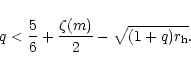
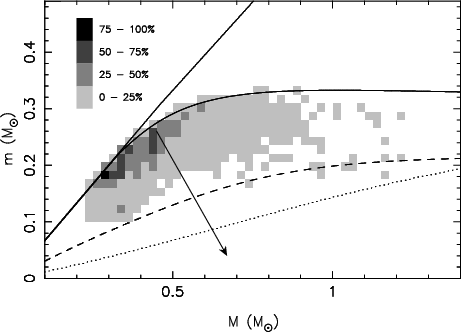
In Fig. 1 we show the limiting mass ratio for
dynamically stable mass transfer (Eq. (4)) as the upper
solid line, with  derived from Eq. (5). The
initial mass-transfer rates, as given by Eq. (3), can be
higher than the Eddington limit of the accretor (Tutukov & Yungelson 1979). The
matter that cannot be accreted is lost from the system, taking along
some angular momentum. The binary system may remain stable even though
it loses extra angular momentum. However heating of the transferred
material, may cause it to expand and form a common envelope in which
the two white dwarfs most likely merge (Hang & Webbing 1999). Therefore, we
impose the additional restriction to have the initial mass transfer
rate lower than the Eddington accretion limit for the companion
(
derived from Eq. (5). The
initial mass-transfer rates, as given by Eq. (3), can be
higher than the Eddington limit of the accretor (Tutukov & Yungelson 1979). The
matter that cannot be accreted is lost from the system, taking along
some angular momentum. The binary system may remain stable even though
it loses extra angular momentum. However heating of the transferred
material, may cause it to expand and form a common envelope in which
the two white dwarfs most likely merge (Hang & Webbing 1999). Therefore, we
impose the additional restriction to have the initial mass transfer
rate lower than the Eddington accretion limit for the companion
( 10
10
 yr-1). This changes the limiting mass
ratio below which AM CVn stars can be formed to the lower solid line
in Fig. 1. In this figure we over-plotted our model
distribution of the current birthrate of AM CVn stars that form from
close binary white dwarfs (see Sect. 4).
yr-1). This changes the limiting mass
ratio below which AM CVn stars can be formed to the lower solid line
in Fig. 1. In this figure we over-plotted our model
distribution of the current birthrate of AM CVn stars that form from
close binary white dwarfs (see Sect. 4).
In the derivation of the Eq. (3) it is implicitly assumed that the secondary rotates synchronously with the orbital revolution and that the angular momentum which is drained from the secondary is restored to the orbital motion via tidal interaction between the accretion disk and the donor star (see, e.g. Verbunt & Rappaport 1988, and references therein).
However, the orbital separation when Roche lobe overflow starts is
only about 0.1  and the formation of the accretion disk is
not obvious; the matter that leaves the vicinity of the first
Lagrangian point initially follows a ballistic trajectory, passing the
accreting star at a minimum distance of 10% of the binary
separation (Lubow & Shu 1975), i.e. at a distance comparable to the radius
of a white dwarf (
and the formation of the accretion disk is
not obvious; the matter that leaves the vicinity of the first
Lagrangian point initially follows a ballistic trajectory, passing the
accreting star at a minimum distance of 10% of the binary
separation (Lubow & Shu 1975), i.e. at a distance comparable to the radius
of a white dwarf (
 ). So, the accretion stream may
well hit the surface of the accretor directly instead of forming an
accretion disk around it (Webbink 1984).
). So, the accretion stream may
well hit the surface of the accretor directly instead of forming an
accretion disk around it (Webbink 1984).
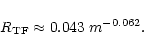
The minimum distance at which the accretion stream passes the accretor
is computed by Lubow & Shu (1975) (their
 ),
which we fit with
),
which we fit with
 is presented as a dotted line in
Fig. 1; above this line the accretion stream hits the
white dwarfs' surface directly and no accretion disk is formed.
is presented as a dotted line in
Fig. 1; above this line the accretion stream hits the
white dwarfs' surface directly and no accretion disk is formed.
In absence of the disk the angular momentum of the stream is converted
into spin of the accretor and mechanisms other than disk-orbit
interaction are required to transport the angular momentum of the
donor back to the orbit. The small separation between the two stars
may result in tidal coupling between the accretor and the donor which
is in synchronous rotation with the orbital period. The efficiency of
this process is uncertain (Smarr & Blandford 1976; Campbell 1984), but if tidal coupling
between accretor and donor is efficient the stability limit for mass
transfer is the same as in the presence of the disk
(Eq. (4)). In the most extreme case all the angular
momentum carried with the accretion stream is lost from the binary
system. The lost angular momentum can be approximated by the angular
momentum of the ring that would be formed in the case of a point-mass
accretor:
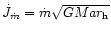 ,
where
,
where
 is the radius of the ring in units of a. This sink of
angular momentum leads to an additional term
is the radius of the ring in units of a. This sink of
angular momentum leads to an additional term
 in the brackets in Eq. (3). As a result the condition
for dynamically stable mass transfer
becomes more rigorous:
in the brackets in Eq. (3). As a result the condition
for dynamically stable mass transfer
becomes more rigorous:
given by Verbunt & Rappaport (1988) and again the
additional restriction of a mass transfer rate below the Eddington
limit) is shown in Fig. 1 as the dashed line.
Figure 1 shows that, with our assumptions, none of the AM
CVn binaries which descend from double white dwarfs (which we will
call the white dwarf family) forms a disk at the onset of mass
transfer. After about 107 yr, when the donor mass has decreased
below 0.05
(see Fig. 4) and the orbit has become
wider a disk will form.
Only one of the currently known 14 close double white dwarfs possibly
is an AM CVn progenitor; WD1704+481A has
 hr,
hr,
 and
and
 (Maxted et al. 2000). It is close to the limit for dynamical stability, but
because the initial mass transfer rate is expected to be
super-Eddington it may merge.
(Maxted et al. 2000). It is close to the limit for dynamical stability, but
because the initial mass transfer rate is expected to be
super-Eddington it may merge.
1.2
(Tutukov & Fedorova 1989 Ergma & Fedorova 1990)![[*]](/icons/foot_motif.gif) . When the mass of
the helium star decreases below
. When the mass of
the helium star decreases below
 ,
core helium
burning stops and the star becomes semi-degenerate. This causes the
exponent in the mass-radius relation to become negative and, as a
consequence, mass transfer causes the orbital period to increase. The
minimum period is 10min. With strongly decreasing mass
transfer rate the donor mass drops below 0.01
in a few Gyr,
while the period of the system increases up to 1hr; in the
right range to explain the AM CVn stars. The luminosity of the donor
drops below
,
core helium
burning stops and the star becomes semi-degenerate. This causes the
exponent in the mass-radius relation to become negative and, as a
consequence, mass transfer causes the orbital period to increase. The
minimum period is 10min. With strongly decreasing mass
transfer rate the donor mass drops below 0.01
in a few Gyr,
while the period of the system increases up to 1hr; in the
right range to explain the AM CVn stars. The luminosity of the donor
drops below
 and its effective temperature to several
thousand K. We will call the AM CVn stars that formed in this way the
helium star family. Note that in this scenario a disk
will always form because the orbit is rather wide at the onset of
the mass transfer. The equations for efficient coupling thus hold.
and its effective temperature to several
thousand K. We will call the AM CVn stars that formed in this way the
helium star family. Note that in this scenario a disk
will always form because the orbit is rather wide at the onset of
the mass transfer. The equations for efficient coupling thus hold.
The progenitors of these helium stars have masses in the range 2.3-5
.
The importance of this scenario is enhanced by the long
lifetimes of the helium stars:
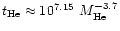 yr (Iben & Tutukov 1985), comparable to the main-sequence
lifetime of their progenitors, so that there is enough time to lose
angular momentum by gravitational wave radiation and start mass
transfer before the helium burning stops.
yr (Iben & Tutukov 1985), comparable to the main-sequence
lifetime of their progenitors, so that there is enough time to lose
angular momentum by gravitational wave radiation and start mass
transfer before the helium burning stops.
Our simulation of the population of helium stars with white dwarf
companions, suggests that at the moment they get into contact the
majority of the helium stars are at the very beginning of core helium
burning. This is illustrated in Fig. 2. Having this in
mind, we approximate the mass-radius relation for semi-degenerate
stars by a power-law fit to the results of computations of
Fedorova (1989) for a 0.5
star, which filled its Roche lobe
shortly after the beginning of core helium burning (their model 1.1).
For the semi-degenerate part of the track we obtain (in solar
units):
 from the model of Savonije et al. (1986) which had
 at the onset of the mass transfer reveals a rather weak
dependence of our results on the mass-radius relation.
at the onset of the mass transfer reveals a rather weak
dependence of our results on the mass-radius relation.
As noticed by Savonije et al. Savonije et al. (1986), severe mass loss in the phase before the period minimum, increases the thermal time-scale of the donor beyond the age of the Galactic disk and thus prevents the donor from becoming fully degenerate and keeps it semi-degenerate.
Another effect of the severe mass loss is the quenching of the helium
burning in the core. Tutukov & Fedorova (1989) show that during the mass transfer
the central helium content hardly changes (especially for low mass
helium stars). Therefore, despite the formation of an outer convective
zone, which penetrates inward to regions where helium burning took
place, one would expect that in the majority of the systems the
transferred material is helium-rich down to very low donor masses.
However, donors with He-exhausted cores at the onset of mass transfer
(
 )
may in the course of their evolution start to
transfer matter consisting of a carbon-oxygen mixture (see Fig. 3
in Ergma & Fedorova 1990, who used the same evolutionary code as Tutukov & Fedorova).
)
may in the course of their evolution start to
transfer matter consisting of a carbon-oxygen mixture (see Fig. 3
in Ergma & Fedorova 1990, who used the same evolutionary code as Tutukov & Fedorova).
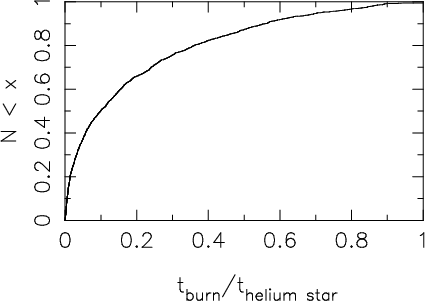 |
Figure 2: Cumulative distribution of the ratios of the helium burning time that occurred before the mass transfer started and the total helium burning time for the model systems |
 ), derived by means of population synthesis. It is possible
that only a fraction of them evolves into AM CVn stars. Upon Roche
lobe overflow, before the period minimum, most helium donors lose mass
at an almost constant rate close to
), derived by means of population synthesis. It is possible
that only a fraction of them evolves into AM CVn stars. Upon Roche
lobe overflow, before the period minimum, most helium donors lose mass
at an almost constant rate close to
 yr-1. Accretion of He at such rates by a carbon-oxygen (CO) white
dwarf may trigger a detonation in the layer of the accumulated matter
(Taam 1980). This may further cause the detonation of the
underlying CO dwarf, so-called edge-lit detonation, ELD
(Livne 1990; Livne & Glasner 1991; Woosley & Weaver 1994; Livne & Arnett
1995). The conditions for ELD to occur: the mass of
the white dwarf, the range of accretion rates, the mass of the
accumulated layer, etc. are still actively debated.
yr-1. Accretion of He at such rates by a carbon-oxygen (CO) white
dwarf may trigger a detonation in the layer of the accumulated matter
(Taam 1980). This may further cause the detonation of the
underlying CO dwarf, so-called edge-lit detonation, ELD
(Livne 1990; Livne & Glasner 1991; Woosley & Weaver 1994; Livne & Arnett
1995). The conditions for ELD to occur: the mass of
the white dwarf, the range of accretion rates, the mass of the
accumulated layer, etc. are still actively debated.
However, examples computed by Limongni & Tornambè (1991) and Woosley & Weaver (1994) show that
if
 yr-1 the helium layer inevitably
detonates if
yr-1 the helium layer inevitably
detonates if
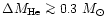 and
and
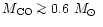 .
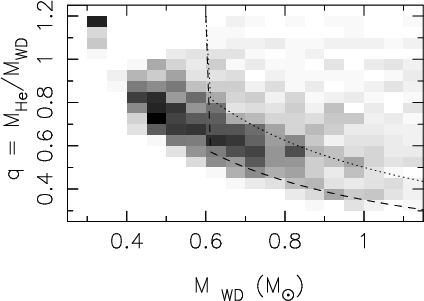
Therefore, as one of the extreme cases, we reject
all systems which satisfy these limits from the sample of progenitors
of AM CVn stars, assuming that they will be disrupted before the
helium star enters the semi-degenerate stage. As another extreme,
we assume that only 0.15
has to be accreted for ELD
(as a compromise between results of Limongi & Tornambè 1991; Woosley & Weaver 1994). The
relevant cut-offs are shown in Fig. 3.
.
Therefore, as one of the extreme cases, we reject
all systems which satisfy these limits from the sample of progenitors
of AM CVn stars, assuming that they will be disrupted before the
helium star enters the semi-degenerate stage. As another extreme,
we assume that only 0.15
has to be accreted for ELD
(as a compromise between results of Limongi & Tornambè 1991; Woosley & Weaver 1994). The
relevant cut-offs are shown in Fig. 3.
For CO white dwarf accretors less massive than 0.6
we assume that
accretion of helium results in "flashes'' in which the He layer is
ejected or lost via a common envelope formed due to expansion of the
layer. Such events may be repetitive.
Limongi & Tornambè (1991) show that for accretion rates below
 yr-1 more than
 helium has to be accreted before
detonation. For systems in which the donor becomes semi-degenerate and
the mass accretion rates are low we limit the accumulation of He only
by adopting the Chandrasekhar mass as a maximum to the total mass of
the accreting white dwarf.
helium has to be accreted before
detonation. For systems in which the donor becomes semi-degenerate and
the mass accretion rates are low we limit the accumulation of He only
by adopting the Chandrasekhar mass as a maximum to the total mass of
the accreting white dwarf.
![\begin{figure}
\par\includegraphics[angle=-90,width=8.7cm,clip]{H2552f05.ps}\hspace*{0.5mm}
\includegraphics[angle=-90,width=8.7cm,clip]{H2552f06.ps}\end{figure}](/articles/aa/full/2001/12/aah2552/img53.gif) |
Figure 5: The current Galactic population of AM CVn systems of the two families for models I (left) and II (right). The grey scale indicates the logarithm of the number of systems. The upper branch is the helium star family; the lower branch the white dwarf family. The lines show the orbital period and mass transfer rate evolution and correspond to the lines in Fig. 4 |
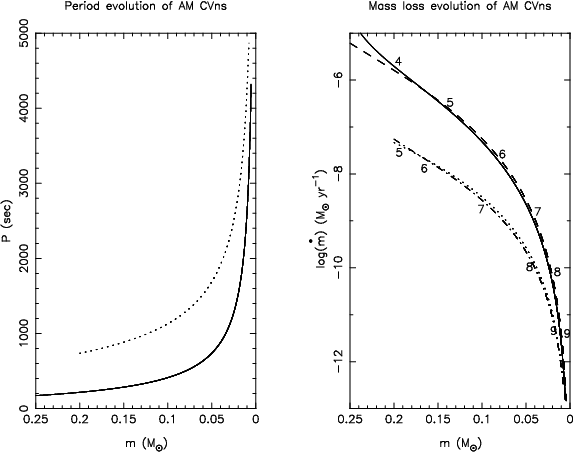
yr-1. In the
same time interval the orbital period increases from a few minutes, in
the case of the white dwarf family, or from a little over 10 min,
for the helium star family, to a few thousand seconds. The
semi-degenerate donor systems have lower mass transfer rates and
larger periods for the same donor mass due to their larger radii. The
fact that the period is independent of the accretor mass (M) is a
consequence of Eq. (2) and Keplers 3rd law leading to
 .
.
Copyright ESO 2001