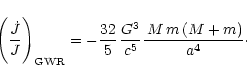
The rate of angular momentum loss ( )
of a binary system
with a circular orbit due to gravitational wave radiation (GWR) is
(Landau & Lishiftz 1971):
)
of a binary system
with a circular orbit due to gravitational wave radiation (GWR) is
(Landau & Lishiftz 1971):
 |
(1) |
In a binary with stable mass transfer the change of the radius of the
donor exactly matches the change of its Roche lobe. This condition
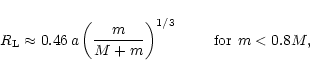
combined with an approximate equation for the size of the Roche lobe
(Paczynski 1967),
 is the logarithmic derivative of the radius of the
donor with respect to its mass (
is the logarithmic derivative of the radius of the
donor with respect to its mass (
 d
d  d
d  ).
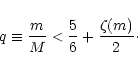
For the mass transfer to be stable, the term in brackets must be
positive, i.e.
).
For the mass transfer to be stable, the term in brackets must be
positive, i.e.
Copyright ESO 2001
![\begin{displaymath}
\frac{\dot{m}}{m} = \left (
\frac{\dot{J}}{J} \right )_{\rm...
...[\frac{\zeta (m)}{2} +
\frac{5}{6} - \frac{m}{M} \right]^{-1}.
\end{displaymath}](/articles/aa/full/2001/12/aah2552/img12.gif)