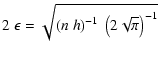
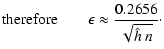
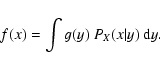
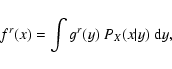
![[*]](/icons/foot_motif.gif) ,
,
A&A 463, 671-682 (2007)
DOI: 10.1051/0004-6361:20065224
,F. Royer1 - J. Zorec2 - A. E. Gómez1
1 - GEPI/CNRS UMR 8111, Observatoire de Paris, 5 place Jules Janssen, 92195 Meudon Cedex, France
2 - CNRS, Institut d'Astrophysique de Paris, 98bis boulevard Arago, 75014 Paris, France
Received 17 March 2006 / Accepted 22 October 2006
Abstract
Aims. A sample of
 of B9 to F2-type main sequence single stars has been built from highly homogeneous
parameters determined for a large sample cleansed of objects presenting the Am and Ap phenomenon as well as of all known binaries. The aim is to study the distributions of rotational velocities in the mass range of A-type stars for normal single objects.
of B9 to F2-type main sequence single stars has been built from highly homogeneous
parameters determined for a large sample cleansed of objects presenting the Am and Ap phenomenon as well as of all known binaries. The aim is to study the distributions of rotational velocities in the mass range of A-type stars for normal single objects.
Methods. Robust statistical methods are used to rectify the
distributions for the projection effect and the error distribution. The equatorial velocity distributions are obtained for about 1100 stars divided in six groups defined by the spectral type, under the assumption of randomly orientated rotational axes.
Results. We show that late B and early A-type main-sequence stars have genuine bimodal distributions of true equatorial rotational velocities probably due to angular momentum loss and redistribution that the star underwent before reaching the main sequence. A striking lack of slow rotators is noticed among intermediate and late A-type stars.
Key words: stars: early-type - stars: rotation
The observed rotation of stars in early main sequence (MS) evolutionary stages, known as the "dwarf'' stage, is the result of a long process of global angular momentum loss and angular momentum redistribution inside the stars. This process begins with the star formation phases, which encompass the fragmentation of rotating clouds (Bodenheimer 1981; Matsumoto et al. 1997) and the angular momentum losses required to solve the angular momentum problem through initial magnetic braking (Mouschovias & Morton 1985b,a) and bipolar overflows (Pudritz 1985). They give the characteristics that can be considered as their "initial conditions'' at the birth-line. Further pre-main sequence (PMS) processes of angular momentum exchange and/or magnetic locking with the accretion disc (Edwards et al. 1993; Königl 1991), angular momentum losses by stellar winds (Shu et al. 2000; Schatzman 1962) and internal angular momentum redistribution phenomena shape the internal structural patterns and rotational characteristics of stars at the zero-age main sequence (ZAMS) that may be called the "initial conditions'' of stars in the MS.
Depending on the stellar internal structural pattern thus acquired, the chemical composition and the morphology of the magnetic fields, fossil and those created in the star (Spruit 2002,1999), the radiative and convective regions can be more or less coupled hydrodynamically (Latour et al. 1981) and/or magnetically (Barnes 2003) to produce the internal angular momentum profile (Pinsonneault et al. 1990; Endal & Sofia 1981; MacGregor & Brenner 1991; Stauffer et al. 1984; Soderblom et al. 2001; Keppens et al. 1995; Soderblom et al. 1993).
Thus, according to differences in the processes and respective efficiencies to produce loss and exchange of angular momentum with the environment, as well as to many ways the stars can manage to redistribute the angular momentum in their interior, a variety of internal rotational laws in the ZAMS among objects with the same mass can be present. If only rigid rotation were prevalent, rather simple functions would characterize the probability distribution of a single quantity: the angular velocity rate
 (
(
 is the critical rotational velocity). Such distributions would probably be unimodal. On the other hand, the conjunction of a variety of rotational laws and rotational rates of coeval stars with the same mass in a single rotational distribution can have a multimodal aspect.
Guthrie (1982) found that late B-type stars in clusters have bimodal rotational velocity distributions, while they are unimodal for the same class of field stars. Bimodality was also observed for the rotation of young solar mass stars in Orion (Barnes 2003; Choi & Herbst 1996; Attridge & Herbst 1992; Herbst et al. 2001). For masses intermediate to the above cases, Abt & Morrell (1995) found bimodal-like distributions among A0-F0 objects in the MS, where the component from low rotators was ascribed to the chemically peculiar Am and Ap stars.
However, a high fraction of objects with the Am phenomenon were found to be binaries (Debernardi 2000). Ap star peculiarity requires a given time after the ZAMS to appear and thus it can be considered evolution-dependent (Hubrig et al. 2000; Stepien 2000). All these facts can then be summarized as follows:
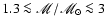 bimodality is clearly apparent only in cluster late B-type stars, it may correspond to some star formation characteristics.
Thus, the aim of this paper is to see: 1) whether single late B- and A-type field stars in the early main sequence evolutionary phases have unimodal or multimodal rotational distributions; 2) whether the rotational distributions of intermediate and late A-type stars bear signatures related to the complexity of their stellar envelope/atmospheric structure.
The data used in this paper and the selection of samples are described in Sect. 2. The
distributions are presented in Sect. 3. Section 4 gives details on the statistical processing of stellar samples to get the equatorial velocity distributions from the observed
values and describes the resulting distributions. The results are discussed in Sect. 5 and summarized in Sect. 6.
data sources
When studying distributions of stellar parameters, large but also homogeneous samples are needed to avoid or minimize possible biases. The hitherto largest list of rotational velocities is provided by Gebocki & Stawikowski (2000), who gathered
parameters from the literature of over 11 000 stars of all spectral types without magnitude limitations. Nonetheless, this catalog is built from about 200 different bibliographic sources and therefore may be highly heterogeneous. We preferred then to base our study on two homogeneous data sets: the
obtained using the Fourier transform method (FT) by Royer et al. (2002a,b) and the
determined by Abt & Morrell (1995, hereafter called AM) and Abt et al. (2002, hereafter called ALG, or AMALG when both papers are referred to) from the FWHM of He I and Mg II lines calibrated in the
scale of Slettebak et al. (1975). Nevertheless, these two data sets are different. The AMALG sample is complete down to the apparent magnitude V=6.5 mag and contains A- and B-type stars of all classes from the northern hemisphere.
The I  II sample concerns objects from both hemispheres, some down to magnitude V=8 mag, and observation of those with missing
parameters were privileged. The selection criteria used to establish the I II stellar sample are summed up in Gerbaldi & Mayor (1989).
II sample concerns objects from both hemispheres, some down to magnitude V=8 mag, and observation of those with missing
parameters were privileged. The selection criteria used to establish the I II stellar sample are summed up in Gerbaldi & Mayor (1989).
![\begin{figure}
\par\includegraphics[width=8.1cm,clip]{5224fi01.ps} \end{figure}](/articles/aa/full/2007/08/aa5224-06/img26.gif) |
Figure 1:
Distribution of spectral types of the bright stars (V<8) with known
in the spectral type range B9-F2. The thin-dashed histogram represents the stars from Gebocki & Stawikowski (2000) and the thick-dashed histogram is the sample from Royer et al. (2002b). The gray histogram is for B9-type stars in Abt et al. (2002). |
| Open with DEXTER | |
Table 1:
Highlight on the four common stars between Slettebak et al. (1975,
SCBWP), Abt et al. (2002) and Papers I and II (standard deviation is
indicated; dash "-'' stands for only one measurement) and comparison
with data from the literature.
from the literature are classified in three subgroups according to the way they are derived: by-product of a spectrum synthesis or frequency analysis of the lines profiles. Flags from HIPPARCOS catalog are indicated:
variability flag H52 (C: constant, D: duplicity-induced variability,
M: possibly micro-variable, P: periodic variable, -: no certain
classification) and double annex flag H59 (C: component solution, -: no entry in the Double and Multiple Systems Annex).
The merging of
data from the I II sample and AM has already been dealt with in Paper II. The distribution of the number of stars with measured
in the resulting sample is displayed in Fig. 1 (thick-dashed histogram). As a comparison, the same distribution for G ebocki & Stawikowski's in the spectral type range B9-F2 is over-plotted (thin-dashed histogram).
In this figure we see that the exhaustive compilation by Gebocki & Stawikowski contains a significantly larger amount of data for stars in the B9 to A0-type spectral interval and for F2-type stars. The lack of late B-type stars noted in I II can, however, be completed with the ALG data to obtain a merged sample that becomes comparable in size with the exhaustive collection in Gebocki & Stawikowski (2000) in the whole spectral range from B9 to F2 as shown by the gray shading in Fig. 1. So, the rotational velocity distributions studied in the present paper are based entirely on the I II plus AMALG merged and homogenized sample of
parameters.
ebocki & Stawikowski's in the spectral type range B9-F2 is over-plotted (thin-dashed histogram).
In this figure we see that the exhaustive compilation by Gebocki & Stawikowski contains a significantly larger amount of data for stars in the B9 to A0-type spectral interval and for F2-type stars. The lack of late B-type stars noted in I II can, however, be completed with the ALG data to obtain a merged sample that becomes comparable in size with the exhaustive collection in Gebocki & Stawikowski (2000) in the whole spectral range from B9 to F2 as shown by the gray shading in Fig. 1. So, the rotational velocity distributions studied in the present paper are based entirely on the I II plus AMALG merged and homogenized sample of
parameters.
scale
AMALG determined
for nearly 2800 B- and A-type stars in the northern hemisphere using the full width at half maximum (FWHM) of the He I 4471 and Mg II 4481 Å lines calibrated in the
scale of Slettebak et al. (1975).
The merging with the A-type part of the sample (AM) was carried out in Paper II.
The intersection of the B-type part (ALG) with I II contains 64 common stars, essentially of spectral types B8, B9 and B9.5. The comparison of both
scales is displayed in Fig. 2. From this diagram we can see that there is a systematic deviation, in the sense that the

 from I II are on average
  16% larger than those in ALG. This confirms the global tendency of
to be lower when determined with the Slettebak et al. calibration (cf. Royer et al. 2002b). Both scales coincide, however, for
16% larger than those in ALG. This confirms the global tendency of
to be lower when determined with the Slettebak et al. calibration (cf. Royer et al. 2002b). Both scales coincide, however, for
 .
The linear regression line between both scales was determined with GaussFit (Jefferys et al. 1998b,a), a robust least squares minimization program, to obtain empirical functions:
.
The linear regression line between both scales was determined with GaussFit (Jefferys et al. 1998b,a), a robust least squares minimization program, to obtain empirical functions:
![\begin{figure}
\par\includegraphics[width=8.2cm,clip]{5224fi02.ps}\end{figure}](/articles/aa/full/2007/08/aa5224-06/img34.gif) |
Figure 2:
Comparison of
data for the 64 common stars from Papers I and II (I II) and Abt et al. (2002, ALG). The solid line stands for the first bisector. |
| Open with DEXTER | |
In Papers I II there are also four standard stars common with Slettebak et al. which are listed in Table 1 and whose
can be compared. Other details on these objects are given in Appendix A.
Equation (1) was used only for stars of late B spectral types, i.e. B9 and B9.5. The resulting I II plus AMALG sample thus contains 2167
parameters of stars from spectral type B9 to F2.
We align the
parameters to our I II rotational velocity scale.
According to the gravity darkening (GD) effect, the fastest rotating regions (equatorial zone) contribute less to the global line flux than higher latitudes, in particular when it concerns He I 4471 and Mg II 4481 Å lines. It has been shown (cf. Stoeckley 1968; Frémat et al. 2005) that the interpretation of spectral lines of fast rotating stars with classical methods leads systematically to underestimated values of
.
Nevertheless, Slettebak et al. (1975), who take GD into account, report that their
parameters are systematically lower than those from classical methods by roughly 15% among early stars up to spectral type A2, which is contrary to what is predicted by modern calculations of non-LTE rotationally broadened lines affected by GD (Frémat et al. 2005). The difference noted by Slettebak et al. (1975) drops to only a few percent for stars later than A2. Howarth (2004) re-examined Slettebak's et al.
scale and confirmed the above-mentioned underestimation.
Since the
parameters in papers I II are systematically higher than those by AMALG, which mirror Slettebak's et al. (1975) scale, we adopted a conservative position and decided to use our FT scale of
for the merged I II plus AMALG data source. Except for the assumptions that underlie the FT method, the I II
scale is independent of any other calibration. This scale has been confirmed by a new, more robust FT method (Reiners & Royer 2004) and proved to be consistent also with new
determinations (e.g. Fekel 2003; Erspamer & North 2003).
We study the characteristics of the
distributions in the MS evolutionary phase. Since we cannot determine ages for all studied stars, we perform a statistical selection of those objects that could be in the MS stage. To this end, we make a selection of "dwarf'' stars and retain only those with luminosity classes from V to IV. This luminosity class criterion is large enough to take into account possible rotation induced effects in fast rotators, which make stars look more luminous or evolved than they are (Collins et al. 1991; Frémat et al. 2005; Collins & Sonneborn 1977).
The luminosity classes used for this selection are the ones compiled in the HIPPARCOS catalog (ESA 1997).
The 1500 selected stars were divided into spectral type subsamples,
based on the spectral types compiled in the HIPPARCOS catalog.
In establishing the subgroups, we looked for a compromise between the sample size and the radius dependence with mass. The correspondence between spectral type and radius used is from Habets & Heintze (1981). The relation between spectral class and B-V color index is shown in Fig. 3. The mean error on B-V,
 mag, is small in comparison with the color overlap between the different spectral classes. A running standard deviation (on 200 points) on this relation enables us to estimate the error in the spectral classification: about one sub-class for
 mag, and about two sub-classes for
 mag. The color index B-V=0.15 mag approximately corresponds to the spectral class A5 (Cowley et al. 1970). Color indices can be rather strongly affected in late type stars by fast rotation effects if rotational rates are
 (Collins et al. 1991; Frémat et al. 2005; Collins & Sonneborn 1977). Since we cannot correct in advance individual spectral types for possible induced rotational changes, we conclude a posteriori that this phenomenon affects only a low fraction of stars (see Fig. 10:
7.6% in B9, 5.4% in A0-A1, 4.2% in A2-A3, 4.2% in A4-A6, 3.6% in A7-A9 and 2.5% in F0-F2). The full spectral range B9-F2 was thus divided into six groups, which are listed in Table 2.
(Collins et al. 1991; Frémat et al. 2005; Collins & Sonneborn 1977). Since we cannot correct in advance individual spectral types for possible induced rotational changes, we conclude a posteriori that this phenomenon affects only a low fraction of stars (see Fig. 10:
7.6% in B9, 5.4% in A0-A1, 4.2% in A2-A3, 4.2% in A4-A6, 3.6% in A7-A9 and 2.5% in F0-F2). The full spectral range B9-F2 was thus divided into six groups, which are listed in Table 2.
![\begin{figure}
\par\includegraphics[width=8.2cm,clip]{5224fi03.ps}\end{figure}](/articles/aa/full/2007/08/aa5224-06/img39.gif) |
Figure 3:
Comparison between the spectral class and the B-V color index (both from the HIPPARCOS catalog) for the stars in the
sample, with luminosity classes V, IV-V and IV. The colored contour indicates the number of stars per bin of 0.01 mag, per spectral class: black - 1 to 5 stars; dark gray - 5 to 10 stars; light gray - 10 to 15 stars; white - more than 15 stars. The average error bar in B-V is indicated:
mag. |
| Open with DEXTER | |
Table 2:
Subsamples of Main-Sequence stars (classes V, IV-V and IV): the mean radii
 and the mean masses
 are derived from Habets & Heintze (1981), as well as the relative variation of the radius
  and of the mass
 along the interval of spectral type. For each subsample, the number of stars is given.
Table 3:
Moments of the
distributions for each spectral
subsample. "total'' corresponds to the whole subsample (including CP and CB stars); "normal'', CP and CB stars are also distinguished. For both "total'' and "normal'' subsamples, the moments are given for different groups of luminosity class: all (IV, IV-V, V), V and IV (class IV-V luminosity stars only are not considered because they represent a very small fraction of the sample). The number of stars (#), the center and the dispersion of the distribution are given. Centers are estimated using the median and the mean, and the dispersion is evaluated with the standard deviation.
In order to remove stars whose rotation could have been modified by tidal or magnetic braking, chemically peculiar stars (CP) and "close'' binary stars (CB) have been separated from "normal'' stars. This choice is justified because of the a priori selection biases in the I II sample. Selection criteria for the southern sample from Paper I are described by Gerbaldi & Mayor (1989). They focused on "normal'' A-type stars, excluding any known peculiar or spectroscopic binary stars. The same criteria have been used for the northern sample in Paper II.
 mag are flagged as CB stars. The compilation by Pédoussaut et al. (1985) of spectroscopic binaries is used to complete the identification, together with the "Eighth catalog of the orbital elements of Spectroscopic Binaries'' (Batten et al. 1989).
In what follows, all stars that do not obey CB or CP criteria are simply called "normal''. Since these "normal'' stars constitute the bulk of our stellar sample, we need a statistical inference of the fraction of stars where the CP and CB characters are still unknown.
values, determined the spectral classification and identified the chemical peculiarities. The catalog of Renson et al. (1991) was also used to account for peculiar stars. To test the completeness of this catalog we plot in the top panel of Fig. 4 all A-type stars in the HIPPARCOS catalog, the CP stars in the Renson et al. (1991) catalog and Pédoussaut's et al. (1985) compilation of spectroscopic binaries. The number of stars is displayed on a logarithmic scale against the V-magnitude. In the middle panel of Fig. 4 we give the merged I II plus AMALG data set (hatched histogram), where the short-dashed line is a fit of their distribution up to V=6.5 mag. The light gray histogram gives the CP stars identified in this paper over which we have superimposed the long-dashed linear fit valid up to V=6.5 mag. We see that the fraction of CP stars to all stars in the merged sample is fairly constant for all magnitudes brighter than V=6.5 mag and it represents roughly 15% of objects. The same fraction, and, in the same magnitude interval, is also seen in the top panel. Making the hypothesis that the proportion of CP stars in our merged ensemble remains at 15% also for  mag, the scaled distribution (dark gray) shows the deficit of undetected CP, which amounts only to some 20 stars.
![\begin{figure}
\par\includegraphics[width=8.25cm,clip]{5224fi04.ps}\end{figure}](/articles/aa/full/2007/08/aa5224-06/img153.gif) |
Figure 4:
Distributions of V magnitudes and completeness of the CP and CB stars. The numbers of stars are given in logarithmic scale. Top panel: the distributions (in the range 3-8 mag) are displayed for the A-type stars in the HIPPARCOS catalog, and their intersection with the lists given by Renson et al. (1991) and Pédoussaut et al. (1985). Middle panel: the distributions are shown for the
sample (hatched histogram) and the selected CP stars (light gray). The dark gray histogram is the
sample scaled to the number of CP stars in the V-magnitude range 4-6 mag. Bottom panel: the distributions are shown for the
sample (hatched histogram) and the selected CB stars from the list by Pédoussaut et al. (1985) only (light gray). The dark gray histogram is the
sample scaled to the number of binary stars in the V-magnitude range 4-5 mag. |
| Open with DEXTER | |
 -
-
 ,
ESA 1997) or those with large magnitude difference (
,
ESA 1997) or those with large magnitude difference (
 -4 mag). Considering the mass-luminosity relation from Gerbaldi et al. (1999), the magnitude difference leads approximately to
 and then for
 mag, the corresponding mass ratio is
 .
.
![\begin{figure}
\par\includegraphics[width=12cm,clip]{5224fi05.ps}\end{figure}](/articles/aa/full/2007/08/aa5224-06/img160.gif) |
Figure 5:
Cumulative distributions of
of the six subsamples of main sequence stars from B9- to F2-type. Dark hatched, light hatched and plain white areas, from bottom to top, respectively stand for "normal'', CP and CB stars. |
| Open with DEXTER | |
Pédoussaut et al. (1985) provide an "exhaustive'' list of spectroscopic binaries and the estimation of the lack of detected binaries is based on this list only. We remove binaries from the
sample to minimize rotational changes induced by tidal braking and the consequent synchronization. The completeness limit magnitude of the list of spectroscopic binaries is estimated in the top panel in Fig. 4, which barely reaches V=5 mag. The distribution of the
sample is scaled as in the previous paragraph, according to the number of spectroscopic binaries in the magnitude range 4-5 mag. The scaled distribution (dark gray, bottom panel) gives an estimate of possible undetected spectroscopic binaries, of about 200 stars, mainly for  mag. However the frequency of binaries decreases with decreasing mass ratio q (Wolff 1978) and correspondingly the synchronization time increases (Zahn 1975). On the other hand, the maximum of the period distribution of spectroscopic binaries in the spectral range A0-A9 is for
  d and for
  d the frequency drops to 25% (Kogure 1981). The most substantial fraction of stars in the A0-A9 range with
that can be expected to be affected by tidal braking must then correspond to
d the frequency drops to 25% (Kogure 1981). The most substantial fraction of stars in the A0-A9 range with
that can be expected to be affected by tidal braking must then correspond to
 and
and  d. The synchronization time is a strong function of the D/R ratio, where D is the separation of components and R the radius of the primary:
 (Zahn 1975). For
,
d, average stellar mass
(Zahn 1975). For
,
d, average stellar mass
 and radius
 we obtain
  ,
so that
,
so that
 ,
where
,
where
 is the time spent in the main sequence. At shorter periods the number of spectroscopic stars decreases, while for longer periods the synchronization time increases strongly, i.e. for d, it is
 .
This means that the possibly 13% unidentified binaries will not negatively affect our statistics. Moreover, a slowing down of rotation by 50% of the rotational velocities in the missing binaries would affect the overall average estimate of
by less than 4%, because more than half have
.
This means that the possibly 13% unidentified binaries will not negatively affect our statistics. Moreover, a slowing down of rotation by 50% of the rotational velocities in the missing binaries would affect the overall average estimate of
by less than 4%, because more than half have  d.
d.
These deficits of stars occur not only for slow rotators. Among the 218 identified "CP'' stars, only 87 have
 ,
i.e. about 40%. As far as the spectroscopic binaries are concerned, among the 79 stars in common with the list by Pédoussaut et al. (1985), 43 stars have
,
i.e. about 54%.
,
i.e. about 40%. As far as the spectroscopic binaries are concerned, among the 79 stars in common with the list by Pédoussaut et al. (1985), 43 stars have
,
i.e. about 54%.
The number of objects in the different spectral-type subgroups, and the different categories ("normal'', CB, CP) are given in Table 3. All the objects are listed in Table 4.
The histograms of
of each of the six subsamples are displayed
in Fig. 5. The associated statistical estimators are
listed in Table 3. Distinction has been made between the "total'' subsample and its components:
"normal'', "CP'' and "CB'' stars (respectively represented as dark hatched, light hatched and
plain white areas in Fig. 5). The distinction in Table 3 is also made according to the luminosity class: "all'' classes (V, IV-V and IV), "V'' only and "IV'' only.
Mean, median and dispersion estimators are also given for each group.
Table 4:
(extract) List of the 1541 B9- to F2-type stars, with their
value, spectral type, associated subgroup and classification (CP, CB, blank stands for "normal'').
Several trends are noticeable in the
distributions, as seen in Fig. 5:
 distributions for most massive stars (B9 and A0-A1) suggest a bimodality, even when only taking into account "normal'' stars.
A double peak in the
distributions for most massive stars (B9 and A0-A1) suggest a bimodality, even when only taking into account "normal'' stars.
A double peak in the  of A0V-type stars was pointed out by Ramella et al. (1989). The distributions for B9 and A0-A1 groups are very similar. This similarity becomes clear if the histograms normalized to the number of stars in each group are compared (as they are displayed in Fig. 7). There are two maxima, one near
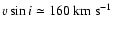 and the other near
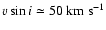 .
The excess of stars with small
cannot be considered due to Am and Ap stars, as most of them were removed from the sample.
.
The excess of stars with small
cannot be considered due to Am and Ap stars, as most of them were removed from the sample.
from B9 to F0-F2 groups, which is only marginally correlated with the critical equatorial velocity
 ;
i.e.
;
i.e.
 ,
while
,
while
 .
.
stars ( 70
), in the full subsamples, diminishes from B9 to A6-type stars (B9: 31%; A0-A1: 31%; A2-A3: 24%; A4-A6: 10%) and then increases towards the later types (A7-A9: 14%; F0-F2: 24%). There is a striking lack of stars with
70
), in the full subsamples, diminishes from B9 to A6-type stars (B9: 31%; A0-A1: 31%; A2-A3: 24%; A4-A6: 10%) and then increases towards the later types (A7-A9: 14%; F0-F2: 24%). There is a striking lack of stars with
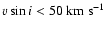 in the A4-A6 group. The same tendency is found, considering "normal'' stars, but the proportion is lower. The effect of the proportion of low
stars is also reflected in the variation of the dispersion (see Table 3). It decreases from B9 to A4 stars, and reaches a plateau around 60
when the distribution is not significantly skewed.
in the A4-A6 group. The same tendency is found, considering "normal'' stars, but the proportion is lower. The effect of the proportion of low
stars is also reflected in the variation of the dispersion (see Table 3). It decreases from B9 to A4 stars, and reaches a plateau around 60
when the distribution is not significantly skewed.
The observed
parameter is the projection of the equatorial velocity v of the star on the line of sight, i being the inclination between the stellar rotation axis and the line of sight.
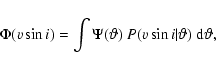
The Probability Density Function (hereafter PDF) of the
is thus the result of the convolution between the distribution of "true'' equatorial velocities v, the distribution of inclination angles i, and the observational error law.
Let  be the true projected rotational velocity of a star; the PDF of
can be written as:
be the true projected rotational velocity of a star; the PDF of
can be written as:
 is the conditional probability of
![$\ensuremath{v\sin i}\in[\vartheta,\vartheta+{\rm d}\vartheta]$](/articles/aa/full/2007/08/aa5224-06/img188.gif) .
.
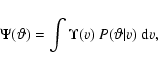
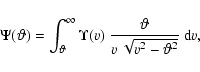
 is the PDF of "true'' projected velocities, which itself can be written as:
 is the conditional probability of
![$\vartheta\in[v,v+{\rm d}v]$](/articles/aa/full/2007/08/aa5224-06/img191.gif) ,
and
,
and
 is the PDF of the "true'' equatorial velocities.
The aim of this section is to recover the distribution
from the observations.
The observed PDF
 can be estimated from the
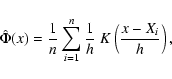
data. For that purpose, the kernel estimator
can be estimated from the
data. For that purpose, the kernel estimator
 ,
with kernel K, is used. Details can be found in Appendix C.1. The estimator
is defined as:
,
with kernel K, is used. Details can be found in Appendix C.1. The estimator
is defined as:
is expected to be multiplicative, as shown in Papers I and II. This can be understood by considering the
as a scale/dilation parameter, like the dispersion (whereas the radial velocity is a shift parameter such as the mean). The error on the empirical dispersion is asymptotically proportional to the dispersion (see Appendix B).
The natural error law would thus be a log-normal distribution for the
.
In Paper I, the distribution of observed
for Sirius is perfectly fitted either by a normal or a log-normal distribution.
This triggers the processing of this step in logarithmic space of velocities, to remove the variance heterogeneity (Zar 1999). The data are significantly higher than zero to safely use
 instead of
 (Bartlett 1947).
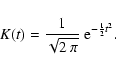
The smoothing of the PDF is then performed on logarithmic velocities, and the PDF
(Bartlett 1947).
The smoothing of the PDF is then performed on logarithmic velocities, and the PDF
 is computed by the Kernel method, using a Gaussian kernel (standard normal distribution):
 ,
as a solution of Eq. (12) in Sheather & Jones (1991), is given in Table 5 for each subsample.
,
as a solution of Eq. (12) in Sheather & Jones (1991), is given in Table 5 for each subsample.
Table 5:
Estimated bandwidth for the kernel method and mean integrated squared error: for each subsample, the size n (number of stars) is given, as well as the estimated
according to Sheather & Jones (1991), computed in the logarithmic velocity scale, and the variability band width  (Eq. (C.4)).
Using a unique value
for a given sample of logarithmic
data will create artificial and non significant distribution modes at low
.
For low
values, the bandwidth h constant in logarithmic space is underestimated, due to the limitation of the precision on derived
.
In addition, for some of the subsamples, the number of slow rotators is small, which contributes to the presence of non significant peaks in the distributions. These peaks are clearly visible in the linear velocity space (Fig. 7).
Bowman & Azzalini (1997, Chap 2.3) propose a way of quantifying the variability of the density estimates and therefore assessing the significance of the present modes. Using this method, only variance is assessed to compute the resulting "variability bands'', but the graphical display of this variance structure allows the separation between the genuine features and the "noisy'' ones.
The variability bands are estimated by the parameter (Table 5, see Appendix C.1) and are over-plotted as gray areas in Figs. 6 and 7.
The PDFs
,
for each subsample, are the result of the kernel density estimations. The result for the largest subsample (A0-A1) is shown in Fig. 6.
![\begin{figure}
\par\includegraphics[width=8.1cm,clip]{5224fi06.ps}\end{figure}](/articles/aa/full/2007/08/aa5224-06/img201.gif) |
Figure 6:
Distributions of the logarithmic rotational velocities
for the A0-A1 subsample. The corresponding scale of
is plotted as the upper x-axis. The histogram represents the data for "normal'' stars, displayed in Fig. 5. The solid line is the smoothed distribution
,
obtained by using a Kernel method with a Gaussian kernel, on the
.
The thick dotted line stands for the distribution
 of the "true'' logarithmic velocities, corrected by a Gaussian error law (see text).
 |
| Open with DEXTER | |
![\begin{figure}
\par\includegraphics[width=12cm,clip]{5224fi07.ps}\end{figure}](/articles/aa/full/2007/08/aa5224-06/img202.gif) |
Figure 7:
Distributions of rotational velocities for the observed subsamples: shaded histograms are the observed
and are identical to the histograms for "normal'' stars in Fig. 5; dashed lines stand for the smoothed distributions of true projected rotational velocities
;
solid thick lines are the distributions of true equatorial velocities
and the gray strips are their associated variability bands.
Dotted lines are the distributions found by AM: in our A0-A1 sample both peculiar and normal star distributions are overplotted, in our A2-A3 sample the distribution of A3-A4 stars found by Abt & Morrell (1995) is overplotted, and in our A4-A6 and A7-A9 samples the distribution of A5-F0 stars is shown. |
| Open with DEXTER | |
This operation is an intermediate step to recover the PDF of true equatorial velocities.
The rotational velocity and its associated error can be written as:
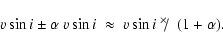
 (i.e. terms of second order are negligible), the error can be written in a multiplicative form. Therefore the logarithmic scale can be considered:
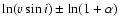 .
In this case, the coefficient
is taken to be 0.1. In Papers I and II, it was respectively 0.06 and 0.05 for
derived from ECHELEC and AURÉLIE data, but for the
measured by Abt, the relative error is closer to 10%. Using
.
In this case, the coefficient
is taken to be 0.1. In Papers I and II, it was respectively 0.06 and 0.05 for
derived from ECHELEC and AURÉLIE data, but for the
measured by Abt, the relative error is closer to 10%. Using
 ,
the second order is obviously negligible, and a 1%-effect on the observed
is not significant.
,
the second order is obviously negligible, and a 1%-effect on the observed
is not significant.
The error of
is assumed to be normally distributed with a mean of 0 and a variance of
 .
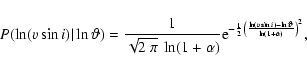
The conditional probability
.
The conditional probability
 is a Gaussian function:
 |
(8) |
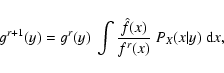
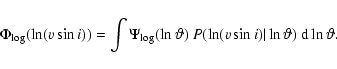
is derived using the Lucy (1974) iterative technique. Further details are given in Appendix C.2. The PDF
and
of the subsample A0-A1 are shown in Fig. 6 and illustrate the steepening and sharpening of the distribution deconvolved by the error law.
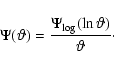
The resulting distributions are transformed back in linear velocity space following:
 |
(9) |
are displayed for all the subsamples in Fig. 7.
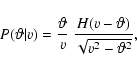
Under the assumption of randomly oriented rotation axes, the
conditional probability
 in Eq. (3) is:
.
Combining Eqs. (3) and (10), the PDF of becomes:
Two ways are possible to compute the final distribution of equatorial velocities
.
In this work, only the Lucy-iteration technique (Lucy 1974) has been used.
These distributions
are displayed in Fig. 7 for the six subsamples, and described in the next section.
The distributions of true equatorial velocities imply the following facts:
 35
,
and for fast rotators 190
.
For the A0-A1 subsample: they are 60
and 200
respectively.
The modes of fast rotators (
35
,
and for fast rotators 190
.
For the A0-A1 subsample: they are 60
and 200
respectively.
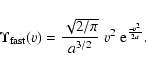
The modes of fast rotators ( ), for B9 and A0-A1 type stars, are fitted by Maxwellian PDFs (Fig. 8).
As shown by Deutsch (1967), the distributions of v are well fitted by Maxwellian functions:
), for B9 and A0-A1 type stars, are fitted by Maxwellian PDFs (Fig. 8).
As shown by Deutsch (1967), the distributions of v are well fitted by Maxwellian functions:
 |
(12) |
 .
The proportion of slow rotators (
.
The proportion of slow rotators ( )
is taken as the excess compared to the Maxwellian fast rotator distribution. The results are displayed in Table 6. The slow rotator peak corresponds to some 19 stars for B9-type stars, and about 66 stars for A0-A1-type stars.
)
is taken as the excess compared to the Maxwellian fast rotator distribution. The results are displayed in Table 6. The slow rotator peak corresponds to some 19 stars for B9-type stars, and about 66 stars for A0-A1-type stars.
![\begin{figure}
\par\includegraphics[width=7.6cm,clip]{5224fi08.ps}\end{figure}](/articles/aa/full/2007/08/aa5224-06/img222.gif) |
Figure 8: Slow rotators in B9 and A0-A1 type stars: the PDF of equatorial velocities v (solid line) are displayed. The fast rotator mode is fitted by a Maxwellian distribution (dashed line), and the slow rotator distribution is estimated as the excess compared to the Maxwellian distribution (hatched area). The difference between both distributions is plotted (bold solid line) together with its propagated variability band (gray strip). For the A0-A1 type stars, the distribution of chemically peculiar objects found by AM is overplotted (dotted line), normalized to represent the same number of stars. |
| Open with DEXTER | |
Table 6:
Characteristics of the bimodal distributions: the fast rotator mode
from the Maxwellian distribution parameter a, the proportion p of slow rotators as the excess compared to the Maxwellian fast rotator distribution, the corresponding number  of slow rotators in the observed sample, and the mean of the slow rotator distribution
 .
.
 concerns a negligible fraction of stars. Moreover the variability bands associated with the distributions argue that the presence of these slow rotators is not significant. These objects are probably unknown synchronized binaries or chemically peculiar stars that pollute the sample of "normal'' stars. There is a net lack of rotators with
  .
An absolute minimum of this fraction is seen in the A4-A6 group.
.
An absolute minimum of this fraction is seen in the A4-A6 group.
![\begin{figure}
\par\includegraphics[width=7.4cm,clip]{5224fi09.ps}\end{figure}](/articles/aa/full/2007/08/aa5224-06/img227.gif) |
Figure 9:
Projected rotational velocities as a function of the B-V index (from HIPPARCOS catalog) of the 150 "normal'' stars in the F0-F2 subgroup. Filled circles ()
stand for F0-type stars, open squares ( )
for F1 and asterisks (*) for F2-type stars. The hatched strip emphasizes the lack of object in the area ( )
for F1 and asterisks (*) for F2-type stars. The hatched strip emphasizes the lack of object in the area (
 ,
B-V<0.295 mag), the only object in this area is HD 36876. The dotted line is the 40-point running average of
for the 150 objects.
,
B-V<0.295 mag), the only object in this area is HD 36876. The dotted line is the 40-point running average of
for the 150 objects. |
| Open with DEXTER | |
 appears in the F0-F2 subgroup. This mode of slow rotators, around 20
,
in the distribution for early-F stars is significant.
The B-V distribution for all the "normal'' F0-F2 stars, ranging from 0.2 to 0.4 mag (Fig. 9), shows that all (but one) stars with
have color index
appears in the F0-F2 subgroup. This mode of slow rotators, around 20
,
in the distribution for early-F stars is significant.
The B-V distribution for all the "normal'' F0-F2 stars, ranging from 0.2 to 0.4 mag (Fig. 9), shows that all (but one) stars with
have color index
 mag. It ensues that the slow rotator peak (
)
is only composed of stars redder than B-V= 0.3 mag.
The decrease of rotation along the main sequence through the early F-type stars was pointed out by Wilson (1966) and Kraft (1967). The decrease in rotational velocity observed in Fig. 9 is the beginning of this rotational break. A similar decrease occurs also for class III giants (Gray 1989).
mag. It ensues that the slow rotator peak (
)
is only composed of stars redder than B-V= 0.3 mag.
The decrease of rotation along the main sequence through the early F-type stars was pointed out by Wilson (1966) and Kraft (1967). The decrease in rotational velocity observed in Fig. 9 is the beginning of this rotational break. A similar decrease occurs also for class III giants (Gray 1989).
 in all groups, except for the F0-F2 for which at
there is only an inflection.
in all groups, except for the F0-F2 for which at
there is only an inflection.
-probability distributions (see Appendix D). They are shown in Fig. 10. It can be seen that in each group, more than half of the stars rotate with
 and that the marked lacks of stars are for
 .
Objects with
can undergo geometrical deformations induced by the rotation, which implies that their spectral characteristics may be somewhat aspect angle dependent.
.
Objects with
can undergo geometrical deformations induced by the rotation, which implies that their spectral characteristics may be somewhat aspect angle dependent.
![\begin{figure}
\par\includegraphics[width=12cm]{5224fi10.ps}\end{figure}](/articles/aa/full/2007/08/aa5224-06/img233.gif) |
Figure 10:
Distributions of angular velocities
derived from v distributions in Fig. 7 and using Appendix D. Only the variability band of each PDF is displayed. |
| Open with DEXTER | |
Figure 7 compares the distributions of true rotational velocities from AM (dotted lines) with those obtained in this work (solid lines). For the later A-type subgroups (A2-A3, A4-A6, A7-A9), there is good agreement between the distribution of normal stars in AM and ours. It suggests that our selection of non CP stars is efficient. As regards our distributions for A4-A6 and A7-A9 subgroup, compared to the corresponding A5-F0 in AM, the tails towards lower v drop more steeply in our study.
On the other hand a strong discrepancy is observed in the A0-A1 subgroup. The fast rotator mode found in the present work corresponds to the distribution found by AM for normal stars (Fig. 7). The excess of slow rotators emphasized in Fig. 8 has a distribution similar to the Ap+Am stars found by AM, even though to discard the CP and CB stars, the same selection criteria as for later type stars were applied.
Abt (2000) argues that rotational velocity alone discriminates the normal A-type stars from the peculiar ones. However Mathys (2004) points out that Abt's definition of peculiar stars encompasses stars that do not exhibit the abundances anomalies of "classical'' CP stars.
The main objective of this paper was to obtain distributions of surface rotational velocities of a sample of field stars in a spectral type range where objects with earlier spectral types have radiative envelopes and those with cooler spectral types have convective envelopes. The present research is intended to detect signatures of multimodal rotational velocity distributions among "normal'' dwarf stars that are in the early MS evolutionary phases.
Up to now, for stars with masses
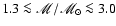 ,
there are indications for bimodality only for cluster late B-type stars (Guthrie 1982) and for near solar mass stars (references in Barnes 2003). In the mass range concerned by the A0-F0 stellar sample of Abt & Morrell (1995), the detected excess of low rotators was assigned entirely to Am and Ap stars. The Ap phenomenon is, however, evolutionary related, because it appears after the stars completed at least the first third of their MS life (Hubrig et al. 2000; Stepien 2000). On the other hand, most Am stars do not have a luminosity class determination, so that their evolutionary status is unclear. Moreover, a large fraction, if not all of them, are binaries (Debernardi 2000).
The Am+Ap group cannot then be considered as indicative of a low velocity component in a possible bimodal distribution. We cleansed our stellar sample of objects with known Am and Ap signatures and of all known close binaries to avoid strong spurious effects on the velocity distributions carried by braking effects that cannot be considered as forming part of the initial MS conditions for single stars. Thus, as binaries and stars with low rotation possibly due to evolutionary effects were removed, the distributions we found for field B9, A0-A1 and F0-F2 stars may be considered as genuinely bimodal.
,
there are indications for bimodality only for cluster late B-type stars (Guthrie 1982) and for near solar mass stars (references in Barnes 2003). In the mass range concerned by the A0-F0 stellar sample of Abt & Morrell (1995), the detected excess of low rotators was assigned entirely to Am and Ap stars. The Ap phenomenon is, however, evolutionary related, because it appears after the stars completed at least the first third of their MS life (Hubrig et al. 2000; Stepien 2000). On the other hand, most Am stars do not have a luminosity class determination, so that their evolutionary status is unclear. Moreover, a large fraction, if not all of them, are binaries (Debernardi 2000).
The Am+Ap group cannot then be considered as indicative of a low velocity component in a possible bimodal distribution. We cleansed our stellar sample of objects with known Am and Ap signatures and of all known close binaries to avoid strong spurious effects on the velocity distributions carried by braking effects that cannot be considered as forming part of the initial MS conditions for single stars. Thus, as binaries and stars with low rotation possibly due to evolutionary effects were removed, the distributions we found for field B9, A0-A1 and F0-F2 stars may be considered as genuinely bimodal.
The simplest explanation for this bimodality is that the braking of surface rotational velocities through interactions with the circumstellar disc prior to the ZAMS phase is long-lasting. The two velocity peaks would then imply the existence of two preferential interaction time scales, which is difficult to prove. However, this explanation is insufficient, because in stars with spectral types from A2 to A9 the bimodal aspect of velocity distribution is not obvious. Some phenomena of internal angular momentum redistribution also may be present.
There is a lack of stars with
 in the A4-A6 spectral-type group. This group is roughly in the middle of the transition from stars with radiative envelopes to those with convective envelopes. The behavior of the 1600 Å intensity jump (Böhm-Vitense 1982) in stars from A1 to A7 reveals a strong ionization balance change in the envelope, and so in their structural patterns, as we pass from one spectral type to another. It can thus happen that either the PMS angular momentum set-up phenomena are related to stellar structure and its external ionization balance, or that in the early ZAMS phases some internal redistribution of angular momentum operates, making
unlikely.
in the A4-A6 spectral-type group. This group is roughly in the middle of the transition from stars with radiative envelopes to those with convective envelopes. The behavior of the 1600 Å intensity jump (Böhm-Vitense 1982) in stars from A1 to A7 reveals a strong ionization balance change in the envelope, and so in their structural patterns, as we pass from one spectral type to another. It can thus happen that either the PMS angular momentum set-up phenomena are related to stellar structure and its external ionization balance, or that in the early ZAMS phases some internal redistribution of angular momentum operates, making
unlikely.
On the other hand, in all subgroups there is a rough average of  stars with
 .
These stars are subjected to rotationally induced geometrical distortions and to gravitational darkening. Since the local effective temperature is, according to the von Zeipel theorem,
.
These stars are subjected to rotationally induced geometrical distortions and to gravitational darkening. Since the local effective temperature is, according to the von Zeipel theorem,
 (g is the local stellar surface gravity) in stars with radiative envelopes and
 (Lucy 1967; Pérez Hernández et al. 1999) in objects with convective envelopes, a strong mixing of stars with different masses is expected in the hottest stellar groups. The gravitational darkening effect can also play a role in the selection of objects in the A4-A6 spectral-type group. In fact, pole-on stars rotating at rates
 which are seen as A3 (average hemisphere effective temperature
 K), likely would be seen equator-on as A7 (average hemisphere effective temperature
 K). In non-rotating stellar models, the effective temperature range
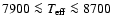 K corresponds to the transition from stars with radiative envelopes to those with convective envelopes.
It would then be interesting to investigate if such objects present a radiative/convective structural dichotomy and if the lack of low rotators in the A4-A6 group is related to this structural characteristic.
K corresponds to the transition from stars with radiative envelopes to those with convective envelopes.
It would then be interesting to investigate if such objects present a radiative/convective structural dichotomy and if the lack of low rotators in the A4-A6 group is related to this structural characteristic.
Since there is a correlation between the strength of magnetic fields, low rotation and presence of the CP character in A to B-type stars (Mathys 2004), a thorough inquiry of the nature of objects with low rotation in our sample that do not have apparent CP aspects is needed. However, the separation of stars in our sample with genuine low equatorial velocity v from those with small  is not obvious. Our planned determination of detailed fundamental parameters and identification of fast rotating stars with low
in model atmospheres for fast rotators may help.
is not obvious. Our planned determination of detailed fundamental parameters and identification of fast rotating stars with low
in model atmospheres for fast rotators may help.
This work is based on a large and homogeneous sample of
measurements of B9 to F2-type gathered from Royer et al. (2002b) and Abt et al. (2002). This sample was carefully cleaned of evolved stars and known chemically peculiar and/or binary stars, resulting in a sample of about 1100 main-sequence single stars. This stellar sample was divided into six spectral type groups, chosen to maximize statistical significance and mass resolution, to allow for detection of possible mass dependencies of velocity distributions.
The distributions of true equatorial velocities have been obtained from observed
distributions using the iterative technique described by Lucy (1974) to correct for the error and random inclination distributions.
 .
.
may be due to formation processes and phenomena of angular momentum loss and redistribution undergone during PMS phases.
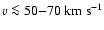 from A2 to A9-type MS field stars. The minimum of stars in this interval is for A4-A6-type stars.
 .
Hence, it should not be excluded that the faster rotating A-type stars, mainly A4-A6-types, might have envelopes that have non homogeneous structures in latitude: radiative (polar regions) and convective (equatorial regions).
.
Hence, it should not be excluded that the faster rotating A-type stars, mainly A4-A6-types, might have envelopes that have non homogeneous structures in latitude: radiative (polar regions) and convective (equatorial regions).
Acknowledgements
We thank Dr H. Levato for the early communication of the B stars rotational velocities. Discussions with Dr F. Arenou were very useful, and we also thank him for giving access to the code computing the kernel estimator. We are deeply grateful to Prof. S. Sheather for providing the subroutine which estimates the data-based bandwidth. We warmly thank the anonymous referee.
The four common B-type stars between measurements from Papers I and II and the standard values from Slettebak et al. (1975) are listed in Table 1. There is little available recent data about any
measurement for these objects. Some details are given below:
 Tau has been observed at high angular resolution by Richichi & Percheron (2002) and no suspicion of binarity has been found. The resulting uniform disk angular diameter is 1.56
  0.11 mas.
 Her was discovered by HIPPARCOS to be a slowly pulsating B star with a period of

 (ESA 1997). Masuda & Hirata (2000) recently observed its line-profile variation in He I 4471 and Mg II 4481 Å. These variations could induce some measurement effects on the
and explain the discrepancy found between this work and the results in the literature.
(ESA 1997). Masuda & Hirata (2000) recently observed its line-profile variation in He I 4471 and Mg II 4481 Å. These variations could induce some measurement effects on the
and explain the discrepancy found between this work and the results in the literature.
 Lyr is described in Appendix of Paper II.
 Aqr is described in Appendix of Paper I.
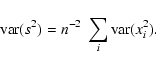
The empirical variance is estimated by
 ,
where xi are supposed to have a dispersion
,
where xi are supposed to have a dispersion  .
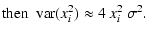
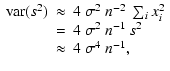
The variance of this estimator is:
.
The variance of this estimator is:
 |
(A.1) |
 |
|||
 |
(A.2) |
 |
(A.3) |
 .
Thus
.
Thus
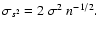
The dispersion of the empirical standard deviation s is therefore:
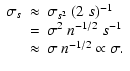 |
(A.4) |
This method for density estimation is extensively described in Silverman (1986) and Bowman & Azzalini (1997). Applications can also be found in the literature (see e.g. Arenou 1993; Jorissen et al. 2001).
Using the kernel function K, the probability density function  is estimated by:
is in estimating .
It is defined as:
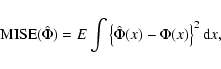 |
(C.2) |
 denotes the expectation value of a function f(x) in a variable x.
Minimizing the MISE allows the choice of the best kernel function. Although it is well known that the so-called Epanechnikov kernel is the kernel function minimizing the MISE (Silverman 1986), the Gaussian kernel, with a lower efficiency, was chosen in order to make use of the Sheather & Jones (1991) method for estimating the bandwidth parameter h.
This latter parameter is estimated using the Fortran subroutine available from Sheather & Jones (1991). The kernel estimator
is computed using the C code written by Arenou (1993).
denotes the expectation value of a function f(x) in a variable x.
Minimizing the MISE allows the choice of the best kernel function. Although it is well known that the so-called Epanechnikov kernel is the kernel function minimizing the MISE (Silverman 1986), the Gaussian kernel, with a lower efficiency, was chosen in order to make use of the Sheather & Jones (1991) method for estimating the bandwidth parameter h.
This latter parameter is estimated using the Fortran subroutine available from Sheather & Jones (1991). The kernel estimator
is computed using the C code written by Arenou (1993).
The variability bands, as described by Bowman & Azzalini (1997, Chap. 2.3), are computed to assess the significance of the modes in the derived distributions. For a given estimated density function
defined by Eq. (C.1), and according to Bowman & Azzalini (1997), the variability band width around
 is:
is:
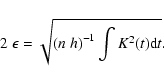 |
(C.3) |
 in Sect. 4.1, and the corresponding values are given in Table 5 for each estimated
 .
The variability band of
.
The variability band of
 is bounded by both functions
 .
.
These bands, first computed for the smoothed estimated distributions, are propagated through the whole processing (Lucy-iteration technique) from smoothed density functions to final deconvolved ones.
Lucy (1974) gives an iterative deconvolution scheme to solve the problem of estimating the density function g(Y) of a quantity Y from a sampled population characterized by:
 is the estimation of the PDF f(x) based on the observed data.
These operations are carried out using the smoothed distribution and overlapping parabola integration method (Davis & Rabinowitz 1984).
To stop the iterations, Lucy used a  test. We preferred to use a Kolmogorov-Smirnov test to check whether the hypothesis
 is true within a 1%-threshold.
In the calculations carried out on the
data and detailed in Sect. 4.1, the number of iterations of the Lucy technique is 3 or 4 for the deconvolution by the error distribution
is true within a 1%-threshold.
In the calculations carried out on the
data and detailed in Sect. 4.1, the number of iterations of the Lucy technique is 3 or 4 for the deconvolution by the error distribution
![$\left[f(x)=\Phi_{\rm log}(\ln(\ensuremath{v\sin i} )), g(y)=\Psi_{\rm log}(\ln(\vartheta))\right]$](/articles/aa/full/2007/08/aa5224-06/img282.gif) ,
and ranges from 12 to 40 for deconvolution by the inclination distribution [
,
and ranges from 12 to 40 for deconvolution by the inclination distribution [
 ,
,
 ].
].
In this representation, the variation of the polar radius with
 is neglected.
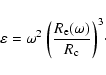
The Roche model of surface equipotential for a rotating star gives:
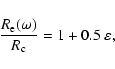 |
(D.1) |
 is the critical radius:
 ,
and
,
and
 |
(D.2) |
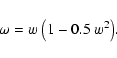
 ,
it follows that:
,
it follows that:
 |
(D.3) |