A&A 456, 151-159 (2006)
DOI: 10.1051/0004-6361:20065204
Ionization structure in the winds of B[e] supergiants
II. Influence of rotation on the formation of equatorial hydrogen neutral zones
M. Kraus1,2
1 - Astronomický ústav, Akademie ved Ceské republiky, Fricova 298, 251 65 Ondrejov, Czech Republic
2 -
Sterrekundig Instituut, Universiteit Utrecht, Princetonplein 5, 3584 CC Utrecht, The Netherlands
Received 14 March 2006 / Accepted 3 May 2006
Abstract
Context. B[e] supergiants are known to have non-spherical winds, and the existence of disks that are neutral in hydrogen close to their stellar surface has been postulated. A suitable mechanism to produce non-spherical winds seems to be rapid rotation, and at least for three B[e] supergiants in the Magellanic Clouds rotation velocities at a substantial fraction of their critical velocity have been found.
Aims. We want to find suitable recombination distances in the equatorial plane of rapidly rotating stars that explain the observed huge amounts of neutral material in the vicinity of B[e] supergiants.
Methods. We perform ionization structure calculations in the equatorial plane around rapidly rotating luminous supergiants. The restriction to the equatorial plane allows us to treat the ionization balance equations 1-dimensionally, while the stellar radiation field is calculated 2-dimensionally, taking into account the latitudinal variation of the stellar surface parameters. The stellar parameters used correspond to those known for B[e] supergiants. The assumptions made in the computations all have in common that the total number of available ionizing photons at any location within the equatorial plane is overestimated, resulting in upper limits for the recombination distances.
Results. We find that despite the drop in equatorial surface density of rapidly rotating stars (neglecting effects like bi-stability and/or wind compression), hydrogen and helium recombine at or close to the stellar surface, for mass loss rates
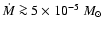 yr-1 and rotation speeds in excess of
 .
.
Key words: stars: rotation - stars: mass-loss - stars: winds, outflows - stars: supergiants
In a series of papers Maeder & Meynet discussed the importance and the
influence of rapid rotation on the evolution of stars, the chemical yields
and non-spherical mass and angular momentum loss (see e.g. Maeder 1999; Meynet & Maeder 2000; Maeder & Meynet 2000). The influence of rotation on so many stellar parameters
results also in the shaping of the wind and the nebula. There
has been the suggestion that the appearance of non-spherical winds around
some massive and luminous stars might be caused by rotation (Maeder
2002; Maeder & Desjacques 2001). Stars for which this might
be appropriate are the Luminous
Blue Variables and the B[e] supergiants.
Zickgraf et al. (1985) suggested that the hybrid character of
the optical spectra of B[e] supergiants is due to a non-spherical (two-component) wind. The
strong infrared excess indicates the presence of a huge amount of hot
circumstellar dust, and polarimetric observations, e.g. by Magalhães
(1992), Magalhães et al. (2006), and Melgarejo et al. (2001), confirmed the non-spherical geometry of the
circumstellar material around B[e] supergiants. The existence of a
geometrically thick circumstellar disk responsible for the polarized emission
and the location of the hot dust seems nowadays to be well established
(for an overview see e.g. Kraus & Miroshnichenko 2006). The formation
mechanism of these disks is, however, still rather unclear. There exist two
promising approaches: (1) the bi-stability mechanism introduced by Lamers &
Pauldrach (1991) and further investigated, especially with respect to the
influence of rotation on the formation of B[e] supergiant stars' disks, by
Pelupessy et al. (2000), and (2) the wind-compressed disk,
introduced by Bjorkman & Cassinelli (1993). Both models however have
difficulties in explaining all observed quantities of the
B[e] supergiants' disks in a self-consistent way. In addition, there is still
no consensus about the nature of these disks, whether they can be described by
a high density equatorial outflowing wind or by a Keplerian viscous disk (see
e.g. Porter 2003; Kraus & Miroshnichenko 2006).
Recently, these disks have been suggested to be neutral in hydrogen in
the vicinity of the stellar surface. Tracers for hydrogen neutral material are
e.g. the strong [O I] emission lines arising in the optical spectra of
B[e] supergiants. Modeling of their line luminosities revealed that, in
order to keep the
mass loss rate of the star at a reliable value, these lines must originate
within a few stellar radii from the surface (Kraus & Borges Fernandes
2005; Kraus et al. 2006). In addition, several
B[e] supergiants are found to show band-head emission from hot (3000-5000 K)
CO gas (McGregor et al. 1988). Follow-up studies of
high-resolution spectra for at least one of them led to the conclusion that
this hot CO gas is located at about 2-3 AU from the hot stellar surface
(Kraus 2000; Kraus et al. 2000).
The existence of neutral material close to these luminous
B[e] supergiants is surprising and needs to be investigated in detail. The goal
of our study is therefore to find scenarios that allow neutral material to
exist close to the surface of these stars.
In a first attempt, Kraus & Lamers (2003, hereafter Paper I)
calculated the ionization structure of B[e] supergiants, assuming a
latitude-dependent mass flux that increases from pole to equator. With such a model they
could show that, even with moderate total mass loss rates, hydrogen recombines
in the equatorial direction close to the star leading to a hydrogen neutral
disk-like structure.
Here, we investigate the influence of rotation
on the stellar parameters and consequently on the ionization structure in the
winds and disks of B[e] supergiants.
Rotation causes a flattening of the stellar surface and therefore a reduction
of the local net gravity in the equatorial region. The decrease in gravity from
pole to equator equally results in a decrease of the stellar flux which
is proportional to the local net gravity. Hence, the effective temperature
also decreases from pole to equator, known as gravity darkening
(or polar brightening, von Zeipel 1924).
The latitude dependence of the gravity and effective temperature has also
impacts on the stellar wind parameters (see e.g. Lamers & Cassinelli
1999): the escape velocity following from the balance
between gravitational and centripetal forces becomes latitude-dependent,
decreasing from pole to equator. The same holds for the terminal wind velocity
which is (for line-driven winds) proportional to the escape velocity.
Even the mass flux from the star tends to decrease from pole to equator
if gravity darkening is taken into account in the CAK theory as shown by
Owocki et al. (1998).
More important for the ionization structure calculations is the density in
the wind, and we will show in Sect. 2 that the density at
any given distance also decreases from pole to equator. A rotating star
will therefore have a less dense wind in the equatorial region, unless
special effects such as bi-stability or wind compression play a role.
Both important parameters in the ionization balance equations, i.e. the
effective surface temperature and the surface density, decrease from pole
to equator. While the decrease in surface temperature tends to decrease the
number of available photons suitable to ionize H and He, the decrease in
surface density reduces the optical depth along the line of sight
from a point in the wind to the star. Both effects are therefore counteracting
with respect to the location where recombination takes place. While a reduction
of ionizing photons will shift the recombination distance towards the star,
the reduction in optical depth along the direction to the star will shift it
further outwards. The outcome of the ionization balance equations is therefore
unpredictable and very sensitive to the chosen input parameters. We thus
investigate the ionization structure in the wind of a rotating star in
more detail.
The paper is structured as follows: in Sect. 2 we provide the
equations that describe the surface distribution of the effective temperature,
mass flux, escape velocity (and hence terminal wind velocity), and hydrogen
density for a rigidly rotating star. The ionization structure calculations
restricted to the equatorial plane of the systems are performed in
Sect. 3 where also the results for the recombination distances
of helium and hydrogen are shown. The influence of the assumptions on these
results and the applicability of the models to B[e] supergiants are discussed
in Sects. 4 and 5, respectively, and the conclusions
are given in Sect. 6.
2 The surface and wind structure of rigidly rotating stars
In this paper, we restrict our investigations to rigid rotation only, and
we neglect any influences due to bi-stability and wind-compression.
The potential  of a rotating star is given by the sum of
gravitational and centrifugal potential. The latitude dependence
of the stellar radius,
of a rotating star is given by the sum of
gravitational and centrifugal potential. The latitude dependence
of the stellar radius,  ,
i.e. the shape of the star, is determined
by the equipotential surfaces,
,
i.e. the shape of the star, is determined
by the equipotential surfaces,
 ,
for which
it is assumed that all the mass is concentrated in the core. These
equipotential surfaces are given by
,
for which
it is assumed that all the mass is concentrated in the core. These
equipotential surfaces are given by
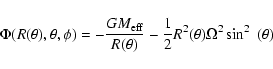 |
(1) |
where  is the co-latitude with
 at the pole,
 is the effective stellar mass, i.e. the stellar mass reduced by the
effects of radiation pressure due to electron scattering, and
is the effective stellar mass, i.e. the stellar mass reduced by the
effects of radiation pressure due to electron scattering, and  is the
angular velocity. With the
definitions of
is the
angular velocity. With the
definitions of
 ,
,
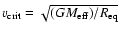 ,
and
,
and
 ,
the
latitude-dependent stellar radius is found from Eq. (1) which
results in the following cubic function
,
the
latitude-dependent stellar radius is found from Eq. (1) which
results in the following cubic function
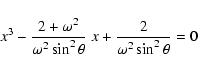 |
(2) |
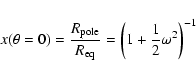
with the solution
 |
(3) |
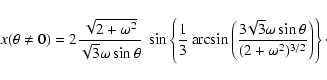
and
 |
(4) |
Equations (3) and (4) describe the stellar radius
at all latitudes for a star rotating rigidly with a specific value of  .
.
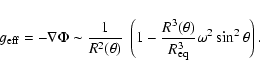
Rotation not only influences the radius of the star but also results in a
latitude-dependent surface temperature distribution, because the stellar
flux, F, is proportional to the local effective gravity,
 ,
which is calculated from
,
which is calculated from
 |
(5) |
Since
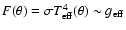 ,
the surface temperature
,
the surface temperature
 behaves as
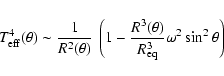 |
(6) |
or, if we express the latitude-dependent effective temperature in terms
of the polar temperature,
 ,
replace by
,
replace by  ,
and make use of relation (3),
,
and make use of relation (3),
For the purpose of our paper it is important to treat the surface effective
temperature (as well as all other following parameters) properly, which means
that we have to take into account the rotationally distorted stellar surface.
How different the results can be when accounting only for gravity darkening but
neglecting the real shape of the star is shown in Fig. 1.
![\begin{figure}
\par\resizebox{8.5cm}{!}{\includegraphics[clip]{5204fig1.eps}}\end{figure}](/articles/aa/full/2006/34/aa5204-06/Timg35.gif) |
Figure 1:
Effective temperature distribution on the surface of a rotating
star. The different curves, which are normalized to the polar temperature, are
for different rotational velocities indicated by from low values ( upper curves) to high values ( lower curves).
In the top panel the
rotational distortion of the stellar surface has been neglected. |
| Open with DEXTER |
There we
compare the surface temperature distribution calculated from
Eq. (7) which accounts for the distorted surface with the
one resulting from a rotating star but under the assumption of an unperturbed,
spherical surface (i.e.
 ). In this latter case,
resulting from Eq. (6) is simply given by
(see e.g. Lamers & Cassinelli 1999; Lamers
). In this latter case,
resulting from Eq. (6) is simply given by
(see e.g. Lamers & Cassinelli 1999; Lamers![[*]](/icons/foot_motif.gif) 2004)
2004)
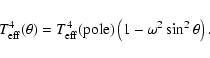 |
(8) |
This equation also describes globally the influence of rigid rotation, i.e. the
drop in temperature from pole to equator. However, the absolute value of the
effective temperature at any location on the stellar surface is different,
as is obvious from the comparison in Fig. 1:
- For
 the rotationally distorted surface is cooler at
all latitudes.
the rotationally distorted surface is cooler at
all latitudes.
- For
 the effective temperature of the rotationally distorted surfaces
is higher for small to intermediate latitudes, but becomes (much) lower in
the equatorial regions, compared to the corresponding spherical surfaces.
the effective temperature of the rotationally distorted surfaces
is higher for small to intermediate latitudes, but becomes (much) lower in
the equatorial regions, compared to the corresponding spherical surfaces.
These severe differences in surface temperature distribution have non-negligible
effects on the stellar radiation field at any point in the wind. A proper
treatment of the stellar parameters by accounting for the rotationally
distorted surface is therefore an important ingredient in our ionization
balance calculations.
For the mass flux,  ,
we follow the description of Owocki et al.
(1998) given by their Eq. (2)
,
we follow the description of Owocki et al.
(1998) given by their Eq. (2)
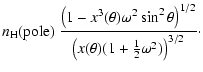
![\begin{displaymath}\frac{F_{\rm m}(\theta)}{F_{\rm m}({\rm pole})} = \left[ \fra...
...a)}
{g_{\rm eff}({\rm pole})}\right]^{1-\frac{1}{\alpha}}\cdot
\end{displaymath}](/articles/aa/full/2006/34/aa5204-06/img44.gif) |
(9) |
This equation describes the latitude-dependent mass flux according to CAK
theory (Castor et al. 1975). Neglecting bi-stability effects, which
means that the force multiplier  is constant all over the surface,
and introducing gravitational darkening according to the von Zeipel theorem
(i.e.
is constant all over the surface,
and introducing gravitational darkening according to the von Zeipel theorem
(i.e.
 )
results in
)
results in
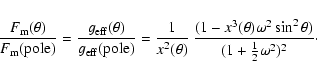 |
(10) |
The surface distribution of the mass flux for different values of
is
shown in the top panel of Fig. 2.
![\begin{figure}
\par\resizebox{8.5cm}{!}{\includegraphics[clip]{5204fig2.eps}}\end{figure}](/articles/aa/full/2006/34/aa5204-06/Timg48.gif) |
Figure 2:
Distribution of the mass flux ( top panel), the escape velocity ( mid panel), and the hydrogen density ( bottom panel) on the surface of a rotating
star. The different curves in each plot, which are normalized to the
corresponding polar value of the parameters, are for different rotational
velocities indicated by .
All parameters drop from pole to equator. This
effect becomes stronger with increasing values of . |
| Open with DEXTER |
The escape velocity of a rotating star follows from balancing gravitational
and centripetal forces on the stellar surface which means that the effective
gravity
 must equal
 .
Since the terminal wind velocity,
.
Since the terminal wind velocity,
 ,
is, according to line-driven
wind theories (see e.g. Lamers & Cassinelli 1999, Chapter 8),
proportional to the escape velocity,
,
is, according to line-driven
wind theories (see e.g. Lamers & Cassinelli 1999, Chapter 8),
proportional to the escape velocity,
 ,
we find the following
relation for the latitude dependence of the terminal velocity
,
we find the following
relation for the latitude dependence of the terminal velocity
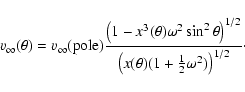 |
(11) |
The latitude dependence of the terminal velocity for different values of
is shown in the middle panel of Fig. 2.
It is known that the mass flux and the terminal velocity
decrease from pole to equator, even if the rotational distortion of the
stellar surface is neglected in their derivation (see Lamers & Cassinelli
1999). For the ionization structure calculations, however,
we need to know the density distribution in the wind.
In a non-rotating, spherically symmetric stationary wind, the density at any
location r in the wind is related to the mass loss rate,  ,
of the
star and the wind velocity, v(r), via the equation of mass continuity
,
of the
star and the wind velocity, v(r), via the equation of mass continuity
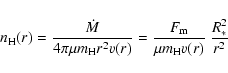 |
(12) |
where  is the mean molecular weight and
  denotes the
particle density of hydrogen given in cm-3.
From the right-hand side of this equation it follows immediately that in a
non-spherically symmetric wind, the radial density distribution at any latitude
can be written in the form
denotes the
particle density of hydrogen given in cm-3.
From the right-hand side of this equation it follows immediately that in a
non-spherically symmetric wind, the radial density distribution at any latitude
can be written in the form
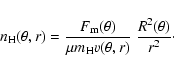 |
(13) |
For our further calculations, we assume that the wind velocity is constant
in radial direction, i.e.
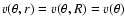 .
Therefore
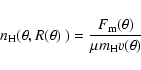
we can re-write Eq. (13) in the form
.
Therefore
we can re-write Eq. (13) in the form
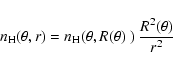 |
(14) |
where
 |
(15) |
defines the density distribution along the stellar surface.
With the additional simplification of
 ,
we can express the surface density distribution,
,
we can express the surface density distribution,
 ,
by using the relations for the mass
flux given by Eq. (10) and for the terminal velocity given by
Eq. (11)
,
by using the relations for the mass
flux given by Eq. (10) and for the terminal velocity given by
Eq. (11)
This surface density distribution, as the result of the ratio of mass
flux to terminal velocity, is plotted for different values of
in
the lower panel of Fig. 2. It also decreases from pole to equator.
This means that a rigidly rotating star will have a less dense wind in
the equatorial region, unless bi-stability and wind compression play a role.
3 Ionization structure calculations
Since we are searching for the existence of a hydrogen neutral equatorial
region, we restrict our calculations to the equatorial plane only. This
leads to the simplification of a symmetrical stellar radiation field with
respect to the equatorial plane. Therefore, it is sufficient to solve the
ionization balance equations along one radial direction, which we will call
the y-axis.
As in Paper I, our model wind consists of hydrogen and helium, only. This
means that we have to solve two coupled ionization balance equations that
are treated in the on-the-spot (OTS) approximation. This approximation states
that every photon generated via
recombination and able to ionize hydrogen or helium will be absorbed
immediately in the close vicinity of its generation location. The ionization
balance equations for this case are given in Sect. 4. of Paper I.
The recombination distance is found by applying a root-finding routine.
Usually, a few iteration steps are sufficient for an accuracy in distance
better than 1%.
Besides the OTS approximation, which defines the diffuse radiation field, we
need
to calculate the stellar radiation field at any point in the equatorial plane,
or, due to the symmetry in our case, at any point along the y-axis.
Differently from the treatment in Paper 1 we no longer use the assumption
that the star is a point source. The stellar parameters of a rotating star
vary strongly over the stellar surface, especially for increasing stellar
rotation. We therefore calculate the stellar radiation by integrating the
latitude-dependent surface flux over the rotationally distorted stellar
surface. This is done in the following way:
- We define the stellar input parameters
,
 ,
,
 ,
,
 ,
,
 .
.
- We define the rotation velocity, .
- With
and
we calculate the shape of
the stellar surface, i.e. .
We thereby make use of
Eq. (3) and of the
mass conservation that relates the spherical radius to the equatorial
and polar radii via
 .
.
- At each location r along the y-axis we determine the
angular extent of the stellar surface and its shape.
This defines the size of the stellar surface (or the surface
segment) from which radiation will arrive at point r.
- Along this stellar surface segment we calculate the distribution
of
and
,
and the resulting
radiation temperature
 (see Sect. 3.2).
- The stellar flux as a function of latitude is then approximated by
 .
.
- The total stellar radiation field at point r along the y-axis follows
from integration of
over the segment of the
rotationally distorted surface.
- To account for optical depth effects, we calculate the minimum optical
depth, which occurs along the y-axis (because of the shortest distance
and the lowest density). This optical depth is adopted for all
directions towards the stellar surface.
In this calculation of the stellar radiation field at any point r along the
y-axis we make one important approximation, which is the adoption of the
minimum optical depth towards all directions from r to the stellar surface.
This assumption results in an overprediction of the available ionizing photons,
because the stellar radiation from the higher latitudes with higher
 will be absorbed less. The resulting recombination distance will
therefore be overestimated.
will be absorbed less. The resulting recombination distance will
therefore be overestimated.
3.2 The radiation temperature
The stellar radiation temperature is defined in our calculations as
the Planck temperature which describes the part of the stellar spectrum
that delivers the ionizing photons, i.e. the spectrum shortwards
of 912 Å. The determination of the latitude dependence of the radiation
temperature is not straightforward. We therefore briefly explain how we
calculate it.
We start with Kurucz model atmospheres (Kurucz 1979) for
solar metallicity stars and  values between 2.0 and 3.5. We do not
investigate higher values of
because we are mainly interested in
giants and supergiants. For each model atmosphere in this
range and
for all available effective temperatures we fitted a Planck function
to the spectrum shortwards of 912 Å. This delivers the radiation
temperature for the corresponding (
,
)
combination.
The radiation temperature is therefore a function of these two parameters, i.e.
values between 2.0 and 3.5. We do not
investigate higher values of
because we are mainly interested in
giants and supergiants. For each model atmosphere in this
range and
for all available effective temperatures we fitted a Planck function
to the spectrum shortwards of 912 Å. This delivers the radiation
temperature for the corresponding (
,
)
combination.
The radiation temperature is therefore a function of these two parameters, i.e.
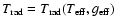 ,
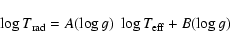
and we found the
following useful parametrization:
,
and we found the
following useful parametrization:
 |
(18) |
with the two functions  and
and  given by
in the range of
 K. The error in
radiation temperature introduced by this fitting procedure is less than 5% for
the higher values of
,
and less than 3% for the lower ones.
We thus can compute
for any combination of
and
values that will occur along the surface of a rigidly rotating star,
and hence we can calculate the appropriate stellar radiation at all locations
on the stellar surface.
K. The error in
radiation temperature introduced by this fitting procedure is less than 5% for
the higher values of
,
and less than 3% for the lower ones.
We thus can compute
for any combination of
and
values that will occur along the surface of a rigidly rotating star,
and hence we can calculate the appropriate stellar radiation at all locations
on the stellar surface.
Since
is a function of both
and
,
its latitude dependence will be different from the one of the effective
temperature (see Sect. 3.4), and will also vary for stars with
different stellar parameters.
For our calculations we chose stars with a polar effective temperature
of
 K and
K and
 .
According to Eq. (18) this combination results in a polar radiation
temperature of
.
According to Eq. (18) this combination results in a polar radiation
temperature of
 K.
K.
The radius of the non-rotating star is fixed at
 .
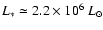
Together with the chosen effective temperature this results in a luminosity of
the non-rotating star of
.
Together with the chosen effective temperature this results in a luminosity of
the non-rotating star of
 ,
which
places the star in the B-type supergiant region within the HR diagram.
,
which
places the star in the B-type supergiant region within the HR diagram.
The polar values of the effective temperature and gravity (and hence radiation
temperature) are fixed for all our model calculations. Fixing the polar
effective temperature means that we are not calculating a star that is
spinning up. This would result in an increase of polar temperature with
increasing rotation velocity. Instead, we are calculating stars with the same
polar effective temperature having different rotation velocities. This means
that we are dealing with stars of different luminosities. The total
luminosity of a star is
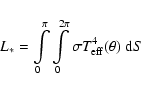 |
(21) |
where dS is the surface element of an ellipsoid, given by
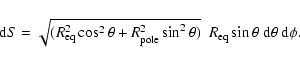 |
(22) |
The difference in luminosity of rotating stars having the same
polar effective temperature is shown in the upper panel of Fig. 3
where we plotted the distribution of the stellar luminosities as a function of
.
With increasing rotation speed, the stellar luminosity drops. The
difference is largest between the non-rotating and the critically rotating star,
and is about a factor 2.
![\begin{figure}
\par\resizebox{8.5cm}{!}{\includegraphics[clip]{5204fig3.eps}}\end{figure}](/articles/aa/full/2006/34/aa5204-06/Timg92.gif) |
Figure 3:
Top panel: stellar luminosity as a function of
for our model
stars with
 K and
.
Bottom panel: mass loss rate as a function of ,
normalized to the
spherical mass loss rate.
Both parameters show a decrease with increasing rotation speed. The difference
between the non-rotating and the critically rotating star is about a
factor 2. K and
.
Bottom panel: mass loss rate as a function of ,
normalized to the
spherical mass loss rate.
Both parameters show a decrease with increasing rotation speed. The difference
between the non-rotating and the critically rotating star is about a
factor 2.
|
| Open with DEXTER |
Similarly, we can calculate the mass loss rates of our model stars.
The mass loss rate follows from
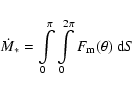 |
(23) |
and the ratio of the mass loss rate over the mass loss rate of the spherical
star is plotted as a function
of
in the lower panel of Fig. 3.
The mass loss rate shows a difference of about a factor 2 between the
non-rotating and the critically rotating star. The behaviour of both the
luminosity and the mass loss rate with
is identical because
both
 and
and
 are proportional
to
(see Eqs. (7) and (10)
respectively). We can therefore conclude that an almost critically
rotating star will have only half the total luminosity and half the total mass
loss rate of its non-rotating counterpart, having both the same polar
mass flux and effective temperature.
are proportional
to
(see Eqs. (7) and (10)
respectively). We can therefore conclude that an almost critically
rotating star will have only half the total luminosity and half the total mass
loss rate of its non-rotating counterpart, having both the same polar
mass flux and effective temperature.
In our calculations, the polar mass flux,
 ,
is a free
parameter. Its value is
varied over a large range to investigate the ionization structure of rotating
stars and to find the recombination distances (see Sect. 3.4).
,
is a free
parameter. Its value is
varied over a large range to investigate the ionization structure of rotating
stars and to find the recombination distances (see Sect. 3.4).
We further use a distant independent wind velocity, which is set to the terminal
velocity, i.e.
 .
For the polar wind velocity
we adopt
.
For the polar wind velocity
we adopt
 km s-1. The radial
electron temperature distribution in the wind is assumed to be constant, and we
set
km s-1. The radial
electron temperature distribution in the wind is assumed to be constant, and we
set
 .
The influence of these assumptions and simplifications on the results
are discussed in Sect. 4.
.
The influence of these assumptions and simplifications on the results
are discussed in Sect. 4.
3.4 Recombination in the equatorial plane
We calculated the equatorial recombination distance of H and He for stars with
a large range in polar mass fluxes,
.
For each mass flux we
considered rotation velocities
covering the complete range from 0 to 1. In Fig. 4 we show the results of three representative models,
calculated for
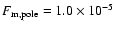 ,
,
 ,
and
,
and
 g s-1 cm-2. The recombination radii for
helium (left panel) and hydrogen (right panel) are given in units of the
corresponding -dependent stellar equatorial radius,
g s-1 cm-2. The recombination radii for
helium (left panel) and hydrogen (right panel) are given in units of the
corresponding -dependent stellar equatorial radius,
 .
Helium recombines for all models already close to the stellar
surface. The recombination distance is found to decrease steadily with
increasing stellar rotation, reaching the stellar surface for
.
Helium recombines for all models already close to the stellar
surface. The recombination distance is found to decrease steadily with
increasing stellar rotation, reaching the stellar surface for
 .
This means that for rapidly rotating stars helium is neutral at the
stellar surface. For hydrogen, the situation is different. For polar mass
fluxes
.
This means that for rapidly rotating stars helium is neutral at the
stellar surface. For hydrogen, the situation is different. For polar mass
fluxes
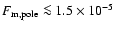 g s-1 cm-2 the
recombination distances decrease with increasing ,
reach a minimum
in the range
g s-1 cm-2 the
recombination distances decrease with increasing ,
reach a minimum
in the range
 ,
and increase again for higher
rotation speeds. If the input polar mass flux is higher than
g s-1 cm-2, hydrogen shows the same trend as helium, i.e.
the recombination distances decrease steadily for increasing stellar rotation.
They reach also the surface of the star, but for rotation speeds
,
and increase again for higher
rotation speeds. If the input polar mass flux is higher than
g s-1 cm-2, hydrogen shows the same trend as helium, i.e.
the recombination distances decrease steadily for increasing stellar rotation.
They reach also the surface of the star, but for rotation speeds
 .
The models with
.
The models with
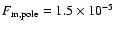 g s-1 cm-2seem to be the case in "transition''. They show a kink at
 and a
subsequent steep drop in recombination distance.
and a
subsequent steep drop in recombination distance.
![\begin{figure}
\par\resizebox{8.5cm}{!}{\includegraphics[clip]{5204fig4.eps}}\end{figure}](/articles/aa/full/2006/34/aa5204-06/Timg107.gif) |
Figure 4:
Distance r in the equatorial plane in terms of the equatorial radius
at which recombination of He II ( left panel) and
H II ( right panel) takes place for stars rotating with different
velocities, indicated by .
The curves are ( from top to bottom) for
polar mass fluxes of:
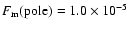 ,
and
g s-1 cm-2. ,
and
g s-1 cm-2. |
| Open with DEXTER |
What causes the minimum and especially the strong increase in
hydrogen recombination distance for the lower mass flux models?
This rather unexpected behaviour can be understood upon inspection of
Fig. 5. There we plotted the variation of the individual equatorial
surface parameters with ,
and of special interest are the radiation
temperature and the particle density. Figure 5 shows that with increasing
rotation velocity, the density drops much
quicker from pole to equator than the temperature. For recombination to take
place right above the stellar surface, the number of ionizing photons has to be
reduced. This can be done either by decreasing the radiation temperature, or by
increasing the equatorial surface density and hence the optical depth. Since
the decrease in radiation temperature is determined by the rotation velocity
(with a fixed input polar value) we can only increase the input polar mass flux
to achieve a higher surface density for a given rotation velocity. A higher
density also has the effect of triggering recombination, this is however
only a secondary effect while the blocking of the radiation field is the
more important one. The density
in the top model shown in Fig. 4 is no longer high enough
for stars with
 to absorb the ionizing photons
provided by the still rather high radiation temperature. Therefore, ionization
takes over again and shifts the recombination distance for higher rotation
velocities further out. Whether recombination takes place close to the star
therefore sensitively depends on the chosen input parameters of the rotating
star.
to absorb the ionizing photons
provided by the still rather high radiation temperature. Therefore, ionization
takes over again and shifts the recombination distance for higher rotation
velocities further out. Whether recombination takes place close to the star
therefore sensitively depends on the chosen input parameters of the rotating
star.
![\begin{figure}
\par\resizebox{8.5cm}{!}{\includegraphics[clip]{5204fig5.eps}}\end{figure}](/articles/aa/full/2006/34/aa5204-06/Timg109.gif) |
Figure 5:
Surface parameters in the equatorial plane, normalized to their polar
values, as functions of the rotational velocity.
is the density at
any distance. |
| Open with DEXTER |
4 Discussion
For our calculations we made a few assumptions, and we briely discuss
their influence on the model results:
The electron temperature.
The winds of hot stars are known to start with an electron temperature of about
 at the stellar surface. Further out, they cool quickly
(within a few stellar radii) and converge towards a more or less constant
(terminal temperature) value (see e.g. Drew 1989). The adoption of a
constant (in radial direction) and maximum (i.e.
at the stellar surface. Further out, they cool quickly
(within a few stellar radii) and converge towards a more or less constant
(terminal temperature) value (see e.g. Drew 1989). The adoption of a
constant (in radial direction) and maximum (i.e.
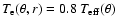 )
electron temperature reduces (or suppresses)
the total number of recombinations taking place, because the recombination
coefficient is small for high temperatures but increases with decreasing
temperature (see Fig. 2 in Paper I). Our assumption therefore inhibits
recombination and shifts the equilibrium of the ionization balance in favour of
the ionization of the wind material. This means that we have
overestimated the recombination distance.
)
electron temperature reduces (or suppresses)
the total number of recombinations taking place, because the recombination
coefficient is small for high temperatures but increases with decreasing
temperature (see Fig. 2 in Paper I). Our assumption therefore inhibits
recombination and shifts the equilibrium of the ionization balance in favour of
the ionization of the wind material. This means that we have
overestimated the recombination distance.
The wind velocity. The velocity distribution in winds of hot stars can
usually be approximated by a  -law (see e.g. Lamers & Cassinelli
1999) which describes the increase in velocity from the
small surface value to the terminal velocity. First, using the maximum (i.e.
terminal) velocity instead of the more realistic -law increasing
velocity distribution results in an underestimation of the density, especially
at distances close to the star. Second, the chosen value of 2000 km s-1for the polar terminal velocity is rather high for a B-type supergiant and
results equally in an underestimation of the density. Both assumptions
therefore lead to an underestimation of the optical depth seen by the stellar
radiation and an overestimation of the recombination distance.
-law (see e.g. Lamers & Cassinelli
1999) which describes the increase in velocity from the
small surface value to the terminal velocity. First, using the maximum (i.e.
terminal) velocity instead of the more realistic -law increasing
velocity distribution results in an underestimation of the density, especially
at distances close to the star. Second, the chosen value of 2000 km s-1for the polar terminal velocity is rather high for a B-type supergiant and
results equally in an underestimation of the density. Both assumptions
therefore lead to an underestimation of the optical depth seen by the stellar
radiation and an overestimation of the recombination distance.
The optical depth. We calculate the optical depth properly only along
the y-axis. Since the surface density of a rotating star drops from pole
to equator and since the distance from the stellar surface to any point along
the y-axis is the shortest one over which stellar photons can be absorbed,
this optical depth value is the smallest. Adopting this minimum optical depth
for all directions towards the stellar surface therefore underestimates the real
optical depth and allows more ionizing photons to penetrate the wind material
to larger distances. This leads to an overestimation of the
recombination distance.
The OTS approximation. In the OTS approximation it is assumed that every
photon created via recombination and able to (re-)ionize hydrogen or helium
will be absorbed in the close vicinity of its generation location, and none
will escape from the wind. These leads to additional
ionizing photons (better known as the diffuse radiation field) at any location
in the wind. The OTS approximation, even if not fully applicable
for the lower density regions, tends to overestimate the number of available
photons everywhere in the wind and therefore favours the ionization of the
wind material.
All these assumptions and simplifications made in our computations and listed
here show the tendency to overestimate the number of ionizing photons available
at a certain location in the wind. Consequently, the recombination radius
is shifted away from the star which means that our calculated distances at
which the material is found to recombine are upper limits.
5 Applicability to the B[e] supergiants
In Sect. 3.4 we showed that the equatorial winds of rapidly rotating
stars might be neutral in hydrogen right from the stellar surface, even
though the density in the equatorial wind is much lower than in the polar
regions. Since our main goal is to find possible formation mechanisms
for hydrogen neutral disks around B[e] stars and especially B[e] supergiants,
we discuss here how reliable the results are and whether they are indeed
applicable to the known B[e] supergiants.
The rotation velocities of B[e] supergiants. Our model is based
on the assumption that B[e] supergiants are rapidly rotating stars. What is
the evidence for their rapid rotation? In fact not much is known about their
rotation velocities. Due to their high density circumstellar medium, most of
them do not show any photospheric absorption lines which might be used to
derive a possible rotation speed. There are, however, three (out of 15) B[e]
supergiants in the Magellanic Clouds for which photospheric absorption lines
have been detected. From these line profiles only the projected stellar rotation
(i.e.  )
can be derived with high accuracy. With their (often) poorly
known inclinations i, only lower limits to the real rotation speeds
could be derived. These were found to be
)
can be derived with high accuracy. With their (often) poorly
known inclinations i, only lower limits to the real rotation speeds
could be derived. These were found to be
 and
and
 for the two LMC B[e] supergiants Hen S93 and R 66
(Gummersbach et al. 1995; Zickgraf 2006,
respectively), and
for the two LMC B[e] supergiants Hen S93 and R 66
(Gummersbach et al. 1995; Zickgraf 2006,
respectively), and
 for the SMC B[e] supergiant
R 50 (Zickgraf 2000). Especially the latter seems
to rotate at a substantial amount of its critical velocity providing the
basis for our research, although we cannot generalize that all B[e] supergiants
are rapidly rotating.
for the SMC B[e] supergiant
R 50 (Zickgraf 2000). Especially the latter seems
to rotate at a substantial amount of its critical velocity providing the
basis for our research, although we cannot generalize that all B[e] supergiants
are rapidly rotating.
Stellar luminosities and effective temperatures.
A summary of the stellar parameters (
,
L*, R*) of the MC
B[e] supergiants is given e.g. in Zickgraf (2006). From this list
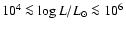
it is obvious that the stellar luminosities and effective temperatures of the
B[e] supergiants cover the range
 and
and
![$10~000 \la T_{\rm eff}[{\rm K}] \la 27~000$](/articles/aa/full/2006/34/aa5204-06/img118.gif) ,
and our chosen values of the
effective temperature fall well into this range while our luminosities are taken
as maximum values. The literature values for the B[e] supergiant effective
temperatures, however, should be taken with caution because they
have mainly been derived from fitting Kurucz model atmospheres to the observed
spectral energy distributions (see Zickgraf 1998 and references
therein). However, these model atmospheres have been calculated under the
assumption of spherically symmetric, non-rotating (i.e. uniformly bright) stars.
If B[e] supergiants are indeed rapidly rotating, then for a proper
determination of the mean (i.e. observable) effective temperature
a comparison with composite spectra should be undertaken (see e.g. Lovekin et al. 2006). Of course, to do so the inclination and the rotational
velocities must be known which is usually not the case for B[e] supergiants.
,
and our chosen values of the
effective temperature fall well into this range while our luminosities are taken
as maximum values. The literature values for the B[e] supergiant effective
temperatures, however, should be taken with caution because they
have mainly been derived from fitting Kurucz model atmospheres to the observed
spectral energy distributions (see Zickgraf 1998 and references
therein). However, these model atmospheres have been calculated under the
assumption of spherically symmetric, non-rotating (i.e. uniformly bright) stars.
If B[e] supergiants are indeed rapidly rotating, then for a proper
determination of the mean (i.e. observable) effective temperature
a comparison with composite spectra should be undertaken (see e.g. Lovekin et al. 2006). Of course, to do so the inclination and the rotational
velocities must be known which is usually not the case for B[e] supergiants.
Mass loss rates. The models presented in Fig. 4 are for
stars with polar mass fluxes between
 and
g s-1 cm-2. Therefore, the range in mass loss rates
covered by these calculations extends from
and
g s-1 cm-2. Therefore, the range in mass loss rates
covered by these calculations extends from
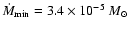 yr-1 (critically rotating star with lower polar
mass flux) to
yr-1 (critically rotating star with lower polar
mass flux) to
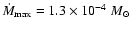 yr-1
(non-rotating star with higher polar mass flux), and is in good agreement
with the known mass loss rates for MC B[e] supergiants, which range from
about
yr-1
(non-rotating star with higher polar mass flux), and is in good agreement
with the known mass loss rates for MC B[e] supergiants, which range from
about
 yr-1 to about
 yr-1(see Zickgraf 2006).
The equatorial surface density.
According to Eq. (12), the surface density of a non-rotating star
behaves as
 .
For our model calculations we have chosen mass loss rates in the range reliable
for B[e] supergiants, but we used some maximum values for the velocity (
.
For our model calculations we have chosen mass loss rates in the range reliable
for B[e] supergiants, but we used some maximum values for the velocity (
 )
and stellar radius. Therefore, for non-rotating stars the surface densities
in our calculations provide some lower limits.
)
and stellar radius. Therefore, for non-rotating stars the surface densities
in our calculations provide some lower limits.
For (especially rapidly) rotating stars, the situation becomes more complicated.
Now, the surface density is found to drop from pole to equator. On the other
hand, B[e] supergiants are supposed to have circumstellar disks. These disks
are much denser than what is found for the polar wind regions, with density
contrasts on the order of
 .
Models proposed to explain the formation of these high density disks are the
bi-stability mechanism (Lamers & Pauldrach 1991; Pelupessy
2000) and wind compression (Bjorkman & Cassinelli 1993).
While the bi-stability mechanism in a rotating star might account
for an increase by a factor of
.
Models proposed to explain the formation of these high density disks are the
bi-stability mechanism (Lamers & Pauldrach 1991; Pelupessy
2000) and wind compression (Bjorkman & Cassinelli 1993).
While the bi-stability mechanism in a rotating star might account
for an increase by a factor of  10 in equatorial density only, the wind
compression, especially for rapidly rotating stars (or more precisely the flow
of material towards the equatorial plane), can be inhibited due to the
appearance of a non-radial force provided by the radiation (Owocki et al.
1996). Recently, the existence of a slow solution
in line-driven winds of rapidly rotating stars has been found (Curé
2004; Curé et al. 2005). Inclusion of the bi-stability
jump resulted in an equatorial density enhancement (at least in the
close vicinity of the star) by a factor of 100-1000, just what is needed
to explain the disks of B[e] supergiants. However, these solutions have been
found adopting a spherically symmetric star and neglecting gravity darkening,
and it still needs to be confirmed that these slow solutions
will also exist when gravity darkening is taken properly into account.
10 in equatorial density only, the wind
compression, especially for rapidly rotating stars (or more precisely the flow
of material towards the equatorial plane), can be inhibited due to the
appearance of a non-radial force provided by the radiation (Owocki et al.
1996). Recently, the existence of a slow solution
in line-driven winds of rapidly rotating stars has been found (Curé
2004; Curé et al. 2005). Inclusion of the bi-stability
jump resulted in an equatorial density enhancement (at least in the
close vicinity of the star) by a factor of 100-1000, just what is needed
to explain the disks of B[e] supergiants. However, these solutions have been
found adopting a spherically symmetric star and neglecting gravity darkening,
and it still needs to be confirmed that these slow solutions
will also exist when gravity darkening is taken properly into account.
Our models do not account for any density enhancements either due to
bi-stability or due to wind compression. Such an increase in equatorial
surface density by a factor 100-1000 (for the same imput values) would
result in a recombination distance even closer to the stellar surface, or
would mean that the polar mass flux of the model star can be reduced by the
same factor and the material would still recombine in the vicinity of the star.
Such a lower mass flux (and hence a lower mass loss rate) might be desirable
if the winds of B[e] supergiants are clumped. A clumpy wind in contrast to the
assumed smooth density distribution is found to overestimate the mass loss
rates (derived e.g. from H)
by a factor of 10 or more
(see e.g. Hillier 2005; Bouret et al. 2005).
Even if the winds of B[e] supergiants will turn out to have lower mass loss
rates, the ionization structure calculations presented in this paper show
that recombination of the equatorial wind material of rapidly rotating stars
can take place at or at least close to the stellar surface.
6 Conclusion
We investigated the influence of rigid rotation on the surface and wind
parameters of hot luminous stars, with emphasis on the non-spherical winds
of B[e] supergiants. Since B[e] supergiants are known to have equatorial disks
that show evidence for hydrogen neutral material in the
vicinity of the stellar surface, the calculations are restricted to the
equatorial plane. Due to the symmetric stellar radiation field (with respect
to the equatorial plane) the problem of finding the recombination distance
reduces even to the 1-dimensional case. The radiation field is however treated
2-dimensionally, to properly account for the latitude dependences of the
parameters like effective temperature, wind velocity and density.
The ionization balance equations are solved in a pure hydrogen plus helium wind.
All assumptions made during our calculations have in common that the number
of available ionizing photons at any location within the equatorial plane is
overestimated. This results in a shift of the recombination distance
to larger values, which means that we have calculated upper limits for
the recombination distance.
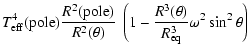
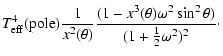
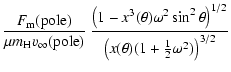
The major result is that despite the drop in equatorial surface density with
increasing rotation velocity (neglecting any possible equatorial density
enhancement due to bi-stability and/or wind compression), hydrogen recombines
at (or close to) the stellar surface for rotating models with a polar mass flux
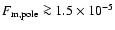 g s-1 cm-2 and rotation
velocities
(see Fig. 4).
These mass fluxes correspond to mass loss rates
yr-1 for our chosen model stars with supergiant
stellar and wind parameters. Since the mass loss rates for B[e] supergiants are
found to lie in the range
g s-1 cm-2 and rotation
velocities
(see Fig. 4).
These mass fluxes correspond to mass loss rates
yr-1 for our chosen model stars with supergiant
stellar and wind parameters. Since the mass loss rates for B[e] supergiants are
found to lie in the range
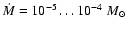 yr-1we can expect that at least some of these stars might have hydrogen
neutral equatorial material close to their stellar surface, given that they
are indeed (rapidly) rotating stars, as is found for at least three of them.
yr-1we can expect that at least some of these stars might have hydrogen
neutral equatorial material close to their stellar surface, given that they
are indeed (rapidly) rotating stars, as is found for at least three of them.
Acknowledgements
I am grateful to Henny Lamers for his helpful comments and suggestions and
for his proof-reading of
the draft of this paper. This research was supported by grants from GA CR
205/04/1267 and from the Nederlandse Organisatie voor Wetenschappelijk
Onderzoek (NWO) grant No. 614.000.310.
- Bjorkman, J. E., &
Cassinelli, J. P. 1993, ApJ, 409, 429 [NASA ADS] [CrossRef] (In the text)
- Bouret, J.-C., Lanz,
T., & Hillier, D. J. 2006, A&A, 438, 301 [EDP Sciences] [NASA ADS] [CrossRef] (In the text)
- Castor, J. I., Abbott, D. C.,
& Klein, R. I. 1975, ApJ, 195, 157 [NASA ADS] [CrossRef] (In the text)
- Curé, M. 2004,
ApJ, 614, 929 [NASA ADS] [CrossRef] (In the text)
- Curé, M., Rial, D.
F., & Cidale, L. 2005, A&A, 437, 929 [EDP Sciences] [NASA ADS] [CrossRef] (In the text)
- Drew, J. E. 1989, ApJS, 71,
267 [NASA ADS] [CrossRef] (In the text)
- Gummersbach,
C. A., Zickgraf, F.-J., & Wolf, B. 1995, A&A, 302, 409 [NASA ADS] (In the text)
- Hillier, D. J.
2005, in The Fate of the Most Massive Stars, ed. R. Humphreys &
K. Stanek (San Francisco: ASP), ASP Conf. Ser., 332, 219
(In the text)
- Kraus, M. 2000, Modeling of
the Near IR Emission from the Peculiar B[e] star MWC 349, Ph.D.
Thesis, University of Bonn
(In the text)
- Kraus, M.,
& Borges Fernandes, M. 2005, in The nature and evolution of
disks around hot stars, ed. R. Ignace & K. G. Gayley (San
Francisco: ASP), ASP Conf. Ser., 337, 254
(In the text)
- Kraus, M.,
& Lamers, H. J. G. L. M. 2003, A&A, 405, 165 [EDP Sciences] [NASA ADS] [CrossRef] (Paper 1)
(In the text)
- Kraus, M., &
Miroshnichenko, A. S. 2006, Stars with the B[e] Phenomenon, (San
Francisco: ASP), in press
(In the text)
- Kraus, M.,
Borges Fernandes, M., Andrade Pilling, D., & de Araújo,
F.X. 2006, in Stars with the B[e] Phenomenon, ed. M. Kraus & A.
S. Miroshnichenko (San Francisco: ASP), ASP Conf. Ser., in press
[arXiv:astro-ph/0511822]
(In the text)
- Kraus, M.,
Krügel, E., Thum, C., & Geballe, T. R. 2000, A&A, 362,
158 [NASA ADS] (In the text)
- Kurucz, R. L. 1979,
ApJS, 40, 1 [NASA ADS] [CrossRef] (In the text)
-
Lamers, H. J. G. L. M., & Cassinelli, J. P. 1999, Introduction
to stellar winds (Cambridge University Press)
(In the text)
- Lamers, H. J. G. L. M., &
Pauldrach, A. W. A. 1991, A&A, 244, L5 [NASA ADS] (In the text)
- Lamers, H. J. G. L.
M., 2004, in Stellar Rotation, ed. A. Maeder & P. Eenens (San
Francisco: ASP), IAU Symp., 215, 479
(In the text)
- Lovekin, C. C.,
Deupree, R. G., & Short, C. I. 2006, ApJ, in press
[arXiv:astro-ph/0602084]
(In the text)
- Maeder, A. 1999,
A&A, 347, 185 [NASA ADS] (In the text)
- Maeder, A. 2002,
A&A, 392, 575 [EDP Sciences] [NASA ADS] [CrossRef] (In the text)
- Maeder, A., &
Desjaques, V. 2001, A&A, 372, L 9
(In the text)
- Maeder, A., &
Meynet, G. 2000, A&A, 361, 159 [NASA ADS] (In the text)
- Meynet, G., &
Maeder, A. 2000, A&A, 361, 101 [NASA ADS] (In the text)
- Magalhães,
A. M. 1992, ApJ, 398, 286 [NASA ADS] [CrossRef] (In the text)
-
Magalhães, A. M., Melgarejo, R., Pereyra, A., & Carciofi,
A. C. 2006, Stars with the B[e] Phenomenon, ed. M. Kraus & A.
S. Miroshnichenko (San Francisco: ASP), ASP Conf. Ser., in press
[arXiv:astro-ph/0602170]
(In the text)
- McGregor, P. J.,
Hillier, D. J., & Hyland, A. R. 1988, ApJ, 334, 639 [NASA ADS] [CrossRef] (In the text)
- Melgarejo, R.,
Magalhães, A. M., Carciofi, A. C., & Rodrigues, C. V.
2001, A&A, 377, 581 [EDP Sciences] [NASA ADS] [CrossRef] (In the text)
- Owocki, S. P., Cranmer, S.
R., & Gayley, K. G. 1996, ApJ, 472, L115 [NASA ADS] [CrossRef] (In the text)
- Owocki, S. P.,
Cranmer, S. R., & Gayley, K. G. 1998, Ap&SS, 260, 149 [NASA ADS] (In the text)
- Pelupessy, I.,
Lamers, H. J. G. L. M., & Vink, J. S. 2000, A&A, 359,
695 [NASA ADS] (In the text)
- Porter, J. M. 2003,
A&A, 398, 631 [EDP Sciences] [NASA ADS] [CrossRef] (In the text)
- von Zeipel, H.
1924, MNRAS, 84, 665 [NASA ADS] (In the text)
- Zickgraf, F.-J.
1998, Non-spherical stellar winds in the post-main sequence
evolution of massive stars, Habilitation Thesis, Heidelberg
University
(In the text)
- Zickgraf,
F.-J. 2000, in The Be Phenomenon in early-type stars, ed. M. A.
Smith, H. F. Henrichs, & J. Fabregat (San Francisco: ASP), ASP
Conf. Ser., 214, 26
(In the text)
- Zickgraf,
F.-J. 2006, in Stars with the B[e] Phenomenon, ed. M. Kraus &
A. S. Miroshnichenko (San Francisco: ASP), ASP Conf. Ser., in
press
(In the text)
- Zickgraf,
F.-J., Wolf, B., Stahl, O., Leitherer, C., & Klare, G. 1985,
A&A, 143, 421 [NASA ADS] (In the text)
Copyright ESO 2006

![\begin{figure}
\par\resizebox{8.5cm}{!}{\includegraphics[clip]{5204fig1.eps}}\end{figure}](/articles/aa/full/2006/34/aa5204-06/img35.gif)
![\begin{figure}
\par\resizebox{8.5cm}{!}{\includegraphics[clip]{5204fig2.eps}}\end{figure}](/articles/aa/full/2006/34/aa5204-06/img48.gif)





![\begin{figure}
\par\resizebox{8.5cm}{!}{\includegraphics[clip]{5204fig3.eps}}\end{figure}](/articles/aa/full/2006/34/aa5204-06/img92.gif)
![\begin{figure}
\par\resizebox{8.5cm}{!}{\includegraphics[clip]{5204fig4.eps}}\end{figure}](/articles/aa/full/2006/34/aa5204-06/img107.gif)
![\begin{figure}
\par\resizebox{8.5cm}{!}{\includegraphics[clip]{5204fig5.eps}}\end{figure}](/articles/aa/full/2006/34/aa5204-06/img109.gif)