![[*]](/icons/foot_motif.gif)
G. De Marchi1 - L. Pulone2 - F. Paresce3
1 - ESA, Space Science Department, Keplerlaan
1, 2200 AG Noordwijk, The Netherlands
2 -
INAF, Osservatorio Astronomico di Roma, Via di Frascati 33, 00040 Monte
Porzio Catone, Italy
3 -
INAF, Viale del Parco Mellini 84, 00136 Roma, Italy
Received 6 July 2005 / Accepted 28 November 2005
Abstract
We have used the FORS-1 camera on the VLT to study the main sequence
(MS) of the globular cluster NGC 6218 in the V and R bands. The
observations cover an area of
 around the
cluster centre and probe the stellar population out to the cluster's
half-mass radius (
around the
cluster centre and probe the stellar population out to the cluster's
half-mass radius (
 ). The colour-magnitude
diagram (CMD) that we derive in this way reveals a narrow and well
defined MS extending down to the
). The colour-magnitude
diagram (CMD) that we derive in this way reveals a narrow and well
defined MS extending down to the  detection limit at
 ,
or about 6 magnitudes below the turn-off, corresponding
to stars of
,
or about 6 magnitudes below the turn-off, corresponding
to stars of  0.25
0.25  .
The luminosity function (LF) obtained
with these data shows a marked radial gradient, in that the ratio of
lower- and higher-mass stars increases monotonically with radius. The
mass function (MF) measured at the half-mass radius, and as such
representative of the cluster's global properties, is surprisingly
flat. Over the range 0.4-0.8 ,
the number of stars per unit
mass follows a power-law distribution of the type
.
The luminosity function (LF) obtained
with these data shows a marked radial gradient, in that the ratio of
lower- and higher-mass stars increases monotonically with radius. The
mass function (MF) measured at the half-mass radius, and as such
representative of the cluster's global properties, is surprisingly
flat. Over the range 0.4-0.8 ,
the number of stars per unit
mass follows a power-law distribution of the type
 ,
where, for comparison, Salpeter's IMF would be
,
where, for comparison, Salpeter's IMF would be
 .
We expect that such a flat MF does not represent the
cluster's IMF but is the result of severe tidal stripping of the stars
from the cluster due to its interaction with the Galaxy's gravitational
field. Our results cannot be reconciled with the predictions of recent
theoretical models that imply a relatively insignificant loss of stars
from NGC 6218 as measured by its expected very long time to
disruption. They are more consistent with the orbital parameters based
on the Hipparcos reference system that imply a much higher degree of
interaction of this cluster with the Galaxy than assumed by those
models. Our results indicate that, if the orbit of a cluster is known,
the slope of its MF could be useful in discriminating between the
various models of the Galactic potential.
.
We expect that such a flat MF does not represent the
cluster's IMF but is the result of severe tidal stripping of the stars
from the cluster due to its interaction with the Galaxy's gravitational
field. Our results cannot be reconciled with the predictions of recent
theoretical models that imply a relatively insignificant loss of stars
from NGC 6218 as measured by its expected very long time to
disruption. They are more consistent with the orbital parameters based
on the Hipparcos reference system that imply a much higher degree of
interaction of this cluster with the Galaxy than assumed by those
models. Our results indicate that, if the orbit of a cluster is known,
the slope of its MF could be useful in discriminating between the
various models of the Galactic potential.
Key words: stars: Hertzsprung-Russell (HR) and C-M diagrams - stars: luminosity function, mass function - Galaxy: globular clusters: general - globular clusters: individual: NGC 6218
A satisfactory understanding of the properties of the initial mass
function (IMF) of globular clusters (GCs) is a major objective of
current astrophysical research in that GCs are the closest example of
star formation at high redshift (Krauss & Chaboyer 2003). The most
reliable observations so far available that reach near the bottom of
the stellar MS indicate that all halo clusters have a very similar
present global MF (PGMF), which peaks at 0.35
(Paresce
& De Marchi 2000; De Marchi et al. 2005). The
internal dynamical relaxation process via stellar encounters is now
reasonably well understood (Meylan & Heggie 1997) and validated
observationally (e.g. De Marchi et al. 2000; Albrow et al. 2002; Pasquali et al. 2004) and allows us to derive the
global properties of the MF from a limited number of measurements
within a cluster.
Nevertheless, any hope to infer useful information on the properties of the IMF from the observed present global MF (PGMF) rests on our ability to roll back the effects that the tidal field of the Galaxy has exerted on the stellar population of the clusters (Paresce & De Marchi 2000). Gravitational shocking due to repeated interactions with the bulge and disc of the Galaxy profoundly disrupt the original mass distribution by ejecting low mass stars from the core and by compressing the tidal boundary in phase space at each encounter. These phenomena, integrated over the orbit and time and eventually causing the disruption of the cluster, can substantially alter the shape of the MF thereby completely masking the properties of the IMF (Vesperini & Heggie 1997).
Theoretical models describing the interaction of GCs with the Galactic tidal field have become progressively more detailed and, possibly, accurate in the past decade or so. This has been made possible by an in-depth analysis of the mechanisms responsible for cluster disruption (Aguilar et al. 1988; Gnedin & Ostriker 1997) and by the availability of more accurate space motion parameters for the clusters (Dauphole et al. 1996; Odenkirchen et al. 1997). Models that make use of GC proper motion information (Dinescu et al. 1999; Baumgardt & Makino 2003) should, in principle, provide a more reliable description of the clusters' past dynamical history than those purely based on radial velocity data (Gnedin & Ostriker 1997). On the other hand, the models of Gnedin & Ostriker (1997) explain rather convincingly, albeit in a statistical sense, why the GCs that we see today are not randomly distributed in parameter space but rather occupy regions of low probability of disruption.
The most useful indicator of the past dynamical history of GCs that
models of this type produce is the time to disruption,  ,
namely the time over which a cluster would be completely dissolved by
tidal forces. Unfortunately, this parameter is not directly observable,
thereby making it more difficult to assess the validity of the
models. It is, therefore, necessary to relate
to other
measurable parameters.
,
namely the time over which a cluster would be completely dissolved by
tidal forces. Unfortunately, this parameter is not directly observable,
thereby making it more difficult to assess the validity of the
models. It is, therefore, necessary to relate
to other
measurable parameters.
A rather obvious indication of a cluster's tidal disruption would seem to be the presence of an extended tidal tail (Leon et al. 2000; Odenkirchen et al. 2003). The unequivocal detection of tidal tails, however, is hard to achieve on the basis of photometric information alone (Baumgardt & Kroupa 2005), which is often the only available data. A more robust, and potentially more powerful approach consists in looking at the properties of the MF of MS stars and at its variations within the cluster, with respect to that of other well behaved reference GCs. This has allowed us to identify, for the first time, the clear signature of tidal disruption in the cluster NGC 6712, in the form of a severe depletion of low-mass stars (De Marchi et al. 1999; Andreuzzi et al. 2001).
While our discovery has proved that GCs are indeed subject to the
effects of tidal stripping, the widely different values of predicted by various models for NGC 6712 have, at the same time,
raised concerns as to the validity of the present physical
understanding of the processes involved. In order to better understand
the possible magnitude of the underlying discrepancy, we have studied
the properties of the MF of another GC, NGC 6218, which, according to
all three sets of presently available models (Gnedin & Ostriker 1997;
Dinescu et al. 1999; Baumgardt & Makino 2003) should have experienced
an insignificant or very mild interaction with the Galactic tidal
field. We would expect that its PGMF should accurately reflect the IMF
and our aim was to use NGC 6218 as a reference for NGC 6712 and
other clusters. In this paper we report on the properties of its MF
that shows that there may be something terribly wrong with these models
or, more likely, with their assumptions.
The structure of the paper is as follows. The observations and their reduction are described in Sect. 2, whereas the results of the photometry are discussed in Sect. 3. Section 4 is devoted to the LF and MF of MS stars at various locations in the cluster. The dynamical structure of NGC 6218, as derived from these data, is presented in Sect. 5 and the overall implications for the understanding of the interaction between GCs and the potential field of the Galaxy are discussed in Sect. 6.
The observations on which this paper is based were obtained in 1999 June with the FORS1 camera at ESO's Very Large Telescope UT1, using the high resolution collimator with a field of view (FOV) of
 on a side and a plate-scale of
 per pixel. The log
of the observations, carried out in service observing mode, is given in
Table 1. Seeing conditions were excellent on both observing nights (1 June and 16 June), and the point spread function (PSF) had an average
full width at half maximum of
per pixel. The log
of the observations, carried out in service observing mode, is given in
Table 1. Seeing conditions were excellent on both observing nights (1 June and 16 June), and the point spread function (PSF) had an average
full width at half maximum of
 .
Observations were carried out
in the Bessell V and R bands, with the exposure times listed in
Table 1. The total equivalent exposure time corresponds to 2160 s in V and 1440 s in R.
.
Observations were carried out
in the Bessell V and R bands, with the exposure times listed in
Table 1. The total equivalent exposure time corresponds to 2160 s in V and 1440 s in R.
The telescope was pointed at the nominal centre of NGC 6218 at
RA(J2000
 and Dec(J2000
 ,
corresponding to Galactic coordinates
l=15.7 and b=26.3. Thanks to the relatively wide FOV of FORS-1,
our observations reach out to the cluster's half-mass radius (
,
corresponding to Galactic coordinates
l=15.7 and b=26.3. Thanks to the relatively wide FOV of FORS-1,
our observations reach out to the cluster's half-mass radius (
 ;
Harris 1996) and comfortably contain the region within
twice the core radius (
;
Harris 1996) and comfortably contain the region within
twice the core radius (
 ;
Harris 1996).
;
Harris 1996).
Table 1: Log of the observations.
![\begin{figure}
\par\includegraphics[width=18cm,clip]{3775fig1.ps}
\end{figure}](/articles/aa/full/2006/13/aa3775-05/img22.gif) |
Figure 1:
Negative image of the cluster NGC 6218 of 180 sec duration in
the Bessell V band. North is up and East to the left. The field spans
on a side. |
| Open with DEXTER | |
The raw data were processed using the standard VLT pipeline calibration
and photometry was later performed using the DAOPHOTII/ALLFRAME package
(Stetson 1987, 1994). In particular, we first performed a photometric
reduction using the
 ,
and
,
and
 tasks in order to
build a preliminary list of stars on each single exposure. These lists
were used to compute the coordinate transformation between each
individual frame and a reference image. All the exposures, regardless
of their wavelength band, could thus be matched and combined to obtain
a median image, free from cosmic ray hits and with the highest
signal-to-noise ratio for the final star finding procedure. The
latter was performed in two steps, first by applying the routines daofind and allstar on the stacked, deep multi-filter image, by
setting the detection threshold at above the local
background level. We then analysed the PSF-subtracted image to recover
objects missed in the first step. The final star list was then used as
input to allframe for simultaneous PSF-fitting photometry of all
of the objects in the individual frames. In order to take proper
account of the geometric distortion of the optics, we have devised an
automated procedure to define the best PSF candidate objects in each
region of our target field.
tasks in order to
build a preliminary list of stars on each single exposure. These lists
were used to compute the coordinate transformation between each
individual frame and a reference image. All the exposures, regardless
of their wavelength band, could thus be matched and combined to obtain
a median image, free from cosmic ray hits and with the highest
signal-to-noise ratio for the final star finding procedure. The
latter was performed in two steps, first by applying the routines daofind and allstar on the stacked, deep multi-filter image, by
setting the detection threshold at above the local
background level. We then analysed the PSF-subtracted image to recover
objects missed in the first step. The final star list was then used as
input to allframe for simultaneous PSF-fitting photometry of all
of the objects in the individual frames. In order to take proper
account of the geometric distortion of the optics, we have devised an
automated procedure to define the best PSF candidate objects in each
region of our target field.
The overall procedure above detected about 16 000 bona fide objects in NGC 6218. Their instrumental magnitudes were finally transformed to the standard Johnson system by using the photometric standard field PG 2213, observed with the same instrumental set-up during our runs.
Our
detection limits correspond to magnitudes
and
 ,
where the photometric error reaches 0.1 mag.
,
where the photometric error reaches 0.1 mag.
The V, V-R CMD of the complete set of 16 015 objects that we have
detected is shown in Fig. 2. At magnitudes brighter than
 the CMD clearly shows the sequences of stars evolved off
the MS (sub-giant, red-giant and horizontal branches), as well as a
conspicuous population of blue straggler stars. All these objects are
discussed in detail in a forthcoming paper (Sabbi et al. 2006). Here we
concentrate on the cluster MS, which is narrow and well defined from
the turn-off at V=18.8, where the photometric error is small
(
the CMD clearly shows the sequences of stars evolved off
the MS (sub-giant, red-giant and horizontal branches), as well as a
conspicuous population of blue straggler stars. All these objects are
discussed in detail in a forthcoming paper (Sabbi et al. 2006). Here we
concentrate on the cluster MS, which is narrow and well defined from
the turn-off at V=18.8, where the photometric error is small
(
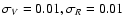 ), through to V=24, where
the error on the magnitude grows to
), through to V=24, where
the error on the magnitude grows to
 and
and
 .
At
,
where our detection limit for the star-finding algorithm falls, the increasing
photometric error makes it difficult to distinguish the MS from
possible contaminating field stars. The photometric errors and
detection limit given here represent an average value over the whole
image, but given the considerable density gradient of our target field
the detection limit is brighter in the innermost regions and results in
a lower photometric completeness there, as we explain in Sect. 4.
.
At
,
where our detection limit for the star-finding algorithm falls, the increasing
photometric error makes it difficult to distinguish the MS from
possible contaminating field stars. The photometric errors and
detection limit given here represent an average value over the whole
image, but given the considerable density gradient of our target field
the detection limit is brighter in the innermost regions and results in
a lower photometric completeness there, as we explain in Sect. 4.
Figure 3 shows, traced over the same CMD of
Fig. 2, the MS ridge line (solid curve) obtained by
applying a sigma-clipping method to the colour of the stars along the
MS, as explained in Sect. 4. The dashed line in the same figure
corresponds to the theoretical isochrone computed by Baraffe et al.
(1997) for a 10 Gyr old cluster with metallicity
![$[\rm M/H]=-1$](/articles/aa/full/2006/13/aa3775-05/img30.gif) and helium
content Y=0.25, as is appropriate for NGC 6218. The excellent fit
shown in Fig. 3 corresponds to a distance modulus
(m-M)V=14.23 and colour excess
E(B-V)=0.18, which compare
favourably with the recently obtained
(m-M)V=14.11 and colour
excess
E(B-V)=0.19 of Hargis & Sandquist (2004). The difference in
the distance modulus is small and fully consistent with the uncertainty
on our absolute photometric calibration, and it would vanish if we were
to take the distance modulus of Sato et al. (1989), namely
(m-M)V=14.25. We note here that the small discrepancy between the observed
MS ridge line and that predicted by theoretical models at the lowest
mass end (see Fig. 2) is a well known limitation of the
theory and most probably stems from the lack of a proper treatment of
the TiO molecular opacity, as extensively discussed in Baraffe et al.
(1998; see also Chabrier 2001). The discrepancy becomes progressively
smaller at longer wavelengths (Pulone et al. 2003, 1998).
In any case, as we explain in the following section, this small
uncertainty does not affect our conclusions on the mass distribution of
MS stars, because over the mass range covered by our observations
(0.3-0.8 )
an uncertainty of 0.1 mag in V translates to an uncertainty of 0.01
on the mass.
and helium
content Y=0.25, as is appropriate for NGC 6218. The excellent fit
shown in Fig. 3 corresponds to a distance modulus
(m-M)V=14.23 and colour excess
E(B-V)=0.18, which compare
favourably with the recently obtained
(m-M)V=14.11 and colour
excess
E(B-V)=0.19 of Hargis & Sandquist (2004). The difference in
the distance modulus is small and fully consistent with the uncertainty
on our absolute photometric calibration, and it would vanish if we were
to take the distance modulus of Sato et al. (1989), namely
(m-M)V=14.25. We note here that the small discrepancy between the observed
MS ridge line and that predicted by theoretical models at the lowest
mass end (see Fig. 2) is a well known limitation of the
theory and most probably stems from the lack of a proper treatment of
the TiO molecular opacity, as extensively discussed in Baraffe et al.
(1998; see also Chabrier 2001). The discrepancy becomes progressively
smaller at longer wavelengths (Pulone et al. 2003, 1998).
In any case, as we explain in the following section, this small
uncertainty does not affect our conclusions on the mass distribution of
MS stars, because over the mass range covered by our observations
(0.3-0.8 )
an uncertainty of 0.1 mag in V translates to an uncertainty of 0.01
on the mass.
![\begin{figure}
\par\includegraphics[width=7.8cm,clip]{3775fig2.ps}
\end{figure}](/articles/aa/full/2006/13/aa3775-05/img31.gif) |
Figure 2:
Colour-magnitude diagram of an area of
around the centre of NGC 6218. |
| Open with DEXTER | |
In order to study possible changes of the stellar population with
position in the cluster, we have defined four distinct concentric
regions over the area of our images. The innermost three are annuli
 wide, while the fourth region includes all objects farther
than
wide, while the fourth region includes all objects farther
than
 from the cluster centre through to the edge of the
frame. For simplicity, hereafter we refer to these regions as "centre''
and "rings'' 1 through 3. They contain, respectively, 1664, 4234, 5469
and 4648 objects. If instead of fixing the width of the rings we had
kept constant their area or the number of stars in them, the radial
extent of the annuli would have obviously changed. On the other hand,
we have verified that the progressive variation of the CMD and LF with
radius is largely insensitive to the exact size of the rings.
from the cluster centre through to the edge of the
frame. For simplicity, hereafter we refer to these regions as "centre''
and "rings'' 1 through 3. They contain, respectively, 1664, 4234, 5469
and 4648 objects. If instead of fixing the width of the rings we had
kept constant their area or the number of stars in them, the radial
extent of the annuli would have obviously changed. On the other hand,
we have verified that the progressive variation of the CMD and LF with
radius is largely insensitive to the exact size of the rings.
The CMDs of the individual regions are shown in the four panels of Fig. 4. The most notable differences among the four panels is the marked central concentration of the blue stragglers, which are totally absent in the third ring, and the remarkable lack of bright red giants in the cluster centre, where the red giant branch stops one to two magnitudes fainter than outside. These issues are discussed elsewhere (Sabbi et al. 2006).
![\begin{figure}
\par\includegraphics[width=7.8cm,clip]{3775fig3.ps}
\end{figure}](/articles/aa/full/2006/13/aa3775-05/img34.gif) |
Figure 3:
Main sequence ridge line of NGC 6218 (solid curve) compared
with the theoretical isochrones of Baraffe et al. (1997; dashed line)
for an age of 10 Gyr and metallicity
![$[\rm M/H]=-1.0$](/articles/aa/full/2006/13/aa3775-05/img3.gif) .
The best fit of the
isochrones to the observed MS requires a distance modulus
(m-M)V=14.23 and a colour excess
E(B-V)=0.18, consistent with the most
recent estimates of Hargis & Sandquist (2004). .
The best fit of the
isochrones to the observed MS requires a distance modulus
(m-M)V=14.23 and a colour excess
E(B-V)=0.18, consistent with the most
recent estimates of Hargis & Sandquist (2004). |
| Open with DEXTER | |
![\begin{figure}
\par\includegraphics[width=8.8cm,clip]{3775fig4.ps}
\end{figure}](/articles/aa/full/2006/13/aa3775-05/img35.gif) |
Figure 4: Individual CMDs of the four regions in which we have divided our NGC 6218 field. |
| Open with DEXTER | |
Also noteworthy in Fig. 4 is the rapid fading of the MS in
the cluster centre well before the onset of significant photometric
incompleteness. For instance, at
 the completeness is still
above 50% (see below) and the photometric error small (
the completeness is still
above 50% (see below) and the photometric error small (
 ,
,
 ), but the MS is already so sparse in
the CMD that it cannot be distinguished from field stars. This finding
is already a clear indication of the mass segregation that accompanies
the normal dynamical relaxation process of GCs. Due to the
equipartition of energy among stars, less massive objects tend to
increase their kinetic energy and move onto larger orbits that force
them outwards, away from the cluster centre, for most of their orbital
period.
), but the MS is already so sparse in
the CMD that it cannot be distinguished from field stars. This finding
is already a clear indication of the mass segregation that accompanies
the normal dynamical relaxation process of GCs. Due to the
equipartition of energy among stars, less massive objects tend to
increase their kinetic energy and move onto larger orbits that force
them outwards, away from the cluster centre, for most of their orbital
period.
In order to study this effect in a more quantitative way, we decided to derive the LF of MS stars at various locations inside the cluster. In particular, one has to pay special attention to photometric incompleteness, which acts differentially on the LF and affects more prominently the denser central regions and less or marginally the outer rings. Incompleteness is due to crowding and to saturated stars, whose bright halo can mask possible faint objects in their vicinity, both more likely to affect substantially the central regions (see Fig. 1). If ignored or corrected for in a uniform way across the whole image, by applying the same correction to all regions, these effects would bias the final results and mimic the presence of a high degree of mass segregation. For this reason, we conducted a series of artificial star experiments for the four individual regions (core and three rings), using the most appropriate local PSF for each.
The artificial star tests were run on the combined images, in both
bands. For each 0.5 mag bin we carried out 10 trials by adding
a fraction of 10% of the total number of objects (see Sect. 2).
These trials were followed by running the tasks daophot.daofind,
daophot.allstar and daophot.allframe, with the same
parameters used in the reduction of the scientific images so that we
could assess the fraction of objects recovered by the procedure and the
associated photometric errors. The resulting photometric completeness
is given in Table 2 for each region as a function of the V magnitude, along with the associated  uncertainty.
In order to derive the LF from the CMDs of Fig. 4, one
needs to separate true MS stars from field objects. The latter are
however not significant at the Galactic latitude of NGC 6218
(b=26.3), as Fig. 2 already shows. The Galaxy model of
Ratnatunga & Bahcall (1985) predicts about 17 field stars per arcmin2 towards the direction of NGC 6218 down to magnitude V=25,
with about half of them in the range
23 < V < 25. This would
correspond to 200 contaminating field stars in our FOV down to
V=25 of which 100 brighter than V=23. The CMD of
Fig. 2 has of order 2000 stars in the range  ,
before any correction for incompleteness, and there are approximately 14 000 stars brighter than that magnitude. Therefore, it would seem
perfectly unnecessary to take field star contamination into account.
,
before any correction for incompleteness, and there are approximately 14 000 stars brighter than that magnitude. Therefore, it would seem
perfectly unnecessary to take field star contamination into account.
On the other hand, since field star contamination affects more
prominently the lower end of the MS, which is most relevant to our
investigation, we decided to remove it at all magnitudes. To this aim,
we made use of the colour information in the CMD and applied the  clipping criterion described by De Marchi & Paresce (1995)
to identify the possible outliers. In practice, from the CMDs of
Fig. 4 we measured the LF of MS stars by counting the
objects in each 0.5 mag bin and within
clipping criterion described by De Marchi & Paresce (1995)
to identify the possible outliers. In practice, from the CMDs of
Fig. 4 we measured the LF of MS stars by counting the
objects in each 0.5 mag bin and within  5 times the colour
standard deviation around the MS ridge line and rejected the rest as
field objects. This procedure identifies about 350 field stars in the
magnitude range
18 < V < 23 and about 50 at fainter magnitudes.
When photometric incompleteness is taken into account, the resulting
number of contaminating stars is approximately a factor of four higher
than that predicted by the model of Bahcall & Soneira (1985). It is,
nevertheless, very small (
5 times the colour
standard deviation around the MS ridge line and rejected the rest as
field objects. This procedure identifies about 350 field stars in the
magnitude range
18 < V < 23 and about 50 at fainter magnitudes.
When photometric incompleteness is taken into account, the resulting
number of contaminating stars is approximately a factor of four higher
than that predicted by the model of Bahcall & Soneira (1985). It is,
nevertheless, very small ( )
when compared to the rest of
bona fide MS stars and, in each magnitude bin, it is smaller than the
statistical uncertainty associated with the counting process. In the
following, we will consider only bona fide MS stars as defined in this
way but, as will become clear in the rest of the paper, our conclusions
would remain unchanged had we decided to ignore field star
contamination and treat all stars as cluster members.
)
when compared to the rest of
bona fide MS stars and, in each magnitude bin, it is smaller than the
statistical uncertainty associated with the counting process. In the
following, we will consider only bona fide MS stars as defined in this
way but, as will become clear in the rest of the paper, our conclusions
would remain unchanged had we decided to ignore field star
contamination and treat all stars as cluster members.
Table 2:
Photometric completeness f and the associated
uncertainty, both in percent, in the four regions in which
we have divided our NGC 6218 field.
Table 3: Average main sequence fiducial points and colour width.
The average MS fiducial points are drawn as a solid line in
Fig. 3 and are listed in Table 3 together with the colour
width of the MS (
 ). Table 4 gives the four LFs,
before and after correction for photometric incompleteness, and the
corresponding rms errors coming from the Poisson statistics of the
counting process (only for the LF corrected for incompleteness). All
values have been rounded off to the nearest integer. The data are also
shown graphically in Fig. 5, where the squares give the LF
of the four regions, with the centre at the bottom and the outermost
ring at the top. As Fig. 5 shows, all four LFs are
remarkably flat, with the two central rings displaying a sensible drop
in the number counts at low masses for MV>6.5 (see upper axis). This
result is very robust, because only data-points with an associated
photometric completeness in excess of 50% are shown in
Fig. 5.
). Table 4 gives the four LFs,
before and after correction for photometric incompleteness, and the
corresponding rms errors coming from the Poisson statistics of the
counting process (only for the LF corrected for incompleteness). All
values have been rounded off to the nearest integer. The data are also
shown graphically in Fig. 5, where the squares give the LF
of the four regions, with the centre at the bottom and the outermost
ring at the top. As Fig. 5 shows, all four LFs are
remarkably flat, with the two central rings displaying a sensible drop
in the number counts at low masses for MV>6.5 (see upper axis). This
result is very robust, because only data-points with an associated
photometric completeness in excess of 50% are shown in
Fig. 5.
A flat or dropping LF (i.e. one that drops with increasing magnitude)
is not unusual in the core of GCs, where the effects of mass
segregation are strongest. Such is, for instance, the case of 47 Tuc
(Paresce et al. 1995), NGC 6397 (King et al. 1995) and NGC 7078 (De Marchi & Paresce 1996; Pasquali et al.
2004). What is most unusual, however, is a flat LF near the cluster's
half-mass radius, where a sample of 12 GCs studied by us (Paresce & De Marchi 2000) has revealed a remarkably consistent behaviour with a LF
increasing monotonically from the TO luminosity to
 .
For
NGC 6218 this is clearly not the case, since the top LF in
Fig. 5 samples the stellar population from a radius of
through to
.
For
NGC 6218 this is clearly not the case, since the top LF in
Fig. 5 samples the stellar population from a radius of
through to
 ,
with an equivalent radius of
,
with an equivalent radius of
 ,
comfortably reaching the nominal cluster's half-mass
radius at
(Harris 1996). While near the half-mass
radius of NGC 6397 the number of stars per unit magnitude grows by a
factor of about four from the TO luminosity to
(King
et al. 1998), this number remains practically constant for NGC 6218.
So far, the only GCs known to have a dropping or flat LF near the
half-mass radius are NGC 6712 (De Marchi et al. 1999) and Pal 5 (Koch
et al. 2004) and both are expected to have undergone a strong dynamical
interaction with the Galactic tidal field, at variance with the
expectations for NGC 6218.
,
comfortably reaching the nominal cluster's half-mass
radius at
(Harris 1996). While near the half-mass
radius of NGC 6397 the number of stars per unit magnitude grows by a
factor of about four from the TO luminosity to
(King
et al. 1998), this number remains practically constant for NGC 6218.
So far, the only GCs known to have a dropping or flat LF near the
half-mass radius are NGC 6712 (De Marchi et al. 1999) and Pal 5 (Koch
et al. 2004) and both are expected to have undergone a strong dynamical
interaction with the Galactic tidal field, at variance with the
expectations for NGC 6218.
Table 4:
Luminosity functions measured in each of the four regions in
which we have divided our NGC 6218 field. For each region, the table
gives as a function of the V-band magnitude the number
of stars per half-magnitude bin before ( )
and after (N)
completeness correction and the uncertainty on N.
)
and after (N)
completeness correction and the uncertainty on N.
The LFs shown in Fig. 5 can in principle be converted into MFs, since we have shown in Fig. 3 that the cluster MS is
well fitted, within the theoretical and observational errors, by the
available theoretical models of low-mass stars (Baraffe et al. 1997).
We can, thus, reasonably expect these models to provide a reliable
relationship between luminosity and mass. On the other hand, in order
to keep observational errors clearly separated from theoretical
uncertainties, we prefer to fold a model MF through the derivative of
the mass-luminosity (M-L) relationship and compare the resulting
model LF with the observations. The solid lines in Fig. 5
are the theoretical LFs obtained by multiplying a simple power-law MF
of the type
 by the derivative of the M-L relationship. Although the MF of GCs is more complex than a simple
power-law, particularly at low masses (Paresce & De Marchi 2000), over
the narrow mass range (0.4-0.8 )
spanned by these
observations this simplifying assumption is valid (De Marchi et al. 2005).
by the derivative of the M-L relationship. Although the MF of GCs is more complex than a simple
power-law, particularly at low masses (Paresce & De Marchi 2000), over
the narrow mass range (0.4-0.8 )
spanned by these
observations this simplifying assumption is valid (De Marchi et al. 2005).
With the adopted M-L relationship, a distance modulus
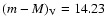 and colour excess
E(B-V)=0.18 (see Sect. 3), V=18.8corresponds to the TO mass of 0.8 .
The lowest mass reached
in each region is indicated in Fig. 5 and varies from 0.6
in the core to 0.4
in ring 3. The
power-law MF indices that best fit the data are indicated in the figure
caption and range from
and colour excess
E(B-V)=0.18 (see Sect. 3), V=18.8corresponds to the TO mass of 0.8 .
The lowest mass reached
in each region is indicated in Fig. 5 and varies from 0.6
in the core to 0.4
in ring 3. The
power-law MF indices that best fit the data are indicated in the figure
caption and range from
 in the core to
 in
the outermost ring near the half-mass radius. The fact that these
values are all positive implies that the number of stars is decreasing
with mass. With the notation used here, the canonical Salpeter IMF would have
in
the outermost ring near the half-mass radius. The fact that these
values are all positive implies that the number of stars is decreasing
with mass. With the notation used here, the canonical Salpeter IMF would have
 .
For comparison, over the same mass range
spanned by the MF of ring 3, the power-law index that best fits the MF of NGC 6397 is
.
For comparison, over the same mass range
spanned by the MF of ring 3, the power-law index that best fits the MF of NGC 6397 is
 and that of the other 11 GCs in
the sample studied by Paresce & De Marchi (2000) is of the same order.
It is, therefore, clear that NGC 6218 is surprisingly devoid of
low-mass stars, at least out to its half-mass radius.
and that of the other 11 GCs in
the sample studied by Paresce & De Marchi (2000) is of the same order.
It is, therefore, clear that NGC 6218 is surprisingly devoid of
low-mass stars, at least out to its half-mass radius.
![\begin{figure}
\par\includegraphics[width=8cm,clip]{3775fig5.ps}
\end{figure}](/articles/aa/full/2006/13/aa3775-05/img54.gif) |
Figure 5:
The squares are the LF of the four regions in NGC 6218, after
correction for photometric incompleteness, as given in Table 4. The
model LFs that best fit the data are shown as solid lines. The index of
their corresponding power-law MF is, from bottom to top,
 and 0.1. A positive index means that the number of stars
decreases with mass. The MS stellar mass corresponding to the faintest
data point of each LF is indicated, in units of .
and 0.1. A positive index means that the number of stars
decreases with mass. The MS stellar mass corresponding to the faintest
data point of each LF is indicated, in units of . |
| Open with DEXTER | |
 ,
and by four
structural parameters describing, respectively, the scale radius (
,
and by four
structural parameters describing, respectively, the scale radius ( ), the scale velocity (
 ), the central value of the
dimensionless gravitational potential
), the central value of the
dimensionless gravitational potential  ,
and the anisotropy
radius (
,
and the anisotropy
radius ( ).
).
From the parameter space defined in this way, we selected those models
that simultaneously fit both the observed surface brightness profile
(SBP) and the central value of the velocity dispersion as measured,
respectively, by Trager et al. (1995) and by Pryor et al. (1988).
However, while forcing a good fit to these observables constrains the
values of ,
,
,
and ,
the
MF can still take on a variety of shapes. To break this degeneracy, we
imposed the additional condition that the model LF agrees with that
observed at all available locations simultaneously. This, in turn, sets
very stringent constraints on the PGMF, i.e. on the MF of the cluster
as a whole.
For practical purposes, the model PGMF has been divided into sixteen different mass classes, covering main sequence stars, white dwarfs and heavy remnants, precisely as described in Pulone et al. (1999). We ran a large number of trials looking for a suitable shape of the PGMF such that the local MFs implied by mass segregation would locally fit the observations. As explained in the previous section, in order to keep observational errors and theoretical uncertainties separate, we converted the model MFs into to LFs, using the same M-L relation, distance modulus and colour excess of Fig. 5, and compared those to the observations.
![\begin{figure}
\par\includegraphics[width=8cm,clip]{3775fig6.ps}
\end{figure}](/articles/aa/full/2006/13/aa3775-05/img60.gif) |
Figure 6:
Same LFs as those of Fig. 5, but here the solid
lines show the LFs predicted by our multi-mass Michie-King model at
various radii inside the cluster, starting from the same PGMF with
index
.
The expected radial variation of the LF is fully
consistent with the observations. |
| Open with DEXTER | |
The set of model LFs that best fits all available observations is shown
in Fig. 6 and is drawn from the same PGMF with index
for stars less massive than 0.8 .
Figure 7 illustrates the remarkably good fit to the SBP,
whereas the values of the best fitting structural parameters are given
in Table 5, where they can be compared with those in the literature.
The agreement is excellent, apart from a small difference in the value
of the tidal radius which is, admittedly, not seriously constrained by
our data. We note here that we can directly compare the observed SBP
with our model since the solid line in Fig. 7 corresponds
to stars of 0.8 ,
which are those contributing most of
the cluster's light. As one should expect, stars in different mass
classes have different projected radial distributions, with the
relative density at any location governed by the relaxation process.
![\begin{figure}
\par\includegraphics[width=7.6cm,clip]{3775fig7.ps}
\end{figure}](/articles/aa/full/2006/13/aa3775-05/img61.gif) |
Figure 7: The surface brightness profile of NGC 6218 (crosses, from Trager et al. 1995) is well reproduced by our dynamical model (solid line). The observations are normalised to the central value of the best fitting profile (dashed line) as given by Trager et al. (1995). |
| Open with DEXTER | |
As for the shape of the PGMF,
implies that it is rather
flat or even decreasing with mass. This may have already been inferred
by the flat shape of the MF measured near the half-mass radius  ,
as it is known that the latter is a good approximation to the
cluster's PGMF (Richer et al. 1991; De Marchi et al. 1995).
Nevertheless, it is comforting to see that a PGMF of this type is
consistent with the shape of the MF observed elsewhere in the cluster,
suggesting that the radial change of the MF with radius is the result
of the relaxation process and that, therefore, the cluster is in
dynamical equilibrium, at least out to the half-mass radius.
,
as it is known that the latter is a good approximation to the
cluster's PGMF (Richer et al. 1991; De Marchi et al. 1995).
Nevertheless, it is comforting to see that a PGMF of this type is
consistent with the shape of the MF observed elsewhere in the cluster,
suggesting that the radial change of the MF with radius is the result
of the relaxation process and that, therefore, the cluster is in
dynamical equilibrium, at least out to the half-mass radius.
This also allows us to set some constraints on the shape of the MF for
stars above the TO mass, namely those that have now evolved into
degenerate objects (white dwarfs, neutron stars or even black holes).
Although not as tightly constrained as for MS stars, the power-law
index
of stars more massive than the TO is much closer to the
Salpeter value, with  giving the best fit. This parameter
determines the fraction of heavy remnants in the cluster, which we find
to be of order
giving the best fit. This parameter
determines the fraction of heavy remnants in the cluster, which we find
to be of order  ,
and affects the overall distribution of the
stars in all other classes of mass, to which the SBP is rather
sensitive. We find that values of
larger or smaller than -2give a progressively worse fit to the SBP, which becomes unacceptable
for
,
and affects the overall distribution of the
stars in all other classes of mass, to which the SBP is rather
sensitive. We find that values of
larger or smaller than -2give a progressively worse fit to the SBP, which becomes unacceptable
for
 or
or
 .
.
The central velocity dispersion predicted by our model (see Table 5)
agrees well with the observed value reported by Pryor & Meylan (1993)
and implies a total cluster mass of
 ,
also in line with that of
,
also in line with that of
 derived by
those authors. The mass to light (M/L) ratio that we obtain depends
on the assumed total luminosity of the cluster, which appears to be
rather uncertain in the literature. The total V-band apparent
magnitude varies from V=6.05 of Peterson & Reed (1987; also adopted
by Djorgovski 1993) to V=6.77 of Webbink (1985). In his recent
catalogue, Harris (1996; revision 2003) gives V=6.70, corresponding
to a total absolute magnitude
MV = -7.31 and a total
luminosity of
derived by
those authors. The mass to light (M/L) ratio that we obtain depends
on the assumed total luminosity of the cluster, which appears to be
rather uncertain in the literature. The total V-band apparent
magnitude varies from V=6.05 of Peterson & Reed (1987; also adopted
by Djorgovski 1993) to V=6.77 of Webbink (1985). In his recent
catalogue, Harris (1996; revision 2003) gives V=6.70, corresponding
to a total absolute magnitude
MV = -7.31 and a total
luminosity of

 .
With the latter
value, we obtain
M/LV=1.7 for the whole cluster and
M/LV=1.6 inside the core radius.
.
With the latter
value, we obtain
M/LV=1.7 for the whole cluster and
M/LV=1.6 inside the core radius.
Table 5: Cluster structural parameters for NGC 6218.
What does a flat PGMF tell us about NGC 6218? Using a sample of 12 halo GCs for which deep HST observations are available, Paresce & De Marchi (2000) showed that their PGMF must directly reflect the
properties of the IMF. This conclusion is based on the observation that
those clusters have very different properties (total mass, metallicity,
concentration and space motion parameters) but they show, in practice,
the same or very similar PGMF. This would be hard to justify if the
clusters were initially born with very different IMFs. The underlying
common IMF, exemplified by that of NGC 6397, is best represented by a
power-law distribution that tapers off below 0.3
(see
Paresce & De Marchi 2000; and De Marchi et al. 2005, for details).
The PGMF of NGC 6218 clearly does not match that of the 12 objects in
the sample of Paresce & De Marchi (2000), because it is remarkably
flat. However, at least two other cases of flat or even dropping PGMF
have been reported, namely those of NGC 6712 (De Marchi et al. 1999)
and Pal 5 (Koch et al. 2004), with NGC 6712 revealing an even
stronger deficit of low-mass stars than NGC 6218. On the other hand,
there are good observational reasons to believe that both NGC 6712 and
Pal 5 have suffered severe tidal disruption that has considerably
altered their original distribution of stellar masses. For instance,
Pal 5 has well defined tidal tails extending over  across
the sky (Odenkirchen et al. 2001). But, more generally, the present
total mass and space motion parameters of these clusters imply that
they have some of the highest destruction rates in the whole Galactic
GC system. Gnedin & Ostriker (1997) predict a remaining lifetime as
low as 0.3 Gyr for NGC 6712 and 1 Gyr for Pal 5,
whereas Dinescu et al. (1999) give a time to disruption of 3.9 Gyr for NGC 6712 and just 0.1 Gyr for Pal 5,
respectively. Although not in agreement with one another, these sets of
values are far lower than the average time to disruption, which for
both authors is of order 12 Gyr (and thus comparable with the typical
GC age).
across
the sky (Odenkirchen et al. 2001). But, more generally, the present
total mass and space motion parameters of these clusters imply that
they have some of the highest destruction rates in the whole Galactic
GC system. Gnedin & Ostriker (1997) predict a remaining lifetime as
low as 0.3 Gyr for NGC 6712 and 1 Gyr for Pal 5,
whereas Dinescu et al. (1999) give a time to disruption of 3.9 Gyr for NGC 6712 and just 0.1 Gyr for Pal 5,
respectively. Although not in agreement with one another, these sets of
values are far lower than the average time to disruption, which for
both authors is of order 12 Gyr (and thus comparable with the typical
GC age).
Quite surprisingly, however, the total mass and space motion parameters
of NGC 6218 do not seem to put this cluster in any imminent danger. In
fact, the estimated time to disruption for this object varies from 23.5 Gyr (Gnedin & Ostriker 1997) to 33 Gyr (Dinescu
et al. 1999). Similarly, collisional N-body simulations of a cluster
with the properties of NGC 6218 moving in an external tidal field
produce a total lifetime for this object of  Gyr (H.
Baumgardt, private comm.; see Baumgardt & Makino 2003 for model
details). Assuming a GC age of
Gyr (H.
Baumgardt, private comm.; see Baumgardt & Makino 2003 for model
details). Assuming a GC age of  Gyr (Krauss & Chaboyer
2003), this implies
Gyr (Krauss & Chaboyer
2003), this implies
 Gyr for NGC 6218. In
other words, none of these models implies a dynamically troubled past
for NGC 6218, leaving in principle open the possibility that it was
born with a rather flat IMF, at least in the mass range covered by our
observations. While such a hypothesis cannot a priori be
excluded, this would be the first case known.
Gyr for NGC 6218. In
other words, none of these models implies a dynamically troubled past
for NGC 6218, leaving in principle open the possibility that it was
born with a rather flat IMF, at least in the mass range covered by our
observations. While such a hypothesis cannot a priori be
excluded, this would be the first case known.
On the other hand, models of the dynamical interaction of GCs with the Galactic tidal field are, unfortunately, still subject to large uncertainties. As both Gnedin & Ostriker (1997) and Dinescu et al. (1999) point out, different assumptions on the initial conditions (cluster orbits) and on the Galactic potential can result in rather different destruction rates for the same cluster. While these models are useful to address the replenishment of the halo over time from the disruption of individual clusters, and therefore helpful to understand the global properties of the GC system and its evolution, they may be still too crude to precisely describe the past history of individual clusters.
We, however, believe that the apparent discrepancy between the
predicted value of
and the shape of the PGMF of NGC 6218
is simply due to the wrong assumption as to the cluster orbit. In fact,
the space motion parameters used by the authors above for NGC 6218 are not
consistent with the latest determination of its absolute proper motion
based on the Hipparcos reference system. The proper motion measured by
Brosche et al. (1991), combined with the radial velocity measurements
of Pryor & Meylan (1993), allowed Dauphole et al. (1996) to put some
constraints on the space motion parameters of this cluster. Their
findings were confirmed by an independent analysis of the orbit, based
on improved absolute proper motions (Scholz et al. 1996), which
indicated that NGC 6218 should have a short orbital period (0.17 Gyr) but also that it never ventures closer than 3 kpc
from the Galactic centre, with less than 15% of its orbit lying
within 1 kpc of the Galactic plane. However, a more recent study of
the orbit of NGC 6218, based on the new Hipparcos reference system
(ESA 1997), has led Odenkirchen et al. (1997) to the conclusion that
NGC 6218 has a highly irregular motion. In particular, they find that
the low value of the cluster's axial angular momentum forces it to pass
the Galactic centre at short distance (
 kpc) and to
get into strong interaction with the Galactic bulge, since the bulge
destruction rate scales with the fourth power of
kpc) and to
get into strong interaction with the Galactic bulge, since the bulge
destruction rate scales with the fourth power of  (Dinescu
et al. 1999).
(Dinescu
et al. 1999).
With an orbit of this type, the total lifetime of NGC 6218 predicted
by the models of Baumgardt & Makino (2003; H. Baumgardt priv. comm.)
would decrease from 29 Gyr to 17 Gyr, thus implying a time until
disruption of only
 Gyr, assuming a typical GC age of 12.5 Gyr as above (Krauss & Chaboyer 2003). Although
not as small as that of NGC 6712 or Pal 5, this value of places NGC 6218 among the clusters at higher risk of disruption and
suggests that a considerable fraction of its original stellar
population should have been stripped from the cluster.
Gyr, assuming a typical GC age of 12.5 Gyr as above (Krauss & Chaboyer 2003). Although
not as small as that of NGC 6712 or Pal 5, this value of places NGC 6218 among the clusters at higher risk of disruption and
suggests that a considerable fraction of its original stellar
population should have been stripped from the cluster.
We can estimate the amount of mass lost by NGC 6218 in the hypothesis
mentioned above that all GCs were born with a very similar IMF (Paresce
& De Marchi 2000). As for the latter, we use the tapered power-law
proposed by De Marchi et al. (2005) and find that the present total
mass due to MS stars is about one fifth of the original
 .
This value is in full agreement with the revised
calculations of H. Baumgardt (priv. comm.) suggesting an initial mass
of
.
This value is in full agreement with the revised
calculations of H. Baumgardt (priv. comm.) suggesting an initial mass
of
 .
A natural question to pose is when this
major mass loss process took place.
.
A natural question to pose is when this
major mass loss process took place.
If the cluster is in thermo-dynamical equilibrium, one only needs
to look at the half-mass relaxation time in order to answer this
question. The data are compatible with this hypothesis, since our model
imposes the condition of energy equipartition and Fig. 6 and
Table 5 show that this is consistent with the radial variation of the
MF and the cluster's structural parameters. Under this assumption, the half-mass
relaxation time suggested by our models is
 Gyr. This value is slightly lower than the
 Gyr given by Djorgovski (1993) and
 Gyr of
Gnedin & Ostriker (1997), although still compatible with them, because
the MF assumed by these authors is very steep at the low mass end,
contrary to what we find, thus resulting in a much larger number of
objects in the cluster. In any case, it seems possible to exclude that
a major mass loss episode happened in the course of the past 1 Gyr or
so, since in that case the cluster should have not yet reached a
condition of equilibrium. The fact that tidal tails are very tenuous
around NGC 6218 (if at all present; see Lehmann & Scholz 1997) gives
support to this scenario. Mass loss must, therefore, have happened
either long ago or continuously, over the cluster lifetime, at a low
rate of about
Gyr of
Gnedin & Ostriker (1997), although still compatible with them, because
the MF assumed by these authors is very steep at the low mass end,
contrary to what we find, thus resulting in a much larger number of
objects in the cluster. In any case, it seems possible to exclude that
a major mass loss episode happened in the course of the past 1 Gyr or
so, since in that case the cluster should have not yet reached a
condition of equilibrium. The fact that tidal tails are very tenuous
around NGC 6218 (if at all present; see Lehmann & Scholz 1997) gives
support to this scenario. Mass loss must, therefore, have happened
either long ago or continuously, over the cluster lifetime, at a low
rate of about
 per orbit.
The present data do not allow us to explore the past dynamical history of NGC 6218 in more detail. Nevertheless, our results show the importance of feeding models of GC distruption with reliable cluster orbits, since the strength and extent of the interaction between the Galaxy and GCs can vary dramatically with the orbit. However, it also depends on the gravitational potential of the Galaxy, and particularly on that of the bulge, thereby making it crucial for models of this type to rely on a solid observational description of the structure of the Galaxy and of its components (thin/thick disc, bulge, halo), which is presently lacking. This information should become available in the near future with the advent of missions such as SIM and Gaia. But already now, if the cluster orbit is reasonably well understood, observations of the cluster PGMF can set meaningful constraints on the mass distribution in the Galaxy. Indeed, the PGMF is a more reliable indicator of the past dynamical history of a cluster than, for instance, its present location and space motion parameters or even the presence and extent of its tidal tails. The position and velocity of a cluster are instantaneous quantities and can vary largely in time. Tidal tails are made up of unbound stars and, as such, are short lived and can only probe the immediate past of a cluster. The PGMF, on the other hand, reflects the integrated effect of the interaction with the Galaxy throughout the whole life of the cluster and provides an indication of the amount of mass lost to the Galaxy. By measuring the PGMF of a sizeable number of clusters, including those with chaotic or anyhow irregular orbits, it should be possible to set meaningful constraints on the form of the Galactic potential well before the availability of astrometric data from interferometric space observatories.
Acknowledgements
It is a pleasure to thank Dana Dinescu and Holger Baumgardt for very useful discussions and the latter also for providing us with the results of his simulations ahead of publication.