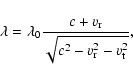
 |
(1) |
A&A 446, 747-771 (2006)
DOI: 10.1051/0004-6361:20053818
E. W. Greisen1 - M. R. Calabretta2 - F. G. Valdes3 - S. L. Allen4
1 - National Radio Astronomy Observatory,
PO Box O,
Socorro, NM 87801-0387, USA
2 - Australia Telescope National Facility,
PO Box 76,
Epping, NSW 1710, Australia
3 - National Optical Astronomy Observatories,
PO Box 26732,
Tucson, AZ 85719, USA
4 - UCO/Lick Observatory,
University of California,
Santa Cruz, CA 95064, USA
Received 12 July 2005 / Accepted 5 October 2005
Abstract
Greisen & Calabretta (2002, A&A, 395, 1061) describe a generalized
method for specifying the coordinates of FITS data samples. Following
that general method, Calabretta & Greisen (2002, A&A, 395, 1077) describe
detailed conventions for defining celestial coordinates as they are
projected onto a two-dimensional plane. The present paper extends the
discussion to the spectral coordinates of wavelength, frequency, and
velocity. World coordinate functions are defined for spectral axes
sampled linearly in wavelength, frequency, or velocity, linearly in
the logarithm of wavelength or frequency, as projected by ideal
dispersing elements, and as specified by a lookup table.
Key words: methods: data analysis - techniques: image processing - techniques: radial velocities - techniques: spectroscopic - astronomical data bases: miscellaneous
The present paper is the third in a series of papers that establishes methods by which information about the physical coordinates of FITS data may be transferred along with the binary image, random groups, and table data. In "Paper I'' Greisen & Calabretta (2002) describe a revised method for transferring coordinate information in the FITS header and outline some rules governing the values assigned to the new standard header keywords. In "Paper II'' Calabretta & Greisen (2002) specify the conventions necessary to define celestial coordinates in a two-dimensional projection of the sky. This paper defines the parameters and conventions needed to specify spectral information including frequency, wavelength, and velocity. In addition to these basic conversions, a world coordinate function is defined to describe ideal optical dispersers of several common types. Several concepts that were suggested by spectroscopic issues are generalized to apply to all types of coordinate axes. These are a generalized description of non-linear algorithms, the -LOG and -TAB non-linear algorithms, and an axis-naming keyword. In "Paper IV'', Calabretta et al. (2005) specify methods to describe the distortions inherent in the image coordinate systems of real astronomical data.
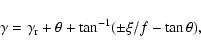
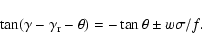
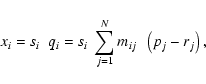
Paper I describes the computation of the world or physical coordinates
as a multi-step process. The vector of pixel offsets from the
reference point is multiplied by a linear transformation matrix and
then scaled to physical units. Mathematically, this is given by
The final step in the computation is the conversion of these linear relative coordinates into the actual physical coordinates. The conventions to be applied to spectral axes, i.e. to frequency, wavelength, and velocity axes, are described in this paper.
![\begin{figure}
\par {\includegraphics[width=18cm]{3818fig1.eps} }
\end{figure}](/articles/aa/full/2006/05/aa3818-05/img27.gif) |
Figure 1:
Conventional velocities as a function of true radial
velocity for selected values of the transverse velocity. The apparent
radial velocity  is plotted in the left panel, the radio
velocity V/c is plotted in the center panel, and the optical
velocity Z/c is plotted in the right panel. Note that, at a
transverse velocity of 0.9 c, the red shift z always exceeds 1.
Note that each family of curves intersects the axis of zero
velocity measure at the same values of
is plotted in the left panel, the radio
velocity V/c is plotted in the center panel, and the optical
velocity Z/c is plotted in the right panel. Note that, at a
transverse velocity of 0.9 c, the red shift z always exceeds 1.
Note that each family of curves intersects the axis of zero
velocity measure at the same values of
 because the
redshift is zero for these combinations of
and
because the
redshift is zero for these combinations of
and
 .
Thus, regardless of the value of
,
for any
given redshift the velocity measures agree on whether the object
appears to be receding or approaching. However, the object may
appear to be receding at high speed even when it is actually
approaching at high speed, though the converse is never true. At
transverse velocities of .
Thus, regardless of the value of
,
for any
given redshift the velocity measures agree on whether the object
appears to be receding or approaching. However, the object may
appear to be receding at high speed even when it is actually
approaching at high speed, though the converse is never true. At
transverse velocities of
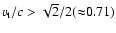 all of the velocity measures are positive (receding) regardless
of whether the object is actually receding or approaching.
Furthermore, for
all of the velocity measures are positive (receding) regardless
of whether the object is actually receding or approaching.
Furthermore, for
 below -0.5, the faster the object
approaches, the smaller the transverse velocity required to make it
appear to be receding!
below -0.5, the faster the object
approaches, the smaller the transverse velocity required to make it
appear to be receding! |
| Open with DEXTER | |
At this stage in the discussion, we consider the spectral world coordinate at the reference point on all other axes. This covers the relatively simple case in which the spectral world coordinate is not dependent on the other world coordinates. Methods to describe deviations from this assumption due to the choice of spectral reference system are discussed in Sect. 7, while instrumental distortions are discussed briefly in Sect. 9 and, in more detail, in Paper IV.
Spectral coordinates are commonly given in units of frequency,
wavelength, velocity, and other parameters proportional to these
three. The coordinate types discussed here are then frequency,
wavelength, and "apparent radial velocity'' denoted by the
symbols  ,
,
 ,
and
,
and  .
There are also three
conventional velocities frequently used in astronomy. These are
the so-called "radio'' velocity, "optical'' velocity, and redshift,
denoted here by V, Z, and z and given by
.
There are also three
conventional velocities frequently used in astronomy. These are
the so-called "radio'' velocity, "optical'' velocity, and redshift,
denoted here by V, Z, and z and given by
 ,
,
 and z = Z / c.
The velocities are defined so that an object receding from the
observer has a positive velocity. We assume throughout that each
image has at most one spectral coordinate axis; a similar limit on
celestial coordinates was assumed in Paper II.
and z = Z / c.
The velocities are defined so that an object receding from the
observer has a positive velocity. We assume throughout that each
image has at most one spectral coordinate axis; a similar limit on
celestial coordinates was assumed in Paper II.
As discussed by Lindegren & Dravins (2003), the apparent radial velocity to be described here is itself a conventional velocity. The shift of a spectral line from its rest frequency is caused by a variety of effects, not just the Doppler shift due to a radial motion. The time dilation of an object moving with respect to the observer causes a spectral shift, even if that motion is entirely transverse. Gravitational fields at the radiating object and along the line of sight to the observer will shift the observed frequency. Furthermore, the apparent spectroscopic velocity may be produced at a peculiar point in the object, e.g. upwelling convective cells, rather than at the center of mass of the object. It may also be affected by absorption in intervening material and in particular by the cosmic redshift. We will use the term "apparent radial velocity'' here simply to refer to that pseudo-physical velocity described by the equations presented here. The apparent radial velocity then is a sum of all spectroscopic effects presented as if they were solely a radial velocity. While this may be sufficiently accurate for many uses, observers wishing to achieve very high accuracies should consult Lindegren & Dravins, and references therein, closely.
The effect of a transverse velocity deserves a little more discussion.
As given by Lang (1974),
is the true radial velocity,
is the
true transverse velocity, c is the speed of light, and miscellaneous
effects such as gravitational redshifts are assumed negligible. Even
at ordinary astronomical velocities, this has a measurable effect; a
transverse velocity of 100 km s-1 produces an apparent velocity
of 17 m s-1. The effects of transverse velocities such as might
be found in astronomical jet sources on the apparent radial, radio,
and optical conventional velocities are illustrated in
Fig. 1. When the transverse velocity is zero,
radio velocity ranges from  to +c, optical velocity from
-c to
to +c, optical velocity from
-c to  ,
and apparent radial velocity is
when
,
and apparent radial velocity is
when
 .
Because of all of the other processes that shift the
observed frequency, it is inappropriate to propose keywords to
describe true velocities at this time. Additional discussion of
this matter is deferred to Appendix A.
.
Because of all of the other processes that shift the
observed frequency, it is inappropriate to propose keywords to
describe true velocities at this time. Additional discussion of
this matter is deferred to Appendix A.
For the purposes of this section and the next, we consider those
spectral axes at a single celestial coordinate that are linearly
sampled in wavelength, frequency, or apparent radial velocity.
The radio and optical "velocities'' are directly proportional to
frequency and wavelength, respectively, and thus do not constitute
additional cases for the type of sampling. Frequency and wavelength
axes may also be regularly sampled in their logarithm. Wavelengths
are sometimes given "in air'' rather than in vacuum and denoted
here by
 .
This non-linear distinction is discussed in
Sect. 4. Frequency may also be described in energy
(
.
This non-linear distinction is discussed in
Sect. 4. Frequency may also be described in energy
( )
units and in Kaysers ("wave number''
)
units and in Kaysers ("wave number''
 )
units.
)
units.
Following the convention of Papers I and II, the first four
characters of CTYPE
 specify
![[*]](/icons/foot_motif.gif) the
coordinate type, the fifth character is `-' and the next three
characters specify a predefined algorithm for computing the world
coordinates from intermediate physical coordinates. When k is
the spectral axis, the first four characters shall be one of the codes
shown in Table 1. The mathematical symbols we will use
for the codes and their default units are also listed. Units are
specified with the CUNIT
keyword. Standard values for unit
strings are defined in Paper I. The IAU-standard prefixes for
scaling the units are described in Paper I and should be used with all
coordinate types, except that the dimensionless ones are not scaled.
the
coordinate type, the fifth character is `-' and the next three
characters specify a predefined algorithm for computing the world
coordinates from intermediate physical coordinates. When k is
the spectral axis, the first four characters shall be one of the codes
shown in Table 1. The mathematical symbols we will use
for the codes and their default units are also listed. Units are
specified with the CUNIT
keyword. Standard values for unit
strings are defined in Paper I. The IAU-standard prefixes for
scaling the units are described in Paper I and should be used with all
coordinate types, except that the dimensionless ones are not scaled.
Table 1:
Spectral coordinate type codes, (characters 1-4 of
CTYPE
).
The non-linear algorithm in use is specified by the final
3 characters of CTYPE
.
In spectral codes, the first of the
three characters specifies the physical parameter type in which the
data are regularly sampled, the second character is 2, and
the third character specifies the physical parameter type in which the
coordinate is expressed. Non-linear algorithm codes, the last
four to be introduced later, are summarized in Table 2.
When the algorithm in use is linear, the last four characters of
CTYPE
shall be blank.
The original FITS paper by Wells et al. (1981) contained a
number of suggestions for the values of CTYPE i. Those suggestions
are to be superseded by the conventions of this paper and of
Papers I and II.
Table 2:
Non-linear algorithm codes, (characters 6-8 of
CTYPE
).
The relationships between the basic physical quantities
 ,
and
are shown in Table 3. The
symbols
,
and
are shown in Table 3. The
symbols  and
and  are the rest wavelength and frequency,
respectively, of the spectral line used to associate velocity with
observed wavelength and frequency. The relationships between the
derived quantities and the basic quantities with which they are
associated are shown in Table 4. Derivatives are
included in both tables since they will be needed in the coordinate
computation.
are the rest wavelength and frequency,
respectively, of the spectral line used to associate velocity with
observed wavelength and frequency. The relationships between the
derived quantities and the basic quantities with which they are
associated are shown in Table 4. Derivatives are
included in both tables since they will be needed in the coordinate
computation.
This section describes the computation of coordinates that are
sampled linearly or logarithmically in a coordinate of similar type,
and of coordinates that are sampled linearly in a coordinate of
different type. The intermediate world coordinate for spectral axis
k, given by Eq. (1), will be denoted, for convenience,
by
 ,
which is defined by the
keyword CRVAL
.
,
which is defined by the
keyword CRVAL
.
Linear coordinates are represented in CTYPE
by characters 1-4
containing any code in column one of Table 1 and
characters 5-8 blank. The world coordinate value for spectral axis
k is computed with the above definitions and
Eq. (1) as
Data are often sampled in logarithmic increments in one or more coordinates. For example, spectra are sometimes sampled in logarithmic increments of wavelength or frequency. With this type of sampling, the source motion, expressed as V, Z, or z, shifts the "pixel'' coordinates of spectral features by the same amount over the whole image. This allows relative velocities between spectra to be determined using cross-correlation methods in the pixel arrays.
For logarithmic axes, the last four characters shall be `-LOG'. While there are only three logarithmic coordinates
commonly used in spectroscopy, namely FREQ-LOG, WAVE-LOG
and AWAV-LOG, it would be unwise to forbid any coordinate
type with the -LOG non-linear algorithm. Many such combinations
may have little physical meaning or be intractable mathematically, but
these are simply reasons to be cautious when using -LOG. This
algorithm is evaluated simply
 so that Eq. (4) is satisfied to
first order at points near the reference point. Thus
so that Eq. (4) is satisfied to
first order at points near the reference point. Thus
 .
This form of the logarithmic algorithm also has
the desirable attribute that the units of the coordinate (S),
reference coordinate, and scale are the same and are of a simple form.
The units for CRVAL
,
CDELT
,
and CD k_
.
This form of the logarithmic algorithm also has
the desirable attribute that the units of the coordinate (S),
reference coordinate, and scale are the same and are of a simple form.
The units for CRVAL
,
CDELT
,
and CD k_
 are
specified by the CUNIT
keyword as defined in Paper I. These
quantities are in normal, non-logarithmic units such as `Hz' for
FREQ-LOG and `m' for WAVE-LOG. The prefixes and
alternate units described in Paper I may be used, such as `MHz'
and `Angstrom'.
are
specified by the CUNIT
keyword as defined in Paper I. These
quantities are in normal, non-logarithmic units such as `Hz' for
FREQ-LOG and `m' for WAVE-LOG. The prefixes and
alternate units described in Paper I may be used, such as `MHz'
and `Angstrom'.
Table 3: Basic spectral transformation equations.
Table 4: Extended spectral transformation equations.
Logarithmic quantities are frequently expressed as log base 10
rather than as natural logarithms. For such data, the CDELT
and CD k_
will need to compensate by including a factor of
 .
.
The generality of this algorithm, and the -TAB algorithm to
be introduced below, suggest the need for a more general description
of the coordinate than may be indicated in the first four letters in
the value of CTYPE
.
We hereby reserve the keyword

 card for that axis. This keyword
provides a name for an axis in a particular WCS, while the WCSNAMEa keyword names the particular WCS as a whole.
card for that axis. This keyword
provides a name for an axis in a particular WCS, while the WCSNAMEa keyword names the particular WCS as a whole.
We now consider the case where an axis is linearly sampled in spectral variable X, but is to be expressed in terms of variable S.
Given the large number of spectral variables in Table 1
it is clear that there are very many pairwise combinations; in
general, the relationship between any pair may be non-linear.
However, each of the spectral variables in Table 1 is
linearly related to one or other of
,
,
or .
Thus we may restrict X to one of these four basic
variables.
Even with this restriction on X there are still many possible
combinations of X and S. In order to reduce the number still
further we introduce an intermediate variable, denoted by P,
that is the basic variable,
,
,
or
,
with which S is associated via a linear relation. This
associate variable is listed for each spectral variable in Col. 4 of
Table 1. Thus the sequence of transformations may be
summarized as

Table 3 lists the equations, X= X(P), and
their inverses, P= P(X), linking the basic spectral types
,
and
(discussion of
is deferred
to Sect. 4). These equations are generally non-linear.
Likewise, Table 4 lists the linear relations, S=
S(P), and their inverses, P= P(S), linking each spectral
variable with its associate. When S is one of the basic types,
,
,
or ,
then  and
S(P) is identity.
and
S(P) is identity.
Thus the functional relationship between S and X is specified via intermediate variable P as S(X) = S(P(X)) with inverse X(S) = X(P(S)). Since S(P) is linear, Pand X must always differ, otherwise P(X) would be identity with the result that S(X) would be linear, contrary to the assumption of a non-linear axis.
Non-linear spectral coordinate codes are constructed on this basis by combining the spectral coordinate type code for S from Table 1 with the non-linear spectral algorithm code in Table 2. The first letter of the algorithm code defines X as frequency (F), wavelength (W), air wavelength (A), or apparent radial velocity (V), and the third letter likewise defines P. For example, in ZOPT-F2W, X is Frequency, P is Wavelength, and the non-linear conversion between the two (F2W) is defined in Table 3, Eq. (10). The desired spectral coordinate S is redshift (ZOPT), and this is related to associate variable P, the Wavelength, by the linear equation given in Table 4, Eq. (36).
It is apparent from the foregoing that it is possible to construct
invalid spectral CTYPE coordinate codes. For example,
ZOPT-F2V is unrecognized since z is associated with
,
not .
That is not to say that this code could not be
interpreted in principle - after all, equations linking z and
could have been included in Table 4 -
simply that it is not recognized in practice. The associate variable,
P, was introduced in the first place to reduce the possible number
of combinations and adding new ones like this would defeat that
purpose. This is particularly relevant to the software
implementation; ZOPT-F2V would tell software to chain its -
function with a
- z function but, in general, the
latter function will not have been defined.
Consider now the computation of spectral coordinate S for an axis
that is linearly sampled in X. The statement that an axis is
linearly sampled in X simply means that
 is constant. This constant is determined by
imposing the requirement that
is constant. This constant is determined by
imposing the requirement that
 |
(43) |
 |
(44) |
as a function of  ,
,
 being constant and
 a function
of X. Given that the functions S= S(P) and P=
P(X) are known, as are their inverses X= X(P) and P=
P(S), then the equation for S as a function of w may be
obtained from Eqs. (42) and (45)
is given by CRVAL
.
a function
of X. Given that the functions S= S(P) and P=
P(X) are known, as are their inverses X= X(P) and P=
P(S), then the equation for S as a function of w may be
obtained from Eqs. (42) and (45)
is given by CRVAL
.
Equation (46) suggests a three-step algorithm chain:
 and
are
constants that need be computed once only, the latter
obtained from Eq. (45) as a function of
.
and
are
constants that need be computed once only, the latter
obtained from Eq. (45) as a function of
.
 |
(47) |
Table 5: Sample non-linear coordinate combinations, where w, the intermediate coordinate of Eq. (3), has a different meaning for each of these equations It has units given by the spectral coordinate type code as listed in Table 1.
As an example of a non-linear coordinate computation, consider a
ZOPT-F2W axis. F in the F2W code indicates that
the axis is linearly sampled in frequency, but it is to be expressed
in terms of redshift as indicated by the spectral coordinate type of
ZOPT. Table 1 indicates that redshift is
associated with wavelength, hence the W in F2W is
correct. Of the X, P, and S variables in the preceding
section, the axis is linear in frequency so X is ,
the
associated variable is wavelength, so P is ,
and the
required variable is redshift, so S is z.
Since CRVAL
for the ZOPT-F2W axis would be recorded as a
redshift,  ,
this must first be converted to frequency by
applying Eqs. (34),
,
this must first be converted to frequency by
applying Eqs. (34),

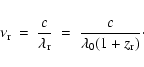 for Eq. (42). Then
 (i.e.
)
is obtained from Eqs. (35) and
(11) evaluated at the reference point:
(i.e.
)
is obtained from Eqs. (35) and
(11) evaluated at the reference point:
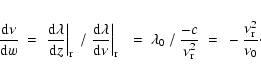 (i.e. X) at w using
Eq. (42):
(i.e. X) at w using
Eq. (42):
 (i.e. P) may be computed from
using Eq. (10) from
Table 3:
(i.e. P) may be computed from
using Eq. (10) from
Table 3:
 using Eq. (36) from Table 4:

 and z and
simplifying we obtain
and z and
simplifying we obtain

One thing to notice about the equations of Table 5 is that the meaning of w differs for each. For example, Eq. (55) may not be obtained from Eq. (56) simply by multiplying both sides by c: in Eq. (56) w is a redshift (ZOPT), whereas in Eq. (55) it is an optical velocity (VOPT).
Aside from CRVAL
,
the coordinate computations of
Sect. 3.4 require one extra parameter when evaluating the
F2V, V2F, W2V, V2W, A2V, and
V2A non-linear algorithms, namely the rest frequency or
wavelength of the spectral-feature of interest. These are fundamental
physical parameters so, rather than use the PV i_ma parameters
defined in Paper I, which would tend to disguise them, the
special floating-valued keywords

 and ,
respectively. Their units are `Hz' and `m' respectively, fixed to save having additional
keywords to define them. RESTWAVa is for wavelengths in
vacuum only. One or the other of these keywords must be included
for the above-mentioned algorithm codes; usually RESTFRQa would be given for F2V and V2F, and RESTWAVa for the others. FITS writers should always write one or other of
these when it is meaningful to do so, even for algorithm codes such as
F2W or W2A that do not require them.
and ,
respectively. Their units are `Hz' and `m' respectively, fixed to save having additional
keywords to define them. RESTWAVa is for wavelengths in
vacuum only. One or the other of these keywords must be included
for the above-mentioned algorithm codes; usually RESTFRQa would be given for F2V and V2F, and RESTWAVa for the others. FITS writers should always write one or other of
these when it is meaningful to do so, even for algorithm codes such as
F2W or W2A that do not require them.
Keyword RESTFREQ has been used in previous FITS files and should be recognized as equivalent to RESTFRQ.
The wavelengths so far discussed are measured in vacuum. However,
dispersion coordinates for UV, optical, and IR spectra at
 nm are commonly given as wavelengths in air. The relative
difference between the two varies between 0.028% and 0.032% across
this range. To identify wavelengths measured in dry air at standard
temperature and pressure rather than in vacuo, we introduce the
coordinate type AWAV for which the reference value and
increment must be expressed accordingly.
nm are commonly given as wavelengths in air. The relative
difference between the two varies between 0.028% and 0.032% across
this range. To identify wavelengths measured in dry air at standard
temperature and pressure rather than in vacuo, we introduce the
coordinate type AWAV for which the reference value and
increment must be expressed accordingly.
The two measures of wavelength are related by
is the wavelength in vacuum,
is the
wavelength in air, and
 is the index of refraction
of dry air at standard temperature and pressure. This varies
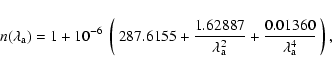
non-linearly with wavelength. The standard relation given by
Cox (2000) is mathematically intractable and somewhat dated.
The International Union of Geodesy and Geophysics (1999)
adopted the rather simpler formula
is the wavelength in micrometers. This formula
suffices for conversions from air to vacuum when no more than 0.25
parts per million accuracy is required. The derivative, which may be
required in Eq. (45), is
of `AWAV' and
evaluated with Eq. (4).
is the index of refraction
of dry air at standard temperature and pressure. This varies
non-linearly with wavelength. The standard relation given by
Cox (2000) is mathematically intractable and somewhat dated.
The International Union of Geodesy and Geophysics (1999)
adopted the rather simpler formula
is the wavelength in micrometers. This formula
suffices for conversions from air to vacuum when no more than 0.25
parts per million accuracy is required. The derivative, which may be
required in Eq. (45), is
of `AWAV' and
evaluated with Eq. (4).
Algorithm codes for the non-linear conversions are A2F,
A2W, A2V, and their complements, F2A, W2A,
and V2A as listed in Table 2. Use of the
three-step procedure described in Sect. 3.4 would require
as a function of each of the other spectral
variables, together with their inverses and derivatives. Thus it is
much simpler to handle air wavelengths as a separate, extra step in
the algorithm chain. For example, to compute world coordinates for
VRAD-A2V, the value of CRVAL
would first have to be
converted from radio velocity to air wavelengths via
Eqs. (18), (10), and (67), and
 for Eq. (45) would be obtained
from Eqs. (19), (7), and (66).
Then, the value of
computed for w via
Eq. (42) would be transformed to vacuum wavelengths via
Eq. (64), and then to radio velocity via
Eqs. (6) and (20).
for Eq. (45) would be obtained
from Eqs. (19), (7), and (66).
Then, the value of
computed for w via
Eq. (42) would be transformed to vacuum wavelengths via
Eq. (64), and then to radio velocity via
Eqs. (6) and (20).
![\begin{figure}
{\includegraphics[width=18cm]{3818fig2.ps} }
\end{figure}](/articles/aa/full/2006/05/aa3818-05/img139.gif) |
Figure 2:
Geometry of gratings, prisms, and grisms. This simplified
representation omits the collimation and focusing optics.
Dashed lines mark ray paths in the plane of the figure - the
"dispersion plane''. The normal to the grating/exit prism
face and the normal to the detector plane are each projected
onto the dispersion plane, and angles  , ,
 ,
and ,
and
 are measured with respect to these projected normals.
Usually the incident ray for a prism or grism is perpendicular
to the entry face so that
is equal to the prism angle,
are measured with respect to these projected normals.
Usually the incident ray for a prism or grism is perpendicular
to the entry face so that
is equal to the prism angle,
 .
Angle
is wavelength-dependent, and
consequently so is the offset .
Angle
is wavelength-dependent, and
consequently so is the offset  in the dispersion direction
on the detector. The intermediate spectral world coordinate,
w, is proportional to .
Reference wavelength
in the dispersion direction
on the detector. The intermediate spectral world coordinate,
w, is proportional to .
Reference wavelength
 follows the reference ray defined by
 and illuminates the reference point at
 .
The normal to the detector plane is shown tilted by
angle
from the reference ray though typically this
angle is zero. The grating spacing G-1 is indicated. .
The normal to the detector plane is shown tilted by
angle
from the reference ray though typically this
angle is zero. The grating spacing G-1 is indicated. |
| Open with DEXTER | |
One common form of spectral data is produced by imaging the light from a disperser. The wavelengths of the light at some position in the image are related to the position and wavelength of the light in the field of view illuminating the disperser; the relation is defined by the physics of the disperser. In general the light received at a pixel in the detector is a superposition of different wavelengths from different points in the field of view. However, if the field of view is limited spatially, usually by aperture masks and fiber optics, each pixel receives light from only a small range of wavelengths. It is then possible to define a world coordinate function relating pixel position and effective wavelength. This is the basis of many astronomical spectrographs.
In the following section we use the physical relation applicable to the dispersers commonly used in astronomical spectrographs to define a world coordinate function for computing spectral coordinates. The relation applies to the simple, though common, case of single dispersers. More complex spectrographs with multiple dispersers, such as those using multiple passes through prisms, are not described by the methods of this section. The equations developed below also assume that the radiation enters perpendicular to the face of the prism, a condition not met by some widely used spectrometers. Alternatives to using this ideal world coordinate function, based on the physics of simple dispersers, are the table lookup described in Sect. 6 and empirical function fits provided by the the distortion function mechanism described in Paper IV.
We require that the dispersion occurs along just one direction on the detector and that the intermediate coordinates are computed so that only one world coordinate axis corresponds to wavelength. Paper IV describes how distortions and effects of the aperture shape can be removed to satisfy this requirement. The distortion correction is also used to remove aberrations causing departures from the ideal physical behavior of the dispersers assumed here.
The dispersers we consider are gratings, prisms, and grisms, which are a combination of a prism with a grating within or on the surface of the prism. Gratings may be reflecting or transmissive and may be fabricated with surface relief rulings, holographic surface relief patterns, and holographic volume phase patterns. In the discussion we use the terms grooves, lines, and ruling to refer to the periodic diffraction structures that produce the interference. By combining the two physical equations for interference and refraction a single world coordinate function covers all these cases with appropriate choice of parameters.
This section defines a world coordinate function using the basic laws of refraction and interference. It is beyond the scope of this discussion to give the full background for the laws and concepts underlying dispersive spectroscopy. Of the many texts on the subject, a standard reference is Astronomical Optics by Schroeder (1999).
Spectroscopic dispersers are based on interference and refraction effects which are naturally described in terms of wavelength. Moreover, they are most often used in the regime where wavelength is commonly the spectral coordinate. For these reasons the grism function is defined in terms of wavelength. The function assumes that all of the dispersion occurs at one place. This is why combinations of dispersers, other than a single grism, are not described by this function. This assumption means that for prisms and grisms the function is rigorously correct only when the light enters perpendicular to the face of the prism and the grating is at the exit face. However, even when these conditions are not exactly met the function may still be a good approximation with slight adjustments of the parameters.
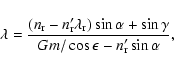
The basic physical relationship between the wavelength, ,
the
angle of incidence of the light, ,
and the
diffracted/refracted angle, ,
is given by a combination
of the grating interference equation and Snell's law of refraction:
 is the wavelength-dependent index of
refraction of the prism material. For a pure prism the order m is
zero and for a reflection or transmission grating
is the
unit function. The plane containing
and
is the dispersion plane, illustrated in Fig. 2, and the angles
are measured relative to the projection in the dispersion plane of the
normal to the grating or exit prism face. Usually the normal does lie
in the dispersion plane, but small values of
is the wavelength-dependent index of
refraction of the prism material. For a pure prism the order m is
zero and for a reflection or transmission grating
is the
unit function. The plane containing
and
is the dispersion plane, illustrated in Fig. 2, and the angles
are measured relative to the projection in the dispersion plane of the
normal to the grating or exit prism face. Usually the normal does lie
in the dispersion plane, but small values of  ,
the angle
between the normal and the dispersion plane, are sometimes used for
instrumental design reasons.
,
the angle
between the normal and the dispersion plane, are sometimes used for
instrumental design reasons.
By convention, the angles of incidence and diffraction/refraction are
measured from the normal to the beam and
is
always measured positive in the anticlockwise direction. The sign
changes on either side of the normal and this determines the sign of
.
Thus, for the reflection grating in Fig. 2,
 and
and
 ,
and vice versa for a transmission
grating, prism, or grism.
,
and vice versa for a transmission
grating, prism, or grism.
Reflection grating geometry is sometimes defined by the angle  measured from the camera axis to the collimator axis and the tilt tof the bisector relative to the grating normal. If
and tobey the same sign convention as ,
then
measured from the camera axis to the collimator axis and the tilt tof the bisector relative to the grating normal. If
and tobey the same sign convention as ,
then
 .
.
In spectrographs with prisms or grisms the requirement that the
incident light be normal to the prism entry face means that is equal to the prism angle (
in Fig. 2). Even
for oblique entry, identifying
with the prism angle is often
a good initial approximation.
The requirement that the diffraction and refraction occur at one point
means that
is fixed and independent of wavelength. The
variation of
with wavelength then defines the relation between
wavelength and position
on the detector. The reference
wavelength
is the wavelength at the reference point
corresponding to the zero point of
and the intermediate spectral
world coordinate w.
The prism's dispersive power derives from the variation of its index
of refraction with wavelength. While this variation depends on the
material and is generally non-linear, it is sufficient to approximate
it by a first-order Taylor expansion about the reference wavelength,
:
 as a shorthand for
 ,
and likewise
,
and likewise
 for
for
 .
Combining Eqs. (68) and
(69) yields the grism equation
,
and
may be zero in different types of spectrographs.
.
Combining Eqs. (68) and
(69) yields the grism equation
,
and
may be zero in different types of spectrographs.
In order to define a world coordinate function we need
as a
function of the intermediate world coordinate, w, which is
proportional to .
Since Eq. (70) gives
as a function of
it remains to determine the
relationship between
and .
First note that
Eq. (70) evaluated at
 provides
,
as in
Fig. 2.
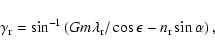
Figure 2 shows angle ,
which is measured
from the reference ray to the camera axis using the same sign
convention as ,
i.e. if
is clockwise-positive as for a
grism then so is .
Normally
would be zero, but it is
included here to provide a small correction. Depending on the sign
convention for ,
simple geometry for a flat detector gives
is such that increases as
increases, and the minus sign otherwise.
Section 5.1.3 discusses the resolution of this potential
sign ambiguity.
In keeping with the preceding sections we wish to define general grating, prism, and grism world coordinate representations such as WAVE-GRI, FREQ-GRI, etc.
Bearing in mind that the grism equation, Eq. (70), is
expressed in terms of wavelength, then given a FREQ-GRI axis,
for example, it would be straightforward to convert the reference
frequency,
 ,
given by CRVAL k, from frequency to
wavelength via
,
given by CRVAL k, from frequency to
wavelength via
 .
However, it would not be valid to
convert the intermediate spectral world coordinate, w, from
frequency to wavelength like this because it is not a true frequency.
While it may be a close approximation near the reference point it
deviates at points away from it.
.
However, it would not be valid to
convert the intermediate spectral world coordinate, w, from
frequency to wavelength like this because it is not a true frequency.
While it may be a close approximation near the reference point it
deviates at points away from it.
Thus, interpretation of an axis such as FREQ-GRI necessarily
involves a procedure similar to that of Sect. 3.4, and to
apply that methodology we need a parameter, the grism parameter,
 ,
that is a known function of the spectral variables and for
which the axis is linearly sampled; this will substitute for X in
Eq. (42). Since
is proportional to w
,
that is a known function of the spectral variables and for
which the axis is linearly sampled; this will substitute for X in
Eq. (42). Since
is proportional to w
 |
(73) |
 is a constant. Combining this with Eq. (72)
we have
is a constant. Combining this with Eq. (72)
we have
Following Sect. 3.4 (with X replaced by ), we
have
 is constant:
,
,
or ,
with which S is most closely
associated. Recognized spectral variables and their associates are
listed in Table 1. When S is one of the basic types,
,
,
or ,
as is often the case, then
whence
is constant:
,
,
or ,
with which S is most closely
associated. Recognized spectral variables and their associates are
listed in Table 1. When S is one of the basic types,
,
,
or ,
as is often the case, then
whence
 .
.
As previously, we require that CDELT i or CD i_j be set so that
 |
(79) |
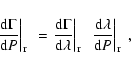
directly in terms of
we may use
 |
(80) |
 itself may be deduced from the
derivatives of Eqs. (75) and (70):
itself may be deduced from the
derivatives of Eqs. (75) and (70):
 and
and
 come from
Tables 3 and 4 respectively. In the
common case where S, and hence P, is wavelength then
and
are both unity.
come from
Tables 3 and 4 respectively. In the
common case where S, and hence P, is wavelength then
and
are both unity.
The foregoing provides everything needed to compute
from
w, and this forms the first step of a five-step algorithm chain
for computing S from w:
at w using Eq. (77).
 and
and
 are constants that
need be computed once only;
from
Eq. (76) and
from
Eq. (82) using the appropriate equations from
Tables 3 and 4.
from
using the inverse of
Eq. (75):
are constants that
need be computed once only;
from
Eq. (76) and
from
Eq. (82) using the appropriate equations from
Tables 3 and 4.
from
using the inverse of
Eq. (75):
 |
(83) |
from
via
Eq. (70).
using the appropriate equation from
Table 3.
As usual, the inverse computation is effected by traversing the
algorithm chain in the reverse direction. The inverse equations
required for the backward steps have already been given except that
for Eq. (70):
 |
Grism parameters required for these calculations are provided by the
PV k_ma keywords defined in Table 6, with
given by Eq. (71), and
computed from the coordinate reference value, CRVAL k, by the
appropriate equations from Tables 3 and
4. Default values for missing parameters are also
defined in the table. Generally only the first three parameters will
appear for gratings and the first five for grisms.
Table 6: Grism parameters, their default values, and required units.
A question raised above was how CDELT i or CD i_j may be set by a
WCS composer so that
 .
.
| w= sk qk | (85) |
 by design,
 and
and
 come from Tables 4 and
3 respectively, and
come from Tables 4 and
3 respectively, and
 is the
wavelength dispersion (e.g. in nm/pixel) measured at the reference
point and this is an instrumental parameter. Thus we have everything
needed to compute sk. When S is wavelength, then all but the
last factor in Eq. (86) is unity, and
is the
wavelength dispersion (e.g. in nm/pixel) measured at the reference
point and this is an instrumental parameter. Thus we have everything
needed to compute sk. When S is wavelength, then all but the
last factor in Eq. (86) is unity, and
 .
.
It is the correct choice of sign for
that
resolves the sign ambiguity in Eq. (74).
Thus far we have ignored the distinction between vacuum and air
wavelengths in the discussion of grism world coordinates. In fact,
the
variable that appears in the grism equation may be
either, and in general
in Eq. (68) is the
index of refraction of the prism material with respect to the
surrounding medium, either air or vacuum.
If the dispersion takes place in vacuum, as it does, for example, in a
spectrograph on a spacecraft, then the grism equation is correct for
vacuum wavelengths; if in air, it is correct for air wavelengths and
in Sects. 5.1.1, 5.1.2, and
5.1.3 should be replaced everywhere by
.
Then as discussed in Sect. 4, the computation of quantities
such as
 in Eq. (82) is
best handled by using the vacuum wavelength, ,
as an
intermediary, effectively introducing an extra step into the algorithm
chain.
in Eq. (82) is
best handled by using the vacuum wavelength, ,
as an
intermediary, effectively introducing an extra step into the algorithm
chain.
In order to distinguish between grisms operated in air and in vacuum we hereby reserve the use of GRI exclusively for vacuum operation and introduce GRA for operation in dry air at standard temperature and pressure.
Note that for real spectrographs operated in air at an observatory, the actual wavelength system that GRA describes is for air at the local conditions. The coordinate value and increment at the reference point are normally adjusted to the values at standard conditions during calibration. If the accuracy of the wavelength measurement requires it, any further correction between wavelength at local conditions and wavelength at standard conditions may be accomplished via the methods of Paper IV.
![\begin{figure}
{\includegraphics[width=8cm]{3818fig3.ps} }
\verb*!CTYPE1 = \lq AWAV...
...Diffraction order! \\
\verb*!PV1_2 = 13.9 / [deg] Incident angle!
\end{figure}](/articles/aa/full/2006/05/aa3818-05/img189.gif) |
Figure 3: KPNO Coudé Feed spectrograph with a long focal length and a 3K CCD. |
| Open with DEXTER | |
![\begin{figure}
{\includegraphics[width=8cm]{3818fig4.ps} }
\verb*!CTYPE1 = \lq AWAV...
...Diffraction order! \\
\verb*!PV1_2 = 64.8 / [deg] Incident angle!
\end{figure}](/articles/aa/full/2006/05/aa3818-05/img190.gif) |
Figure 4:
KPNO Hydra Fiber Bench Spectrograph using an echelle grating
in
 order with a 2K CCD.
 |
| Open with DEXTER | |
This section illustrates application of the GRA world coordinate function with three real-world examples of spectral images from Kitt Peak National Observatory (KPNO) spectrographs (Figs. 3-5). Each spectrum is of an arc calibration lamp that produces emission lines of known wavelength. The position of each line in the image along the spectral world coordinate axis is measured by centroiding on the spectral line profile and identified with the known rest wavelength to create a list of pixel positions and wavelengths.
Each example figure shows plots of the positions and wavelengths for a
particular spectrograph. The pixel positions are plotted along the
bottom axis. Rather than plot the wavelengths directly, where it
would be difficult to see the shape of the curve, the difference or
correction between the known (air) wavelengths and the simple linear
world coordinate function AWAV (
 )
are shown. The corrections are plotted along the left axes. In these
examples the wavelength units are consistently Angstroms.
)
are shown. The corrections are plotted along the left axes. In these
examples the wavelength units are consistently Angstroms.
The top axis is labeled with simple AWAV linear coordinates. The right axis divides the wavelength correction by CDELT1, the linear dispersion at the reference pixel. This represents the shift, in pixels, of the wavelengths on the detector relative to where they would occur in a spectrograph with a linear dispersion relation.
![\begin{figure}
{\includegraphics[width=8cm]{3818fig5.ps} }
\verb*!CTYPE1 = \lq AWAV...
...fraction! \\
\verb*!PV1_4 = -1.077E6 / [m^(-1)] Refraction deriv!
\end{figure}](/articles/aa/full/2006/05/aa3818-05/img192.gif) |
Figure 5: KPNO MARS spectrograph with a 450 lines/mm volume phase holographic grism and a 2K CCD. |
| Open with DEXTER | |
The departure of the data points from zero indicate the magnitude of the world coordinate errors that would occur by using the simple linear AWAV world coordinate function. The solid lines in the figures are the difference between the wavelengths produced by the AWAV-GRA grating coordinate function and the linear AWAV coordinate function evaluated at the pixel positions in the image.
The usefulness of the ideal grating coordinate function is that the curves go through the measured data points with an appropriate choice of parameters. The parameters are essentially those known for the spectrograph and disperser with small adjustments to some of the parameters to produce the best fit to the calibration data. (These small adjustments may be viewed as corrections for the simplifications in the optical model.) In these examples the dispersion function represented by the grating world coordinate relation is as good as typically provided by empirical polynomial functions. Higher order effects due to aberrations are corrected by the distortion correction methods defined in Paper IV.
A close reading of the equations above will reveal that the seven
grism parameters listed in Table 6 are not
independent. We have chosen these parameters because of their
physical meaning. However, the independent parameters are
 and
.
It is these combinations of parameters which must be used
in fitting data.
and
.
It is these combinations of parameters which must be used
in fitting data.
Each figure shows the arc line measurements, the coordinate function curve, and the relevant world coordinate keywords used to produce the curve. Not all of the WCS keywords are shown.
The first example shows the behavior of a long focal length spectrograph with a reflection grating used at a low angle of incidence. Because of the long focal length the deviation from linearity is relatively small though still clearly significant. The grating has a density of 316 lines/mm and is used in first order to produce a spectrum centered near 5225.2 Å with a dispersion of 0.43 Å/pixel.
The next example uses a 316 lines/mm echelle reflection grating, a grating designed for use at large angles from the grating normal, operated in a higher order. It is used to produce a spectrum centered near 5136.8 Å with a dispersion of 0.13 Å/pixel. The departure from linearity is in the opposite sense from the other examples because the echelle grating is used with the diffracted angle at a greater angle than the incidence angle. The higher order results in a fairly large departure from a linear WCS.
The last example illustrates use of a grism. However, this is not the more common grism with a ruled grating on the output face and the input face oriented normal to the incident beam. Instead, the grating is sandwiched in the middle of the prism. The prism is oriented with the beam entering and leaving the prism at equal angles to the faces resulting in a straight through configuration as with a standard grism.
Another unusual feature of this grism is that it uses a volume phase holographic (VPH) grating. While the intensity response is different from a surface relief grating (ruled or holographic) the dispersion behavior is the same.
The full optical equation is complex even in this symmetric configuration, but as shown in the figure using the GRA function, a very good description of the coordinates can be obtained.
The prism has a
 angle with an index of refraction of 1.764
near the reference wavelength. The grating has an equivalent
interference pattern of 450 lines/mm. Using these values and
adjusting the derivative of the index of refraction produces
Fig. 5.
angle with an index of refraction of 1.764
near the reference wavelength. The grating has an equivalent
interference pattern of 450 lines/mm. Using these values and
adjusting the derivative of the index of refraction produces
Fig. 5.
There are numerous instances in which a physical coordinate is well defined at each pixel along an image axis, but the relationship of the coordinate values between pixels cannot be described by a simple functional form. An obvious example of this would be a three-dimensional image consisting of a sequence of two-dimensional images of an astronomical object recorded at an arbitrary sequence of times determined in part by weather and time assignment committees. As another example, the calibration of some spectrographs, such as those employing a diode array detector, is represented best by a list of frequencies or wavelengths for each pixel on the spectral axis rather than some functional form.
To support such representations for primary images and image
extensions, we define a table-lookup form for the value of
CTYPE
as xxxx-TAB, where xxxx are four
letters representing the type of coordinate, e.g. TIME or FREQ. As in Paper I, which established the "4-3'' convention
for CTYPE i, the coordinate xxxx is a "real''
coordinate, such as FREQ, not an intermediate coordinate, such
as FREQ-F2W, requiring an additional linear or non-linear
algorithm in order to be converted into a physical coordinate.
Consider first the case of a single (one-dimensional) coordinate
axis. The -TAB algorithm uses a list of coordinate values, the
coordinate array, to record coordinate values of the
appropriate type for the coordinate axis. A second list of the same
length, the indexing vector, may be used in addressing the
coordinate array. The indexing vector provides one level of
indirection which may be used to vary the sampling frequency of the
coordinate array along the coordinate axis. The coordinate could
then be sampled at smaller intervals over that portion of the range in
which the instrument is more non-linear and sampled more coarsely over
regions in which it is better behaved. The indexing algorithm, based
on linear interpolation, is defined in Sect. 6.1.2. If the
indexing vector is absent, it is taken to have values
 ,
where K is the number of values in the coordinate
array. See Sect. 6.2.2 for an example of the use of the
indexing vector.
,
where K is the number of values in the coordinate
array. See Sect. 6.2.2 for an example of the use of the
indexing vector.
The concept described above covers separable (one-dimensional) axes
only. It may be extended simply to M non-separable axes so long as
the indexing vectors for each of the M axes are separable. Mcoordinate values are required for each of the possible index
positions. Therefore, the coordinates will be in a single
(1+M)-dimensional array. This coordinate array will have
dimensions
 ,
where Km is the maximum
value of the index on axis m+1 of the coordinate array. For
simplicity, degenerate axes are forbidden; therefore, Km > 1.
The indexing vectors for each of the M axes each contain a
one-dimensional array of length Km.
,
where Km is the maximum
value of the index on axis m+1 of the coordinate array. For
simplicity, degenerate axes are forbidden; therefore, Km > 1.
The indexing vectors for each of the M axes each contain a
one-dimensional array of length Km.
![\begin{figure}
\includegraphics[width=8.8cm]{3818f6.eps}\par
\end{figure}](/articles/aa/full/2006/05/aa3818-05/img197.gif) |
Figure 6:
-TAB logic flow with and without an indexing vector.
The coordinate array subscript m associated with intermediate
world coordinate axis i is specified with keyword PV i_ .
In the case of an independent -TAB axis it would have value 1.
Note that .
In the case of an independent -TAB axis it would have value 1.
Note that  is computed either with the CD i_j
form of the linear transformation matrix or the PC i_j plus
CDELT i form.
is computed either with the CD i_j
form of the linear transformation matrix or the PC i_j plus
CDELT i form. |
| Open with DEXTER | |
The data in the indexing vectors must be monotonically increasing or decreasing, although two adjacent index values in the vector may have the same value. However, it is not valid for an index value to appear more than twice in an index vector, nor for an index value to be repeated at the start or at the end of an index vector. Furthermore, repeated index values are allowed only in the case of one-dimensional separable axes. (See the following section for a discussion of the reasons for these limitations and how interpolation is done in such cases; see also Sect. 6.2.3 for an example of equal index values and further discussion of interpolation.) Application programs must not sort the index and coordinate arrays since this makes the relative order of the two equal index values indeterminate. The requirement for monotonic index values should eliminate any need for sorting. Note that it does not imply any ordering of the values in the coordinate array.
The indexing algorithm is illustrated schematically in
Fig. 6 for the one-dimensional case. In the general
case, to determine the M non-separable coordinate values Cm, one
first determines the M indices,
for addressing the
appropriate location in the table. If intermediate world coordinate
axis i is associated with the  axis in the coordinate
array, one evaluates
axis in the coordinate
array, one evaluates
 |
(87) |
 ,
corresponding to .
Then the coordinate value, Cm, of type specified by the first four
characters of CTYPE
,
is that at location
,
corresponding to .
Then the coordinate value, Cm, of type specified by the first four
characters of CTYPE
,
is that at location
 in the coordinate array, again using
linear interpolation as needed.
in the coordinate array, again using
linear interpolation as needed.
In detail, the algorithm for computing
,
and thence
Cm, is as follows. Scan the indexing vector,
 ,
sequentially starting from the first element,
,
sequentially starting from the first element,  ,
until
a successive pair of index values is found that encompass (i.e. such that
,
until
a successive pair of index values is found that encompass (i.e. such that
 for monotonically
increasing index values or
for monotonically
increasing index values or
 for
monotonically decreasing index values for some k). Then, when
for
monotonically decreasing index values for some k). Then, when
 ,
interpolate linearly on the indices
,
interpolate linearly on the indices
 then the result is undefined.
In the case where an index value is equal to ,
the algorithm
above will find the interval
 for
monotonically increasing index values or
for
monotonically increasing index values or
 for monotonically decreasing index values, except when
 .
Since two consecutive index values may be equal,
the index following the matched index must be examined. If
.
Since two consecutive index values may be equal,
the index following the matched index must be examined. If
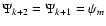 (or
(or
 ),
then
and Cm are undefined.
),
then
and Cm are undefined.
Linear interpolation via Eq. (88) applies for in the range
to  inclusive. Outside this range, for
K > 1, linear extrapolation is allowed for values of
such
that
inclusive. Outside this range, for
K > 1, linear extrapolation is allowed for values of
such
that
 or
or
 for monotonic
increasing index values, and for
for monotonic
increasing index values, and for
 or
or
 for monotonic
decreasing index values. Extrapolation is also allowed for K = 1with
in the range
for monotonic
decreasing index values. Extrapolation is also allowed for K = 1with
in the range
 (noting that
should be equal to 1 in this case) whence
(noting that
should be equal to 1 in this case) whence
 .
.
The value of
derived from
must lie in the range
 .
These extrapolation limits permit
assignment of coordinates to the regions of the pixels on the boundary
of the array which are outside of the centers of the boundary pixels
but within the conceptual "edge'' of the boundary pixels. In the
case of a single separable coordinate with
.
These extrapolation limits permit
assignment of coordinates to the regions of the pixels on the boundary
of the array which are outside of the centers of the boundary pixels
but within the conceptual "edge'' of the boundary pixels. In the
case of a single separable coordinate with
 ,
the coordinate value is given by
,
the coordinate value is given by
such that
 or
or
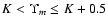 linear extrapolation is permitted, with
Cm = C1 when K = 1.
linear extrapolation is permitted, with
Cm = C1 when K = 1.
Conceptually, to compute the change in coordinate value between
 and
and
 ,
in the case when
,
in the case when
 and/or
 ,
difference the two values of Cmobtained for
,
difference the two values of Cmobtained for
 and
and
 in the limit that
goes to zero. In practice, the
computation is straightforward and it is not necessary to take limits.
in the limit that
goes to zero. In practice, the
computation is straightforward and it is not necessary to take limits.
The inverse computation, in which one determines a
given a
coordinate Cm, is relatively straightforward, at least in the case
of a single separable coordinate. One scans the coordinate vector
from the start looking for a pair of values that encompass Cm.
Having found a pair, one must then check the indexing vector. If the
two index values are unequal, then the correct pair has been found.
Otherwise the search must be continued. When a correct coordinate
pair has been found, the inverse of Eq. (89) is
applied to determine
.
The inverse of
Eq. (88) then yields .
It is understood that the general keywords CUNIT
 ,
CRDER
,
and CSYER
apply to the output
coordinate Cm rather than the -TAB coordinate keywords
CRVAL
et al. Similarly, if the table lookup determines
celestial coordinates, the general keywords RADESYS
,
CRDER
,
and CSYER
apply to the output
coordinate Cm rather than the -TAB coordinate keywords
CRVAL
et al. Similarly, if the table lookup determines
celestial coordinates, the general keywords RADESYS  and
EQUINOX
apply to the output celestial coordinates rather
than the input -TAB coordinates.
and
EQUINOX
apply to the output celestial coordinates rather
than the input -TAB coordinates.
Standard FITS binary tables extensions (XTENSION = `BINTABLE')
will be used to hold the coordinate array in a single cell of a column
of a one-row table. The length of this array is given in the FITS
table header by the repeat count in the TFORM n keyword, where
n is the number of the column containing the coordinate array.
The dimensions of the coordinate array will be given in the FITS table
header by the keyword TDIM n set to `(M, K1, K2,
 KM)', where n is the column containing the coordinate
array. Note in particular that if M = 1 the coordinate array is
formally two-dimensional though the first axis is degenerate.
The repeat count in the TFORM n keyword value is the product
of M and all the Km. The indexing vectors for each of the
M axes, if present, will occupy separate columns, each containing a
one-dimensional array of length Km.
KM)', where n is the column containing the coordinate
array. Note in particular that if M = 1 the coordinate array is
formally two-dimensional though the first axis is degenerate.
The repeat count in the TFORM n keyword value is the product
of M and all the Km. The indexing vectors for each of the
M axes, if present, will occupy separate columns, each containing a
one-dimensional array of length Km.
The BINTABLE extension containing the coordinate array must be in the same FITS file as the data that reference it.
The parameters required by -TAB are the table extension name
(EXTNAME), the table version number (EXTVER), the table
level number (EXTLEVEL), the column name for the coordinate
array (TTYPEn1), the column name for the indexing vector
(TTYPEn2), and the axis number m associated with
intermediate world coordinate axis i in the coordinate array. The
keywords used for this purpose are PS i_
 ,
PV i_
,
PV i_
 ,
PV i_
,
PV i_
 ,
PS i_
,
PS i_
,
and PV i_
,
PS i_
,
PS i_
,
and PV i_
 ,
respectively. These are summarized in Table 7.
For images, PS i_
has no default; for tables a
missing or blank PS i_
is taken to be the current
table (see below). PV i_
and PV i_
both have a default value of 1. PS i_
never has a default; it must be present and be assigned a value
actually occurring in table PS i_
.
If
PS i_
is missing or has a value of all blanks, the
indexing vector is taken to be a list of integers from 1 to Kmand
becomes a direct index of axis PV i_
in
the array specified by PS i_
.
If PV i_
is present and assigned a value, then that value must
actually occur in table PS i_
.
Note that the
values given to PS i_
and PS i_
are not case
sensitive since the FITS Standard (Hanisch et al. 2001)
states that "String comparisons with the values of TTYPE n keywords should not be case sensitive.''
,
respectively. These are summarized in Table 7.
For images, PS i_
has no default; for tables a
missing or blank PS i_
is taken to be the current
table (see below). PV i_
and PV i_
both have a default value of 1. PS i_
never has a default; it must be present and be assigned a value
actually occurring in table PS i_
.
If
PS i_
is missing or has a value of all blanks, the
indexing vector is taken to be a list of integers from 1 to Kmand
becomes a direct index of axis PV i_
in
the array specified by PS i_
.
If PV i_
is present and assigned a value, then that value must
actually occur in table PS i_
.
Note that the
values given to PS i_
and PS i_
are not case
sensitive since the FITS Standard (Hanisch et al. 2001)
states that "String comparisons with the values of TTYPE n keywords should not be case sensitive.''
Table 7: Parameter keywords used for the -TAB algorithm.
The use of -TAB for M related axes requires the header to
specify the array PS i_
to be the same for each of
the M axes. The dimensions of this array must be given in the
header as
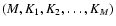 .
These dimensions determine
the maximum range of the array index (1 to Km) for each axis. The
indexing vectors for each of the M axes, if present, will occupy
separate columns, each containing a one-dimensional array of length
Km. The M values of PV i_
must account for all
M axes. If any of these conditions are not met, the result is
undefined.
.
These dimensions determine
the maximum range of the array index (1 to Km) for each axis. The
indexing vectors for each of the M axes, if present, will occupy
separate columns, each containing a one-dimensional array of length
Km. The M values of PV i_
must account for all
M axes. If any of these conditions are not met, the result is
undefined.
If a FITS file contains multiple XTENSION HDUs (header-data units) with the specified EXTNAME, EXTLEVEL, and EXTVER, then the result of the WCS table lookup is undefined. If the specified FITS BINTABLE contains no column, or multiple columns, with the specified TTYPE n, then the result of the WCS table lookup is undefined. The specified FITS BINTABLE must contain only one row.
No units conversions are to be performed. CUNIT i must be the same
as TUNITn of the binary table, where n is the column number
corresponding to PS i_
.
We recommend strongly that the value chosen for EXTNAME always begin with the four letters WCS-. If this is done, generic programs will recognize the table as part of the WCS portion of the data and will be less likely to separate the table from the rest of the WCS.
The -TAB implementation is more complicated than most other WCS conventions because the coordinate system is not completely defined by keywords in a single FITS header. Software that supports -TAB must be able to gather all the necessary WCS parameters that are in general distributed over two FITS HDUs and in the body of the WCS extension table. The producers of FITS data products should consider the capabilities of the likely recipients of their files when deciding whether or not to use the -TAB convention, and in general should use it only in cases where other simpler WCS conventions are not adequate.
Binary table extensions containing array data columns may need a table-lookup function for coordinate values. Seemingly the most convenient form of -TAB would be one in which the -TAB array(s) are also table cells in the same row as the data array. However, a separate coordinate table would be more economical if it applied to data arrays in multiple rows. The -TAB keywords for such tables are iCTYPna, iSn_0a, iVn_1a, iVn_2a, iSn_1a, and iSn_2a, where n is the column number of the array of data and i is the intermediate world coordinate axis number. If iSn_0a is missing or blank, the present binary table is taken to be the coordinate lookup table. In that case, the coordinate array(s) are taken to be single-cell arrays in the same row as the data array and keywords iVn_1a and iVn_2a are ignored.
Strictly speaking, the -TAB representation is not required for binary or ASCII table extensions containing only one data value per cell because each of the coordinate values associated with the datum may be stored in separate columns. However, -TAB does provide a convenient method of solving one of the problems pertaining to such tables, namely identifying the data column. If the table contains a column of data and another one or more columns of coordinate values pertaining to those data, then one can define the coordinates of the data column as being of type -TAB. In this case, the critical keywords are iCTYPna to declare the coordinate axis type and iSn_1a to identify the corresponding coordinate column. Since the data value column contains only one value, the coordinate column should only contain one value. Then, the usual coordinate keywords (jCRPXn / jCRPna, ijPCna, ijCDna, iCDLTn / iCDEna) may be omitted since their defaults yield the desired result that output index pixel equals the input data pixel (both of which are 1 in the assumed case). Note too that tables of this type - one value per table cell - may be in either ASCII or binary table form.
To illustrate the use of -TAB with two non-separable axes,
let
us consider a specific example of a four-dimensional image array.
Assume that axes 1 and 3 are handled either linearly or by one of the
non-linear single-axis cases (including -TAB). However,
assume that axes 2 and 4 require table lookup in a mutually dependent
fashion. Thus i = 2 for m = 1 and i = 4 for m = 2 and
the required keywords are
PS2_0 = `WCS-TAB' PS4_0 = `WCS-TAB' |
PV2_1 = 1 PV4_1 = 1 |
PV2_2 = 1 PV4_2 = 1 |
PS2_1 = `COORDS' PS4_1 = `COORDS' |
PS2_2 = `INDEX2' PS4_2 = `INDEX4' |
PV2_3 = 1 PV4_3 = 2 |
A real example that could use this particular algorithm is represented by a spectral image of a portion of the sky taken with a single radio telescope. The observer commands the telescope to point at a regular grid of coordinates, but, due to wind loading and other pointing errors, the telescope achieves the commanded positions only approximately. The actual celestial coordinates observed are, however, accurately measured. These data could then be represented usefully as a two-dimensional array of spectra, but accurate celestial coordinates for each spectrum could be found only by a 2-dimensional table lookup.
Since there has been no generally agreed upon FITS format for spectral data with explicit wavelengths assigned to each pixel, data providers have resorted to defining their own formats. Examples from the Hubble Space Telescope and the Very Large Array are shown below, recast into the -TAB algorithm.
Two types of Hubble Space Telescope data serve as examples of the -TAB algorithm. The two cases illustrate the evolution from simple images to the more powerful constructs provided by FITS extensions and binary tables. The purpose of discussing these formats is not to explain the HST formats, but to illustrate a couple of types of data that can be represented by the -TAB algorithm. Therefore, some details of these formats are ignored.
The early HST spectrographs, FOS and GHRS, adopted a format based only on simple FITS images. The basic concept is that the spectral flux values are given in one image and the vacuum wavelengths, in Angstroms, are given as the pixel values in another image. The two are associated by filenames. The filenames have the same basename, but different filename extensions for an exposure. To represent these spectra with a FITS WCS based on the -TAB method, while continuing to use an image representation for the spectral fluxes, one replaces the separate wavelength image with a table extension.
Table 8: WCS keywords in the spectral image for FOS and GHRS example.
Table 9: WCS keywords in the STIS table for two of the spectral columns.
Table 8 shows the minimum WCS keywords required in the primary image header. The PS1_0 keyword value defines the coordinate table to be in a binary table extension with name `WCS-TAB'. The coordinate table extension consists of one column, named `WAVELENGTH', and one row. The array values and length correspond to the original image format.
Other WCS keywords defined in Paper I would also be included as needed. The intermediate coordinate transformation must produce indexing values equal to the pixel coordinate in the image. Since the defaults for these keywords are defined in Paper I to produce pixel coordinates, it is not strictly necessary to include these keywords.
The second generation HST spectrograph, STIS, adopted a binary table format very close to one of those defined for the -TAB algorithm. In the STIS one-dimensional extracted echelle format each exposure is stored in a separate binary table. The extracted data from an exposure consist of a number of echelle orders each of which is stored in a separate row. The wavelengths and various associated "spectra'' are array elements in different columns. An associated spectrum is an array of a single type data quantity such as fluxes, errors, or data quality flags.
To convert this format to the -TAB representation only requires
adding the 1CTYP n and 1S n_ keywords to
specify the coordinate type and coordinate column name for each
spectral column n. There are six types of spectral quantities
for each order: gross, background, net, flux, error, and data quality
flag. So there must be six pairs of keywords. Since the same
wavelength column applies to each of the spectra, the keyword values
are repeated six times, but with different column numbers in the
keywords. Table 9 shows the WCS keywords for two
of the spectral columns. The 1S n_0 keywords are
omitted, signifying that the coordinate array column is in the same
table as the spectra.
keywords to
specify the coordinate type and coordinate column name for each
spectral column n. There are six types of spectral quantities
for each order: gross, background, net, flux, error, and data quality
flag. So there must be six pairs of keywords. Since the same
wavelength column applies to each of the spectra, the keyword values
are repeated six times, but with different column numbers in the
keywords. Table 9 shows the WCS keywords for two
of the spectral columns. The 1S n_0 keywords are
omitted, signifying that the coordinate array column is in the same
table as the spectra.
As noted for the FOS and GHRS format, additional WCS keywords are included as needed and the intermediate coordinate transformation values may be absent since this defines an indexing by pixel coordinate. In the STIS data, the units of the wavelength array are vacuum Angstroms so the 1CUNI n keyword would be required.
Table 10: Sample coordinate table. Each displayed column is actually a one-cell array of the (single-row) table.
Radio interferometry data are now best represented in binary tables
with each row representing the visibility at one time on one antenna
pair with a vector of data representing the complex values for all
polarizations and frequencies observed. These telescopes often allow
the user to observe  regularly-sampled spectral channels
starting from L arbitrarily chosen intermediate frequencies (IFs).
Furthermore, this spectral data pattern may be used with one receiver
and, a few minutes later, with other receivers at very different
frequencies. Because of the great flexibility in the choice of
the IFs and receivers, the frequencies present in the data may only be
described by a table. Because that description is very repetitive, we
choose to put it in a table separate from the visibility table.
regularly-sampled spectral channels
starting from L arbitrarily chosen intermediate frequencies (IFs).
Furthermore, this spectral data pattern may be used with one receiver
and, a few minutes later, with other receivers at very different
frequencies. Because of the great flexibility in the choice of
the IFs and receivers, the frequencies present in the data may only be
described by a table. Because that description is very repetitive, we
choose to put it in a table separate from the visibility table.
We can construct a single column table of all
 frequencies observed. However, by using a
second column for an indexing vector, we can take advantage of the
regular sampling of the
spectral channels. If we set iCRVLn, iCDLTn, and iCRPXn (for binary table format) or CRVAL i,
CDELT i, and CRPIX i (for random groups and image
formats) to one, then Table 10 may represent the actual
frequencies, where
frequencies observed. However, by using a
second column for an indexing vector, we can take advantage of the
regular sampling of the
spectral channels. If we set iCRVLn, iCDLTn, and iCRPXn (for binary table format) or CRVAL i,
CDELT i, and CRPIX i (for random groups and image
formats) to one, then Table 10 may represent the actual
frequencies, where  is the frequency of channel 1 in IF
 and
and
 is the increment in frequency between the
regularly sampled channels of IF .
This example is shown
graphically in Fig. 7.
is the increment in frequency between the
regularly sampled channels of IF .
This example is shown
graphically in Fig. 7.
In general, the FITS WCS papers do not consider the process by which the physical effects represented by the values in the FITS array have been measured. The measurable quantity may have been sampled over regions small enough to be considered as points in a widely separated grid of world coordinates. Alternatively, the measurable quantity may have been integrated across overlapping adjacent regions. The FITS WCS papers do not indicate whether it is valid to presume that the values in adjacent array elements represent physically adjacent quantities, nor do they indicate whether it is valid to interpolate the WCS across the extent of an array element.
Some world coordinate axes are defined to have integral values with conventional meanings (e.g. COMPLEX, STOKES). Interpolating a world coordinate value across the extent of a FITS array element along the direction of an axis which is conventionally defined to be integral would clearly be inappropriate. Nevertheless, for other types of world coordinate axes in traditional FITS arrays, the adjacent elements in the NAXIS-dimensional array can often be presumed to represent adjacent locations in a measurement continuum. This adjacency is relevant, for example, to image display programs when the image is magnified so that one FITS array element extends across multiple display pixels. In such cases a FITS display program may attempt to interpolate WCS values across the extent of an array element. With CTYPE k values other than -TAB this is commonly done by linear interpolation between the presumably adjacent array elements. However for coordinate axes where the CTYPE k is described by the xxxx-TAB non-linear algorithm there can be no presumption of adjacency.
![\begin{figure}
\includegraphics[width=8.8cm]{3818f7.eps}\end{figure}](/articles/aa/full/2006/05/aa3818-05/img255.gif) |
Figure 7:
Example taken from radio interferometry using
-TAB with an indexing vector. The FITS keywords shown are suitable
for the random groups format. The observation is made at a number of
frequencies, with a number
of regularly spaced
spectral channels beginning from each of a number of arbitrary
base frequencies .
The use of an indexing vector reduces
the number of values in the table from one array of 30 to two arrays
of 10 each. In a real case the number of spectral channels would be
significantly larger, making the space savings significant. In this
example, pixel pj = 6 produces
 .
This lies at .
This lies at
 .
The resulting coordinate is then .
The resulting coordinate is then
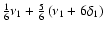 which, as one would expect, equals which, as one would expect, equals
 .
Note
that this example involves only a single independent -TAB axis,
so that PV i_ .
Note
that this example involves only a single independent -TAB axis,
so that PV i_
 . . |
| Open with DEXTER | |
Table 11: Top: keywords in main FITS header for -TAB example, bottom: table keywords and sample arrays for that example.
Notwithstanding these caveats, the use of -TAB does permit specification of changes in the coordinate value across the extent of a single array element. Consider a sequence of two-dimensional images of the sky which have been re-gridded such that the pixel array for each image shares the same 2-D WCS for celestial coordinates. A single 3-D FITS array can hold such a sequence of 2-D images. If the same instrument produced each of the images on different dates then the third dimension might be purely temporal. Alternatively, if different instruments (radio, IR, optical, X-ray) produced each of the images then the third dimension might be spectral. In practice, however, images in such a spectral 3-D image will typically also have different observation dates, so the image will actually span four dimensions of world coordinates.
Akin to the example of a long slit spectrum in Paper II, the WCS of
this four-dimensional case can be represented by the 3-D array. This
fourth dimension could be represented with NAXIS = 4 and NAXIS4 = 1, or with NAXIS = 3 and WCSAXES = 4. Whether
the sequence of images is temporal or spectral, it is certain that the
exposure duration or the spectral bandpass have a non-zero extent and
the -TAB representation does provide the ability to communicate
the start and end times of an observation, or the minimum and maximum
wavelengths of an observation. For this example the WCS keywords are
shown in Table 11, where the keywords relating to axes 1
and 2 are omitted because they are simply celestial coordinates as
described by Paper II. In this example, note the clever use of
the PC matrix to cause the fourth coordinate axis to depend on
the third pixel axis, but not the degenerate fourth pixel axis. FITS
writers can use details such as these to communicate how a display
program might provide meaningful world coordinates at locations across
an array element.
In order to provide coordinate values across the entire array element,
the coordinate values on the boundaries between the array elements are
multiply defined. Such a result should be expected for array elements
representing non-adjacent physical values. It is evident in this case
that the order of the index arrays should not be permuted during the
coordinate lookup. The lower portion of Table 11 shows a
subset of the content of the table(s) referred to by PS _ and PS
  _.
The four columns in the figure are
meant to illustrate the association of table header keywords and table
values. In the FITS file, the keywords would appear in the table
header along with many other keywords while the four arrays of
values would appear in four cells of the one-row binary table.
_.
The four columns in the figure are
meant to illustrate the association of table header keywords and table
values. In the FITS file, the keywords would appear in the table
header along with many other keywords while the four arrays of
values would appear in four cells of the one-row binary table.
The indexing vectors in the table of Table 11
illustrate the reason to allow two values within the indexing
vector to be identical. The rules for the linear interpolation within
such vectors are clear. One must select the two index locations
having values immediately surrounding .
Thus in the present
example, if the time coordinate has
 ,
the third and
fourth index and coordinate values are interpolated. The output time
coordinate is
,
the third and
fourth index and coordinate values are interpolated. The output time
coordinate is
 is
equal to the repeated value in the indexing vector.
is
equal to the repeated value in the indexing vector.
Frequencies, wavelengths, and apparent radial velocities are
always referred to some selected standard of rest (reference frame),
and while they are measured, of necessity, in the observer's rest
frame, they may also be corrected to some other
frame. The velocity correction is computed from the
vector dot product of the direction vector and the relative velocity
vector of the two reference frames. In addition, the corrections from
topocentric, the frame in which the observations are usually made, to
geocentric and then to barycentric or heliocentric are dependent on
the dot product with time-variable velocity vectors. As a
consequence, the "velocity'' with respect to the reference frame
depends on direction. Differential effects over a field of view may
be important in some high precision applications; for example, they
may amount to 5 km s-1 for the Local Group correction over
a field of one degree. In another example, observations of Galactic
CO over two-degree fields separated by two degrees failed to align by
two spectral channels (Mangum et al. 2000).
Table 12: Recognized values for SPECSYS a, SSYSOBS a, and SSYSSRC a.
If a frequency, wavelength or apparent radial velocity associated
with an image plane has been corrected to some other frame by
transforming the CRVAL
et al. values, then differential errors
may arise at points away from the reference point. For example, it is
normal in radio astronomy to observe a field while holding constant the
velocity of the reference point with respect to the local standard of
rest. See Sect. 10.2 for a more detailed discussion of
the complications inherent in such data.
Nonetheless, each image plane shares a constant topocentric frequency
(or apparent radial velocity). The velocity (and
frequency and wavelength) with respect to the local standard of rest
is then a function of celestial coordinate within the image. In order
to denote this, we introduce two character-valued keywords. The
first,
 and b columns give the
standard Galactic longitude and latitude of the reference
frame, Blaauw et al. (1960).
This table includes the traditional heliocentric system which the
authors believe should be deprecated. It has frequently been misused
as an alias for barycentric and would, if high accuracy is desired,
require the observing date in order to allow conversions between it
and the other systems. The table also includes the WMAP microwave
background dipole as a velocity system. Since, as the data are
refined over time, this system will change, its use at present should
be restricted to situations for which it is particularly appropriate
and the parameters used should be well commented. The
radio-astronomy example described above has SPECSYS = `LSRK' and
SSYSOBS = `TOPOCENT' indicating that the spectral axis is
expressed as a kinematic Local Standard of Rest velocity, but that
each right ascension by declination image plane is at a constant
topocentric spectral coordinate.
and b columns give the
standard Galactic longitude and latitude of the reference
frame, Blaauw et al. (1960).
This table includes the traditional heliocentric system which the
authors believe should be deprecated. It has frequently been misused
as an alias for barycentric and would, if high accuracy is desired,
require the observing date in order to allow conversions between it
and the other systems. The table also includes the WMAP microwave
background dipole as a velocity system. Since, as the data are
refined over time, this system will change, its use at present should
be restricted to situations for which it is particularly appropriate
and the parameters used should be well commented. The
radio-astronomy example described above has SPECSYS = `LSRK' and
SSYSOBS = `TOPOCENT' indicating that the spectral axis is
expressed as a kinematic Local Standard of Rest velocity, but that
each right ascension by declination image plane is at a constant
topocentric spectral coordinate.
Many spectrometers suffer from a significant variation in their spectral coordinate as a function of celestial coordinate. Such variations are the primary subject of Paper IV, while the concepts of this work refer to images produced by, or corrected to, an ideal spectrometer. In general we recommend that the frame corrections will get folded into the instrumental ones and that the image produced after the Paper IV corrections will have identical SSYSOBS and SPECSYS. This is not required, but would certainly simplify matters.
It is not appropriate for this work to define the parameters of
the recognized rest frames. The parameters needed to compute
geocentric frequencies/velocities from topocentric are the sidereal
time (or Earth rotation angle) and the observatory location. The
observing date is needed to convert from geocentric to barycentric
coordinates. The new keywords

Astronomers have traditionally quoted telescope positions using terrestrial longitude, latitude, and height, but, for computation of topocentric velocity, these values are immediately converted into a geocentric Cartesian triple. A precise conversion from longitude, latitude, and height, however, requires knowledge of the geodetic datum in which they are expressed. There are about 1000 geodetic datums in use. These are described by the United States Department of Defense (2000) in a printed document also available over the Internet. Some of the datums deviate from geocentricity by over a kilometer.
Table 13: New spectral keywords including forms for use in tables. All table keywords except the coordinate name have the same form for the BINTABLE vector image format and the pixel list format.
Rather than burden FITS with these details of geodetic tradition,
three new keywords


It may be helpful for the FITS writer to provide information on the
relative radial velocity between the observer and the selected
standard of rest in the direction of the celestial reference
coordinate. The keyword
 is not used since the WCS version a might not be expressed in velocity units.
The frame of rest defined with respect to the source (SOURCE) is
useful for comparing internal apparent radial velocities in
objects at different redshifts. This allows the FITS writer to apply
all the cosmological and other model-dependent corrections,
leaving a coordinate local to the object. For this frame of
rest, it is necessary to define the velocity with respect to some
other frame of rest. The keywords
 in Table 13 along with the other keywords
defined in this paper.
in Table 13 along with the other keywords
defined in this paper.
The use of coordinate keywords to describe a multi-dimensional vector in a single element of a FITS binary table (Cotton et al. 1995), and a tabulated list of pixel coordinates in a FITS ASCII (Harten et al. 1988) or binary table was discussed in Papers I and II. In this section, we extend those discussions to the keywords specific to spectral coordinates. This convention is considered an integral part of the full world coordinates convention.
Table 13 lists the corresponding set of coordinate system keywords for use with each type of FITS image representation. The keywords defined in this paper and their allowed values are applicable to all three image storage formats. The following notes apply to the naming conventions used in Table 13:
,
then the
simpler form of the keyword name, as used for primary arrays, may be
used. For example, if all the images in the table have the same
location, then one may use one set of OBSGEO-X, OBSGEO-Y,
and OBSGEO-Z keywords rather than multiple OBSGX n,
OBSGY n, and OBSGZ n keywords. If both forms of
these keywords appear, then column-specific values are applied to
the specified columns and the non-specfic values are applied to all
other columns. (Note, however, that the WCS keywords defined
for tables in Papers I and II must always be specified using the more
complex keyword name with the column number suffix and the axis number
prefix.)
There are instruments having spectral coordinates that are a function of other coordinates in the resulting image, e.g. celestial position. For example, optical astronomers use imaging Michelson interferometers and scanning Fabry-Perot instruments to produce three-dimensional images with two celestial and one spectroscopic coordinate. Because the path length through such instruments increases off the optical axis of the telescope, the observed wavelength is a function of celestial coordinate in each plane of the image cube. In general, this is a subject reserved for Paper IV since such instruments almost always have lesser distortions that need to be parameterized and corrected along with the path length correction.
One particularly difficult case should be mentioned here. Objective prism instruments produce data in which the image of each object in the field has been spread out into a spectrum. Thus the output image is the convolution of the sky with both a spatial point-spread-function and a spectral dispersive point-spread function, both in the two dimensions of the output image. The methods used to specify coordinates described in the present paper and in Papers I and II are unable to handle such complex data. However, rather than ignore the world coordinates entirely, writers of such images should consider providing the celestial coordinates that would be correct for the image if it had been taken at a single representative wavelength. That wavelength would be specified in a third WCS axis. Alternate axis descriptions could then be used to specify the same information for other wavelengths. Multi-order echelle spectrographs also produce images in which multiple spectral orders overlap each other as well as the celestial axes and, hence, their coordinates cannot be described by the methods of Papers II and III.
Analysis of both objective prism and echelle spectrograph images can produce tables of spectra that are easily described by the present methods.
Table 14: Example image header.
Table 15: Additional keywords for example header.
Let us consider an example. The partial FITS header in Table 14 was produced for data from the Very Large Array. The FITS WCS standard states that all WCS keywords must be reproduced for the alternate descriptions, but those for non-spectral axes have been omitted for the sake of brevity and clarity. We have also updated the keywords to the standards of Papers I, II, and III. We will derive additional header keywords that could also have been written. These are shown in Table 15, again leaving out axes 1 and 2 of the alternate WCS versions.
The spectral-line cube is regularly sampled in frequency and the primary description is of a linear frequency axis (from the CTYPE3 keyword value `FREQ'). CRVAL3 and CRPIX3 record that the 63-channel spectrum was centered with channel 32 at 1.37835117405 GHz, some 42 MHz from the rest frequency (RESTFRQ = 1.420405752 GHz) of neutral hydrogen (H I), the line under investigation. As indicated by the SPECSYS keyword, it is shown as if it had been observed at a constant topocentric frequency. For the moment, let us assume that the observations were made over a short interval and that this is correct.
As allowed by Paper I, we use alternate axis description letter
codes in a mnemonic fashion. Using Z for optical, the first
alternate axis description for the spectral axis reflects the
observer's request that a Doppler shift be applied to the H I line
frequency appropriate for a source with a barycentric
optical-convention velocity of 9120 km s-1. Combining
Eqs. (30) and (6), we get

 ,
,
 indicated by CRVAL1 and CRVAL2, it may be verified that the topocentric correction amounts to
26.108 km s-1. Now this correction between reference frames is
a true velocity and thus the relativistic formula, Eq. (8),
should be used, whereupon the frequency recorded by CRVAL3 may
be obtained. The frequency decreases as the observer moves away from
the source position.
indicated by CRVAL1 and CRVAL2, it may be verified that the topocentric correction amounts to
26.108 km s-1. Now this correction between reference frames is
a true velocity and thus the relativistic formula, Eq. (8),
should be used, whereupon the frequency recorded by CRVAL3 may
be obtained. The frequency decreases as the observer moves away from
the source position.
With CRVALZ set to
 m s-1 it remains to compute
CDELT3Z. This is obtained by transforming CDELT3 from the
topocentric to the barycentric frame with Eq. (8) expressed
as
m s-1 it remains to compute
CDELT3Z. This is obtained by transforming CDELT3 from the
topocentric to the barycentric frame with Eq. (8) expressed
as

The correction for the observatory's motion due to the Earth's rotation and orbital motion with respect to the barycenter amounted to 26.108 km s-1 in the direction of the source. As illustrated in Table 15, this velocity shift can be represented in the FITS header with the new keyword VELOSYS.
The barycentric frequency may be used as another alternate axis description. The reference frequency and frequency increment for SPECSYSF = `BARYCENT' have already been computed above. The relevant keywords have axis description F (for frequency) in Table 15.
The frequency description may be translated into a wavelength description simply using Eqs. (10) and (11), shown in Table 15 using axis description W (for wavelength).
The frequency description with respect to the BARYCENT may also be expressed simply as a radio velocity (also regularly sampled) using Eqs. (20) and (21). This is shown as axis description version R (for radio).
A apparent radial velocity description (version V for velocity) requires the use of Eq. (14) for the reference value and Eq. (15) for the increment.
An assumption made throughout this paper, particularly in Sect. 7, is that data are provided with at least celestial coordinate information in addition to the spectral coordinates discussed here. The normal method of providing such data is with the full set of coordinate keywords including WCSAXES with a value of at least 3 (for two celestial and one spectral axis) even if only one celestial position was observed. For spectra in tables, it would be possible to have simple columns for the celestial coordinates, labeled as such. But, as discussed at the end of Sect. 6.1.4, this simple case may still use the full WCS nomenclature in order to associate the coordinate columns with the data column.
One important assumption made in Sect. 10.1 was that the topocentric velocity does not change significantly during the course of the observation. We now consider the consequences if this assumption is violated. In this we are interested in particular with three-dimensional "data cubes'' containing multiple samples on each of two spatial axes and one spectral axis.
For some instruments, it may be possible to correct the data for each short exposure to a consistent WCS and then combine exposures to improve the sensitivity. For example, single-dish radio telescopes observe a single direction at a time, allowing the spectral axis in each observed spectrum to be scaled and resampled before it is added into a three-dimensional image. For this type of instrument it is a relatively simple matter to correct for topocentric motion.
However, other instruments observe multiple directions simultaneously and also routinely combine multiple exposures to form an image. While the error over a single exposure may be negligible, images made by aperture synthesis radio telescopes, for example, are often based on multiple exposures taken months apart. These exposures are usually made with different array configurations, which may change on a timescale of months, in order to sample the Fourier space adequately for imaging and deconvolution. Therefore, these data are affected not only by the rotation of the Earth but also by its motion around the Sun which usually is not negligible.
As a specific example, the actual observation on which Sect. 10.1 is based required an integration time of several hours. During this time the observing frequency was adjusted for the topocentric Doppler shift so that the barycentric frequency at the map center remained constant. This ensured that the spectral feature of interest, associated with a source near the map center, remained in the same spectral channel. However, this means that the primary spectral axis description, based as it is in the topocentric frame, is not strictly correct. It was used in this data as an aid to interferometric analysis, the resulting error being considered negligible, but strictly speaking a barycentric frequency reference frame, the F alternative WCS in the header, is the correct one.
Even so, the barycentric frame is only strictly correct at the map center since the topocentric Doppler correction varies across the field-of-view; the correction is computed as the dot product of the observatory's velocity vector and a unit direction vector which, of course, varies across the field. This gives rise to a differential error that is greatest when the velocity vector is orthogonal to the direction to the source and least when it is parallel or anti-parallel. In other words, the differential correction is greatest when the correction is zero, and least when the correction is greatest.
For diurnal rotation the worst case differential error occurs for a
telescope at the equator observing a source on the local meridian. For
an angular offset, ,
from the tracking center the maximum
differential error is
 which amounts to 8.7 m s-1for
 .
The worst case change in the differential error
over the course of 12 hours occurs for an equatorial telescope
observing a field at the north or south point on the horizon; it is
.
The worst case change in the differential error
over the course of 12 hours occurs for an equatorial telescope
observing a field at the north or south point on the horizon; it is
 or 17.5 m s-1 for
.
If data from exposures separated by several months are
combined then the Earth's 30 km s-1 orbital velocity scales
up the worst-case error to 1.0 km s-1 for
.
Note that, in the example of Sect. 10.1, the
barycentric correction is close to the maximum value so the
differential correction is nearly at its minimum.
or 17.5 m s-1 for
.
If data from exposures separated by several months are
combined then the Earth's 30 km s-1 orbital velocity scales
up the worst-case error to 1.0 km s-1 for
.
Note that, in the example of Sect. 10.1, the
barycentric correction is close to the maximum value so the
differential correction is nearly at its minimum.
The relevance of the SSYSOBSa keyword immediately becomes apparent in this context. It records the reference frame in which the frequency has no spatial variation; in other frames the reference frequency and frequency increment are only strictly correct at the reference point. While SSYSOBSa will most often indicate the topocentric frame, it is possible to regrid (resample) the spectral data by applying a position-dependent shift-and-scale so that SSYSOBSa has some other value.
Differential Doppler effects are often neglected for contemporary observations made with small angular fields or modest spectral resolution. However, instruments now under development will be capable of significantly greater sensitivity over wider fields-of-view and/or spectral resolution and hence will need to consider the effects discussed here.
The new keywords required for spectral coordinate systems are summarized in Table 13. SPECSYSa, SSYSOBSa, SSYSSRCa, and ZSOURCEa are used to specify velocity reference frames; MJD-AVG, DATE-AVG, OBSGEO-X, OBSGEO-Y, OBSGEO-Z, VELOSYSa, and ZSOURCEa enable conversion between these standards of rest; and RESTFRQa, RESTFREQ, and RESTWAVa define the spectral line for which velocities are measured. Variants of these keywords for use with tabular data are also defined.
These new keywords and their allowed values, along with new values for the standard header keywords formalized by Paper I, and the associated algorithms and methods introduced here allow an accurate description of spectral coordinates in FITS images. Wavelength, frequency, apparent radial velocity and oft-used quantities that are linearly related to them, such as redshift, energy, and radio velocity, may now be expressed as functions of pixel coordinate along an axis regularly sampled in wavelength, frequency, or apparent radial velocity.
A non-linear algorithm is also provided for spectral dispersers commonly used at optical wavelengths: gratings, prisms, and the combination of the two, grisms. Although developed for ideal dispersers, it was shown to apply quite well to real-world dispersers with suitable fine adjustment of the instrumental parameters.
The multi-dimensional -TAB table lookup algorithm developed for
wavelength calibration will be useful for much more than just spectral
axes. Several others of the methods introduced here are also completely
general; logarithmic (-LOG) coordinates, and the
CNAME
keyword. The mathematical formalism described in
Sect. 3.4 for constructing one-dimensional non-linear
coordinate systems also has wide validity.
The discussion of Sect. 2, particularly Fig. 1, indicates the importance of transverse, as well as radial velocities, in spectroscopy at significant velocities. To be concrete, consider a relativistic jet emanating from a distant galaxy. In principle, the galaxy's systemic, cosmological redshift can be measured separately and used to correct the jet's observed redshift thereby providing its kinematic redshift (i.e. associated with a true velocity) in the reference frame of the galaxy.
Clearly knowledge of the velocity is fundamental in studying jet kinematics and dynamics. However, it can only be computed from the kinematic redshift if the jet's orientation angle is known. Note that the equations involving velocity in Table 3 are actually only correct if the transverse velocity is zero. For example, Eq. (12) is just a special case of Eq. (2). This is why the velocity is always referred to in the paper as being "apparent.''
There are instances where the orientation angle may be inferred by
geometry (e.g. by the observed tilt of an accretion disk) or by
modelling. Defining the orientation angle as
we have
 |
(A.1) | ||
 |
(A.2) | ||
 |
(A.3) |
is the radial velocity,
is the transverse
velocity, and
 is the total space velocity. The
orientation angle
is defined so that
is the total space velocity. The
orientation angle
is defined so that
 is
towards the observer,
is
towards the observer,
 is transverse, and
 is away from the observer. It is beyond the scope of this paper to
describe how
should be determined or what exactly it means
for particular relativistic observers, other than that it resolves the
kinematic velocity into radial and tangential components. With these
definitions, the equations of Table 3 are given in
Table A.1. Note that for
is away from the observer. It is beyond the scope of this paper to
describe how
should be determined or what exactly it means
for particular relativistic observers, other than that it resolves the
kinematic velocity into radial and tangential components. With these
definitions, the equations of Table 3 are given in
Table A.1. Note that for  Eqs. (A.8) and (A.13) have two valid solutions
for
Eqs. (A.8) and (A.13) have two valid solutions
for
 but none otherwise. For
 they have only
one valid solution for any value of .
Invalid solutions,
i.e. those with
they have only
one valid solution for any value of .
Invalid solutions,
i.e. those with
 ,
are the negative of the valid
solution for
,
are the negative of the valid
solution for  .
.
Table A.1: Velocity equations using orientation and total velocity.
There are other combinations that are of interest, including

It has been proposed that we introduce a single keyword to express
so that we may express velocities in terms of a true space
velocity
 rather than an apparent velocity
as done
throughout this paper. However, astrophysical jets are thought to be
conical in form, to interact along their boundaries with the external
medium, and to change direction, even assuming helical shapes. Thus,
there is no single angle
rather than an apparent velocity
as done
throughout this paper. However, astrophysical jets are thought to be
conical in form, to interact along their boundaries with the external
medium, and to change direction, even assuming helical shapes. Thus,
there is no single angle  that can normally be used to
describe all directions in an image and one should probably not even
assume that
is independent of redshift in any one direction.
For those cases in which a single angle may be appropriate, such as a
spectrum of a spatially limited region in a relativistic jet, we
reserve the keyword
that can normally be used to
describe all directions in an image and one should probably not even
assume that
is independent of redshift in any one direction.
For those cases in which a single angle may be appropriate, such as a
spectrum of a spatially limited region in a relativistic jet, we
reserve the keyword
 to express the angle in degrees. All of this discussion has neglected non-velocity
redshifts such as those due to the gravity of the black hole thought
to be at the base of the astrophysical jet. Therefore, we choose to
leave the full expression of internal velocities within a celestial
object to those observers who are armed with both extensive
observations and a detailed model. Apparent velocity is a suitable,
semi-physical concept appropriate to a general FITS standard.
to express the angle in degrees. All of this discussion has neglected non-velocity
redshifts such as those due to the gravity of the black hole thought
to be at the base of the astrophysical jet. Therefore, we choose to
leave the full expression of internal velocities within a celestial
object to those observers who are armed with both extensive
observations and a detailed model. Apparent velocity is a suitable,
semi-physical concept appropriate to a general FITS standard.
Acknowledgements
The authors wish to acknowledge constructive comments and contributions from the following: Wim Brouw (Australia Telescope National Facility), Bob Hanisch (Space Telescope Science Institute), Jonathan McDowell (Harvard University), William Pence (Goddard Space Flight Center), Arnold Rots (CfA Harvard University), William Thompson (Goddard Space Flight Center), Doug Tody (National Radio Astronomy Observatory), and Patrick Wallace (UK Starlink).
The SLALIB software library developed by Patrick Wallace was helpful in the preparation of Sect. 7 and should be of considerable help to users of conventions described in this work. It is available via http://www.starlink.ac.uk/.
The National Radio Astronomy Observatory is a facility of the (U.S.) National Science Foundation operated under cooperative agreement by Associated Universities, Inc.
The Australia Telescope is funded by the Commonwealth of Australia for operation as a National Facility managed by CSIRO.
The National Optical Astronomy Observatory is a facility of the (U.S.) National Science Foundation operated under cooperative agreement by Associated Universities for Research in Astronomy, Inc.
UCO/Lick Observatory is operated by the University of California.
 General Assembly, Birmingham, UK, 111
(http://www.iugg.org/1999crendus.pdf)
(In the text)
General Assembly, Birmingham, UK, 111
(http://www.iugg.org/1999crendus.pdf)
(In the text)