1 - Theoretical Physics Institute, Department of Physics, University of Alberta, Edmonton, AB, T6G 2J1
![[*]](/icons/foot_motif.gif) , Canada
, Canada
2 - Institute for Advanced Studies in Basic Sciences, Zanjan 45195, Iran
A&A 436, 999-1008 (2005)
DOI: 10.1051/0004-6361:20041796
V. Rezania1,2 - J. C. Samson1
1 - Theoretical Physics Institute,
Department of Physics,
University of Alberta,
Edmonton, AB, T6G 2J1, Canada
2 -
Institute for Advanced Studies in Basic Sciences,
Zanjan 45195, Iran
Received 5 August 2004 / Accepted 19 February 2005
Abstract
We propose a new model for quasi-periodic oscillations
(QPOs) based on oscillating magnetohydrodynamic modes in neutron
star magnetospheres. We argue that
the interaction of the accretion disk with the magnetosphere can
excite resonant shear Alfvén waves in a region of enhanced
density gradients, the region where accretion material flows along the
magnetic field lines in the magnetosphere (see Fig. 1).
We demonstrate that depending on the distance
of this region from the star and the magnetic
field strength, the frequency of the field line resonance can
range from several Hz (a weaker field, farther from the star), to
approximately kHz frequencies (a stronger field,  2-10 stellar
radii from the star). We show that such oscillations are able to
significantly modulate inflow of matter from the high density
region toward the star's surface and possibly produce the observed
X-ray spectrum. In addition, we show that the observed 2:3 frequency ratio of QPOs is a natural result of our model.
2-10 stellar
radii from the star). We show that such oscillations are able to
significantly modulate inflow of matter from the high density
region toward the star's surface and possibly produce the observed
X-ray spectrum. In addition, we show that the observed 2:3 frequency ratio of QPOs is a natural result of our model.
Key words: stars: neutron - stars: magnetic fields - X-rays: binaries
The discovery of quasi-periodic oscillations (QPOs) in low-mass
X-ray binaries (LMXBs) has been reported and discussed in recent
studies in theoretical and observational astrophysics. The Rossi X-Ray Timing Explorer has observed oscillations in the
X-ray flux of about 20 accreting neutron stars. These oscillations
are very strong and remarkably coherent with frequencies ranging
from 10 Hz to 1200 Hz. The kHz frequencies
correspond to dynamical
time scales at radii of a few tens of kilometers, and are possibly
closely related to the Keplerian orbital frequency of matter in
the inner disk. Almost all sources have also shown twin spectral
peak QPOs in the 500 Hz to 1200 Hz part of the X-ray spectrum,
and both peaks move up and down in frequency simultaneously.
Although there are some detailed differences between different types of X-ray sources, the observed QPOs are remarkably similar, both in frequency and peak separation. (Six of the 20 known sources were originally identified as "Z'' sources and the rest are known as "atoll'' sources (see Table 1). For more information about the atoll and Z sources, see van der Klis 2000). Such a similarity shows that QPOs should depend on the general characteristics of the X-ray sources which are common to all systems. In other words, the QPO can be regarded as a generic feature of the accreting neutron star.
Table 1: Observed frequencies of kilohertz QPOs in Z and atoll sources.
Remarkably, the characteristic
dynamical time scale for material orbiting near the compact object
is comparable to the observed millisecond X-ray variability, i.e.
because
 where r is the distance of
the orbiting material from the center of the compact object with mass M (circular orbit),
where r is the distance of
the orbiting material from the center of the compact object with mass M (circular orbit),
 dyn cm2/g2, and
 g.
Such a natural time scale is
the foundation of most models for the observed QPOs.
Alpar & Shaham (1985) first proposed a beat-frequency model to explain the
low-frequency horizontal branch oscillation (HBO) seen in Z sources (see also Lamb et al. 1985). They used the Alfvén radius,
where the magnetic pressure balances the ram pressure of
the infalling material in spherical accretion,
g.
Such a natural time scale is
the foundation of most models for the observed QPOs.
Alpar & Shaham (1985) first proposed a beat-frequency model to explain the
low-frequency horizontal branch oscillation (HBO) seen in Z sources (see also Lamb et al. 1985). They used the Alfvén radius,
where the magnetic pressure balances the ram pressure of
the infalling material in spherical accretion,
 ,
as the preferred
radius. For this Alfvén radius, the assumptions are: the
magnetic field is stellar dipole, the velocity and mass density are for the
free-fall case.
Here
,
as the preferred
radius. For this Alfvén radius, the assumptions are: the
magnetic field is stellar dipole, the velocity and mass density are for the
free-fall case.
Here
 is the mass accretion rate (this corresponds to
 yr-1 and is typical of low-mass accreting neutron
stars)
in units of 1017 g s-1 and
yr-1 and is typical of low-mass accreting neutron
stars)
in units of 1017 g s-1 and  is the magnetic
dipole moment at the stellar surface in units of 1026 G cm3.
Note that we assumed that
is the magnetic
dipole moment at the stellar surface in units of 1026 G cm3.
Note that we assumed that  is constant in time and position.
Miller et al. (1996,1998) proposed a beat-frequency model to study
kHz QPOs, the so-called
sonic-point beat-frequency model, based on a new preferred
radius, the sonic radius. In this model, they assumed that near
the neutron star there is a very narrow region of the disk in
which the radial inflow velocity increases rapidly as the radius
decreases. Such a sharp transition in the radial velocity of
plasma flow from subsonic to supersonic happens at the "sonic
point'' radius,
 .
This radius tends to be close to
the innermost stable circular orbit (ISCO),
.
This radius tends to be close to
the innermost stable circular orbit (ISCO),
 ,
however, radiative stresses may
change its location, as required by the observation that the kHz QPO frequencies vary with time. Comparing the HBO and kHz QPO frequencies,
clearly
,
however, radiative stresses may
change its location, as required by the observation that the kHz QPO frequencies vary with time. Comparing the HBO and kHz QPO frequencies,
clearly
 ,
so part of the accreting
matter must remain in near-Keplerian orbits well within
,
so part of the accreting
matter must remain in near-Keplerian orbits well within  .
An important prediction of the sonic-point model is that
.
An important prediction of the sonic-point model is that
 is constant at the spin
frequency of the neutron star
is constant at the spin
frequency of the neutron star
 ,
which is
contrary to observations (Lamb & Miller 2001). Accurate observations from
the millisecond pulsar SAX J1808.4-3658 show that the frequency separation
,
which is
contrary to observations (Lamb & Miller 2001). Accurate observations from
the millisecond pulsar SAX J1808.4-3658 show that the frequency separation
 Hz,
while the pulsar spin frequency is
Hz,
while the pulsar spin frequency is
 Hz (Wijnands et al. 2003; Chakrabarty et al. 2003).
Nonetheless, further observations reveal that the frequency
separation
Hz (Wijnands et al. 2003; Chakrabarty et al. 2003).
Nonetheless, further observations reveal that the frequency
separation  decreases when
  increases.
Stella & Vietri (1998,1999) proposed a relativistic
precession model in which the high kHz QPO frequency
is
identified with the Keplerian frequency of an orbit in the disk
(similar to the beat-frequency model) and the low kHz QPO frequency  with the periastron precession of that orbit.
Furthermore, in the relativistic model
and
are not expected to be
equal as in a beat-frequency interpretation. An interesting
result of the relativistic precession model is that should decrease not only when
increases (as observed) but
also when it decreases sufficiently.
However, in this model it is not clear how the X-ray flux is modulated
at these frequencies.
with the periastron precession of that orbit.
Furthermore, in the relativistic model
and
are not expected to be
equal as in a beat-frequency interpretation. An interesting
result of the relativistic precession model is that should decrease not only when
increases (as observed) but
also when it decreases sufficiently.
However, in this model it is not clear how the X-ray flux is modulated
at these frequencies.
Recently Zhang (2004) proposed a model for kHz QPOs based on
magnetohydrodynamic (MHD)
Alfvén oscillations in the disk. He introduced a new preferred radius, the
quasi-sonic point radius, where the Alfvén velocity matches
the orbital Keplerian velocity. The author suggested that the upper and lower kHz frequencies are the MHD Alfvén wave frequencies
at the quasi-sonic point radius with low and high
accreted material mass densities, respectively.
In this model,
the frequency separation will decrease when
increases
and/or sufficiently decreases.
Although his results show good agreement
with observations, several issues are left unresolved.
For example, no mechanism is suggested to explain the
excitation of Alfvén wave oscillations within the star's magnetosphere.
More importantly, it is not clear how these Alfvén wave frequencies modulate
the X-ray flux coming from the surface of the star.
In this paper, we propose a new model to explain QPOs in LMXBs
based on interaction of accreting
plasma with the neutron star magnetosphere. This interaction is a
common feature in all accreting binary systems. Matter transfers
from the companion star to the compact
object. This matter is accelerated by the gravitational pull of
the compact object and hits the magnetosphere of the star with a
sonic/supersonic speed. The MHD interaction of the infalling
plasma with the neutron star magnetosphere will alter not only
the plasma flow toward the surface of the star, as assumed by
current QPO models, but also the structure of the star's
magnetosphere. The magnetic field of the neutron star is
distorted inward by the infalling plasma of the Keplerian
accretion flow. Since the gravity of the star confines the inward
flow to a small solid angle 10-2 ster, the magnetic
field of the star will be more compressed in the disk plane than
in other areas (see Fig. 1). Furthermore, in a more
realistic picture, one would expect that the highly accelerated
plasma due to the infall process would be able to penetrate
the magnetic field lines. Such material will be trapped
by the magnetic field lines and produce enhanced density
gradient regions
within the magnetosphere.
However, due to the material's initial
velocity, the penetrating material moves along the field lines,
finally hitting the star's
surface at the magnetic poles and producing the observed X-ray
fluxes (Fig. 1). See Ghosh et al. (1977) for more details.
![\begin{figure}
{\includegraphics[width=.8\hsize,clip]{1796fig1.eps} }
\end{figure}](/articles/aa/full/2005/24/aa1796-04/img64.gif) |
Figure 1:
A schematic and idealized side view of an accreting
neutron star-disk system. The neutron star's strong gravity
causes a very high velocity flow toward the magnetosphere. As a
result, the magnetosphere is pushed inward in the disk plane but
balloons outward in a direction away from the disk plane. Some of
the plasma may leave the disk and flow along the field lines. The
magnetic star-disk connection by a dipolar magnetosphere as well
as the polar accretion flow along the field lines are part of a
reasonable but simplified picture of magnetized star-disk systems
in general. The dashed box represents the model that we
considered in this paper.
 represents the surface of
the star,
represents the surface of
the star,
 is on the disk plane,
 and
and
 are embedded in the density gradient region. The
directions of the ambient magnetic field and the plasma flows in
the box are indicated by the vertical arrows, while the direction
of the gradient in the Alfvén speed is shown by the horizontal
arrows.
are embedded in the density gradient region. The
directions of the ambient magnetic field and the plasma flows in
the box are indicated by the vertical arrows, while the direction
of the gradient in the Alfvén speed is shown by the horizontal
arrows. |
| Open with DEXTER | |
Besides modifying the geometry of the magnetosphere, the compressing
action of the accretion flow can excite some plasma perturbations in the
region of enhanced density gradients. This can be understood as
the inward motion of the accretion flow being halted
by the outward magnetic pressure at a certain distance from the
star, the Alfvén radius (Ghosh et al. 1977). The
accretion flow pushes the stellar magnetic field toward the star
until the pressure of the infalling plasma
 balances the magnetic pressure
 .
Here
.
Here  and
and  are the density and radial velocity of the
infalling matter and
are the density and radial velocity of the
infalling matter and  is the poloidal magnetic field at the
disk plane. Therefore, any instability in the disk at the Alfvén
radius would disturb such quasi-equilibrium configurations as well
as the structure of the magnetosphere,
possibly through the Rayleigh-Taylor and/or ballooning
instability.
As an example, the interaction
of the solar wind with the Earth's magnetosphere excites resonant shear
Alfvén waves, or field line resonances (FLRs), along the
magnetic field lines (Samson 1991). As a result,
such Alfvén waves may be excited by the compressive
accreting plasma in the magnetosphere of an accreting neutron star
with the accretion flow playing the role of the solar wind.
is the poloidal magnetic field at the
disk plane. Therefore, any instability in the disk at the Alfvén
radius would disturb such quasi-equilibrium configurations as well
as the structure of the magnetosphere,
possibly through the Rayleigh-Taylor and/or ballooning
instability.
As an example, the interaction
of the solar wind with the Earth's magnetosphere excites resonant shear
Alfvén waves, or field line resonances (FLRs), along the
magnetic field lines (Samson 1991). As a result,
such Alfvén waves may be excited by the compressive
accreting plasma in the magnetosphere of an accreting neutron star
with the accretion flow playing the role of the solar wind.
The plan of this paper is as follows. We outline the occurrence of resonant coupling in a magnetized plasma in Sect. 2. We review the excitation of shear Alfvén waves by studying linear perturbations in MHD. Next, the occurrence of FLRs, as a result of a resonant coupling between the compressional and shear Alfvén waves, is discussed. To illustrate the basic features of FLRs, the excitation of these resonances in a rectilinear magnetic field is considered. In Sect. 3, in order to consider a more realistic model for an accreting neutron star, we study the influence of the ambient flow along the field line on the excitation of FLRs. We demonstrate that in this case the eigenfrequency of the Alfvén modes is modulated by the velocity of the field-aligned plasma flow. Depending on the field line where the resonance occurs, the eigenfrequency of the FLR is in the range of several hundred Hz to kHz. Furthermore, in the presence of this flow, the plasma displacement parallel to the magnetic field lines is non-zero. This is very important because these displacements, which are missing in the case of zero ambient flow, might be responsible for modulating the motion of infalling material toward the magnetic poles and producing the observed X-ray fluxes. Existence of this non-zero parallel component distinguishes our study from other related investigations in which the modulation of X-ray flux in observed QPOs is fairly unclear or ambiguous. A possible occurrence of more than one peak in the power spectrum is also discussed. In addition, we show that the observed 2:3 frequency ratio of QPOs is a natural result of our model. Section 4 is devoted to summarizing our results and further discussion.
In general, the dynamics of an ideal magnetized plasma is
described by plasma density ,
plasma pressure p,
gravitational potential  ,
velocity vector
,
velocity vector  and magnetic
field
and magnetic
field  :
:
 ,
,
 const., is assumed in this paper in order to
complete the above equations.
const., is assumed in this paper in order to
complete the above equations.
In a steady state (i.e.
 ), Eqs. (1)
have been studied in detail in connection with the problem of stellar
winds from rotating magnetic stars (Mestel 1968a,b) and in
connection with diffusing/flowing plasma into magnetospheres in
accreting neutron stars (Elsner & Lamb 1977,1984; Ghosh et al. 1977). Obviously, in
the case of accreting neutron stars,
represents the inflow
velocity of matter accreted to stars, while in stars with a
stellar wind it represents the plasma outflow velocity.
), Eqs. (1)
have been studied in detail in connection with the problem of stellar
winds from rotating magnetic stars (Mestel 1968a,b) and in
connection with diffusing/flowing plasma into magnetospheres in
accreting neutron stars (Elsner & Lamb 1977,1984; Ghosh et al. 1977). Obviously, in
the case of accreting neutron stars,
represents the inflow
velocity of matter accreted to stars, while in stars with a
stellar wind it represents the plasma outflow velocity.
Consider an axisymmetric system consisting of
a rotating star with a constant angular velocity
 along the z-axis and a magnetic field
whose symmetry axis is aligned with
the rotation axis of the star.
By decomposing the velocity and magnetic field vectors into poloidal
and toroidal components:
along the z-axis and a magnetic field
whose symmetry axis is aligned with
the rotation axis of the star.
By decomposing the velocity and magnetic field vectors into poloidal
and toroidal components:
 denote
poloidal and toroidal components, respectively,
denote
poloidal and toroidal components, respectively,  is the
angular velocity of the plasma,
is the
angular velocity of the plasma,  is the
distance from the axis of the rotation, and
is the
distance from the axis of the rotation, and
 is a unit toroidal vector. We note that both f and
are constant along a given field line. Equation (4) can be rewritten as
is a unit toroidal vector. We note that both f and
are constant along a given field line. Equation (4) can be rewritten as
 |
(5) |
 is the magnitude of velocity along the
poloidal magnetic field
is the magnitude of velocity along the
poloidal magnetic field
 with magnitude
and
with magnitude
and
 .
Furthermore, Ghosh et al. (1977) have shown that at distances close to
the Alfvén radius, the magnitude of the poloidal component of
the inflow velocity (for accreting systems)
.
Furthermore, Ghosh et al. (1977) have shown that at distances close to
the Alfvén radius, the magnitude of the poloidal component of
the inflow velocity (for accreting systems)  approaches the
poloidal Alfvén speed
approaches the
poloidal Alfvén speed  ,
i.e.
,
i.e.
 |
(8) |
In MHD, waves can propagate in three different modes including
shear Alfvén waves, and the fast and slow compressional modes
(Landau & Lifshitz 1992). In a homogeneous plasma, one can easily show that
these three modes are linearly independent. However, in an
inhomogeneous medium these three modes can be coupled, yielding
either a resonant coupling (Southwood 1974; Hasegawa 1976), or an unstable
ballooning mode (Liu 1997; Ohtani & Tamao 1993). FLRs result from the coupling
of the fast compressional and the shear Alfvén modes
whereas the ballooning instability results from the coupling
of the slow compressional and the shear Alfvén modes. However,
in the cold-plasma approximation (which is appropriate for
neutron star magnetospheres), the slow compressional wave does not exist.
FLRs are standing waves that are stimulated
in a pulsar with gradients in the Alfvén speed transverse
to the ambient B-field, particularly within density boundary
layers (a parallel gradient in the Alfvén speed is also included).
Efficient coupling between the shear Alfvén wave and
the fast compressional
wave can produce a relatively narrow FLR spectrum,
even when the driver is broadband.
The linear theory of FLRs was developed by Chen & Hasegawa (1974) and
Southwood (1974) and applied to auroral phenomena by Hasegawa (1976).
Samson et al. (2003) developed a nonlinear model with a nonlocal
electron conductivity to explain the evolution of field-aligned
potential drops and electron acceleration to form auroral arcs. They
studied the possible coupling between the fast compressional mode
and the shear Alfvén mode in an inhomogeneous plasma with a radial
gradient in the Alfvén velocity
 .
For further discussion of mode conversion for shear Alfvén waves see for
instance Stix (1992), and for an example of computational models
see Rickard & Wright (1994). Analytic solutions for toroidal FLRs in dipole magnetic fields
can be found in Taylor & Walker (1984).
.
For further discussion of mode conversion for shear Alfvén waves see for
instance Stix (1992), and for an example of computational models
see Rickard & Wright (1994). Analytic solutions for toroidal FLRs in dipole magnetic fields
can be found in Taylor & Walker (1984).
To illustrate the resonant coupling between the fast compressional mode and the shear Alfvén mode we study the excitation of FLRs in an inhomogeneous plasma in a rectilinear magnetic field model.
Plasma dynamics can often be described by the adiabatic ideal MHD equations:
 |
|||
 |
 |
(10a) | ||
 |
(10b) | ||
 |
(10c) | ||
 |
(10d) |
 and
and
 ,
and
,
and
 .
Here we assumed that the total pressure
(fluid+field)
.
Here we assumed that the total pressure
(fluid+field)
 is constant.
Equation (11) yields two turning
points at G(x) = 0,
and two resonances at F(x) = 0.
Close to the resonance positions, Eq. (11) can be
approximated by
is constant.
Equation (11) yields two turning
points at G(x) = 0,
and two resonances at F(x) = 0.
Close to the resonance positions, Eq. (11) can be
approximated by
 |
(14) |
In the case of a strong magnetic field, or for a cold plasma (i.e.
 ), one can put
 .
Then G(x) and F(x), Eqs. (12) and (13), reduce
to
.
Then G(x) and F(x), Eqs. (12) and (13), reduce
to
 and
and
 are considered perfectly reflecting
(i.e.
are considered perfectly reflecting
(i.e.  at boundaries).
Further, we assume that neutron star and accretion disk surfaces
are perfectly conducting so that the
displacement
at boundaries).
Further, we assume that neutron star and accretion disk surfaces
are perfectly conducting so that the
displacement  vanishes at these surfaces. In the rectilinear model
we represented these boundaries by planes at constant z, i.e.
on the disk and
on the star's surface (see Fig. 1).
vanishes at these surfaces. In the rectilinear model
we represented these boundaries by planes at constant z, i.e.
on the disk and
on the star's surface (see Fig. 1).
Briefly, the FLR mechanism can be outlined as follows: the incoming compressional wave hits the stellar magnetosphere and reaches a field line (or a magnetospheric shell) at which the frequency of the incoming wave matches the eigenfrequency of the standing shear Alfvén wave along that particular filed line. The resulting forced-oscillating system causes the amplitude of the shear Alfvén wave to grow in time, forming FLRs.
The FLR mechanism is generic and likely to occur in many astrophysical magnetospheres. As a result, one would expect that FLRs likely occur not only in the Earth's magnetosphere but also in the magnetospheres of accreting neutron stars. In the case of the Earth's magnetosphere, the source of energy for the FLRs is the interaction of the solar wind with the magnetosphere (Harrold & Samson 1992). In accreting neutron stars, the accreted plasma interacts with the stars' magnetosphere, allowing the compressional mode to propagate into the magnetosphere and flow along the field lines toward the magnetic poles. Such a compressional action of the accretion flow can excite resonant shear Alfvén waves in the enhanced density regions filled by plasma flowing along the field lines. In Sect. 3 we consider this mechanism more carefully to address its possible relation to the QPOs observed in accreting neutron stars in LMXBs.
As discussed above, FLRs have been used to model electron acceleration and auroral arcs in the Earth's magnetosphere. Although FLRs are likely to be excited in any magnetospheric system with an input of compressional energy, one must carefully evaluate the differences between the Earth's and neutron star magnetospheres. In neutron star magnetospheres, for example, the strong magnetic field of the neutron star, the rapid stellar rotation and the intense radiation pressure from the stellar surface should be considered.
In the case of the Earth's magnetosphere, due to the small gravitational attraction of the Earth and also its large distance from the Sun, the solar wind impacts the whole Sunward side of the geomagnetosphere. This supersonic solar wind produces the so-called bow shock structure at the outer boundary of the geomagnetosphere. On the contrary, the strong gravity of the neutron star creates a converging flow that is supersonic long before the flow hits the star's magnetosphere. Such a localized flow is able to change the structure of the magnetosphere in local areas, particularly in the equatorial plane. In addition, the highly variable nature of the exterior flow can change the magnetosphere's structure dramatically in time. The large flux of plasma stresses the star's outer magnetosphere and creates a relatively high plasma density in this region. The plasma then flows along the field lines, an interior flow, until it hits the star's surface near the magnetic poles (see Fig. 1). In this section we study the excitation of FLRs by considering such plasma flows in the neutron star magnetosphere. In the context of the Earth's magnetosphere, however, Harrold & Samson (1992) studied the resonant excitation of Alfvén waves by surface waves excited by the solar wind and plasma flows in the Earth's magnetosheath.
The presence of a flow
in the plasma adds more modes to the
plasma waves. In general, such flows are a combination of plasma
flow along the magnetic field lines,
 ,
and rotational motion
of the plasma around the star, with angular velocity
,
and rotational motion
of the plasma around the star, with angular velocity
 ,
i.e.
,
i.e.
 (see Eq. (2)).
As we shall see in Eq. (22a), the existence of
alone induces a non-zero parallel (relative to
the direction of the magnetic field) component of displacement
that vanishes in a cold plasma
if
(see Eq. (2)).
As we shall see in Eq. (22a), the existence of
alone induces a non-zero parallel (relative to
the direction of the magnetic field) component of displacement
that vanishes in a cold plasma
if
 .
We note that this component can be responsible for
modulating the infalling plasma flow near the star's surface with
FLRs' frequencies and producing the observed X-ray fluxes, see Eq. (22a) below. We will return to this point later.
.
We note that this component can be responsible for
modulating the infalling plasma flow near the star's surface with
FLRs' frequencies and producing the observed X-ray fluxes, see Eq. (22a) below. We will return to this point later.
In a strong magnetic field, the usual definition of the Alfvén
velocity,
 ,
is not correct as with
this non-relativistic definition, velocities can be
larger than the speed of light, c. The correct definition,
the relativistic Alfvén velocity, uses energy density
,
is not correct as with
this non-relativistic definition, velocities can be
larger than the speed of light, c. The correct definition,
the relativistic Alfvén velocity, uses energy density
 relative to c2, which for an ideal gas reads
.
Consequently the (relativistic)
Alfvén velocity is
in the equatorial plane (assuming p=0).
As shown in this figure, close to the star the relativistic
Alfvén velocity approaches the speed of light, i.e.
 .
This definition for the Alfvén velocity is used extensively
in studies of relativistic jet dynamics in black hole systems and quasars
(see for an example Mizuno et al. 2004).
Again, we use a linear approximation
to obtain a dispersion relation with resonant coupling.
.
This definition for the Alfvén velocity is used extensively
in studies of relativistic jet dynamics in black hole systems and quasars
(see for an example Mizuno et al. 2004).
Again, we use a linear approximation
to obtain a dispersion relation with resonant coupling.
![\begin{figure}
\par\includegraphics[angle=0,width=8cm,clip]{1796fig2.eps}
\end{figure}](/articles/aa/full/2005/24/aa1796-04/img135.gif) |
Figure 2:
Radial profile of the relativistic Alfvén speed (in units of speed of light) in the equatorial plane, see Eq. (30).
 is the radius of
the neutron star. Here we assumed p=0,
is the radius of
the neutron star. Here we assumed p=0,
 km, km,  , ,
 g s-1 and g s-1 and
 G cm3. G cm3. |
| Open with DEXTER | |
The linearized perturbed magnetohydrodynamic
equations in the presence of an ambient flow can be obtained from Eqs. (9) as
 .
.
 and
and
 are the total unperturbed and perturbed
plasma pressure (fluid + field), respectively.
Here
are the total unperturbed and perturbed
plasma pressure (fluid + field), respectively.
Here
 and
are the unperturbed quantities
while
and
are the unperturbed quantities
while
 and
and
 are the perturbed quantities.
Furthermore, we consider the slow rotation approximation and
neglect both the toroidal field
are the perturbed quantities.
Furthermore, we consider the slow rotation approximation and
neglect both the toroidal field  and velocity
  ,
Eq. (2), for simplicity. Such assumptions may not
be entirely accurate, but simplify
our calculations significantly.
,
Eq. (2), for simplicity. Such assumptions may not
be entirely accurate, but simplify
our calculations significantly.
To treat the problem analytically, we again consider a
rectilinear magnetic field configuration. Although
this configuration may not be suitable for an accreting neutron
star, it may describe QPOs.
Separating Eqs. (20) into parallel and perpendicular
components relative to the ambient magnetic field and assuming
perturbed quantities in the form of
 |
(21) |
 is the Doppler shifted frequency,
  is the
eigenfrequency, k|| is the wave number in the parallel
direction,
is the
eigenfrequency, k|| is the wave number in the parallel
direction,
 ,
,
 is the
sound velocity. Note that we assumed
that all ambient quantities are functions of
is the
sound velocity. Note that we assumed
that all ambient quantities are functions of
 only.
In order to derive Eq. (22), Eq. (22a)
uses Eqs. (22d) and (22e),
Eq. (22b) uses
Eq. (22d), and Eq. (22f) is a combination of Eqs. (22c), (22d), and (22e).
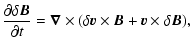
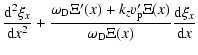
Equation (22a) shows that the plasma displacement
parallel to the ambient field does not vanish even in the cold
plasma approximation (p=0). The non-zero
only.
In order to derive Eq. (22), Eq. (22a)
uses Eqs. (22d) and (22e),
Eq. (22b) uses
Eq. (22d), and Eq. (22f) is a combination of Eqs. (22c), (22d), and (22e).
Equation (22a) shows that the plasma displacement
parallel to the ambient field does not vanish even in the cold
plasma approximation (p=0). The non-zero  can affect and then
modulate the motion of plasma along the field lines. This
modulation will occur at the frequency of the resonant shear Alfvén
waves
and should be observed in the X-ray fluxes.
can affect and then
modulate the motion of plasma along the field lines. This
modulation will occur at the frequency of the resonant shear Alfvén
waves
and should be observed in the X-ray fluxes.
We set the magnetic field in the z-direction with
gradients in the ambient parameters in the x-direction (
)
only, i.e.
 ,
and further
,
and further
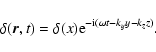 |
(23) |
 and
and
 and
and
 are
functions of x. For
are
functions of x. For
 Eqs. (24) and (25) reduce to the one
obtained in Sect. 2.2.1, Eqs. (11), (15) and (16)
with
Eqs. (24) and (25) reduce to the one
obtained in Sect. 2.2.1, Eqs. (11), (15) and (16)
with  replaced by h, as expected.
Mathematically our result is similar to the one obtained by Harrold & Samson (1992),
however, they considered a different model in which
flow in the Earth's magnetosheath is perpendicular to the B-field and there
is no ambient flow in the region of FLRs.
For a constant flow along magnetic field lines, i.e.
 ,
Eq. (24) reduces to
,
Eq. (24) reduces to
 due to the plasma flow and a shear
Alfvén mode
due to the plasma flow and a shear
Alfvén mode
 .
They produce two frequency peaks
in the spectrum that vary with time if the velocities change with
time. The value of
.
They produce two frequency peaks
in the spectrum that vary with time if the velocities change with
time. The value of
 where L is the length of
the field line and is of the order of the radius of the neutron star,
where L is the length of
the field line and is of the order of the radius of the neutron star,
 .
Therefore, for
.
Therefore, for
 cm and
 cm s-1 we get
 Hz, which is
comparable to the frequencies of the observed QPOs.
In the limit
Hz, which is
comparable to the frequencies of the observed QPOs.
In the limit
 these modes become a
single mode of a regular Alfvén resonance. In the case of
these modes become a
single mode of a regular Alfvén resonance. In the case of
 this mode becomes consistent with a single mode (17). For a superalfvénic flow, i.e.
 ,
however, the MHD Alfvén waves and the resulting FLRs are
suppressed due to propagation of the MHD wave,
.
In the case of superalfvénic plasma flow, one has
,
however, the MHD Alfvén waves and the resulting FLRs are
suppressed due to propagation of the MHD wave,
.
In the case of superalfvénic plasma flow, one has
 |
(28) |
As a result, we expect that
the two FLR peaks (Eq. (27)) occur where
and
are
more or less comparable (i.e. of the same order of magnitude). As we now show,
using the flow velocity and the Alfvén velocity definitions below,
one might expect that the FLRs likely occur at
 .
.
![\begin{figure}
\par\includegraphics[angle=0,width=7.3cm,clip]{1796fig3.eps}
\end{figure}](/articles/aa/full/2005/24/aa1796-04/img189.gif) |
Figure 3:
Frequency of the regular Alfvén resonance
(
)
as function of r,
 .
The closer to
the star the higher the frequency. From bottom to top .
The closer to
the star the higher the frequency. From bottom to top
 and .8c, respectively. Here
km,
and
and .8c, respectively. Here
km,
and
 . . |
| Open with DEXTER | |
![\begin{figure}
\par\includegraphics[angle=0,width=7.3cm,clip]{1796fig4.eps}
\end{figure}](/articles/aa/full/2005/24/aa1796-04/img190.gif) |
Figure 4:
Frequency of the regular Alfvén resonance (
)
as a function of
the Alfvén wave speed at the stellar radius,
.
The larger the Alfvén speed the
higher the frequency. From top to bottom
 ,
and 4, respectively. Here
km,
and
. ,
and 4, respectively. Here
km,
and
.
|
| Open with DEXTER | |
 and
and
 where
where
 is the free fall mass density,
one can rewrite Eq. (27) as:
is the free fall mass density,
one can rewrite Eq. (27) as:
 |
 |
 |
|
|
 |
(29) |

 cm s-1 and
 cm s-1 are inflow and Alfvén
velocities at the surface of the star. Here
is the magnetic field dipole
moment at the surface of the star in units of 1026 G cm3,
is the mass of accretion rate in units of 1017 g s-1,
cm s-1 are inflow and Alfvén
velocities at the surface of the star. Here
is the magnetic field dipole
moment at the surface of the star in units of 1026 G cm3,
is the mass of accretion rate in units of 1017 g s-1,
 ,
and
is the radius of the star. Figures 3 and 4 show the regular
Alfvén resonance frequencies (
)
or FLRs, as a
function of distance from the star and the Alfvén
speed. It is clear that the closer to the star and/or the
larger the Alfvén velocity the higher the frequency. Therefore,
for an Alfvén speed of say
,
and
is the radius of the star. Figures 3 and 4 show the regular
Alfvén resonance frequencies (
)
or FLRs, as a
function of distance from the star and the Alfvén
speed. It is clear that the closer to the star and/or the
larger the Alfvén velocity the higher the frequency. Therefore,
for an Alfvén speed of say
 one obtains the
frequency of about 1000 Hz at
one obtains the
frequency of about 1000 Hz at
 as expected.
Furthermore, since the Alfvén velocity depends on the energy density
(or density) of the plasma which varies due to
several processes such as magneto-turbulence at boundaries during
the accretion, the resulting FLR frequencies will also vary with
time. In addition, the position where the resonance takes place
is also subject to change in time due to the time-varying
accretion rate. Such time-varying behavior causes time varying
frequencies or quasi-periodic frequencies, as observed.
as expected.
Furthermore, since the Alfvén velocity depends on the energy density
(or density) of the plasma which varies due to
several processes such as magneto-turbulence at boundaries during
the accretion, the resulting FLR frequencies will also vary with
time. In addition, the position where the resonance takes place
is also subject to change in time due to the time-varying
accretion rate. Such time-varying behavior causes time varying
frequencies or quasi-periodic frequencies, as observed.
Setting  as the observed peak separation frequency
 and
and  as the upper QPO
frequency
as the upper QPO
frequency
 ,
one can find
,
one can find
 and
as
and
as
vs.
and ,
respectively, along with the observed values. The curves are drawn
by assuming
 with (top to bottom)
 Hz, 750 Hz, and 650 Hz. As shown by
observations, the value of
decreases when the
magnitude of
decreases (sufficiently) and/or it increases.
Such behavior is expected in our model (see Fig. 6).
Hz, 750 Hz, and 650 Hz. As shown by
observations, the value of
decreases when the
magnitude of
decreases (sufficiently) and/or it increases.
Such behavior is expected in our model (see Fig. 6).
![\begin{figure}
\par\includegraphics[angle=0,width=7.5cm,clip]{1796fig5.eps}
\end{figure}](/articles/aa/full/2005/24/aa1796-04/img219.gif) |
Figure 5:
Variation of the spectral peak separation
with
the lower frequency ,
see Eqs. (31) and (31b).
The resulting curves are compared
with the observed values for different systems.
The solid curves
from bottom to top correspond to
 and 860 Hz. The dashed curve corresponds to
 Hz. Here we assumed Hz. Here we assumed
 km, km,
 ,
and . ,
and . |
| Open with DEXTER | |
![\begin{figure}
\par\includegraphics[angle=0,width=8.5cm,clip]{1796fig6.eps}
\end{figure}](/articles/aa/full/2005/24/aa1796-04/img220.gif) |
Figure 6:
Variation of the spectral peak separation
with the upper frequency ,
see Eqs. (31a) and (31b).
The resulting curves are compared
with the observed values for different systems.
The solid curves
from bottom to top correspond to
and 860 Hz. The dashed curve corresponds to
Hz. Here we assumed
km,
,
and .
|
| Open with DEXTER | |
The lower QPO frequency can also be rewritten as
 .
As a result,
we obtain the frequency ratio
to
.
As a result,
we obtain the frequency ratio
to
and the Alfvén
velocity ,
one can obtain different frequency ratios.
For example, if the velocity of the inflow plasma is 2 (
 )
times greater than the Alfvén velocity, i.e.
)
times greater than the Alfvén velocity, i.e.
 ,
one
can get a 2:3 (3:5) ratio. For a free-falling plasma along the
lines of a dipolar magnetic field,
,
one
can get a 2:3 (3:5) ratio. For a free-falling plasma along the
lines of a dipolar magnetic field,
 ,
whereas
,
whereas
 ,
the condition
,
the condition
 (
(
 )
is satisfied at
)
is satisfied at
 (here
(here
 is assumed).
The occurrence of FLRs is very
likely to be at this distance from the star.
is assumed).
The occurrence of FLRs is very
likely to be at this distance from the star.
Such pairs of high frequencies with a 2:3 frequency ratio have
been observed in the X-ray flux of some neutron stars in
LMXBs and black hole
systems (the 3:5 ratio has been in one source), and it would
appear that this feature is common to those systems.
However, recent statistical analyses by Belloni et al. (2004,2005) showed that
although the two high and low kHz QPO frequencies in LMXBs are well correlated,
the frequency-frequency correlation is significantly different from
a 2:3 relation. They analyzed all published values of kHz QPO frequencies
from neutron star systems and found that the strong linear correlation observed
between the lower and upper kHz QPO frequencies in both Atoll and Z sources
is not compatible with a single constant ratio.
Furthermore, by analysis of a much larger RXTE/PCA dataset for Sco X-1, they showed that
there is no sharp concentration around a 2:3 ratio, but that the ratios
are broadly distributed over the range
820-1150 Hz.
The explanation for such rational ratios is still a mystery. In black hole systems, it has been suggested that such frequencies correspond to a trapped g-mode or c-mode of disk oscillation in the Kerr metric, see for example Kato (2001) and references therein. In neutron star systems they are explained as the fundamental and the first harmonic of the non-axisymmetric (m=1) g-mode (Kato 2002,2003). Further, Rezzolla et al. (2003a,b) studied small perturbations of an accretion torus orbiting close to the black hole and modeled the observed high QPO frequencies with basic p-modes of relativistic tori. They showed that these modes behave as sound waves trapped in the torus with eigenfrequencies appearing in the sequence 2:3:4:... Abramowicz et al. (2003) also proposed that the observed rational ratios of frequencies may be due to the strong gravity of the compact object and a non-linear resonance between radial and vertical oscillations in accretion disks.
In the present work, we have studied the interaction of an accretion disk with a neutron star magnetosphere in the LMXBs. The recent extensive observations reveal the existence of quasi-periodic oscillations in the X-ray fluxes of such stars. These oscillations, with frequencies ranging from 10 Hz to 1200 Hz, have been the subject of several theoretical and observational investigations. Based on theoretical models for the observed aurora in the Earth's magnetosphere, we have introduced a generic magnetospheric model for accretion disk-neutron star systems to address the occurrence and the behavior of the observed QPOs in those systems. In order to explain those QPOs consistently, we consider the interaction of the accreting plasma with the neutron star magnetosphere. Due to the strong gravity of the star, a very steep and supersonic flow hits the magnetosphere boundary and deforms its structure drastically. Such a plasma flow can readily excite different MHD waves in the magnetosphere, including shear Alfvén waves.
In the Earth's magnetosphere, occurrence of aurorae is a result of
the resonant coupling between the shear Alfvén waves and the fast
compressional waves (produced by the solar wind). These resonances
are known as FLRs and are reviewed in detail in Sect. 2 of this paper. We argue that such resonant coupling
is likely to occur in neutron star magnetospheres due to the
interaction with accreting plasma. In the context
of QPOs in neutron star magnetospheres, we formulated an improved FLR
model by considering a plasma flow moving with velocity
along the
magnetic field lines. Such flows are likely to occur in a neutron star
magnetosphere (Ghosh et al. 1977). For a simple geometry, a
rectilinear magnetic field, and in the presence of a plasma flow
we found: (a) two resonant MHD modes with
frequencies
 ;
(b) the
resulting frequencies for
;
(b) the
resulting frequencies for
 cm-1 and typical flow and/or Alfvén velocity .1 cat the stellar surface will be in kHz range within a few stellar radii.
Our results match the kHz oscillations
observed in the X-ray fluxes in LMXBs. As shown in Figs. 3 and 4, the closer to the star
and/or the larger the Alfvén velocity the higher the frequency;
(c) the quasi-periodicity of the observed oscillations can be
understood by noting that due to several processes such as
magneto-turbulence at boundaries and the time varying accretion
rate, the FLR frequencies may vary with time; (d) a non-zero
plasma displacement along the magnetic field lines .
Such a displacement, which oscillates with resulting frequencies
cm-1 and typical flow and/or Alfvén velocity .1 cat the stellar surface will be in kHz range within a few stellar radii.
Our results match the kHz oscillations
observed in the X-ray fluxes in LMXBs. As shown in Figs. 3 and 4, the closer to the star
and/or the larger the Alfvén velocity the higher the frequency;
(c) the quasi-periodicity of the observed oscillations can be
understood by noting that due to several processes such as
magneto-turbulence at boundaries and the time varying accretion
rate, the FLR frequencies may vary with time; (d) a non-zero
plasma displacement along the magnetic field lines .
Such a displacement, which oscillates with resulting frequencies
 ,
modulates the flow of the plasma toward the surface
of the neutron star. As a result, the X-ray flux from the star will
show these frequencies as well; (e) setting
,
modulates the flow of the plasma toward the surface
of the neutron star. As a result, the X-ray flux from the star will
show these frequencies as well; (e) setting
 and
and
 ,
one can explain the behavior of the
peak separation frequency
relative to the upper QPO frequency .
As observed, the value of decreases as the magnitude of
decreases and/or increases.
Figure 6 clearly shows such a behavior; (f) for
(obtained at
,
one can explain the behavior of the
peak separation frequency
relative to the upper QPO frequency .
As observed, the value of decreases as the magnitude of
decreases and/or increases.
Figure 6 clearly shows such a behavior; (f) for
(obtained at
 for
for
 ),
the frequency ratio
),
the frequency ratio
 is comparable with the observed frequency ratio 2:3 in some neutron star systems. However, a broad range of
frequency ratios (Belloni et al. 2004,2005) is expected as values
of
and
change.
is comparable with the observed frequency ratio 2:3 in some neutron star systems. However, a broad range of
frequency ratios (Belloni et al. 2004,2005) is expected as values
of
and
change.
Interestingly, using the observed values of QPO frequencies, one
can determine the mass density and the magnetic dipole moment
of the star using
 |
(33a) | ||
 |
(33b) |
 ,
,
 ,
,
and B0 is the magnetic field
strength at the surface of the star. In Table 1, we calculate
the average density
,
,
and B0 is the magnetic field
strength at the surface of the star. In Table 1, we calculate
the average density
 and magnetic dipole moment
 of the star for a fixed value x=10. Note that larger frequencies
may occur at smaller distances, i.e. x<10. Our results are
compatible with realistic neutron star parameters.
of the star for a fixed value x=10. Note that larger frequencies
may occur at smaller distances, i.e. x<10. Our results are
compatible with realistic neutron star parameters.
Furthermore, our model is able to explain the low frequency
(10 Hz) quasi-periodic oscillations observed in rapid
bursters such as MXB 1730-335 and GRO J1744-28 (Masetti et al. 2000). Such
low frequencies can be extracted from the model by considering
smaller inflow/Alfvén velocities and/or further distances from the
star.
Nevertheless, in order to avoid a number of complexities in our calculations, we used approximations such as slow rotation and a cold plasma. These assumptions may place some restrictions on the validity of our model and results. Future studies will be devoted to overcoming these restrictions.
Acknowledgements
V.R. wishes to thank Mariano Mendez for kindly providing QPO data. The authors appreciate the referee's careful reading of the manuscript and valuable suggestions. This research was supported by the National Sciences and Engineering Research Council of Canada.









![$\displaystyle \nu_2(x)\simeq k_zv_{\rm p}(R_{\rm s})\big[x^{-1/2}
+2.5\mu_{26}\...
.../ M_\odot\right)^{-1/4}\left(R_{\rm s}/ 10~{\rm km}\right)^{-7/4}x^{-9/4}\big],$](/articles/aa/full/2005/24/aa1796-04/img212.gif)
![$\displaystyle \Delta\nu(x)\simeq k_zv_{\rm p}(R_{\rm s})\big[x^{-1/2}-2.5\mu_{2...
.../ M_\odot\right)^{-1/4}\left(R_{\rm s}/ 10~{\rm km}\right)^{-7/4}x^{-9/4}\big].$](/articles/aa/full/2005/24/aa1796-04/img213.gif)


