![[*]](/icons/foot_motif.gif)
.
.
.
.
.
.
.
.
.
.
.
.
.
.
.
.
.
.
.
.
.
.
.
.
.
.
.
.
.
.
.
.
.
.
.
.
.
.
.
.
.
.
.
.
.
.
.
.
.
.
.
.
.
.
.
.
.
.
.
.
 .
The frequency of
orbital motion at the ISCO, the highest possible stable orbital
frequency, is
.
The frequency of
orbital motion at the ISCO, the highest possible stable orbital
frequency, is
 .
.
. . . . . . . . . . . . . . . . . . . . . . . . . . . . . .
 .
At the point where magnetosphere interacts with the accretion disk
(more likely at the disk's inner edge),
however, there is a sudden increase in the magnetospheric plasma density,
say
.
At the point where magnetosphere interacts with the accretion disk
(more likely at the disk's inner edge),
however, there is a sudden increase in the magnetospheric plasma density,
say
 ,
due to
the motion of accretion material along field lines. After this thin region (compared
to the entire magnetosphere), the
magnetospheric plasma density drops to
again. Therefore,
the enhanced density gradient
region is not a region with a gradient in the plasma density only. It is a region
with a different (higher) plasma density compared into the rest of the magnetosphere.
,
due to
the motion of accretion material along field lines. After this thin region (compared
to the entire magnetosphere), the
magnetospheric plasma density drops to
again. Therefore,
the enhanced density gradient
region is not a region with a gradient in the plasma density only. It is a region
with a different (higher) plasma density compared into the rest of the magnetosphere.
.
.
.
.
.
.
.
.
.
.
.
.
.
.
.
.
.
.
.
.
.
.
.
.
.
.
.
.
.
.
 ,
one needs to
integrate the momentum Eq. (1a):
,
one needs to
integrate the momentum Eq. (1a):


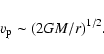
where M is the mass of the neutron star (Ghosh et al. 1977; Mestel 1968a,b). In the above equation the pressure term is neglected. Equation (6) shows conservation of energy in a frame corotating with the star, while in a nonrotating frame the extra term
 appears, that represents the
work done by the magnetic field on the flowing plasma. However, as
argued by Ghosh et al. (1977) the poloidal velocity in the inner magnetosphere
where
appears, that represents the
work done by the magnetic field on the flowing plasma. However, as
argued by Ghosh et al. (1977) the poloidal velocity in the inner magnetosphere
where
 is nearly equal to the free-fall velocity, i.e.
.
.
.
.
.
.
.
.
.
.
.
.
.
.
.
.
.
.
.
.
.
.
.
.
.
.
.
.
.
.
.
.
.
.
.
.
.
.
.
.
.
.
.
.
.
.
.
.
.
.
.
.
.
.
.
.
.
.
.
.
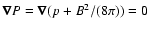 .
This is
valid for a non-rotating or very slowly rotating star.
.
This is
valid for a non-rotating or very slowly rotating star.
.
.
.
.
.
.
.
.
.
.
.
.
.
.
.
.
.
.
.
.
.
.
.
.
.
.
.
.
.
.
 vanishes in
the cold plasma.
vanishes in
the cold plasma.
.
.
.
.
.
.
.
.
.
.
.
.
.
.
.
.
.
.
.
.
.
.
.
.
.
.
.
.
.
.
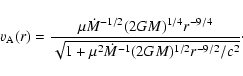
Here we assumed p=0. Using the above relation the Alfvén velocity at the surface of the star will be
 0.8 c, .997 c, and c for
 ,
and
1028 G cm3, respectively. At further distances from the
star, however, the relativistic Alfvén velocity reduces to its
classical version which we used instead.
The values given here for the relativistic
Alfvén velocity at the stellar surface are for a neutron star with
,
and
1028 G cm3, respectively. At further distances from the
star, however, the relativistic Alfvén velocity reduces to its
classical version which we used instead.
The values given here for the relativistic
Alfvén velocity at the stellar surface are for a neutron star with
 km,
km,
 g s-1 and
  .
.
. . . . . . . . . . . . . . . . . . . . . . . . . . . . . .
.
.
.
.
.
.
.
.
.
.
.
.
.
.
.
.
.
.
.
.
.
.
.
.
.
.
.
.
.
.