Bootis
![[*]](/icons/foot_motif.gif)
A&A 434, 1085-1095 (2005)
DOI: 10.1051/0004-6361:20042140
BootisF. Carrier1 - P. Eggenberger1 - F. Bouchy1,2
1 - Observatoire de Genève, 51 chemin de Maillettes,
1290 Sauverny, Switzerland
2 - Laboratoire d'Astrophysique de Marseille, Traverse du Siphon, BP 8, 13376 Marseille Cedex 12, France
Received 8 October 2004 / Accepted 31 December 2004
Abstract
Several attempts have been made to detect solar-like oscillations in the
G0 IV star Boo. We present here new observations on this star
simultaneously conducted with two spectrographs: CORALIE
mounted on the 1.2-m Swiss telescope at the ESO La Silla Observatory (Chile)
and ELODIE based on the 1.93-m telescope at the Observatoire de Haute-Provence (France). In total, 1239 spectra were collected over 13 nights.
The power spectrum of the high precision velocity time
series clearly presents several identifiable peaks between 0.4 and 1.0 mHz showing
regularity with a large and small separation of  = 39.9
  Hz and
 = 3.95 Hz respectively. Twenty-two individual
frequencies have been identified. Detailed models based on these measurements and
non-asteroseismic observables were computed
using the Geneva evolution code including shellular rotation and atomic diffusion.
By combining these seismological data with non-asteroseismic observations, we determine
the following global parameters for Boo:
a mass of
= 3.95 Hz respectively. Twenty-two individual
frequencies have been identified. Detailed models based on these measurements and
non-asteroseismic observables were computed
using the Geneva evolution code including shellular rotation and atomic diffusion.
By combining these seismological data with non-asteroseismic observations, we determine
the following global parameters for Boo:
a mass of

 ,
an age
,
an age
 Gyr and an initial metallicity
 .
We also show that the mass of
Boo is very sensitive to the choice of the observed metallicity, while
the age of
Boo depends on the input physics used.
Indeed, a higher metallicity favours a higher mass, while
non-rotating models without overshooting predict a smaller age.
.
We also show that the mass of
Boo is very sensitive to the choice of the observed metallicity, while
the age of
Boo depends on the input physics used.
Indeed, a higher metallicity favours a higher mass, while
non-rotating models without overshooting predict a smaller age.
Key words: stars: individual: Boo - stars variables: general - stars: fundamental parameters - techniques: radial velocities
A primary target for the search for p-mode oscillations is the well-studied bright subgiant G0
Bootis (HR5235). Several attempts have been made to detect solar-like oscillations in the
G0 IV star
Boo. The first result was obtained by Kjeldsen et al. (1995)
with observations conducted with the 2.5-m Nordic Optical Telescope (NOT) on La Palma.
In contrast to all other detections which were based on velocity measurements
obtained using high-dispersion spectrographs with stable references, they monitored changes
in the equivalent widths (EW) of temperature-sensitive spectral lines. This enabled them to determine
a large separation of 40.3 Hz. Meanwhile, a search for velocity oscillations in
Boo
using the AFOE spectrograph
by Brown et al. (1997) has failed to detect a stellar signal.
The analysis of NOT data was refined by Kjeldsen et al. (2003)
using all existing complementary data: new EW measurements obtained with the NOT, new
radial velocities (RV) measured at Lick Observatory and RVs from Brown with the AFOE spectrograph.
They found a large separation of = 40.4 Hz and identified 21 oscillation
frequencies.
In this paper, we report Doppler observations of
Bootis made with the CORALIE and
the ELODIE spectrographs in a multi-site configuration. These new measurements confirm the detection of p-modes
and enable the identification of twenty-two individual mode frequencies, which are compared with those
independently identified by Kjeldsen et al. (2003). We also present new models of
Boo based on our seismological
constraints. The observations and data
reduction are presented in Sect. 2, the acoustic spectrum analysis and the mode identification
in Sect. 3, the calibration and modeling of
Boo in Sect. 4, and the conclusion is given in Sect. 5.
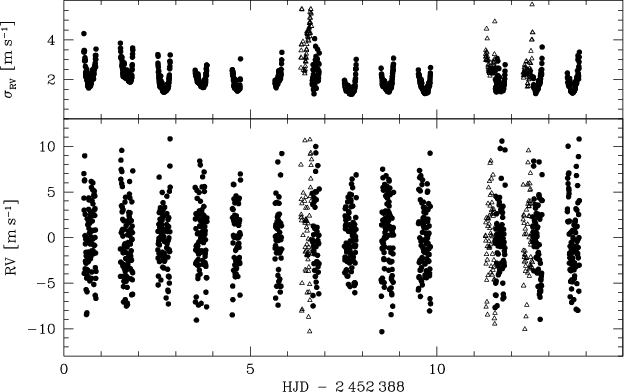 |
Figure 1:
Radial-velocity measurements of
Boo. The dispersion
reaches 3.8 m s-1. CORALIE and ELODIE data are represented with full circles and open
triangles respectively. The upper panel represents the photon noise uncertainties. |
| Open with DEXTER | |
Boo was observed in May 2002 simultaneously with the spectrographs
CORALIE at La Silla Observatory (Chile) and ELODIE
at the Observatoire de Haute-Provence (France) in order to improve the window function
and to make the mode identification easier (see Sect. 3).
Boo was observed over fourteen nights (April 23-May 07 2002) with CORALIE, the high-resolution (50 000)
echelle spectrograph mounted on the 1.2-m Swiss telescope at La Silla, known for the p-mode identification in
the  Cen system (Bouchy & Carrier 2002; Carrier & Bourban 2003).
During the stellar exposures, the spectrum of a
thorium lamp carried by a second fiber is simultaneously recorded in order to
monitor the spectrograph's stability and thus to obtain high-precision
velocity measurements. A description of the spectrograph and the data reduction process is
presented in Carrier et al. (2001) and Bouchy et al. (2001).
Exposure times of 180 s, thus cycles of 295 s with a dead-time of 115 s, allowed us to obtain 1055 spectra,
with a typical signal-to-noise ratio (S/N) in the range of 115-260 at 550 nm.
For each night, radial velocities were computed relative to the
highest signal-to-noise ratio optical spectrum obtained in the middle of the
night. The mean for each night is then subtracted.
The radial velocity measurements are shown in Fig. 1 and their distribution and
dispersion are listed in Table 1. The dispersion of these measurements reaches 3.6 m s-1.
Cen system (Bouchy & Carrier 2002; Carrier & Bourban 2003).
During the stellar exposures, the spectrum of a
thorium lamp carried by a second fiber is simultaneously recorded in order to
monitor the spectrograph's stability and thus to obtain high-precision
velocity measurements. A description of the spectrograph and the data reduction process is
presented in Carrier et al. (2001) and Bouchy et al. (2001).
Exposure times of 180 s, thus cycles of 295 s with a dead-time of 115 s, allowed us to obtain 1055 spectra,
with a typical signal-to-noise ratio (S/N) in the range of 115-260 at 550 nm.
For each night, radial velocities were computed relative to the
highest signal-to-noise ratio optical spectrum obtained in the middle of the
night. The mean for each night is then subtracted.
The radial velocity measurements are shown in Fig. 1 and their distribution and
dispersion are listed in Table 1. The dispersion of these measurements reaches 3.6 m s-1.
Table 1: Distribution and dispersion of Doppler measurements. Indications for ELODIE measurements are in brackets.
In order to compute the power spectrum of the velocity time series, we use
the Lomb-Scargle modified algorithm (Lomb 1976; Scargle 1982)
with a weight being assigned to each
point according its uncertainty estimate. The time scale gives a formal resolution
of 0.87 Hz. The resulting periodogram, shown in Fig. 2,
exhibits a series of peaks near 0.8 mHz, exactly where
the solar-like oscillations for this star are expected.
Typically for such a power spectrum, the noise has two components:
 calculated between 1.2 and 1.6 mHz
is 0.0179 m2 s-2, namely 11.9 cm s-1 in amplitude. With 1239 measurements, this high frequency noise
corresponds to
calculated between 1.2 and 1.6 mHz
is 0.0179 m2 s-2, namely 11.9 cm s-1 in amplitude. With 1239 measurements, this high frequency noise
corresponds to
 m s-1. This radial velocity uncertainty,
larger than for other stars observed with the spectrograph CORALIE (see e.g. Eggenberger et al. 2004a or
Bouchy & Carrier 2002), can be mainly explained by the high rotational velocity of
Boo (
m s-1. This radial velocity uncertainty,
larger than for other stars observed with the spectrograph CORALIE (see e.g. Eggenberger et al. 2004a or
Bouchy & Carrier 2002), can be mainly explained by the high rotational velocity of
Boo (
 km s-1, determined
from CORALIE spectra).
km s-1, determined
from CORALIE spectra).
 .
Note that the filtering induced by the radial velocity computation does not influence the frequency of the peaks in the
range 0.4-1.1 mHz, but could slightly change their amplitudes.
The amplitude of the strongest peaks reaches 79 cm s-1, corresponding to a signal to noise ratio of 6 (in the amplitude spectrum).
This amplitude is estimated as the height of the peaks in the power spectrum with a quadratic subtraction of the mean noise level.
The analysis of the 184 ELODIE spectra in addition to the CORALIE spectra allows us to diminish the
first and second daily aliases (11.57 and 23.14 Hz) by only 9 %. Note that a full coverage of ELODIE data would
have allowed us to diminish daily aliases by 33%.
.
Note that the filtering induced by the radial velocity computation does not influence the frequency of the peaks in the
range 0.4-1.1 mHz, but could slightly change their amplitudes.
The amplitude of the strongest peaks reaches 79 cm s-1, corresponding to a signal to noise ratio of 6 (in the amplitude spectrum).
This amplitude is estimated as the height of the peaks in the power spectrum with a quadratic subtraction of the mean noise level.
The analysis of the 184 ELODIE spectra in addition to the CORALIE spectra allows us to diminish the
first and second daily aliases (11.57 and 23.14 Hz) by only 9 %. Note that a full coverage of ELODIE data would
have allowed us to diminish daily aliases by 33%.
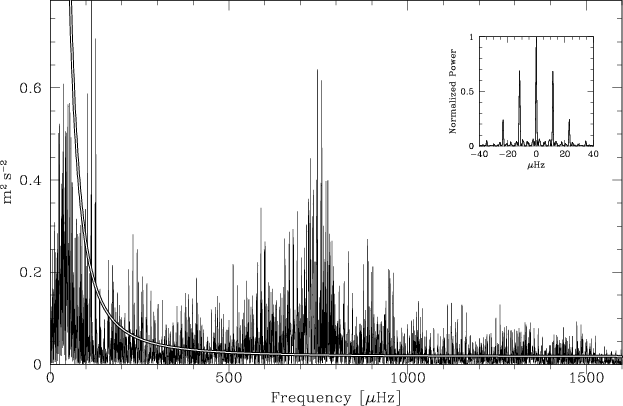 |
Figure 2:
Power spectrum of the radial velocity measurements of
Boo.
The window function is shown in the inset. The noise is represented by the white line. |
| Open with DEXTER | |
In solar-like stars, p-mode oscillations of low-degree are expected to produce a
characteristic comb-like structure in the power spectrum with mode
frequencies
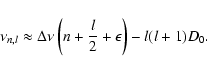
 reasonably well approximated by the asymptotic
relation (Tassoul 1980):
reasonably well approximated by the asymptotic
relation (Tassoul 1980):
 if the
asymptotic relation holds exactly, and
if the
asymptotic relation holds exactly, and  are sensitive to the sound speed near the core and to
the surface layers respectively.
The quantum numbers n and l correspond to the radial
order and the angular degree of the modes, and
and
to the large and small separations.
To search for periodicity in the power spectrum, an autocorrelation
is calculated and presented in Fig. 3. As the large spacing is not
strictly constant, we use an undersampled power spectrum with a resolution of 1.75 Hz.
We are thus less sensitive to small variations of the large spacing versus the frequency.
Each peak of the autocorrelation corresponds to a structure present in the power spectrum.
The two strong peaks at low frequency close to 11.5 and 23 Hz
correspond to the daily aliases. The most probable large spacing
is situated near 40 Hz for
Boo.
The result of the autocorrelation confirms the large spacing of 40.4 Hz deduced
from Kjeldsen et al. (2003).
are sensitive to the sound speed near the core and to
the surface layers respectively.
The quantum numbers n and l correspond to the radial
order and the angular degree of the modes, and
and
to the large and small separations.
To search for periodicity in the power spectrum, an autocorrelation
is calculated and presented in Fig. 3. As the large spacing is not
strictly constant, we use an undersampled power spectrum with a resolution of 1.75 Hz.
We are thus less sensitive to small variations of the large spacing versus the frequency.
Each peak of the autocorrelation corresponds to a structure present in the power spectrum.
The two strong peaks at low frequency close to 11.5 and 23 Hz
correspond to the daily aliases. The most probable large spacing
is situated near 40 Hz for
Boo.
The result of the autocorrelation confirms the large spacing of 40.4 Hz deduced
from Kjeldsen et al. (2003).
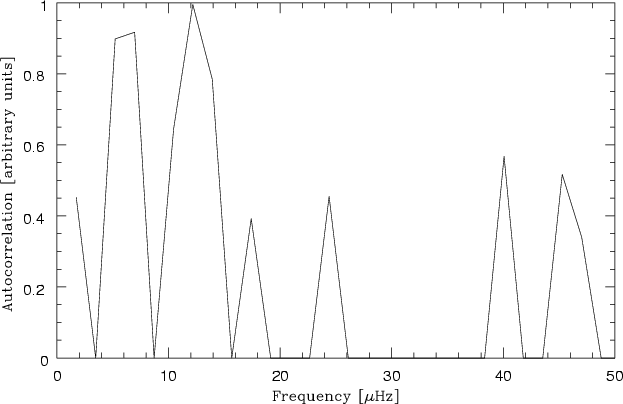 |
Figure 3:
Autocorrelation of the power spectrum undersampled with a resolution of
1.75 Hz and a threshold of 0.2 m2 s-1. The large splitting is estimated
to be about 40 Hz. |
| Open with DEXTER | |
![\begin{figure}
\par\includegraphics[width=8.8cm,clip]{2140f4.eps}\end{figure}](/articles/aa/full/2005/18/aa2140/img37.gif) |
Figure 4:
Top: original power spectrum of
Boo. Bottom: cleaned power spectrum: all peaks listed
in Table 2 have been removed. The dot-dashed, dotted and dashed lines indicate an amplitude of 5 ,
4
and 3,
respectively. Numerous peaks are still present below 3,
since no peaks have been cleaned below this threshold. These peaks can be due to p-mode oscillations and noise or have
artificially been
added by the extraction algorithm due to the finite lifetimes of the modes ,
4
and 3,
respectively. Numerous peaks are still present below 3,
since no peaks have been cleaned below this threshold. These peaks can be due to p-mode oscillations and noise or have
artificially been
added by the extraction algorithm due to the finite lifetimes of the modes |
| Open with DEXTER | |
Table 2:
Identification of extracted frequencies. Some frequencies can be either  modes or due to noise.
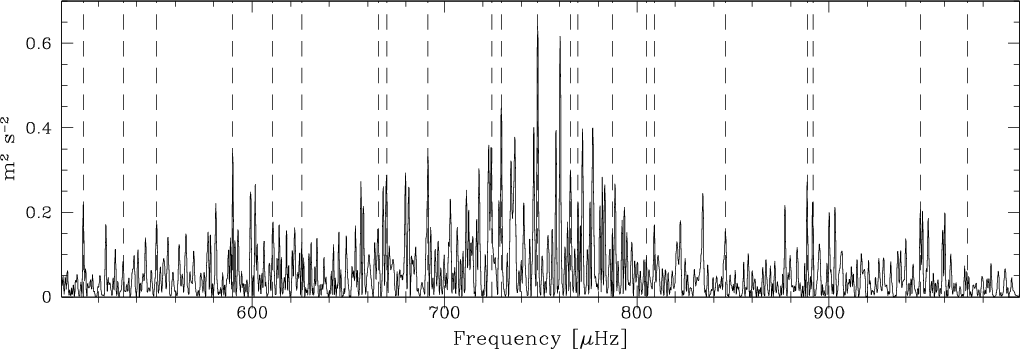 |
Figure 5:
Power spectrum of
Boo with the twenty-two extracted frequencies indicated by dashed lines.
The identification of each extracted frequency is given in Table 3. |
| Open with DEXTER | |
![\begin{figure}
\par\includegraphics[width=8.6cm,clip]{2140f6.eps}\end{figure}](/articles/aa/full/2005/18/aa2140/img40.gif) |
Figure 6:
Echelle diagram of identified modes (in black) with a
large separation of 39.9 Hz. The
modes  (
(
 ), ),  (
( ),
and
( ),
and
(
 )
are represented with a size proportional to
their amplitude. Open symbols correspond to modes determined
by Kjeldsen et al. (2003). Both identifications are
in good agreement at low frequency. However, at high frequency
their
mode frequencies ( )
are represented with a size proportional to
their amplitude. Open symbols correspond to modes determined
by Kjeldsen et al. (2003). Both identifications are
in good agreement at low frequency. However, at high frequency
their
mode frequencies ( )
seem to be identified in this paper
as
modes
(), and their
modes ( )
seem to be identified in this paper
as
modes
(), and their
modes (  )
are not present in our data. )
are not present in our data. |
| Open with DEXTER | |
The frequencies were extracted using an iterative algorithm, which identifies the highest peak between
400 and 1100 Hz and subtracts
it from the time series.
First, we iterated this process until all peaks with an amplitude higher than  were removed
(see Fig. 4).
represents the noise in the amplitude spectrum decreasing from 14.5 to 12.2 cm s-1in the above mentioned interval (see Sect. 3). Peaks with amplitudes below the 3
threshold were
not considered since they
were too strongly influenced by noise and by interactions between noise and daily aliases.
This threshold, which ensures that the selected peaks have
only a small
chance to be due to noise, gave a total of twenty-three frequencies (see Table 2).
Because of the daily alias of 11.57 Hz,
we cannot know a priori whether the frequency
selected by the algorithm is the right one or an alias. We thus considered
that the frequencies could be shifted by
were removed
(see Fig. 4).
represents the noise in the amplitude spectrum decreasing from 14.5 to 12.2 cm s-1in the above mentioned interval (see Sect. 3). Peaks with amplitudes below the 3
threshold were
not considered since they
were too strongly influenced by noise and by interactions between noise and daily aliases.
This threshold, which ensures that the selected peaks have
only a small
chance to be due to noise, gave a total of twenty-three frequencies (see Table 2).
Because of the daily alias of 11.57 Hz,
we cannot know a priori whether the frequency
selected by the algorithm is the right one or an alias. We thus considered
that the frequencies could be shifted by  Hz, and made echelle diagrams
for different large spacings near 40 Hz until each frequency could be identified as
an ,
or
mode.
In this way, we found an average large spacing of 39.9 Hz.
It is difficult to identify
modes as they appear to be mixed modes. Some identified
modes
could thus rather be due to noise, e.g. peaks at 625.7 and 665.4 Hz.
The peak at 728.3 Hz was attributed to noise, however it could be related to the
mode 729.5 Hz
"split'' owing to its lifetime.
Hz, and made echelle diagrams
for different large spacings near 40 Hz until each frequency could be identified as
an ,
or
mode.
In this way, we found an average large spacing of 39.9 Hz.
It is difficult to identify
modes as they appear to be mixed modes. Some identified
modes
could thus rather be due to noise, e.g. peaks at 625.7 and 665.4 Hz.
The peak at 728.3 Hz was attributed to noise, however it could be related to the
mode 729.5 Hz
"split'' owing to its lifetime.
Table 3:
Oscillation frequencies (in Hz). The frequency resolution
of the time series is 0.87 Hz.
The echelle diagram showing the twenty-two identified modes is shown in Fig. 6.
The frequencies of the modes are shown in Fig. 5 and are given in Table 3,
with the radial order of each oscillation mode deduced from the asymptotic relation
(see Eq. (1)) assuming that the parameter
is near the solar value
(
 ).
We can see that the oscillation modes do not strictly follow the asymptotic relation due to mixed
modes
and a large curvature of others modes in the echelle diagram.
The average small spacing has a value of
).
We can see that the oscillation modes do not strictly follow the asymptotic relation due to mixed
modes
and a large curvature of others modes in the echelle diagram.
The average small spacing has a value of
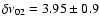 Hz.
The large spacing is separately determined for each value of
Hz.
The large spacing is separately determined for each value of  and is
given in the last line of Table 3. The weighted average of these three
and is
given in the last line of Table 3. The weighted average of these three
 yields the value of
 Hz.
Hz.
The twenty-two identified modes are compared to previously identified ones by Kjeldsen et al. (2003) in Fig. 6. Both identifications are rather in good agreement at low frequency but present major discrepancies at high frequency. Although the present data have a higher S/N, additional measurements are needed to resolve these ambiguities.
Concerning the amplitudes of the modes, theoretical computations predict oscillation
amplitudes between 1 and 1.5 m s-1 for a 1.6
star
like
Boo, with mode lifetimes of the order of a few days
(Houdek et al. 1999). The amplitudes of the highest modes,
in the range 55-80 cm s-1, are then lower than expected. The observations indicate that oscillation amplitudes
are typically 2.5-3.5 times solar.
This disagreement can be partly explained by the lifetimes of the modes.
Indeed, the oscillation modes have finite lifetimes
because they are continuously damped. Thus, if the star is observed for a time longer than
the lifetime of the modes, the signal is weakened due to
the damping of the modes and to their re-excitation with a random phase.
In order to compare the asteroseismic observations with theoretical predictions, stellar models were computed using the Geneva evolution code including shellular rotation and atomic diffusion (see Eggenberger et al. 2005 for more details). We used the OPAL opacities, the NACRE nuclear reaction rates (Angulo et al. 1999) and the standard mixing-length formalism for convection.
Following Di Mauro et al. (2003) (hereafter DM03),
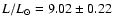
the luminosity of
Boo was deduced from the Hipparcos parallax:
 .
Concerning the effective temperature,
we added recent results to the references used by DM03 to determine
a new average value (see Table 4). As a result, the effective temperature
.
Concerning the effective temperature,
we added recent results to the references used by DM03 to determine
a new average value (see Table 4). As a result, the effective temperature
 K was adopted. This value is in perfect agreement with the
effective temperature of
K was adopted. This value is in perfect agreement with the
effective temperature of
 K used by DM03, with a larger error which seems
to us more realistic in view of the different values found in the literature.
The box in the HR diagram for
Boo
delimited by the observed effective temperature and luminosity is shown in Fig. 7.
K used by DM03, with a larger error which seems
to us more realistic in view of the different values found in the literature.
The box in the HR diagram for
Boo
delimited by the observed effective temperature and luminosity is shown in Fig. 7.
The metallicity of
Boo adopted by DM03 is [Fe/H
![$]=0.305~ \pm~ 0.051$](/articles/aa/full/2005/18/aa2140/img51.gif) .
Compared to different observed metallicities, this value seems to be quite large.
We thus decided to adopt
a lower average value of [Fe/H
.
Compared to different observed metallicities, this value seems to be quite large.
We thus decided to adopt
a lower average value of [Fe/H
![$]=0.23 \pm 0.07$](/articles/aa/full/2005/18/aa2140/img52.gif) ,
which is determined from the recent measurements
listed in Table 4.
,
which is determined from the recent measurements
listed in Table 4.
Finally, we used the observed surface velocity of
Boo to constrain the rotational velocity of our models.
From Coralie spectra, we determined a rotational velocity
km s-1. Since the value of the
angle i is unknown, we assumed that it is close to 90
 .
Thus our models of
Boo have to reproduce a
surface velocity of about 13 km s-1.
.
Thus our models of
Boo have to reproduce a
surface velocity of about 13 km s-1.
Table 4:
Metallicity and temperature determination for
Boo (since 1990).
The errors on the selected parameters are
chosen to encompass all acceptable values (last line).
The computation of a stellar model for a given star consists of finding the set of stellar modeling parameters which best reproduces
all observational
data available for this star.
The characteristics of a stellar model including the effects of rotation
depend on six modeling parameters: the mass M of the star, its age (t hereafter),
the mixing-length parameter
 for convection, the initial surface velocity
 and two parameters describing the initial chemical composition of the star. For these two parameters,
we chose the initial hydrogen abundance
and two parameters describing the initial chemical composition of the star. For these two parameters,
we chose the initial hydrogen abundance
 and the initial ratio between the mass fraction of heavy elements and hydrogen
 .
Assuming that this ratio is proportional to the abundance ratio [Fe/H], we can directly relate (Z/X) to [Fe/H]
by using the solar value
.
Assuming that this ratio is proportional to the abundance ratio [Fe/H], we can directly relate (Z/X) to [Fe/H]
by using the solar value
 given by Grevesse & Sauval (1998).
Moreover, we fixed the mixing-length parameter to its solar calibrated value (
given by Grevesse & Sauval (1998).
Moreover, we fixed the mixing-length parameter to its solar calibrated value (
 )
and we assumed the
initial hydrogen abundance
to be
)
and we assumed the
initial hydrogen abundance
to be
 .
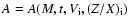
As a result, any characteristic A of a given stellar model has the following formal dependences with respect to modeling parameters:
.
As a result, any characteristic A of a given stellar model has the following formal dependences with respect to modeling parameters:
 .
.
The determination of the set of modeling parameters
 leading to the best agreement
with the observational constraints is made in two steps. First, we constructed a grid of models with position in the HR diagram
in agreement with the observational values of the luminosity and effective temperature (see Fig. 7).
Note that the initial ratio between the mass fraction of heavy elements and hydrogen
is directly constrained by the observed surface metallicity [Fe/H], while the initial velocity
is directly constrained by the observed rotational velocity.
leading to the best agreement
with the observational constraints is made in two steps. First, we constructed a grid of models with position in the HR diagram
in agreement with the observational values of the luminosity and effective temperature (see Fig. 7).
Note that the initial ratio between the mass fraction of heavy elements and hydrogen
is directly constrained by the observed surface metallicity [Fe/H], while the initial velocity
is directly constrained by the observed rotational velocity.
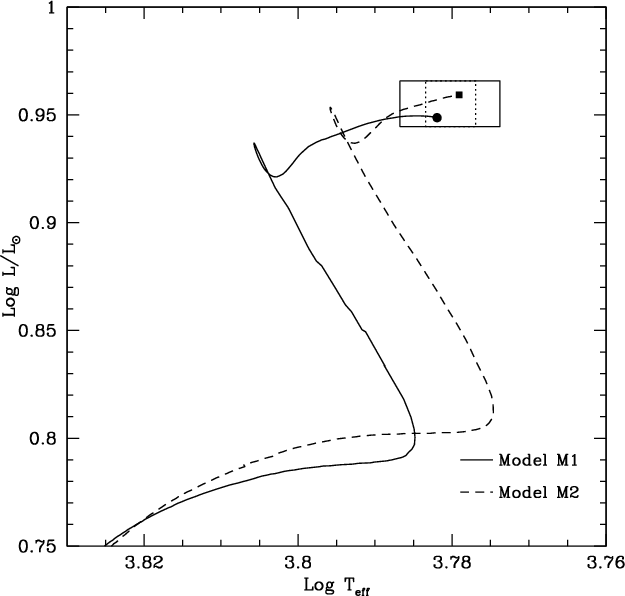 |
Figure 7:
Evolutionary tracks in the HR diagram for two models of
Boo.
The dot and the square indicate the location of the M1 and M2 model respectively.
The error box in continuous line indicates the observational constraints of L and
 used in our
analysis, while the dotted box corresponds to the constraints used by Di Mauro et al. (2003).
used in our
analysis, while the dotted box corresponds to the constraints used by Di Mauro et al. (2003). |
| Open with DEXTER | |
For each stellar model of this grid, low-
p-mode frequencies were then calculated using the Aarhus adiabatic
pulsations package written by Christensen-Dalsgaard (1997). Following our observations, modes
 with frequencies between 0.4 and 1.1 mHz were computed and the mean large (
)
and small spacings (
)
were determined. The mean large spacing was computed by considering only the radial modes.
Once the asteroseismic characteristics of all models of the grid were determined, we performed a
with frequencies between 0.4 and 1.1 mHz were computed and the mean large (
)
and small spacings (
)
were determined. The mean large spacing was computed by considering only the radial modes.
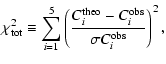
Once the asteroseismic characteristics of all models of the grid were determined, we performed a  minimization
as in Eggenberger et al. (2004b). Thus, two functionals are defined:
minimization
as in Eggenberger et al. (2004b). Thus, two functionals are defined:
 and
and
 .
The
functional is defined as follows:
.
The
functional is defined as follows:
 contains the following observables for one star:
![$\displaystyle {\vec C} \equiv (L/L_{\odot},T_{{\rm eff}},
[{\rm Fe/H}],\Delta \nu,\delta \nu_{02}) .$](/articles/aa/full/2005/18/aa2140/img71.gif) |
 contains the theoretical values of these observables for the model to be tested, while
the values of
contains the theoretical values of these observables for the model to be tested, while
the values of
 are those
listed above. The vector
are those
listed above. The vector
 contains the errors on these observations.
Note that the observed rotational velocity is not included in this minimization because of its large uncertainty resulting
from the unknown inclination angle i.
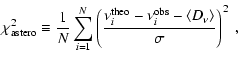
The
functional is defined as follows:
contains the errors on these observations.
Note that the observed rotational velocity is not included in this minimization because of its large uncertainty resulting
from the unknown inclination angle i.
The
functional is defined as follows:
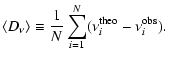
 Hz is the error on the observed frequencies estimated as the frequency resolution, N=22is the number of observed frequencies, and
 is the mean value of the differences between
the theoretical and observed frequencies :
is the mean value of the differences between
the theoretical and observed frequencies :
 |
was determined, we refined the grid in the vicinity of this
preliminary solution in order to find the best solution which minimizes at the same time
and
.
Using the observational constraints listed in Sect. 4.1 with the observed frequencies listed in Table 3,
we performed the
minimization described above. We found the solution
 ,
Gyr,
,
Gyr,
 km s-1 and
.
The position of this model in the HR
diagram (denoted model M1 in the following) is indicated by a dot in Fig. 7.
The characteristics of this model are given in Table 5.
The confidence limits of each modeling parameter given in Table 5 are estimated as the maximum/minimum values which
fit the observational constraints when the other calibration parameters are fixed to their medium value.
Note that the radius deduced for
Boo
km s-1 and
.
The position of this model in the HR
diagram (denoted model M1 in the following) is indicated by a dot in Fig. 7.
The characteristics of this model are given in Table 5.
The confidence limits of each modeling parameter given in Table 5 are estimated as the maximum/minimum values which
fit the observational constraints when the other calibration parameters are fixed to their medium value.
Note that the radius deduced for
Boo
 is in good agreement with the
interferometric radius of
is in good agreement with the
interferometric radius of

 and
and
 determined respectively
with the Mark III optical interferometer (Mozurkewich et al. 2003) and
with the VLTI (Kervella et al. 2004).
determined respectively
with the Mark III optical interferometer (Mozurkewich et al. 2003) and
with the VLTI (Kervella et al. 2004).
Table 5:
Models for
Boo. The M1 and M2 models include rotation and atomic diffusion,
while the M3 model is a standard model computed with an overshooting parameter
 .
The upper part of the table gives the observational constraints used for the
calibration. The middle part of the table presents the modeling parameters with their confidence limits, while the bottom
part presents the global parameters of the star.
.
The upper part of the table gives the observational constraints used for the
calibration. The middle part of the table presents the modeling parameters with their confidence limits, while the bottom
part presents the global parameters of the star.
Theoretical p-mode frequencies of the M1 model are compared to the observed frequencies by plotting the echelle diagram (see Fig. 8).
Note that in this figure the systematic difference
between theoretical and observed frequencies
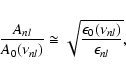
has been taken into account. Following Christensen-Dalsgaard et al. (1995), the theoretical oscillation amplitudes are estimated by
 |
(4) |
the normalized energy of the mode.  and
and
 are
obtained by interpolating to frequency
are
obtained by interpolating to frequency  in the results of radial modes.
The model shows that
modes deviate from the asymptotic relation for p-modes.
This is a consequence of the avoided crossings (Christensen-Dalsgaard et al. 1995; Guenther & Demarque 1996;
DM03; Guenther 2004, hereafter GU04).
This results in frequencies which are shifted relative to the frequencies expected for pure p-modes.
This is particularly true for the
modes at low frequency which strongly deviate from the asymptotic relation.
The observed frequencies for
modes seem to deviate from the asymptotic relation, which is in accordance with
theoretical predictions. However, Fig. 8 shows that the model results are not able to precisely reproduce
the individual frequencies of these modes at low frequency.
![\begin{figure}
\par\includegraphics[width=8.3cm,clip]{2140f8.eps} \end{figure}](/articles/aa/full/2005/18/aa2140/img108.gif) |
Figure 8:
Echelle diagram for the M1 model with a large spacing
 Hz. Open symbols refer to theoretical
frequencies, while the filled circles correspond to the observed frequencies
listed in Table 3. Open circles are used for modes with ,
triangles for ,
squares for
and pentagons for
Hz. Open symbols refer to theoretical
frequencies, while the filled circles correspond to the observed frequencies
listed in Table 3. Open circles are used for modes with ,
triangles for ,
squares for
and pentagons for  .
The
size of the open symbols is proportional to the relative surface amplitude of the mode (see text). Modes with too small
surface amplitudes (e.g. g modes) are not shown on this diagram. .
The
size of the open symbols is proportional to the relative surface amplitude of the mode (see text). Modes with too small
surface amplitudes (e.g. g modes) are not shown on this diagram. |
| Open with DEXTER | |
Figure 8 also shows that
the agreement between observations and theoretical predictions for modes with
and is good, except for the two
modes with
the smallest and the largest frequency ( and 888.7 Hz).
Note that the
modes are also influenced by the avoided crossings.
However, the effects of coupling
become much weaker for these modes than for modes with ,
since p-modes with
penetrate less deep in the stellar interior.
and 888.7 Hz).
Note that the
modes are also influenced by the avoided crossings.
However, the effects of coupling
become much weaker for these modes than for modes with ,
since p-modes with
penetrate less deep in the stellar interior.
The variations of the large and small spacing with frequency are given in Fig. 9.
Large spacings for
modes are not plotted in Fig. 9, since these modes deviate
too strongly from the asymptotic behaviour of pure p-modes.
Table 5 and Fig. 9 show that the mean large spacing of the M1 model is in perfect
agreement with the observed value. The observed variation of the large spacing with the frequency is also correctly reproduced
by the model, except for the large value of the
point close to 900 Hz.
Table 5 and Fig. 9 also show that the observed small spacings are compatible with theoretical predictions.
The observed mean small spacing is however slightly larger than the theoretical one; this is mainly due to the large value
of the observed small spacing at 724.5 Hz.
We conclude that the observed frequencies listed in Table 3 are compatible with theoretical predictions.
Although the general agreement is satisfactory,
we also note some discrepancies between observed and predicted frequencies, especially for the
modes
at low frequency.
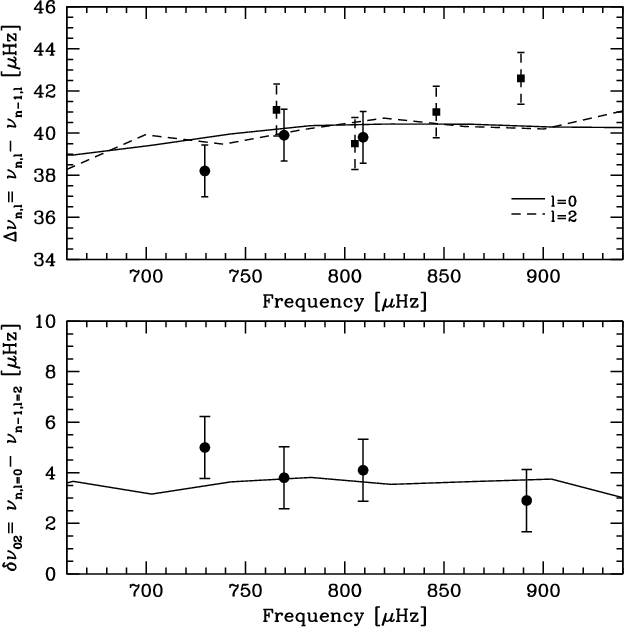 |
Figure 9:
Large and small spacings versus frequency for the M1 model.
Dots indicate the observed values of the large ()
and small spacings, while squares correspond
to the large spacing determined with
modes. |
| Open with DEXTER | |
Detailed studies of
Boo based on the asteroseismic observations of
Kjeldsen et al. (2003) have already been
performed by DM03 and GU04.
Compared to these studies, we notice that our M1 model has a smaller mass. Indeed, DM03 found that the mass of
Boo
is limited to the range
M=(1.64-1.75) ,
while GU04 proposed two different solutions: a model with a mass
of 1.706
which has exhausted its hydrogen core,
and another model with a mass of 1.884
which is still on the main-sequence, but is approaching hydrogen exhaustion.
These two authors used the same non-asteroseismic
constraints (see Sect. 4.1). However, contrary to the analysis by DM03 and contrary to the present work, GU04 used
a calibration method (the QDG method) which is not limited to models with position in the HR diagram in agreement with the observational values of the luminosity and effective temperature.
This explains why GU04 found another solution with a mass of 1.884 ,
while DM03 determined a mass
between 1.64 and 1.75 .
Recently, Di Mauro et al. (2004) (hereafter DM04) showed that main-sequence models
provide a match to the observed location of
Boo in the
HR diagram when overshooting from the convective core (
 )
is included in the computation.
)
is included in the computation.
![\begin{figure}
\par\includegraphics[width=8.3cm,clip]{2140f10.eps} \end{figure}](/articles/aa/full/2005/18/aa2140/img112.gif) |
Figure 10: Helium abundance profile in the external layers of the star at different ages during its evolution on the main-sequence. The model on the top only includes atomic diffusion, while the model on the bottom includes atomic diffusion and shellular rotation. Apart from the inclusion of rotation, the two models have been computed with the same initial parameters corresponding to the M1 model. |
| Open with DEXTER | |
The fact that our M1 model is less massive than the solution of about 1.7 found by DM03 and GU04 can either be due to the different observational constraints used or to the different
input physics of the evolution codes.
Indeed, our models include shellular rotation and atomic diffusion unlike the models calculated
by DM03 and GU04. For stars more massive than about 1.4 ,
it is necessary to introduce another transport mechanism,
like rotationally induced mixing, in order to counteract the effect of atomic
diffusion in the external layers. When only atomic diffusion is included in
a star with a thin convective envelope, helium and heavy elements are drained out
of the envelope, resulting in too low surface abundances which are incompatible with
observation. This is illustrated in Fig. 10 which shows the helium profile in the external
layers at different ages during the evolution on the main-sequence for a model
including only atomic diffusion and for the M1 model which includes shellular rotation and atomic
diffusion. Figure 10 shows that rotationally induced mixing prevents the helium from being
drained out of the convective envelope. Indeed, the decrease of the surface helium abundance during the
main-sequence evolution is found to be very small for models including rotation and atomic diffusion.
To investigate the effects of non-asteroseismic observational constraints on
the solution, we decided to redo the whole calibration
using the non-asteroseismic constraints adopted by DM03 and GU04.
The metallicity was increased to Z=0.04and a temperature of
 K was adopted. Note that we still used our asteroseismic constraints for this calibration.
In this way, we found the solution
K was adopted. Note that we still used our asteroseismic constraints for this calibration.
In this way, we found the solution
 ,
,
 Gyr,
Gyr,
 km s-1 and
 .
The position of this model in the HR
diagram (called model M2 in the following) is denoted by a square in Fig. 7.
The characteristics of the M2 model are given in Table 5.
We conclude that the difference in the adopted value for the metallicity explains the different mass determined. Indeed, Fig. 8
shows that the fact that we used
K instead of
K
has no significant influence on the solution since the M1 model is also included in the smaller observational box determined by DM03.
.
The position of this model in the HR
diagram (called model M2 in the following) is denoted by a square in Fig. 7.
The characteristics of the M2 model are given in Table 5.
We conclude that the difference in the adopted value for the metallicity explains the different mass determined. Indeed, Fig. 8
shows that the fact that we used
K instead of
K
has no significant influence on the solution since the M1 model is also included in the smaller observational box determined by DM03.
The higher metallicity used by DM03 and GU04 results of course from the larger value of the observed [Fe/H]: they adopted
[Fe/H
![$]=0.305 \pm 0.051$](/articles/aa/full/2005/18/aa2140/img118.gif) ,
while we fixed [Fe/H] to
,
while we fixed [Fe/H] to
 for the M1 calibration. However, we notice that it also results from the way
one relates the observed [Fe/H] to the mass fractions Z and X used in the models. Indeed, we directly related (Z/X) to [Fe/H]
by using the solar value
given by Grevesse & Sauval (1998), while DM03 related
Z, and not (Z/X), to [Fe/H]. As a result, for the same value of [Fe/H]=0.305, we determined Z=0.032 while DM03 obtained
a higher value of Z=0.040 (for X=0.7).
for the M1 calibration. However, we notice that it also results from the way
one relates the observed [Fe/H] to the mass fractions Z and X used in the models. Indeed, we directly related (Z/X) to [Fe/H]
by using the solar value
given by Grevesse & Sauval (1998), while DM03 related
Z, and not (Z/X), to [Fe/H]. As a result, for the same value of [Fe/H]=0.305, we determined Z=0.032 while DM03 obtained
a higher value of Z=0.040 (for X=0.7).
We conclude that the derived mass of
Boo is very sensitive to the choice of the observed metallicity. When
a metallicity of [Fe/H
![$]=0.23~ \pm~ 0.07$](/articles/aa/full/2005/18/aa2140/img120.gif) is adopted, a mass of
is adopted, a mass of
 is found. When the higher metallicity determined by
DM03 is used, we obtain a mass of
is found. When the higher metallicity determined by
DM03 is used, we obtain a mass of
 ,
in perfect agreement with the results of
DM03 and GU04.
,
in perfect agreement with the results of
DM03 and GU04.
Contrary to the masses, the ages of the M1 and M2 models are very similar (2.67 and 2.65 Gyr respectively) and are therefore not very
sensitive to a change in metallicity. However, this age is larger than the age of 2.393 Gyr obtained by GU04 for its solution with a mass of
1.706 .
DM03 pointed out that the age of the models depends on the inclusion of overshooting:
the age is about 2.3-2.4 Gyr without overshooting, and between 2.4-2.7 Gyr in the presence of overshooting. The age of
Boo
seems therefore to be sensitive to the input physics used.
To investigate these effects on the solution, we decided to calculate models without rotation
and atomic diffusion using the same observational constraints as the M2 model. In this way, we find the solution
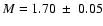 and
and
 Gyr, in perfect accordance with the results of GU04 and
DM03. Rotating models predict a larger age for
Boo than non-rotating ones.
This illustrates the fact that, for small initial velocities, rotational effects are found to mimic the effects due
to an overshoot of the convective core into the radiative zone.
Indeed, the lifetimes of rotating models are enhanced with respect to those of standard models, because
the mixing feeds the core with fresh hydrogen fuel. As a result, the exhaustion of hydrogen in the central
region is delayed and the time spent on the main-sequence increases. This can be seen in Fig. 11
which shows the ratio of the mass of the convective core to the total mass of the star (
Gyr, in perfect accordance with the results of GU04 and
DM03. Rotating models predict a larger age for
Boo than non-rotating ones.
This illustrates the fact that, for small initial velocities, rotational effects are found to mimic the effects due
to an overshoot of the convective core into the radiative zone.
Indeed, the lifetimes of rotating models are enhanced with respect to those of standard models, because
the mixing feeds the core with fresh hydrogen fuel. As a result, the exhaustion of hydrogen in the central
region is delayed and the time spent on the main-sequence increases. This can be seen in Fig. 11
which shows the ratio of the mass of the convective core to the total mass of the star (
 )
as a function of the central hydrogen abundance (
)
as a function of the central hydrogen abundance (
 ).
We see that the rotating model exhibits a larger convective core for a given
,
i.e. for
a given evolutionary stage on the main-sequence, than the standard model without overshooting. In the same
way, the non-rotating model with
also exhibits a larger convective core on the main-sequence
than standard models without overshooting. This explains why the inclusion of rotation or overshooting increases
the lifetimes of the model on the main-sequence and hence the deduced age for
Boo.
).
We see that the rotating model exhibits a larger convective core for a given
,
i.e. for
a given evolutionary stage on the main-sequence, than the standard model without overshooting. In the same
way, the non-rotating model with
also exhibits a larger convective core on the main-sequence
than standard models without overshooting. This explains why the inclusion of rotation or overshooting increases
the lifetimes of the model on the main-sequence and hence the deduced age for
Boo.
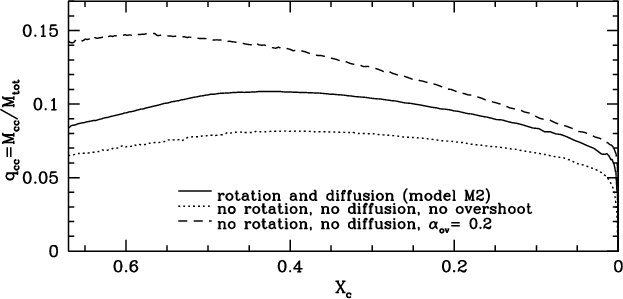 |
Figure 11:
Ratio of the mass of the convective core to the total mass of the star (
)
as a function of the central hydrogen abundance (
), for a standard model without overshooting,
for a standard model with
and for a model with rotation and atomic diffusion.
Apart from the inclusion of rotation and overshooting, the three models have been computed with the same initial
parameters corresponding to the M2 model.
|
| Open with DEXTER | |
Finally, we investigated the solution of a model which is still on the main-sequence. As found by
DM04, these models do not provide a match to the observed
and L of
Boo
unless overshooting is included. Thus, our analysis using the input physics described above leads
to only one solution which is in accordance with asteroseismic and non-asteroseismic
observables: the M1 model which is in the post-main-sequence phase of evolution.
Using the observational constraints listed in Sect. 4.1, we tried to determine a model of
Boo
which is still on the main-sequence by computing non-rotating stellar models including overshooting.
In this way, we found that a model computed with an overshooting parameter
and a mass of 1.7
 enables us to match the location of
Boo in the HR
diagram (see Fig. 12). As discussed above, the mass of this model (denoted model M3 in the following)
is lower than the mass of 1.884
determined by GU04 and the
values of
M=(1.75-1.90)
found by DM04, because of the smaller metallicity used in our
analysis. The characteristics of the M3 model are given in Table 5.
enables us to match the location of
Boo in the HR
diagram (see Fig. 12). As discussed above, the mass of this model (denoted model M3 in the following)
is lower than the mass of 1.884
determined by GU04 and the
values of
M=(1.75-1.90)
found by DM04, because of the smaller metallicity used in our
analysis. The characteristics of the M3 model are given in Table 5.
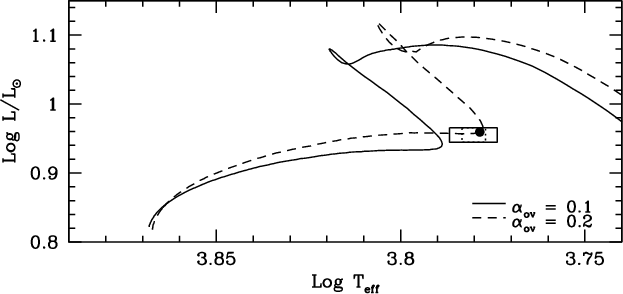 |
Figure 12:
Evolutionary tracks in the HR diagram for two models of 1.7
computed with a different amount of overshooting.
The dot indicates the location of the M3 model.
The error box in continuous line corresponds to the observational constraints of L and
used in our
analysis, while the dotted box corresponds to the constraints used by DM03. |
| Open with DEXTER | |
![\begin{figure}
\par\includegraphics[width=8.3cm,clip]{2140f13.eps} \end{figure}](/articles/aa/full/2005/18/aa2140/img127.gif) |
Figure 13:
Echelle diagram for the M3 model with a large spacing
Hz. Open symbols refer to theoretical
frequencies, while the filled circles correspond to the observed frequencies
listed in Table 3. Open circles are used for modes with ,
triangles for ,
squares for
and pentagons for . |
| Open with DEXTER | |
As already pointed out by GU04 and DM04, the fundamental seismic difference between
post-main-sequence (M1) and main-sequence (M3) models
concerns the avoided crossings.
Models in the post-main-sequence phase show
modes that deviate
from the asymptotic relation, while models still on the main-sequence show
no occurrence of avoided crossing. Indeed, for these models only modes with a radial order lower than
the observed ones are mixed (see Figs. 8 and 13).
Since observation show
modes that deviate
from the asymptotic relation, we conclude that models in the
post-main-sequence phase of evolution are in better agreement with the asteroseismic measurements than the
main-sequence models. Moreover, the small separation of the M3 model is smaller than that of the M1 model and is
therefore in slightly poorer agreement with the observed frequencies (see Fig. 14).
Note that DM04 also found that post-main-sequence models are characterized by larger small separations than
main-sequence models. Although the M1 model constitutes the solution
that best reproduced all
observational constraints, the actual precision on the observed frequencies
does not enable us to definitively reject the solution on the main-sequence.
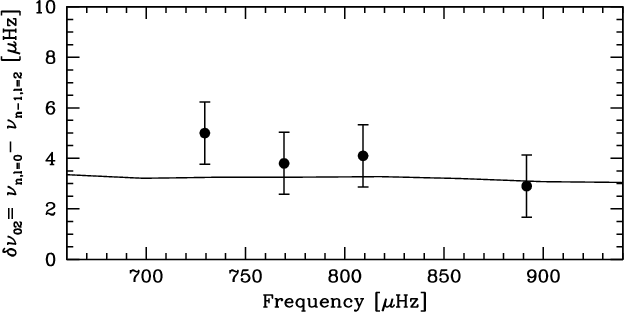 |
Figure 14: Small separations versus frequency for the M3 model. Dots indicate the observed values of the small separations. |
| Open with DEXTER | |
Boo yield a clear detection of p-mode oscillations.
Several identifiable modes appear in the power spectrum between 0.4 and 1.1 Hz
with average large and small spacings of 39.9 and 3.95 Hz respectively and
a maximal amplitude of 79 cm s-1. The global results are in rather good agreement
with the recent work by Kjeldsen et al (2003) who found large and small spacings
of 40.4 and 3.00 Hz. However, the comparison of the individual frequencies leads to
some discrepancies. Although the present data have a higher S/N, additional Doppler measurements
using spectrographs like HARPS (ESO) and forthcoming MOST data with a clean window function
might help resolve these ambiguities.
We identified 22 mode frequencies which have been compared to theoretical models.
The combination of non-asteroseismic observations now available for
Boo with the observed p-mode
frequencies listed in Table 3 leads to the following solution:
a model in the post-main-sequence phase of evolution, with a mass of
,
an age
Gyr and an initial metallicity
.
We also show that the mass of
Boo is very sensitive to the choice of the observed metallicity and that
its age depends on the inclusion of rotation and atomic diffusion. Indeed, non-rotating models
without overshooting predict a smaller age of
 Gyr.
Gyr.
Acknowledgements
We would like to thank J. Christensen-Dalsgaard for providing us with the Aarhus adiabatic pulsation code. Part of this work was supported financially by the Swiss National Science Foundation.