A&A 428, 943-951 (2004)
DOI: 10.1051/0004-6361:20034399
On the pulse-width statistics in radio pulsars
M. Kolonko
1,2 - J. Gil 3 - K. Maciesiak 3
1 - Institute of
Nuclear Physics, Radzikowskiego 152, 31-342 Kraków,
Poland
2 - Institute of Astronomy, Jagiellonian
University, Orla 171, 30-244 Kraków, Poland
3 - Institute of Astronomy, University of Zielona
Góra, Lubuska 2, 65-265 Zielona Góra, Poland
Received 25 September 2003 / Accepted 28 July 2004
Abstract
We perform Monte Carlo simulations of pulsar periods, pulse-widths and
magnetic inclination angles. Using the available
observational data sets we study possible parent
distribution functions by means of the Kolmogorov-Smirnov
significance tests. We also use an additional condition that the
numbers of generated interpulses, whether from both magnetic poles
or from a single pole, are at the observed levels. We derived
a model distribution function of magnetic inclination angles
which has a local maximum near
 and another
weaker one near
and another
weaker one near
 .
The gamma function is a plausible
distribution function describing pulsar periods.
The average beaming fraction describing the fraction of observable
radio pulsars is about 0.12.
.
The gamma function is a plausible
distribution function describing pulsar periods.
The average beaming fraction describing the fraction of observable
radio pulsars is about 0.12.
Key words: stars: pulsars: general - stars: neutron - stars: rotation
Statistical studies of the pulse-width in mean profiles of radio
pulsars are an important tool for investigations of the geometry of
pulsar radiation. One especially important parameter that can be
derived from such studies is the inclination angle between the
magnetic and the spin pulsar axes. Early studies were carried out
by Henry & Paik (1969), Roberts & Sturrock (1973,1972), Backer (1976) and
Manchester & Lyne (1977). Since the amount
of the available data was small, these papers suffered from
problems of small number statistics. A more complete work was
performed by Prószynski (1979) and Lyne & Manchester (1988), who analyzed samples of
about 200 pulse-width data measured near 400 MHz. Although the
database used in these papers was quite rich, the pulse-width
measurements were contaminated by the interstellar scattering
dominating at low radio frequencies. More recently Gil & Han (1996, GH96
hereafter) compiled a new database of 242 pulse-widths
W10 (corresponding to about 10% of the maximum intensity)
measured at a higher radio frequency (near 1.4 GHz), which was
relatively unbiased compared to the lower frequency data.
GH96 used their pulse-width database to perform Monte Carlo
simulations in an attempt to derive the distribution statistics of
pulsar periods, pulse widths, magnetic inclination angles and
rates of interpulses. They concluded by comparing
the simulated and observed (or observationally derived) quantities
that the observed distribution of the inclination angles resembles
a sine function following from the flat (random) distribution in
the parent population, and that the probability (beaming fraction)
of observing a pulsar was about 0.16. GH96 also pointed out that
the rates of interpulse occurrence should be considered as an
important aspect of pulsar population studies.
On the other hand, Tauris & Manchester (1998, henceforth TM98) using a
different method based on an analysis of the indirectly derived
polarization position angles and magnetic inclination angles
concluded that the observed distribution of the latter is
cosine-like rather than sine-like as suggested by GH96. They also
obtained the beaming factor
 ,
considerably lower than
0.16 obtained by GH96. TM98 pointed out a likely source of this
discrepancy, namely the incorrect assumption used by GH96 that the
observed distribution and the parent distribution of pulsar
periods are similar. Recently, Zhang et al. (2003, henceforth ZJM03)
followed the Monte-Carlo simulation scheme developed by GH96.
ZJM03 argued that both the parent distribution function and the
observed distribution of pulsar periods can be modelled by the
gamma function but with different values of the free parameters, and
their Monte-Carlo simulations included searching for a 2D grid of
these parameters. As a result, ZJM03 concluded that indeed the
cosine-like distribution (suggested by TM98) is much more
suitable to model the inclination angles in the parent pulsar
population than the flat distribution (suggested by GH96). They
argued that the most plausible parent distribution is a modified
cosine function, which has a peak around
,
considerably lower than
0.16 obtained by GH96. TM98 pointed out a likely source of this
discrepancy, namely the incorrect assumption used by GH96 that the
observed distribution and the parent distribution of pulsar
periods are similar. Recently, Zhang et al. (2003, henceforth ZJM03)
followed the Monte-Carlo simulation scheme developed by GH96.
ZJM03 argued that both the parent distribution function and the
observed distribution of pulsar periods can be modelled by the
gamma function but with different values of the free parameters, and
their Monte-Carlo simulations included searching for a 2D grid of
these parameters. As a result, ZJM03 concluded that indeed the
cosine-like distribution (suggested by TM98) is much more
suitable to model the inclination angles in the parent pulsar
population than the flat distribution (suggested by GH96). They
argued that the most plausible parent distribution is a modified
cosine function, which has a peak around  and another
weaker peak near
and another
weaker peak near  .
They also obtained the beaming factor
.
They also obtained the beaming factor
 0.12, consistent with the result of TM98.
As emphasized by ZJM03 in the conclusions of their paper, neither
they nor TM98 considered potentially important
constraints related to the observable interpulse emission.
Although GH96 did consider the issue of interpulse emission, their
estimate of rates of occurrence was not quite correct (see Sect. 3.4
in this paper). Moreover, their statistical analysis was biased by
the incorrect assumption mentioned above concerning the parent
distribution of pulsar period. In this work we follow the
simulation scheme of ZJM03 but we include the actual rates of
interpulse occurrences. We demonstrate that a pure cosine
distribution of the magnetic inclination angles generates too
few interpulses compared to observations and should be
rejected as a plausible distribution function. We found that the
modified cosine function of ZJM03 (see Eq. (9)) is much better in
this respect, mainly because of the weak second maximum near
.
Both the above distribution functions can
reproduce the observed distributions of pulse-widths, pulsar
periods and inclination angles almost equally well, and thus the
observed interpulse statistics provide the most restrictive
constraint discriminating between different trial distribution
functions.
Table 1:
Results of Monte Carlo simulations - reproduction of Table 1 in ZJM03.
Table 2:
Results of Monte Carlo simulations.
It is generally accepted that the pulsar radio emission is
relativistically beamed (Graham-Smith 2003) along the open dipolar field
lines (to within  ,
where
,
where
 is the Lorentz
factor of the emitting sources). Thus, the pulse width W10 at
the level of 10% of the maximum profile intensity can be written as
is the Lorentz
factor of the emitting sources). Thus, the pulse width W10 at
the level of 10% of the maximum profile intensity can be written as
![\begin{displaymath}W_{10}=4\arcsin\left\{\frac{\sin~[(\rho_{10}+\beta)/2]\sin~
[...
...}-\beta)/2]}{\sin\alpha\cdot\sin~(\alpha+\beta)}\right\}^{1/2}
\end{displaymath}](/articles/aa/full/2004/48/aa0399-03/img13.gif) |
(1) |
(Gil 1981), where  is the beam-width
corresponding to the 10% intensity level,
is the beam-width
corresponding to the 10% intensity level,  is the inclination
angle of the magnetic axis to the spin axis,
is the inclination
angle of the magnetic axis to the spin axis,  is the impact
angle of the closest approach of the line-of-sight to the magnetic
axis, and thus
is the impact
angle of the closest approach of the line-of-sight to the magnetic
axis, and thus
 is the observer angle between
the spin axis and the line-of-sight. It is worth noting that
Eq. (1) assumes the symmetry of a pulsar beam with
respect to the fiducial plane containing both the spin and the
magnetic pulsar axes. Thus, the appropriate pulse width database
should contain only pulsars with symmetrical profiles for which
is the observer angle between
the spin axis and the line-of-sight. It is worth noting that
Eq. (1) assumes the symmetry of a pulsar beam with
respect to the fiducial plane containing both the spin and the
magnetic pulsar axes. Thus, the appropriate pulse width database
should contain only pulsars with symmetrical profiles for which
 ,
where
,
where  is the pulse longitude measured from
the fiducial phase corresponding to the fiducial plane (e.g.
GH96).
is the pulse longitude measured from
the fiducial phase corresponding to the fiducial plane (e.g.
GH96).
The opening angle of the radio beam (beam-width) corresponding to the
10% intensity level can be derived from pulse width measurements
W10 (and ,
values) in the form of the
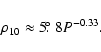
so-called  relation (Gil et al. 1984). Lyne & Manchester (1988) obtained
 for the pulse-width data at
408 MHz, which scaled to 1.4 GHz is
for the pulse-width data at
408 MHz, which scaled to 1.4 GHz is
 |
(2) |
However, Biggs (1990)
reanalyzed the same data sample and concluded that
 |
(3) |
Rankin (1993b,a) analyzed a large amount of available pulse-width
data interpolated to the frequency 1 GHz and obtained a
bimodal distribution of the opening angles, according to which for
a given pulsar period the opening angle adopts one of the two
preferred values. This result was later confirmed at frequency
1.4 GHz by Gil et al. (1993, GKS93 henceforth) and
independently by Kramer et al. (1994) and the resulting relation reads
![\begin{displaymath}\rho_{10}=\left\{
\begin{array}{l} 6\hbox{$.\!\!^\circ$ }3 P^...
...\ [2mm] 4\hbox{$.\!\!^\circ$ }9 P^{-0.5} , \end{array} \right.
\end{displaymath}](/articles/aa/full/2004/48/aa0399-03/img23.gif) |
(4) |
with smaller angles preferred at shorter periods. GKS93 argued
that
 is preferred in 80% of pulsars with P<0.7 s,
and this constraint was used by GH96 (their Table 2), while ZJM03
used
for P<0.7 s and
is preferred in 80% of pulsars with P<0.7 s,
and this constraint was used by GH96 (their Table 2), while ZJM03
used
for P<0.7 s and
 for other periods
(their Table 1). We denote the former option by Eq. (4a) and
the latter one by Eq. (4b) in Table 2. It is worth noticing
that
relations expressed by
Eqs. (2)-(4) are, to some extent,
equivalent. In fact, Eq. (2) seems to reflect the
tendency of smaller angles being preferred at short periods in
Eq. (4), and Eq. (3)
represents the average of both values appearing in
Eq. (4). Nevertheless, we use all the above
relations in our simulation procedure (Sect. 4).
for other periods
(their Table 1). We denote the former option by Eq. (4a) and
the latter one by Eq. (4b) in Table 2. It is worth noticing
that
relations expressed by
Eqs. (2)-(4) are, to some extent,
equivalent. In fact, Eq. (2) seems to reflect the
tendency of smaller angles being preferred at short periods in
Eq. (4), and Eq. (3)
represents the average of both values appearing in
Eq. (4). Nevertheless, we use all the above
relations in our simulation procedure (Sect. 4).
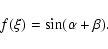
It is reasonable to assume that both the rotation axis and the
observer's direction are randomly oriented in space. Thus, the
probability density function for the observer angle
is
 |
(5) |
However, the distribution of the inclination angle may depend on
many unknown factors, and the most common probability density
functions in the parent population of pulsars include the flat
function
 |
(6) |
for the
random distribution, the sine function
 |
(7) |
for the sine-like distribution, and the cosine
function
 |
(8) |
for the
cosine-like distribution. One can consider some more complicated
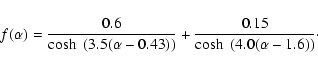
probability density functions. For example, ZJM03 argued that the
plausible parent distribution of the inclination angle can be
described in the form
 |
(9) |
This function has a weak local maximum near
 ,
which is an important feature with regard to the
interpulse occurrence statistics. We test all the above functions
in our Monte Carlo simulation procedure (Sect. 4).
,
which is an important feature with regard to the
interpulse occurrence statistics. We test all the above functions
in our Monte Carlo simulation procedure (Sect. 4).
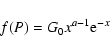
GH96 demonstrated that the observed distribution of periods of 516
pulsars with
 s (Pulsar
Catalog Taylor et al. 1993) can be well fitted by the gamma function
s (Pulsar
Catalog Taylor et al. 1993) can be well fitted by the gamma function
 |
(10) |
with x=P/m, where m=0.3and a=2.5 (G0 is the normalization constant dependent on
a). ZJM03 used this function to fit the period distribution in a
much larger sample of 1164 pulsar periods
s
and obtained m=0.278 and a=2.277. Although the parent
distribution of periods is certainly different from the observed
distribution, it is convenient to represent the former also in the
general form of a gamma function (Eq. (10)), with values of
m and a treated as free model parameters that can be derived
in 2D grid search implemented in the Monte Carlo simulations
(Sect. 4).
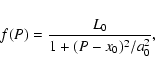
For a comparison one can also try some other trial probability
density distribution functions, like the Lorentzian distribution
function
 |
(11) |
or even the Gaussian distribution function
![\begin{displaymath}f(P)=\frac{1}{\sqrt{2\pi}\sigma_0}\exp\left[\frac{-(P-x_0)^2}{2\sigma_0}\right]
\cdot
\end{displaymath}](/articles/aa/full/2004/48/aa0399-03/img35.gif) |
(12) |
Again, the values of free parameters can be
derived in a 2D grid search within the Monte Carlo simulations
(Sect. 4).
Following the arguments given by Lyne & Manchester (1988), GH96 and
Mitra & Deshpande (1999) we first assume that the pulsar beam is circular or
almost circular. If this is the case, then the detection condition
(see GH96 for details) is:
 |
(13) |
for the
typical Main Pulse (MP) emission. However, one should also include
the rare interpulse (IP) emission, seen in a few percent of pulsars.
Two models were proposed to explain this emission occurring about
180 degrees of longitude from the centroid of the MP: the double
pole (DP-IP) model, in which MP and IP originate from opposite
magnetic poles (Rickett & Lyne 1968; Manchester & Lyne 1977), and the single pole (SP-IP), in
which both MP and IP are associated with the same pole. The
detection condition for the DP-IP model is
 |
(14) |
(e.g. GH96), which favors a nearly orthogonal
rotators
 .
Both MP and IP in pulsars that
belong to the DP-IP class show relatively narrow duty cycles, contrary
to the broad profiles in the SP-IP class associated with nearly
aligned rotators
.
Both MP and IP in pulsars that
belong to the DP-IP class show relatively narrow duty cycles, contrary
to the broad profiles in the SP-IP class associated with nearly
aligned rotators
 .
There are two possibilities
within the SP-IP: in the first one the MP and the IP represent two
cuts through one conical beam (Manchester 1978; Manchester & Lyne 1977). The other
possibility is when the line-of-sight stays in the overall pulsar
beam for the entire pulsar period, so the MP and IP correspond to
cuts through two nested conical beams (Gil 1983). The detection
conditions for these two versions of SP-IP models are
.
There are two possibilities
within the SP-IP: in the first one the MP and the IP represent two
cuts through one conical beam (Manchester 1978; Manchester & Lyne 1977). The other
possibility is when the line-of-sight stays in the overall pulsar
beam for the entire pulsar period, so the MP and IP correspond to
cuts through two nested conical beams (Gil 1983). The detection
conditions for these two versions of SP-IP models are
 |
(15) |
and
 |
(16) |
respectively. Both these
conditions are checked alternatively. One should mention that only
the latter condition was used by GH96, which resulted in too low
rates of SP-IP compared to observations.
One can also consider a quite natural possibility that the pulsar
beam has a tendency towards meridional compression, with the ratio of
minor to major ellipse axes
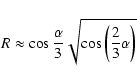 |
(17) |
depending on the inclination angle (Biggs 1990; McKinnon 1993).
Then the appropriate detection conditions (generalizations of
Eqs. (13)-(15)) are:
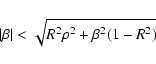 |
(18) |
for the
Main Pulse emission,
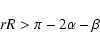 |
(19) |
for
the DP-IP emission, and
 |
(20) |
or
 for the SP-IP emission, where
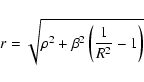 |
(21) |
is the latitudinal beam dimension. Note that  and
and
 ,
where
,
where  is the observationally deduced beam
radius (see GH96 for details).
is the observationally deduced beam
radius (see GH96 for details).
In our statistical analysis we compare the simulated distributions
with the directly (W10, P, IP occurrences) or
indirectly  observed data by means of the Kolmogorov-Smirnov
(K-S
henceforth) significance tests. Using the numerical methods given
by Press et al. (1992) we compute the maximum distance
observed data by means of the Kolmogorov-Smirnov
(K-S
henceforth) significance tests. Using the numerical methods given
by Press et al. (1992) we compute the maximum distance  (maximum difference between cumulative distribution functions
corresponding to the observed and simulated data sets) as well as
the significance
(maximum difference between cumulative distribution functions
corresponding to the observed and simulated data sets) as well as
the significance  of any non zero value of .
The value of
represents the probability that both the
simulated and the observed data sets are drawn from the same
parent distribution. We adopt an arbitrary criterion that
of any non zero value of .
The value of
represents the probability that both the
simulated and the observed data sets are drawn from the same
parent distribution. We adopt an arbitrary criterion that
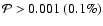 for distributions of P, W10 and at the same time.
Using the available database of pulsar
parameters![[*]](/icons/foot_motif.gif) we selected a sample of 1165 normal pulsars with periods P with
we selected a sample of 1165 normal pulsars with periods P with
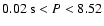 s (Fig. 1). We rejected all millisecond and
other recycled pulsars, since they represent different period and
magnetic inclination angle populations than typical pulsars. This
sample of observed pulsar periods can be fitted by the gamma
function expressed by Eq. (10) with m=0.28 and
a=2.28 (see upper panel in Fig. 1).
s (Fig. 1). We rejected all millisecond and
other recycled pulsars, since they represent different period and
magnetic inclination angle populations than typical pulsars. This
sample of observed pulsar periods can be fitted by the gamma
function expressed by Eq. (10) with m=0.28 and
a=2.28 (see upper panel in Fig. 1).
![\begin{figure}
\par\includegraphics[width=8.8cm,clip]{0399fig1.eps}\end{figure}](/articles/aa/full/2004/48/aa0399-03/Timg56.gif) |
Figure 1:
Observed distribution of 1165 pulsar periods with
s ( upper panel) and simulated distribution
corresponding to case (1) in Table 2 ( lower panel). The solid
lines represent the analytical fit to the observed distribution in
the form of a gamma function with m=0.28 and a=2.28, while the
dashed line represents the parent density distribution gamma
function with m=0.34 and a=2.52. |
| Open with DEXTER |
We use the database of 238 pulse-width measurements W10 taken
at the frequency of about 1.4 GHz (upper panel in Fig. 2),
compiled by GH96 (their Table 1 and Fig. 1). These measurements
were carefully selected from the available databases to satisfy
all criteria imposed by the symmetry of Eq. (1),
(see comments below this equation and GH96 for more details).
ZJM03 demonstrated that another available database (containing 265
pulsars), that of Gould & Lyne (1998), is equivalent to that of GH96 in the
sense that the values of W10 are roughly the same in both
these databases. It is worth noting that these two databases
are based on completely different profile widths measurements.
![\begin{figure}
\par\includegraphics[width=8.8cm,clip]{0399fig2.eps}\end{figure}](/articles/aa/full/2004/48/aa0399-03/Timg57.gif) |
Figure 2:
Observed distribution of 238 pulse widths W10 taken
from GH96 ( upper panel) and simulated distribution corresponding
to case (1) in Table 2 ( lower panel). |
| Open with DEXTER |
While the values of W10 and P as well as the interpulse
occurrences are direct observational quantities, the values of the
inclination angles
can only be indirectly observed by
means of the polarization measurements
(Rankin 1990,1993b; Lyne & Manchester 1988; Gould 1994; Rankin 1993a). Following the arguments of ZJM03
we used the database of the inclination angles compiled by
Rankin (1993b,a). This database contains 149 measurements of the
magnetic inclination angles, whose distribution is presented in
the upper panel of Fig. 3. Most of these
values were derived not from the polarization measurements but
from the so-called pulse-width/period relation established for
core components by Rankin (1993a). However, as demonstrated by TM98,
values of inclination angles derived by this method are roughly
consistent with those estimated from the polarization measurements
(LM88; Gould 1994).
![\begin{figure}
\par\includegraphics[width=8.8cm,clip]{0399fig3.eps}\end{figure}](/articles/aa/full/2004/48/aa0399-03/Timg58.gif) |
Figure 3:
Observed distribution of 149 magnetic inclination angles
taken from Rankin (1993b) ( upper panel) and simulated
distribution corresponding to case (1) in Table 2 ( lower panel).
The solid line represents the parent density distribution function
expressed by Eq. (9). |
| Open with DEXTER |
The fraction of interpulses in the observed sample of pulsars
provides useful information about pulsar geometry (see GH96).
However, the statistical studies of this phenomenon are difficult
since the ratio of amplitudes of the interpulse to the main-pulse
is often about 1% and varies with frequency (Hankins & Fowler 1986). The
only representative sample of interpulses can be found in Table 6
of the Catalog of 558 pulsars (Taylor et al. 1993). There are 22 pulsars
with interpulses 
 in this sample, with only 3 certain
cases (B0826-34, B0950+08, B1929+10) corresponding to a single
magnetic pole (Lyne & Manchester 1988, their Fig. 8). Most likely PSR
B1848+04 with a very broad main-pulse also belongs to this
category. To be consistent with our selection of pulsar
periods (Sect. 3.2) one should exclude millisecond and other
recycled pulsars from both the total pulsar sample and from the
sample of pulsars with interpulses (this was not done in GH96, who
incorrectly estimated rates of interpulse occurrences as a result
of this mistake). Table 3 lists our final sample of interpulse
pulsars, in which we identified 10 DP-IP and 4 SP-IP
cases. This corresponds to the rates of
occurrence of above 2% and 0.8% for DP-IP and SP-IP,
respectively. For a comparison, in the published sample of 420
pulsars found during the Parkes multibeam pulsar survey
(Morris et al. 2002; Kramer et al. 1994; Manchester et al. 2001) one can clearly identify 4 cases
of DP-IP and 1 case of SP-IP, and a few low intensity candidates.
This gives lower limits of about 1% and 0.24%, respectively. It
is difficult to estimate the actual rates of IP occurrence until
a sensitive search for interpulses in the newly discovered
pulsars is made. We assume that the plausible distributions of
periods P and inclination angles
in the parent pulsar
population should be able to explain about 2% of DP-IP and
slightly above 0.5% of SP-IP in the normal pulsar population
(excluding millisecond and other recycled pulsars).
in this sample, with only 3 certain
cases (B0826-34, B0950+08, B1929+10) corresponding to a single
magnetic pole (Lyne & Manchester 1988, their Fig. 8). Most likely PSR
B1848+04 with a very broad main-pulse also belongs to this
category. To be consistent with our selection of pulsar
periods (Sect. 3.2) one should exclude millisecond and other
recycled pulsars from both the total pulsar sample and from the
sample of pulsars with interpulses (this was not done in GH96, who
incorrectly estimated rates of interpulse occurrences as a result
of this mistake). Table 3 lists our final sample of interpulse
pulsars, in which we identified 10 DP-IP and 4 SP-IP
cases. This corresponds to the rates of
occurrence of above 2% and 0.8% for DP-IP and SP-IP,
respectively. For a comparison, in the published sample of 420
pulsars found during the Parkes multibeam pulsar survey
(Morris et al. 2002; Kramer et al. 1994; Manchester et al. 2001) one can clearly identify 4 cases
of DP-IP and 1 case of SP-IP, and a few low intensity candidates.
This gives lower limits of about 1% and 0.24%, respectively. It
is difficult to estimate the actual rates of IP occurrence until
a sensitive search for interpulses in the newly discovered
pulsars is made. We assume that the plausible distributions of
periods P and inclination angles
in the parent pulsar
population should be able to explain about 2% of DP-IP and
slightly above 0.5% of SP-IP in the normal pulsar population
(excluding millisecond and other recycled pulsars).
Table 3:
Interpulse emission in normal pulsars (after Table 6 in Taylor et al. 1993).
We performed Monte Carlo simulations of the pulse widths W10,
pulsar periods P and inclination angles ,
in
an attempt to reproduce the observed distributions of these
quantities. We have used the random number generator given in
Press et al. (1992). Our simulation procedure can be described as a
number of sequential steps:
-
- (1)
- Generate the inclination angle
as a random
number with the parent probability density function
 corresponding to Eqs. (6)-(9), respectively.
- (2)
- Generate the observer angle
as a
random number with the parent probability density function
 (Eq. (5)), and calculate the impact angle
 .
.
- (3)
- Generate the pulsar period P as a random number with
the parent probability density function f(P) corresponding to
Eqs. (10)-(12), respectively.
Record the free model parameters of each function used.
- (4)
- For a given value of P calculate the opening angle
corresponding to Eqs. (2)-(4),
respectively.
- (5)
- Check the detection condition corresponding to
Eqs. (13)-(15) for
 simulated pulsars for each combination of relations (Eqs. (2)-(4)) and distribution
functions f(P) (Eqs. (10)-(12)) and (Eqs. (6)-(9)). Record the number of observed
pulsars
simulated pulsars for each combination of relations (Eqs. (2)-(4)) and distribution
functions f(P) (Eqs. (10)-(12)) and (Eqs. (6)-(9)). Record the number of observed
pulsars
 .
Calculate the beaming fraction
.
Calculate the beaming fraction
 ,
as well as the rates of detected interpulses
from two magnetic poles (DP-IP) and from a single magnetic pole
(SP-IP).
,
as well as the rates of detected interpulses
from two magnetic poles (DP-IP) and from a single magnetic pole
(SP-IP).
- (6)
- For each set of parameters
 and
and
 corresponding to the observable pulsar calculate
the pulse width W10 according to Eq. (1), and
record the relevant information
corresponding to the observable pulsar calculate
the pulse width W10 according to Eq. (1), and
record the relevant information
 .
.
- (7)
- Judge the statistical significance using the
K-S tests for the simulated and observed distributions of pulse
width W10, period P and inclination angle .
To make sure that our simulation software works properly, we began
with a reproduction of results given in the previous statistical
works of GH96 and ZJM03. As expected, we managed to reproduce the
K-S statistics for W10, beaming fraction f and the rates of
observed interpulses given in Table 2 of GH96.
However, the K-S test for pulsar
periods (not included in GH96) resulted in very low probabilities
(below 10-6), confirming the suggestion of TM98 that the
distribution of periodsin the parent pulsar population is
significantly different from that of the observed distribution. As
we argue later in this paper, a plausible parent distribution
of periods can be expressed as a gamma function
(Eq. (10)) with
 and
and
 ,
in
contrast to m=0.3 and a=2.5 obtained for the observed sample
of 516 pulsar periods by GH96, or m=0.28 and a=2.28 obtained
for 1165 periods used in this paper (see also ZJM03).
,
in
contrast to m=0.3 and a=2.5 obtained for the observed sample
of 516 pulsar periods by GH96, or m=0.28 and a=2.28 obtained
for 1165 periods used in this paper (see also ZJM03).
The twelve entries in Table 1 correspond to cases A1-A4, B1-B4 and
C1-C4 from Table 1 in ZJM03 (we excluded cases D1-D4 since for
s=5.8/8.8=0.65 they are equivalent to cases A1-A4). As one can
see, we reproduced quite well the results of K-S tests for P,
W10 and ,
as well as the values of the beaming fraction
f. We added the rates of the interpulse occurrence and concluded
that the pure
 distribution of the parent inclination
angles (A1, B1 and C1) generates too few DP-IP (about 0.3%
compared to about 2% observed). Thus, although the pure
distribution gives very good results for K-S tests
(consistent with the results of TM98 and ZJM03), it should be
rejected on the grounds of unacceptable interpulse statistics. We
found that the modified cosine distribution of ZJM03 (see Eq. (9))
not only gives the plausible results of K-S test, but also
reproduces the rate of occurrence of both DP-IP
distribution of the parent inclination
angles (A1, B1 and C1) generates too few DP-IP (about 0.3%
compared to about 2% observed). Thus, although the pure
distribution gives very good results for K-S tests
(consistent with the results of TM98 and ZJM03), it should be
rejected on the grounds of unacceptable interpulse statistics. We
found that the modified cosine distribution of ZJM03 (see Eq. (9))
not only gives the plausible results of K-S test, but also
reproduces the rate of occurrence of both DP-IP  and
SP-IP
and
SP-IP
 .
.
We have examined 19200 combinations of distribution functions of
pulsar periods (Eqs. (10)-(12) with
200 combinations of parameters in each case), opening angles
(Eqs. (2)-(4a,b)), inclination
angles (Eqs. (6)-(9)) as well as two options of the beam shape: circular
(Eqs. (13)-(16)) and elliptical
(Eqs. (17)-(21)). We recorded only those cases in which
the following conditions were simultaneously satisfied: the
probabilities
that the observed and simulated
distributions of P, W10 and
exceeded 0.001, as well
as that the rates of occurrence of DP-IP and SP-IP exceeded 2% and
0.5%, respectively. With the adopted step of 0.02 in the
parameters of the gamma, Lorentzian and Gaussian functions
(Eqs. (10)-(12)), this resulted in 15 records, and
Table 2 presents 5 representative cases with the highest rates of
SP-IP occurrence. We believe that case (1) is the most plausible
one and Figs. 1-3 present a visual comparison of the observed and
simulated distribution corresponding to this case. Below we
discuss some aspects of our analysis, which are not reflected in
Table 2.
Both gamma (Eq. (10)) and Lorentzian (Eq. (11))
functions with parameter values
,
and
 ,
,
 respectively, are
plausible parent density distribution functions. However, the
gamma function seems much better suited to reflect the skewed
character of the pulsar period distribution. The Gaussian function
(Eq. (12)) is rather unlikely. In the best case
corresponding to x0=0.73 and
respectively, are
plausible parent density distribution functions. However, the
gamma function seems much better suited to reflect the skewed
character of the pulsar period distribution. The Gaussian function
(Eq. (12)) is rather unlikely. In the best case
corresponding to x0=0.73 and
 ,
the significance
is only about 0.0003.
,
the significance
is only about 0.0003.
ZJM03 argued, ignoring the issue of the interpulse emission, that
the parent distribution of the magnetic inclination angles can be
expressed by the cosine function or modified cosine function
represented by Eq. (9) in this paper. Including the
analysis of interpulse statistics we confirm the latter but refute
the former, since the cosine function generates less than 0.3% of
DP-IP (as compared with about 2% observed). This is a strong
conclusion since better statistics of interpulse occurrences
will not alter it. The sine-like function (Eq. (7)) generates
too many DP-IP  and far too few SP-IP
  ,
while the interpulse rates generated by the flat distribution
function (Eq. (6)) are roughly comparable with
observations, especially when associated with the meridionally
compressed beam (Eq. (17)), but the results of the K-S test for
the magnetic inclination angles are not promising
,
while the interpulse rates generated by the flat distribution
function (Eq. (6)) are roughly comparable with
observations, especially when associated with the meridionally
compressed beam (Eq. (17)), but the results of the K-S test for
the magnetic inclination angles are not promising
 .
Therefore, the modified cosine function
(Eq. (9)) is the only plausible density distribution
function that satisfies all constraints. We have checked whether
one can improve the statistical results by changing values of the
parameters in Eq. (9). It appeared that without
violating the basic condition that
.
Therefore, the modified cosine function
(Eq. (9)) is the only plausible density distribution
function that satisfies all constraints. We have checked whether
one can improve the statistical results by changing values of the
parameters in Eq. (9). It appeared that without
violating the basic condition that
 for all
considered quantities (P, W10 and ), one can only
increase the interpulse rates by a small fraction (e.g. from
0.74% to 0.77% for SP-IP).
for all
considered quantities (P, W10 and ), one can only
increase the interpulse rates by a small fraction (e.g. from
0.74% to 0.77% for SP-IP).
For the 15 cases satisfying all constraints adopted in our
analysis, the beaming fraction f defined as the number of
detected pulsars divided by 50 000 detection attempts is
 .
This is consistent with the probabilities of observing a
normal radio pulsar obtained by both TM98 and ZJM03. One
should emphasize that this beaming fraction is only a mean value,
which is biased by the underlying period distribution. The actual
beaming fraction for a given pulsar is obviously period-dependent,
as can be seen from Eqs. (2)-(4).
.
This is consistent with the probabilities of observing a
normal radio pulsar obtained by both TM98 and ZJM03. One
should emphasize that this beaming fraction is only a mean value,
which is biased by the underlying period distribution. The actual
beaming fraction for a given pulsar is obviously period-dependent,
as can be seen from Eqs. (2)-(4).
In this paper we performed statistical studies using the Monte Carlo simulations of the possible parent distributions of pulsar
periods P and magnetic inclination angles .
We generated
synthetic distributions of the pulse-widths W10, as well as
the interpulse occurrences, and compared them with the
observational data. We found that the observed distributions
of pulsar periods, pulse widths and inclination angles are
relatively easy to reproduce with a variety of trial density
distribution functions. However, when we used the criterion that
the K-S significance probabilities
for P, W10 and
are higher than 0.001 and that the generated interpulse
rates agree with the observed rates, we were left with just a
few possibilities, presented in Table 2. Our results can be
summarized as follows:
-
- (1)
- The distribution of the magnetic inclination angles in
the parent pulsar population is a complicated function represented
by Eq. (9), which has a local maximum around
and another weaker one around
.
This function reproduces the observed distribution of the observed
inclination angles (Fig. 3), as well as generates the rates of
occurrence of interpulses at observed levels.
- (2)
- The parent distribution of periods in the normal pulsar
population (excluding millisecond and other recycled pulsars) can
be described by the gamma function (Eq. (10)) with
parameters
and
.
The actual
values of these parameters differ slightly depending on the
-P relation (Eqs. (2)-(4)).
- (3)
- There is no evidence that the shape of the pulsar beam
deviates significantly from a circular crossection. It seems
that a binomial distribution of the opening angles represented by
Eq. (4) is the preferred one (especially the version referred
as to Eq. (4a)).
- (4)
- The beaming fraction f, that is the mean value of the fraction of observable
pulsars or the mean probability of observing a normal pulsar, is
.
In general, our results are consistent with those of ZJM03.
However, we added the constraints related to the interpulse
analysis and found that this aspect of our analysis is the
most restrictive one. We were able to reject the pure cosine
distribution of the inclination angles, but we confirmed their
modified cosine function which has a local maximum around
and another weaker one near
.
It seems that this function should be treated as a model rather
than the true underlying distribution, as it is hard to justify
physically why the distribution should have peaks near
and
(which effectively means a deficit
of the inclination angles at
small values and an excess at large values
with respect to a pure cosine distribution function).
Nevertheless, this means that the evolution of the magnetic
inclination angles in pulsars cannot be described by any simple
law (alignment, counter-alignment, etc.). However, the competition
between the alignment (due to magnetic dipole radiation) and
counter-alignment (due to magnetospheric currents associated with
pulsar wind) could perhaps lead to such a complicated underlying
distribution function.
Although we improved the analysis of ZJM03 by adding the
interpulse statistics, we are still lacking an analysis of the
possible effect of the intrinsic luminosity of radio pulsars on
our results. This problem is, however, very difficult and
complicated and we will postpone a full treatment of this to a
subsequent paper. The proper approach would be to compare the
synthetic radio luminosity with the minimum detectable flux
achieved in a given pulsar survey, and thus it can be applied only
to uniform data sets of pulsars detected in single survey. Our
data do not have such a degree of uniformity. However, most
surveys were less sensitive to long-period pulsars, as it follows
from the nature of the applied Fourier-transform method. Since the
interpulse emission (which appears to be the most restrictive
constraint in our analysis) occurs mainly at shorter periods,
a possible under-representation of pulsars with longer periods
should not significantly affect our general results.
Acknowledgements
This work is partially supported by the Grant 1 P03D 029 26 of the
Polish State Committee for Scientific Research. We thank E. Gil
and U. Maciejewska for technical help. We also thank the anonymous
referee for very constructive and helpful criticism.
- Backer, D. C. 1976, ApJ, 209,
895 [NASA ADS] [CrossRef] (In the text)
- Biggs, J. D. 1990, MNRAS,
245, 514 [NASA ADS] (In the text)
- Gil, J. 1981, Acta Phys.
Pol., B12, 1081 (In the text)
- Gil, J. 1983, A&A, 127,
267 [NASA ADS] (In the text)
- Gil, J. A., & Han, J.
L. 1996, ApJ, 458, 265 [NASA ADS] [CrossRef] (GH96)
- Gil, J., Gronkowski, P.,
& Rudnicki, W. 1984, A&A, 132, 312 [NASA ADS] (In the text)
- Gil, J., Kijak, J., &
Seiradakis, J. H. 1993, A&A, 272, 268 [NASA ADS] (GKS93)
(In the text)
- Gould, D. M. 1994, Ph.D.
Thesis, University of Manchester
- Gould, D. M., & Lyne,
A. G. 1998, MNRAS, 301, 235 [NASA ADS] [CrossRef] (In the text)
- Graham-Smith, F. 2003, The
radio emission from pulsars, Reports on Progress in Physics, 66,
173
(In the text)
- Hankins, T. H., &
Fowler, L. A. 1986, ApJ, 304, 256 [NASA ADS] [CrossRef] (In the text)
- Henry, G. R., & Paik,
H. J. 1969, Nature, 224, 1188 (In the text)
- Kramer, M.,
Wielebinski, R., Jessner, A., Gil, J. A., & Seiradakis,
J. H. 1994, A&AS, 107, 515 [NASA ADS] (In the text)
- Kramer, M., Bell, F.
J., Manchester, R. N., et al. 1994, MNRAS, 342, 1299 [NASA ADS]
- Lyne, A. G., &
Manchester, R. N. 1988, MNRAS, 234, 477 [NASA ADS] (In the text)
- Manchester, R. N., &
Lyne, A. G. 1977, MNRAS, 181, 761 [NASA ADS] (In the text)
- Manchester, R. N. 1978, Proc.
Astr. Soc. Aust., 3, 200 [NASA ADS]
- Manchester, R. N. 1996, in
Pulsars: Problems and Progress, ed. S. Johnston, M. A. Walker,
& M. Bailes (San Francisco: Astronomical Society of the
Pacific), IAU Coll., 160, 193
- Manchester, R. N.,
& Lyne, A. G., Camilo, F., et al. 2001, MNRAS, 328,
17 [NASA ADS] [CrossRef]
- McKinnon, M. M. 1993, ApJ,
413, 317 [NASA ADS] [CrossRef]
- Mitra, D., & Deshpande,
A. A. 1999, A&A, 346, 906 [NASA ADS] (In the text)
- Morris, D. J., Hobbs,
G., Lyne, A. G., et al. 2002, MNRAS, 335, 275 [NASA ADS] [CrossRef]
- Press, W. H.,
Teukolsky, S. A., Vatterling, W. T., & Flannery, B. P. 1992,
Numerical Receipes (Fortran) (Cambridge University Press)
(In the text)
- Prószynski, M. 1979,
A&A, 79, 8 [NASA ADS] (In the text)
- Rankin, J. M. 1990, ApJ, 352,
247 [NASA ADS] [CrossRef]
- Rankin J. M., 1993a, ApJ,
405, 285 [NASA ADS] [CrossRef]
- Rankin J. M., 1993b, ApJS,
85, 145 [NASA ADS] [CrossRef]
- Rickett, B. J., & Lyne,
A. G. 1968, Nature 218, 934
- Roberts, D. H., &
Sturrock, P. A. 1972, ApJ, 172, 435 [NASA ADS] [CrossRef]
- Roberts, D. H., &
Sturrock, P. A. 1973, ApJ, 181, 161 [NASA ADS] [CrossRef]
- Taylor J. H., Manchester
R. N., & Lyne A. G., 1993, ApJS, 88, 529 [NASA ADS] [CrossRef] (Pulsar Catalog)
(In the text)
- Tauris, T. M., &
Manchester, R. N. 1998, MNRAS, 298, 625 [NASA ADS] [CrossRef] (TM98)
(In the text)
- Zhang, L., Jiang, Z.-J.,
& Mei, D.-Ch. 2003, PASJ, 55, 461 [NASA ADS] (ZJM03)
(In the text)
Copyright ESO 2004
![\begin{figure}
\par\includegraphics[width=8.8cm,clip]{0399fig1.eps}\end{figure}](/articles/aa/full/2004/48/aa0399-03/img56.gif)
![\begin{figure}
\par\includegraphics[width=8.8cm,clip]{0399fig2.eps}\end{figure}](/articles/aa/full/2004/48/aa0399-03/img57.gif)
![\begin{figure}
\par\includegraphics[width=8.8cm,clip]{0399fig3.eps}\end{figure}](/articles/aa/full/2004/48/aa0399-03/img58.gif)