Pictoris disc
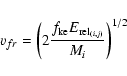
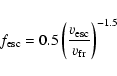
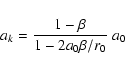
A&A 408, 775-788 (2003)
DOI: 10.1051/0004-6361:20031017
Pictoris discP. Thébault1 - J. C. Augereau2,3 - H. Beust4
1 - Observatoire de Paris, Section de Meudon,
92195 Meudon Principal Cedex, France
2 - CEA Saclay, Centre de
l'Orme des Merisiers, 91191 Gif-sur-Yvette Cedex, France
3 - Leiden
Observatory, PO Box 9513, 2300 Leiden, The Netherlands
4 -
Laboratoire d'Astrophysique de l'Observatoire de Grenoble,
Université J. Fourier, BP 53, 38041 Grenoble Cedex 9, France
Received 21 March 2003 / Accepted 19 June 2003
Abstract
Dust particles observed in extrasolar planetary discs
originate from undetectable km-sized bodies but this valuable
information remains uninteresting if the theoretical link between
grains and planetesimals is not properly known. We outline in this
paper a numerical approach we developed in order to address this
issue for the case of dust producing collisional cascades.
The model is based on a particle-in-a-box method. We follow the
size distribution of particles over eight orders of magnitude in
radius taking into account fragmentation and cratering according
to different prescriptions. Particular attention is paid to
the smallest particles, close to the radiation pressure induced cut-off size
 ,
which are placed on highly eccentric orbits by the stellar
radiation pressure.
We applied our model to the case of the inner (<10 AU) Pictoris disc, in
order to quantitatively derive the population of progenitors needed
to produce the small amount of dust observed in this region
(
,
which are placed on highly eccentric orbits by the stellar
radiation pressure.
We applied our model to the case of the inner (<10 AU) Pictoris disc, in
order to quantitatively derive the population of progenitors needed
to produce the small amount of dust observed in this region
( 1022 g). Our simulations show that the collisional
cascade from kilometre-sized bodies to grains significantly departs from
the classical
1022 g). Our simulations show that the collisional
cascade from kilometre-sized bodies to grains significantly departs from
the classical
 power law: the smallest particles
(
power law: the smallest particles
(
 )
are strongly depleted while an overabundance of
grains with size
)
are strongly depleted while an overabundance of
grains with size  2
and a drop of grains with size 100
develop regardless of the disc's dynamical excitation,
and initial surface density. However, the global
dust to planetesimal mass ratio remains close to its
value. Our rigorous approach thus confirms the depletion in mass in
the inner Pictoris disc initially inferred from questionable
assumptions. We show moreover that collisions are a sufficient source
of dust in the inner Pictoris disc. They are actually unavoidable even
when considering the alternative scenario of dust production by slow
evaporation of km-sized bodies. We obtain an upper limit of 0.1
2
and a drop of grains with size 100
develop regardless of the disc's dynamical excitation,
and initial surface density. However, the global
dust to planetesimal mass ratio remains close to its
value. Our rigorous approach thus confirms the depletion in mass in
the inner Pictoris disc initially inferred from questionable
assumptions. We show moreover that collisions are a sufficient source
of dust in the inner Pictoris disc. They are actually unavoidable even
when considering the alternative scenario of dust production by slow
evaporation of km-sized bodies. We obtain an upper limit of 0.1
 for the total disc mass below 10 AU. This upper limit is
not consistent with the independent mass estimate
(at least
for the total disc mass below 10 AU. This upper limit is
not consistent with the independent mass estimate
(at least
 )
in the frame of the
Falling Evaporating Bodies (FEB) scenario explaining
the observed transient features activity. Furthermore, we show that the mass
required to sustain the FEB activity implies a so important mass loss
that the phenomena should naturally end in less than 1 Myr, namely in
less than one twentieth the age of the star (at least
)
in the frame of the
Falling Evaporating Bodies (FEB) scenario explaining
the observed transient features activity. Furthermore, we show that the mass
required to sustain the FEB activity implies a so important mass loss
that the phenomena should naturally end in less than 1 Myr, namely in
less than one twentieth the age of the star (at least
 years).
In conclusion, these results might help converge towards a coherent picture
of the inner Pictoris system: a low-mass disc of collisional debris leftover
after the possible formation of planetary embryos, a result which would be
coherent with the estimated age of the system.
years).
In conclusion, these results might help converge towards a coherent picture
of the inner Pictoris system: a low-mass disc of collisional debris leftover
after the possible formation of planetary embryos, a result which would be
coherent with the estimated age of the system.
Key words: stars: planetary systems - stars: individual:
Pictoris -
stars: planetary systems: formation
Pictoris system
The dusty and gaseous
Pictoris disc has been intensively
studied since the first resolved image was obtained in 1984 (Smith & Terrile 1984).
This system is particularly interesting since it is still one of the best
examples of a possible young extrasolar planetary system. It should
be stressed that considering the estimated age of the system, i.e. at
least
years (Barrado y Navascués et al. 1999),
Pictoris is no longer
in its earliest formation stage and that if planetary accretion had to
occur then it should already be finished.
The Pictoris disc has been observed in various wavelengths and has a
radial extent of at least 1500 AU (Larwood & Kalas 2001). Due to obvious
observational constraints (10 AU at
Pic's distance correspond
to 0.5
 ), it is mostly the outer part of the disc beyond
30 AU that has been extensively mapped and studied with the
highest spatial resolution (the reader might refer to Artymowicz 1997
for a complete review). The global picture is that of a relative
central gap in the dust density, followed by a density peak around 100 AU and a slow decrease outwards. The exact density profile remains
relatively uncertain since it strongly depends on both the assumed
size distribution for the dust population and the grain optical
properties. As a consequence the total mass of dust is also relatively
uncertain, but might be of the order of 0.3 to
0.5
), it is mostly the outer part of the disc beyond
30 AU that has been extensively mapped and studied with the
highest spatial resolution (the reader might refer to Artymowicz 1997
for a complete review). The global picture is that of a relative
central gap in the dust density, followed by a density peak around 100 AU and a slow decrease outwards. The exact density profile remains
relatively uncertain since it strongly depends on both the assumed
size distribution for the dust population and the grain optical
properties. As a consequence the total mass of dust is also relatively
uncertain, but might be of the order of 0.3 to
0.5
 (Li & Greenberg 1998; Artymowicz 1997). Note that "dust" mass
estimates always strongly depend on the upper size limit
considered, and that observations do not constraint very well the
abundance of the bigger dust particles where most of the mass is
supposed to be. Observations show mostly the signature of micron-sized
grains visible through scattered light (e.g. Mouillet et al. 1997; Kalas & Jewitt 1995) and
thermal emission (Lagage & Pantin 1994). Millimetre-sized grains are detected
by millimetre wavelength photometry (Zuckerman & Becklin 1993; Chini et al. 1991) and by
resolved imaging in the submillimeter domain but with a poor angular
resolution (Holland et al. 1998).
(Li & Greenberg 1998; Artymowicz 1997). Note that "dust" mass
estimates always strongly depend on the upper size limit
considered, and that observations do not constraint very well the
abundance of the bigger dust particles where most of the mass is
supposed to be. Observations show mostly the signature of micron-sized
grains visible through scattered light (e.g. Mouillet et al. 1997; Kalas & Jewitt 1995) and
thermal emission (Lagage & Pantin 1994). Millimetre-sized grains are detected
by millimetre wavelength photometry (Zuckerman & Becklin 1993; Chini et al. 1991) and by
resolved imaging in the submillimeter domain but with a poor angular
resolution (Holland et al. 1998).
Actually no direct information is available for all objects bigger
than a few millimetres. Analytical estimates have shown that the
observed dust cannot be primordial since its expected lifetime imposed
by the rate of destructive mutual collisions is much shorter than the
estimated age of the system (Lagrange et al. 2000; Artymowicz 1997). Thus dust must be
constantly produced within the disc. Candidates for producing this
dust are supposingly kilometer-sized planetesimals which may generate
dust either by evaporation of volatiles (Lecavelier 1998; Li & Greenberg 1998) or/and
by collisional erosion (Augereau et al. 2001; Mouillet et al. 1997; Artymowicz 1997). In either case,
the total mass of the disc must be dominated by these parent bodies.
Artymowicz (1997) estimated that if a steady state collisional law in
(Dohnanyi 1969) holds from the smallest dust grains
to the biggest planetesimals, then one might expect at least
140
of kilometre-sized objects. But, as noted
by the author himself, such extrapolations remain very uncertain.
Scattered light observations have also revealed several more or less
marked asymmetries in the outer disc (see Kalas & Jewitt 1995, for a detailed
presentation). Some of these asymmetries are believed to be due
to the presence of an embedded planet. It is in particular the case of
the slight warp in inclination (3 )
of the disc's mid plane
observed up to 80 AU. This warp has been successfully interpreted by
the dynamical response of a planetesimal disc to the pull of a
Jupiter-like object located at about 10 AU from the star on a
slightly inclined orbit (Mouillet et al. 1997). To extend this scenario to
the dust disc moreover allows to reproduce large-scale vertical
asymmetries up to about 500 AU (Augereau et al. 2001). The planetary
hypothesis is reinforced by new asymmetries evidenced at mid-IR
wavelengths in the inner disc (Wahhaj et al. 2003).
)
of the disc's mid plane
observed up to 80 AU. This warp has been successfully interpreted by
the dynamical response of a planetesimal disc to the pull of a
Jupiter-like object located at about 10 AU from the star on a
slightly inclined orbit (Mouillet et al. 1997). To extend this scenario to
the dust disc moreover allows to reproduce large-scale vertical
asymmetries up to about 500 AU (Augereau et al. 2001). The planetary
hypothesis is reinforced by new asymmetries evidenced at mid-IR
wavelengths in the inner disc (Wahhaj et al. 2003).
Nevertheless, these indirect effects of an hypothetic planet are
detected much further away from the star than the planet's actual
location. As indicated in the previous section, there is a strong
lack of data for the region within 10 AU which is probably the most
interesting area in terms of presence of planets and planet formation.
Most of the informations on this region has been indirectly inferred by
fitting the Spectral Energy Distribution (SED) in the near and middle
infrared. There seems to be a general agreement on the fact that the
inner part of the disc is significantly depleted in dust, though
opinions strongly differ on the exact extension and intensity of this
depletion (see Li & Greenberg 1998, for a detailed discussion on this
topic). To the present day, one of the most complete studies
remains that of Li & Greenberg (1998), taking into account a large set of
parameters and especially realistic grain properties (porosity, size
distributions, chemical compositions) based on observations,
laboratory experiments and dust collection into space. This work
claims that there is no more than
 g of dust in the
r<40 AU region, as compared to
g of dust in the
r<40 AU region, as compared to
 g in the [40,100] AU
area. The main problem is that such SED fits are strongly model
dependent, and in particular that the dust surface density
distribution cannot be uniquely determined because of its coupling to
the grain size distribution and to the optical
properties. Furthermore, the Li & Greenberg (1998) fitting has been
performed assuming that all dust is of pure comet-evaporation origin
and that its size distribution fits in situ dust observations around
the Halley comet. As will be discussed later on (Sect. 5), this
assumption probably cannot hold for the inner Beta-Pic disc.
g in the [40,100] AU
area. The main problem is that such SED fits are strongly model
dependent, and in particular that the dust surface density
distribution cannot be uniquely determined because of its coupling to
the grain size distribution and to the optical
properties. Furthermore, the Li & Greenberg (1998) fitting has been
performed assuming that all dust is of pure comet-evaporation origin
and that its size distribution fits in situ dust observations around
the Halley comet. As will be discussed later on (Sect. 5), this
assumption probably cannot hold for the inner Beta-Pic disc.
There is nevertheless one independent evidence for an inner dust depletion
deduced from direct observations: Pantin et al. (1997) obtained resolved
 m images of the r<100 AU region, with a resolution of
5 AU after deconvolution. They concluded that there is a
density drop of almost an order of magnitude in the innermost
r<10 AU area, although a puzzling density peak seems to be observed
at 5 AU. These authors inferred a total dust mass of
m images of the r<100 AU region, with a resolution of
5 AU after deconvolution. They concluded that there is a
density drop of almost an order of magnitude in the innermost
r<10 AU area, although a puzzling density peak seems to be observed
at 5 AU. These authors inferred a total dust mass of
 g for the r<10 AU area.
Note that this estimate is
also strongly model dependant, though it doesn't make any assumption
concerning the mechanism producing the dust: the authors suppose a
power law for the size distribution with a change of power law index at
a given size (and thus 3 free parameters).
The Pantin et al. (1997) mass estimate is
significantly lower than the one that can be deduced from
Li & Greenberg (1998) for the same region, i.e.
g for the r<10 AU area.
Note that this estimate is
also strongly model dependant, though it doesn't make any assumption
concerning the mechanism producing the dust: the authors suppose a
power law for the size distribution with a change of power law index at
a given size (and thus 3 free parameters).
The Pantin et al. (1997) mass estimate is
significantly lower than the one that can be deduced from
Li & Greenberg (1998) for the same region, i.e.
 g,
especially when taking into account the fact that the upper grain size
limit of Li & Greenberg (1998), 0.4 mm, is smaller than the 1 mm limit of
Pantin et al. (1997). Extrapolating the Li & Greenberg (1998) estimate up to
the 1 mm limit leads to a total dust mass of
g,
especially when taking into account the fact that the upper grain size
limit of Li & Greenberg (1998), 0.4 mm, is smaller than the 1 mm limit of
Pantin et al. (1997). Extrapolating the Li & Greenberg (1998) estimate up to
the 1 mm limit leads to a total dust mass of
 g.
But as mentioned before, all authors agree on one core
assumption: there is a dust depletion in the inner
Pictoris
system.
g.
But as mentioned before, all authors agree on one core
assumption: there is a dust depletion in the inner
Pictoris
system.
Table 1: Summary of mass estimates for the inner 10 AU region, as derived from previous works.
power law applies from the parent bodies down to
the observed micron-sized grains. This is the usual assumption commonly
made to easily derive parent bodies masses in extrasolar dust discs
(e.g. Augereau et al. 1999 for HR 7496 A).
This would here lead to a mass of objects
in the 10 to 50 km range comprised between
 (taking the Pantin et al. 1997, dust
density) and
(taking the Pantin et al. 1997, dust
density) and
 (taking
the Li & Greenberg 1998, estimate). These values seem very low, especially
compared to the 140
mass of planetesimals
estimate for the whole system (Artymowicz 1997) which was in accordance with the
picture of an "early Solar System". This tends to reinforce the image
of a strong mass depletion in the inner disc. Note that the concurrent
cometary evaporation scenario also gives a quantitative link between
the observed dust and the source kilometre-sized comets
(e.g. Eq. (2) of Lecavelier 1998), but this estimate does not constrain
the number of non-evaporating objects.
(taking
the Li & Greenberg 1998, estimate). These values seem very low, especially
compared to the 140
mass of planetesimals
estimate for the whole system (Artymowicz 1997) which was in accordance with the
picture of an "early Solar System". This tends to reinforce the image
of a strong mass depletion in the inner disc. Note that the concurrent
cometary evaporation scenario also gives a quantitative link between
the observed dust and the source kilometre-sized comets
(e.g. Eq. (2) of Lecavelier 1998), but this estimate does not constrain
the number of non-evaporating objects.
There is nevertheless another way to get informations on the
planetesimal population
through the study of the so called Falling Evaporating Bodies
(hereafter FEB) phenomenon. It is indeed believed that the
evaporation of at least kilometer-sized bodies is responsible for the
transient absorption features regularly observed in various spectral
lines: CaII, MgII, FeII, etc. (e.g. Beust et al. 1996; Vidal-Madjar et al. 1994; Boggess et al. 1991).
Several theoretical and numerical studies have shown that these FEB
might be bodies located at the 3:1 and/or 4:1 resonances with a giant
planet on a slightly eccentric orbit located around 10 AU. These
objects are excited on high eccentricity e orbits which allow them to
pass sufficiently close to the star, i.e. less than 0.4 AU, for
silicate to evaporate (see Beust & Morbidelli 2000; Thébault & Beust 2001, and references
therein). Thébault & Beust (2001) estimated that the number
density of planetesimals required to fit the observed rate of
absorption features would lead to a mass of 15-50
objects in the 10 to 50 km range when assuming an equilibrium
differential law in R-3.5 in the inner <10 AU region. This
very high estimate is close to the Artymowicz (1997) estimate
for the whole disc and strongly exceeds, by at least a factor
103, the above-mentioned much lower dust-mass-extrapolated
estimations for the inner disc.
There is thus yet no coherent picture of the inner -Pic
system's structure, especially for the crucial link between the
observed dust and unseen bigger parent bodies. The main reason for
this is that deriving mass estimate from a simple power law from the
micron to the kilometre might be strongly misleading.
A first argument is that a very small difference in the power law
index leads to enormous differences when extrapolating it over such a
wide size range. If q is this index, then the mass ratio between 2
populations of sizes R1 and R2 reads
M1/M2 =
(R1/R2)(q+4). As an example, the incompatibility between the
 FEB mass estimate and the
 -
-
 extrapolated from the observed
dust density might be solved when changing the q index in the later
extrapolation from -3.5 to -3.2. But the single power law approach
raises also other problems. Firstly, there is no reason why the upper
size limit of the collisional cascade should be 10 or
50 km. Extrapolating a q=-3.5 power law up to, say, 1000 km
instead of 50 km, would lead to a 4.5 times superior mass of large
objects, thus reducing the magnitude of the inner mass depletion. But
then, taking the same upper limit for the rest of disc (i.e. outside
10 AU) would increase the total mass of the system to unrealistically
high values (more than 1000
). In this case two
different size distributions should hold for the inner and the outer
systems.
extrapolated from the observed
dust density might be solved when changing the q index in the later
extrapolation from -3.5 to -3.2. But the single power law approach
raises also other problems. Firstly, there is no reason why the upper
size limit of the collisional cascade should be 10 or
50 km. Extrapolating a q=-3.5 power law up to, say, 1000 km
instead of 50 km, would lead to a 4.5 times superior mass of large
objects, thus reducing the magnitude of the inner mass depletion. But
then, taking the same upper limit for the rest of disc (i.e. outside
10 AU) would increase the total mass of the system to unrealistically
high values (more than 1000
). In this case two
different size distributions should hold for the inner and the outer
systems.
Secondly, it is almost certain that a single -3.5 equilibrium power law cannot hold over such an extremely large size range. For such a power law to apply, all particles in the system should have reached mutual collisional equilibrium. This is perhaps not the case here, especially for the bigger bodies which, depending on their number density, might have low collision rates. Furthermore, such a power law is theoretically achieved only for an infinitely small lower size cutoff. As shown by Campo Bagatin et al. (1994), any finite size cutoff will give rise to wavy size distribution structures which can strongly differ from the theoretical -3.5 slope. The reason for such size distribution waves is simple: the smallest particles will be over-abundant since they have no smaller bodies to destroy them. This over-abundance will give rise to an under-abundance for all bigger bodies that might be collisionally fragmented by these minimum-sized objects. This will in turn lead to an over-abundance of bigger bodies, and so on. This point is of great importance here since there is an obvious size cutoff for our system, i.e. the smallest grains that are not blown away by the star's radiation pressure and which are typically micron-sized. Apart from this cutoff effect, the smallest grains are also expected to have a very peculiar behaviour: even if radiation pressure is not able to remove them, it should nevertheless place them on highly eccentric orbits, thus augmenting their impact velocities and shattering power, but at the same time reducing their density in the inner region since they will spend most of their orbits very far away from the star. The physical link between dust and planetesimals is thus a complex one, that cannot be handled by simple analytical power laws.
We propose here to address these problems by performing accurate
numerical simulations. A statistical particle-in-a-box code is used to
study the mutually coupled collisional evolution of a swarm of objects
ranging in size from large planetesimals down to the smallest
micron-sized grains. The code is similar to the ones developed for
asteroid populations studies but stretches down to very small dust
particles and takes into account the peculiar dynamical evolution of
micron-sized grains submitted to the star's radiation pressure. We
detail in Sects. 2 and 3 the numerical approach we
use to derive a realistic grain size distribution at a distance of a
few AU resulting from a collisional cascade in the radiative
environment of Pictoris. We explore the impact of the free parameters,
along with the two extreme surface densities independently deduced
from dust and gas observations of Pictoris, on the final size distribution
after 10 Myr (Sect. 4). We then discuss in Sect. 5 the implications of our approach and show how it
helps to go towards a coherent view of the inner Pictoris disc (Sect. 6).
We will here follow the classical particle in a box approach
used by models studying the asteroid belt size distribution
(e.g. Petit & Farinella 1993). We consider a typical annulus of material in the
inner disc, of radius 1 AU and located at 5 AU from the star. The
system is divided into n boxes accounting for each particle size
within the annulus. The size increment between two adjacent bins is
21/3. At each time step the evolution of the number
 of
bodies of size Rk is given by
of
bodies of size Rk is given by
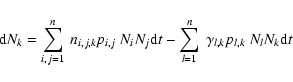
 for a
catastrophic fragmentation impact and
for a
catastrophic fragmentation impact and
 (satisfying the
mass conservation condition) for a cratering event).
The temporal evolution of Nk is then computed using a first order
eulerian code with a variable time step.
One key information needed for estimating
ni,j,k,
(satisfying the
mass conservation condition) for a cratering event).
The temporal evolution of Nk is then computed using a first order
eulerian code with a variable time step.
One key information needed for estimating
ni,j,k,
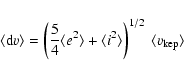
 and pi,j is the dynamical state of the system,
which can be parameterised by the average impact velocities
and pi,j is the dynamical state of the system,
which can be parameterised by the average impact velocities
 .
.
As stated in the previous section, there is yet no clear picture of
the system we intend to study. We have in particular no precise idea
of the dynamical state of the inner disc. There is nevertheless some
indirect evidence of the dynamical state in the outer parts, given by
the observed thickness of the disc. The disc aspect ratio in the 100
AU region is believed to be 0.1 (Augereau et al. 2001). Thus, a first
order approximation of the average inclination of the observed dust
particles would be half this value, i.e. 0.05 rd.
However, this value only gives very partial
information, and this for several reasons:
 value cannot be directly deduced from
 ,
at least for
the micron-sized population, where orbits might strongly depart from
the equilibrium
,
at least for
the micron-sized population, where orbits might strongly depart from
the equilibrium
 equipartition
relation (points 2 and 3 will be discussed in more details in Sect. 3).
and
values of the parent bodies in the considered r<10 AU
region as free parameters (see Sect. 4.3), but we will
nevertheless refer to the
equipartition
relation (points 2 and 3 will be discussed in more details in Sect. 3).
and
values of the parent bodies in the considered r<10 AU
region as free parameters (see Sect. 4.3), but we will
nevertheless refer to the
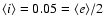 case as our "nominal" case. Note that our simulations do not
directly use the
and
parameters but the average relative velocity parameter
given by Lissauer & Stewart (1993):
case as our "nominal" case. Note that our simulations do not
directly use the
and
parameters but the average relative velocity parameter
given by Lissauer & Stewart (1993):
 is the average Keplerian velocity of
the bodies. Furthermore, we will assume the same
is the average Keplerian velocity of
the bodies. Furthermore, we will assume the same
 ,
,
 and
thus
and
thus
 for all
particles, with the important exception of the micron-sized grains
which are significantly affected by the star's radiation pressure (see
Sect. 3 for more details). We will also make the
simplifying assumption that our particle in a box system is not
dynamically evolving, so that
remains constant
throughout the run.
for all
particles, with the important exception of the micron-sized grains
which are significantly affected by the star's radiation pressure (see
Sect. 3 for more details). We will also make the
simplifying assumption that our particle in a box system is not
dynamically evolving, so that
remains constant
throughout the run.
As described in Sects. 1.2 and 1.3, there are two independent
estimates of the density of bodies in the inner disc: 1) a dust mass
(all bodies smaller than 1 mm) of
 -
g derived
from fits of the observed SED 2) a mass of
of
planetesimals in the 10-50 km range required to sustain the FEB
activity. As previously discussed, these 2 estimates appear totally
incompatible when assuming an equilibrium differential R-3.5 size
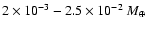
distribution throughout the system, since in this case the mass of
planetesimals extrapolated from the dust estimate is only
-
g derived
from fits of the observed SED 2) a mass of
of
planetesimals in the 10-50 km range required to sustain the FEB
activity. As previously discussed, these 2 estimates appear totally
incompatible when assuming an equilibrium differential R-3.5 size
distribution throughout the system, since in this case the mass of
planetesimals extrapolated from the dust estimate is only
 .
In order to check how strong an
incompatibility there really is, or if there is any incompatibility at
all, we will consider two extreme initial discs (see Sects. 4.1 and 4.2):
.
In order to check how strong an
incompatibility there really is, or if there is any incompatibility at
all, we will consider two extreme initial discs (see Sects. 4.1 and 4.2):
 (i.e. 2 boxes under the
ejection size, see
Sect. 3) up to
(i.e. 2 boxes under the
ejection size, see
Sect. 3) up to
 km which is compatible with observed
dust mass estimates. We chose to take an
initial dust mass of
km which is compatible with observed
dust mass estimates. We chose to take an
initial dust mass of
 g in the whole inner disc
(i.e.
g in the whole inner disc
(i.e.
 g in the considered 1 AU annulus around 5
AU), an intermediate value between the Pantin et al. (1997) and
Li & Greenberg (1998) estimates. This leads
to a total initial mass of
g in the considered 1 AU annulus around 5
AU), an intermediate value between the Pantin et al. (1997) and
Li & Greenberg (1998) estimates. This leads
to a total initial mass of
 g for the
whole system. This initial density distribution will be taken for our
"nominal" case;
up to
km and compatible with an average FEB
estimate of 25
g for the
whole system. This initial density distribution will be taken for our
"nominal" case;
up to
km and compatible with an average FEB
estimate of 25
 of 10-50 km-sized objects in the
1-10 AU region (i.e.
of 10-50 km-sized objects in the
1-10 AU region (i.e.
 in the considered
annulus), which leads to a total initial mass of
in the considered
annulus), which leads to a total initial mass of
 g.
,
ranging from
to
km, with two adjacent boxes
separated by a factor 21/3 in size, thus leading to a total
number of 103 boxes for the "nominal" case where
g.
,
ranging from
to
km, with two adjacent boxes
separated by a factor 21/3 in size, thus leading to a total
number of 103 boxes for the "nominal" case where
 cm
(see Sect. 3).
cm
(see Sect. 3).
The core of such a code is the prescription giving ni,j,k for a
given
.
Basically, impacts can be divided into
two categories: catastrophic fragmentation and
cratering, depending on the value of the impacting energy as
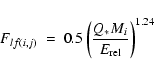
compared to Q*, the threshold specific energy of the bodies,
which represents their resistance to shattering and is deduced from
laboratory experiences and analytical considerations. Q* is by
definition the value of the specific energy Q (the ratio of the
projectile kinetic energy to the target mass) when the mass of the
largest remaining fragment Mlf(i) is equal to 0.5 Mi.
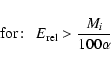
The problem is that estimations of Q* do strongly differ from one author to another (see Fig. 8 of Benz & Asphaug 1999, for an overview). Basically, all authors agree on one core assumption, i.e. the response of solid bodies to impacts is divided in two distinct regimes: the strength regime for small bodies, where the object's resistance decreases with size, and the gravity regime for larger objects where resistance increases with size because of the object's self-gravity (e.g. Housen & Holsapple 1990). Nevertheless, the slopes and turn over size from one regime to another are still a great subject of debate. We will here consider separately two different Q*prescriptions (see Sect. 4.5):
 is the relative kinetic energy of the system given by
 .
Note that this relation
is valid only for head-on impacts and has to be corrected by taking
into account its value averaged over all impacts angles. We will here
follow Petit & Farinella (1993) and take the average value:
.
Note that this relation
is valid only for head-on impacts and has to be corrected by taking
into account its value averaged over all impacts angles. We will here
follow Petit & Farinella (1993) and take the average value:
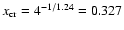 ,
since
,
since
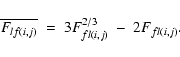
 for
Flf(i,j)=1/8.
for
Flf(i,j)=1/8.
Catastrophic fragmentation occurs by definition when
Flf(i,j) is
less than 0.5. If we suppose that the produced fragment size
distribution follows a single-exponent power law
 ,
then there is a unique set of values for q and C derived from the
value of
Flf(i,j) and the mass conservation condition. As pointed
out in several previous studies, this single power law specification
is the easiest to handle in models but it is a strong
oversimplification. It gives rise to several problems, in particular
the possibility to get so-called "supercatastrophic" impacts where
q<-4, for which there is a divergence of the total mass when
taking infinitely small lower cutoff. As noted by Tanga et al. (1999)
"...values beyond -3 for the exponent of the cumulative size
distribution cannot hold down to very small sizes, because this would
lead to unreasonably large reconstructed masses. For this reason it
is clear that, at some value of the size, the distributions are
expected to have a definite change of slope". Note that this change of
slope between the small and large fragments domain is also supported
by experimental experiments (Davis & Ryan 1990). This problem is
particularly crucial for the present study since our size cutoff is
extremely small (see below).
,
then there is a unique set of values for q and C derived from the
value of
Flf(i,j) and the mass conservation condition. As pointed
out in several previous studies, this single power law specification
is the easiest to handle in models but it is a strong
oversimplification. It gives rise to several problems, in particular
the possibility to get so-called "supercatastrophic" impacts where
q<-4, for which there is a divergence of the total mass when
taking infinitely small lower cutoff. As noted by Tanga et al. (1999)
"...values beyond -3 for the exponent of the cumulative size
distribution cannot hold down to very small sizes, because this would
lead to unreasonably large reconstructed masses. For this reason it
is clear that, at some value of the size, the distributions are
expected to have a definite change of slope". Note that this change of
slope between the small and large fragments domain is also supported
by experimental experiments (Davis & Ryan 1990). This problem is
particularly crucial for the present study since our size cutoff is
extremely small (see below).
As a consequence, we will here adopt 2 different power laws of index
q1 and q2, each holding for a different mass range and
always taken such as the small mass index q2 is smaller than
q1. The main problem is to determine where the change of slope
occurs and what the difference in slope is. We shall remain careful
and keep the slope changing size
 as well as the ratio
q1i/q2i as free parameters that will be explored in the runs
(see Sect. 4.6). Note that once
as well as the ratio
q1i/q2i as free parameters that will be explored in the runs
(see Sect. 4.6). Note that once  and
q1i/q2i are given, the values q1i and q2i for the
fragments produced on a target i by an impactor j are uniquely
determined through the set of relations:
and
q1i/q2i are given, the values q1i and q2i for the
fragments produced on a target i by an impactor j are uniquely
determined through the set of relations:
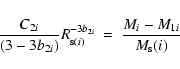
![\begin{displaymath}M_{1i}~=~\left[\frac{b_{1i}M^{b_{1i}}_{lf(i)}} {(1-b_{1i})}
\...
...(i)}~-~M^{(1-b_{1i})}_{{\rm s}(i)}\right)
~+~M_{lf(i)} \right]
\end{displaymath}](/articles/aa/full/2003/35/aa3759/img79.gif) |
(5) |
| C1i = 3b1iR3b1ilf(i) | (6) |
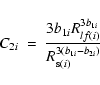 |
(7) |
 and
and
 ,
,
 is the mass of an object of size
,
M1i is
the total mass of fragments produced in the domain where the
is the mass of an object of size
,
M1i is
the total mass of fragments produced in the domain where the
 law applies, i.e. between the size of the slope
transition
and the size of the largest fragment
Rlf(i), and C1i and C2i are the coefficients for the
two
and
law applies, i.e. between the size of the slope
transition
and the size of the largest fragment
Rlf(i), and C1i and C2i are the coefficients for the
two
and
 power laws. This
set of equation is solved numerically for each (i,j) couple.
power laws. This
set of equation is solved numerically for each (i,j) couple.
For the cratering case (
Flf>0.5), we will take the simplified
prescription of Petit & Farinella (1993), where a fixed power law index
 is
considered. The total mass of craterized mass is given by
is
considered. The total mass of craterized mass is given by
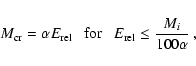 |
(9) |
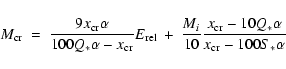 |
(10) |
 is the crater excavation coefficient which depends on
the material properties. We will explore values of
(Sect. 4.6) ranging from 10-9 to
is the crater excavation coefficient which depends on
the material properties. We will explore values of
(Sect. 4.6) ranging from 10-9 to
 s2 cm-2,
the extreme values corresponding to "hard" and "soft" material
respectively (see Petit & Farinella 1993, and references therein), and take
10-8 s2 cm-2 as our "nominal" value. The mass of the
largest fragment produced by the impact is then equal to
s2 cm-2,
the extreme values corresponding to "hard" and "soft" material
respectively (see Petit & Farinella 1993, and references therein), and take
10-8 s2 cm-2 as our "nominal" value. The mass of the
largest fragment produced by the impact is then equal to
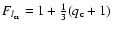
 ,
where
,
where
 .
.
The fraction of fragmented material reaccumulated onto the parent
bodies is the result of the competing ejectas' kinetic energy and the
parent bodies' gravitational potential. We will make the simplified
assumption that all fragments produced after an (i,j) impact have
the same velocity distribution (Stern & Colwell 1997):
 is the fraction of kinetic energy
that is not dissipated after an impact. We will make here the
classical assumption that
is the fraction of kinetic energy
that is not dissipated after an impact. We will make here the
classical assumption that
 for high velocity impacts
(Fujiwara et al. 1989). The mass fraction of fragment material that escapes
the target+impactor system is given by (Stern & Colwell 1997):
for high velocity impacts
(Fujiwara et al. 1989). The mass fraction of fragment material that escapes
the target+impactor system is given by (Stern & Colwell 1997):
 is the escape velocity of the colliding bodies system.
The main challenge of this simulation is that we would like to study
the collisional correlation between objects ranging from the
micron-sized to the kilometre-sized domain, i.e. separated by 8
orders of magnitude in size. Our lower cutoff is indeed the "real"
physical cutoff
imposed by the effect of the star's radiation
pressure. Radiation pressure also strongly affects particles bigger
than
,
but still in the same size range, by placing them on
highly eccentric orbits. These eccentricities depend on the ratio
between the radiation pressure force
 and the
gravitational force
and the
gravitational force
 .
For a particle produced by a parent
body on a (
a0,e0) orbit at a distance r0 from the star,
one gets:
.
For a particle produced by a parent
body on a (
a0,e0) orbit at a distance r0 from the star,
one gets:
 ,
,
 ), then
grains with
), then
grains with
 are ejected from the system on hyperbolic
orbits. The cutoff size
is by definition the size for which
are ejected from the system on hyperbolic
orbits. The cutoff size
is by definition the size for which
 and grains with sizes R larger than
are
related to
through the relation
and grains with sizes R larger than
are
related to
through the relation
 .
The
blow-out size
depends on the stellar spectra and on grains
optical properties. For
Pictoris we use a low-resolution A5V
spectra derived from Kurucz stellar models and we adopt the chemical
grain composition proposed by Li & Greenberg (1998) (we refer to the
latter paper and to Augereau et al. 1999, for a full discussion on chemical and optical
properties of the grains assumed here).
Bare compact silicate ("Si'') grains in the surroundings of Pictoris and smaller than
.
The
blow-out size
depends on the stellar spectra and on grains
optical properties. For
Pictoris we use a low-resolution A5V
spectra derived from Kurucz stellar models and we adopt the chemical
grain composition proposed by Li & Greenberg (1998) (we refer to the
latter paper and to Augereau et al. 1999, for a full discussion on chemical and optical
properties of the grains assumed here).
Bare compact silicate ("Si'') grains in the surroundings of Pictoris and smaller than
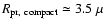 m
have
.
The same grains but coated by an organic
refractory ("or'') mantle in a Si:or volume ratio of 1:2 as proposed
by Li & Greenberg (1998) are ejected from the system on unbound orbits if
they are smaller than
m
have
.
The same grains but coated by an organic
refractory ("or'') mantle in a Si:or volume ratio of 1:2 as proposed
by Li & Greenberg (1998) are ejected from the system on unbound orbits if
they are smaller than
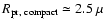 m. Actually the main uncertainty on
relies on the
grain porosity P. The
porosity affects the optical properties of the grains and consequently
m. Actually the main uncertainty on
relies on the
grain porosity P. The
porosity affects the optical properties of the grains and consequently
 .
But actually the
ratio more dramatically depends on
P through the grain density in
especially for large
porosities. The density of porous grains is related to the density of
the same but compact grain by the simple relation:
.
But actually the
ratio more dramatically depends on
P through the grain density in
especially for large
porosities. The density of porous grains is related to the density of
the same but compact grain by the simple relation:
 which implies for large porosities:
 .
From SED fitting, Li & Greenberg (1998) constrained Pin the narrow range [0.95, 0.975]. But these values are obtained when
assuming that all grains are of cometary origin, an assumption that
we believe might not hold for inner Pictoris disc (see the more complete
discussion in Sect. 5.3). In the present paper we keep P has a
free parameter with
.
From SED fitting, Li & Greenberg (1998) constrained Pin the narrow range [0.95, 0.975]. But these values are obtained when
assuming that all grains are of cometary origin, an assumption that
we believe might not hold for inner Pictoris disc (see the more complete
discussion in Sect. 5.3). In the present paper we keep P has a
free parameter with
 m (i.e.
 )
taken as our reference nominal case (see Sect. 4.4).
)
taken as our reference nominal case (see Sect. 4.4).
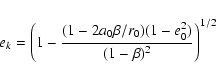
The radiation pressure induced eccentricity expressed by Eq. (14) is significant,
say  0.1, for all particles comprised
between
and 5
.
Thus all objects in this size
range will have orbital characteristics that depart from the general
average values defined in Sect. 2.1. This will significantly affect
the collision rates and physical outcomes for impacts involving these
small grains. For these impacts, Eq. (2) is no longer valid in
its simple form and
0.1, for all particles comprised
between
and 5
.
Thus all objects in this size
range will have orbital characteristics that depart from the general
average values defined in Sect. 2.1. This will significantly affect
the collision rates and physical outcomes for impacts involving these
small grains. For these impacts, Eq. (2) is no longer valid in
its simple form and
 will be numerically
estimated. To do this, we use a simplified version of a deterministic
collisional model (Thébault et al. 2002, and references therein) to
derive average
between a population of targets
having the nominal orbital characteristics as defined in Sect. 2.1
and a population of impactors with a given
will be numerically
estimated. To do this, we use a simplified version of a deterministic
collisional model (Thébault et al. 2002, and references therein) to
derive average
between a population of targets
having the nominal orbital characteristics as defined in Sect. 2.1
and a population of impactors with a given  (i.e. akand ek), all randomly distributed within the 1-10 AU region.
Another major consequence of these radiation-induced high ek is
that small grains will spend a significant fraction of their orbits
outside the inner disc. Thus, at a given moment, only a fraction
fi(k) Nk of these bodies will actually be present in the
considered system. These
 are numerically
estimated with a simple code randomly spreading 10 000 test particles
of a given
uniformly produced in the 1-10 AU region
(Table 2).
are numerically
estimated with a simple code randomly spreading 10 000 test particles
of a given
uniformly produced in the 1-10 AU region
(Table 2).
Table 2:
Numerical estimate of
in the 5
AU region, for a swarm of grains produced in the whole 1-10 AU
region, as a function of
(see text for details). Note that
for low ,
ek might become lower than the average
eccentricity for the parent bodies in the disc (see Sect. 2.1). In
such a case, the radiation pressure effect is neglected for all
 and the values of
rescaled so that
and the values of
rescaled so that
 for
for
 .
.
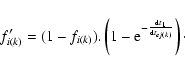
It is important to note that these
values
are not reached instantaneously: small grains produced after an impact
need time to reach the remote aphelion of their high a and high eorbits. If
 is the typical time needed for a small grain
produced in the inner disc to reach r=10 AU when placed on a high ak and
ek orbit, then during a time step
is the typical time needed for a small grain
produced in the inner disc to reach r=10 AU when placed on a high ak and
ek orbit, then during a time step
 ,
the fraction of
produced k grains that leaves the system will be approximated
through the simplified relation:
,
the fraction of
produced k grains that leaves the system will be approximated
through the simplified relation:
are then added to
a "bodies on their way to leave" subdivision of the k population,
that will in turn decrease by a
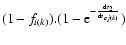 fraction at the
next time step
fraction at the
next time step
 ,
etc.
,
etc.
Another possible effect affecting the smallest high
particles
is that a fraction of them might be destroyed by collisions outside the
considered inner disc, since they spend an important fraction of their orbit
close to their apoastron which might lie beyond 10 AU. These
collisions would prevent them from re-entering the inner system.
Such collisions are by definition not modeled by
the collisional evolution Eq. (1), and this could lead to an
overestimation of the density of these bodies.
Taking into account this apoastron-collisions removal effect
requires one to make physical
assumptions about the external parts of the disc and would add several badly
constrained free parameters to our already large set of variables, in
particular the rates and timescales for these collisional destructions as
a function of .
We nevertheless tried to investigate the possible
importance of this effect by performing test runs where we
artificially introduced a new parameter
fcl(k), standing for the fraction of k bodies destroyed by collisions
in the r>10 AU region and the corresponding destruction time scale
 .
The induced removal of k bodies is then treated the same way as in
Eq. (15). fcl(k) might be taken
equal to the fraction of
grains produced within the inner
1-10 AU disc which have their periastron outside 10 AU.
The dependency of
with
is more difficult to establish,
and several values will be explored.
.
The induced removal of k bodies is then treated the same way as in
Eq. (15). fcl(k) might be taken
equal to the fraction of
grains produced within the inner
1-10 AU disc which have their periastron outside 10 AU.
The dependency of
with
is more difficult to establish,
and several values will be explored.
As will be shown in Sect. 4.7, the obtained results do not significantly depart from our "nominal" case. As a consequence, and for sake of clarity, we chose to neglect, in a first approximation, this apoastron-collision effect.

Even if these particles' ultimate fate is to leave the system, their
ejection takes also a certain amount of time and numerous very small
grains, in this transition phase towards ejection, might be present in
the system and thus collisionaly interacting with other objects. As
a consequence, our runs will be performed with 2 bins below the
limiting
size. The fraction of
bodies that do
not leave the system after an impact is computed the same way as in
Eq. (15), by numerically estimating dtej(k) and setting
fi(k)=0.
We present here the results obtained for several runs exploring all
important parameters the system's collisional evolution depends on.
As previously mentioned, we define as our "nominal" case the one
defined in Sect. 2.1. Initial conditions for this reference case are
summarized in Table 3. For sake of clarity, all other parameters
are separately explored in individual runs, even though some
parameters should in principle not be independently explored,
like in particular
the value of
(i.e. the grains' porosity) and the
fragmentation and/or cratering prescriptions. All runs are
carried out until
 years, i.e. approximately one
third of the minimum age of the system (Barrado y Navascués et al. 1999).
years, i.e. approximately one
third of the minimum age of the system (Barrado y Navascués et al. 1999).
Table 3: Initial parameters for the nominal reference run (see text for details).
![\begin{figure}
\par\includegraphics[angle=0,origin=br,width=8.8cm]{ms3759f1.ps}\end{figure}](/articles/aa/full/2003/35/aa3759/img136.gif) |
Figure 1:
Size distribution for the low-mass nominal system (see
Table 3) at 5 different epochs. Note that the y-axis displays
the mass contained in one size bin, which is a correct way of
displaying the mass distribution since all size bins are equally
spaced in a logarithmic scale. This plot is more "visual" than a more
classical
 one, since it can be directly interpreted in terms
of mass contribution (and mass loss or mass increase) of each size
range to the total mass.
one, since it can be directly interpreted in terms
of mass contribution (and mass loss or mass increase) of each size
range to the total mass. |
| Open with DEXTER | |
Figure 1 shows clearly how the system quickly departs from the
initial R-3.5 distribution. A wavy structure rapidly appears
because of the minimum size cut-off, in accordance with Campo Bagatin et al. (1994).
This structure is building up progressively, starting from the lowest
sizes and expanding towards the bigger objects bins. A quasi
steady-state is reached after 106 years and no significant
further evolution of the system is observed in the next
 years, except for a slow decrease of the system's total
mass. As could be logically expected, the wavy structure is the
most significant in the small size domain. There is in particular a
strong mass depletion, of a factor 40, in the
10-2-1 cm range, with the lowest density point around
years, except for a slow decrease of the system's total
mass. As could be logically expected, the wavy structure is the
most significant in the small size domain. There is in particular a
strong mass depletion, of a factor 40, in the
10-2-1 cm range, with the lowest density point around  cm. This depletion has 2 distinct causes: 1) the overabundance
of very small particles due to the size cut-off. Note however that this
overabundance, though still present, is significantly damped or even
erased for the smallest particles (close to
),
because these bodies spend a significant fraction of their orbits
outside the inner disc (see the fi(k) parameter in
Table 2). 2) The high
values for impacts
involving particles close to
,
which are on highly eccentric
orbits.
cm. This depletion has 2 distinct causes: 1) the overabundance
of very small particles due to the size cut-off. Note however that this
overabundance, though still present, is significantly damped or even
erased for the smallest particles (close to
),
because these bodies spend a significant fraction of their orbits
outside the inner disc (see the fi(k) parameter in
Table 2). 2) The high
values for impacts
involving particles close to
,
which are on highly eccentric
orbits.
Another important result is that the total mass loss of the system
over 107 years remains relatively limited, i.e. less than 12%
(cf. Fig. 2). Furthermore, the ratio
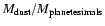 ,
after large initial variations,
progressively converges towards a value which is 1/3 of the
d
,
after large initial variations,
progressively converges towards a value which is 1/3 of the
d
 power law value. This is mostly due to a decrease
of
power law value. This is mostly due to a decrease
of
 ,
with
,
with
 being almost constant.
![\begin{figure}
\par\includegraphics[angle=0,origin=br,width=8.8cm]{ms3759f2.ps}\end{figure}](/articles/aa/full/2003/35/aa3759/img140.gif) |
Figure 2: Temporal evolution of the system's total mass for different cases. |
| Open with DEXTER | |
![\begin{figure}
\par\includegraphics[angle=0,origin=br,width=8.8cm]{ms3759f3.ps}\end{figure}](/articles/aa/full/2003/35/aa3759/img142.gif) |
Figure 3:
Temporal evolution of the ratio
for
different cases, where
is the total mass of all objects smaller
than 1 mm and
is the mass of all objects bigger
than 10 km. The horizontal line gives the initial value corresponding
to an academic
 size distribution.
 |
| Open with DEXTER | |
![\begin{figure}
\par\includegraphics[angle=0,origin=br,width=8.8cm]{ms3759f4.ps}\end{figure}](/articles/aa/full/2003/35/aa3759/img143.gif) |
Figure 4: Size distribution at 5 different epochs for the massive-disc case, where the total mass of the system is chosen in order to match the planetesimal mass estimates deduced from FEB mechanism analysis (see Sect. 2.2). |
| Open with DEXTER | |
The massive-disc case turns out to be significantly different (Fig. 4). Although a quasi steady-state is here also rapidly reached and has a profile similar to that of the nominal case, this steady-state is obtained for a much higher density. This leads to much faster mass loss than in the previous case, exceeding one order of magnitude at the end of the simulation (Fig. 5), since mass loss in a given collisional system increases with the square of the system's density. We discuss the implications of these results on the FEB phenomena in Sect. 5.1.
![\begin{figure}
\par\includegraphics[angle=0,origin=br,width=8.8cm]{ms3759f5.ps}\end{figure}](/articles/aa/full/2003/35/aa3759/img144.gif) |
Figure 5: Temporal evolution of the system's total mass for the massive disc case. |
| Open with DEXTER | |
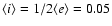 ,
two different disc excitations have been tested: one
low excitation case at
,
two different disc excitations have been tested: one
low excitation case at
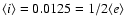 and one high excitation case at
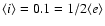 ,
all other parameters being equal (Fig. 6).
,
all other parameters being equal (Fig. 6).
As could logically be expected, the total mass loss is much higher in the
high excitation case, 18%, than in the low excitation case,
4%. Nevertheless, the steady-state regime profile is
significantly different for both runs. The density well in the
0.01-1 cm range is in particular much deeper for the dynamically cold
disc. This is a fully logical result when considering the fact that
the radiation pressure induced high e of the smallest grains only
weakly depends on the dynamical state of the parent bodies (Eq. (14)).
As a consequence, the contrast between the excitation, and thus the
shattering power, of the smallest grains and
that of the rest of the particles is very high. The destruction rate of
bodies in the 0.01-1 cm range by small grains is thus at the same level
than in the nominal case, whereas the production rate of 0.01-1 cm grains
by collisions between bigger objects is much lower, hence the deeper
density well.
Conversely, for the high excitation case, the contrast between the
small grains' and bigger objects' destructive powers is significantly damped,
hence a shallower density drop in the 0.01-1cm range.
![\begin{figure}
\par\includegraphics[angle=0,origin=br,width=8.8cm]{ms3759f6.ps}\end{figure}](/articles/aa/full/2003/35/aa3759/img148.gif) |
Figure 6: Final distribution (at t=107 years) for different levels of the disc's dynamical excitation. |
| Open with DEXTER | |
 m. We investigated different
porosities, and thus different
values, all other parameters
being equal (with always 2 size boxes below
). As can be
clearly seen in Fig. 7, changing the value of
results mainly in shifting the wavy structure without affecting its
overall profile. Although it is not strictly speaking a homothetic
shift, mainly because of the complexity of the Q* prescription,
differences are minor ones, and the density drop is always located at
roughly
m. We investigated different
porosities, and thus different
values, all other parameters
being equal (with always 2 size boxes below
). As can be
clearly seen in Fig. 7, changing the value of
results mainly in shifting the wavy structure without affecting its
overall profile. Although it is not strictly speaking a homothetic
shift, mainly because of the complexity of the Q* prescription,
differences are minor ones, and the density drop is always located at
roughly
 .
.
![\begin{figure}
\par\includegraphics[angle=0,origin=br,width=8.8cm]{ms3759f7.ps}\end{figure}](/articles/aa/full/2003/35/aa3759/img150.gif) |
Figure 7:
Final distribution (at t=107 years) for different values
of
. |
| Open with DEXTER | |
![\begin{figure}
\par\includegraphics[angle=0,origin=br,width=8.8cm]{ms3759f8.ps}\end{figure}](/articles/aa/full/2003/35/aa3759/img151.gif) |
Figure 8: Final mass distribution (at t=107 years) for different Q* prescriptions. |
| Open with DEXTER | |
of the
slope transition. These parameters were both explored in independent
runs whose results are presented in Fig. 9. As can be
clearly seen, the values of
q1/q2 and
only moderately
affect the final size distribution within the system.
As appears in Fig. 10, the cratering prescription, in
particular the value of the excavation coefficient ,
has a
more significant effect on the physical evolution of the system.
Taking a very hard material prescription (
 )
leads
indeed to a final size distribution which is very close to a
power law. The density drop in the sub-centimeter
size-range is in particular significantly reduced, with only a
factor 8 drop in a narrow region around
10-2 cm. Conversely, the very soft material run
(
)
leads
indeed to a final size distribution which is very close to a
power law. The density drop in the sub-centimeter
size-range is in particular significantly reduced, with only a
factor 8 drop in a narrow region around
10-2 cm. Conversely, the very soft material run
(
 )
leads to a deeper density drop and a more
pronounced wavy structure throughout the size distribution. This
dependency of the size distribution profile on the cratering
prescription is easily understandable when realizing that, in the
0.01 to 1 cm domain, cratering is a much more efficient process
than fragmentation in terms of mass removal (Table 4); mainly
because of the cratering events due to the high e grains in the
to 10
)
leads to a deeper density drop and a more
pronounced wavy structure throughout the size distribution. This
dependency of the size distribution profile on the cratering
prescription is easily understandable when realizing that, in the
0.01 to 1 cm domain, cratering is a much more efficient process
than fragmentation in terms of mass removal (Table 4); mainly
because of the cratering events due to the high e grains in the
to 10
 range.
Note however, that for the system as a whole, it is fragmentation which is
clearly the dominating mass removing process (Table 4).
range.
Note however, that for the system as a whole, it is fragmentation which is
clearly the dominating mass removing process (Table 4).
Table 4: This table sums up, for all objects within 3 different size ranges, the respective amount of mass that is removed by all cratering and all fragmenting impacts. These values are obtained in the steady state regime for the nominal case.
![\begin{figure}
\par\includegraphics[angle=0,origin=br,width=8.8cm]{ms3759f9.ps}\end{figure}](/articles/aa/full/2003/35/aa3759/img156.gif) |
Figure 9:
Final mass distribution (at t=107 years)
for different values of the free parameters of our bimodal power law:
i.e. the ratio of their slopes
q1/q2 and the position of the slope
changing size
with respect to the size  of the impacted body.
 |
| Open with DEXTER | |
![\begin{figure}
\par\includegraphics[angle=0,origin=br,width=8.8cm]{ms3759f10.ps}\end{figure}](/articles/aa/full/2003/35/aa3759/img157.gif) |
Figure 10:
Final mass distribution (at t=107 years) for different
values of the excavation coefficient . |
| Open with DEXTER | |
![\begin{figure}
\par\includegraphics[angle=0,origin=br,width=8.8cm]{ms3759f11.ps}\end{figure}](/articles/aa/full/2003/35/aa3759/img158.gif) |
Figure 11: Final mass distribution (at t=107 years) for an academic case with a very efficient removal of small particles by hypothetic collisions in the r>10 AU region (see text for details). |
| Open with DEXTER | |
As discussed in Sect. 3.2, we chose to perform additional test runs
checking the possible influence of small particles removal by collisions
outside the inner disc. This effect is arbitrarily parameterised by the two
parameters
and fcl(k) (see Sect. 3.2).
We present here results obtained for the most extreme case, where
was unrealistically supposed to be equal to one orbital period of
a
particle. As appears clearly from Fig. 11,
differences to the nominal case remain marginal. As expected, the main
difference is found for bins just below the
cut-off, with a
factor 4 number density difference for the first bin corresponding to
bound orbits (
 ). Nevertheless, this difference already drops
to 25% for particles of size
). Nevertheless, this difference already drops
to 25% for particles of size
 (
(
 ).
As a consequence, the sharp density drop induced by the apoastron collisions
effect remains confined to a narrow size range of particles. Furthermore,
this density drop does not have significant consequences on the rest
of the size distribution and doesn't affect the global profile of the wavy
size distribution. This is because it affects particles which are already
strongly depleted because of their high a and e (low fi(k)) values.
Besides, this removing effect's dependency on
is relatively
similar to that of the one induced by low fi(k)) values; it will thus only
tend to reinforce an effect already taken into account.
Thus, further depleting these populations does not lead to drastic changes.
).
As a consequence, the sharp density drop induced by the apoastron collisions
effect remains confined to a narrow size range of particles. Furthermore,
this density drop does not have significant consequences on the rest
of the size distribution and doesn't affect the global profile of the wavy
size distribution. This is because it affects particles which are already
strongly depleted because of their high a and e (low fi(k)) values.
Besides, this removing effect's dependency on
is relatively
similar to that of the one induced by low fi(k)) values; it will thus only
tend to reinforce an effect already taken into account.
Thus, further depleting these populations does not lead to drastic changes.
 g-1 and
 g-1 s-1. It is easy to see that
extrapolating this law to the past
leads to masses that become rapidly unrealistically high. Thus, the
planetesimal density required to sustain the FEB phenomenon
corresponds to a very rapidly evolving system and cannot be maintained
over a long period of time. One could argue that considering a
dynamically colder system would significantly reduce the system's mass
loss. But this would not solve the problem, since the strength of the
FEB producing mean-motion resonances directly depends on the system's
excitation, so that reducing the disc's excitation would require an
even higher number density of planetesimals in order to get the
observed FEB rate (Thébault & Beust 2001).
g-1 s-1. It is easy to see that
extrapolating this law to the past
leads to masses that become rapidly unrealistically high. Thus, the
planetesimal density required to sustain the FEB phenomenon
corresponds to a very rapidly evolving system and cannot be maintained
over a long period of time. One could argue that considering a
dynamically colder system would significantly reduce the system's mass
loss. But this would not solve the problem, since the strength of the
FEB producing mean-motion resonances directly depends on the system's
excitation, so that reducing the disc's excitation would require an
even higher number density of planetesimals in order to get the
observed FEB rate (Thébault & Beust 2001).
The problem with the sofar accepted FEB scenario is then the following: from combined observations and modelling, the massive disc required to sustain the observed activity should erode significantly within less than 106 yrs, giving a natural end to the FEB phenomenon. If this was to be the case, then we would be presently witnessing a very transient phenomenon. This does not appear satisfactory from a statistical point of view. Should this mean that the FEB scenario should be rejected as a whole? We believe that it is too early to state anything definitely. There are several reasons for that:
We must first recall that the estimate for the necessary disc
population for sustaining the FEB activity is derived through a chain
calculation which depends on several poorly constrained parameters
(see the extended discussion in Thébault & Beust 2001). Thébault & Beust (2001)
(Eqs. (7) and (8)) showed that the most crucial parameter is here
 ,
i.e. the minimum size of bodies able to become
observable FEBs, since the deduced total mass scales roughly as
,
i.e. the minimum size of bodies able to become
observable FEBs, since the deduced total mass scales roughly as
 in the simplified case where a power law of
index q applies for the size distribution above
,
so any change to
may induce drastic changes to the
estimated disc mass. Thébault & Beust (2001) assumed
in the simplified case where a power law of
index q applies for the size distribution above
,
so any change to
may induce drastic changes to the
estimated disc mass. Thébault & Beust (2001) assumed
 km, but this value is poorly known and could
easily vary by one order of magnitude.
exists
because bodies smaller than
are assumed to
evaporate too quickly and consequently make too few periastron
passages in the refractory evaporation zone (
km, but this value is poorly known and could
easily vary by one order of magnitude.
exists
because bodies smaller than
are assumed to
evaporate too quickly and consequently make too few periastron
passages in the refractory evaporation zone ( 0.4 AU) to
significantly contribute to the observable spectral activity. The
value of
is thus related to the evaporation rate of
the FEBs themselves. Simulations of the dynamics of the material
produced by FEB evaporation (Beust et al. 1996) led to derive
production rates of a few
0.4 AU) to
significantly contribute to the observable spectral activity. The
value of
is thus related to the evaporation rate of
the FEBs themselves. Simulations of the dynamics of the material
produced by FEB evaporation (Beust et al. 1996) led to derive
production rates of a few
 as necessary to
yield observable spectral components. We believe that this part of the
scenario needs to be revised. The main reason for that is that in
Beust et al. (1996) simulations, the material escaped from the
FEBs was assumed for simplicity to consist of the metallic ions we
study and volatile material. The metallic ions undergo a strong
radiation pressure from the star while this is not the case for the
volatiles. Hence the volatiles retain the metallic ions around the FEB
coma for a while, leading to observable components. The production
rate was then derived from the necessary amount of volatiles to retain
the ions, and from assumptions about the chemical composition of the
body. All this is obviously the weakest part of the scenario.
as necessary to
yield observable spectral components. We believe that this part of the
scenario needs to be revised. The main reason for that is that in
Beust et al. (1996) simulations, the material escaped from the
FEBs was assumed for simplicity to consist of the metallic ions we
study and volatile material. The metallic ions undergo a strong
radiation pressure from the star while this is not the case for the
volatiles. Hence the volatiles retain the metallic ions around the FEB
coma for a while, leading to observable components. The production
rate was then derived from the necessary amount of volatiles to retain
the ions, and from assumptions about the chemical composition of the
body. All this is obviously the weakest part of the scenario.
Besides, Karmann et al. (2001) showed that if the FEB
progenitors are supposed to originate from 4-5 AU from the star,
they should no longer contain ices today (i.e. volatile material),
apart from an eventual residual core. More recently, Karmann et al. (2003)
made an independent theoretical study of the evaporation
behaviour of such objects when they gradually approach the star on
repeated periastron passages. The evaporation rates derived are thus
independent from any observation. Basically, this work shows that
10 km sized bodies fully evaporate with repeated
periastron passages, and that evaporation rates of a few
are actually reached, but this occurs
only when the periastron is less than 0.2 AU, i.e. well
inside the dust evaporation zone and shortly before the final
evaporation of the body. Before that, any FEB entering the dust evaporation
zone (0.4 AU) but for which the periastron has not yet reached
0.2 AU actually evaporates, but at a weaker rate. If it is small,
it thus survives more periastron passages than in previous estimates,
and may contribute to the observational statistics.
However, whether bodies with no or very few volatiles may generate
observable components is questionable, as volatiles have a crucial role
in the dynamics of the metallic ions. Within the refractory
material, some species suffering low radiation pressure, and that
are probably abundant (carbon, silicon, ...) may play the retaining
role of volatiles. Obviously this question must be reinvestigated
with more realistic simulations, but a probably outcome will be that
could end up to be at least one order of magnitude
less than previously estimated. In this context, our chain calculation
would lead to a much lower disc mass necessary for sustaining the FEB
activity.
In this context, it is impossible to rule out the FEB scenario on this basis alone, but this remain a problematic possibility. All we can presently state is that the disc populations inferred by Thébault & Beust (2001) are unrealistic and that the FEB scenario should at least be reinvestigated much more carefully.
Putting aside the peculiar massive disc problem, the most striking
result, present for almost all tested simulations, is a final
size-distribution that significantly departs from a R-3.5 power
law, especially in the small size domain. The only exception to this
behaviour is a run with a very hard material parameter for the
cratering prescription, which means that alternative
size-distribution profiles cannot be completely ruled out, although
they seem to represent a marginal possibility. Of course, due to the
complexity of the studied problem, all free parameters could not be
exhaustively explored. Besides, there are some parameters that are
strongly coupled, i.e. fragmentation and cratering prescriptions
should in principle not be independently explored. Nevertheless,
there seems to be a global tendency towards a common feature which
consists of a lack of objects close to the limiting ejection size
,
a density peak at 2
and a sharp density
drop compared to the R-3.5 law, of one or two orders of
magnitude in mass, at 100
.
It is also important to
note that a very badly constrained parameter such as the disc's
dynamical excitation does not seem to have a crucial influence on the
profile, thus reinforcing the genericity of this result.
These departures from the
power law do not lead
to radical changes in the global dust vs. planetesimal mass ratio in
the system, which only decreases by a factor 3-4. If
 g is a typical value for the amount of dust (i.e. R<1 mm)
in the inner 10 AU region (see Sect. 1), then we estimate from
our results that the corresponding mass
of
g is a typical value for the amount of dust (i.e. R<1 mm)
in the inner 10 AU region (see Sect. 1), then we estimate from
our results that the corresponding mass
of
 km objects should be 3.5-
 ,
which remains a value comparable
to the one roughly derived from a R-3.5 power law (see Sect. 1).
Even stretching this value up to the
,
which remains a value comparable
to the one roughly derived from a R-3.5 power law (see Sect. 1).
Even stretching this value up to the
 km range does not lead to more than
 of "large" objects. Our calculations thus
quantitatively confirm what had been previously inferred from
questionable assumptions (an R-3.5 power law): there is a lack
of objects, that holds even for large planetesimals, in the inner
disc.
of "large" objects. Our calculations thus
quantitatively confirm what had been previously inferred from
questionable assumptions (an R-3.5 power law): there is a lack
of objects, that holds even for large planetesimals, in the inner
disc.
This is an additional problem for the FEB scenario, since this value is far from being enough in order to account for the sharp incompatibility between the amount of observed dust and the required amount of FEB inducing planetesimals. In any case, it appears clearly that the FEB model as it is currently accepted cannot be compatible with a "reasonable" estimate of the dust production rate in the inner disc.
Let us recall that the precise SED fit performed by Li & Greenberg (1998)
was obtained assuming that the dust is of pure cometary origin and is
not affected by collision processes. On the contrary, in our
simulations we implicitly made the assumption that the inner Pictoris dust
disc is made of collisional debris. We do believe that our results
retrospectively justify this assumption, although without ruling out
the possible presence of evaporating bodies, and this for several
reasons.
 of currently evaporating comets in a dust disc, where
directly
depends on
,
the total dust mass, and
of currently evaporating comets in a dust disc, where
directly
depends on
,
the total dust mass, and
 ,
the
typical lifetime for a dust particle before destruction. Taking the
same Halley-at-1-AU evaporation rates as Lecavelier (1998) and bodies of
20 km in radius leads to
,
the
typical lifetime for a dust particle before destruction. Taking the
same Halley-at-1-AU evaporation rates as Lecavelier (1998) and bodies of
20 km in radius leads to
 .
Considering
that collisional lifetimes of dust grains are of the order of
103 years in the inner Beta-Pic disc (Fig. 12), we
get
.
Considering
that collisional lifetimes of dust grains are of the order of
103 years in the inner Beta-Pic disc (Fig. 12), we
get
 of evaporating comets in the
r<10 AU region. This value represents 10% of the
estimated total mass of kilometre-sized objects
(cf. Table 1), which should mean that one out of ten
planetesimal objects is an evaporating comet. Although such a
possibility cannot be completely ruled out, it seems nevertheless
rather unlikely since Karmann et al. (2001) has showed that all kilometre-sized
objects originating from the 5 AU region should no longer contain volatile
material today.
One could argue that the previous calculation depends
on poorly constrained parameters and that the requested number of
evaporating bodies could be lower. But even in this case there is one
crucial problem to solve: what is the mechanism constantly refilling
the inner disc with so many fresh comets?
The main difficulty is that this refilling has to be very effective and
rapid, since the average time needed for a 10 km body at 5 AU to lose all
its volatile material is less than 100 years (see Fig. 2 of
Karmann et al. 2001).
of evaporating comets in the
r<10 AU region. This value represents 10% of the
estimated total mass of kilometre-sized objects
(cf. Table 1), which should mean that one out of ten
planetesimal objects is an evaporating comet. Although such a
possibility cannot be completely ruled out, it seems nevertheless
rather unlikely since Karmann et al. (2001) has showed that all kilometre-sized
objects originating from the 5 AU region should no longer contain volatile
material today.
One could argue that the previous calculation depends
on poorly constrained parameters and that the requested number of
evaporating bodies could be lower. But even in this case there is one
crucial problem to solve: what is the mechanism constantly refilling
the inner disc with so many fresh comets?
The main difficulty is that this refilling has to be very effective and
rapid, since the average time needed for a 10 km body at 5 AU to lose all
its volatile material is less than 100 years (see Fig. 2 of
Karmann et al. 2001).
g of dust in the <10 AU
region might be explained, within a moderate mass disc, by collisional
processes alone. Moreover, such a low mass disc is consistent with
what should be expected, in the inner disc, considering the age of the
system: a disc of debris left over after the accretion process of
planetary embryos (see next subsection). In short, there is no need
for a cometary activity in terms of production of the observed dust.
g dust disc would anyway
be unavoidable. This would strongly affect the size distribution,
which would probably tend towards the steady-state profiles displayed
in Sect. 4.
![\begin{figure}
\par\includegraphics[angle=0,origin=br,width=8.8cm]{ms3759f12.ps}\end{figure}](/articles/aa/full/2003/35/aa3759/img178.gif) |
Figure 12: Typical lifetime, as a function of its size, of a dust particle in the inner disc before destruction by collision (steady state regime of the nominal case). |
| Open with DEXTER | |
Of course, these arguments are relevant only for the inner Pic disc. We do not rule out the possibility that comet
evaporation could be a dominant dust-production source in the outer
parts of the system, as suggested by the Orbital Evaporating Bodies
scenario proposed by Lecavelier (1998) for the region beyond 70 AU. This might appear to be a somewhat paradoxal result, since evaporation
processes should be more effective in the inner regions. But let
us once again stress that these higher evaporation rates are
precisely what makes it difficult to find a way to sustain evaporation
activity over long time scales in the inner disc (as previously
mentioned, a 10 km object evaporates in less than 100 years at 5 AU).
At larger distances, volatile evaporation rates are much lower,
thus reducing the crucial problem of "refilling" the evaporation
region with fresh material. Of course, distances from the star must
remain within the limiting distance at which evaporation is possible, i.e. 100-150 AU for CO (Lecavelier et al. 1996).
Of course, one cannot rule out the possible presence of isolated much more massive objects, such as planets or planetary embryos, whose isolation decouples them from the collisional cascade responsible for the dust production (a possibility considered by Wyatt & Dent (2002) for the Fomalhaut system). In fact, the low mass in the dust-to-planetesimals range could be interpreted as the consequence of the presence of such planetary embryos: most of the initial mass of the system would already have been accreted in these embryos, leaving a sparse disc of remnants. This would be in accordance with the estimated age of the system, a few 107 years, which significantly exceeds the expected timespan for the formation of planetary embryos (e.g. Lissauer 1993), so that if embryos have to form, then they should be already here.
Another argument previously proposed in favour of the presence
of already formed massive
embryos is that such objects are a good way to explain the disc's
thickness. Artymowicz (1997) estimated that numerous Moon-sized bodies
are required in order to induce vertical velocity dispersions of
smaller bodies of the order of
 .
Nevertheless, as
pointed out by Mouillet et al. (1997), a giant planet on a slightly inclined
orbit (like the planet required to explain the warp in the outer
regions) could achieve just the same result: rapid precession of the
dust particles orbits in the inner regions would lead to thicken the
disc so that the aspect ratio appears to be equal to the planet's
inclination.
.
Nevertheless, as
pointed out by Mouillet et al. (1997), a giant planet on a slightly inclined
orbit (like the planet required to explain the warp in the outer
regions) could achieve just the same result: rapid precession of the
dust particles orbits in the inner regions would lead to thicken the
disc so that the aspect ratio appears to be equal to the planet's
inclination.
Pictoris disc?
The present study show that the observed 1021 to 1022 g
of dust in the inner disc is compatible with what would be expected
from a collisional cascade within a disc of a few
 bodies ranging from micron to
kilometre-sized objects, without the need for any additional
cometary-evaporation activity. And even if there was such a cometary
activity, the required density of objects would inevitably lead to
important collisional effects.
bodies ranging from micron to
kilometre-sized objects, without the need for any additional
cometary-evaporation activity. And even if there was such a cometary
activity, the required density of objects would inevitably lead to
important collisional effects.
Simulations also show that the size distribution settles towards a
quasi-equilibrium state that strongly departs from the classical
 Dohnanyi power law. This is particularly true
for the smallest grains close to the radiation pressure ejection
limit. However, these departures do not too strongly affect the
global Dust-to-Planetesimal mass ratio and cannot account for the
incompatibility between the small amount of observed dust and the huge
number of kilometre-sized FEBs requested to sustain the transient
absorption features activity. Furthermore, our runs show that this
requested mass of FEBs leads to a much too rapidly collisionaly
eroding disc that cannot survive on long timescales. The FEB scenario
thus cannot hold in its present form and has to be seriously revised.
Dohnanyi power law. This is particularly true
for the smallest grains close to the radiation pressure ejection
limit. However, these departures do not too strongly affect the
global Dust-to-Planetesimal mass ratio and cannot account for the
incompatibility between the small amount of observed dust and the huge
number of kilometre-sized FEBs requested to sustain the transient
absorption features activity. Furthermore, our runs show that this
requested mass of FEBs leads to a much too rapidly collisionaly
eroding disc that cannot survive on long timescales. The FEB scenario
thus cannot hold in its present form and has to be seriously revised.
We might thus converge towards a coherent picture of the inner Pictoris disc: this inner disc should be boundered by one giant planet
of 1
 ,
located around 10 AU on a slightly inclined
(in order to explain the observed outer warp) and possibly eccentric
orbit (in order to trigger the FEB activity). The observed amount of
dust should be produced by collisional erosion within a low mass
disc. Such a low mass disc could be made of debris leftover after the
accretion of one or several planetary embryos, the presence of which
is fully compatible with the estimated age of the system, i.e. a few
107 years.
In other words, we should be now witnessing a planetary system in a
late or at least intermediate stage. The bulk of the accretion process
is over, but a consequent disc of remnants is still present and
collisionaly eroding.
,
located around 10 AU on a slightly inclined
(in order to explain the observed outer warp) and possibly eccentric
orbit (in order to trigger the FEB activity). The observed amount of
dust should be produced by collisional erosion within a low mass
disc. Such a low mass disc could be made of debris leftover after the
accretion of one or several planetary embryos, the presence of which
is fully compatible with the estimated age of the system, i.e. a few
107 years.
In other words, we should be now witnessing a planetary system in a
late or at least intermediate stage. The bulk of the accretion process
is over, but a consequent disc of remnants is still present and
collisionaly eroding.
Our results would also help putting new constraints on the SED fits that are usually performed to derive dust densities and radial distributions from observed spectra. Let us recall that the dust mass estimations for the inner disc, which we used as inputs for our simulations, have been computed either by postulating that grains are of cometary origin (Li & Greenberg 1998) or by doing a pure mathematical fit with several free parameters (Pantin et al. 1997). In this respect, it would be interesting to perform a work similar to that of Li & Greenberg (1998) but with a population of collisionaly produced grains as input. An interesting attempt at doing such a kind of study has been recently made by Wyatt & Dent (2002) in their very detailed study of the Fomalhaut's debris disc. Nevertheless, their precise fit of the SED was made assuming a single power law for the size distribution (even though the authors were fully aware of the fact that such an academic distribution cannot hold for the smallest grains because of the cutoff effect). Such an SED-fit analysis goes beyond the scope of the present paper and requires additional work.
It requires in
particular to model the whole Pictoris disc and not only the
innermost parts that only partially contribute to the total flux.
Only then could the obtained size distribution be compared to
SEDs integrated over the whole disc. A crucial problem would probably
be to see if the underabundance of millimetre-sized objects that we
obtained in the inner disc is also to be found for the system as
a whole; this would then contradict previous estimates stating
that the observed mass of millimetre objects is in accordance
with a -3.5 equilibrium power law (Artymowicz 1997).
Such a study should of course also address more deeply the question
of the physical nature of the dust grains.
It will be the purpose of a forthcoming paper.
Acknowledgements
The authors wish to thank M. Wyatt and P. Artymowicz for fruitful comments and discussions. J. C. Augereau was supported by a CNES grant and a European Research Training Network "The Origin of Planetary Systems'' (PLANETS, contract number HPRN-CT-2002-00308) fellowship.