

We observed GD 358 as the primary target in May-June of 2000 to
provide another "snapshot'' of the behavior of GD 358 with minimal
alias problems. For the period May 23rd to June 8th, this run provided coverage ( 80%)
that was intermediate between the 1994 run
(86% coverage) and the 1990 run (with 69% coverage).
The 2000 WET run had several objectives: 1) look for additional
modes besides the known
80%)
that was intermediate between the 1994 run
(86% coverage) and the 1990 run (with 69% coverage).
The 2000 WET run had several objectives: 1) look for additional
modes besides the known  k=8 through 18 modes;
2) investigate the multiplet splitting structure of the pulsation modes;
3) look for amplitude changes of the known modes;
4) determine the structure of the "combination peaks'', including
the maximum order seen; and 5) provide simultaneous observations for
HST time resolved spectroscopy.
k=8 through 18 modes;
2) investigate the multiplet splitting structure of the pulsation modes;
3) look for amplitude changes of the known modes;
4) determine the structure of the "combination peaks'', including
the maximum order seen; and 5) provide simultaneous observations for
HST time resolved spectroscopy.
Before we can start interpreting the peaks in the FT, we need to
select an amplitude limit for what constitutes a "real'' peak
versus a "noise'' peak.
Kepler (1993) and Schwarzenberg-Czerny (1991, 1999), following
Scargle (1982), demonstrated that non-equally spaced data sets
and multiperiodic light curves, as
all the Whole Earth Telescope data sets are, do not have a normal
noise distribution, because the residuals are correlated.
The probability that a peak
in the Fourier transform has a 1/1000 chance of being due
to noise, not a real signal, for our large frequency range of
interest,![[*]](/icons/foot_motif.gif) requires at least peaks above
requires at least peaks above
 ,
where the
average amplitude
,
where the
average amplitude
 is the square root
of the power average (see also Breger et al. 1993 and
Kuschnig et al. 1997 for a similar estimative).
is the square root
of the power average (see also Breger et al. 1993 and
Kuschnig et al. 1997 for a similar estimative).
| Year |
 |
|
| (days) | (mma) | |
| 1990 | 244 8031.771867 | 0.62 |
| 1994 | 244 9475.001705 | 0.58 |
| 1996 | 245 0307.617884 | 1.44 |
| 2000 | 245 1702.402508 | 0.29 |
Table 5 shows that the noise,
represented by
,
for the 2000 data set is
the smallest to date, allowing us to detect smaller amplitude
peaks. Several peaks in the multi-frequency fits are below the
limit and therefore should be
considered only as upper limits to the components.
The present mode identification follows that of the 1990 data set,
published by Winget et al. (1994).
They represent the pulsations in terms of spherical harmonics
 ,
with each eigenmode described by three quantum
numbers: the radial overtone number k, the degree
,
with each eigenmode described by three quantum
numbers: the radial overtone number k, the degree  ,
also called the angular momentum quantum number, and the
azimuthal number m, with
,
also called the angular momentum quantum number, and the
azimuthal number m, with  possible values, from
 to
to  .
For a perfectly spherical star, all
.
For a perfectly spherical star, all
 eigenmodes with the same values of k and
should
have the same frequency, but rotation
causes each eigenmode to have a frequency also dependent on m.
Magnetic fields also lift the m degeneracy.
The assigned radial order k value
are the outcome of a comparison with model calculations presented
in Bradley & Winget (1994), and are consistent with the observed mass and
parallax, as discussed in their paper. Vuille et al. (2000) determinations
followed the above ones.
In the upper part of Fig. 1, we placed a mark for
equally spaced periods (correct in the asymptotic limit),
using the 38.9 s spacing derived by Vuille et al., starting with
the k=17 mode. The observed period spacings in the FT are
very close to equal, consistent with previous observations.
eigenmodes with the same values of k and
should
have the same frequency, but rotation
causes each eigenmode to have a frequency also dependent on m.
Magnetic fields also lift the m degeneracy.
The assigned radial order k value
are the outcome of a comparison with model calculations presented
in Bradley & Winget (1994), and are consistent with the observed mass and
parallax, as discussed in their paper. Vuille et al. (2000) determinations
followed the above ones.
In the upper part of Fig. 1, we placed a mark for
equally spaced periods (correct in the asymptotic limit),
using the 38.9 s spacing derived by Vuille et al., starting with
the k=17 mode. The observed period spacings in the FT are
very close to equal, consistent with previous observations.
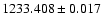
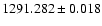
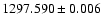
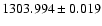
| k | Frequency | Amplitude |
 |
 |
(mma) | (s) | |
| 18 |
 |
 |
 |
| 17+ |
 |
 |
 |
| 17 |
 |
 |
 |
| 17- |
 |
 |
 |
| 16+ |
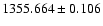 |
 |
 |
| 16 |
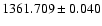 |
 |
 |
| 16- |
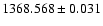 |
 |
 |
| 15+ |
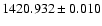 |
 |
 |
| 15 |
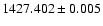 |
 |
 |
| 15- |
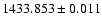 |
 |
 |
| 14+ |
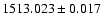 |
 |
 |
| 14 |
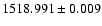 |
 |
 |
| 14- |
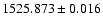 |
 |
 |
| 13+ |
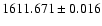 |
 |
 |
| 13 |
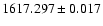 |
 |
 |
| 13- |
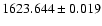 |
 |
 |
| 12 |
 |
 |
 |
| 11+ |
 |
 |
 |
| 11 |
 |
 |
 |
| 11- |
 |
 |
 |
| 10+ |
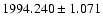 |
 |
|
| 10 |
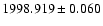 |
 |
 |
| 10- |
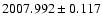 |
 |
 |
| 9+ |
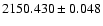 |
 |
 |
| 9 |
 |
 |
 |
| 9- |
 |
 |
 |
| 8+ |
 |
 |
 |
| 8 |
 |
 |
 |
| 8- |
 |
 |
 |
| k | Frequency | Amplitude |
|
|
|
(mma) | (s) | |
| 18+ |
 |
 |
 |
| 18 |
 |
 |
 |
| 18- |
 |
 |
 |
| 17+ |
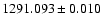 |
 |
 |
| 17 |
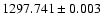 |
 |
 |
| 17- |
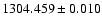 |
 |
 |
| 16+ |
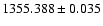 |
 |
 |
| 16 |
 |
<0.89 | |
| 16- |
 |
 |
 |
| 15+ |
 |
 |
 |
| 15 |
 |
 |
 |
| 15a |
 |
 |
 |
| 15- |
 |
 |
 |
| 14 |
 |
 |
 |
| 13+ |
 |
 |
 |
| 13 |
 |
 |
 |
| 13- |
 |
 |
 |
| 12 |
 |
 |
 |
| 11 |
 |
<0.71 | |
| 10 |
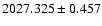 |
<0.46 | |
| 9+ |
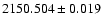 |
 |
 |
| 9 |
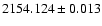 |
 |
 |
| 9- |
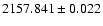 |
 |
 |
| 8+ |
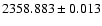 |
 |
 |
| 8 |
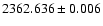 |
 |
 |
| 8- |
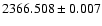 |
 |
 |
| k | Frequency | Amplitude |
|
|
|
(mma) | (s) | |
| 19 |
 |
 |
 |
| 18 |
 |
< 2.1 | |
| 17+ |
 |
 |
 |
| 170 |
 |
 |
 |
| 17- |
 |
 |
 |
| 16+ |
 |
< 1.9 | |
| 160 |
 |
 |
 |
| 16- |
 |
|
 |
| 150 |
 |
< 2.2 | |
| 15- |
 |
 |
 |
| 14 |
 |
 |
 |
| 13+ |
 |
 |
 |
| 130 |
 |
 |
 |
| 13- |
 |
< 2.2 | |
| 12 |
 |
|
 |
| 11 |
 |
 |
 |
| 10 |
 |
 |
 |
| 9+ |
 |
 |
 |
| 90 |
 |
 |
 |
| 9- |
 |
 |
 |
| 8+ |
 |
 |
 |
| 80 |
 |
 |
 |
| 8- |
 |
 |
 |
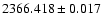
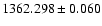
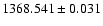
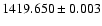
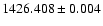
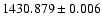
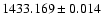
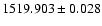
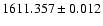
For a more self-consistent comparison, we took the data from the 1990, 1994 WET runs and the August 1996 run and derived the periods of the dominant modes via a nonlinear least squares fit. In Tables 6, 7 and 8 we present the results of a non-linear simultaneous least squares fit of 23 to 29 sinusoids, representing the main periodicities, to the 1990, 1994 and 1996 data sets. We use the nomenclature ka, for example 15-, to represent a subcomponent with m=-1 of the k=15 mode in these tables. The difference in the frequencies reported in this paper compared to the previous ones is due to our use of the simultaneous non-linear least-squares frequency fitting rather than using the Fourier Transform frequencies.
We note that both the Fourier analysis and multi-sinusoidal fit assume the signal is composed of sinusoids with constant amplitudes, which is clearly violated in the 1996 data set. The changing amplitudes introduce spurious peaks in the Fourier transform. This will not affect the frequency of the modes, but the inferred amplitude will be a poor match to the (non-sinusoidal) light curve amplitude.
In Table 5 we present the
average amplitude of the data sets, from 1000 to 3000  Hz,
after the main periodicities, all above
,
have been subtracted. For the 2000 data set, the initial
for the frequency range from 0
to 10 000 Hz, is 0.69 mma. For the high frequency range above
3000 Hz,
Hz,
after the main periodicities, all above
,
have been subtracted. For the 2000 data set, the initial
for the frequency range from 0
to 10 000 Hz, is 0.69 mma. For the high frequency range above
3000 Hz,
 mma.
mma.
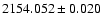
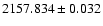
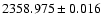
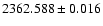
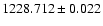
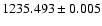
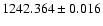
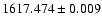
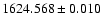
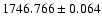
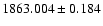
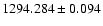
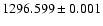
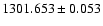
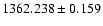
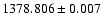
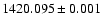
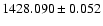
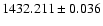
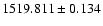
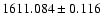
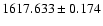
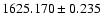
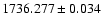
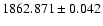
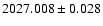
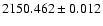
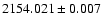
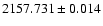
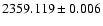
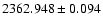
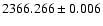
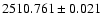
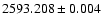
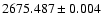
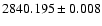
To provide the most accurate frequencies possible, we rely on a non-linear least squares fit of sinusoidal modes with guesses to the observed periods, since these better take into account contamination or slight frequency shifts due to aliasing. In Table 9 we present the results of a simultaneous non-linear least squares fit of 29 sinusoids, representing the main periodicities of the 2000 data set, simultaneously. All the phases have been measured with respect to the barycentric Julian coordinated date BCT 2 451 702.402 508.
| k | Frequency | Period | Amplitude |
|
|
|
(s) | (mma) | (s) | |
| 20 |
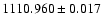 |
 |
 |
 |
| 19 |
 |
 |
 |
 |
 |
 |
 |
 |
 |
| 18 |
 |
 |
 |
 |
| 17+ |
 |
 |
 |
 |
| 17 |
 |
 |
 |
 |
| 17- |
 |
 |
 |
 |
| 16 |
 |
 |
 |
 |
| 16- |
 |
 |
 |
 |
| 15+ |
 |
 |
 |
 |
| 15 |
 |
 |
 |
 |
| 15- |
 |
 |
 |
 |
| 14 |
 |
 |
 |
 |
| 13+ |
 |
 |
 |
 |
| 13 |
 |
 |
 |
 |
| 13- |
 |
 |
 |
 |
| 12 |
 |
 |
 |
 |
| 11 |
 |
 |
 |
 |
| 10 |
 |
 |
 |
 |
| 9+ |
 |
 |
 |
 |
| 9 |
 |
 |
 |
 |
| 9- |
 |
 |
 |
 |
| 8+ |
 |
 |
 |
 |
| 8 |
 |
 |
 |
 |
| 8- |
 |
 |
 |
 |
 |
 |
 |
 |
 |
 |
 |
 |
 |
 |
| 7 |
 |
 |
 |
 |
 |
 |
 |
 |
 |
Armed with the new frequencies in Table 9, we comment
on regions of particular interest in the FT.
First, we identify several newly detected modes at
P=373.76 s,
 Hz, amp = 8.43 mma;
P=852.52 s,
Hz, amp = 8.43 mma;
P=852.52 s,
 Hz, amp = 2.74 mma; and
P=900.13 s,
Hz, amp = 2.74 mma; and
P=900.13 s,
 Hz, amp = 2.03 mma.
Based on the mode assignments of Bradley & Winget (1994) we identify
these modes as k=7, 19, and 20.
The mode identification is based on the proximity of
the detected modes with those predicted by the models, or even the
asymptotical period spacings, but also because of resonant mode coupling,
i.e., a stable mode will be driven to visibility if a coupled mode
falls near its frequency, as it happens for k=7, which is very close to
the combination of
k=17 and k=16; and k=20, which falls near
the resonance of the 8- and the
mode at
Hz, amp = 2.03 mma.
Based on the mode assignments of Bradley & Winget (1994) we identify
these modes as k=7, 19, and 20.
The mode identification is based on the proximity of
the detected modes with those predicted by the models, or even the
asymptotical period spacings, but also because of resonant mode coupling,
i.e., a stable mode will be driven to visibility if a coupled mode
falls near its frequency, as it happens for k=7, which is very close to
the combination of
k=17 and k=16; and k=20, which falls near
the resonance of the 8- and the
mode at  Hz
(see next paragraph).
It is important to note that these modes appear in combination peaks
with other modes, as shown in Table 11.
This reinforces our belief that these modes are physical modes, and not
just erroneously identified combination peaks.
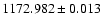
We note that Bradley (2002) analyzed single site data taken over several
years, and found peaks at 1172 or
Hz
(see next paragraph).
It is important to note that these modes appear in combination peaks
with other modes, as shown in Table 11.
This reinforces our belief that these modes are physical modes, and not
just erroneously identified combination peaks.
We note that Bradley (2002) analyzed single site data taken over several
years, and found peaks at 1172 or  Hz in
April 1985, May 1986, and June 1992 data, lending additional credence to
the detection of the k=19 mode or its alias.
Hz in
April 1985, May 1986, and June 1992 data, lending additional credence to
the detection of the k=19 mode or its alias.
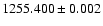
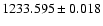
The first previously known region of interest surrounds the k=18 mode,
which lies
near  Hz, according to previous observations.
In the 2000 data, the largest amplitude peak in this region lies at
Hz, which is over
Hz, according to previous observations.
In the 2000 data, the largest amplitude peak in this region lies at
Hz, which is over  Hz from the previous location.
Given that other modes (especially the one at k=17) has shifted by
less than
Hz from the previous location.
Given that other modes (especially the one at k=17) has shifted by
less than  Hz, we are inclined to rule out the possibility that
the k=18 mode shifted by Hz.
One possible solution is offered by seismological models of GD 358,
which predict an
mode near Hz.
For example, the best ML2 fit to the 1990 data (from
Metcalfe et al. 2002, Table 3), has an
mode
at
Hz, we are inclined to rule out the possibility that
the k=18 mode shifted by Hz.
One possible solution is offered by seismological models of GD 358,
which predict an
mode near Hz.
For example, the best ML2 fit to the 1990 data (from
Metcalfe et al. 2002, Table 3), has an
mode
at
 Hz (P= 798.3 s).
This would also be consistent with the larger number of subcomponents
detected, although they may be caused only by amplitude changes during
the observations. Figure 9 shows the region of the k=18 mode
in the FT for the 1990 data set (solid) and the 2000 data set (dashed);
it is consistent with the k=18 mode being the Hz for both data
sets, and they even have similar amplitudes.
While we avoided having to provide an explanation for why only
the k=18 mode would shift by Hz, we have introduced another
problem, as geometrical cancellation for an
mode
introduces a factor of 0.26 in relation to unity for an
mode. Thus, the identification of the Hz
as an
mode, which has a measured amplitude of 14.86 mma,
implies a physical amplitude higher than that of the highest
amplitude
mode, around 30 mma.
Hz (P= 798.3 s).
This would also be consistent with the larger number of subcomponents
detected, although they may be caused only by amplitude changes during
the observations. Figure 9 shows the region of the k=18 mode
in the FT for the 1990 data set (solid) and the 2000 data set (dashed);
it is consistent with the k=18 mode being the Hz for both data
sets, and they even have similar amplitudes.
While we avoided having to provide an explanation for why only
the k=18 mode would shift by Hz, we have introduced another
problem, as geometrical cancellation for an
mode
introduces a factor of 0.26 in relation to unity for an
mode. Thus, the identification of the Hz
as an
mode, which has a measured amplitude of 14.86 mma,
implies a physical amplitude higher than that of the highest
amplitude
mode, around 30 mma.
Kotak et al. (2003), analyzing time-resolved spectra obtained at the
Keck in 1998, show the velocity variations of the k=18 mode
at Hz is similar to those for the k=15 and k=17 modes,
concluding all modes are .
They did not detect a mode
at Hz.
In Fig. 10 we show the pre-whitened results; pre-whitening
was done by subtracting from the observed light curve a synthetic light
curve constructed with a single sinusoid with frequency, amplitude
and phase that minimizes the Fourier spectrum at the frequency of the
highest peak. A new Fourier spectrum is calculated and the next dominant
frequency is subtracted, repeating the procedure until no significant
power is left.
It is important to notice that with pre-whitening, the order of
subtraction matters. As an example, in the 2000 data set, if we
subtract the largest peak in the region of the k=18 mode, at 1255.41 Hz, followed by the next highest peak at 1256.26 Hz
and the next at 1254.44 Hz, we are left with a peak at only
1.3 mma at 1232.76 Hz. But if instead we subtract only the
1255.41 Hz
followed by the peak left at 1233.24 Hz, its amplitude is
around 3.1 mma, i.e., larger. Pre-whitening assumes the frequencies are
independent in the observed, finite, data set.
If they were, the order of subtraction would not affect the result.
Because the order of subtraction matters, the basic assumption
of pre-whitening does not apply.
We attempt to minimize this effect by noting that the frequencies
change less than the amplitudes, and use the FT frequencies in a
simultaneous non-linear least squares fit of all the eigenmode
frequencies.
But even the simultaneous
non-linear least squares fit uses the values of the Fourier
transform as starting points, and could converge to a local
minimum of the variance instead of the global minimum.
The modes with periods between 770 and 518 s (k=17 through 13) are
present in the 2000 data, though with different amplitudes than in
previous years.
Another striking feature of the peaks in 2000 is that one multiplet
member of each mode has by far the largest amplitude, so that without
data from previous WET runs, we would not know that the modes are
rotationally split.
The frequencies of these modes are stable to about  Hz
or less with the exception of the 16- mode, where the frequency
jumped from about
Hz
or less with the exception of the 16- mode, where the frequency
jumped from about
 Hz in 1990 and 1994 to about
  Hz
in 1996 and 2000 (see Fig. 11).
Most of these frequency changes are larger than the formal frequency
uncertainty from a given run (typically less than
Hz
in 1996 and 2000 (see Fig. 11).
Most of these frequency changes are larger than the formal frequency
uncertainty from a given run (typically less than  Hz), so
there is some process in GD 358 that causes the mode frequencies to
"wobble'' from one run to the next.
We speculate that this may be related to non-linear mode coupling
effects.
Whatever the origin of the frequency shifts, it renders these modes
useless for studying evolutionary timescales through rates of period
change.
Hz), so
there is some process in GD 358 that causes the mode frequencies to
"wobble'' from one run to the next.
We speculate that this may be related to non-linear mode coupling
effects.
Whatever the origin of the frequency shifts, it renders these modes
useless for studying evolutionary timescales through rates of period
change.
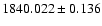
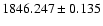
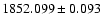
The k=12 through 10 modes deserve separate mention because their
amplitudes are always small; between 1990 and 2000, the largest amplitude
peak was only 1.6 mma.
The small amplitudes can make accurate frequency determinations
difficult, and all three modes have frequency shifts of 13 to  Hz
between the largest amplitude peaks in a given mode.
The k=10 mode shows the largest change with the 1990 data showing
the largest peaks at
Hz
between the largest amplitude peaks in a given mode.
The k=10 mode shows the largest change with the 1990 data showing
the largest peaks at
 Hz and
 Hz, while the 2000
data has one peak dominating the region at
Hz, while the 2000
data has one peak dominating the region at
 Hz.
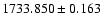
An examination of the data in Bradley (2002) shows that the k=12 mode
seems to consistently show a peak near 1733 to
Hz.
An examination of the data in Bradley (2002) shows that the k=12 mode
seems to consistently show a peak near 1733 to  Hz, and that
only the 1994 data has the peak shifted to
Hz, and that
only the 1994 data has the peak shifted to
 Hz, suggesting
that 1994 data may have found an alias peak or that the Hz
mode could be the m=+1 member and the
Hz mode is the
m=-1 member. The data in Bradley (2002) do not show convincing
evidence for the k=11 or 10 modes, so we cannot say anything else
about them.
Hz, suggesting
that 1994 data may have found an alias peak or that the Hz
mode could be the m=+1 member and the
Hz mode is the
m=-1 member. The data in Bradley (2002) do not show convincing
evidence for the k=11 or 10 modes, so we cannot say anything else
about them.
It is interesting to note that the k=8 and
k=9 modes are always seen as a triplet,
with 3.58 Hz separation for k=9, even in the 1996 data set.
Our measured spacings are 3.54 and 3.69 Hz, from m=-1 to m=0 and
m=0 to m=1.
The k=8 mode
in 2000 shows an m=0 component below our statistical
detection limit (A= 0.41 mma, when the local
 mma),
but the m=1 and m=-1 modes
remain separated by
mma),
but the m=1 and m=-1 modes
remain separated by
 Hz. All the higher k modes
are seen as singlets in the 2000 data set.
We also note that the k=8 and 9 modes have by far the most
stable frequencies.
The frequencies are always the same to within
Hz. All the higher k modes
are seen as singlets in the 2000 data set.
We also note that the k=8 and 9 modes have by far the most
stable frequencies.
The frequencies are always the same to within  Hz, and in
some cases better than
Hz, and in
some cases better than  Hz.
However, the frequency shifts are large enough to mask any possible
signs of evolutionary period change, as Fig. 12 shows.
Thus, we are forced to conclude that GD 358 is not a stable enough
"clock'' to discern evolutionary rates of period change.
Hz.
However, the frequency shifts are large enough to mask any possible
signs of evolutionary period change, as Fig. 12 shows.
Thus, we are forced to conclude that GD 358 is not a stable enough
"clock'' to discern evolutionary rates of period change.
Copyright ESO 2003
![\begin{figure}
\par\includegraphics[width=8.8cm,clip]{k18.ps}\end{figure}](/articles/aa/full/2003/14/aa3375/img395.gif)