

The dereddened R magnitudes of the GRB host galaxies with determined
redshifts are given in Table .1. They were estimated in
the Vega system taking account of most of the published papers
and GRB Coordinates Network circulars directly or indirectly reporting
on optical observations of fading GRB afterglows and their hosts.
When several R magnitudes of a given source were available in the
literature, the various measurements were weighted according to their
photometric uncertainty, and subsequently averaged to get a final
homogenized value. In some cases, we also relied on the host
contribution derived from the fit of the R-band optical transient
light-curve when the latter was clearly well constrained. The Rmagnitude of the GRB 990506 host galaxy was measured from an
R-band image that we obtained using the EFOSC2 instrument on the
ESO 3.6-m telescope at La Silla.
| Redshift | Photometry |
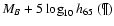 |
||||||||
| Source | GRB | z | Ref. |
 |
R mag | References | (1) | (2) | ||
| GRB J194641.9-193605 | 020813 | 1.25 | 1 | 0.109 | 24.70  0.20
0.20 |
2 | -19.30 | |||
| GRB J151455.8-192454 | 020531 | 1.00 | 3 | 0.140 | 22.05
0.20 |
4 | -21.35 | |||
| GRB J135803.1-312222 | 020405 | 0.69 | 5 | 0.050 | 20.90
0.20 |
5 | -21.50 | |||
| GRB J111518.0-215656 | 011211 | 2.14 | 6 | 0.036 | 24.90
0.30 |
7 | -20.55 | |||
| GRB J113429.6-760141 | 011121 | 0.36 | 8 | 0.508 | 24.60
0.40 |
9 | -16.15 | -16.25 | ||
| GRB J225559.9+405553 | 010921 | 0.45 | 10 | 0.145 | 21.45
0.15 |
10, 11 | -19.75 | -19.95 | ||
| GRB J145212.5+430106 | 010222 | 1.48 | 12 | 0.023 | 25.70
0.15 |
13, 14 | -18.75 | -18.50 | ||
| GRB J170409.7+514711 | 000926 | 2.04 | 15 | 0.024 | 24.80
0.10 |
15 | -20.50 | |||
| GRB J021834.5+074429 | 000911 | 1.06 | 16 | 0.120 | 25.10
0.10 |
16 | -18.80 | -18.85 | ||
| GRB J122519.3+200611 | 000418 | 1.12 | 17 | 0.033 | 23.80
0.20 |
18, 19 | -19.90 | -19.85 | ||
| GRB J162018.6+292636 | 000301 | 2.04 | 20 | 0.052 | 27.85
0.30 |
21 | -17.45 | |||
| GRB J015915.5-403933 | 000210 | 0.85 | 22 | 0.017 | 23.45
0.10 |
22 | -19.50 | -19.50 | ||
| GRB J050931.3+111707 | 991216 | 1.02 | 23 | 0.633 | 25.30
0.20 |
24 | -18.15 | |||
| GRB J163353.5+462721 | 991208 | 0.71 | 25 | 0.016 | 24.30
0.20 |
25, 26 | -18.30 | -18.30 | ||
| GRB J223153.1-732429 | 990712 | 0.43 | 27 | 0.032 | 21.85
0.15 |
28, 29, 30 | -19.35 | -19.50 | ||
| GRB J050954.5-720753 | 990705 | 0.84 | 31 | 0.122 | 21.80
0.10 |
31, 32, 33 | -21.65 | -21.75 | ||
| GRB J133807.1-802948 | 990510 | 1.62 | 27 | 0.118 | 27.50
0.30 |
34 | -17.20 | |||
| GRB J115450.1-264035 | 990506 | 1.31 | 17 | 0.065 | 25.50
0.20 |
this work | -19.75 | -19.45 | ||
| GRB J152530.3+444559 | 990123 | 1.60 | 35 | 0.016 | 24.30
0.40 |
26, 36, 37, 38 | -20.40 | -20.05 | ||
| GRB J235906.7+083507 | 980703 | 0.97 | 39 | 0.058 | 22.40
0.20 |
26, 40, 41, 42 | -20.90 | -20.80 | ||
| GRB J101757.8+712725 | 980613 | 1.10 | 43 | 0.090 | 25.80
0.10 |
44 | -17.85 | -17.90 | ||
| GRB J115626.4+651200 | 971214 | 3.42 | 45 | 0.016 | 25.60
0.20 |
26, 45, 46 | -21.30 | -21.30 | ||
| GRB J180831.6+591851 | 970828 | 0.96 | 47 | 0.038 | 25.10
0.30 |
47 | -18.85 | -18.35 | ||
| GRB J065349.4+791619 | 970508 | 0.83 | 48 | 0.049 | 25.10
0.20 |
26, 48, 49 | -17.85 | -17.75 | ||
| GRB J050146.7+114654 | 970228 | 0.69 | 50 | 0.234 | 24.60
0.20 |
50, 51, 52 | -17.85 | -17.80 | ||
Notes:
 Foreground Galactic extinction. For all cases
excepted GRB 990705, it has been estimated from the DIRBE/IRAS dust maps of Schlegel et al. (1998). For GRB 990705 which occured behind the Large Magellanic Cloud, we used
the results of Dutra et al. (2001).
Foreground Galactic extinction. For all cases
excepted GRB 990705, it has been estimated from the DIRBE/IRAS dust maps of Schlegel et al. (1998). For GRB 990705 which occured behind the Large Magellanic Cloud, we used
the results of Dutra et al. (2001).
 Derived from the V magnitude of Fruchter et al. (2000a) assuming a spectral
slope
Derived from the V magnitude of Fruchter et al. (2000a) assuming a spectral
slope
 . .
 The absolute B magnitudes were derived
assuming a
The absolute B magnitudes were derived
assuming a  CDM Universe with CDM Universe with
 and
and
 .
Column (1) gives the estimations which were obtained by applying proper k-corrections
and B-R colours to the observed R magnitudes. The results given in Col. (2) were derived
from the observed flux density at the redshifted B-band wavelength. .
Column (1) gives the estimations which were obtained by applying proper k-corrections
and B-R colours to the observed R magnitudes. The results given in Col. (2) were derived
from the observed flux density at the redshifted B-band wavelength.
|
The redshifts given in Table .1 have also been taken from the literature. In most cases, they were determined from emission lines directly observed in the spectra of the hosts. For the other sources, they were derived as the redshifts of the furthest absorbing medium observed in absorption within the spectra of the GRB optical transients. We made the assumption that the first interstellar medium illuminated by the background afterglow is indeed that of its host galaxy itself. We note that this hypothesis has been confirmed in several cases where the derived redshift could have been confirmed with emission lines from the host.
These redshifts and R magnitudes were subsequently used to derive
the absolute B magnitudes given in Col. (1) of
Table .1, assuming a CDM Universe with
,
.
For each host, the
k-correction for the R-filter and rest-frame B-R colour used for
this computation were estimated taking account of the type of SED
suggested by its R-K and/or optical colours when available (see
Table 2 and Fig. 4), otherwise
assuming a blue continuum with a spectral slope
.
To better establish the validity of our results, we also estimated,
for most of the hosts, the absolute B magnitudes from the observed
flux density at the redshifted B-band wavelength. For each case,
this flux density was derived interpolating the various broad-band
filter magnitudes given in the literature (see Table .1
for references) including the K magnitudes given in
Table 2. The final results are indicated in
Col. (2) of Table .1. To compare the two methods, we
computed the difference between the estimations given in the two
columns, and found a mean value < MB(1) - MB(2) > = 0.07 and a dispersion 
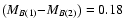 .
.
Copyright ESO 2003