

Observations were performed using the ESO facilities in Chile and the Gemini-North telescope in Hawaii. Ten GRB host galaxies, most of them located in the southern hemisphere and selected for having had an optical and/or radio bright afterglow, were imaged at near-infrared wavelengths. Our sample of sources is listed in Table 1 together with a log of the observations.
The NIR data were obtained with the Infrared Spectrometer And Array
Camera (ISAAC) on the Very Large Telescope (VLT) at Paranal, the Son
OF ISAAC (SOFI) installed on the New Technology Telescope (NTT) at La
Silla, and with the Adaptive Optics Hokupa'a / QUIRC instrument on
Gemini-North at Mauna Kea. Observations were carried out between
March 2000 and September 2001 under photometric conditions. A  filter (2.0-2.3
 m) was used for the ISAAC and SOFI data, while
the observations on Gemini were performed with a K' filter
(1.9-2.3m). The focal lens configurations resulted in a
respective pixel size of 0
m) was used for the ISAAC and SOFI data, while
the observations on Gemini were performed with a K' filter
(1.9-2.3m). The focal lens configurations resulted in a
respective pixel size of 0
 148, 0
297 and 0
02
for the ISAAC, SOFI and Hokupa'a images. The seeing remained rather
stable during the observations of one given source, though it varied
between 0
6 and 1
5 from one night to another.
Individual frames were obtained as a co-addition of 12 single
exposures of 10 seconds each. The series of acquisition for each
object were then carried out in a jitter mode, with a dither of the
frames following either a random pattern characterized by typical
offsets
148, 0
297 and 0
02
for the ISAAC, SOFI and Hokupa'a images. The seeing remained rather
stable during the observations of one given source, though it varied
between 0
6 and 1
5 from one night to another.
Individual frames were obtained as a co-addition of 12 single
exposures of 10 seconds each. The series of acquisition for each
object were then carried out in a jitter mode, with a dither of the
frames following either a random pattern characterized by typical
offsets  30
30
 on the sky for the ISAAC and SOFI images,
or a regular grid with shifts of 5
for the Hokupa'a data.
For the ISAAC observations, we reached a total on-source integration
time of 1 hour per object.
on the sky for the ISAAC and SOFI images,
or a regular grid with shifts of 5
for the Hokupa'a data.
For the ISAAC observations, we reached a total on-source integration
time of 1 hour per object.
Data reduction was performed following the standard techniques of NIR image processing. To estimate the thermal background contribution of each frame, a "sky'' map was generated using a median-average of the 9 jittered images directly preceding and following a given acquisition. The corresponding "sky'' was then scaled to the mode of the object frame and subsequently subtracted. This method allowed us to remove in the meantime the contributions of the bias and dark current. Finally, the differential pixel-to-pixel response of the arrays was corrected using flat-field images taken as part of the instrument calibration plans. For the ISAAC and Hokupa'a data, these flat-fields were obtained by observing a blank-field of the sky during twilights, while a white screen within the dome of the NTT was used for the SOFI observations. For the latter, we noticed that the low spatial frequencies of the detector sensitivity were not properly taken into account with the dome images. They were therefore corrected using a low-order polynomial 2D-fit of the array response, a method often refered as the "illumination correction technique''. Photometric calibrations were performed using the NICMOS standard stars from Persson et al. (1998).
![\begin{figure}
\par\includegraphics[width=15.6cm,clip]{3369.f1.eps}\end{figure}](/articles/aa/full/2003/11/aa3369/img25.gif) |
Figure 1:
Near-infrared images of the gamma-ray burst host galaxies
listed in Table 1. Observations were performed with a
filter, except in the case of the GRB 980329 host for which a
K' filter was used. Each frame has a field of view of
45
 45
and an orientation with the North
to the top and the East to the left. From the top to the bottom and
the left to the right, they were tentatively ordered with increasing
distance of the host from Earth. The GRB 981226 and GRB 001011 host
galaxies have been assigned a plausible redshift range as described in
Sect. 3.1, while references for the other redshifts are
given in Table 2. In the last four images, the
targets were not detected. 45
and an orientation with the North
to the top and the East to the left. From the top to the bottom and
the left to the right, they were tentatively ordered with increasing
distance of the host from Earth. The GRB 981226 and GRB 001011 host
galaxies have been assigned a plausible redshift range as described in
Sect. 3.1, while references for the other redshifts are
given in Table 2. In the last four images, the
targets were not detected. |
| Redshift | Photometry | ||||||||
| Source | GRB | z | Ref. | K mag | References | R-K colour  |
Abs. K mag. |
||
| GRB J225559.9+405553 | 010921 | 0.45 | 1 | 19.05  0.1
0.1 |
1 | 2.40
0.25 |
-22.50 | ||
| GRB J145212.5+430106 | 010222 | 1.48 | 2 | 23.5
0.0 |
3 | 2.20
0.30 |
-21.25 | ||
| GRB J182304.6-505416 | 001011 | 21.45
0.2 |
this work | 3.75
0.45 |
|||||
| GRB J122519.3+200611 | 000418 | 1.12 | 4 | 21.3
0.2 |
this work | 2.50
0.40 |
-22.65 | ||
| GRB J015915.5-403933 | 000210 | 0.85 | 5 | 20.95
0.2 |
this work | 2.50
0.30 |
-22.25 | ||
| GRB J061331.1-515642 | 000131 | 4.5 | 6 |  22.5 22.5 |
this work | ||||
| GRB J163353.5+462721 | 991208 | 0.71 | 7 | 21.7
0.2 |
8 | 2.60
0.40 |
-21.00 | ||
| GRB J223153.1-732429 | 990712 | 0.43 | 9 | 20.05
0.1 |
this work | 1.80
0.30 |
-21.40 | ||
| GRB J133807.1-802948 | 990510 | 1.62 | 9 | 22.5 |
this work | ||||
| GRB J115450.1-264035 | 990506 | 1.31 | 4 | 21.45
0.2 |
this work | 4.05
0.35 |
-22.90 | ||
| GRB J122311.4+064405 | 990308 | 21.5 |
this work | ||||||
| GRB J152530.3+444559 | 990123 | 1.60 | 10 | 21.9
0.4 |
8, 11 | 2.40
0.80 |
-23.10 | ||
| GRB J232937.2-235554 | 981226 | 21.1
0.2 |
this work | 3.40
0.50 |
|||||
| GRB J235906.7+083507 | 980703 | 0.97 | 12 | 19.6
0.1 |
8 | 2.80
0.30 |
-23.95 | ||
| GRB J070238.0+385044 | 980329 | 23.0 |
this work | ||||||
| GRB J115626.4+651200 | 971214 | 3.42 | 13 | 22.4
0.2 |
8 | 3.20
0.40 |
-24.45 | ||
| GRB J180831.6+591851 | 970828 | 0.96 | 14 | 21.5
0.3 |
14 | 3.60
0.60 |
-22.05 | ||
| GRB J065349.4+791619 | 970508 | 0.83 | 15 | 22.7
0.2 |
8 | 2.40
0.40 |
-20.45 | ||
| GRB J050146.7+114654 | 970228 | 0.69 | 16 | 22.6
0.3 |
8, 17 | 2.00
0.50 |
-20.05 | ||
Notes:
 For all sources except the GRB 981226 and
GRB 001011 hosts, the R-K colours were estimated using the Rmagnitudes given in Table .1 of
Appendix A. The R-band photometry for the host galaxy of GRB 981226 has been derived from
Saracco et al. (2001b), Frail et al. (1999) and Holland et al. (2000b), while that of the GRB 001011
host is taken from Gorosabel et al. (2002).
For all sources except the GRB 981226 and
GRB 001011 hosts, the R-K colours were estimated using the Rmagnitudes given in Table .1 of
Appendix A. The R-band photometry for the host galaxy of GRB 981226 has been derived from
Saracco et al. (2001b), Frail et al. (1999) and Holland et al. (2000b), while that of the GRB 001011
host is taken from Gorosabel et al. (2002).
 Defined as
 h65 assuming a
  CDM Universe with CDM Universe with
 and
and
 (h65 = H0 (km s-1 Mpc-1) / 65).
 Estimated from an extrapolation of the afterglow K-band light curve
(Frail et al. 2002).
Estimated from an extrapolation of the afterglow K-band light curve
(Frail et al. 2002).
References: (1) Price et al. (2002c); (2) Jha et al. (2001); (3) Frail et al. (2002); (4) Bloom et al. (2002a); (5) Piro et al. (2002); (6) Andersen et al. (2000); (7) Castro-Tirado et al. (2001); (8) Chary et al. (2002); (9) Vreeswijk et al. (2001); (10) Kulkarni et al. (1999); (11) Bloom et al. (1999); (12) Djorgovski et al. (1998); (13) Kulkarni et al. (1998); (14) Djorgovski et al. (2001); (15) Bloom et al. (1998a); (16) Bloom et al. (2001); (17) Fruchter et al. (1999a). |
Each galaxy was observed more than 150 days after the date of its
hosted GRB event (see Col. 3 of Table 1). Assuming the
least favourable case of a bright GRB optical transient (R mag
20 at GRB + 2 days) with a break in the light-curve occuring
2 days after the burst and a slow decay with time (temporal
index
 ), we estimate that all GRB counterparts should
have been fainter than R mag
35 at the time of the
observations. Taking account of a power law spectrum
), we estimate that all GRB counterparts should
have been fainter than R mag
35 at the time of the
observations. Taking account of a power law spectrum
 for the modelling of the afterglow emission, we
set a lower limit K mag
for the modelling of the afterglow emission, we
set a lower limit K mag  33. In our data, the flux
contribution of any extra light from the fading afterglows should
therefore be completely negligible relative to the emission of the
host galaxies.
33. In our data, the flux
contribution of any extra light from the fading afterglows should
therefore be completely negligible relative to the emission of the
host galaxies.
Our final images are presented in Fig. 1. For each observation, the
astrometry was performed using foreground stars of the USNO catalog,
and the GRB hosts were identified within 1
of the positions
of the GRB transients. Among the ten sources of our sample, six host
galaxies are clearly detected in our -band data. Using the task
phot within the IRAF
package![[*]](/icons/foot_motif.gif) , we measured their
total magnitude in an aperture of 5
in diameter centered on
the source, with the exception of GRB 990506 host which lies only
1.8
from another extended object. Since this host
galaxy has a very compact morphology at optical wavelengths
(
, we measured their
total magnitude in an aperture of 5
in diameter centered on
the source, with the exception of GRB 990506 host which lies only
1.8
from another extended object. Since this host
galaxy has a very compact morphology at optical wavelengths
(
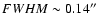 ), as revealed by the high resolution
HST images (Holland et al. 2000c), we assumed that we get a good
estimation of its overall emission within an aperture of
1.5
in diameter, inside which 95% of the
total flux would be included if the light profile is Gaussian. Given
our typical uncertainty on the photometry (0.2 mag) and taking
account of the prescriptions mentioned in the ISAAC Data Reduction
Guide,
we found the
), as revealed by the high resolution
HST images (Holland et al. 2000c), we assumed that we get a good
estimation of its overall emission within an aperture of
1.5
in diameter, inside which 95% of the
total flux would be included if the light profile is Gaussian. Given
our typical uncertainty on the photometry (0.2 mag) and taking
account of the prescriptions mentioned in the ISAAC Data Reduction
Guide,
we found the
 colour terms to be negligible in the final
conversions to K magnitudes.
colour terms to be negligible in the final
conversions to K magnitudes.
The foreground Galactic extinctions in the direction of our targets
were derived from the DIRBE/IRAS dust maps of Schlegel et al. (1998)
assuming the
RV=3.1 extinction curve of Cardelli et al. (1989).
The final dereddened magnitudes of our sources are given in
Table 2, together with their redshifts obtained from
various papers of the literature. To increase the size of our sample,
we also added in our analysis nine other GRB hosts with a determined
K-band photometry already published by other authors (see caption
of Table 2 for references). Including our results,
the number of GRB host galaxies detected in the NIR by October 2002
thus amounts to 15 sources out of the 35 GRBs which were so far localized with a
sub-arcsecond error box (Greiner 2002).
Copyright ESO 2003