

One of the goals of this paper is to study the influence of the
interaction between M 51 and its companion on the cluster formation in
the region of the inner spiral arms.
To this purpose we compare the observed age distribution of the
clusters with predictions for a constant cluster formation rate.
This comparison is hampered by two effects: (a) the disruption of
clusters
and (b) the fading of clusters below the detection limit.
The disruption time of the clusters in the inner spiral arms of M 51 is given
by Eq. (4).
We see that only clusters with an initial mass
larger than about 104  will survive more than 40 Myrs.
Figure 13 shows the histogram of the formation
rates of the detected clusters, in number per Myr,
for 140 clusters with
 and with an
energy distribution that is fitted with an accuracy of
and with an
energy distribution that is fitted with an accuracy of
 .
The sample of 111 clusters
with
and with an age uncertainty of
.
The sample of 111 clusters
with
and with an age uncertainty of
 ,
and the full sample of 285 clusters
with
,
not shown here, have a
distribution very similar to the one shown in Fig. 12.
,
and the full sample of 285 clusters
with
,
not shown here, have a
distribution very similar to the one shown in Fig. 12.
 .
This drop is the result of the concentration of clusters
at ages
.
This drop is the result of the concentration of clusters
at ages
 that was apparent in the mass versus age
diagrams of Fig. 10, and was explained in Sect. 6.
that was apparent in the mass versus age
diagrams of Fig. 10, and was explained in Sect. 6.
 ,
which is the time of the interaction
of M 51 with its companion, and which is the age of the huge
starburst in the nucleus of M 51. There is a hint of a small peak
around
,
which is the time of the interaction
of M 51 with its companion, and which is the age of the huge
starburst in the nucleus of M 51. There is a hint of a small peak
around
 .
However this peak is only
.
However this peak is only  high. Its reality has to be verified with a larger sample of clusters.
The general decrease in the formation rate of the observed clusters
is partly due to the evolutionary fading of the clusters and partly
due to the disruption of clusters.
In Sect. 6 and in Fig. 10 we have shown that clusters
with an initial mass of 104
fade below the detection
limit when they are older than
 .
This can explain the
decrease in the formation rate of clusters older than about 150 Myrs.
However, clusters with
.
This can explain the
decrease in the formation rate of clusters older than about 150 Myrs.
However, clusters with
 and younger than about
100 Myr should still all be detectable. The fact that we see a
decrease in the apparent cluster formation rate must thus be due to
the disruption of clusters (unless for some unknown reason the cluster
formation rate has been steadily increasing from 100 Myrs up to now, which
we consider unlikely).
and younger than about
100 Myr should still all be detectable. The fact that we see a
decrease in the apparent cluster formation rate must thus be due to
the disruption of clusters (unless for some unknown reason the cluster
formation rate has been steadily increasing from 100 Myrs up to now, which
we consider unlikely).
It is interesting that the CFR in the inner spiral arms of M 51, at a
distance of about 1 to 3 kpc from the nucleus, does not show any
evidence for a peak
at the age of the strongest interaction of M 51 with its companion
galaxy. The closest approach occurred about 250-400 Myrs ago
according to the dynamical models of Barnes (1998) or 400-500
and 50-100 Myrs ago according to Salo & Laurikainen (2000).
The only significant peak occurred at
 .
However we
attributed this peak to the large changes in the energy distributions
of the models in the age range of
.
However we
attributed this peak to the large changes in the energy distributions
of the models in the age range of
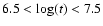 ,
and not to a
real increase in the CFR.
,
and not to a
real increase in the CFR.
Copyright ESO 2003
![\begin{figure}
\par\includegraphics[width=8.8cm,clip]{h3780f13.ps}\end{figure}](/articles/aa/full/2003/02/aah3780/img192.gif)

 uncertainty
due to the Poisson statistics in each bin (
uncertainty
due to the Poisson statistics in each bin (
 )
is indicated. The diagram shows that the formation rate of the
observed clusters decreases with age. This is due to the disruption of
the older clusters.
)
is indicated. The diagram shows that the formation rate of the
observed clusters decreases with age. This is due to the disruption of
the older clusters.