

 1500 AU, that covers a substantial range of
radii and is flatter than r-3/2. The absolute density is
relatively large,
1500 AU, that covers a substantial range of
radii and is flatter than r-3/2. The absolute density is
relatively large,
 cm-3 at 1500 AU.
 AU, dust and
gas decouple. This is caused by the evaporation of the icy mantles
when the dust temperature reaches 100 K, which injects large amounts
of water in the gas phase (about a factor ten more) increasing the
cooling efficiency of the gas. The gas temperature drops by about 20
K and remains lower than the dust temperature until at
AU, dust and
gas decouple. This is caused by the evaporation of the icy mantles
when the dust temperature reaches 100 K, which injects large amounts
of water in the gas phase (about a factor ten more) increasing the
cooling efficiency of the gas. The gas temperature drops by about 20
K and remains lower than the dust temperature until at  AU
the dust FIR pumping of the water molecules counterbalances the water
line cooling and couples again the gas and dust temperatures. The
heating and cooling of the gas in the envelope follow the general
properties discussed in CHT96 (see also Ceccarelli et al. 2000a). The
heating is dominated by the NIR water pumping, gas-grains collisions
and the compression of the gas in the innermost regions, while
gas-dust collisions are the main heating factor in the outer parts of
the envelope and when the dust and gas decouple at
AU.
The gas cooling is dominated by the line emission of water, oxygen and
CO. In the outer parts of the envelope the cooling is dominated by the
CO line emission, while in the intermediate region the cooling is
dominated by the oxygen and water lines, as the CO lines become
rapidly thick. At
AU
the dust FIR pumping of the water molecules counterbalances the water
line cooling and couples again the gas and dust temperatures. The
heating and cooling of the gas in the envelope follow the general
properties discussed in CHT96 (see also Ceccarelli et al. 2000a). The
heating is dominated by the NIR water pumping, gas-grains collisions
and the compression of the gas in the innermost regions, while
gas-dust collisions are the main heating factor in the outer parts of
the envelope and when the dust and gas decouple at
AU.
The gas cooling is dominated by the line emission of water, oxygen and
CO. In the outer parts of the envelope the cooling is dominated by the
CO line emission, while in the intermediate region the cooling is
dominated by the oxygen and water lines, as the CO lines become
rapidly thick. At  AU, the cooling by the water lines
takes over, due to the icy mantle evaporation, and dominates the
cooling by orders of magnitude with respect to O and CO. Note that
before the ices evaporation (i.e. at
AU, the cooling by the water lines
takes over, due to the icy mantle evaporation, and dominates the
cooling by orders of magnitude with respect to O and CO. Note that
before the ices evaporation (i.e. at  AU), the heating is
dominated by the gas compression and the cooling by the H2O line
emission. The increase of the gaseous water abundance by a factor ten
causes an increase of about the same amount in the gas cooling rate,
whereas the compression heating rate just increases by 20%. The gas
heating becomes hence dominated by the gas-grains collisions, which
tend to couple dust and gas. In the specific case of IRAS 4, the water
cooling rate
AU), the heating is
dominated by the gas compression and the cooling by the H2O line
emission. The increase of the gaseous water abundance by a factor ten
causes an increase of about the same amount in the gas cooling rate,
whereas the compression heating rate just increases by 20%. The gas
heating becomes hence dominated by the gas-grains collisions, which
tend to couple dust and gas. In the specific case of IRAS 4, the water
cooling rate
 and gas-grains collisions heating
rates
and gas-grains collisions heating
rates
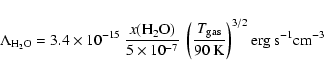
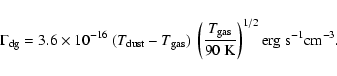
 can be approximated by the following expressions,
at the radius just before the evaporation (for the details see CHT96):
can be approximated by the following expressions,
at the radius just before the evaporation (for the details see CHT96):
 |
(6) |
 |
(7) |
20 K.
The CO and atomic oxygen abundances are constant across the envelope,
within the studied range, i.e. 30 to 3000 AU. We will discuss in the
next paragraph the effect of varying the CO abundance across the
envelope to take into account the CO depletion when the dust
temperature is below the CO-rich ice evaporation temperature. As
widely discussed previously, the water abundance undergoes a jump of
about a factor ten at
AU, when H2O-rich ices evaporate
(dust temperature larger than 100 K).
One interesting prediction of this study is the existence of a hot
core like region in the innermost parts of the envelope, where the
dust temperature reaches the sublimation temperature of the grain
mantles.
 ,
i.e. a factor five lower than the "canonical''
value. Their explanation is that CO molecules freeze out on the grain
mantles and the gas phase CO results therefore depleted across the
envelope. This result has been recently confirmed by JSD02, who quote
CO/H
,
i.e. a factor five lower than the "canonical''
value. Their explanation is that CO molecules freeze out on the grain
mantles and the gas phase CO results therefore depleted across the
envelope. This result has been recently confirmed by JSD02, who quote
CO/H
 in the outer envelope of IRAS 4. The question
arises whether the CO is depleted across the entire envelope or not,
as also remarked by JSD02. We checked with our model if the
millimeter observations would be sensitive to higher abundances of CO
in regions where the dust temperature exceeds the CO-rich ice
evaporation temperature, i.e. 25-30 K. We found that if the
C18O J = 3-2 line is optically thin, the bulk of the J = 3-2 line
is emitted at 3000 AU. This is because of the excitation of the
CO J = 3-2 line itself. In the optically thin and thermalized line
approximation it is possible to derive the following approximate
analytical expression (strictly speaking, valid only for the CO
millimeter lines):
in the outer envelope of IRAS 4. The question
arises whether the CO is depleted across the entire envelope or not,
as also remarked by JSD02. We checked with our model if the
millimeter observations would be sensitive to higher abundances of CO
in regions where the dust temperature exceeds the CO-rich ice
evaporation temperature, i.e. 25-30 K. We found that if the
C18O J = 3-2 line is optically thin, the bulk of the J = 3-2 line
is emitted at 3000 AU. This is because of the excitation of the
CO J = 3-2 line itself. In the optically thin and thermalized line
approximation it is possible to derive the following approximate
analytical expression (strictly speaking, valid only for the CO
millimeter lines):
![\begin{displaymath}I_J \propto \int \frac{{\rm exp}[-E_J/k{T_{\rm gas}}]}{T_{\rm gas}} {\rm d}r.
\end{displaymath}](/articles/aa/full/2002/44/aa2736/img106.gif) |
(8) |
 K,
does not vary by more than 20% with temperatures between 20 K and 40 K, and decreases for temperatures larger than 40 K. As a
result, the line intensity in the outer envelope is linearly
proportional to the radius of the emitting gas, and therefore
increases going outward, i.e. the emission is dominated by the outer
envelope where CO is depleted.
We run a case in which there is no CO depletion across the envelope,
(i.e. the CO abundance is constant and equal to 10-4), a case
where CO is depleted on the entire envelope (i.e. the CO abundance is
constant and equal to
), and a third case where CO
is depleted only in the outer envelope (i.e. the CO abundance is
K,
does not vary by more than 20% with temperatures between 20 K and 40 K, and decreases for temperatures larger than 40 K. As a
result, the line intensity in the outer envelope is linearly
proportional to the radius of the emitting gas, and therefore
increases going outward, i.e. the emission is dominated by the outer
envelope where CO is depleted.
We run a case in which there is no CO depletion across the envelope,
(i.e. the CO abundance is constant and equal to 10-4), a case
where CO is depleted on the entire envelope (i.e. the CO abundance is
constant and equal to
), and a third case where CO
is depleted only in the outer envelope (i.e. the CO abundance is
 when
when
 K and 10-4 in the
rest of the envelope). The last two cases give the same intensity
(within 15%) on both C18O J = 3-2 and J = 2-1 lines, while the
first one gives an intensity larger by about a factor 3. Therefore,
the last two cases, CO depletion across the entire envelope and
depletion in the outer envelope only, are not distinguishable by the
C18O J = 3-2 and J = 2-1 observations. In this sense, we think
that the
K and 10-4 in the
rest of the envelope). The last two cases give the same intensity
(within 15%) on both C18O J = 3-2 and J = 2-1 lines, while the
first one gives an intensity larger by about a factor 3. Therefore,
the last two cases, CO depletion across the entire envelope and
depletion in the outer envelope only, are not distinguishable by the
C18O J = 3-2 and J = 2-1 observations. In this sense, we think
that the
 observations cannot probe the innermost
regions and that it is possible that the measured CO depletion is only
relative to the external regions of the envelope.
observations cannot probe the innermost
regions and that it is possible that the measured CO depletion is only
relative to the external regions of the envelope.
This situation would be similar to what has been claimed to occur
in IRAS 16293-2422 (Ceccarelli et al. 2001), based on the indirect evidence
provided by the D2CO emission. The D2CO molecule is considered
a grain mantle product, as gas phase reactions seem unable to form an
appreciable amount of this molecule. Ceccarelli et al. showed that in
IRAS 16293-2422 the D2CO emission originates in the region of the
envelope where
 K. The proposed
interpretation is that D2CO is trapped in CO-rich ices that
evaporate when the dust temperature exceeds 30 K. Hence, in
IRAS 16293-2422 there is an outer region of the envelope where CO is
frozen onto the grain mantles (
K), and a
regions with
K where CO is released into the
gas phase and has the standard 10-4 abundance. A similar
scenario has been also suggested by JSD02 for other
Class 0 sources that show CO depletion.
K. The proposed
interpretation is that D2CO is trapped in CO-rich ices that
evaporate when the dust temperature exceeds 30 K. Hence, in
IRAS 16293-2422 there is an outer region of the envelope where CO is
frozen onto the grain mantles (
K), and a
regions with
K where CO is released into the
gas phase and has the standard 10-4 abundance. A similar
scenario has been also suggested by JSD02 for other
Class 0 sources that show CO depletion.
 m maps
simultaneously) and assuming a single power law index. They found a
power law index equal to 1.8 and 1.3 for 4A and 4B respectively,
consistent with the Shu inside-out solution adopted in our model. At
1000 AU they estimate a density equal to 6 (4A) and 2 (4B)
m maps
simultaneously) and assuming a single power law index. They found a
power law index equal to 1.8 and 1.3 for 4A and 4B respectively,
consistent with the Shu inside-out solution adopted in our model. At
1000 AU they estimate a density equal to 6 (4A) and 2 (4B)
 cm-3, which are quite comparable with our estimate:
 cm-3. We emphasize that the two methods, their
and our, are totally independent, and use different data, continuum
and line observations respectively. The fact that both predict
approximately the same density structure in a certain way validate
both methods, or at least increases the probability that both models
describe reasonably well IRAS 4.
cm-3. We emphasize that the two methods, their
and our, are totally independent, and use different data, continuum
and line observations respectively. The fact that both predict
approximately the same density structure in a certain way validate
both methods, or at least increases the probability that both models
describe reasonably well IRAS 4.
Apart from the density and temperature profiles, our model also constrains
the water abundance profile. It is reasonable to ask whether our
predicted water abundance in the innermost and outer regions of the
envelope are realistic and if they have any support from different
observations. The situation here is somewhat complicated by the fact
that there aren't many other independent ways to measure the water
abundance. From a theoretical point of view the abundance in the
outer envelope,
 ,
can be very well compared with chemistry
model predictions (e.g. Lee et al. 1996). In this respect, the value
that we derive is certainly not extraordinary and rather plausible.
From an observational point of view Bergin et al. (2002)
succeeded to detect the 557 GHz water line in the NGC1333 molecular
cloud. They estimate the water abundance in the region to be 10-7, with unfortunately a relatively large error (10) due
to the many uncertainties in the excitation of the line.
Moneti et al. (2001) derived a water abundance of
,
can be very well compared with chemistry
model predictions (e.g. Lee et al. 1996). In this respect, the value
that we derive is certainly not extraordinary and rather plausible.
From an observational point of view Bergin et al. (2002)
succeeded to detect the 557 GHz water line in the NGC1333 molecular
cloud. They estimate the water abundance in the region to be 10-7, with unfortunately a relatively large error (10) due
to the many uncertainties in the excitation of the line.
Moneti et al. (2001) derived a water abundance of
 in
the clouds in the line of sight of the galactic center. These authors
claim that this is very likely the abundance of standard molecular
clouds. In summary, the water abundance that we find for the cold
region of the IRAS 4 envelope is consistent with other studies.
Regarding the abundance in the inner region,
in
the clouds in the line of sight of the galactic center. These authors
claim that this is very likely the abundance of standard molecular
clouds. In summary, the water abundance that we find for the cold
region of the IRAS 4 envelope is consistent with other studies.
Regarding the abundance in the inner region,
 ,
the
value that we obtain seem to be lower than what expected if all the
water ice is injected in the gas phase and a large fraction of the
oxygen is locked in this ice. A typical water ice abundance is
estimated around 10-4 (Tielens et al. 1991). However, SWAS
observations of IRAS 4 and other low mass protostars suggest that the
water abundance in their outflows is around 10-6 (Neufeld et
al. 2001; Bergin et al. 2002), i.e. similar to the value that we find.
Those estimates are very rough and could easily be off by a factor ten
(Neufeld et al. 2000), as they are based on one transition only, but
nevertheless have the advantage that the observed emission is
certainly dominated by the outflow (the spectral resolution of these
observations is 1.2 km s-1) so there are no doubts on its
origin. Since the water abundance in the outflow would be probably
dominated by the grain mantles released in the gas phase, these
observations probably measure the water content in the mantles, very
much as our observations measure (indirectly) the water content
mantles in the inner hot like region. The two measurements seem to be
consistent in giving a rather low value. Whether this validates both
measures is less certain than the density profile case: it certainly
does not discredit the two measures. Finally, even the comparison of
our estimate of the accretion rate and central mass are in good
agreement with the previous estimates, based on a different method (line
profile and molecule H2CO), by Di Francesco et al. (2001). We derived
,
the
value that we obtain seem to be lower than what expected if all the
water ice is injected in the gas phase and a large fraction of the
oxygen is locked in this ice. A typical water ice abundance is
estimated around 10-4 (Tielens et al. 1991). However, SWAS
observations of IRAS 4 and other low mass protostars suggest that the
water abundance in their outflows is around 10-6 (Neufeld et
al. 2001; Bergin et al. 2002), i.e. similar to the value that we find.
Those estimates are very rough and could easily be off by a factor ten
(Neufeld et al. 2000), as they are based on one transition only, but
nevertheless have the advantage that the observed emission is
certainly dominated by the outflow (the spectral resolution of these
observations is 1.2 km s-1) so there are no doubts on its
origin. Since the water abundance in the outflow would be probably
dominated by the grain mantles released in the gas phase, these
observations probably measure the water content in the mantles, very
much as our observations measure (indirectly) the water content
mantles in the inner hot like region. The two measurements seem to be
consistent in giving a rather low value. Whether this validates both
measures is less certain than the density profile case: it certainly
does not discredit the two measures. Finally, even the comparison of
our estimate of the accretion rate and central mass are in good
agreement with the previous estimates, based on a different method (line
profile and molecule H2CO), by Di Francesco et al. (2001). We derived  =
=


 against the
 quoted by Di Francesco et al. (2001), and M* =
0.5
against the
0.23-0.71
.
quoted by Di Francesco et al. (2001), and M* =
0.5
against the
0.23-0.71
.
To conclude, these studies show that the values we derive of the four parameters of our model are plausible and nothing of particularly surprising, with the possible exception of the water abundance in the innermost regions. In other words, if we had to choose a priori those values we would have chosen exactly what we found. The conclusion is that it is very probable that at least most of the observed water emission in IRAS 4 originates in the envelopes. If any, just a small fraction should therefore be associated with the outflow. Our final comment is therefore that care should be taken when interpreting the observed water emission towards low mass, Class 0 protostars as due to shocks (e.g. Ceccarelli et al. 1998; Nisini et al. 1999, GNL01), as we showed in two out two cases that the massive envelopes surrounding these sources dominate the water emission, just because of the large total column density. As a matter of fact, Class I sources, which are characterized by less massive envelopes, do not show up strong water emission (Ceccarelli et al. 2000a).
The mass and accretion rate we derived for IRAS 4A and B are of the
same order of magnitude of those found in IRAS 16293-2422
(Ceccarelli et al. 2000a). IRAS 16293-2422 seems more massive (0.8
) than IRAS 4A (0.5
), and accreting at a slightly
lower accretion rate (3 against 5
 ).
Assuming a constant accretion rate, those values give an age of 10 000
years and 27 000 for IRAS 4 and IRAS 16293-2422 respectively. Hence
IRAS 16293-2422 seems more evolved than IRAS 4. Moreover, IRAS 4
possesses an hot core like region about two times smaller than
IRAS 16293-2422 (80 AU against 150 AU). Ground-based H2CO and
CH3OH observations (Blake et al. 1995; Maret et al. in
preparation) confirm that IRAS 4 is in fact colder, and therefore less
bright in these molecular transitions than IRAS 16293-2422, and that
indeed the IRAS 4 hot core like region is very small. This fact
coupled with the larger distance of IRAS 4 from the Sun may explain the
apparent difference in the molecular emission of these two sources,
which is much richer in IRAS 16293-2422. This conclusion is also in
agreement with the relatively higher millimeter continuum observed in
IRAS 4, which implies a larger amount of cold dust surrounding this
source than IRAS 16293-2422. In addition, the region where the dust
temperature is higher than 30 K is smaller in IRAS 4 (1500 AU)
than in IRAS 16293-2422 (4000 AU), i.e. the CO depleted part of
the envelope is relatively larger in IRAS 4 than in IRAS 16293-2422.
This may explain why the CO depletion has been observed towards IRAS 4
and not in IRAS 16293-2422 (van Dishoeck et al. 1995; Ceccarelli et al. 2000b).
).
Assuming a constant accretion rate, those values give an age of 10 000
years and 27 000 for IRAS 4 and IRAS 16293-2422 respectively. Hence
IRAS 16293-2422 seems more evolved than IRAS 4. Moreover, IRAS 4
possesses an hot core like region about two times smaller than
IRAS 16293-2422 (80 AU against 150 AU). Ground-based H2CO and
CH3OH observations (Blake et al. 1995; Maret et al. in
preparation) confirm that IRAS 4 is in fact colder, and therefore less
bright in these molecular transitions than IRAS 16293-2422, and that
indeed the IRAS 4 hot core like region is very small. This fact
coupled with the larger distance of IRAS 4 from the Sun may explain the
apparent difference in the molecular emission of these two sources,
which is much richer in IRAS 16293-2422. This conclusion is also in
agreement with the relatively higher millimeter continuum observed in
IRAS 4, which implies a larger amount of cold dust surrounding this
source than IRAS 16293-2422. In addition, the region where the dust
temperature is higher than 30 K is smaller in IRAS 4 (1500 AU)
than in IRAS 16293-2422 (4000 AU), i.e. the CO depleted part of
the envelope is relatively larger in IRAS 4 than in IRAS 16293-2422.
This may explain why the CO depletion has been observed towards IRAS 4
and not in IRAS 16293-2422 (van Dishoeck et al. 1995; Ceccarelli et al. 2000b).
Finally, despite this difference in the age, the water abundance in the envelope is remarkably similar in the two sources, both in the outer part of the envelope and in the inner ones, where ice mantles are predicted to evaporate. This is an important piece of information, suggesting that the ice mantle formation in the two sources underwent a similar process, despite the macroscopic difference between the two molecular clouds which the two sources belong to. In the case of IRAS 16293-2422, the cloud seems very quiescent, shielded from strong UV and/or X-ray radiation (e.g. Castets et al. 2001) and with even evidence of large CO depletion (Caux et al. 1999b). In the other case, IRAS 4, the cloud presents cavities excavated by the several young stars of the region (e.g. Lefloch et al. 1998), and it is probably permeated by the X-rays emitted by them. A forthcoming study will allow to measure the H2CO and CH3OH abundances in the inner hot core like region of IRAS 4 (Maret et al. in preparation) and make comparisons with that found in IRAS 16283-2422 (Ceccarelli et al. 2000b). This study will hence help to understand in more detail how apparently different conditions in the parental clouds affect the grain mantle composition.
Copyright ESO 2002
![\begin{figure}
\par\includegraphics[width=8.8cm,clip]{2736f6.eps}
\end{figure}](/articles/aa/full/2002/44/aa2736/img96.gif)