

 m) of the IRAS 4 region was
performed using LWS. The observations were obtained on three positions
in LWS grating mode, with a spectral resolution of about 200 (AOT
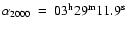
LO1). The first position was centered in between IRAS 4A and IRAS 4B
(
m) of the IRAS 4 region was
performed using LWS. The observations were obtained on three positions
in LWS grating mode, with a spectral resolution of about 200 (AOT
LO1). The first position was centered in between IRAS 4A and IRAS 4B
(
 ,
,
 ), and hence LWS80
 beam includes both sources. The two other positions aimed
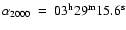
to the lobe peaks of the outflow powered by IRAS 4: NE-red,
beam includes both sources. The two other positions aimed
to the lobe peaks of the outflow powered by IRAS 4: NE-red,
 ,
,
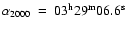
 ), and SW-blue,
 ,
,
 ). These
observations, performed during revolution 847, are made of 30 scans on
the central position and 10 scans on the two other positions. The
sampling rate was 1/4 of the grating resolution element (0.29 m
in the 43-92 m range, and 0.15 m in the 84-196 m
range). The integration time for each sampled point was 12 s on the
central position, and 4 s on the outflow positions.
). These
observations, performed during revolution 847, are made of 30 scans on
the central position and 10 scans on the two other positions. The
sampling rate was 1/4 of the grating resolution element (0.29 m
in the 43-92 m range, and 0.15 m in the 84-196 m
range). The integration time for each sampled point was 12 s on the
central position, and 4 s on the outflow positions.
![\begin{figure}
\par\includegraphics[width=16cm,clip]{2736f1.eps}
\end{figure}](/articles/aa/full/2002/44/aa2736/img34.gif) |
Figure 1: ISO-LWS spectra observed towards IRAS 4 on source (top line), NE-red (middle line) and SW-blue (bottom line). |
Figure 1 shows the observed 60-200 m spectra in the
three observed positions, and Table 1 reports the measured line
fluxes. The errors quoted in this table include statistical errors,
errors due to the uncertainty of the baseline removal, and an absolute
calibration error of 30%. The first striking result of these
observations is the dramatic difference within the three spectra:
while that including IRAS 4A and 4B is very rich in CO and water lines,
molecular emission is barely detected towards the outflow peaks (where
the millimeter CO emission is the brightest). On the contrary, the
fine structure [OI] 63 m and [CII] 157 m lines have comparable
fluxes in the three observed positions. Finally, we wish to comment
our results with respect to previous published data reductions. The
present line flux determination agrees with that quoted by
Ceccarelli et al. (1999) when considering the uncertainties. However, we
note several differences with respect to the values quoted in
GNL01. While there is a relatively good agreement between their fluxes
of the strongest lines and ours (see Table 1), there is a
noticeable discrepancy between our respective reductions regarding the
weakest lines. We think that this is probably due to a too optimistic
evaluation of the noise in GNL01. For example, in the NE-red position
we find a statistical error around 175 m of
 erg s-1 cm-2 m-1, while Giannini et al.
quote
erg s-1 cm-2 m-1, while Giannini et al.
quote
 erg s-1 cm-2 m-1 in
their Table 3. We do not confirm neither the detection of CO lines
with
erg s-1 cm-2 m-1 in
their Table 3. We do not confirm neither the detection of CO lines
with

![[*]](/icons/foot_motif.gif) , nor the 125.4, 83.3, 66.4 and 58.7 m water lines on-source. As shown in our Fig. 1, we
only detected the 179.5 m 174.6 m and 108.0 m lines in
the outflow peak position NE-red, and the CO lines between
, nor the 125.4, 83.3, 66.4 and 58.7 m water lines on-source. As shown in our Fig. 1, we
only detected the 179.5 m 174.6 m and 108.0 m lines in
the outflow peak position NE-red, and the CO lines between
 and 17. We also do not confirm their detections of CO
 lines in the NE-red outflow peak position. Finally, in the
SW-blue position we only detected C+ and OI 63 m emission and
very marginally the H2O 179 m lines.
lines in the NE-red outflow peak position. Finally, in the
SW-blue position we only detected C+ and OI 63 m emission and
very marginally the H2O 179 m lines.
| Specie | Transition | Wavelength |
 |
Fluxes | ||
| (m) |
(cm-1) | On source | NE-red | SW-blue | ||
| o-H2O | 221-221 | 180.49 | 134.9 |
 |
<0.5 | <0.5 |
| 212-101 | 179.53 | 79.5 |
 |
 |
0.6  0.4
0.4 |
|
| 303-212 | 174.63 | 136.7 |
 |
|
< 0.5 | |
| 414-303 | 113.54 | 224.5 |
 |
<0.5 | <0.5 | |
| 221-110 | 108.07 | 134.9 |
 |
 |
<0.5 | |
| 505-414 | 99.48 | 325.3 |
 |
<0.5 | <0.5 | |
| 616-505 | 82.03 | 447.3 |
 |
<0.5 | <0.5 | |
| 423-312 | 78.74 | 300.5 |
|
<0.5 | <0.5 | |
| 321-212 | 75.38 | 212.1 |
 |
<0.5 | <0.5 | |
| p-H2O | 322-313 | 156.19 | 206.3 |
|
<0.5 | <0.5 |
| 313-202 | 138.53 | 142.3 |
|
<0.5 | <0.5 | |
| 220-111 | 100.98 | 136.2 |
 |
<0.5 | <0.5 | |
| 322-211 | 89.99 | 206.3 |
|
<0.5 | <0.5 | |
| 331-220 | 67.09 | 285.1 |
 |
<0.5 | <0.5 | |
| CO | 14-13 | 186.00 | 403.5 |
 |
 |
<0.5 |
| 15-14 | 173.63 | 461.1 |
 |
 |
<0.5 | |
| 16-15 | 162.81 | 522.5 |
|
 |
<0.5 | |
| 17-16 | 153.26 | 587.7 |
|
 |
<0.5 | |
| 18-17 | 144.78 | 656.8 |
|
<0.5 | <0.5 | |
| 19-18 | 137.20 | 729.7 |
|
<0.5 | <0.5 | |
| 20-19 | 130.37 | 806.4 |
|
<0.5 | <0.5 | |
| OH |
 - -
 |
119.33 | 83.7 |
|
<0.5 | <0.5 |
 - -
|
84.51 | 201.9 |
|
<0.5 | <0.5 | |
 - -
|
79.15 | 126.3 |
|
<0.5 | <0.5 | |
| [OI] | 3P1-3P0 | 145.48 | 227.7 | <0.5 | <0.5 | <0.5 |
| 3P2-3P2 | 63.17 | 158.7 |
 |
 |
|
|
| [CII] | 2P3/2-2P1/2 | 157.74 | 63.7 |
|
 |
|
Copyright ESO 2002
 .
.