

As before (Paper I), we have cross-correlated the entries in our deep optical catalogue with the IRAS Point Source Catalogue (IRAS PSC). The IRAS PSC has been extensively used for studies of the large-scale structures in the Universe (e.g., Saunders et al. 2000). Our deep optical galaxy catalogue in the ZOA offers an opportunity to verify the performance of "blind'' IRAS searches (i.e., selecting galaxies purely on the basis of their IRAS colours) close to the Galactic Plane, where source confusion could play a significant role.
We have selected galaxies in our optical galaxy catalogues which have a positional overlap (within a radius of 2 arcmin) with sources in the IRAS PSC. Within this selection, there are some galaxies for which the IRAS PSC association is unlikely because of their unlikely colours or large positional offsets. They are marked with "N'' in Table 1. They are not accepted as a galaxy with a credible IRAS PSC counterpart, nor are they listed in Table 3.
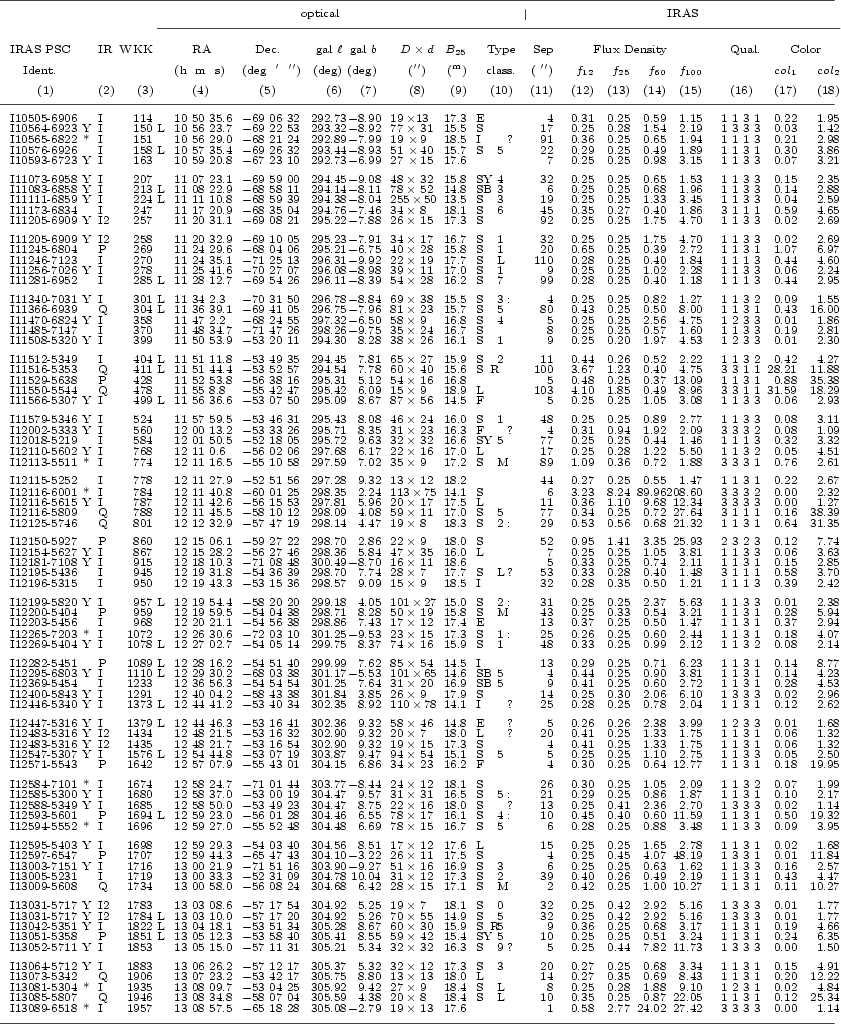
A sample page of the remaining galaxies is given in Table 3![[*]](/icons/foot_motif.gif) .
The entries in Table 3 are:
.
The entries in Table 3 are:
 m.
m.
m.
m.
m, 25 m, 60 m, and 100 m, where "1''
indicates a lower limit, "2'' an uncertain flux, and "3'' a good quality flux.
m.
m.
m.
m.
m, 25 m, 60 m, and 100 m, where "1''
indicates a lower limit, "2'' an uncertain flux, and "3'' a good quality flux.
 .
.
211 Galaxies in our Crux catalogue have a positional overlap (within a radius of 2 arcmin) with sources in the IRAS PSC. Of these galaxies, 64 are unlikely IRAS galaxies (N) because of their atypical IRAS colours and large positional offset to the centre of the IRAS PSC source.
Similarly, we found a positional overlap for 266 galaxies in the Great Attractor region. Of these 266 galaxies, 71 galaxies have an unlikely counterpart.
Only 171 of the 342 galaxies in the Crux and GA region listed in Table 3 have a certain IRAS counterpart, based on the second and third colour criterion of Yamada et al. (1993), i.e., col1 < 1 and 0.8 < col2 < 5.0, respectively (see Cols. 17 and 18). They are labelled with an "I''. Within this sample of 171 galaxies there are 10 IRAS PSC sources that have two galaxies associated with them, and one IRAS PSC source with three galaxies, indicated by "I2'' and "I3'', respectively, in Col. 2. So there are 171 galaxies associated with 159 IRAS PSC sources.
The number of galaxies with certain IRAS PSC cross-identification
is reduced to 165 (associated with 143 IRAS PSC sources) if a strict lower limit for the flux density at
60 m, i.e.,
f60 = 0.6 Jy, is imposed.
Surprisingly, only 104 IRAS PSC sources were identified by Yamada et al. (1993), leaving 39 sources (=27%)
undetected. Note, that all the galaxies found by Yamada et al. (1993), that satisfy our selection
criterion of
 ,
have been retrieved by our deep optical survey.
,
have been retrieved by our deep optical survey.
A further 94 galaxies have a likely IRAS counterpart, primarily based on their positional overlap.
These galaxies are indicated by a "P'' in Col. 2. In this sample there are
two IRAS PSC sources that have two galaxies belonging to them, indicated by "P2'' in Col. 2.
72 IRAS PSC sources of this sample have
 Jy.
These galaxies do not comply with the preset colour restriction of
Jy.
These galaxies do not comply with the preset colour restriction of
 (see
Fig. 13), but they are all bona fide galaxies.
(see
Fig. 13), but they are all bona fide galaxies.
Finally, there are 77 galaxies for which their association with an IRAS PSC source is questionable,
mostly because of their large positional offset to the IRAS sources and sometimes because of their
unlikely IRAS colours (see Fig. 13). These galaxies are indicated by a "Q''.
The average properties of galaxies in each of these samples are listed in Table 4.
From Table 4 it is clear that the IRAS PSC traces a population of large
(<D )
and bright (<B25
)
and bright (<B25
 )
galaxies. They are predominantly spiral
galaxies (
)
galaxies. They are predominantly spiral
galaxies ( 80%). The "P'' sample consists of large and bright galaxies, as bright
as the certain (I) IRAS PSC galaxies.
80%). The "P'' sample consists of large and bright galaxies, as bright
as the certain (I) IRAS PSC galaxies.
| Sample | <B25> | <D> | Separation |
 |
| I |
 |
 |
 |
159 |
| P |
|
 |
 |
92 |
| Q |
 |
 |
 |
72 |
In Fig. 13 we show a colour-colour diagram (
f12f25/f260 vs.
f100/f60)
of the galaxies with an IRAS PSC assocations. The galaxies with a certain IRAS PSC counterpart (I) are
shown as filled circles, the possible counterparts (P) as open circles and the questionable assocations (Q) as stars. The selection criteria of Yamada et al. (1993) are indicated by the dashed lines.
Yamada (1994) already noted that the upper limit in the
f100/f60 colour restriction, imposed to
limit the contamination by Galactic cirrus, will make the "blind'' IRAS search less complete.
As we see here, this incompleteness is substantial (37%).
We have obtained redshifts for 35 of the galaxies in the "P'' sample (38%) (Woudt 1998) and 77%
of them lie in the redshift range 1400-5500 kms-1 and are hence important tracers of the large-scale
structures in the nearby Universe. The remaining 23% (8 galaxies, all in the GA region) are located beyond
10000 kms-1. All these galaxies are, however, missed in blind IRAS searches.
Figure 14 shows the distribution (in Galactic coordinates) of the galaxies in the Crux region with an IRAS PSC association. The galaxies in the "I'' sample are shown as filled circles and the galaxies in the "P'' sample as open circles. The majority of the galaxies are located north of the Galactic Plane, in particular the galaxies in the "P'' sample; 26 galaxies (out of 29) are located at positive Galactic latitudes and these galaxies are most likely associated with the Norma supercluster (Fairall et al. 1998).
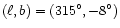
The overdensity at
 noted in Fig. 2 is totally absent in Fig. 14.
There are, in fact, no galaxies at all in the IRAS PSC in this part of the sky. This again suggests that
this overdensity is more distant.
noted in Fig. 2 is totally absent in Fig. 14.
There are, in fact, no galaxies at all in the IRAS PSC in this part of the sky. This again suggests that
this overdensity is more distant.
The distribution of the galaxies in the GA region with a certain and probable IRAS counterpart is also shown in Fig. 14. Most of the galaxies are located below the Galactic Plane in an extended region around the Norma cluster. The IRAS PSC galaxies trace the general overdensity of galaxies in the GA region. They do not, however, reveal the rich and nearby Norma cluster in the way our deep optical search has done.
In Fig. 15 we show a comparison of the galaxy distribution in the optical
and in the far infrared around the rich galaxy cluster of Norma. Unlike the centrally
condensed overdensity in the optical distribution (left panel of Fig. 15),
the IRAS PSC data merely show an extended overdensity (see Fig. 14) with no clear
peak around the central part of the Norma cluster (right panel of Fig. 15).
This is in line with the expectation that the IRAS data do trace the general large-scale
structures, but are insensitive to the elliptical galaxies that reside in rich clusters.
![\begin{figure}
\par\includegraphics[width=8.7cm,clip]{H2872F15.ps}\end{figure}](/articles/aa/full/2001/47/aah2872/img169.gif) |
Figure 15: The distribution in Galactic coordinates of the galaxies from our deep optical galaxy catalogue centred on the Norma cluster (left panel), and the galaxies with an IRAS PSC counterpart in the same region (right panel, symbols as in Fig. 14). |
Copyright ESO 2001
![\begin{figure}
\par\includegraphics[width=8.8cm,clip]{H2872F13.ps}\end{figure}](/articles/aa/full/2001/47/aah2872/img166.gif)
![\begin{figure}
\par\includegraphics[width=8.8cm,clip]{H2872F14.ps}\end{figure}](/articles/aa/full/2001/47/aah2872/img167.gif)