

The top panels of Fig. 8 show the distribution of the observed magnitudes (left) and diameters
(right) of the 3759 galaxies in the Crux region. On average the galaxies are quite small
(<D> = 23
 1) and faint (<B25> = 18
 2); nearly
identical to what was found in the Hydra/Antlia
region (Paper I), i.e., 21
8 and 18
2.
The above graph indicates that our survey is fairly complete for galaxies
greater than
2); nearly
identical to what was found in the Hydra/Antlia
region (Paper I), i.e., 21
8 and 18
2.
The above graph indicates that our survey is fairly complete for galaxies
greater than
 or brighter than
 .
As the diameters and magnitudes in this diagram are heavily influenced by the obscuring
effects of the Milky Way, these numbers should be regarded as indicative only.
.
As the diameters and magnitudes in this diagram are heavily influenced by the obscuring
effects of the Milky Way, these numbers should be regarded as indicative only.
In the Crux region, 106 galaxies have a recorded major diameter
 (the Lauberts (1982) diameter limit which is indicated in Fig. 8). Of the 88 galaxies recorded
by Lauberts in the Crux region, 22 (=25%) are actually smaller than 60
(the Lauberts (1982) diameter limit which is indicated in Fig. 8). Of the 88 galaxies recorded
by Lauberts in the Crux region, 22 (=25%) are actually smaller than 60
 .
In almost all cases, these galaxies are either covered by many stars, or are part of a double/triple system.
Nonetheless, 40 galaxies (40/106 = 38%) with
were not previously recorded by Lauberts. These statistics
improve somewhat in favour of the Lauberts catalogue for galaxies larger than
.
In almost all cases, these galaxies are either covered by many stars, or are part of a double/triple system.
Nonetheless, 40 galaxies (40/106 = 38%) with
were not previously recorded by Lauberts. These statistics
improve somewhat in favour of the Lauberts catalogue for galaxies larger than
 ,
the diameter
limit for which the ESO-LV catalogue is said to be complete (Hudson & Lynden-Bell 1991).
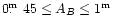
Still, 10 galaxies out of the 45 galaxies larger than
(=22%) were not identified by Lauberts.
,
the diameter
limit for which the ESO-LV catalogue is said to be complete (Hudson & Lynden-Bell 1991).
Still, 10 galaxies out of the 45 galaxies larger than
(=22%) were not identified by Lauberts.
![\begin{figure}
\par\includegraphics[width=6.8cm,clip]{H2872F09.ps}\end{figure}](/articles/aa/full/2001/47/aah2872/img111.gif) |
Figure 9: The distribution of the observed magnitudes (left panel) and diameters (right panel) of the 4423 galaxies discovered in the Great Attractor region. |
Using the DIRBE/IRAS reddening values (Col. 15 in Table 1) the observed parameters
(diameters and magnitudes) can be corrected for absorption following Cameron (1990).
We then obtain the distribution of extinction-corrected magnitudes (B025) and
diameters (D0) as shown in the lower panels of Fig. 8.
Extinction-corrected diameters of the galaxies in the deepest extinction layers seem
unrealistically large. The Circinus galaxy, WKK3050, with
 has an observed
diameter of 457
(
has an observed
diameter of 457
(
 ). After the extinction correction, the diameter of the
Circinus galaxy would be 11.1 degrees (
). After the extinction correction, the diameter of the
Circinus galaxy would be 11.1 degrees (
 )! This galaxy is not displayed in Fig. 8.
Because of this, a more detailed study of the obscurational effects on the magnitudes
and diameters of ZOA galaxies is desired, especially for high extinction (
)! This galaxy is not displayed in Fig. 8.
Because of this, a more detailed study of the obscurational effects on the magnitudes
and diameters of ZOA galaxies is desired, especially for high extinction (
 ).
).
An additional complication arises for the Circinus galaxy, as well as for other strong IRAS galaxies.
This nearby Seyfert 2 galaxy is a strong IRAS source (
f100 = 315.90 Jy).
This most definitely influences the derived Galactic reddening value by Schlegel et al. (1998) at the location of Circinus,
as only 5 arcmin from the centre of Circinus, the extinction drops to
 ,
a full
,
a full  lower.
One should be aware when using the Schlegel et al. (1998) reddening maps
that local galaxies - depending on the flux - can in fact contaminate the reddening values. Care should be taken
when using these extinction values at face-value.
lower.
One should be aware when using the Schlegel et al. (1998) reddening maps
that local galaxies - depending on the flux - can in fact contaminate the reddening values. Care should be taken
when using these extinction values at face-value.
The average, extinction-corrected magnitudes and diameters for the galaxies in the
Crux region are
 and
and
 .
These means have been determined
for the magnitude and diameter range displayed in the lower panels of Fig. 8, not including those galaxies
that might have been overcorrected, i.e., only galaxies with an extinction correction of
.
These means have been determined
for the magnitude and diameter range displayed in the lower panels of Fig. 8, not including those galaxies
that might have been overcorrected, i.e., only galaxies with an extinction correction of
 are
used. Note also that the extinction correction does not take the patchiness in the distribution
of, for instance, local dust clouds into account.
are
used. Note also that the extinction correction does not take the patchiness in the distribution
of, for instance, local dust clouds into account.
A total of 593 galaxies in the Crux region have extinction-corrected diameters larger or equal than
 ,
i.e., the Lauberts (1982) diameter limit. This means that in the absence of the
obscuration by the Milky Way, Lauberts would have detected 593 galaxies instead of
the recorded 88 galaxies. The diminishing effects of the Galactic foreground extinction
could not have been more clearly illustrated.
,
i.e., the Lauberts (1982) diameter limit. This means that in the absence of the
obscuration by the Milky Way, Lauberts would have detected 593 galaxies instead of
the recorded 88 galaxies. The diminishing effects of the Galactic foreground extinction
could not have been more clearly illustrated.
The upper panels of Fig. 9 display the distribution of the observed apparent
magnitude (B25) and major diameter (D) of the galaxies unveiled in the GA region. The observed
characteristics of the galaxies in the GA region are significantly different from both the Crux and
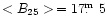
Hydra/Antlia region, see also Sect. 6.4. On average, the galaxies are somewhat larger (
 )
and much brighter (
)
and much brighter (
 )
compared to the Crux region (
)
compared to the Crux region (
 and
and
 )
and the
Hydra/Antlia region (
)
and the
Hydra/Antlia region (
 and
).
This either means that the Galactic foreground extinction is much lower in the GA region (to explain
for the fact that the galaxies are on average 0.7 mag brighter in the GA region), or,
alternatively, the GA region encompasses a nearby overdensity of galaxies.
and
).
This either means that the Galactic foreground extinction is much lower in the GA region (to explain
for the fact that the galaxies are on average 0.7 mag brighter in the GA region), or,
alternatively, the GA region encompasses a nearby overdensity of galaxies.
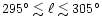
From the Galactic reddening maps (Schlegel et al. 1998) there is some evidence that the mean extinction
for galaxies in the Crux region is somewhat higher (
 )
compared to galaxies in the GA and Hydra/Antlia regions
(see the large excursion of the
)
compared to galaxies in the GA and Hydra/Antlia regions
(see the large excursion of the
 contour below the Galactic Plane
at
contour below the Galactic Plane
at
 in Fig. 1).
This difference is not enough, however, to fully explain
why galaxies in the GA region are 0.7 mag brighter, especially since galaxies in the Hydra/Antlia
region are subjected to approximately the same extinction as galaxies in the GA region.
Therefore both effects seem to have influenced the GA sample (see Sect. 6.4).
in Fig. 1).
This difference is not enough, however, to fully explain
why galaxies in the GA region are 0.7 mag brighter, especially since galaxies in the Hydra/Antlia
region are subjected to approximately the same extinction as galaxies in the GA region.
Therefore both effects seem to have influenced the GA sample (see Sect. 6.4).
In the GA region, 161 galaxies have a major diameter
,
of which 95 had been recorded
previously by Lauberts (1982). 13 of the galaxies found by Lauberts (1982) have diameters smaller than
60
.
In the Crux region, 38% of the galaxies larger
than
had not been recorded by Lauberts, in the GA region this incompleteness is 40%.
The "extinction-corrected'' magnitude and diameter distributions of the galaxies in the GA region
are shown in the lower panels of Fig. 9.
The mean, extinction-corrected magnitude and diameter of the galaxies in the GA region
is
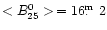 ,
and
,
and
 ,
respectively. These values have been determined based on the
galaxies displayed in the lower panels of Fig. 9, i.e., not including the galaxies in the
deepest layers of the foreground extinction for which the correction becomes increasingly uncertain.
Galaxies with a total extinction correction of
,
respectively. These values have been determined based on the
galaxies displayed in the lower panels of Fig. 9, i.e., not including the galaxies in the
deepest layers of the foreground extinction for which the correction becomes increasingly uncertain.
Galaxies with a total extinction correction of
 mag (see Cameron 1990)
are not included in these statistics.
mag (see Cameron 1990)
are not included in these statistics.
A total of 584 galaxies have extinction-corrected diameters larger or equal than 60
,
i.e., the
Lauberts (1982) diameter limit. In the absence of the obscuration by the Milky Way, Lauberts would have detected
584 galaxies within the limits of our survey, instead of the recorded 108 galaxies. Again, these numbers demonstrate
the incompleteness (=82%) in the Lauberts catalogue near the plane of the Milky Way.
The cumulative magnitude and diameter curves,
 and
and
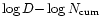 ,
plotted in Fig. 10 allow us to assess the completeness of our optical survey.
For this analysis, we have taken all the galaxies in the Crux region and the Great Attractor region
together.
The four different curves in Fig. 10 illustrate four intervals
in Galactic foreground extinction. In the interval
,
plotted in Fig. 10 allow us to assess the completeness of our optical survey.
For this analysis, we have taken all the galaxies in the Crux region and the Great Attractor region
together.
The four different curves in Fig. 10 illustrate four intervals
in Galactic foreground extinction. In the interval
 (open circles in Fig. 10), 2978 galaxies are present.
4045 galaxies are located in the next interval (
(open circles in Fig. 10), 2978 galaxies are present.
4045 galaxies are located in the next interval (
 ,
open squares),
932 galaxies in
,
open squares),
932 galaxies in
 (open triangles), and 157 galaxies are present in
the interval
(open triangles), and 157 galaxies are present in
the interval
 (filled triangles).
In the top panels which shows the "observed'' diameter and magnitude distribution,
one can see a linear increase in the cumulative number distribution for
 up
to
up
to
 and
and
 (
(
 ),
after which the curves begin to flatten. These numbers give a fair indication of the
completeness limits of the observed parameters of our survey and compare well with the
completeness limits found in the Hydra/Antlia region (
),
after which the curves begin to flatten. These numbers give a fair indication of the
completeness limits of the observed parameters of our survey and compare well with the
completeness limits found in the Hydra/Antlia region (
 and D = 14''for
,
see Paper I).
and D = 14''for
,
see Paper I).
In terms of merging our optical catalogue with existing catalogues, we should, however, consider the completeness limits of the "extinction-corrected'' parameters (see the bottom panels of Fig. 10, where one can read of the completeness limits once the curves begin to flatten). The two curves in Fig. 11 show how our observed diameter completeness limit of D = 16'' translates into an extinction-corrected diameter completeness limit for elliptical and spiral galaxies, respectively, as a function of the Galactic foreground extinction, following the precepts of Cameron (1990). The horizontal bars in Fig. 11 correspond to the completeness limits derived from the four different intervals displayed in the lower-right panel of Fig. 10, indicating the range of which they were determined. The vertical bars show the error in the determined completeness limit.
The curves illustrate that at higher extinction, the diameter correction increases dramatically. An uncertainty
of 0.1 mag in the Galactic foreground extinction translates into an uncertainty of 7%, 8% and 11%
in the diameter correction for AB = 2 ,
3
and 4,
respectively. For the extinction-correction
we use the galaxy classification given in Table 1. As the dominant fraction of
the galaxies found in our survey are spirals - the mixture of galaxy types in the
Crux and GA region is (E-S0:S-I:unclassified)
,
3
and 4,
respectively. For the extinction-correction
we use the galaxy classification given in Table 1. As the dominant fraction of
the galaxies found in our survey are spirals - the mixture of galaxy types in the
Crux and GA region is (E-S0:S-I:unclassified)  (10%:75%:15%) -
it is to be expected that our measured diameter completeness limit follows the "spiral'' curve
closely.
(10%:75%:15%) -
it is to be expected that our measured diameter completeness limit follows the "spiral'' curve
closely.
Despite the uncertainties in the extinction correction, Fig. 11 shows that we are complete for all
galaxies (spiral and elliptical) with
 for
for
 and that we are complete for all galaxies (ellipticals and spirals) with
 for
,
the
ESO-LV diameter completeness limit. This, again, is consistent with the results in
the Hydra/Antlia region (Paper I).
for
,
the
ESO-LV diameter completeness limit. This, again, is consistent with the results in
the Hydra/Antlia region (Paper I).
In Fig. 12, we compare the magnitude distribution in the Great Attractor region with that
of the Hydra/Antlia and Crux region for all the galaxies with
.
The distribution is
given in number of galaxies per square degree in bins of 0.5 mag. At extinction levels
,
the total area covered in the Hydra/Antlia, Crux and Great Attractor region is approximately
223, 266 and 175 square degrees, respectively. Within these limits, there are 3227, 3629 and 4326 galaxies present
in our catalogues.
The distribution of the extinction-corrected magnitudes (lower-right panel of Fig. 12 of the Hydra/Antlia and Crux galaxies match surprisingly well, despite the different large-scale structures that have been observed in these regions (Kraan-Korteweg et al. 1995; Fairall et al. 1998). The extinction-corrected magnitude distribution in the Great Attractor region is noticeably different, it reveals a significant excess of galaxies in the Great Attractor region.
In the histogram in the top panel of Fig. 12 the difference of the GA distribution
with the mean of the Crux and Hydra/Antlia profiles (lower-right panel) is shown.
The distribution (shape) of the excess galaxies is similar to the magnitude
distribution of galaxies in the Coma cluster (data from Godwin et al. 1983)
for
 ,
except for an offset of the histogram of
,
except for an offset of the histogram of
 1 magnitude. Hence, this excess could (in part) be explained by a rich cluster of
galaxies present in the Great Attractor region, i.e., the Norma cluster.
The galaxies in Coma are (on average) one magnitude fainter than the
excess galaxies in the Great Attractor region which puts the excess
galaxies in the distance range of the Great Attractor, i.e., 1.6 times closer than Coma,
implying a redshift-distance of 4250 kms-1. Given the uncertainties in the extinction correction,
this number should be regarded as tentative only.
1 magnitude. Hence, this excess could (in part) be explained by a rich cluster of
galaxies present in the Great Attractor region, i.e., the Norma cluster.
The galaxies in Coma are (on average) one magnitude fainter than the
excess galaxies in the Great Attractor region which puts the excess
galaxies in the distance range of the Great Attractor, i.e., 1.6 times closer than Coma,
implying a redshift-distance of 4250 kms-1. Given the uncertainties in the extinction correction,
this number should be regarded as tentative only.
Despite the uncertainties - most notably the extinction correction - the magnitude distribution in the GA region alone provides strong evidence for a significant excess of galaxies belonging to the Great Attractor, a large fraction of which is due to the Norma cluster.
It should be noted that the galaxies in the vicinity of the Norma cluster are of distinctly different morphological mix as
compared to the overall mixture of galaxy types. Overall, the galaxy mixture is
(E/S0-Spiral/Irregular-Uncertain)
(10%-75%-15%), but
within the Abell radius of the Norma cluster (
 at the distance of the Norma cluster; Woudt 1998) the galaxian mix is
(E/S0-S/I-Uncertain) = (20%-68%-12%), and within the core radius of the Norma cluster (
at the distance of the Norma cluster; Woudt 1998) the galaxian mix is
(E/S0-S/I-Uncertain) = (20%-68%-12%), and within the core radius of the Norma cluster (
 ;
Woudt 1998)
the mixture of galaxy types is (E/S0-S/I-Uncertain) = (48%-48%-4%).
These numbers indicate that the Norma cluster is a rich cluster, dominated by a large population of early-type galaxies.
;
Woudt 1998)
the mixture of galaxy types is (E/S0-S/I-Uncertain) = (48%-48%-4%).
These numbers indicate that the Norma cluster is a rich cluster, dominated by a large population of early-type galaxies.
Copyright ESO 2001
![\begin{figure}
\par\includegraphics[width=6.8cm,clip]{H2872F08.ps}\end{figure}](/articles/aa/full/2001/47/aah2872/img110.gif)
![\begin{figure}
\par\includegraphics[width=6.4cm,clip]{H2872F10.ps}\end{figure}](/articles/aa/full/2001/47/aah2872/img140.gif)
 ,
the open
squares are galaxies with
,
the open
squares are galaxies with
![\begin{figure}
\par\includegraphics[width=6.8cm,clip]{H2872F11.ps}\end{figure}](/articles/aa/full/2001/47/aah2872/img144.gif)
![\begin{figure}
\par\includegraphics[width=7cm,clip]{H2872F12.ps}\end{figure}](/articles/aa/full/2001/47/aah2872/img145.gif)