

 transient
The EPIC images of the central 30 of M 31 (Fig. 1
represents part of EPIC PN image) contain more than 100 discrete X-ray
sources as well as unresolved emission near the centre (see Paper I
for more details).
The detections include sources seen with Einstein , ROSAT , or
Chandra (TF,PFJ,Su97,Su01,G2000) as well as new sources. The
transient source discovered by Chandra (G2000) is clearly
seen in both XMM-Newton observations (Sect. 3.2). In the June observation,
there is a bright new transient which was not seen previously (Sect. 3.1).
Several other bright sources demonstrated significant variability
on half of a year time scale, so that uncertainties of count rate
measurements do not overlap for the two observations.
We have analyzed 66 sources with limiting count rate
of M 31 (Fig. 1
represents part of EPIC PN image) contain more than 100 discrete X-ray
sources as well as unresolved emission near the centre (see Paper I
for more details).
The detections include sources seen with Einstein , ROSAT , or
Chandra (TF,PFJ,Su97,Su01,G2000) as well as new sources. The
transient source discovered by Chandra (G2000) is clearly
seen in both XMM-Newton observations (Sect. 3.2). In the June observation,
there is a bright new transient which was not seen previously (Sect. 3.1).
Several other bright sources demonstrated significant variability
on half of a year time scale, so that uncertainties of count rate
measurements do not overlap for the two observations.
We have analyzed 66 sources with limiting count rate![[*]](/icons/foot_motif.gif) 4 counts/ks and found 10 variables.
These sources are listed in Table 2 along with their XMM positions, June and December count rates in MOS1, and any relevant
identifications (though only count rates in MOS1 are cited, we selected
the sources based on the data from all three XMM-Newton instruments).
The source positions were derived from comparison with Chandra calibrated images of the central region of M 31. The estimated
positional error of 1
4 counts/ks and found 10 variables.
These sources are listed in Table 2 along with their XMM positions, June and December count rates in MOS1, and any relevant
identifications (though only count rates in MOS1 are cited, we selected
the sources based on the data from all three XMM-Newton instruments).
The source positions were derived from comparison with Chandra calibrated images of the central region of M 31. The estimated
positional error of 1
 -3
(in diameter) depends on the
distance of the source from the boresight axis, its intensity and
nearby sources. We estimate 3
as a conservative error limit
for the XMM positions presented in this paper.
-3
(in diameter) depends on the
distance of the source from the boresight axis, its intensity and
nearby sources. We estimate 3
as a conservative error limit
for the XMM positions presented in this paper.
Taking into account the total number of sufficiently bright
detected sources, we conclude that at least  15% of
all sources in the central field of M 31 are variable on a time scale
of several months. We believe, however, that this value should
be considered a lower limit, because the sensitivity
of our analysis was a function of the source flux, and the variability
of many of the fainter sources would not be detected.
Below we discuss in more detail several individual
variable sources in M 31.
15% of
all sources in the central field of M 31 are variable on a time scale
of several months. We believe, however, that this value should
be considered a lower limit, because the sensitivity
of our analysis was a function of the source flux, and the variability
of many of the fainter sources would not be detected.
Below we discuss in more detail several individual
variable sources in M 31.
We found a new bright X-ray source in EPIC PN and EPIC MOS images from
the June observation. The coordinates of the new source are presented
in Table 2. The source was neither detected in
previous Einstein and ROSAT observations nor has been reported from
Chandra observations. During the June observations the flux from
the source was
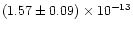 erg s-1 cm-2 (0.3-10 keV),
which corresponds to a luminosity of
erg s-1 cm-2 (0.3-10 keV),
which corresponds to a luminosity of
 erg s-1 in the cited energy band
assuming a power-law spectrum (see Paper III).
The source flux faded to below the background level before
the next XMM-Newton observation of the same field on Dec. 28, 2000.
The upper limit for the count rate for this second observation
was less than 6.4 counts/ks (2
erg s-1 in the cited energy band
assuming a power-law spectrum (see Paper III).
The source flux faded to below the background level before
the next XMM-Newton observation of the same field on Dec. 28, 2000.
The upper limit for the count rate for this second observation
was less than 6.4 counts/ks (2 upper limit for MOS1).
The detected luminosity of the source during the
June 25 observation, as well as its several-month time
scale to fade to quiescence, is typical for bright
X-ray transients in our Galaxy (see reviews by Tanaka & Shibazaki 1996;
Chen et al. 1997).
upper limit for MOS1).
The detected luminosity of the source during the
June 25 observation, as well as its several-month time
scale to fade to quiescence, is typical for bright
X-ray transients in our Galaxy (see reviews by Tanaka & Shibazaki 1996;
Chen et al. 1997).
transient
A bright transient source designated CXO J004242.0+411608 was discovered with
Chandra during a 17.5 ks observation of the core of M 31 on Oct. 13, 1999
(G2000). We detected an X-ray source at the same location
during both our XMM-Newton PV observations. The flux of the source
measured on June 25, 2000 was equal to
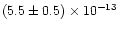 erg s-1 cm-2 (
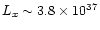 erg s-1).
The source was detected again on Dec. 28, 2000 with flux of
erg s-1).
The source was detected again on Dec. 28, 2000 with flux of
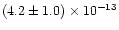 erg s-1 cm-2. Including both the Chandra and
XMM detections, the source has remained bright for more than 14
months, with only slight possible fading (25%) between the two
XMM-Newton observations separated by half of a year. The X-ray
luminosity and spectral shape detected by XMM-Newton (Paper III)
correspond to those of the hard/low state of Galactic black hole
transients (e.g., Tanaka & Lewin 1995). Typically Galactic X-ray transients
fade significantly in less than 100 days (see Chen et al. 1997 for
a review); however, a long plateau in a hard spectral state was
observed from the X-ray transient GRS 1716-249
(Sunyaev et al. 1994; Revnivtsev et al. 1998). We should mention that our sampling does
not allow us to distinguish reliably between single and repeated
outbursts. It will be interesting to follow the evolution of
CXO J004242.0+411608 during future planned observations with XMM-Newton .
erg s-1 cm-2. Including both the Chandra and
XMM detections, the source has remained bright for more than 14
months, with only slight possible fading (25%) between the two
XMM-Newton observations separated by half of a year. The X-ray
luminosity and spectral shape detected by XMM-Newton (Paper III)
correspond to those of the hard/low state of Galactic black hole
transients (e.g., Tanaka & Lewin 1995). Typically Galactic X-ray transients
fade significantly in less than 100 days (see Chen et al. 1997 for
a review); however, a long plateau in a hard spectral state was
observed from the X-ray transient GRS 1716-249
(Sunyaev et al. 1994; Revnivtsev et al. 1998). We should mention that our sampling does
not allow us to distinguish reliably between single and repeated
outbursts. It will be interesting to follow the evolution of
CXO J004242.0+411608 during future planned observations with XMM-Newton .
![\begin{figure}
\par\includegraphics[width=8.8cm,clip]{H3101F2.PS}\end{figure}](/articles/aa/full/2001/42/aah3101/img23.gif) |
Figure 2:
Power density spectra for a supersoft source in M 31 obtained
from each of the three EPIC instruments during the observation on June
25, 2000. The peak power from each of the three instruments occurs at
a frequency corresponding to to a period of 865 s. The vertical
dotted line denotes the best fit value of the period found by the
epoch-folding method. Detection thresholds are indicated by
horizontal dashed lines labelled with the approximate probability
that any of the 1500 or 1300 frequency bins in each PDS (for MOSs and
PN respectively; no averaging applied) would have a noise value
exceeding the indicated power level (Vaughan et al. 1994). |
We detected significant oscillations in the X-ray flux from one of the
bright variable sources in our field (source #9 in
Table 2). The Fourier power density spectra (PDS) from
each of the three independent EPIC instruments (Fig. 2)
show a highly significant periodic signal from this source during the
June observation, with a best-fit period of
 s. The
folded light curve for this source (Fig. 3) is
quasi-sinusoidal with an amplitude of about 40%.
s. The
folded light curve for this source (Fig. 3) is
quasi-sinusoidal with an amplitude of about 40%.
In June 2000 this 865-s pulsator had a spectrum similar to the three
sources in the XMM field previously identified by Kahabka
(1999) as supersoft source (SSS) candidates based on
their ROSAT /PSPC hardness ratios and luminosities (one was identified
with a supernova remnant). The temperature of the blackbody spectral
fit was
 eV with reduced
 (for EPIC-MOS data).
All four SSSs exhibit blackbody-like
spectra with effective temperatures in the range
(for EPIC-MOS data).
All four SSSs exhibit blackbody-like
spectra with effective temperatures in the range
 -150 eV
and no detectable X-ray emission above 1.5 keV (see
Paper III for more detailed discussion of spectral parameters).
Such sources are typically interpreted as accreting
white dwarfs in binary systems, powered by nuclear burning
of the accreted matter on their surfaces (see Kahabka & van den Heuvel 1997 for a review).
-150 eV
and no detectable X-ray emission above 1.5 keV (see
Paper III for more detailed discussion of spectral parameters).
Such sources are typically interpreted as accreting
white dwarfs in binary systems, powered by nuclear burning
of the accreted matter on their surfaces (see Kahabka & van den Heuvel 1997 for a review).
The source count rate during the June 25 observation was equal to
44 counts/ks in the 0.3-1.5 keV energy range (MOS1, see
Table 2). By Dec. 28 the source count rate had faded
down to a level below 5 counts/ks (MOS1); thus, it was not possible to
detect pulsations during the second observation.
All three supersoft sources in the NE portion of our field (sources
## 8, 9 and 10) faded between the June and December observations
(see Table 2). We are aware of a possible sensitivity
degradation in this region of MOS1; however, the result is confirmed
by MOS2 and PN data. In particular, the count rate of the supersoft
pulsator as detected by MOS2 dropped down from
 counts/ks in
June to
counts/ks in
June to  counts/ks in December, while many other sources in
the field showed no significant variability or became brighter in
December.
counts/ks in December, while many other sources in
the field showed no significant variability or became brighter in
December.
We note that there is a nearby source
(
 ,
J2000) with a harder spectrum
which is much fainter than the supersoft pulsator in the June
observation but dominates this region of the sky for the December
observation. The distance between two sources is about 10
,
J2000) with a harder spectrum
which is much fainter than the supersoft pulsator in the June
observation but dominates this region of the sky for the December
observation. The distance between two sources is about 10
 ,
so that they are spatially resolved with XMM-Newton , but their counts are not
completely spatially separated on the detector. Because
the relative flux of the harder source
was much lower during the June observation, it did not significantly
affect our timing and spectral analysis of the SSS. The ROSAT /PSPC
would barely be able to resolve the two sources, so ROSAT 's
RX J0043.3+4117 (Su01#236) may include contributions from both
of them, although its position coincides with that of the harder
source rather than the SSS pulsator.
,
so that they are spatially resolved with XMM-Newton , but their counts are not
completely spatially separated on the detector. Because
the relative flux of the harder source
was much lower during the June observation, it did not significantly
affect our timing and spectral analysis of the SSS. The ROSAT /PSPC
would barely be able to resolve the two sources, so ROSAT 's
RX J0043.3+4117 (Su01#236) may include contributions from both
of them, although its position coincides with that of the harder
source rather than the SSS pulsator.
The 865.5-s period is the shortest among all known SSSs (Greiner 2000).
Interpreted as the binary orbital period, it would be too short to
accommodate a main-sequence companion and would suggest a degenerate
secondary. It may be more plausible to assume that the pulsations
indicate that the white dwarf possesses a magnetic field large enough to
modulate the X-ray emission yet not so large that the spin and orbital
periods are locked, e.g., as in intermediate polars or DQ Her stars
(see review by Cordova 1995). However, the absorbed luminosity of the
object
 erg s-1 (0.3-1.5 keV) is several orders
of magnitude higher then typical for intermediate polars
luminosity range
erg s-1 (0.3-1.5 keV) is several orders
of magnitude higher then typical for intermediate polars
luminosity range
 -1034 (see e.g. Patterson 1994).
The high luminosity and transient nature of the pulsator
may indicate steady burning in a post-nova stage, as has been
observed in a few classical and symbiotic novae (Kahabka & van den Heuvel 1997).
An alternative explanation for the nature of the SSS could be
a double degenerate polar similar to RX J1914.4+2456 (Haberl & Motch 1995; Ramsay et al. 2000).
An interpretation of the source as a foreground object is
unlikely due to the lack of an optical counterpart in Dec. 2000 XMM
OM images up to the limiting magnitude of 19 in the B filter.
-1034 (see e.g. Patterson 1994).
The high luminosity and transient nature of the pulsator
may indicate steady burning in a post-nova stage, as has been
observed in a few classical and symbiotic novae (Kahabka & van den Heuvel 1997).
An alternative explanation for the nature of the SSS could be
a double degenerate polar similar to RX J1914.4+2456 (Haberl & Motch 1995; Ramsay et al. 2000).
An interpretation of the source as a foreground object is
unlikely due to the lack of an optical counterpart in Dec. 2000 XMM
OM images up to the limiting magnitude of 19 in the B filter.
We have searched for coherent periodic modulation on time scales from
10 to 1000 s for about 60 of the brightest sources in the
XMM-Newton field of view; however, only in one case (see previous
subsection) was significant variability detected. The 90% upper
limits to periodic modulation fractions, calculated as the ratio of
the sine amplitude to the constant flux level for periods of 10 000, 300,
and 10 s were obtained in all other cases. These upper limits vary
from 3.6% for the brightest source to 30% for the faintest
sources of the sample.
The lack of detectable variability for many of the individual sources in M 31 may seem surprising compared with rich variability observed from Galactic sources. Our observations so far have included mainly the bulge of M 31, where low-mass X-ray binaries (LMXBs) are most prevalent. Such systems commonly show dips, bursts, and quasi-periodic variability rather than coherent pulsations. We expect to detect more X-ray pulsars during planned XMM observations of M 31 in fields along the disk of M 31, where population I stars and high-mass X-ray binaries (HMXBs) dominate. We must note also that the sensitivity to variability depends strongly on the brightness of the source, and hence our data are not very sensitive to the variability of the many faint sources.
We have also looked for non-periodic variations on all accessible timescales for the same set of objects. No X-ray burst has been detected, however our sensitivity to bursts is restricted to a relatively small luminosity interval by the low count rate of most sources and by the Eddington limit.
Copyright ESO 2001
![\begin{figure}
\par\includegraphics[angle=270,width=8.8cm,clip]{H3101F3.PS}\end{figure}](/articles/aa/full/2001/42/aah3101/img34.gif)