

We calculated the Galactic disk population of binaries containing two
compact objects using the populationsynthesis code SeBa
(Portegies Zwart & Verbunt 1996; Portegies Zwart & Yungelson 1998;
Nelemans et al. 2001b). The basic assumptions used in this paper can
be summarised as follows. The initial primary masses are distributed
according to a power law IMF with index -2.5, the initial mass ratio
distribution is taken flat, the initial semi major axis distribution
flat in log a up to
 ,
and the eccentricities follow
,
and the eccentricities follow
 .
The fraction of binaries in the initial population
of main-sequence stars is 50% (2/3 of all stars are in binaries). A
difference with other studies of the populations of close binaries is
that the mass transfer from a giant to a main sequence star of
comparable mass is calculated using an angular momentum balance
formalism, as described in Nelemans et al. (2000b). For the
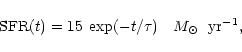
star formation rate of the Galactic disk we use an exponential
function:
.
The fraction of binaries in the initial population
of main-sequence stars is 50% (2/3 of all stars are in binaries). A
difference with other studies of the populations of close binaries is
that the mass transfer from a giant to a main sequence star of
comparable mass is calculated using an angular momentum balance
formalism, as described in Nelemans et al. (2000b). For the
star formation rate of the Galactic disk we use an exponential
function:
 Gyr. With an age of the Galactic disk of 10Gyr it
gives a current star formation rate of 3.6
Gyr. With an age of the Galactic disk of 10Gyr it
gives a current star formation rate of 3.6
 yr-1compatible with observational estimates (Rana 1991; van den Hoek & de Jong 1997). It gives a
Galactic supernova II/Ib rate of 0.02 yr-1 and if supernovae Ia
are produced by merging double carbon-oxygen (CO) white dwarfs it
gives a Galactic rate of 0.002 yr-1. Both are in agreement with
observational estimates by Cappellaro et al. (1999).
yr-1compatible with observational estimates (Rana 1991; van den Hoek & de Jong 1997). It gives a
Galactic supernova II/Ib rate of 0.02 yr-1 and if supernovae Ia
are produced by merging double carbon-oxygen (CO) white dwarfs it
gives a Galactic rate of 0.002 yr-1. Both are in agreement with
observational estimates by Cappellaro et al. (1999).
The current birth- and merger rates and total number of systems in the
Galactic disk with these assumptions are given in
Table 1. We use a notation introduced by Portegies Zwart & Verbunt (1996):
wd, ns and bh for white dwarf, neutron star and black hole
respectively;  and
and  for detached and
semi-detached binaries. The fact that the numbers here are different
from the numbers given in Portegies Zwart & Yungelson (1998, 1999)
for detached and
semi-detached binaries. The fact that the numbers here are different
from the numbers given in Portegies Zwart & Yungelson (1998, 1999)![[*]](/icons/foot_motif.gif) , Nelemans et al. (2001b) and Brown et al. (2001) is caused by the
differences in the assumed IMF, initial binary fraction and star
formation history.
, Nelemans et al. (2001b) and Brown et al. (2001) is caused by the
differences in the assumed IMF, initial binary fraction and star
formation history.
In Fig. 2 we show the period distributions of the binaries of different types in the range of interest for space based gravitational wave detectors. The properties of these populations can be summarised as follows:
Detached double white dwarf binaries: (wd, wd).
Our model for the Galactic disk population of double white dwarfs is
described in detail in Nelemans et al. (2001b). Most double white dwarfs have a
mass ratio around unity and low-mass (
 )
components.
From Table 1 and Fig. 2 it is clear
that they vastly outnumber all other binaries with compact objects in
the Galactic disk.
)
components.
From Table 1 and Fig. 2 it is clear
that they vastly outnumber all other binaries with compact objects in
the Galactic disk.
Semi-detached double white dwarfs (AM CVn stars): [wd, wd). We include in our calculation both AM CVn stars descending from detached close double white dwarfs and from low-mass helium stars with white dwarf companions (Nelemans et al. 2001a). We use Model II of Nelemans et al., which is most favourable for the formation of AM CVn's.
Neutron star - white dwarf binaries: (ns, wd). Neutron star - white dwarf binaries fall into two families (Tutukov & Yungelson 1993a; Portegies Zwart & Yungelson 1999; Tauris & Sennels 2000). In one family the neutron star is formed first. Later the secondary forms a white dwarf and in the mass transfer event the orbit circularizes (e.g. van den Heuvel & Taam 1984). If both components of the initial binary are of comparable mass it can happen that the primary becomes a white dwarf, while the secondary accretes so much mass that it becomes a neutron star (e.g. Tutukov & Yungelson 1993a). In this case the orbits are eccentric. The masses of the white dwarfs are typically low in the first family and high in the second (see Fig. 5 below).
Double neutron star binaries: (ns, ns). The formation and characteristics of the current population of double neutron stars is extensively studied by us in Portegies Zwart & Yungelson (1998). Maybe the most important assumption, which influences the birth rate, orbital periods and eccentricities of neutron star - neutron star binaries, is the kick velocity distribution. We use the one proposed by Hartman (1997).
Black hole binaries: (bh, wd), (bh, ns) and (bh, bh).
The knowledge of the way in which black holes are formed and the range
of masses of their progenitors are still highly uncertain
(see e.g. Woosley & Weaver 1995; Portegies Zwart et al. 1997;
Ergma & van den Heuvel 1998; Wellstein & Langer 1999;
Fryer 1999). The treatment of the
formation of black holes implemented in the present study is described
in some detail in the Appendix. Typical black holes in our model have
masses between 5 and 7
.
In the short orbital period range
(Fig. 2) they are rare and their merger rates are at
least an order of magnitude lower than those of the neutron star
binaries (Table 1). Double black hole binaries are
absent in this period range and do not merge at all in our model.
Copyright ESO 2001
![\begin{figure}
\par\includegraphics[angle=-90,width=8.6cm]{h2754f2.ps}\end{figure}](/articles/aa/full/2001/33/aah2754/img32.gif)
![\begin{figure}
\par\includegraphics[angle=-90,width=7.1cm]{h2754f3.ps}\hspace*{1.2cm}
\includegraphics[angle=-90,width=7.1cm]{h2754f4.ps}\end{figure}](/articles/aa/full/2001/33/aah2754/img34.gif)
 and -3.0 is clearly visible.