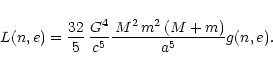
The gravitational wave luminosity of a binary in the nth harmonic is
given by (Peters & Matthews 1963)
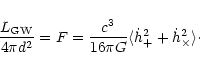
The measurable signal for gravitational wave detectors is the
amplitude of the wave - h+ and
 for the two
polarisations. These can be computed from the GW flux at the Earth
(Press & Thorne 1972)
for the two
polarisations. These can be computed from the GW flux at the Earth
(Press & Thorne 1972)
 |
(2) |
![$h = ({1 \over 2} [h_{\rm +,\max}^2 +
h_{\rm\times,\max}^2])^{1/2}$](/articles/aa/full/2001/33/aah2754/img15.gif) one obtains
one obtains
 is the so called
chirp mass and
is the so called
chirp mass and
 is the angular
frequency of the emitted wave
is the angular
frequency of the emitted wave![[*]](/icons/foot_motif.gif) . In Fig. 1 we plot the
values of
. In Fig. 1 we plot the
values of
 for different eccentricities. High
eccentricity binaries emit most of their energy at higher frequencies
than their orbital frequency, reflecting the fact that the radiation
is more effective near periastron of the orbit. Thus, eccentric
compact binaries may be detectable sources of GW signals at
frequencies higher than their orbital frequency
(cf. Barone et al. 1988; Hils 1991).
for different eccentricities. High
eccentricity binaries emit most of their energy at higher frequencies
than their orbital frequency, reflecting the fact that the radiation
is more effective near periastron of the orbit. Thus, eccentric
compact binaries may be detectable sources of GW signals at
frequencies higher than their orbital frequency
(cf. Barone et al. 1988; Hils 1991).
![\begin{figure}
\par\includegraphics[width=8.7cm]{h2754f1.eps}\end{figure}](/articles/aa/full/2001/33/aah2754/img22.gif) |
Figure 1:
Scale factor of the GW strain amplitude
for the different harmonics (Eq. (3)) for e = 0,
0.2, 0.5 and 0.7. |
| Type |  |
 |
 |
| [2.5ex](wd, wd) | 2.5  10-2
10-2 |
1.1
10-2 |
1.1
108 |
| [wd, wd) | 3.3
10-3 |
- | 4.2
107 |
| (ns, wd) | 2.4
10-4 |
1.4
10-4 |
2.2
106 |
| (ns, ns) | 5.7
10-5 |
2.4
10-5 |
7.5
105 |
| (bh, wd) | 8.2
10-5 |
1.9
10-6 |
1.4
106 |
| (bh, ns) | 2.6
10-5 |
2.9
10-6 |
4.7
105 |
| (bh, bh) | 1.6
10-4 |
- | 2.8
106 |
Copyright ESO 2001