

The spectra presented here have been recorded with detector ``B'' and compressed during downlink. After decompression, the data set was flat-field corrected and the geometric distortion of the detector removed. Finally, spectral pixels were converted to wavelengths and the intensity given in physical units. Standard procedures have been applied for the basic data processing.
As mentioned in Sect. 3.1, the responsivity of the detector is nonuniform on scales of about 20 pixels or less. Several flat-field matrices have been acquired by long exposures of three hours in the H I Lyman continuum at 880 Å while the spectrometer was defocussed. This provides a deep, although not entirely uniform exposure which the SUMER processor compares against a median-20 filtered array in order to extract all non-uniformities smaller than 20 pixels. The small-scale variation amounts to as much as 50%. This includes a pixel-to-pixel variation of approximately 20% in the spatial dimension caused by an analogue-to-digital converter differential non-linearity.
The properties of the detector vary as a function of the extracted charge as the detector is being ``scrubbed'' by the accumulated counts. Thus, the flat-field data need to be updated quite frequently. In all cases, we selected the latest flat-field image obtained before the considered observation for this process.
The fringe fields in the detector MCP-anode gap lead to a geometric distortion which makes the image of the slit shorter at the centre of the detector compared to areas closer to the edges. As a result, the spectral lines are curved (cf. Fig. 1). An artificial ``rectangular grid'' has been produced using averaged stable solar spectral lines and continuum data, from which the distortion has been parametrized. This correction is then applied to the data in order to overcome this shortcoming. The SUMER standard ``destretching procedure'' (Moran 1996) also contains a compensation for the small inclination of the slit image relative to the detector pixel direction, which is caused by a residual alignment error between detector anode and spectrometer grating.
Figure 1 shows a full-detector image centred at  769 Å before and
after the corrections for flat-field and geometric distortions are made. As seen
in the central panel, the continuum features appear to be horizontal in the
dispersion direction and the emission lines are straight to within one
spectral pixel after this correction.
769 Å before and
after the corrections for flat-field and geometric distortions are made. As seen
in the central panel, the continuum features appear to be horizontal in the
dispersion direction and the emission lines are straight to within one
spectral pixel after this correction.
Since there is no absolute wavelength reference available in the spectrometer, a wavelength scale can only be derived using solar chromospheric lines. The dispersion changes as a function of wavelength, and so each exposure needs an individual calibration. The wavelength calibration is based on identifying the position of chromospheric lines on the detector and the assumption of neglibible net Doppler flows for these lines. In quiet regions atomic lines and lines from singly ionized species are formed over a limited range in temperature and other physical conditions, and are known to show relatively small average absolute shifts (e.g., Samain 1991). Also, the observed small velocity variations along the slit in these lines indicate that these lines are very useful for establishing an absolute wavelength scale.
The pixel-to-wavelength relation is achieved by a correlation of the line centroids in the entire 43 Å window with all known reference wavelengths in this window, preferably emission lines from neutrals and singly ionized species, which are fairly strong and unblended in the solar spectrum and for which the absolute wavelengths are known with high accuracy. Since the non-linear dispersion is known very accurately from the optical design, this correlation leads to a constant offset for each exposure. In an iterative process, we inspected the preliminary wavelength calibration of each individual exposure for inconsistencies and deviations. This exercise has been very useful in eliminating misidentifications or finding problems with literature values for some of the reference lines.
The identification of reference lines is sometimes difficult due to the presence
of many overlapping lines and also due to the presence of prominent lines both in
first and second order in the SUMER spectrum. Except for a few close
blends, the line centroids could be determined by multi-Gauss fits with estimated
uncertainties of the order of 0.1 pixel (5 mÅ in first
order). The accuracy of the laboratory wavelengths of atomic lines is
generally better than 2 mÅ. Most of the laboratory wavelengths used for the
wavelength calibration were taken from Kelly (1987).
After the spectra have been calibrated, the wavelengths should be accurate to
typically 10 mÅ or 2 to 5 kms-1 on a velocity scale which is relative to
quiet-Sun chromospheric layers. We do not claim this accuracy for the
sunspot spectra, where this value can easily reach 40 mÅ in cases where either
the measured line or the reference lines or both are shifted by net Doppler flows.
It is also evident that the sunspot spectrum is more noisy, due to acumulative
effect of the narrow slit, the shorter exposure time, and the reduced number of
averaged pixels, which amounts to a factor of 100 less counts.
In several cases, our measured wavelength values, which are reported in the annexed line list, suggest that the literature values have to be revised, in particular, this is the case for wavelengths of forbidden transitions in highly-ionized species, which are difficult to measure in the laboratory. Examples of more accurate measurements, which are beyond the scope of this atlas, are reported by Dammasch et al. (1999b) and Peter & Judge (1999).
The calibration of the spectral response of the SUMER instrument is based on a comparison with a radiometric transfer standard source, which had been calibrated against the Berlin Electron-Storage ring for SYnchrotron radiation (BESSY I) as primary radiometric standard (Hollandt et al. 1996). The transfer source provided 16 emission lines with known photon fluxes of rare gases in the SUMER wavelength range. These have been used as the basis for establishing the spectral responsitivity curves of the instrument in first and second order for both detectors.
Based on the experience with previous solar UV missions the stability of the
calibration was a major concern. The combined effects of molecular organic
contamination and solar irradiation was known to cause degradation of the
optical performance in space. Therefore, a comprehensive cleanliness control
programme was made part of the SUMER project, which successfully avoided this
type of contamination. This could be verified by monitoring the sensitivity
during the mission (Schühle et al. 1998).
The responsivity of the instrument has been monitored from the moment when first
light was received on the telescope. The count rates for well known solar lines at
quiet solar conditions were measured and found to be the same as predicted
by the calibration made on the ground.
During the entire mission, calibration measurements have been carried out
at regular time intervals to track the responsivity of the instrument. The
radiance at selected wavelengths of a quiet-Sun area was monitored
to detect possible changes in the response. Despite the high variability
of the Sun as a source, these measurements confirmed the stability of the
calibration within uncertainty limits of  15% (1
  )
for detector ``A'' (Wilhelm et al. 1997a) and 20% for detector ``B'',
in the range from 537 Å to 1250 Å (Schühle et al. 2000). In addition,
the spectral calibration curves could be refined during flight by measuring solar
line ratios and by observation of standard UV stars (Wilhelm et al. 1997a).
)
for detector ``A'' (Wilhelm et al. 1997a) and 20% for detector ``B'',
in the range from 537 Å to 1250 Å (Schühle et al. 2000). In addition,
the spectral calibration curves could be refined during flight by measuring solar
line ratios and by observation of standard UV stars (Wilhelm et al. 1997a).
Thus we believe that in the wavelength range from 537 Å to 1250 Å the radiometric calibration has been valid until June 1998, the time when the loss of the SOHO attitude control occurred. Our spectrum of the sunspot was taken after recovery of the spacecraft when a change in sensitivity of the SUMER instrument was discovered. Data after the recovery are treated with a correction factor of 43% to account for the average loss of sensitivity attributable to the loss of SOHO. The uncertainty in the determination of this change affects also the overall uncertainty of the radiometric calibration after recovery which we estimate to 30%. At wavelengths longer than 1250 Å the uncertainties are 30% before and 40% after the SOHO recovery.
However, some corrections are necessary for bright lines. The count-rate
capabilities of the detectors are slightly exceeded if
bright lines are placed onto the KBr part of the photocathode, leading
to a local-gain depression of the detector channel plates and dead-time effects of
the electronics (Wilhelm et al. 2000). As a result the intensities of the lines affected
(C III 977 Å, H I Ly 1026 Å, O VI
1032 Å, O VI 1037 Å, H I Ly
1026 Å, O VI
1032 Å, O VI 1037 Å, H I Ly 1216 Å, O I
1302-1306 Å, C II 1335/1336 Å) are underestimated in the raw data.
The corrections, which amount to as much as 30% for the C III line and about
17% for the O VI, H I, O I, and C II lines have been
applied in our atlas. The given intensity of the H I Ly
1216 Å line
is only an approximation, since this bright line could only be observed with the
attenuator. Since the brightness of structures observed on the Sun may have changed
while the spectral range was covered, the intensities of lines may become less
comparable with increasing difference in wavelength.
1216 Å, O I
1302-1306 Å, C II 1335/1336 Å) are underestimated in the raw data.
The corrections, which amount to as much as 30% for the C III line and about
17% for the O VI, H I, O I, and C II lines have been
applied in our atlas. The given intensity of the H I Ly
1216 Å line
is only an approximation, since this bright line could only be observed with the
attenuator. Since the brightness of structures observed on the Sun may have changed
while the spectral range was covered, the intensities of lines may become less
comparable with increasing difference in wavelength.
In the sunspot spectrum, the photon rate of some emission lines heavily exceeded
the detector capabilities. Then, in addition to dead-time losses, some pulses
are registered at a displaced position and appear in both dimensions as ghosts
in an image. These electronic ghosts have been eliminated and appear as gaps
in our spectrum. This correction was needed for H I Ly 973 Å, C III 977 Å, O VI 1032 Å,
O VI 1037 Å, H I Ly
1216 Å,
O V 1218 Å & Mg X 1219 Å/2, N V 1238 Å,
and N V 1242 Å.
973 Å, C III 977 Å, O VI 1032 Å,
O VI 1037 Å, H I Ly
1216 Å,
O V 1218 Å & Mg X 1219 Å/2, N V 1238 Å,
and N V 1242 Å.
To confirm the consistency of the radiometric results further, we compared our
calibration with other solar spectral
instruments which measure the irradiance from the full solar disk.
In using the spectral radiance of this atlas for a comparison with irradiance
data from the full Sun, one has to take into account contributions
from different features on the disk, such as active regions and coronal holes,
and center-to-limb variation (limb brightening), which are not resolved in
full-disk measurements. Full-disk irradiances have been reported for a number
of selected emission lines for which full-Sun raster scans have been made
with the SUMER instrument (Wilhelm et al. 1998). From these
measurements the effects of active regions, coronal hole deficiencies, and
detailed center-to-limb radiance variations have been determined. Most lines
of the solar transition region are from optically thin plasmas and show substantial
limb brightening, which leads to an average radiance of the solar
disk of approximately twice the radiance at disk centre. Therefore, the
irradiance from the full Sun will be higher than from the disk centre
for most of the lines in this spectral range. Work has been done to compare
the irradiances of the quiet Sun measured with SUMER with previous results in the
literature, and whenever a comparison could be made, we found agreement
within the uncertainty margins (Dammasch et al. 1999a).
A comparison of the SUMER radiance spectrum has also been made with the irradiance
spectrum of the Solar-Stellar Irradiance Comparison Experiment (SOLSTICE) on
the Upper Atmospheric Research Satellite (above 1150 Å) and the EUV
Grating Spectrograph (EGS) (below 1190 Å), which was flown on
sounding rockets (Woods et al. 1998a). The latter two instruments have been calibrated against the
Synchrotron Ultraviolet Radiation Facility (SURF) of the US National Institute of
Standards and Technology (NIST) as primary radiometric standard. The comparison between
the SOLSTICE/EGS irradiance spectrum and the SUMER quiet-Sun radiance spectrum
was made between 800 Å and 1600 Å at a spectral resolution of 3 Å
(Schühle et al. 1998). For most parts of the spectrum the agreement was found to be
very good, except where we have dominating second-order lines in the SUMER spectrum
and a spectral region around 950 Å, which could be attributed to an instrumental
effect (Woods 1998b). A detailed comparison between SOLSTICE and SUMER in
the range from 1200 Å to 1560 Å was given by Wilhelm et al. (1999). The comparison
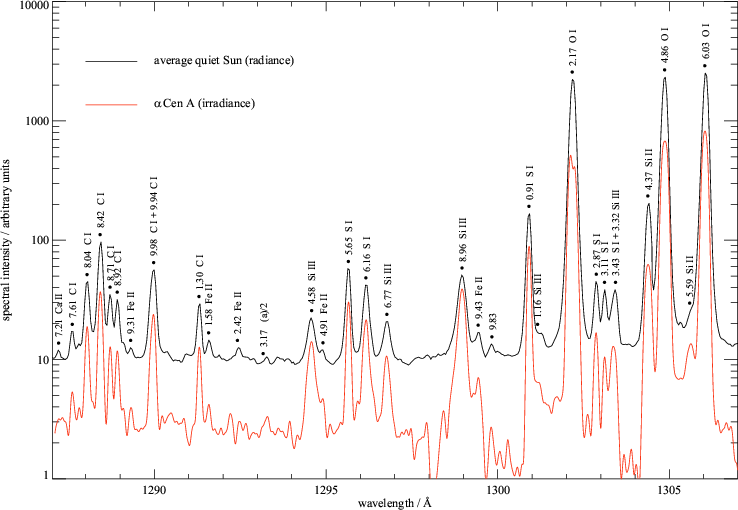
of stellar FUV spectra with the spatially resolved spectra of the Sun is also of
great interest. Figure 3 compares the average quiet-Sun radiance spectrum in the
range from 1287 Å to 1307 Å to the irradiance spectrum of the solar twin G2 V
star Cen A (for details, cf. Ayres 2000) as measured by the Hubble Space
Telescope Imaging Spectrograph (HST-STIS). Both spectra are very similar,
except for second order lines, which are not present in STIS spectra. Faint
lines can be easier seen in the SUMER spectrum, which has a better photon statistic.
The STIS spectrum with its better spectral resolution is very useful for studying line
blends and line reversals due to optical thickness effects. A more detailed analysis
and a radiometric comparison are beyond the scope of this atlas.
Copyright ESO 2001
 mÅ.
mÅ.