SUMER is part of the SOHO mission of ESA and NASA. SOHO
was launched on December 2, 1995 by an Atlas II-AS
Centaur into a transfer trajectory to the first Lagrangian point, L1. It
was injected into a halo orbit around L1 on February 14, 1996 where,
in continuous view of the Sun, it accompanies the Earth at a sunward
distance of
 km. SOHO lost its attitude control on June 25, 1998,
but was subsequently recovered later in 1998.
km. SOHO lost its attitude control on June 25, 1998,
but was subsequently recovered later in 1998.
This section describes details of the instrument and the data acquisition which are relevant for the interpretation of the data. A comprehensive description of the instrument is given by Wilhelm et al. (1995), and first results and inflight performance characteristics are given by Wilhelm et al. (1997b) and Lemaire et al. (1997).
SUMER is a stigmatic normal-incidence spectrograph operating in the range from
465 Å to 1610 Å with optical elements made of silicon carbide
(SiC) and three normal-incidence reflections.
Only a few lines below 500 Å have so far been observed with SUMER.
The off-axis parabola telescope mirror has a plate scale in the slit plane of
6.3  m/arcsec. It can be moved to obtain disk and off-limb spectra in the lower
corona. Four slits with angular dimensions of 4
m/arcsec. It can be moved to obtain disk and off-limb spectra in the lower
corona. Four slits with angular dimensions of 4

 300
,
1
300
,
1
120
,
and 0.3
120
are available, the two short slits can be placed at three
different spatial positions with respect to the detector. We have used the 1
300
slit (slit #2) during the coronal-hole and quiet-Sun
observations given in this atlas. The sunspot was observed using the narrow
0.3
120
slit (slit #7).
300
,
1
300
,
1
120
,
and 0.3
120
are available, the two short slits can be placed at three
different spatial positions with respect to the detector. We have used the 1
300
slit (slit #2) during the coronal-hole and quiet-Sun
observations given in this atlas. The sunspot was observed using the narrow
0.3
120
slit (slit #7).
Two diffraction orders can be observed by SUMER; first order lines and second order lines appear superimposed in the spectrum. A few lines could also be observed in third order (Feldman et al. 1997). The dispersion of the instrument is slightly wavelength dependent. For detector ``B'', it varies from 44.7 mÅ/pixel (first order) and 22.3 mÅ/pixel (second order) at 660 Å to 41.2 mÅ/pixel and 20.6 mÅ/pixel at 1500 Å.
The instrument is equipped with two photon-counting detectors (``A'' and ``B'')
with image encoding in cross-delay-line technique (XDL), for details see
Siegmund et al. (1994). Only one detector can be operated at a time. Each detector
has 1024 spectral and 360 spatial pixels. The pixel size of approximately
26.5 m
26.5 m is defined by the analogue electronics.
The plate scale in the focal plane of the spectrometer is  1 pixel/arcsec
resulting in an effective focal length of the instrument of 5.5 m. By centroiding,
wavelength measurements can be performed with a precision of 5 mÅ and better
if sufficient lines are available for this purpose (cf., Dammasch et al. 1999b).
The central area of the detector is coated with KBr (potassium bromide).
This coating increases the detection quantum efficiency (DQE) mainly in the
range from 900 Å to 1500 Å.
Figure 1 shows a detector readout as raw data in the spectral
range from 746 Å to 791 Å in the bottom panel. Observations of lines on both sections of the
photocathode can be used to discriminate second order lines from first order
lines, since the photocathode responsitivity changes differently for lines in
different orders. Approximately 50 spectral pixels at the extreme ends of the detectors
are covered by a mesh providing a 1:10 attentuation for H I Ly
1 pixel/arcsec
resulting in an effective focal length of the instrument of 5.5 m. By centroiding,
wavelength measurements can be performed with a precision of 5 mÅ and better
if sufficient lines are available for this purpose (cf., Dammasch et al. 1999b).
The central area of the detector is coated with KBr (potassium bromide).
This coating increases the detection quantum efficiency (DQE) mainly in the
range from 900 Å to 1500 Å.
Figure 1 shows a detector readout as raw data in the spectral
range from 746 Å to 791 Å in the bottom panel. Observations of lines on both sections of the
photocathode can be used to discriminate second order lines from first order
lines, since the photocathode responsitivity changes differently for lines in
different orders. Approximately 50 spectral pixels at the extreme ends of the detectors
are covered by a mesh providing a 1:10 attentuation for H I Ly observations.
During the radiometric laboratory calibration (Hollandt et al. 1996), the responsivity of SUMER was determined for both detectors with a transfer standard light source. In-flight calibration refinements indicate that this calibration was valid and stable until the SOHO accident in June 1998. The dark signal of the detectors is extremely low, and for disk observation, scattered light can be neglected. Both detectors show non-uniformity effects typical for micro-channel-plate (MCP) intensifiers. These effects stem from the MCP structure, the inhomogeneity of the electric field, electronic non-linearities, and individual pixel deficiencies. These effects, which are very worrisome for the purpose of imaging, can be compensated to some extent by flat-field and geometric corrections. SUMER regularly generates a flat-field matrix, which can be applied either on board or on the ground.
12.8 Å (in first order), were obtained sequentially.
This offset was used to record the entire spectral range on both the bare and the
KBr-coated part of the MCP, which allows us to discriminate second order lines from
first order lines. For this exercise, it was extremely helpful that the range from
670 Å to 750 Å was recorded in both orders on this detector. The spectral catalogues, presented
here, have been extracted from the KBr-coated portion of the detector, except for the
wavelength region around a telemetry gap (see below) and around H I Ly,
where only the bare part is available. Note that we have to place this
strong line on the attenuator section located at the extreme pixel positions of the
detector. Also, the extreme sections of our spectral range can only be recorded
on the bare part of the detector. The sunspot spectrum was obtained using a
modified observing sequence for faster data acquisition, which was composed of
37 spectral windows, displaced by larger increments of 20.8 Å each.
Whenever possible, the reference spectrum was preceded by a raster sequence
where the spectrometer slit moves perpendicular
to the slit direction to map an area of 120
width. This
raster contains 157 slit positions with a step size of 0.75
.
With an exposure time of 10 s at each spatial position the
complete raster scan takes 26 min. Three spectral windows centred on selected
emission lines were extracted from the detector at each slit position. Monochromatic
images at different wavelengths can be constructed from the raster sequence
by summing up the counts in the line profiles at each spatial location.
Images of the Extreme-Ultraviolet Imaging Telescope (EIT) onboard SOHO
(Delaboudinière et al. 1995) were also taken as context images and used to find the exact slit
position during the observation as well as to co-align the SUMER
observations with those obtained with other instruments. After the
raster sequence, the pointing returns to the target position at the centre of
the raster image where the reference spectrum is to be acquired. This solar
position is maintained if the solar-rotation tracker is activated.
About 300 SUMER reference spectra have been recorded from different locations of the Sun so far. We have selected the reference spectrum obtained on April 20, 1997 as a good choice for the quiet Sun, because neither eruptive phenomena are found in this data set nor do telemetry gaps deteriorate the data quality. From 1485 Å onwards, we have added quiet-Sun ``A''-detector spectra taken on August 12, 1996 in order to present the entire SUMER spectrum of the quiet Sun up to 1609 Å. The criteria for typical coronal-hole spectra provide grounds for debate. There seems to be a gradual scale of the strengths of coronal holes. While our spectrum, recorded near disk centre on October 12, 1996, is characterized by a depression of approximately a factor of two through the entire wavelength range, this difference is only found at wavelengths below 1000 Å in a polar coronal-hole spectrum (cf. Schühle et al. 1999). This aspect is not yet understood and needs further investigation.
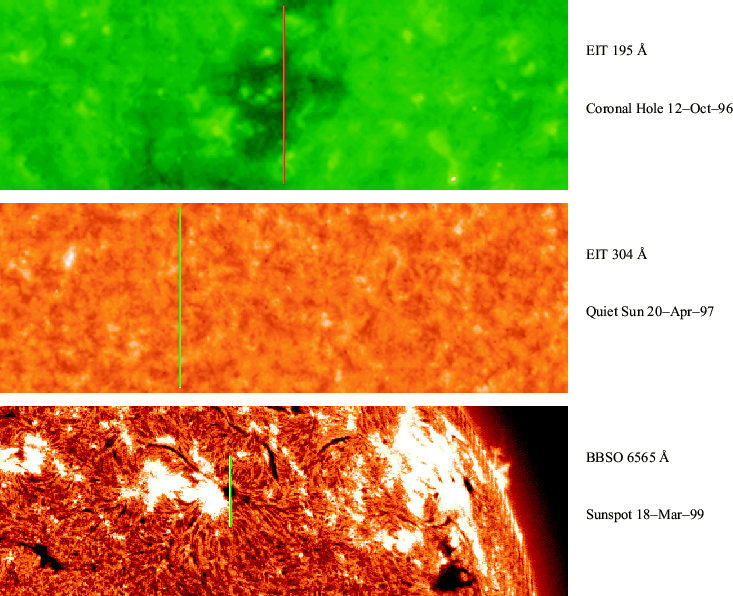
We have selected the sunspot spectrum obtained on March 18, 1999 for our atlas, because this spot was one of the largest observed by SUMER so far and also because the slit seems to have been placed right through the central umbral part. However, we lost a small portion of this spectrum (2 Å) during a telemetry gap. A spectroscopic analysis of this spectrum has been published in more detail by Curdt et al. (2000a). Context images showing the position of the slit during data acquisition are presented in Fig. 2. All observational parameters are summarized in Table 1.
| target | detector | date | t0 | d | x | y | T |
 | slit | rotcomp |
| UT | h |
|
| s | pixel | # | ||||
| coronal hole | B | October 12, 1996 | 20:45 | 5:15 | -66 | -26 | 300 | 171 | 2 | on |
| quiet Sun | B | April 20, 1997 | 00:03 | 5:09 | 0 | 0 | 300 | 300 | 2 | on |
| sunspot | B | March 18, 1999 | 17:36 | 2:51 | 468 | 360 | 90 | 17 | 7 | on |
| quiet Sun | A | August 12, 1996 | 01:13 | 2:07 | 0 | 0 | 113 | 115 | 4 | on |
Copyright ESO 2001
![\begin{figure*}
\centering
\includegraphics[width=15.4cm]{f1_10571.eps}\end{figure*}](/articles/aa/full/2001/32/aa10571/img21.gif)