- ...

![[*]](/icons/foot_motif.gif)
- Based
on public
data released from the UVES commissioning at the VLT/Kueyen
telescope, ESO, Paranal, Chile.
.
.
.
.
.
.
.
.
.
.
.
.
.
.
.
.
.
.
.
.
.
.
.
.
.
.
.
.
.
.
- ...
- Tables A.1,
A.2 and A.3
are only available in electronic form at the CDS via anonymous ftp
to cdsarc.u-strasbg.fr (130.79.128.5) or via
http://cdsweb.u-strasbg.fr/cgi-bin/qcat?J/A+A/373/757
.
.
.
.
.
.
.
.
.
.
.
.
.
.
.
.
.
.
.
.
.
.
.
.
.
.
.
.
.
.
- ...

- Recent measurements from high-z supernovae
favor the non-zero cosmological constant (Perlmutter et al.
1999). When we use the mass density
 and the cosmological constant energy density
 for the flat universe as the results from the supernova
study favor (Perlmutter et al. 1999), the line number density
for the non-evolving
forest can still be approximated by a single power-law dn/d
for the flat universe as the results from the supernova
study favor (Perlmutter et al. 1999), the line number density
for the non-evolving
forest can still be approximated by a single power-law dn/d
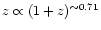 at
0 < z < 4.5with a slight steepening at z < 1: At z > 1, dn/d
at
0 < z < 4.5with a slight steepening at z < 1: At z > 1, dn/d
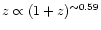 ,
while z < 1, dn/d
,
while z < 1, dn/d
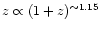 .
.
.
.
.
.
.
.
.
.
.
.
.
.
.
.
.
.
.
.
.
.
.
.
.
.
.
.
.
.
.
.
- ...1999)
- It should be noted that Davé
et al. (1999) assume the QSO-dominated Haardt-Madau UV
background without He II reionization. No other
scaling laws between
 and
and  as a function of z from simulations under
different UV backgrounds are found in the literature.
as a function of z from simulations under
different UV backgrounds are found in the literature.
.
.
.
.
.
.
.
.
.
.
.
.
.
.
.
.
.
.
.
.
.
.
.
.
.
.
.
.
.
.
- ...

-
Note that Ricotti et al. (2000)
found that
 corresponds to
 at z = 2.85 with
He II reionization at ,
almost a factor of
10 smaller than the column density calculated by Eq. (7).
This discrepancy indicates the importance of using the correct ionizing
background in simulations to constrain the temperature
of the IGM.
at z = 2.85 with
He II reionization at ,
almost a factor of
10 smaller than the column density calculated by Eq. (7).
This discrepancy indicates the importance of using the correct ionizing
background in simulations to constrain the temperature
of the IGM.
.
.
.
.
.
.
.
.
.
.
.
.
.
.
.
.
.
.
.
.
.
.
.
.
.
.
.
.
.
.