


We show in Fig. 14 the effects of a stronger or weaker
irradiation on the outbursts. The strength of irradiation is set by
the value of
and we show models for
 .
As irradiation
grows stronger,
.
As irradiation
grows stronger,
 becomes lower (see Eq. (5))
and the first effect is to increase the length of the outburst: more
mass gets accreted before
is reached. Thus, the
relative amount of matter accreted during outburst,
becomes lower (see Eq. (5))
and the first effect is to increase the length of the outburst: more
mass gets accreted before
is reached. Thus, the
relative amount of matter accreted during outburst,
 ,
increases with .
The disc spends more time accreting in
quiescence before it can build up enough density somewhere to reach
,
increases with .
The disc spends more time accreting in
quiescence before it can build up enough density somewhere to reach
 .
.
Like
,
also decreases with
increasing irradiation (see Eq. (3)). Therefore, one would also
expect
to be reached more easily, hence to have
shorter quiescent times. Usually the irradiation flux is low at the
end of quiescence so only large values of
can heat the disc
enough to change
(see Fig. 15).
There are two competing effects: (i) the increased amount of matter
accreted during an outburst lengthens the quiescence time; (ii)
unusually strong irradiation in quiescence lowers the critical
density needed to reach an outburst, which reduces the quiescence
time. This happens when
is large, in which case irradiation
is no longer negligible in quiescence (in contrast to the models of
Sects. 4-5). The numerical models show that there is a
 for which the recurrence time is greatest,
 ,
i.e. the "standard'' value for which persistent
low-mass X-ray binaries are stabilized (Dubus et al. 1999). This is probably no more than a coincidence as
certainly changes as a function of M1,
,
i.e. the "standard'' value for which persistent
low-mass X-ray binaries are stabilized (Dubus et al. 1999). This is probably no more than a coincidence as
certainly changes as a function of M1,
 ,
etc.
,
etc.
The average mass in the disc < > decreases with stronger
irradiation.
> decreases with stronger
irradiation.
 > depends mostly on the mass of the disc
in quiescence. Since
> depends mostly on the mass of the disc
in quiescence. Since
 in quiescence and
decreases with irradiation, <>decreases as well. Another consequence of stronger irradiation are
the higher optical fluxes in outburst due to the higher outer disc
temperatures.
in quiescence and
decreases with irradiation, <>decreases as well. Another consequence of stronger irradiation are
the higher optical fluxes in outburst due to the higher outer disc
temperatures.
 and
and
 is
straightforward. The
parameter sets the viscous time of the
accretion flow (Eq. (16)). A disc with a low viscosity in
quiescence diffuses mass slowly to the inner edge. Therefore, the time
to reach
is longer when
is lower
(see top panel of Fig. 16). This also modifies the peak
accretion rate of the outburst. Similarly, a disc with a higher
viscosity in outburst accretes mass more quickly and the decay time is
shorter (Eqs. (10)-(11)). The conditions for the
disc to enter quiescence and the subsequent evolution are independent
of
.
Therefore, the models shown in the top panel
of Fig. 16 which have different
but the same
have the same recurrence time.
is
straightforward. The
parameter sets the viscous time of the
accretion flow (Eq. (16)). A disc with a low viscosity in
quiescence diffuses mass slowly to the inner edge. Therefore, the time
to reach
is longer when
is lower
(see top panel of Fig. 16). This also modifies the peak
accretion rate of the outburst. Similarly, a disc with a higher
viscosity in outburst accretes mass more quickly and the decay time is
shorter (Eqs. (10)-(11)). The conditions for the
disc to enter quiescence and the subsequent evolution are independent
of
.
Therefore, the models shown in the top panel
of Fig. 16 which have different
but the same
have the same recurrence time.
![\begin{figure}
\par\includegraphics[width=8.1cm,clip]{lightc.eps}\end{figure}](/articles/aa/full/2001/25/aa10456/img240.gif) |
Figure 14:
Effect of changing the irradiation parameter
on the
outburst time evolution and cycle (see Sect. 6.1 for
details).
 (full line), 1 (dash-dotted), 5
(dashed), 100 (dotted). All other parameters are identical to those of
the model described in Sect. 4. The non-irradiated curve shows no reflares
in this particular case. This is in general not the case, even with
evaporation: the same model with M1=6
(full line), 1 (dash-dotted), 5
(dashed), 100 (dotted). All other parameters are identical to those of
the model described in Sect. 4. The non-irradiated curve shows no reflares
in this particular case. This is in general not the case, even with
evaporation: the same model with M1=6  shows them.
 |
![\begin{figure}
\par\includegraphics[width=6.5cm,clip]{irrch.eps}\end{figure}](/articles/aa/full/2001/25/aa10456/img241.gif) |
Figure 15:
Density profiles  in quiescent evaporated discs
before the onset of an outburst. The dotted line is
.
For
in quiescent evaporated discs
before the onset of an outburst. The dotted line is
.
For
 irradiation is negligible in
quiescence and the critical
is the same as for a
non-irradiated disc. For larger values of
irradiation becomes
important, lowering
.
The critical density the disc
must reach before an outburst is significantly less and the recurrence
time between outbursts is decreased. See Sect. 6.1 for details.
irradiation is negligible in
quiescence and the critical
is the same as for a
non-irradiated disc. For larger values of
irradiation becomes
important, lowering
.
The critical density the disc
must reach before an outburst is significantly less and the recurrence
time between outbursts is decreased. See Sect. 6.1 for details. |
![\begin{figure}
\par\includegraphics[width=8.3cm,clip]{lighta.eps}\end{figure}](/articles/aa/full/2001/25/aa10456/img242.gif) |
Figure 16:
Effect of changing the viscosity parameters on the outburst
time profiles. Bottom: changing
modifies the
recurrence time (full line
 ,
dashed line ,
dashed line
 ,
both with ,
both with
 ). Top: changing
modifies the outburst time evolution (full
line ). Top: changing
modifies the outburst time evolution (full
line
 ,
dashed line ,
dashed line
 ,
both with
.
The recurrence time is the same ,
both with
.
The recurrence time is the same
 years). See Sect. 6.2 for details. years). See Sect. 6.2 for details. |
Next, we explore the effect of changing the mass transfer rate
 ,
keeping all other parameters identical. For
inside-out outbursts, the time spent in quiescence with fixed
,
keeping all other parameters identical. For
inside-out outbursts, the time spent in quiescence with fixed
 is the diffusion time of matter from the outer to the inner edge,
which does not depend on
.
However, models including
evaporation show a dependence on
when
is the diffusion time of matter from the outer to the inner edge,
which does not depend on
.
However, models including
evaporation show a dependence on
when
 in quiescence is not negligible compared to
(Eq. (17)). Figure 17 shows the quiescence time
shortens with increasing
.
in quiescence is not negligible compared to
(Eq. (17)). Figure 17 shows the quiescence time
shortens with increasing
.
Higher
result in longer outbursts since (i) the
companion provides more material during the outburst and (ii) the
total disc mass at the onset of the outburst increases with
.
The conditions in the disc are
the same at the end of the outburst, regardless of the mass transfer
rate (except, of course, at the outer edge) because cooling happens in
the same way for discs of the same size. A ring at a given radius can
only cool when
 reaches 104 K and the surface density
behind the front is roughly the same in all cases. Thus, even with
different
,
the discs have almost the same total
mass as they enter quiescence (Fig. 17).
reaches 104 K and the surface density
behind the front is roughly the same in all cases. Thus, even with
different
,
the discs have almost the same total
mass as they enter quiescence (Fig. 17).
In a truncated disc the drift of material in quiescence will
change with
because the distance it has to
travel is rather short. Therefore, the conditions at the beginning of
the outburst depend on the mass-transfer rate. In particular, the
ignition radius increases with
as could be expected:
a larger amount of mass from the outer edge diffuses down the disc and
can trigger the outburst at a larger radius (but as mentioned earlier
outbursts starting at the outer disc edge do not occur). This also
increases the total amount of mass in the disc at the onset of the
outburst and hence the peak accretion rate (see Sect. 4.1).
For the high mass transfer rates the disc stays fully ionized for a
significant fraction of the outburst, leading to a viscous decay. Our
model with the highest
show this is accompanied by
significant variations of the outer radius which produce deviations
from the expected exponential (lower panel of Fig. 17).
![\begin{figure}
\par\includegraphics[width=8.1cm,clip]{varmd.eps}\end{figure}](/articles/aa/full/2001/25/aa10456/img245.gif) |
Figure 17:
Effect of changing
on the outburst
cycles. Top two panels:
and
 for
for
 ,
0.5 (full
line), 5 (dashed line) and 50 (dotted line). The bottom panels zoom on
the outburst for the same models, showing
(full
line) and ,
0.5 (full
line), 5 (dashed line) and 50 (dotted line). The bottom panels zoom on
the outburst for the same models, showing
(full
line) and
 (dotted line),
,
and the transition radius between the hot and cold regions
(dashed line). The other parameters of the models are M1=7 ,
(dotted line),
,
and the transition radius between the hot and cold regions
(dashed line). The other parameters of the models are M1=7 ,
 cm,
,
and
.
See
Sect. 6.3 for details. cm,
,
and
.
See
Sect. 6.3 for details. |
The disc size in the model depends on the strength of the tidal
truncation term in the angular momentum conservation equation and on
the circularization radius. The ratios
 and
and
 depend only on the mass ratio q=M2/M1. Assuming
 ,
which is reasonable for black hole SXTs, we derive
,
which is reasonable for black hole SXTs, we derive
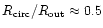 (Papaloizou & Pringle
1977). In the following, we changed the mean outer disc
radius, keeping the above ratio constant. This is equivalent to
simulating binaries with the same components but increasing orbital
period
(Papaloizou & Pringle
1977). In the following, we changed the mean outer disc
radius, keeping the above ratio constant. This is equivalent to
simulating binaries with the same components but increasing orbital
period
 hours (q=0.1).
![\begin{figure}
\par\includegraphics[width=8.2cm,clip]{varrd.eps}\end{figure}](/articles/aa/full/2001/25/aa10456/img254.gif) |
Figure 18:
Effect of changing
on the outburst cycles. Top
two panels:
and
for <
>
 9.3 (dotted line), 25.7 (dashed line), 107
(full line). The bottom panels zoom on the outburst for the same
models, showing
(full line) and
(dotted line),
,
and the transition radius
between the hot and cold regions (dashed line). The other parameters of
the models are M1=7 ,
9.3 (dotted line), 25.7 (dashed line), 107
(full line). The bottom panels zoom on the outburst for the same
models, showing
(full line) and
(dotted line),
,
and the transition radius
between the hot and cold regions (dashed line). The other parameters of
the models are M1=7 ,
 g g s-1,
,
and
.
See Sect. 6.4 for details. s-1,
,
and
.
See Sect. 6.4 for details. |
Increasing the disc size makes it more difficult for the heat front to reach the outer disc radius and fully ionize the disc. In small discs the decay is entirely viscous while larger discs show only irradiation-controlled linear decays (Fig. 18). In the case of a viscous exponential decay the decay rate increases with smaller disc radius in accordance with Eqs. (10)-(11).
The ignition radius of the outburst increases for smaller disc sizes since the diffusion timescale is shorter. Smaller discs are also less massive and, therefore, take less time to replenish than large discs for the same mass transfer rate: the time spent in quiescence is shorter. This also leads to smaller outburst peaks (Sect. 4.1).
Finally, we vary the mass of the accreting object M1. Irradiation
is implicitely assumed to be the same since the prescription for
(Eq. (8)) does not depend on M1.
and
have some dependence on M1(Eqs. (3) and (5)) but their influence on the outburst
is negligible compared to the changes induced by evaporation. The
strength of evaporation depends strongly on M1 through
 and
and  in Eq. (14):
 (this cannot be seen in Menou et al. 2000 where by
error the evaporation formula for neutron-star SXT outbursts uses
(this cannot be seen in Menou et al. 2000 where by
error the evaporation formula for neutron-star SXT outbursts uses
 ). In outburst, this modifies the accretion rate
at which evaporation sets in which in turn reduces the length of the
outburst for lower M1 (see also Meyer & Meyer-Hofmeister 2000
who studied extensively the M1 dependence of the instability cycle
with evaporation, but without irradiation, and reached conclusions
similar to those of Menou et al. 1999).
). In outburst, this modifies the accretion rate
at which evaporation sets in which in turn reduces the length of the
outburst for lower M1 (see also Meyer & Meyer-Hofmeister 2000
who studied extensively the M1 dependence of the instability cycle
with evaporation, but without irradiation, and reached conclusions
similar to those of Menou et al. 1999).
In quiescence, the disc around a lower mass compact object
is truncated at smaller radii which reduces the
inner accretion rate
.
Mass is accumulated more
easily (Eq. (17)), leading to shorter recurrence time
(Fig. 19). The lower accretion rates in the evaporated disc
in quiescence do not necessarily translate into lower quiescent
luminosities. In our assumptions, the increase in accretion efficiency
implied by a lower
(
 )
compensates for the lower
.
Plotting
)
compensates for the lower
.
Plotting
 instead of only
as
in Fig. 19, we find
instead of only
as
in Fig. 19, we find
 gs-1 for both M1=1.4
and 7 .
The
actual efficiency of a
gs-1 for both M1=1.4
and 7 .
The
actual efficiency of a
 neutron star may be much higher
in quiescence than what we assume here. It might actually be more
correct to assume
neutron star may be much higher
in quiescence than what we assume here. It might actually be more
correct to assume  is always 0.1 for the neutron star since
the accreted matter will radiate at the surface. In this case, the
luminosity in quiescence deduced from
will be
higher than for a black hole primary. However, a propeller effect might
significantly reduce the actual mass accretion rate onto a neutron star in
quiescence (Menou et al. 1999c) making the distinction between black holes
and neutron stars less obvious.
is always 0.1 for the neutron star since
the accreted matter will radiate at the surface. In this case, the
luminosity in quiescence deduced from
will be
higher than for a black hole primary. However, a propeller effect might
significantly reduce the actual mass accretion rate onto a neutron star in
quiescence (Menou et al. 1999c) making the distinction between black holes
and neutron stars less obvious.
![\begin{figure}
\par\includegraphics[width=8cm,clip]{varm1.eps}\end{figure}](/articles/aa/full/2001/25/aa10456/img261.gif) |
Figure 19:
Effect of changing M1 on the outburst cycles of the
inner mass accretion rate
.
The model of Sect. 5 is
shown by the full line (M1=7 ). The same model but with
M1=1.4
is shown by the dotted line. See Sect. 6.5 for
details. |
Copyright ESO 2001