

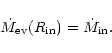
Following the work of Menou et al. (2000), we now assume that the inner disc is gradually evaporated into a hot, radiatively inefficient accretion flow during the decay from outburst. The exact nature of the flow is not important as long as it does not participate in the dynamics of the thin accretion disc. A good assumption is that the inner disc is replaced by an advection-dominated accretion flow (ADAF). ADAF+thin disc models have been successful in explaining the spectral states of SXTs and in particular, the quiescent X-ray flux provided the mass accretion rate in the ADAF is large enough (e.g. Esin et al. 1997).
The accretion timescale in an ADAF becomes of the order of the thermal
timescale so that the inner flow can be considered as quasi-steady and
does not participate in the limit cycle. A good assumption in our
dynamical study is therefore to treat evaporation as a variation of
the inner radius of the thin disc we model. We take the same rate of
evaporation as in Menou et al. (2000):
 |
(15) |
 on R, we can safely neglect
evaporation above this radius. As noted in Menou et
al. (2000), the detailed functional dependence of
on R, we can safely neglect
evaporation above this radius. As noted in Menou et
al. (2000), the detailed functional dependence of
 ,
or of
,
or of
 has essentially no
effect on the results; what matters is the value of the inner disc
radius during quiescence.
has essentially no
effect on the results; what matters is the value of the inner disc
radius during quiescence.
Equation (14) is entirely ad hoc, and is not based on
any particular physical mechanism. There are models that, in
principle, allow for the determination of the evaporation rate
as a function of radius. However, the variety of models shows that
there is no general agreement on the physical cause of
evaporation. For example, Meyer & Meyer-Hofmeister (1994) assume that
electron conduction from the disc to the corona plays a major role,
whereas Shaviv et al. (1999) consider a thermal
instability related to the opacity law. In addition, even for a given
model, the evaporation law depends on parameters which are not easily
measured (as for example the magnetic field and its coherence in the
case of electron conduction; Meyer et al. 2000). As
all these models have been proposed to explain the existence of holes
in observed accretion discs, they, by definition, tend to produce
similar results, i.e. the truncation radius must be at a detectable
distance from the compact objet. And of course, for the same
reason, Eq. (14) would also reproduce these results. The
latest calculations by Meyer et al. (2000) give evaporation rates of
the order of
 g s-1 at 1010 cm from a
  black hole, and
 g s-1 at 109cm. These are larger by a factor
  15 and 2 respectively
than the values we are using here. Note that the
evaporation rate is so high in Meyer et al. (2000) that the
quiescent disc would be truncated at too large a radius to be
unstable.
15 and 2 respectively
than the values we are using here. Note that the
evaporation rate is so high in Meyer et al. (2000) that the
quiescent disc would be truncated at too large a radius to be
unstable.
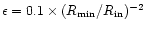
The ADAF efficiency roughly scales as  (i.e. the luminosity
scales as
(i.e. the luminosity
scales as  ,
Esin et al. 1997) . From
Eq. (14), this is equivalent to
,
Esin et al. 1997) . From
Eq. (14), this is equivalent to
 .
In the model, we assume
.
In the model, we assume
 when
when
 (in outburst) and
 when
when
 (in
quiescence). Irradiation is usually negligible in quiescence so these
assumptions have little importance there. Varying
(in
quiescence). Irradiation is usually negligible in quiescence so these
assumptions have little importance there. Varying  may
change slightly the end of the outburst when evaporation becomes
important.
may
change slightly the end of the outburst when evaporation becomes
important.
We took
 cm in all the following models. As
discussed below in Sect. 5.1, the only time
cm in all the following models. As
discussed below in Sect. 5.1, the only time
 is
reached is in outburst where the inner disc is in thermal equilibrium
and close to steady-state. The inner disc edge plays no role in this
case.
is
reached is in outburst where the inner disc is in thermal equilibrium
and close to steady-state. The inner disc edge plays no role in this
case.
In the following we discuss in some detail the same model as in Sect. 4
but including evaporation. The overall outburst time profile is shown in
Fig. 10. A comparison with Fig. 3 shows the
outburst is almost identical but that the disc spends much more time
in quiescence (
 years). The maximum luminosity
reached during outburst is also increased.
years). The maximum luminosity
reached during outburst is also increased.
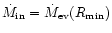
After an outburst is triggered, the mass accretion rate at the inner
edge gradually increases as in the previous model. The inner radius
of the thin disc decreases until its minimum value is reached for
 .
A slight change of
slope is associated with this (at the 4th dot in
Fig. 11). The time
.
A slight change of
slope is associated with this (at the 4th dot in
Fig. 11). The time
 the disc needs to
reach
is a viscous timescale. Before the onset of the
outburst,
the disc needs to
reach
is a viscous timescale. Before the onset of the
outburst,
 cm. Therefore,
is of the order of the difference between
cm. Therefore,
is of the order of the difference between
 at
at
 cm and
 cm. The viscous timescale is given by
 K,
K,
 ,
,
 ,
M1=7
,
M1=7  )
the difference gives about 6 days which is in good agreement with the numerical calculation.
Figure 11 shows the minimum radius is reached at
)
the difference gives about 6 days which is in good agreement with the numerical calculation.
Figure 11 shows the minimum radius is reached at
 days, about 3 days after the onset of the outburst.
The subsequent evolution is identical to the model where the inner radius is kept fixed. The peak accretion rate and optical flux are higher in the model with evaporation because of the different quiescent histories of the discs. When the outburst starts, the discs do not have the same density distribution and total mass (Figs. 3, 10).
The decay from outburst is also identical to the previous model with a
viscous and a linear decay (Fig. 12). The linear
decay has a limited influence on the lightcurve since the cooling
front only propagates to
 cm before evaporation sets in
(
cm before evaporation sets in
(
 days in Fig. 12). Irradiation then
shuts off with the decreasing
and the front cools the whole
disc quickly. At the same time, the inner disc radius rises with the
increasing evaporation which also quickens the cooling. In general,
evaporation and/or changes in the irradiation efficiency take place for
days in Fig. 12). Irradiation then
shuts off with the decreasing
and the front cools the whole
disc quickly. At the same time, the inner disc radius rises with the
increasing evaporation which also quickens the cooling. In general,
evaporation and/or changes in the irradiation efficiency take place for
 at which point
the total disc mass is close to its minimum value (the disc starts
filling in again) and there is little matter left to accrete.
Therefore, the exact prescriptions for
at which point
the total disc mass is close to its minimum value (the disc starts
filling in again) and there is little matter left to accrete.
Therefore, the exact prescriptions for
 and
do not have a significant impact on the outburst
lightcurve. For instance, these produce a difference of only a few
days in the outburst lengths between the model of Sect. 4 and the model of
this section.
and
do not have a significant impact on the outburst
lightcurve. For instance, these produce a difference of only a few
days in the outburst lengths between the model of Sect. 4 and the model of
this section.
![\begin{figure}
\par\includegraphics[width=8.1cm,clip]{tidim.eps}\end{figure}](/articles/aa/full/2001/25/aa10456/img218.gif) |
Figure 10:
Example of an outburst cycle when irradiation and evaporation
are included. The parameters of the model are the same as in
Fig. 3. From top to bottom:
 (full
line) and
(full
line) and
 (dotted line); V magnitude;
 (full line),
 (dotted line) and
 (dashed line), (dashed line),
 .
Details of the outburst and the
evolution of the density and temperature profiles can be seen in
Figs. 11-13. .
Details of the outburst and the
evolution of the density and temperature profiles can be seen in
Figs. 11-13. |
The whole disc becomes cold and enters quiescence when the cooling
front reaches the varying inner radius
.
In
Fig. 12 this happens at
 days when
 cm and
 g
g s-1. The drift time of cold matter is long
and the disc cannot maintain this high accretion rate:
decreases as material is gradually accreted. This adjustment
happens on a long timescale (cold material) which depends on the
s-1. The drift time of cold matter is long
and the disc cannot maintain this high accretion rate:
decreases as material is gradually accreted. This adjustment
happens on a long timescale (cold material) which depends on the
 profile left after the outburst. With a fixed
,
is already very low (about
1012 gs-1, Fig. 7) when the whole
disc becomes cold. This is actually a necessary condition for the disc
at low radii to reach the cold branch. For such low accretion rates, the
supply of material is enough for
to increase steadily
throughout quiescence.
profile left after the outburst. With a fixed
,
is already very low (about
1012 gs-1, Fig. 7) when the whole
disc becomes cold. This is actually a necessary condition for the disc
at low radii to reach the cold branch. For such low accretion rates, the
supply of material is enough for
to increase steadily
throughout quiescence.
This first stage lasts until material from the outer edge had enough
time to drift to the inner edge and increase
.
In
Fig. 13 this happens at
 days. The
first three
radial profiles of Fig. 13 clearly show mass from the outer edge diffusing inwards and reaching the
inner edge at
days. The
first three
radial profiles of Fig. 13 clearly show mass from the outer edge diffusing inwards and reaching the
inner edge at
 days. The disc then steadily builds up
mass until the combination of a decreasing
(hence
days. The disc then steadily builds up
mass until the combination of a decreasing
(hence
 )
and increasing
triggers an outburst
(see also Cannizzo 1998b, Meyer & Meyer-Hofmeister
1999).
)
and increasing
triggers an outburst
(see also Cannizzo 1998b, Meyer & Meyer-Hofmeister
1999).
Under most circumstances (Sect. 4.6) the outburst will be of the inside-out type. The reason is that, because of the very large disc sizes of SXTs, the time it takes for matter to diffuse down the disc is shorter than the accumulation time at the outer disc. A truncated disc does not change this conclusion: evaporation does not prevent inside-out type B outbursts.
However, evaporation does suppress the small mini-outbursts which are
found when the inner disc radius is small (see e.g. Hameury et al. 1998). With
fixed at 109 cm,
is small, of the order of 10 gcm-2, and an outburst can be
triggered easily as soon as matter diffuses in to the inner
radii. This leads to sequences of mini-outbursts which are not
observed. A truncated disc will need to build up more mass before an
outburst can start. The critical density
varies
with R and will be much higher when
is large, of the
order of a 100 gcm-2 at 1010 cm. This prevents small
outbursts from being triggered.
A truncated disc at the onset of an outburst will be more massive than
a non-truncated disc (compare Figs. 3 and
10). But since the disc in outburst cools under the same
conditions (dictated by
 ), the mass of the disc at the
end of the outburst will be roughly the same in both cases. If
), the mass of the disc at the
end of the outburst will be roughly the same in both cases. If  is the mass accreted during the outburst then we have
 .
.
The quiescence time is the time it takes to replenish the mass lost
during the outburst:
and leads to longer
 .
In contrast
to models in which the disc extends to low radii, truncated
discs can have larger
in quiescence implying longer
.
Equation (17) also shows that the
quiescence time depends on the mass transfer rate even for inside-out
outbursts when
in quiescence is a significant
fraction of
.
In contrast
to models in which the disc extends to low radii, truncated
discs can have larger
in quiescence implying longer
.
Equation (17) also shows that the
quiescence time depends on the mass transfer rate even for inside-out
outbursts when
in quiescence is a significant
fraction of
 .
In a disc with low quiescent
,
for inside-out outbursts is of
the order of
.
In a disc with low quiescent
,
for inside-out outbursts is of
the order of
 which is independent of
(Osaki 1996; Smak 1993).
which is independent of
(Osaki 1996; Smak 1993).
![\begin{figure}
\par\includegraphics[width=11.2cm,clip]{rad126b.eps}\hfill
\parbox[b]{55mm}{}
\end{figure}](/articles/aa/full/2001/25/aa10456/img229.gif) |
Figure 11:
The outburst rise for the model of
Sect. 5 which includes irradiation and evaporation (see
Sect. 5.1). Upper left panel shows
and
(dotted line); bottom left panel shows
the V magnitude. Right panels show radial profiles at
the different times indicated by the black dots on the
curves. Evaporation decreases during the first part of
the rise with the thin disc extending to smaller radii. At
days the thin disc reaches the minimum
possible inner radius of the model. The disc then behaves in
exactly the same way as in Fig. 5. |
![\begin{figure}
\par\includegraphics[width=11.2cm,clip]{rad126a.eps}\hfill
\parbox[b]{55mm}{}
\end{figure}](/articles/aa/full/2001/25/aa10456/img231.gif) |
Figure 12:
The outburst decay for the model
discussed in Sect. 5.1. The disc behaves in the same
way as in Fig. 6 until evaporation sets in
at
 days ( days (
 ). This cuts off irradiation and the disc
cools quickly. In contrast to Fig. 6, the
irradiation cutoff happens before the cooling front could
propagate through most of the disc, hence the
irradiation-controlled linear decay ( ). This cuts off irradiation and the disc
cools quickly. In contrast to Fig. 6, the
irradiation cutoff happens before the cooling front could
propagate through most of the disc, hence the
irradiation-controlled linear decay (
 days)
is less obvious in the time profile.
(dotted
line) is shown for the last temperature profile. days)
is less obvious in the time profile.
(dotted
line) is shown for the last temperature profile. |
![\begin{figure}
\par\includegraphics[width=11.2cm,clip]{rad126c.eps}\hfill
\parbox[b]{55mm}{}
\end{figure}](/articles/aa/full/2001/25/aa10456/img232.gif) |
Figure 13:
Quiescence for the model discussed
in Sect. 5.2. The irradiation flux is negligible in
quiescence. Overall, the evolution is the same as in the
standard DIM. Mass transfer from the secondary is slow enough
that matterdiffuses down the disc, gradually increasing
(and lowering
). The outburst
is triggered at
 cm when
reaches
(dotted line). Lower densities at the
beginning of the quiescent state (due to the
irradiation-controlled outburst decay) lead to a long
recurrence time (about 35 years). cm when
reaches
(dotted line). Lower densities at the
beginning of the quiescent state (due to the
irradiation-controlled outburst decay) lead to a long
recurrence time (about 35 years). |
Copyright ESO 2001
![\begin{displaymath}\dot M_{\rm ev}(R)=0.08 \dot M_{\rm Edd} \left[ \left( \frac{...
...l E}\left( \frac{R}{800 R_{\rm s}} \right)^2 \right]^{-1}\cdot
\end{displaymath}](/articles/aa/full/2001/25/aa10456/img189.gif)

