


Within the  0.7 square degree imaged by ISOCAM,
a total of 425 sources has been identified, among which 211 are seen at both
6.7
0.7 square degree imaged by ISOCAM,
a total of 425 sources has been identified, among which 211 are seen at both
6.7  m and 14.3 m. The spatial distribution of the
sources is shown in Fig. 1,
where the "red'' sources
[those with log10(
m and 14.3 m. The spatial distribution of the
sources is shown in Fig. 1,
where the "red'' sources
[those with log10(
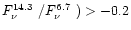 ,
see below]
are indicated as filled circles.
These "red'' sources appear to be clustered into four main groupings: three
sub-clusters in L1688, i.e., Oph A (West), Oph B (North-East),
Oph EF (South) (see also Strom et al. 1995),
as well as a new sub-cluster in L1689S.
,
see below]
are indicated as filled circles.
These "red'' sources appear to be clustered into four main groupings: three
sub-clusters in L1688, i.e., Oph A (West), Oph B (North-East),
Oph EF (South) (see also Strom et al. 1995),
as well as a new sub-cluster in L1689S.
Four bright embedded stars (S1, SR3, WL16, WL22) are spatially resolved by
ISOCAM in both filters.
Their extended mid-IR emission is most likely due to
PAH-like molecules excited by relatively strong far-ultraviolet (FUV)
radiation fields![[*]](/icons/foot_motif.gif) .
These bright sources are displayed as open star symbols in Fig. 1
(SR3, S1, WL22, WL16 from right to left).
.
These bright sources are displayed as open star symbols in Fig. 1
(SR3, S1, WL22, WL16 from right to left).
![\begin{figure}
\par\includegraphics[width=13.5cm,clip]{ms9901f3.eps}
\end{figure}](/articles/aa/full/2001/22/aa9901/img71.gif) |
Figure 3:
a) Logarithmic ratio of the ISOCAM fluxes, log10(
 / /
 ),
versus
displayed for the 207 ISOCAM sources seen
in both filters (excluding the 4 early-type young stars).
The purely ISOCAM color
/
is converted into an IR spectral index, ),
versus
displayed for the 207 ISOCAM sources seen
in both filters (excluding the 4 early-type young stars).
The purely ISOCAM color
/
is converted into an IR spectral index,
 ,
on the right axis, and can be used to identify
sources with mid-IR excesses (above the dashed line).
The completeness limit derived in Sect. 2.4 is displayed as a dotted
line. b) Mid-IR color-color diagram expressed as a
spectral index diagram ,
on the right axis, and can be used to identify
sources with mid-IR excesses (above the dashed line).
The completeness limit derived in Sect. 2.4 is displayed as a dotted
line. b) Mid-IR color-color diagram expressed as a
spectral index diagram
 versus
 for
175 ISOCAM sources also detected in the K band (m6.7 and m14.3on the right and upper axes are calculated as in Persi et al. 2000).
The inclined heavy dashed line marks the
limit to the right of which there is significant
mid-IR excess as in a). The two vertical dashed lines mark
the formal boundary between Class II, flat-spectrum, and Class I
sources (see text for details).
c) Classical near-IR color-color diagram, J-H versus H-K,
for the 152 ISOCAM sources with JHK photometry.
for
175 ISOCAM sources also detected in the K band (m6.7 and m14.3on the right and upper axes are calculated as in Persi et al. 2000).
The inclined heavy dashed line marks the
limit to the right of which there is significant
mid-IR excess as in a). The two vertical dashed lines mark
the formal boundary between Class II, flat-spectrum, and Class I
sources (see text for details).
c) Classical near-IR color-color diagram, J-H versus H-K,
for the 152 ISOCAM sources with JHK photometry. |
A total of 89 previously classified YSOs lie within the area of the
present survey:
2 Class 0, 69 Class I/II, and 18 Class III YSOs.
ISOCAM detected 84 of these 89 YSOs (94%):
97% of the Class I/IIs, 94% of the Class IIIs,
and none of the Class 0s.
The two undetected Class I/IIs (GY256, GY257), and the undetected
Class III (IRS50), are located very close (10
 -15
)
to bright sources (WL6 and IRS48, respectively), which
may account for their non-detection.
The two Class 0 objects (VLA 1623 and IRAS 16293-2422) are
deeply embedded within massive, cold circumstellar envelopes
which are probably opaque at
6.7 m and 14.3 m (see André et al. 1993)
and too weak to be detected by ISOCAM.
-15
)
to bright sources (WL6 and IRS48, respectively), which
may account for their non-detection.
The two Class 0 objects (VLA 1623 and IRAS 16293-2422) are
deeply embedded within massive, cold circumstellar envelopes
which are probably opaque at
6.7 m and 14.3 m (see André et al. 1993)
and too weak to be detected by ISOCAM.
As can be seen in Fig. 3, the mid-IR regime is ideal to detect and
characterize the excess emission due to circumstellar
disks around young stars.
In Fig. 3a,
the 207 sources detected at
6.7 m and 14.3 m (excluding S1, SR3, WL16, WL22) are shown
in a diagram
which displays the logarithmic flux ratio log10(
 )
against the mid-IR flux
.
On the right axis of the diagram,
the flux ratio
has been
converted into a classical IR spectral index,
)
against the mid-IR flux
.
On the right axis of the diagram,
the flux ratio
has been
converted into a classical IR spectral index,
 d
d
 d
d
 (e.g. WLY89),
calculated between 6.7 m and 14.3 m, i.e.,
.
In this diagram, two groups of sources can clearly be distinguished.
The lower ratio group has log10(
(e.g. WLY89),
calculated between 6.7 m and 14.3 m, i.e.,
.
In this diagram, two groups of sources can clearly be distinguished.
The lower ratio group has log10(
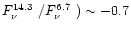 ,
i.e.,
a spectral index on the order of
,
i.e.,
a spectral index on the order of
 ,
which is the
value expected for simple photospheric blackbody emission in
the Rayleigh-Jeans regime.
The dispersion around
is obviously larger for
weaker sources. This is mainly due to increasing photometric uncertainty
with decreasing flux.
The higher ratio group consists of "red'' sources
defined by log10(
) > -0.2 (cf. Nordh et al. 1996).
Most of these actually have
,
which is the
value expected for simple photospheric blackbody emission in
the Rayleigh-Jeans regime.
The dispersion around
is obviously larger for
weaker sources. This is mainly due to increasing photometric uncertainty
with decreasing flux.
The higher ratio group consists of "red'' sources
defined by log10(
) > -0.2 (cf. Nordh et al. 1996).
Most of these actually have  log10(
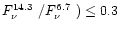 ,
i.e.,
,
i.e.,
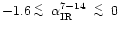 ,
which is typical of
classical T Tauri stars (hereafter CTTS). This range of
roughly delineates the domain of Class II YSOs
(e.g. Adams et al. 1987, AM94; Greene et al. 1994), and
is usually interpreted in terms of
optically thick circumstellar disk emission (e.g. Lada & Adams 1992).
In Fig. 3, the new ISOCAM sources are distinguished from
the previously known cluster members by different symbols.
One can see in Fig. 3a that all the previously known
Class II sources but one lie above the dividing line for red sources,
while all the previously known Class III sources but two lie below it.
,
which is typical of
classical T Tauri stars (hereafter CTTS). This range of
roughly delineates the domain of Class II YSOs
(e.g. Adams et al. 1987, AM94; Greene et al. 1994), and
is usually interpreted in terms of
optically thick circumstellar disk emission (e.g. Lada & Adams 1992).
In Fig. 3, the new ISOCAM sources are distinguished from
the previously known cluster members by different symbols.
One can see in Fig. 3a that all the previously known
Class II sources but one lie above the dividing line for red sources,
while all the previously known Class III sources but two lie below it.
| ISO | Identification |
|
 b b |
| #a | [ ] ] |
||
| 182 | IRS54/GY378 | 1.76 | 6.6 |
| 143 | IRS44/GY269 | 1.57 | 8.7 |
| 137 | CRBR85 | 1.48 | 0.36 |
| 99 | LFAM26/GY197 | 1.25 | 0.064 |
| 29 | GSS30/GY6 | 1.20 | 21. |
| 31 | LFAM1 | 1.08 | 0.13 |
| 65 | WL12/GY111 | 1.04 | 2.6 |
| 108 | EL29/GY214 | 0.98 | 26. |
| 141 | IRS43/GY265 | 0.98 | 6.7 |
| 145 | IRS46/GY274 | 0.94 | 0.62 |
| 21 | CRBR12 | 0.91 | 0.42 |
| 209 | IRS67/L1689-IRS6 | 0.74 | 1.5 |
| 54 | GY91/CRBR42 | 0.70 | 0.17 |
| 134 | WL6/GY254 | 0.59 | 1.7 |
| 159 | IRS48/GY304c | 0.18 | 7.4 |
| 167 | IRS51/GY315c | -0.04 | 1.1 |
| a
The ISO number refers to the numbering of Table 1 (available
only in electronic form at http://cdsweb.u-strasbg.fr/).
b
is estimated by integrating under the observed SED
from 1.2 m to 60m or 100m and extrapolating from
60m or 100m to 200m with a spectral index of m to 60m or 100m and extrapolating from
60m or 100m to 200m with a spectral index of
 .
For the 9 weak sources (ISO .
For the 9 weak sources (ISO # 137, 99, 31, 65, 146, 21, 209, 54 and 133) without
reliable IRAS fluxes,
is
estimated using a typical # 137, 99, 31, 65, 146, 21, 209, 54 and 133) without
reliable IRAS fluxes,
is
estimated using a typical
 m)
ratio of 9.8 (see Sect. 4.3). m)
ratio of 9.8 (see Sect. 4.3).
c Although ISO159  IRS48 and ISO167IRS51 formally lie
below our practical Class I-Class II limit ( IRS48 and ISO167IRS51 formally lie
below our practical Class I-Class II limit (
 ), they are
still considered as Class I YSOs here (cf. WLY89 and AM94). ), they are
still considered as Class I YSOs here (cf. WLY89 and AM94). |
The object WL19, classified as a Class I YSO by WLY89 and as a
reddened Class II by AM94 (see also Lada & Wilking 1984),
is here found to be a "blue'' source in the mid-IR range
(
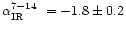 ). This object may
correspond to a luminous Class III star
located behind the cloud (see also Comerón et al. 1993).
Although GY12 formally has a "red'' mid-IR spectral
index (
). This object may
correspond to a luminous Class III star
located behind the cloud (see also Comerón et al. 1993).
Although GY12 formally has a "red'' mid-IR spectral
index (
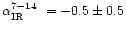 )
here,
we still consider it as a Class III object (cf. Greene et al. 1994).
(The mid-IR color is highly uncertain since GY12
is only marginaly resolved at 14.3 m
from its bright Class I neighbor GSS30.)
Finally the Class III source DoAr21 has a borderline mid-IR
spectral index (
)
here,
we still consider it as a Class III object (cf. Greene et al. 1994).
(The mid-IR color is highly uncertain since GY12
is only marginaly resolved at 14.3 m
from its bright Class I neighbor GSS30.)
Finally the Class III source DoAr21 has a borderline mid-IR
spectral index (
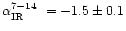 )
but is kept as a
Class III object since its color between 2.2 m and
14.3 m corresponds to
)
but is kept as a
Class III object since its color between 2.2 m and
14.3 m corresponds to
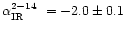 .
.
A total of 71 sources are identified for the first time as mid-IR excess
objects in Fig. 3a.
These new "red'' sources are most likely
all embedded YSOs, i.e., members of the
cluster.
Since dust extinction is roughly the same at
6.7 m and 14.3 m (Rieke & lebofsky 1985;
Lutz 1999), any background source should be
intrinsically red in order to contaminate the sample of red YSOs.
Based on the Galactic model by Wainscoat et al. (1992),
the vast majority
of background objects should appear "blue'' (cf. Fig. 2).
Seven background giant stars (GY45, GY65, VSSG6, GY232, GY351,
GY411, and GY453 - cf. Luhman & Rieke 1999),
and a known foreground dwarf (HD 148352 - Garrison 1967)
are detected, which all have
blue mid-IR colors (
 ,
and -3.1, respectively).
,
and -3.1, respectively).
| ISO | Identification |
|
MJ | MH |
 |
 |
 |
| #a | [mag] | [mag] | [mag] | [] |
[] |
||
| 170 | B162741-244645 | 0.51 | - | 6.1 | 24.9 | 0.018 | 0.047 |
| 103 | WL17/GY205 | 0.42 | 5.2 | - | 22.5 | 0.12 | 0.76 |
| 124 | IRS37/GY244 | 0.35 | - | 2.4 | 36.9 | 0.99 | 0.50 |
| 112 | GY224 | 0.34 | - | 2.4 | 36.2 | 1.1 | 0.56 |
| 118 | IRS33/GY236 | 0.32 | - | 3.6 | 38.3 | 0.28 | 0.15 |
| 33 | GY11 | 0.31 | 10.1 | - | 2.7 | 0.001 | 0.010 |
| 119 | IRS35/GY238 | 0.30 | - | 3.4 | 45.7 | 0.34 | 0.11 |
| 129 | WL3/GY249 | 0.23 | - | 2.2 | 42.2 | 1.3 | 0.34 |
| 75 | GY144 | 0.20 | - | 5.9 | 26.8 | 0.023 | 0.030 |
| 147 | IRS47/GY279 | 0.17 | 2.6 | - | 26.8 | 1.9 | 1.8 |
| 46 | VSSG27/GY51 | 0.17 | 5.2 | - | 21.6 | 0.11 | 0.30 |
| 127 | GY245 | 0.17 | 6.7b | - | 24.7 | 0.023 | 0.11 |
| 161 | GY301 | 0.12 | - | 2.1 | 44.9 | 1.5 | 0.25 |
| 132 | IRS42/GY252 | 0.08 | 2.1 | - | 27.7 | 3.1 | 2.5 |
| 77 | GY152 | 0.05 | - | - | - | 0.037c | 0.015 |
| 70 | WL2/GY128 | 0.05 | - | 2.3 | 38.6 | 1.1 | 0.27 |
| 165 | GY312 | 0.03 | 6.6 | - | 14.8 | 0.027 | 0.064 |
| 85 | CRBR51 | 0.03 | - | - | - | 0.025c | 0.010 |
| 175 | GY344 | 0.02 | 6.5 | - | 17.4 | 0.030 | 0.074 |
| 26 | CRBR15 | 0.01 | 6.7 | - | 14.6 | 0.022 | 0.061 |
| 139 | GY260 | -0.03 | - | 3.7 | 40.3 | 0.24 | 0.058 |
| 37 | LFAM3/GY21 | -0.06 | 4.5 | - | 14.5 | 0.25 | 0.33 |
| 121 | WL20/GY240 | -0.07 | 3.3 | - | 16.5 | 0.86 | 0.67 |
| 51 | B162636-241554 | -0.09 | 4.4 | - | 7.6 | 0.28 | 0.43 |
| 95 | WL1/GY192 | -0.11 | 4.9 | - | 20.9 | 0.15 | 0.16 |
| 122 | IRS36/GY241 | -0.11 | - | 4.9 | 34.3 | 0.066 | 0.025 |
| 171 | GY323 | -0.12 | - | 4.0 | 30.9 | 0.19 | 0.070 |
| 107 | GY213 | -0.15 | 5.6 | - | 19.4 | 0.075 | 0.089 |
| 76 | GY146 | -0.16 | - | 4.1 | 43.5 | 0.17 | 0.025 |
| 120 | IRS34/GY239 | -0.23 | - | 2.4 | 34.8 | 1.1 | 0.19 |
| 144 | IRS45/GY273 | -0.24 | 3.6 | - | 19.5 | 0.66 | 0.45 |
| 204 | L1689-IRS5d | -0.25 | 2.6 | - | 12.8 | 1.9 | 1.4 |
| 17 | GSS26 | -0.30 | 3.2 | - | 22.6 | 0.95 | 0.43 |
| 93 | GY188 | -0.36 | 6.3 | - | 20.5 | 0.034 | 0.020 |
| 98 | GY195 | -0.36 | 5.5 | - | 20.6 | 0.087 | 0.063 |
| 53 | GY84 | -0.39 | 5.8 | - | 14.1 | 0.060 | 0.037 |
| 190 | GY450 | -0.39 | 9.2 | - | 8.6 | 0.002 | 0.008 |
| 23 | SKS1-10 | -0.41 | 7.2 | - | 8.2 | 0.013 | 0.018 |
| 13 | B162607-242725 | -0.41 | 4.6 | - | 19.5 | 0.22 | 0.12 |
| 117 | GY235 | -0.43 | 4.9 | - | 9.9 | 0.16 | 0.12 |
| 212 | L1689-IRS7d | -0.44 | 2.6 | - | 14.7 | 1.8 | 0.64 |
| 79 | GY154 | -0.44 | - | 5.5 | 24.3 | 0.033 | 0.013 |
| 24 | VSSG1 | -0.49 | 3.2 | - | 17.1 | 0.97 | 0.49 |
| 3 | IRS3 | -0.50 | 4.3 | - | 4.6 | 0.31 | 0.28 |
| 39 | S2/GY23 | -0.51 | 2.0 | - | 11.8 | 3.7 | 1.6 |
| 140 | GY262 | -0.52 | 3.5 | - | 23.7 | 0.71 | 0.20 |
| 40 | EL24 | -0.54 | 1.8 | - | 10.0 | 4.5 | 2.1 |
| 52 | VSSG4/GY81 | -0.54 | 5.2 | - | 17.6 | 0.11 | 0.058 |
| 154 | GY291 | -0.60 | 4.3 | - | 23.0 | 0.29 | 0.058 |
| 94 | B162703-242007 | -0.61 | - | 6.6 | 16.6 | 0.010 | 0.006 |
| 128 | WL4/GY247 | -0.67 | 3.2 | - | 19.5 | 1.1 | 0.24 |
| 59 | WL7/GY98 | -0.69 | 4.1 | - | 27.2 | 0.37 | 0.061 |
| 84 | WL21/GY164 | -0.70 | 7.8 | - | 14.2 | 0.007 | 0.008 |
| 67 | GSS39/GY116 | -0.72 | 3.1 | - | 16.3 | 1.1 | 0.25 |
| 41 | GY29 | -0.73 | 5.1 | - | 19.1 | 0.13 | 0.043 |
| 88 | SR24N/GY168 | -0.74 | 2.5 | - | 7.7 | 2.1 | 0.76 |
| 35 | GY15 | -0.75 | 6.2 | - | 11.5 | 0.040 | 0.019 |
| 164 | GY310 | -0.75 | 6.4 | - | 4.0 | 0.032 | 0.024 |
| 63 | GY109 | -0.77 | 5.8 | - | 14.6 | 0.064 | 0.022 |
| 151 | GY284 | -0.77 | 4.9 | - | 7.6 | 0.15 | 0.065 |
| 43 | GY33 | -0.78 | 4.2 | - | 15.5 | 0.36 | 0.092 |
| 138 | B162726-241925 | -0.78 | 7.9 | - | 11.2 | 0.006 | 0.004 |
| 36 | GSS31/GY20 | -0.79 | 1.5 | - | 6.1 | 5.9 | 1.6 |
| 177 | GY352 | -0.79 | 5.2 | - | 17.7 | 0.11 | 0.031 |
| 197 | B162821-244246 | -0.81 | 6.0 | - | 20.3 | 0.050 | 0.009 |
| 110 | SR21/VSSG23 | -0.81 | 1.9 | - | 3.5 | 4.0 | 1.7 |
| 166 | GY314 | -0.83 | 3.4 | - | 6.4 | 0.80 | 0.26 |
| 9 | SKS1-4 | -0.85 | 6.0 | - | 9.5 | 0.051 | 0.022 |
| 12 | B162604-241753 | -0.86 | 6.6 | - | 13.4 | 0.027 | 0.009 |
| 155 | GY292 | -0.90 | 2.7 | - | 10.8 | 1.6 | 0.37 |
| ISO | Identification |
|
MJ | MH |
|
|
|
| #a | [mag] | [mag] | [mag] | [] |
[] |
||
| 88 | SR24S/GY167 | -0.91 | 2.5 | - | 5.9 | 2.2 | 0.72 |
| 19 | GSS29 | -0.91 | 2.9 | - | 9.4 | 1.4 | 0.28 |
| 115 | WL11/GY229 | -0.92 | 6.3 | - | 13.8 | 0.037 | 0.015 |
| 196 | WSB60e | -0.92 | 4.9 | - | 2.8 | 0.16 | 0.075 |
| 30 | GY5 | -0.92 | 6.3 | - | 2.5 | 0.036 | 0.019 |
| 176 | GY350 | -0.94 | 6.4 | - | 6.4 | 0.033 | 0.014 |
| 72 | WL18/GY129 | -0.94 | 4.7 | - | 10.4 | 0.19 | 0.061 |
| 163 | IRS49/GY309 | -0.96 | 3.1 | - | 10.1 | 1.1 | 0.23 |
| 193 | B162812-241138 | -0.99 | 6.2 | - | 6.2 | 0.039 | 0.016 |
| 2 | B162538-242238 | -1.00 | 4.6 | - | 10.9 | 0.22 | 0.063 |
| 78 | VSSG5/GY153 | -1.02 | 3.8 | - | 19.7 | 0.55 | 0.056 |
| 86 | IRS26/GY171 | -1.04 | 5.2 | - | 19.9 | 0.12 | 0.015 |
| 105 | WL10/GY211 | -1.05 | 3.4 | - | 12.5 | 0.78 | 0.12 |
| 87 | B162658-241836 | -1.06 | 6.0 | - | 14.2 | 0.050 | 0.011 |
| 160 | B162737-241756 | -1.08 | 7.2 | - | 4.5 | 0.014 | 0.006 |
| 83 | B162656-241353 | -1.08 | 4.2 | - | 11.1 | 0.33 | 0.058 |
| 32 | GY3 | -1.09 | 6.5 | - | 0.4 | 0.029 | 0.015 |
| 1 | IRS2 | -1.09 | 3.4 | - | 4.9 | 0.79 | 0.15 |
| 185 | GY397 | -1.10 | 6.1 | - | 4.1 | 0.045 | 0.016 |
| 6 | SR4/IRS12 | -1.12 | 2.8 | - | 1.9 | 1.5 | 0.37 |
| 142 | VSSG25/GY267 | -1.13 | 4.0 | - | 9.8 | 0.42 | 0.065 |
| 20 | DoAr24/GSS28 | -1.14 | 3.5 | - | 1.8 | 0.72 | 0.16 |
| 178 | GY371 | -1.16 | 5.2 | - | 7.1 | 0.11 | 0.026 |
| 62 | GSS37/GY110 | -1.19 | 2.7 | - | 8.5 | 1.6 | 0.18 |
| 89 | WL14/GY172 | -1.24 | 5.8 | - | 17.2 | 0.059 | 0.006 |
| 194 | B162813-243249 | -1.24 | 5.2 | - | 5.9 | 0.12 | 0.024 |
| 116 | B162713-241818 | -1.27 | 3.7 | - | 10.7 | 0.57 | 0.046 |
| 106 | B162708-241204 | -1.33 | 4.5 | - | 8.0 | 0.24 | 0.027 |
| 102 | GY204 | -1.33 | 6.2 | - | 1.5 | 0.039 | 0.011 |
| 168 | SR9/IRS52 | -1.35 | 2.7 | - | -0.7 | 1.6 | 0.23 |
| 199 | SR13 | -1.37 | 3.4 | - | -0.9 | 0.78 | 0.12 |
| 187 | SR10/GY400 | -1.39 | 4.1 | - | -3.2 | 0.38 | 0.052 |
| 68 | VSS27 | -1.53 | 2.6 | - | 5.6 | 1.9 | 0.13 |
| 172 | GY326 | -1.56 | 5.3 | - | 8.5 | 0.11 | 0.008 |
| 56 | WSB37/GY93 | -1.58 | 4.7 | - | 1.2 | 0.20 | 0.024 |
| 38 | DoAr25/GY17 | -1.58 | 3.4 | - | 0.7 | 0.83 | 0.11 |
| - | GY256 | - | - | 4.5 | 34.5 | 0.11 | - |
| - | GY257 | - | - | 4.1 | 33.2 | 0.17 | - |
| 90 | WL22/GY174 | - | - | - | - | 29.f | - |
| 92 | WL16/GY182 | - | - | - | - | 44.f | - |
| 207 | IRAS16289-2457 | - | - | - | - | 1.3c | 0.51 |
| 123 | Newg | - | - | - | - | 0.077c | 0.031 |
| 150 | Newg | - | - | - | - | 0.21c | 0.083 |
| 195 | Newg | - | - | - | - | 0.14c | 0.058 |
| 200 | Newg | - | - | - | - | 0.95c | 0.38 |
| 201 | Newg | - | - | - | - | 0.025c | 0.010 |
| 202 | Newg | - | - | - | - | 0.024c | 0.010 |
| 203 | Newg | - | - | - | - | 0.71c | 0.28 |
| 205 | Newg | - | - | - | - | 0.17c | 0.067 |
| 206 | Newg | - | - | - | - | 0.099c | 0.040 |
| 208 | Newg | - | - | - | - | 0.058c | 0.023 |
| 210 | Newg | - | - | - | - | 0.067c | 0.027 |
| 211 | Newg | - | - | - | - | 0.068c | 0.027 |
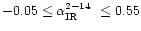 might contain a significant population of transition objects (flat-spectrum
objects) between
Class I protostars and Class II T Tauri stars.
GY245 is taken from Greene et al.
(1994).
GY152, ISO85CRBR51, and the last 13 sources
are not detected in all near-IR bands, and
no reliable MJ or MH can be estimated.
has been obtained using
Eq. (8) (Sect. 4.2).
L1689-IRS5 and ISO212L1689-IRS7 refer to
the IR sources listed by Greene et al. (1994) in L1689.
WSB60 corresponds to the source B162816-243657
in Barsony et al. (1997).
WL22 and ISO92WL16 are young early-type
stars (see Sect. 3.1),
cannot be derived accurately using the method
described in Sect. 4.1. The quoted luminosities for WL22 and WL16
are taken from WLY89 and Comerón et al. (1993), respectively.
They have been scaled to
might contain a significant population of transition objects (flat-spectrum
objects) between
Class I protostars and Class II T Tauri stars.
GY245 is taken from Greene et al.
(1994).
GY152, ISO85CRBR51, and the last 13 sources
are not detected in all near-IR bands, and
no reliable MJ or MH can be estimated.
has been obtained using
Eq. (8) (Sect. 4.2).
L1689-IRS5 and ISO212L1689-IRS7 refer to
the IR sources listed by Greene et al. (1994) in L1689.
WSB60 corresponds to the source B162816-243657
in Barsony et al. (1997).
WL22 and ISO92WL16 are young early-type
stars (see Sect. 3.1),
cannot be derived accurately using the method
described in Sect. 4.1. The quoted luminosities for WL22 and WL16
are taken from WLY89 and Comerón et al. (1993), respectively.
They have been scaled to  pc.
pc.
The newly identified cloud members nicely extend the previously
known Class I/II population toward low IR fluxes.
While previous studies could only identify sources with
 mJy,
the present census is complete for objects down
to
mJy,
the present census is complete for objects down
to
 mJy.
Altogether, a sample of 139 Class I/Class II YSOs
is identified, of which 71 are new members.
The present survey has thus allowed us
to more than double the number of recognized YSOs with
circumstellar IR excess in the
cloud.
mJy.
Altogether, a sample of 139 Class I/Class II YSOs
is identified, of which 71 are new members.
The present survey has thus allowed us
to more than double the number of recognized YSOs with
circumstellar IR excess in the
cloud.
The 139 red YSOs are listed in Table 2 (Class I YSOs)
and Table 3 (Class II YSOs) by decreasing order of
.
Twelve of them (last entries of Table 3) are completely new sources
with respect to published IR surveys.
In Fig. 3,
the YSOs classified as Class I and Class II by AM94
and Greene et al. (1994) are shown as filled stars and filled
circles, respectively.
In the log10(
/
)
versus
diagram, there is no
clear color gap between the two classes of objects,
even though the Class I YSOs tend to lie in the upper part
of the "red'' group (see Fig. 3a).
Since extinction has a negligible effect on the mid-IR ratio
/
,
this suggests that Class I and Class II objects have fairly similar
intrinsic colors between 6.7 m and 14.3 m.
The classical IR spectral index
calculated from 2 m to 10 m (or 25 m)
(e.g. Lada & Wilking 1984 and WLY89) appears to provide a better way of
discriminating between envelope-dominated Class I YSOs
and disk-dominated Class II sources (see Fig. 3b).
In particular, millimeter continuum mapping of optically thin circumstellar
dust emission confirms that, apart from a few important
exceptions (e.g., WL22, WL16, WL17, IRS37, IRS47),
the
objects selected on the basis of
 are indeed Class I protostars surrounded by spheroidal
envelopes (AM94, MAN98).
are indeed Class I protostars surrounded by spheroidal
envelopes (AM94, MAN98).
As expected, the previously known Class I YSOs are
well concentrated in the upper-right part of the
versus
diagram of Fig. 3b (where
and
are close to the
 index used in previous studies -
e.g., AM94 and Greene et al. 1994).
There is also a hint of two gaps in this diagram
at
index used in previous studies -
e.g., AM94 and Greene et al. 1994).
There is also a hint of two gaps in this diagram
at
 and
and
 ,
which roughly bracket the regime of flat-spectrum sources as defined by
Greene et al. (1994).
These may represent a distinct population of
transition objects between Class I and Class II
(e.g. Calvet et al. 1994).
,
which roughly bracket the regime of flat-spectrum sources as defined by
Greene et al. (1994).
These may represent a distinct population of
transition objects between Class I and Class II
(e.g. Calvet et al. 1994).
Here, we thus consider sources with
 as Class I YSOs
(Table 2), sources with
as Class I YSOs
(Table 2), sources with
 as candidate
flat-spectrum objects (see Table 3), and sources with
as candidate
flat-spectrum objects (see Table 3), and sources with
 as Class II YSOs (Table 3).
These limiting indices are displayed in Fig. 3b. In the
following, the candidate flat-spectrum sources will be treated as
Class II YSOs.
as Class II YSOs (Table 3).
These limiting indices are displayed in Fig. 3b. In the
following, the candidate flat-spectrum sources will be treated as
Class II YSOs.
Most of the ISOCAM sources (e.g. 90% of the Class II sources) were also detected in the near-IR (JHK) survey of Barsony et al. (1997). Comparison between Figs. 3b and 3c illustrates the advantage of mid-IR measurements for selecting sources with intrinsic circumstellar IR excesses. While the red and blue groups of Fig. 3a are well separated in the mid-IR diagram of Fig. 3b, they blend together in the near-IR diagram of Fig. 3c.
Figure 3c also shows that most of the ISOCAM-selected YSOs lie within the reddening band associated with the intrinsic locus of CTTSs as derived by Meyer et al. (1997) in Taurus. The few exceptions, which lie to the right of the reddening band, correspond to Class I and flat-spectrum YSOs.
While Class I/II YSOs are easily recognized in the mid-IR
range thanks to their strong IR excesses, Class III objects are difficult
to identify without
deep X-ray and/or radio centimeter continuum observations.
We have used the ROSAT X-ray surveys of Casanova et al. (1995) and
Grosso et al. (2000), along with the VLA radio surveys by, e.g.,
André et al. (1987) and Stine et al.
(1988)
to build up a sample of bona-fide Class III YSOs covered by the present
survey. With the additional Class III candidate WL19 (see Sect. 3.2 above),
there are 38 such YSOs which are listed in order of decreasing
in Table 4.
| ISO | Identification |
|
MJ | MH |
|
|
| #a | (
) |
[mag] | [mag] | [mag] | [] |
|
| 114 | WL19/GY227b | -0.05 | - | -1.0 | 73.4 | 52. |
| 125 | WL5/GY246b | -1.02 | - | -0.7 | 59.8 | 39. |
| 34 | GY12b | -1.06 | 3.3 | - | 19.5 | 0.89 |
| 58 | WL8/GY96b | -1.11 | 1.9 | - | 35.5 | 4.2 |
| 152 | GY289b | -1.33 | 3.3 | - | 27.5 | 0.90 |
| 198 | SR20 | -1.65 | 1.9 | - | 4.0 | 4.0 |
| 133 | GY253b | -1.73 | 3.3 | - | 31.2 | 0.85 |
| 45 | LFAM8/SKS1-19b | -1.82 | 4.2 | - | 25.2 | 0.34 |
| 80 | GY156b | -2.00 | 3.4 | - | 22.5 | 0.84 |
| 10 | DoAr21/GSS23b | -2.00 | 0.7 | - | 6.0 | 15. |
| 27 | WSB28 | -2.06 | 4.1 | - | 4.3 | 0.36 |
| 149 | B162730-244726 | -2.20 | 3.7 | - | 10.3 | 0.61 |
| 135 | VSSG22 | -2.23 | 3.0 | - | 17.1 | 1.2 |
| 64 | VSSG11b | -2.24 | 3.4 | - | 15.2 | 0.83 |
| 73 | VSSG3/GY135 | -2.26 | 2.3 | - | 15.7 | 2.8 |
| 180 | VSSG14/GY372 | -2.51 | 2.2 | - | 5.5 | 3.0 |
| 184 | IRS55/GY380 | -2.65 | 2.6 | - | 6.0 | 1.8 |
| 11 | VSSG19b | -2.75 | 3.8 | - | 3.9 | 0.50 |
| 7 | GSS20 | -2.84 | 3.1 | - | 4.7 | 1.1 |
| 60 | GY101b | ( 0.00) | - | 2.0 | 55.5 | 2.0 |
| 61 | GY103b | (-0.45) | - | 2.6 | 48.5 | 1.1 |
| 126 | GY248b | (-0.82) | 4.2 | - | 25.5 | 0.36 |
| 101 | IRS30/GY203b | (-0.99) | - | 2.2 | 36.5 | 1.6 |
| 14 | B162607-242742 | (-1.43) | 3.5 | - | 20.6 | 0.70 |
| 8 | B162601-242945 | (-1.96) | 3.9 | - | 8.1 | 0.47 |
| 183 | GY377b | (-1.98) | 4.0 | - | 16.0 | 0.40 |
| 157 | GY296b | (-2.02) | 5.5 | - | 5.1 | 0.081 |
| 4 | B162541-242138 | (-2.05) | 5.8 | - | 6.7 | 0.060 |
| 69 | GY122 | (-2.17) | 5.5 | - | 2.7 | 0.080 |
| 96 | GY193 | (-2.24) | 4.2 | - | 7.4 | 0.34 |
| 97 | GY194 | (-2.35) | 4.1 | - | 9.1 | 0.40 |
| 188 | GY410 | (-2.36) | 4.0 | - | 10.2 | 0.43 |
| 66 | GY112 | (-2.42) | 4.2 | - | 3.6 | 0.35 |
| 130 | SR12/GY250b | (-2.48) | 3.4 | - | 1.2 | 0.83 |
| 5 | IRS10 | (-2.78) | 2.7 | - | 5.4 | 1.7 |
| - | IRS50/GY306 | - | 3.7 | - | 11.5 | 0.60 |
| 16 | SR3/GSS25 | - | - | - | - | 100.c |
| 48 | S1/GY70b | - | - | - | - | 1100.c |
| a
The ISO number refers to the numbering in Table 1 (available
only in electronic form at http://cdsweb.u-strasbg.fr/).
b Class III YSOs located inside the CS contours of Fig. 1 (see Sects. 3.5 and 4.4). c For the two B stars ISO16 SR3 and ISO48S1 (e.g. Elias 1978),
cannot be derived using the method described in Sect. 4.1. The quoted
values are taken from Lada & Wilking (1984),
and have been scaled to pc.
|
This Class III sample is unfortunately not as complete as the Class I
and Class II samples discussed above.
According to Grosso et al. (2000), the number of Class IIIs
may be roughly as large as the number of Class IIs: above their typical X-ray
detection limit of
 ergs-1
(corresponding to
ergs-1
(corresponding to
 - see Fig. 7 of Grosso et al.),
they found a Class III/Class II number ratio
of 19/22 in the ROSAT-HRI/ISO-ISOCAM overlapping survey area.
If this ratio is representative of the
complete population of young stars in
,
the total number of Class IIs
found here (123 objects) suggests that as many as 106 Class IIIs may be
present in the cluster down to
- see Fig. 7 of Grosso et al.),
they found a Class III/Class II number ratio
of 19/22 in the ROSAT-HRI/ISO-ISOCAM overlapping survey area.
If this ratio is representative of the
complete population of young stars in
,
the total number of Class IIs
found here (123 objects) suggests that as many as 106 Class IIIs may be
present in the cluster down to
 (our completeness level
for Class IIs, see Sect. 4.4).
A total of 38 Class IIIs are already known within the ISOCAM
survey area, so that 68
unknown Class IIIs may remain to be found.
Since it was noted in Sect. 2.4 that
30 sources detected at 6.7 m
might be unidentified cluster members,
about half of the missing Class IIIs
may have been actually seen by ISOCAM.
(our completeness level
for Class IIs, see Sect. 4.4).
A total of 38 Class IIIs are already known within the ISOCAM
survey area, so that 68
unknown Class IIIs may remain to be found.
Since it was noted in Sect. 2.4 that
30 sources detected at 6.7 m
might be unidentified cluster members,
about half of the missing Class IIIs
may have been actually seen by ISOCAM.
We also note that a large proportion (80/123) of the Class II sources
are closely associated with the densest part of L1688 (see Fig. 1).
Assuming the same proportion applies to Class IIIs, we would
expect 44 unknown Class III sources to be located within
the CS contours of Fig. 1. A total of
39 unclassified ISOCAM sources (also detected by Barsony et al. 1997)
lie within these CS contours where the number
of detected background stars should be small due to high cloud extinction.
Most of these 39 sources might thus be yet unidentified
Class III YSOs. These candidate Class III sources are listed in order of
decreasing
in Table 5.
| ISO | Identification |
|
MJ | MH |
|
|
| #a | (
) |
[mag] | [mag] | [mag] | [] |
|
| 191 | GY463 | -1.46 | 4.4 | - | 25.2 | 0.28 |
| 44 | B162628-241543 | -1.63 | 3.9 | - | 21.7 | 0.45 |
| 81 | VSSG7/GY157 | -2.13 | 2.1 | - | 29.8 | 3.4 |
| 91 | VSSG8/GY181 | -2.20 | 2.4 | - | 22.9 | 2.4 |
| 28 | B162621-241544 | -2.23 | 2.9 | - | 15.5 | 1.4 |
| 18 | SKS1-7 | -2.38 | 3.6 | - | 17.4 | 0.64 |
| 25 | CRBR17 | ( 0.68) | 8.3 | - | 10.1 | 0.004 |
| 153 | GY290 | ( 0.41) | - | 3.7 | 41.5 | 0.31 |
| 100 | B162705-244013b | ( 0.12) | - | - | - | - |
| 109 | GY215b | ( 0.05) | - | - | - | - |
| 104 | GY207 | (-0.31) | - | 4.6 | 39.5 | 0.11 |
| 49 | B162636-241811b | (-0.36) | - | - | - | - |
| 15 | CRBR4 | (-0.41) | - | 1.9 | 58.9 | 2.2 |
| 146 | GY278 | (-0.58) | - | 2.4 | 47.8 | 1.3 |
| 136 | GY258 | (-0.72) | 8.2 | - | 10.8 | 0.004 |
| 55 | IRS16/GY92 | (-0.80) | - | 5.0 | 29.1 | 0.079 |
| 173 | IRS53/GY334 | (-0.81) | - | 2.0 | 40.2 | 2.1 |
| 71 | GY130 | (-0.87) | - | 3.7 | 38.8 | 0.31 |
| 162 | GY309 | (-1.01) | - | 3.3 | 42.5 | 0.47 |
| 50 | B162636-241902 | (-1.06) | 6.6 | - | 14.0 | 0.025 |
| 57 | B162641-241801 | (-1.22) | - | 3.1 | 32.3 | 0.58 |
| 111 | WL9/GY220 | (-1.27) | 5.5 | - | 21.6 | 0.086 |
| 22 | B162618-241712 | (-1.50) | 4.2 | - | 26.8 | 0.34 |
| 113 | IRS32/GY228 | (-1.52) | 3.6 | - | 18.5 | 0.62 |
| 82 | GY163 | (-1.53) | - | 4.1 | 32.8 | 0.19 |
| 131 | GY255 | (-1.57) | 4.2 | - | 21.6 | 0.35 |
| 169 | GY322 | (-1.59) | 4.0 | - | 16.3 | 0.43 |
| 47 | IRS14/GY54 | (-1.85) | 4.7 | - | 16.6 | 0.21 |
| 189 | GY412 | (-1.90) | 5.2 | - | 17.6 | 0.12 |
| 181 | GY373 | (-1.91) | 6.4 | - | 7.7 | 0.032 |
| 174 | GY346 | (-1.93) | 5.6 | - | 19.5 | 0.075 |
| 74 | IRS20/GY143 | (-1.97) | 3.8 | - | 16.0 | 0.50 |
| 179 | GY370 | (-1.99) | 5.4 | - | 10.0 | 0.094 |
| 148 | GY283 | (-2.09) | 4.3 | - | 13.1 | 0.32 |
| 42 | VSSG29/GY37 | (-2.14) | 6.8 | - | 6.5 | 0.021 |
| 192 | GY472 | (-2.14) | 5.9 | - | 20.1 | 0.054 |
| 186 | GY398 | (-2.20) | 5.2 | - | 5.2 | 0.11 |
| 158 | GY297 | (-2.22) | 6.0 | - | 0.7 | 0.047 |
| 156 | GY295 | (-2.52) | 4.3 | - | 4.8 | 0.32 |
and
were not derived for these
sources as they were detected only in the K band by Barsony et al.
(1997).
Copyright ESO 2001