

We consider the equations of motion of a planetesimal assuming the planar, elliptical
restricted three-body problem where the gas drag term is added to the equations. Since
drag brings planetesimals to the central plane where the planet is supposed to orbit,
the planar model is thus justified. Lagrange's equations
are considered for the variation of the orbital elements a, e,  and l where a is the semi-major axis,
e is the eccentricity,
is the longitude of the perihelion
and l is the mean anomaly. In these variables the equations for the variation of the osculating
elements are given by (Brouwer & Clemence 1961)
and l where a is the semi-major axis,
e is the eccentricity,
is the longitude of the perihelion
and l is the mean anomaly. In these variables the equations for the variation of the osculating
elements are given by (Brouwer & Clemence 1961)
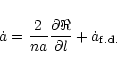
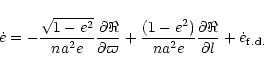
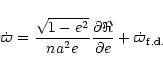
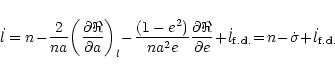 |
(1) |
 is the disturbing function initially assumed in the set of variables
 for the particle and the planet where f is the true anomaly and the
subscript
for the particle and the planet where f is the true anomaly and the
subscript  refers to the planet.
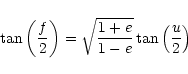
The derivatives with respect to the variables in Eqs. (1) are obtained through the chain rule from the expressions
 |
(2) |
and
 |
(3) |
 as fast variables where u is the
eccentric anomaly.
as fast variables where u is the
eccentric anomaly.
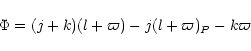
We also consider, instead of l, the resonant variable ( )
given by
)
given by
 |
(4) |
where, j>0 and k are integers with k>0 defining an exterior resonance and k<0 defining an interior one.
Now we have to change the variable l to
in Eqs. (1). A new perturbing
function  is defined as an explicit function of a, e,
and
,
after replacing l by
and
through Eq. (4). This also
changes the explicit dependence of
with ,
thus we define
is defined as an explicit function of a, e,
and
,
after replacing l by
and
through Eq. (4). This also
changes the explicit dependence of
with ,
thus we define
 .
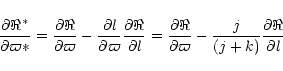
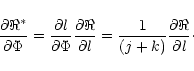
The derivatives of the new perturbing
function with respect to the new variables are related to the derivatives with respect
to the old variables by
.
The derivatives of the new perturbing
function with respect to the new variables are related to the derivatives with respect
to the old variables by
 |
(5) |
and
 |
(6) |
Equation (1) written in these new set of variables becomes
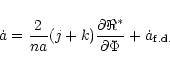 |
(7) |
![\begin{eqnarray*}\dot e =&-&{{\sqrt{1-e^2}}\over{na^2e}} [j-(j+k)\sqrt{1-e^2}] {...
...rtial\Re^\ast}\over{\partial \varpi^\ast}} +\dot e_{ {\rm f.d.}}
\end{eqnarray*}](/articles/aa/full/2001/05/aa10194/img31.gif)
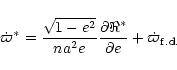

where  is given by Eq. (1). Of course
and
is given by Eq. (1). Of course
and
 have the same geometrical meaning and after the new equations are defined as above,
we can hereafter just drop the stars for simplification.
have the same geometrical meaning and after the new equations are defined as above,
we can hereafter just drop the stars for simplification.
The dissipative terms
 ,
,
 ,
,
 and
and
 are obtained from Gauss equations
(Brouwer & Clemence 1961)
are obtained from Gauss equations
(Brouwer & Clemence 1961)
![\begin{displaymath}\dot a_{ {\rm f.d.}}={{2}\over{n\sqrt{1-e^2}}} [Re\sin f+S(1+e\cos f)]
\end{displaymath}](/articles/aa/full/2001/05/aa10194/img40.gif) |
(8) |
![\begin{displaymath}\dot e_{ {\rm f.d.}}={{\sqrt{1-e^2}}\over{na}} [R\sin f+S{{(e+2\cos f+e\cos ^2f)}\over{(1+e\cos f)}}]
\end{displaymath}](/articles/aa/full/2001/05/aa10194/img41.gif)
![\begin{displaymath}\dot \varpi_{ {\rm f.d.}}={{\sqrt{1-e^2}}\over{nae}} [-R\cos f+S{{(2+e\cos f)}\over{(1+e\cos f)}}\sin f]
\end{displaymath}](/articles/aa/full/2001/05/aa10194/img42.gif)
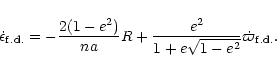
 ,
the equation is given by
,
the equation is given by
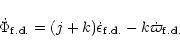 |
(9) |
S and R are the radial and transverse components of the dissipative force. We consider two
expressions for the dissipative force per unit mass:
 |
(10) |
or
 |
(11) |
 ,
C being the drag coefficient (it relates physical
properties of the gas and planetesimal's radius and mass),
,
C being the drag coefficient (it relates physical
properties of the gas and planetesimal's radius and mass),
 the planetesimal velocity and
 the Keplerian velocity at the planetesimal location; the parameter
 is the ratio of the gas speed to the Keplerian speed at the same point, taken as
 (Adachi et al. 1976).
The parameter that defines the use of either Eq. (10) or Eq. (11) is the Reynolds number given
by
(Adachi et al. 1976).
The parameter that defines the use of either Eq. (10) or Eq. (11) is the Reynolds number given
by
 where
where
 is gas density, s is the planetesimal radius and
  is the
viscosity of the gas. For high Reynolds number
(
is the
viscosity of the gas. For high Reynolds number
(
 )
(Weidenschilling 1977),
the gas drag acceleration is given by Eq. (11) and for low Reynolds number (
)
(Weidenschilling 1977),
the gas drag acceleration is given by Eq. (11) and for low Reynolds number (
 )
the gas drag acceleration is
given by Eq. (10). Hereafter we will refer to these expressions as Stokes and v2
gas drag for Eqs. (10) and (11), respectively.
The choice of the right gas drag law thus depends on several parameters. There is
anyway a tendency for the v2 law to be valid for the inner region of a planetary
system since V and
are higher. Also, given standard parameters for the
primordial solar nebula, in many cases trapped planetesimals will experience drag in
an intermediate regime (
)
the gas drag acceleration is
given by Eq. (10). Hereafter we will refer to these expressions as Stokes and v2
gas drag for Eqs. (10) and (11), respectively.
The choice of the right gas drag law thus depends on several parameters. There is
anyway a tendency for the v2 law to be valid for the inner region of a planetary
system since V and
are higher. Also, given standard parameters for the
primordial solar nebula, in many cases trapped planetesimals will experience drag in
an intermediate regime (
 )
(Mothé-Diniz & Gomes 2000). Anyway,
for illustration purposes, in what follows, we will give examples for Stokes drag in
the case of exterior resonances and both Stokes and v2 drag for interior
resonances.
)
(Mothé-Diniz & Gomes 2000). Anyway,
for illustration purposes, in what follows, we will give examples for Stokes drag in
the case of exterior resonances and both Stokes and v2 drag for interior
resonances.
A corotation point is defined as a solution point of
the system of equations:

 ,
where the average is taken over a synodic period T. Defining a generic variable
,
where the average is taken over a synodic period T. Defining a generic variable
 and using the definition of an average value for any
  we have
![\begin{displaymath}<\dot \xi_{i}>={{1}\over{T}}\!\int_0^T \!\dot \xi_{i} {\rm d}...
...=\!
{{1}\over{T}}[\xi_{i}(T)-\xi_{i}(0)]\!=\!0 , i\!=\!1,...,4
\end{displaymath}](/articles/aa/full/2001/05/aa10194/img63.gif) |
(12) |
or
 |
(13) |
which means that all the orbits around an exact corotation point are periodic on the synodic period T. For a point
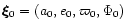 in the vicinity of an exact corotation point, we define:
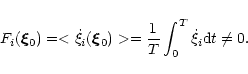 |
(14) |
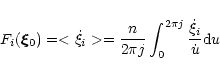 |
(15) |
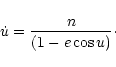 |
(16) |
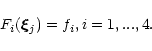
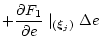
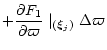
If
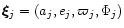 is an initial guess in the vicinity
of an exact corotation point we define fi by:
is an initial guess in the vicinity
of an exact corotation point we define fi by:
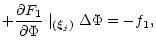
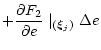
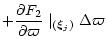
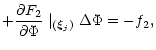
 |
(17) |
 |
 |
||
 |
 |
||
 |
 |
||
 |
 |
||
| (18) | |||
 |
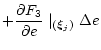 |
||
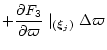 |
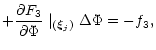 |
||
 |
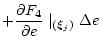 |
||
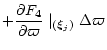 |
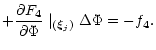 |
 ,
,
 ,
,
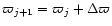 and
and
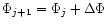 replace the previous ones and the procedure is iterated until
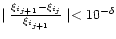 ,
for
all i=1...4, where
,
for
all i=1...4, where  gives the accuracy for
the determination of
the corotation point. The derivatives of Fi introduce second derivatives in respect with
which are
computed in the variables
gives the accuracy for
the determination of
the corotation point. The derivatives of Fi introduce second derivatives in respect with
which are
computed in the variables
 as previously described and the result integrated in u over a synodic period (u and
are related
through
as previously described and the result integrated in u over a synodic period (u and
are related
through
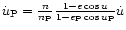 ).
).
By our method, we can also study the linear stability of a equilibrium point calculating the eigenvalues
 and
and
 of the characteristic equation
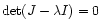 where,
J is the Jacobian matrix given by
where,
J is the Jacobian matrix given by
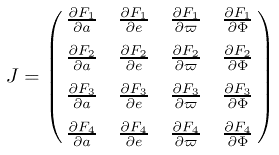 |
(19) |
and I is the unit matrix of rank 4. If all real parts of the eigenvalues are negative the point is stable, but if at least one eigenvalue has a positive real part, the point is unstable.
It must be noted that in the first order method the dissipative terms
and
are dropped from the
Eqs. (7) because they have null average.
To determine the corotation points we have to take an initial guess for the set of variables for a fixed C (drag coefficient). After finding this point (we can do numerical simulation of the N-body equations or use a first order analytical method to have this initial guess) we determine all other points by varying the parameter C. Also a value already obtained for a particular planet eccentricity is an initial guess for a little higher (or lower) planet eccentricity.
To check the validity and accuracy of the (developed) method, we start by determining the corotation points for the 2:3 resonance
considering Stokes drag law for the dissipative force. For the
perturber, we consider a Jupiter mass planet with
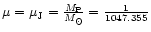 and a fixed orbit with elements:
 ,
,
 and
and
 .
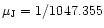
It can be observed in Fig. 1 that there is a good
agreement between the solutions determined by the first order method and those obtained by numerical integrations of the complete
(N-body) equations of motion using the RADAU 16th order integrator
(Everhart 1985).
.
It can be observed in Fig. 1 that there is a good
agreement between the solutions determined by the first order method and those obtained by numerical integrations of the complete
(N-body) equations of motion using the RADAU 16th order integrator
(Everhart 1985).
![\begin{figure}
\par\includegraphics[width=12cm,clip]{MS10194f5r.eps}\end{figure}](/articles/aa/full/2001/05/aa10194/img104.gif) |
Figure 5:
Corotation points for the 3:2 interior resonance for the case of v2drag with planet as in Fig. 1 except for
 |
 105 years). After that, we take an average
for each variable considering only the variations of the elements for the part of the
stable planetesimal's orbit. We see that
these numeric points
match only the stable branch of the solutions.
We checked this by computing the eigenvalues of the Jacobian matrix (Eq. (19)),
yielding a stable solution
for the branch where numerical points were found and an unstable solution corresponding to the other branch.
Next, we tried out the method for a high planetary eccentricity (e=0.1) considering the same mass and semi-major axis as
for the planet as above. For this case, the corotation points both by our method and those obtained by numerical simulations
are shown in
Fig. 2, thus confirming that the first order method works also for high eccentricities. Next, we determined
the corotation points for the 5:7 resonance,
considering the same conditions as in the first case.
We find, by comparing with numerical simulations, that there are high discrepancies between the values obtained by both methods
(see Fig. 3). This came about because the 5:7 resonance for a Jupiter-like planet is an example of an extended corotation (mothé-
Diniz & Gomes 2000). For this case,
the developed method does not give good results due to its limitation as a first order theory in the planet's mass whereas
extended corotation is strongly dependent on the planet's mass. This limitation brings about the deviations found in Fig. 3. Extended corotation resonance was first noted by Mothé-Diniz & Gomes (2000) in numerical studies and its main
characteristic is that there is a continuous range of drag coefficients up to zero for which corotation resonance takes place, or, in
terms of planetesimal size, there is no upper limit of planetesimal radius for which this resonance is effective.
105 years). After that, we take an average
for each variable considering only the variations of the elements for the part of the
stable planetesimal's orbit. We see that
these numeric points
match only the stable branch of the solutions.
We checked this by computing the eigenvalues of the Jacobian matrix (Eq. (19)),
yielding a stable solution
for the branch where numerical points were found and an unstable solution corresponding to the other branch.
Next, we tried out the method for a high planetary eccentricity (e=0.1) considering the same mass and semi-major axis as
for the planet as above. For this case, the corotation points both by our method and those obtained by numerical simulations
are shown in
Fig. 2, thus confirming that the first order method works also for high eccentricities. Next, we determined
the corotation points for the 5:7 resonance,
considering the same conditions as in the first case.
We find, by comparing with numerical simulations, that there are high discrepancies between the values obtained by both methods
(see Fig. 3). This came about because the 5:7 resonance for a Jupiter-like planet is an example of an extended corotation (mothé-
Diniz & Gomes 2000). For this case,
the developed method does not give good results due to its limitation as a first order theory in the planet's mass whereas
extended corotation is strongly dependent on the planet's mass. This limitation brings about the deviations found in Fig. 3. Extended corotation resonance was first noted by Mothé-Diniz & Gomes (2000) in numerical studies and its main
characteristic is that there is a continuous range of drag coefficients up to zero for which corotation resonance takes place, or, in
terms of planetesimal size, there is no upper limit of planetesimal radius for which this resonance is effective.
As a last example for an exterior resonance we show in Fig. 4 the
points for the 7:9 resonance where two planetary masses were considered:
 and
and
 and the same planetary orbit as that used in the first example. It can be noticed that the variation of the mass yields only a small
shift in the location of the points. In all the cases considered above we assumed Stokes drag
as the dissipative force.
and the same planetary orbit as that used in the first example. It can be noticed that the variation of the mass yields only a small
shift in the location of the points. In all the cases considered above we assumed Stokes drag
as the dissipative force.
We next apply our method for interior resonances.
Figure 5 shows the corotation points for the interior 3:2
resonance considering the v2 gas drag case as the dissipative force and considering the perturber with mass:
 and fixed orbit with
elements:
and fixed orbit with
elements:
 ,
e=0.4 and
,
e=0.4 and
 .
We notice that the 3:2 interior resonance is also a case of the extended
corotation and that for a very low value of drag coefficient (which means large planetesimal radius) the equilibrium points
tends to a solution without dissipation (Ferraz-Mello et al. 1993). We have found in our applications the extended case
for interior resonances with planetary excentricities in a range from 0.1 to 0.6 so, we choose e=0.4 as mean value for the
applications shown.
.
We notice that the 3:2 interior resonance is also a case of the extended
corotation and that for a very low value of drag coefficient (which means large planetesimal radius) the equilibrium points
tends to a solution without dissipation (Ferraz-Mello et al. 1993). We have found in our applications the extended case
for interior resonances with planetary excentricities in a range from 0.1 to 0.6 so, we choose e=0.4 as mean value for the
applications shown.
Copyright ESO 2001
![\begin{figure}
\par\includegraphics[width=12cm,clip]{MS10194f1r.eps}\end{figure}](/articles/aa/full/2001/05/aa10194/img103.gif)
 ,
,
 ,
,
 AU and
 .
Continuous line stands for the
first order method and circles stand for
numerical integrations. The dissipative force is Stokes drag
.
Continuous line stands for the
first order method and circles stand for
numerical integrations. The dissipative force is Stokes drag