

Our first order method, although giving a new result (corotation points for interior resonances) and being valid for high eccentricities of the planet and planetesimal, failed to determine the equilibrium points for the case of exterior extended resonances. Thus, in order to determine these correct solutions and also to generally improve the accuracy, we developed a generic method. We might opt for developing a second order method as done by Beaugé et al. (1999) but, as this would probably keep the discrepancies and would anyway spend a large computer time to solve the equations, we chose to develop a complete generic method which spends less time than the second order one.
For this method we do a complete (all variables varying point to point) numerical integration of the Eqs. (7),
considering also the dissipative terms
 and
and
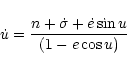
 in the equations. This demands a correction in the expression for the temporal derivative
of the eccentric anomaly (given by Eq. (16)) to
in the equations. This demands a correction in the expression for the temporal derivative
of the eccentric anomaly (given by Eq. (16)) to
 |
(20) |
 .
.
Another important change for this method as compared with the first order method refers
to the definition of Fi (Eq. (14))
and its derivatives (Eqs. (18)).
In the first order method, Fi is defined as function of the average variables and the derivatives of Fi with
respect to
the variables
 are obtained analytically but, for
the generic method the complete integration of the Eqs. (7) requires a new definition for Fi and its derivatives.
Now Fi is defined as a function of the initial variables, i.e.,
are obtained analytically but, for
the generic method the complete integration of the Eqs. (7) requires a new definition for Fi and its derivatives.
Now Fi is defined as a function of the initial variables, i.e.,
 ,
where
,
where
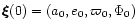 and we obtain the derivatives numerically, by taking this initial point
 and a small enough increment
  ,
,
 ,
,
 and
and
 for each variable in the neighborhood
of this point. Thus, we calculate all the derivatives at this point numerically by
for each variable in the neighborhood
of this point. Thus, we calculate all the derivatives at this point numerically by
 |
|||
 |
|||
| (21) | |||
 |
|||
 |
For this method, we first start with our basic example,
calculating the equilibrium points for the exterior
2:3 resonance considering Stokes drag
as the dissipative force and a planet with Jupiter mass
 and a fixed orbit with elements
 ,
e=0.05 and
,
e=0.05 and
 .
Figure 6 shows the corotation points for this case. It can be observed that
these points are in a better
agreement
.
Figure 6 shows the corotation points for this case. It can be observed that
these points are in a better
agreement![[*]](/icons/foot_motif.gif) than those obtained
by the first order method (Fig. 1).
Following the examples considered in the previous method,
we determine the points for the 5:7 resonance. Comparing the result shown in
Fig. 7 with the one obtained with the first order method (Fig. 3) we observe that this
method gives the correct solutions
and this is indeed a case of extended resonance.
than those obtained
by the first order method (Fig. 1).
Following the examples considered in the previous method,
we determine the points for the 5:7 resonance. Comparing the result shown in
Fig. 7 with the one obtained with the first order method (Fig. 3) we observe that this
method gives the correct solutions
and this is indeed a case of extended resonance.
Next, we determined the points for the 7:9 resonance considering now three planetary masses:
 ,
,
 and
and
 and the
same orbit as considered above. It can be observed in Fig. 8 that this is also a case of the extended resonance
for planet's mass equal to
and the
same orbit as considered above. It can be observed in Fig. 8 that this is also a case of the extended resonance
for planet's mass equal to
 .
Observing this plot, we also
point out that the points found in Fig. 4 (obtained by the first order method) for planetary mass equal to
are wrongly determined and that the
extended resonance occurs only for limited values of planet's mass.
We determined the points for another case of extended resonance. Figure 9 shows these points for the 4:7 resonance with also
three planetary masses considered:
.
Observing this plot, we also
point out that the points found in Fig. 4 (obtained by the first order method) for planetary mass equal to
are wrongly determined and that the
extended resonance occurs only for limited values of planet's mass.
We determined the points for another case of extended resonance. Figure 9 shows these points for the 4:7 resonance with also
three planetary masses considered:
 ,
and
,
and
 and the same orbit.
We have not found any extended corotation for first order resonances even considering high planet's mass or eccentricity. For all examples above, Stokes drag was considered as the dissipative force.
and the same orbit.
We have not found any extended corotation for first order resonances even considering high planet's mass or eccentricity. For all examples above, Stokes drag was considered as the dissipative force.
For interior resonances considering this method we took both Stokes and v2 gas drag laws as dissipative forces.
Figure 10 shows the corotation points for the 3:2 resonance considering both Stokes and v2 gas drag.
Although we had stopped the
numerical points in C=10-6 (year-1, AU-1) they extended for all values below this point.
We also determined the points for other interior resonances, for instance, 2:1 (Fig. 11), 5:2 (Fig. 12) and 5:3 (Fig. 13) each of
them considering both dissipative forces. For all cases above we considered the perturber's mass:
and planetary orbit with elements:
,
e=0.4 and
.
We also study the effect of planet's mass and eccentricity variation in the location of the points. For the first case we
consider the interior 3:2 resonance with perturber's masses:
 ,
,
 ,
,
 and
and
 and fixed orbit with elements:
,
e=0.4 and
.
For the second case, we consider the same resonance and a planet with Jupiter's mass and the same
orbit except for the eccentricity which is varying from 0.1 to 0.6.
It can be observed in Fig. 14 that mass variation causes a small influence in the location of the points for small values of the
drag coefficient
and fixed orbit with elements:
,
e=0.4 and
.
For the second case, we consider the same resonance and a planet with Jupiter's mass and the same
orbit except for the eccentricity which is varying from 0.1 to 0.6.
It can be observed in Fig. 14 that mass variation causes a small influence in the location of the points for small values of the
drag coefficient
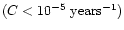 .
On the other hand, Fig. 15 shows that the planet's eccentricity variation brings a large variation in the planetesimal's
eccentricity for small values of drag coefficient
.
On the other hand, Fig. 15 shows that the planet's eccentricity variation brings a large variation in the planetesimal's
eccentricity for small values of drag coefficient
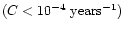 .
Also as
eccentricity increases, the range of drag coefficients that enable resonance trapping
shrinks. Although it seems that for any non null planetary eccentricity there is some
.
Also as
eccentricity increases, the range of drag coefficients that enable resonance trapping
shrinks. Although it seems that for any non null planetary eccentricity there is some
 left that enables resonance trappings into these important first order
resonances, for a low enough planetary eccentricity,
this C range becomes too narrow for any practical meaning (note the logarithm scale of
Fig. 15).
Thus the choice of a high planetary eccentricity
for the example in Fig. 10 was not incidental. It is not without
reason that trappings into important interior resonances like 2:1 and 3:2 are not
presented in previous works. If we assume a Jupiter-like planet, including its
eccentricity equal to 0.05, these trappings are virtually impossible. However,
considering a higher planetary eccentricity as here presented, trappings into these
low order/high "j'' resonances are possible with a non negligible probability.
left that enables resonance trappings into these important first order
resonances, for a low enough planetary eccentricity,
this C range becomes too narrow for any practical meaning (note the logarithm scale of
Fig. 15).
Thus the choice of a high planetary eccentricity
for the example in Fig. 10 was not incidental. It is not without
reason that trappings into important interior resonances like 2:1 and 3:2 are not
presented in previous works. If we assume a Jupiter-like planet, including its
eccentricity equal to 0.05, these trappings are virtually impossible. However,
considering a higher planetary eccentricity as here presented, trappings into these
low order/high "j'' resonances are possible with a non negligible probability.
At last, we determined the points for two high j interior resonances 11:10 and 9:8
(Figs. 16 and 17), considering a planet with
 and fixed orbit with elements:
,
e=0.05 and
.
We observe for
these two examples that for high j the interior resonances are not extended anymore.
These interior resonance trappings, for small planetary masses and modest
eccentricity, have been found in previous works (Kary & Lissauer 1995). They take
place for resonances closer to the planet (high j). For large planetary mass, this
region is chaotic and no trapping can take place, however for small j (further from
the planet), trapping is again possible but just for high planetary eccentricity as
Fig. 15 suggests.
and fixed orbit with elements:
,
e=0.05 and
.
We observe for
these two examples that for high j the interior resonances are not extended anymore.
These interior resonance trappings, for small planetary masses and modest
eccentricity, have been found in previous works (Kary & Lissauer 1995). They take
place for resonances closer to the planet (high j). For large planetary mass, this
region is chaotic and no trapping can take place, however for small j (further from
the planet), trapping is again possible but just for high planetary eccentricity as
Fig. 15 suggests.
Copyright ESO 2001