

We now compare our work with the results of previous studies; in particular the most recent studies of Iben et al. (1997, ITY97) and Han (1998, HAN98).
In Table 2 we show the birth rates of close double white dwarfs for the different models. We also include numbers from HAN98 (model 1) and a set of numbers computed with the same code as used in ITY97, but for an age of the galactic disk of 10 Gyr, as in our models. The numbers of HAN98 are for an age of the disk of 15 Gyr. Our model D is the closest to the models of ITY97 and HAN98, assuming a constant SFR and 100% binaries. To estimate the influence of the binary evolution models only in comparing the different models we correct for their different normalisations.
In the recomputed ITY97 model the formation rate of interacting binaries in which the primary evolves within the age of the Galaxy is 0.35 yr-1. In our model D this number is 0.25 yr-1. In the following we therefore multiply the formation rates of ITY97 as given in Table 2 with 0.71.
In the model of HAN98 one binary with a primary mass
above 0.8  is formed in the Galaxy annually with
 ,
i.e. 0.9 binary with
,
i.e. 0.9 binary with
 ,
which is our
limit to
,
which is our
limit to  .
Correcting for the different assumed age of the
Galaxy we estimate this number to be 0.81; in our model this number is
0.73. We thus multiply the the formation rates of HAN98
as given in Table 2 with 0.9.
.
Correcting for the different assumed age of the
Galaxy we estimate this number to be 0.81; in our model this number is
0.73. We thus multiply the the formation rates of HAN98
as given in Table 2 with 0.9.
Applying these corrections to the normalisation, we find that some
interesting differences remain. The birth rate of double white dwarfs
is 0.029, 0.053 and 0.062 per year for HAN98, model D and
ITY98 respectively. At the same time the ratio of the merger rate to
the birth rate decreases: 0.97, 0.53 and 0.28 for these models. This
can probably be attributed to the different treatment of the common
envelope. HAN98 uses a common envelope spiral-in
efficiency of 1 in Webbinks (1984) formalism, while we
use 4 (for
 ,
see De Kool et al. 1987). ITY97
use the formalism proposed by Tutukov & Yungelson (1979) with an efficiency of 1.
This is comparable to an efficiency of 4-8 in the Webbink
formalism. This means that in the model of HAN98, more
systems merge in a common envelope, which yields a low formation rate
of double white dwarfs. The ones that form (in general) have short
periods for the same reason, so the ratio of merger to birth rate is
high. In the ITY model the efficiency is higher, so more systems will
survive both common envelopes and have generally wider orbits, leading
to a much lower ratio of merger to birth rate. Our model D is somewhat
in between, but also has the different treatment of the first mass
transfer phase (Sect. 2), in which a strong spiral-in is
avoided.
,
see De Kool et al. 1987). ITY97
use the formalism proposed by Tutukov & Yungelson (1979) with an efficiency of 1.
This is comparable to an efficiency of 4-8 in the Webbink
formalism. This means that in the model of HAN98, more
systems merge in a common envelope, which yields a low formation rate
of double white dwarfs. The ones that form (in general) have short
periods for the same reason, so the ratio of merger to birth rate is
high. In the ITY model the efficiency is higher, so more systems will
survive both common envelopes and have generally wider orbits, leading
to a much lower ratio of merger to birth rate. Our model D is somewhat
in between, but also has the different treatment of the first mass
transfer phase (Sect. 2), in which a strong spiral-in is
avoided.
The difference between the models in the SN Ia rate (
 )
is related both to the total merger rate and to the
masses of the white dwarfs. The former varies within a
factor
)
is related both to the total merger rate and to the
masses of the white dwarfs. The former varies within a
factor  1.5: 0.017, 0.028, and 0.028
 for
ITY97, model D, and HAN98, while
is higher by a factor 2-3 in model D compared to the
other models. This is caused by the initial-final mass relation in
our models, which is derived from stellar models with core
overshooting, producing higher final masses.
for
ITY97, model D, and HAN98, while
is higher by a factor 2-3 in model D compared to the
other models. This is caused by the initial-final mass relation in
our models, which is derived from stellar models with core
overshooting, producing higher final masses.
The difference in the birthrate of interacting white dwarfs (
 )
is mainly a consequence of our treatment of the first mass
transfer, which gives for model D a mass ratio distribution which is
peaked to 1 (Sect. 6.4), while in ITY97 and
HAN98 the mass ratio is in general different from 1
(Sect. 7.2), favouring stable mass transfer and the
formation of AM CVn systems. An additional factor, which reduces the
number of AM CVn systems is the assumption in model D and
ITY97 that the mass transfer rate is limited by the
Eddington rate. The formation and evolution of AM CVn stars is
discussed in more detail in Tutukov & Yungelson (1996) and Nelemans et al. (2001).
)
is mainly a consequence of our treatment of the first mass
transfer, which gives for model D a mass ratio distribution which is
peaked to 1 (Sect. 6.4), while in ITY97 and
HAN98 the mass ratio is in general different from 1
(Sect. 7.2), favouring stable mass transfer and the
formation of AM CVn systems. An additional factor, which reduces the
number of AM CVn systems is the assumption in model D and
ITY97 that the mass transfer rate is limited by the
Eddington rate. The formation and evolution of AM CVn stars is
discussed in more detail in Tutukov & Yungelson (1996) and Nelemans et al. (2001).
Comparing our Fig. 2 with the corresponding figure in Saffer et al. (1998), we find the same trend of higher white dwarf masses at longer periods. However, in our model the masses are higher than in the model of Saffer et al. (1998) at the same period. This is a consequence of the absence of a strong spiral-in in the first mass transfer phase in our model, contrary to the conventional common envelope model, as discussed in 2.2.
In our model the mass ratio distribution is peaked at
 .
This is different from the models of ITY97 and
Saffer et al. (1998) which predict a strong concentration to
.
This is different from the models of ITY97 and
Saffer et al. (1998) which predict a strong concentration to
 and from HAN98 who finds typical values of
 ,
with a tail to
,
with a tail to  .
The difference between these two
latter groups of models may be understood as a consequence of enhanced
wind in Han's model (see also Tout & Eggleton 1988), which allows wider
separations before the second common envelope. The mass ratio
distribution of our model, peaked at
.
The difference between these two
latter groups of models may be understood as a consequence of enhanced
wind in Han's model (see also Tout & Eggleton 1988), which allows wider
separations before the second common envelope. The mass ratio
distribution of our model, peaked at
 ,
appears to be more
consistent with the observed mass ratio distribution.
,
appears to be more
consistent with the observed mass ratio distribution.
To explain the lack of observed white dwarfs with masses below 0.3
we had to assume that these white dwarfs cool faster than
predicted by the models of DSBH98.
The same assumption was required by Kerkwijk et al. (2000), to bring the cooling age of the white dwarf that accompanies PSR B1855+09 into agreement with the pulsar spin-down age; and to obtain cooling ages shorter than the age of the Galaxy for the white dwarfs accompanying PSR J0034-0534 and PSR J1713+0747.
The absence of the lowest mass white dwarfs could also be explained by
the fact that a common envelope involving a giant with a low mass
helium core (
 -
-
 )
always leads to a
complete merger, according to Sandquist et al. (2000). However it can not
explain the absence of the systems with
)
always leads to a
complete merger, according to Sandquist et al. (2000). However it can not
explain the absence of the systems with
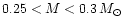 ,
which
would form the majority of the observed systems using the full
DSBH98 cooling (model A1; see Fig. 2).
,
which
would form the majority of the observed systems using the full
DSBH98 cooling (model A1; see Fig. 2).
Copyright ESO 2001