

| Model | SFH | % bin |
 |
 |
SN Ia |
 |
#(wd, wd) |
| (10-2) | (10-2) | (10-3) | (10-3) | (108) | |||
| A | Exp | 50 | 4.8 | 2.2 | 3.2 | 4.6 | 2.5 |
| B | Exp | 100 | 8.1 | 3.6 | 5.4 | 7.8 | 4.1 |
| C | Cnst | 50 | 3.2 | 1.6 | 3.4 | 3.1 | 1.2 |
| D | Cnst | 100 | 5.3 | 2.8 | 5.8 | 5.2 | 1.9 |
| ITY971 | Cnst | 100 | 8.7 | 2.4 | 2.7 | 12.0 | 3.5 |
| HAN981 | Cnst | 100 | 3.2 | 3.1 | 2.9 | 26 | 1.0 |
| 1 Note that ITY97 and HAN98 used a normalisation that is higher than we use | |||||||
for model D by factors
 1.4 and 1.1 respectively (see
Sect. 7.1). 1.4 and 1.1 respectively (see
Sect. 7.1). |
|||||||
Our results are presented in the next subsections. In Sect. 6.1 we give the birth rates and total number of double white dwarfs in the Galaxy. These numbers allow a detailed comparison with results of earlier studies, which we defer to Sect. 7. They cannot be compared with observations directly, with the exception of the SN Ia rate. For comparison with the observed sample, described in Sect. 6.2, we compute magnitude limited samples in the remaining sections. In Sect. 6.3 the distribution over periods and masses is compared with the observations, which constrains the cooling models. Comparison of the mass ratio distribution with the observations gives further support for our new description of a common envelope without spiral-in (Sect. 6.4). In Sect. 6.5 we compare our model with the total population of single and binary white dwarfs and in Sect. 6.6 we compare models that differ in the assumed star formation history with the observed rate of PN formation and the local space density of white dwarfs.
In Table 2 the birth rates for all models are
given. According to Eq. (1) the mass of a binary is on
average 1.5 times the mass of a single star. For each binary in models
A and C we also form a single star, i.e. per binary a total of 2.5
times the mass of a single star is formed (1.5 for the binary, 1 for
the single star). For models B and D only 1.5 times the mass of a
single star is formed per binary. Thus for the same SFR in  yr-1 the frequency of each process involving a binary of the
models A and C is 0.6 times that in models B and D.
yr-1 the frequency of each process involving a binary of the
models A and C is 0.6 times that in models B and D.
For model A the current birth rate for close double white dwarfs is
4.8 10-2 yr-1 in the Galaxy. The expected total
population of close binary white dwarfs in the galactic disk is
2.5 108 (see Table 2).
The double white dwarfs are of the following types: 53% contains two helium white dwarfs; 25% two CO white dwarfs; in 14% a CO white dwarf is formed first and a helium white dwarf later and in 6% a helium white dwarf is formed followed by the formation of a CO white dwarf. The remaining 1% of the double white dwarfs contains an ONeMg white dwarf. The CO white dwarfs can be so called hybrid white dwarfs; having CO cores and thick helium envelopes (Iben & Tutukov 1985, 1987). Of the double CO white dwarfs, 6% contains one and 5% two hybrid white dwarfs. In the mixed pairs the CO white dwarf is a hybrid in 20% of the cases.
Forty eight percent of all systems are close enough to be brought into
contact within a Hubble time. Most are expected to merge. The
estimated current merger rate of white dwarfs is
2.2 10-2 yr-1. The current merger rate of pairs
that have a total mass larger than the Chandrasekhar limit (
 = 1.44)
is 3.2 10-3yr-1. Since the
merging of binary CO white dwarfs with a combined mass in excess of
is a viable model for type Ia SNe (see Livio 1999, for the
most recent review), our model rate can be compared with the
SN Ia rate of (
= 1.44)
is 3.2 10-3yr-1. Since the
merging of binary CO white dwarfs with a combined mass in excess of
is a viable model for type Ia SNe (see Livio 1999, for the
most recent review), our model rate can be compared with the
SN Ia rate of ( )
10-3yr-1 for Sbc
type galaxies like our own (Cappellaro et al. 1999). In 19% of the systems
that come into contact the ensuing mass transfer is stable and an
interacting double white dwarf (identified with AM CVn stars) is
formed. The model birth rate of AM CVn systems is
4.6 10-3 yr-1 (see Table 2).
)
10-3yr-1 for Sbc
type galaxies like our own (Cappellaro et al. 1999). In 19% of the systems
that come into contact the ensuing mass transfer is stable and an
interacting double white dwarf (identified with AM CVn stars) is
formed. The model birth rate of AM CVn systems is
4.6 10-3 yr-1 (see Table 2).
| WD/sdB | P(d) | q | m | sdB | P(d) |
| 0135-052 | 1.556 | 0.90 | 0.25 | 0101+039 | 0.570 |
| 0136+768 | 1.407 | 1.31 | 0.44 | 0940+068 | 8.33 |
| 0957-666 | 0.061 | 1.14 | 0.37 | 1101+249 | 0.354 |
| 1022+050 | 1.157 | 0.35 | 1432+159 | 0.225 | |
| 1101+364 | 0.145 | 0.87 | 0.31 | 1538+269 | 2.50 |
| 1202+608 | 1.493 | 0.40 | 2345+318 | 0.241 | |
| 1204+450 | 1.603 | 1.00 | 0.51 | ||
| 1241-010 | 3.347 | 0.31 | |||
| 1317+453 | 4.872 | 0.33 | |||
| 1704+481A | 0.145 | 0.7 | 0.39 | ||
| 1713+332 | 1.123 | 0.38 | |||
| 1824+040 | 6.266 | 0.39 | |||
| 2032+188 | 5.084 | 0.36 | |||
| 2331+290 | 0.167 | 0.39 | |||
| KPD 0422+5421 | 0.090 | 0.96 | 0.51 | ||
| KPD 1930+2752 | 0.095 | 0.52 | 0.5 |
The properties of the observed double white dwarfs with which we will
compare our models are summarised in Table 3. Only
WD 1204+450 and WD 1704+481 are likely to contain CO white dwarfs,
having components with masses higher than 0.46;
the limiting
mass to form a helium white dwarf (Sweigart et al. 1990). The remaining systems
are probably helium white dwarfs. In principle in the mass range
 white dwarfs could also be hybrid; however
in this range the probability for a white dwarf to be hybrid is
4-5 times lower than to be a helium white dwarf, because hybrid white
dwarfs originate from more massive stars which fill their Roche lobe
in a narrow period range (see, however, an example of such a
scenario for WD
0957-666 in Nelemans et al. 2000). We assume
white dwarfs could also be hybrid; however
in this range the probability for a white dwarf to be hybrid is
4-5 times lower than to be a helium white dwarf, because hybrid white
dwarfs originate from more massive stars which fill their Roche lobe
in a narrow period range (see, however, an example of such a
scenario for WD
0957-666 in Nelemans et al. 2000). We assume
 for
the uncertainty in the estimates of the masses of white dwarfs, which
may be somewhat optimistic.
for
the uncertainty in the estimates of the masses of white dwarfs, which
may be somewhat optimistic.
Table 3 also includes data on subdwarf B stars with suspected white dwarf companions. Subdwarf B (sdB) stars are hot, helium rich objects which are thought to be helium burning remnants of stars which lost their hydrogen envelope. When their helium burning has stopped they will become white dwarfs. Of special interest are KPD 0422+5421 (Koen et al. 1998; Orosz & Wade 1999) and KPD1930+2752 (Maxted et al. 2000). With orbital periods as short as 0.09 and 0.095 days, respectively, their components will inevitably merge. In both systems the sdB components will become white dwarfs before the stars merge. In KPD 1930+2752 the total mass of the components is close to the Chandrasekhar mass or even exceeds it. That makes this system the only currently known candidate progenitor for a SN Ia.
![\begin{figure}
\par\includegraphics[angle=-90,width=6cm,clip]{H2305f5.ps}\hspace...
...\hspace*{4mm}
\includegraphics[angle=-90,width=7cm,clip]{H2305f8.ps}\end{figure}](/articles/aa/full/2001/03/aah2305/img48.gif) |
Figure 2:
Model population of double white dwarfs as function of orbital
period and mass of the brighter white dwarf of the pair. Top left:
distribution of the double white dwarfs that are currently born for
models A. This is independent of cooling. In the remaining three
plots we show the currently visible population of double white
dwarfs for different cooling models: (top right) cooling according
to DSBH98 and Blöcker (1995, model A1); (bottom right)
cooling according to DSBH98, but with faster cooling
for WD with masses below 0.3
(model A2). Both plots are for
a limiting magnitude
 ;
(bottom left) with constant
cooling time of 100 Myr (model A3, note that in this case we only
obtain the total number of potentially visible double white
dwarfs in the Galaxy and we cannot construct a magnitude limited
sample). For comparison, we also plot the observed binary white
dwarfs ;
(bottom left) with constant
cooling time of 100 Myr (model A3, note that in this case we only
obtain the total number of potentially visible double white
dwarfs in the Galaxy and we cannot construct a magnitude limited
sample). For comparison, we also plot the observed binary white
dwarfs |
The observed quantities that are determined for all double white
dwarfs are the orbital period and the mass of the brighter white
dwarf. Following Saffer et al. (1998), we plot in Fig. 2 the
 distributions of the frequency of occurrence for
the white dwarfs which are born at this moment and for the simulated
magnitude limited sample for the models with different cooling
prescriptions, (models A1, A2 and A3; see Table 1),
where we assume
as the limiting magnitude of the
sample
distributions of the frequency of occurrence for
the white dwarfs which are born at this moment and for the simulated
magnitude limited sample for the models with different cooling
prescriptions, (models A1, A2 and A3; see Table 1),
where we assume
as the limiting magnitude of the
sample![[*]](/icons/foot_motif.gif) . For m we always use the
mass of the brighter white dwarf. In general the brighter white
dwarf is the one that was formed last, but occasionally, it is the one
that was formed first as explained in Sect. 2.3.3. For
comparison, we also plot the observed binary white dwarfs in
Fig. 2.
. For m we always use the
mass of the brighter white dwarf. In general the brighter white
dwarf is the one that was formed last, but occasionally, it is the one
that was formed first as explained in Sect. 2.3.3. For
comparison, we also plot the observed binary white dwarfs in
Fig. 2.
There is a clear correlation between the mass of new-born low-mass (He) white dwarf and the orbital period of the pair. This can be understood as a consequence of the existence of a steep core mass-radius relation for giants with degenerate helium cores (Refsdal & Weigert 1970). Giants with more massive cores (forming more massive white dwarfs) have much larger radii and thus smaller binding energies. To expell the envelope in the common envelope, less orbital energy has to be used, leading to a larger orbital period. The spread in the distribution is caused by the difference in the masses of the progenitors and different companion masses.
In the simulated population of binary white dwarfs there are three
distinct groups of stars: He dwarfs with masses below 0.45,
hybrid white dwarfs with masses in majority between 0.4 and 0.5
and periods around a few hours, and CO ones with masses above
0.5.
The last groups are clearly dominated by the lowest mass
objects. The lowest mass CO white dwarfs are descendants of most
numerous initial binaries with masses of components 1-2.
The different cooling models result in very different predicted
observable distributions. Model A1 where the cooling curves of
DSBH98 are applied favours low mass white dwarfs to such
an extent that almost all observed white dwarfs are expected to have
masses below 0.3.
This is in clear contrast with the
observations, in which all but one white dwarf have a mass above
0.3.
Reduced cooling times for white dwarfs with masses below
0.3
(model A2) improves this situation. Model A3, with a
constant cooling time (so essentially only affected by merging due to
GWR), seems to fit all observed systems also nicely. However, a
complementary comparison with the observations as given by cumulative
distributions of the periods (Fig. 3), shows that model
A2 fits the data best, and that model A3 predicts too many short
period systems.
The observed period distribution for double white dwarfs shows a gap between 0.5 and 1 day, which is not present in our models. If we include also sdB binaries, the gap is partially filled in. More systems must be found to determine whether the gap is real.
The comparison of our models with observations suggests that white
dwarfs with masses below 0.3
cool faster than predicted by
DSBH98. Mass loss in thermal flashes and a stellar wind
may be the cause of this.
 |
Figure 3:
Cumulative distribution of periods. Solid line for our best
model (A2); DSBH98 cooling, but with lower luminosity
due to thermal flashes for white dwarfs with masses below
0.3.
Dashed line for DSBH98 without
modifications (model A1) and dash dotted line for constant cooling
time of 100 Myr (model A3). Open squares for the observed double
white dwarfs, filled circles give the observed systems including the
sdB binaries (Table 3) |
The model sample of detectable systems is totally dominated by He
white dwarfs with long cooling times. Given our model birth rates and
the cooling curves we apply, we estimate the number of double white
dwarfs to be detected in a sample limited by
 = 15 as 220
of which only 10 are CO white dwarfs for model A2. Roughly one of
these is expected to merge within a Hubble time having a total mass
above
.
For future observations we give in
Table 4 a list of expected number of systems for
different limiting magnitudes.
= 15 as 220
of which only 10 are CO white dwarfs for model A2. Roughly one of
these is expected to merge within a Hubble time having a total mass
above
.
For future observations we give in
Table 4 a list of expected number of systems for
different limiting magnitudes.
It should be noted that these numbers are uncertain. This is
illustrated by the range in birth rates for the different models
(Table 2) and by the differences with previous
studies (see Sect. 7.1). Additional
uncertainties are introduced by our limited knowledge of the initial
distributions (Eq. (1)) and the uncertainties in the cooling
and the Galactic model (Eq. (2)). For example
Yungelson et al. (1994) compare models with two different  distributions (one peaked towards
 )
and show that
the birth rates differ by a factor 1.7. In general the relative
statistics of the model is more reliable than the absolute
statistics.
)
and show that
the birth rates differ by a factor 1.7. In general the relative
statistics of the model is more reliable than the absolute
statistics.
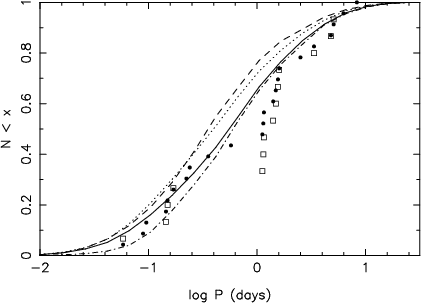 |
Figure 4:
Cumulative distribution of periods. Solid line for model A2
as in Fig. 3, dashed line for the same model but
with
 ,
dash-dotted line for a model
with ,
dash-dotted line for a model
with
 and finally the dotted line for model C
(constant SFR)
and finally the dotted line for model C
(constant SFR) |
|
|
#wd | #wdwd | #SN Ia prog |
| 15.0 | 855 | 220 | 0.9 |
| 15.5 | 1789 | 421 | 1.7 |
| 16.0 | 3661 | 789 | 3.2 |
| 17.0 | 12155 | 2551 | 11.2 |
Before turning to the mass ratio distribution, we illustrate the
influence of the model parameters we choose. We do this by showing
cumulative period distributions for some models with different
parameters in Fig. 4;
(dashed line) and
(dash-dotted line). It
shows that the change in parameters influences the distributions less
than the different cooling models discussed above, although the
observations favour a higher
 .
We also
included the cumulative distribution for model C (with a constant SFR;
dotted line) which differs from that for model A2 in that it has fewer
long period systems. This is a consequence of the larger relative
importance of old, low-mass progenitor binaries in model A2, which
lose less mass and thus shrink less in the first phase of mass
transfer (see Eq. (A.16)).
.
We also
included the cumulative distribution for model C (with a constant SFR;
dotted line) which differs from that for model A2 in that it has fewer
long period systems. This is a consequence of the larger relative
importance of old, low-mass progenitor binaries in model A2, which
lose less mass and thus shrink less in the first phase of mass
transfer (see Eq. (A.16)).
 |
Figure 6:
Cumulative mass ratio distributions for the models A2
(solid line) and A (dotted line) as explained in
Sect. 6.4. The observed mass ratio's are plotted as the
open squares
(dotted line) as explained in
Sect. 6.4. The observed mass ratio's are plotted as the
open squares |
Our assumption that a common envelope can be avoided in the first
phase of mass transfer between a giant and a main-sequence star, is
reflected in the mass ratios of the model systems. A clear prediction
of the model is that close binary white dwarfs must concentrate to
 For the observed systems, the mass ratio can only be
determined if both components can be seen, which in practice requires
that the luminosity of the fainter component is more than 20% of that
of the brighter component (Moran et al. 2000). Applying this selection
criterium to the theoretical model, we obtain the distribution shown
in Fig. 5 for the magnitude limited sample. Note that
since lower mass white dwarfs cool slower this selection criterion
favours systems with mass ratios above unity. In the same figure we
also show the observed systems.
For comparison we also computed a run (A)
in which we used
the standard common envelope treatment for the first phase of mass
transfer, which is done by ITY97 and HAN98.
The fraction of double white dwarfs for which the mass ratio can be
determined according to the selection criterium of a luminosity ratio
greater than 0.2, is 27% for model A2 and 24% for model A.
In a total of 14 systems one thus expects
For the observed systems, the mass ratio can only be
determined if both components can be seen, which in practice requires
that the luminosity of the fainter component is more than 20% of that
of the brighter component (Moran et al. 2000). Applying this selection
criterium to the theoretical model, we obtain the distribution shown
in Fig. 5 for the magnitude limited sample. Note that
since lower mass white dwarfs cool slower this selection criterion
favours systems with mass ratios above unity. In the same figure we
also show the observed systems.
For comparison we also computed a run (A)
in which we used
the standard common envelope treatment for the first phase of mass
transfer, which is done by ITY97 and HAN98.
The fraction of double white dwarfs for which the mass ratio can be
determined according to the selection criterium of a luminosity ratio
greater than 0.2, is 27% for model A2 and 24% for model A.
In a total of 14 systems one thus expects  and
and  systems
of which the mass ratio can be determined. Model A2 fits the observed number
better, but the numbers are too small to draw conclusions. The
distribution of mass ratios in model A
(Fig. 5,
bottom) however clearly does not describe the observations as
well as our model A2, as illustrated in more detail in a plot where
the cumulative mass ratio distributions of the two models and the
observations are shown (Fig. 6).
systems
of which the mass ratio can be determined. Model A2 fits the observed number
better, but the numbers are too small to draw conclusions. The
distribution of mass ratios in model A
(Fig. 5,
bottom) however clearly does not describe the observations as
well as our model A2, as illustrated in more detail in a plot where
the cumulative mass ratio distributions of the two models and the
observations are shown (Fig. 6).
Figures 7 and 8 show the model
spectrum of white dwarf masses for models B and A2, including both
single and double white dwarfs for a limiting magnitude
.
For this plot we consider as "single'' white dwarfs all objects
that were born in initially wide pairs, single merger products, white
dwarfs that became single as a result of binary disruption by SN
explosions, white dwarfs in close pairs which are brighter than their
main-sequence companions and genuine single white dwarfs for the
models with an initial binary fraction smaller than 100%.
These model spectra can be compared to the observed mass spectrum of
DA white dwarfs studied by Bergeron et al. (1992)
and Bragaglia et al. (1995), shown in
Fig. 9. The latter distribution may have to be
shifted to higher masses by about 0.05,
if one uses models of
white dwarfs with thick hydrogen envelopes for mass estimates
(Napiwotzki et al. 1999). Clearly, a binary fraction of 50% fits the observed
sample better, if indeed helium white dwarfs cool much slower than CO
white dwarfs. We can also compare the absolute numbers. Maxted & Marsh (1999)
conclude that the fraction of close double white dwarfs among DA white
dwarfs is between 1.7 and 19% with 95% confidence. For model B the
fraction of close white dwarfs is 43% (853 white dwarfs of
which 368 are close pairs), for model A2 is is 26% (855 white
dwarfs and 220 close pairs). Note that this fraction slightly
decreases for higher limiting magnitudes because the single white
dwarfs are more massive and thus generally dimmer, sampling a
different fraction of Galaxy. An even lower binary fraction apparently
would fit the data better, but is in conflict with the estimated
fraction of binaries among normal main sequence binaries
(Abt 1983; Duquennoy & Mayor 1991).
However this number highly depends on uncertain
selection effects.
There are some features in the model mass spectrum in model A2 that
appear to be in conflict with observations. The first is the clear
trend that with the cooling models of DSBH98, even with
our modifications, there should be an increasing number of helium
white dwarfs towards lower masses. The observed distribution is flat.
A very simple numerical experiment in which we assign a cooling curve
to all helium white dwarfs as the one for a 0.414
white dwarf
according to DSBH98 and a cooling curve as for a
0.605
white dwarf according to Blöcker (1995)
for
all CO white
dwarfs (Fig. 10), shows that an equal cooling time
for all helium white dwarfs seems to be in better agreement with the
observations. It has a fraction of double white dwarfs of 18%.
Another feature is the absence of stars with 0.45
 0.5 in the model distributions. This is a consequence of the fact that
in this interval in our models only hybrid white dwarfs can be
present, which have a low formation probability (see
Sect. 6.2).
0.5 in the model distributions. This is a consequence of the fact that
in this interval in our models only hybrid white dwarfs can be
present, which have a low formation probability (see
Sect. 6.2).
We conclude that an initial binary fraction of 50% can explain the observed close binary fraction in the white dwarf population. The shape of the mass spectrum, especially for the helium white dwarfs is a challenge for detailed mass determinations and cooling models.
 |
Figure 7: Mass spectrum of all white dwarfs for model B (100% binaries). Members of close double white dwarfs are in grey. The cumulative distribution is shown as the solid black line. For comparison, the grey line shows the cumulative distribution of the observed systems (Fig. 9) |
 |
Figure 9: Mass spectrum of observed white dwarfs. Data are taken from Bergeron et al. (1992) and Bragaglia et al. (1995). The solid line is the cumulative distribution |
 |
Figure 10:
Mass spectrum of all white dwarfs as in
Fig. 8 in a model in which all helium white dwarfs
cool like a 0.4
dwarf and all CO white dwarfs cool like a
0.6
white dwarf. Lines are cumulative distributions for the
model (black) and the observations (grey) |
| Model | SFH | % bin | #wd |
 |
 |
 |
| 109 | (10-3) | (10-12) | ||||
| A | Exp | 50 | 9.2 | 1.1 | 19 | 2.3 |
| C | Const | 50 | 4.1 | 0.8 | 8.5 | 1.7 |
| Obs | 4-20 | 3 |
Finally, we compare models A and C (see Table 1), which differ only by the assumed star formation history. The star formation rate was probably higher in the past than at present and some (double) white dwarfs descend from stars that are formed just after the galactic disk was formed.
Table 5 gives the formation rates of PN and the total number of white dwarfs in the Galaxy for models A and C. The total number of white dwarfs is computed by excluding all white dwarfs in binaries where the companion is brighter. The local density of white dwarfs and PN rate are computed with Eq. (3) as described in Sect. 4.4.
We can compare these numbers with the observational estimates for the
local PN formation rate of 3 10-12 pc-3 yr-1(Pottasch 1996) and the local space density of white dwarfs, which range
from e.g. 4.2 10-3 pc-3 (Knox et al. 1999) through
7.6+3.7-0.7 10-3 pc-3 (Oswalt et al. 1995) and
10 10-3 pc-3 (Ruiz & Takamiya 1995) to  10-3 pc-3 (Festin 1998).
This list shows the large uncertainty in the observed local space density of white dwarfs. It appears that the lower values are somewhat favoured in the literature. Both models A and C appear for the moment to be consistent with the observed local white dwarf space density and with the PN formation rate. However, we prefer model A2 since it fits the period distribution better (see Fig. 4).
The ratio of the local space density of white dwarfs to the current
local PN formation rate could in principle serve as a diagnostic for
the star formation history of the Galaxy, given better knowledge of
,
which critically depends on the estimates of the
incompleteness of the observed white dwarf samples and the applied
cooling curves.
Copyright ESO 2001
 )
are in units of yr-1 in the
Galaxy. All numbers (#) are total numbers in the Galaxy. Close
double white dwarfs are represented with (wd, wd). See
Sect.
)
are in units of yr-1 in the
Galaxy. All numbers (#) are total numbers in the Galaxy. Close
double white dwarfs are represented with (wd, wd). See
Sect. 
