

 )
and large rotational velocities (
)
and large rotational velocities (
 km s-1), whereas most of the non-runaways have normal helium
abundances and rotational velocities. Only one classical runaway star,
AE Aur, does not follow this trend, and this was already suspected to
be the result of the DES rather than the BSS. Blaauw suggested that
the
km s-1), whereas most of the non-runaways have normal helium
abundances and rotational velocities. Only one classical runaway star,
AE Aur, does not follow this trend, and this was already suspected to
be the result of the DES rather than the BSS. Blaauw suggested that
the
 -diagram of the small
sample of known runaway stars supported the conjecture that most
runaways are produced by the BSS, since these characteristics are
natural consequences of close binary evolution (Sect. 1; van
den Heuvel 1985).
-diagram of the small
sample of known runaway stars supported the conjecture that most
runaways are produced by the BSS, since these characteristics are
natural consequences of close binary evolution (Sect. 1; van
den Heuvel 1985).
As shown in Table 3, only five of the 23 runaways listed
there have a measurement of  ,
and six do not have a measured
rotational velocity. In order to pursue Blaauw's suggestion, we
therefore constructed a sample of O stars with known rotational
velocities (Penny 1996) and helium abundances (Kudritzki &
Hummer 1990; Herrero et al. 1992). We also
determined, based on Hipparcos astrometry and Hipparcos Input
Catalogue radial velocities, the space velocities of these stars with
respect to their local standard of rest. The
diagram in the left panel of
Fig. 16 shows that these O stars can roughly be divided
into three groups:
(i) those with small rotational velocities,
,
and six do not have a measured
rotational velocity. In order to pursue Blaauw's suggestion, we
therefore constructed a sample of O stars with known rotational
velocities (Penny 1996) and helium abundances (Kudritzki &
Hummer 1990; Herrero et al. 1992). We also
determined, based on Hipparcos astrometry and Hipparcos Input
Catalogue radial velocities, the space velocities of these stars with
respect to their local standard of rest. The
diagram in the left panel of
Fig. 16 shows that these O stars can roughly be divided
into three groups:
(i) those with small rotational velocities,
 km s-1, and normal helium abundances,
 ,
(ii) those with moderate rotational velocities,
,
(ii) those with moderate rotational velocities,
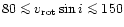 km s-1, and normal to high
helium abundances,
km s-1, and normal to high
helium abundances,
 ,
and
(iii) those with large rotational velocities,
km s-1, and high helium abundances,
,
and
(iii) those with large rotational velocities,
km s-1, and high helium abundances,
 .
The symbols in the left panel of Fig. 16 are chosen
according to the magnitude of the space velocity. The stars
represented by filled circles have space velocities
.
The symbols in the left panel of Fig. 16 are chosen
according to the magnitude of the space velocity. The stars
represented by filled circles have space velocities
 km s-1, and the open circles have
 km s-1; the other symbols indicate
stars for which no Hipparcos data are available (asterisks) or for
stars with insignificant Hipparcos data (starred).
km s-1; the other symbols indicate
stars for which no Hipparcos data are available (asterisks) or for
stars with insignificant Hipparcos data (starred).
![\begin{figure}\includegraphics[angle=0.0, width=15.5cm, clip=true, keepaspectratio=true]{10198_fig17.eps} \end{figure}](/articles/aa/full/2001/02/aa10198/img335.gif) |
Figure 17: Colour vs. absolute magnitude diagrams of the runaways (stars) and their parent association/cluster (small dots). The association/cluster members have been de-reddened using the Q-method. The colours and absolute magnitudes of the runaways have been determined using their spectral types (Table 3; Schmidt-Kaler 1983). The isochrones are from Schaller et al. (1992) for Solar metallicity and standard mass loss. The ages of the associations are indicated in the top right of each panel (US: Upper Scorpius, UCL: Upper Centaurus Lupus, LCC: Lower Centaurus Crux) |
diagram now shows a clear
separation between the runaway stars and the normal O stars. Except
for AE Aur (Sect. 4) all runaways have high helium
abundances,
 ,
and large rotational velocities,
km s-1. Only one star in
this area of the
diagram is
not indicated as a runaway: the double star HIP 113306 (OV7n). This
star is a member of Cep OB3 (
,
and large rotational velocities,
km s-1. Only one star in
this area of the
diagram is
not indicated as a runaway: the double star HIP 113306 (OV7n). This
star is a member of Cep OB3 (
 ,
,
 km s-1).
We thus confirm Blaauw's conclusion that massive runaways predominantly have high helium abundances and large rotational velocities, suggesting that they are formed mainly by the binary-supernova scenario. However, this conclusion is based on a limited sample which is by no means statistically complete. A systematic survey of the radial velocities, rotational velocities and chemical abundances of the early-type stars in the Solar neighbourhood is highly desirable.
© ESO 2001