![[*]](/icons/foot_motif.gif)
A&A 491, 455-464 (2008)
DOI: 10.1051/0004-6361:200810432
B. Vollmer1 - J. Braine2 - C. Pappalardo1 - P. Hily-Blant3
1 - CDS, Observatoire astronomique de Strasbourg, 11 rue de l'université,
67000 Strasbourg, France
2 - Laboratoire d'Astrophysique de Bordeaux (OASU), Université de Bordeaux, UMR 5804, CNRS/INSU, BP 89, 33270 Floirac, France
3 - IRAM, Domaine Universitaire, 300 rue de la Piscine, 38406 Saint-Martin d'Hères, France
Received 20 June 2008 / Accepted 17 September 2008
Abstract
Context. IRAM 30 m 12CO(1-0) and 12CO(2-1) HERA observations are presented for the ram-pressure stripped Virgo spiral galaxy NGC 4522. The CO emission is detected in the galactic disk and the extraplanar gas. The extraplanar CO emission follows the morphology of the atomic gas closely but is less extended. The CO maxima do not appear to correspond to regions where there is peak massive star formation as probed by H emission. The presence of molecular gas is a necessary but not sufficient condition for star formation. Compared to the disk gas, the molecular fraction of the extraplanar gas is 30% lower and the star formation efficiency of the extraplanar gas is about 3 times lower. The comparison with an existing dynamical model extended by a recipe for distinguishing between atomic and molecular gas shows that a significant part of the gas is stripped in the form of overdense arm-like structures. It is argued that the molecular fraction depends on the square root of the total large-scale density. Based on the combination of the CO/H
and an analytical model, the total gas density is estimated to be about 4 times lower than that of the galactic disk. Molecules and stars form within this dense gas according to the same laws as in the galactic disk, i.e. they mainly depend on the total large-scale gas density. Star formation proceeds where the local large-scale gas density is highest. Given the complex 3D morphology this does not correspond to the peaks in the surface density. In the absence of a confining gravitational potential, the stripped gas arms will most probably disperse; i.e. the density of the gas will decrease and star formation will cease.
emission. The presence of molecular gas is a necessary but not sufficient condition for star formation. Compared to the disk gas, the molecular fraction of the extraplanar gas is 30% lower and the star formation efficiency of the extraplanar gas is about 3 times lower. The comparison with an existing dynamical model extended by a recipe for distinguishing between atomic and molecular gas shows that a significant part of the gas is stripped in the form of overdense arm-like structures. It is argued that the molecular fraction depends on the square root of the total large-scale density. Based on the combination of the CO/H
and an analytical model, the total gas density is estimated to be about 4 times lower than that of the galactic disk. Molecules and stars form within this dense gas according to the same laws as in the galactic disk, i.e. they mainly depend on the total large-scale gas density. Star formation proceeds where the local large-scale gas density is highest. Given the complex 3D morphology this does not correspond to the peaks in the surface density. In the absence of a confining gravitational potential, the stripped gas arms will most probably disperse; i.e. the density of the gas will decrease and star formation will cease.
Key words: galaxies: individual: NGC 4522 - galaxies: interactions - galaxies: ISM - galaxies: kinematics and dynamics - stars: formation - radio lines: ISM
The best-studied case of active ram-pressure stripping of a cluster galaxy is NGC 4522 located in the Virgo cluster. Only in this cluster is the resolution of radio telescopes
sufficient (
 kpc) for a detailed analysis of the gas morphology and kinematics.
NGC 4522 is a rather small (
D25=4'=20 kpc) edge-on Sc galaxy with a rotation velocity of
kpc) for a detailed analysis of the gas morphology and kinematics.
NGC 4522 is a rather small (
D25=4'=20 kpc) edge-on Sc galaxy with a rotation velocity of  100 km s-1. It is strongly H I deficient (DEF=0.6; Helou et al. 1984). Its projected distance to the cluster center (M 87) is large (1 Mpc), and its radial velocity with respect to the Virgo cluster mean is high (1150 km s-1). H I and H
observations (Kenney et al. 2004; Kenney & Koopmann 1999) show a
heavily truncated gas disk at a radius of 3 kpc, which is 40% of the optical radius, and a significant amount of extraplanar gas to the west
of the galactic disk. The one-sided extraplanar atomic gas distribution shows high column densities, comparable to those of the adjacent galactic disk. The 6 cm polarized radio continuum emission shows a maximum at the eastern edge of the galactic disk, on the opposite side of the extraplanar gas and star formation. Since the stellar disk is symmetric and undisturbed (Kenney & Koopmann 1999),
a tidal interaction is excluded as the origin of the peculiar
gas distribution of NGC 4522. Thus, this galaxy undergoes ram-pressure
stripping due to the galaxy's rapid motion within the hot and tenuous intracluster gas (ICM) of the Virgo cluster.
100 km s-1. It is strongly H I deficient (DEF=0.6; Helou et al. 1984). Its projected distance to the cluster center (M 87) is large (1 Mpc), and its radial velocity with respect to the Virgo cluster mean is high (1150 km s-1). H I and H
observations (Kenney et al. 2004; Kenney & Koopmann 1999) show a
heavily truncated gas disk at a radius of 3 kpc, which is 40% of the optical radius, and a significant amount of extraplanar gas to the west
of the galactic disk. The one-sided extraplanar atomic gas distribution shows high column densities, comparable to those of the adjacent galactic disk. The 6 cm polarized radio continuum emission shows a maximum at the eastern edge of the galactic disk, on the opposite side of the extraplanar gas and star formation. Since the stellar disk is symmetric and undisturbed (Kenney & Koopmann 1999),
a tidal interaction is excluded as the origin of the peculiar
gas distribution of NGC 4522. Thus, this galaxy undergoes ram-pressure
stripping due to the galaxy's rapid motion within the hot and tenuous intracluster gas (ICM) of the Virgo cluster.
Vollmer et al. (2006) made a dynamical model that includes the effects of ram pressure for NGC 4522.
The model successfully reproduces the large-scale gas distribution and the velocity field.
By assuming a Gaussian distribution of relativistic electrons, they obtained the distribution of polarized radio continuum emission, which reproduces the VLA observations of polarized radio continuum emission at 6 cm. The observed maximum of the polarized radio continuum emission is successfully reproduced. The eastern ridge of polarized radio continuum emission is therefore due to ram pressure compression of the
interstellar medium (ISM) and its magnetic field.
The dynamical model and the analysis of the stellar populations of the outer gas-free disk using optical spectra and UV photometry (Crowl & Kenney 2006) indicate that the ram pressure maximum occurred only 50-100 Myr ago. This scenario has one important caveat: the large projected distance of NGC 4522 (1 Mpc) to the center of the Virgo cluster (M 87). Assuming a static smooth ICM and standard values for the ICM density and the galaxy velocity, the ram pressure at that location seems to be too low by an order of magnitude to produce the observed truncation of the gas disk.
A natural explanation for the enhanced ram pressure efficiency is that the intracluster medium is not static but moving due to the infall of the M 49 group of galaxies from behind (Kenney et al. 2004; Vollmer et al. 2004; Vollmer et al. 2006). In this case the galaxy has just passed the region of highest intracluster medium velocity.
While we know from the H
observations (Kenney et al. 2004; Kenney & Koopmann 1999)
that stars are forming in the extraplanar gas, we do not know the distribution of molecular gas
in these regions. How does the complex multiphase interstellar medium respond to ram pressure
stripping? Can we model the molecular gas content during the interaction using simplified recipes?
Can dense molecular gas decouple from the ram pressure wind as suggested for NGC 4438
(Vollmer et al. 2005)? In this article we present IRAM 30 m 12CO(1-0) and 12CO(2-1) HERA observations of NGC 4522 to investigate the fate of the stripped gas.
We present our CO observations in Sect. 2 followed by the observational results in Sect. 3. The detection of ram pressure wind decoupled molecular clouds is reported in Sect. 4. In Sect. 5 we compare our CO observations to existing H I and H
emission distributions (Kenney et al. 2004) and to the dynamical model of Vollmer et al. (2006). The molecular fraction and star formation efficiencies are discussed in Sect. 6 and we give our conclusions in Sect. 7.
The observations of the CO(1-0) and CO(2-1) lines, with rest frequencies of 115.271204 and 230.53799 GHz respectively, were carried out at the 30 m millimeter-wave telescope on Pico Veleta (Spain) run by the Institut de RadioAstronomie Millimétrique (IRAM). The CO(2-1) observations used the HERA multi-beam
array, with
 dual-polarization receivers, and the WILMA autocorrelator backend with 2 MHz spectral resolution. The CO(1-0) observations used the single-pixel ``AB'' receivers
and the 1 MHz filterbanks as backends. The spectral resolution is 2.6 km s-1 in
both cases. The HERA observations were made in February and March 2006 and the CO(1-0) in November 2006. In both cases, a nutating secondary (``wobbler'') was used with a throw of 180-200 arcsec in order to be clear of any emission from the galaxy. The positions observed in each line are indicated in Figs. 1
and 2 as triangles for CO(2-1) and circles for CO(1-0).
dual-polarization receivers, and the WILMA autocorrelator backend with 2 MHz spectral resolution. The CO(1-0) observations used the single-pixel ``AB'' receivers
and the 1 MHz filterbanks as backends. The spectral resolution is 2.6 km s-1 in
both cases. The HERA observations were made in February and March 2006 and the CO(1-0) in November 2006. In both cases, a nutating secondary (``wobbler'') was used with a throw of 180-200 arcsec in order to be clear of any emission from the galaxy. The positions observed in each line are indicated in Figs. 1
and 2 as triangles for CO(2-1) and circles for CO(1-0).
![\begin{figure}
\par\includegraphics[width=9cm,clip]{10432fig1.eps}\end{figure}](/articles/aa/full/2008/44/aa10432-08/img11.gif) |
Figure 1: IRAM 30 m pointings on a DSS B band image. Triangles: 12CO(2-1) HERA observations. Small circles: 12CO(1-0) observations. Large circles: Binned HERA pointings (see Fig. 7). The large boxes correspond to Figs. 3 to 6. |
| Open with DEXTER | |
![\begin{figure}
\par\includegraphics[width=9cm,clip]{10432fig2.eps}\end{figure}](/articles/aa/full/2008/44/aa10432-08/img12.gif) |
Figure 2: 12CO(2-1) HERA pointings (see Fig. 1) with low noise levels on the H I emission distribution (from Kenney et al. 2004). The large boxes correspond to Figs. 3 to 6. |
| Open with DEXTER | |
Data reduction was straightforward, eliminating any obviously bad channels
and excluding the spectra taken under particularly poor conditions (system temperature
over 1000 K). Spectra were then summed position by position.
System temperatures of the final spectra ranged from 200 to 500 K on the Ta* scale.
All spectra are presented on the main beam temperature scale, assuming telescope
main-beam and forward efficiencies of
 and
and
 for HERA and
 and
and
 for the CO(1-0) line.
The spectra near map edges with noise levels greater than 28 mK (
for the CO(1-0) line.
The spectra near map edges with noise levels greater than 28 mK (
 scale) are left out of Fig. 2. At the assumed distance of NGC 4522, 17 Mpc, the CO(2-1) and CO (1-0) beams correspond to 0.9 and 1.7 kpc respectively. In order to convert CO integrated intensities into molecular gas masses, we have assumed a
 ratio
of
ratio
of
 H2 mol cm-2 per K km s-1.
Our conclusions, however, do not depend strongly on the
H2 mol cm-2 per K km s-1.
Our conclusions, however, do not depend strongly on the
 ratio within reasonable variations.
Figures 3-6 show the 12CO(2-1) HERA spectra (resolution of 11'') together with the H I spectra of Kenney et al. (2004; resolution of 20'') and the model H I and CO emission convolved to the observational resolutions (see Sect. 5). We observe that the H I emission is more extended than the CO emission. Where detected, the velocity of the CO lines are close to the H I velocities. In general, CO linewidths are comparable to the H I linewidths in the galactic disk (Fig. 4), but smaller in the extraplanar regions (Figs. 3, 6). A double-line profile is observed in the CO and H I line west of the galaxy center at offsets (-23,0), (-23,8)(Fig. 5). This kind of line-profile has also been observed in NGC 4438 (Vollmer et al. 2005) another Virgo spiral galaxy which undergoes ram pressure stripping together with a tidal interaction. In the southwestern part of the extraplanar gas the H I profiles show a blueshifted wing (Fig. 6), corresponding to the most strongly pushed gas. Whereas the CO peak in this region is aligned with the H I peak, the blueshifted wing is absent in CO. This might be partly due to the smaller S/N ratio of the CO data compared to the H I data. Even if there is H2 associated with the blueshifted wing, we can conclude that the molecular fraction in this extraplanar gas is lower in the blueshifted wing than in the main line.
Figure 7 shows 12CO(2-1) HERA spectra of selected regions (large circles in Figs. 1, 2). To obtain a better S/N ratio, the HERA spectra within each region were averaged. These selected regions show the following characteristics:
20 km s-1 with respect to the H I line (Fig. 7 left panel).
0.5). Given the sharpness of the gas distribution at the eastern edge and the
pointing uncertainty of the telescope at 115 GHz, this small line ratio
could be due to an offset of the CO(1-0) pointing to the west, i.e. closer to the major axis, with respect to the CO(2-1) pointing.
![\begin{figure}
\par\includegraphics[width=8.5cm,clip]{10432fig3.eps}\end{figure}](/articles/aa/full/2008/44/aa10432-08/img21.gif) |
Figure 3:
IRAM 30 m HERA 12CO(2-1) spectra of the northeastern box of Fig. 1 (black lines). H I spectra from Kenney et al. (2004; red lines). CO (green lines) and H I (blue lines) spectra from the dynamical model of Vollmer et al. (2006). The velocity scale is from 2150 to 2550 km s-1 and the main-beam temperature scale from -40 mK to 80 mK (
scale). |
| Open with DEXTER | |
![\begin{figure}
\par\includegraphics[width=8.68cm,clip]{10432fig4.eps}\end{figure}](/articles/aa/full/2008/44/aa10432-08/img22.gif) |
Figure 4: Same as Fig. 3. |
| Open with DEXTER | |
![\begin{figure}
\par\includegraphics[width=8.8cm,clip]{10432fig5.eps}\end{figure}](/articles/aa/full/2008/44/aa10432-08/img23.gif) |
Figure 5: Same as Fig. 3. |
| Open with DEXTER | |
![\begin{figure}
\par\includegraphics[width=8.8cm,clip]{10432fig6.eps}\end{figure}](/articles/aa/full/2008/44/aa10432-08/img24.gif) |
Figure 6: Same as Fig. 3. |
| Open with DEXTER | |
![\begin{figure}
\par\includegraphics[width=2.9cm,clip]{10432fig7a.eps}\includegra...
...p]{10432fig7b.eps}\includegraphics[width=2.9cm,clip]{10432fig7c.eps}\end{figure}](/articles/aa/full/2008/44/aa10432-08/img25.gif) |
Figure 7: Binned IRAM 30 m HERA 12CO(2-1) spectra (see large circles in Fig. 1). H I spectra from Kenney et al. (2004) (red lines). CO (green lines) and H I (blue lines) spectra from the dynamical model of Vollmer et al. (2006). |
| Open with DEXTER | |
![\begin{figure}
\par\includegraphics[angle=-90,width=9cm,clip]{10432fig8.eps}\end{figure}](/articles/aa/full/2008/44/aa10432-08/img26.gif) |
Figure 8: Black: 12CO(1-0) spectra (see small circles in Fig. 1). Red: convolved 12CO(2-1) HERA spectra. |
| Open with DEXTER | |
In another Virgo spiral galaxy, NGC 4438, Vollmer et al. (2005) found CO emission
not associated with any H I emission. NGC 4438 underwent a tidal interaction 100 Myr ago (Combes et al. 1988) and now undergoes severe ram pressure stripping (Vollmer et al. 2005). A narrow CO line was detected in the northern tidal arm of NGC 4438, with apparently no associated H I.
Since the velocity of the CO line corresponds to that of the stellar component (determined using a dynamical model of the tidal interaction), Vollmer et al. (2005) claimed that these molecular clouds were too dense to be affected by ram pressure, i.e. that they decoupled from the ram pressure wind.
Based on these findings we searched for CO lines in regions devoid of any H I emission: (i) in the ram pressure stripped outer galactic disk (Fig. 9); and (ii) between the northern galactic disk and the extraplanar H I emission (Fig. 10).
We only detect one CO line in the northern part of the galactic disk. The most prominent CO line is detected at the position (30,68); see the little box in Figs. 1
and 2), i.e. between the stellar disk and the stripped extraplanar atomic gas.
The radial velocity of the CO lines is 2250 km s-1, close to the
velocity of the stellar component. The H I line of the stripped
extraplanar H I (Fig. 3) is blueshifted by 30 km s-1. We observe a clear absence of a CO line in the gas-free southwestern part of the disk (Fig. 9 right panel), for which an explanation is proposed in Sect. 6.1.
![\begin{figure}
\par\includegraphics[angle=-90,width=9cm,clip]{10432fig9.eps}\end{figure}](/articles/aa/full/2008/44/aa10432-08/img27.gif) |
Figure 9: Average 12CO(2-1) spectra of the northeastern (45,68) and the southwestern (-38,-61) ends of the galactic disk, where the atomic hydrogen has been removed by ram pressure. No H I emission is detected nor does the model predict any gas. The spectra are averaged over a region of 20''. |
| Open with DEXTER | |
![\begin{figure}
\par\includegraphics[angle=-90,width=8.8cm,clip]{10432fig10.eps}\end{figure}](/articles/aa/full/2008/44/aa10432-08/img28.gif) |
Figure 10: Single 12CO(2-1) HERA spectrum in the northeast that is located outside the H I distribution. The position is marked with an additional box in Fig. 2. |
| Open with DEXTER | |
In this section we will compare the molecular gas and H
distribution to the dynamical model of Vollmer et al. (2006).
In order to estimate the H2 column density distribution, via a zero
moment (integrated intensity) map of the CO(2-1) emission, we proceed as below. For the positions where the S/N of the H I is higher than 2.5 ,
the linewidths of the H I spectra of these positions are determined and the CO spectra integrated over the H I velocity range.
This leads to the CO emission distribution map of Fig. 11
(top panel).
,
the linewidths of the H I spectra of these positions are determined and the CO spectra integrated over the H I velocity range.
This leads to the CO emission distribution map of Fig. 11
(top panel).
![\begin{figure}
\par\includegraphics[width=6.1cm,clip]{10432fig11a.ps}\\ [2mm]
\...
...g11b.ps}\\ [2mm]
\includegraphics[width=6.1cm,clip]{10432fig11c.ps}\end{figure}](/articles/aa/full/2008/44/aa10432-08/img32.gif) |
Figure 11:
Top panel: 12CO(2-1) emission distribution (solid line) on the H I emission distribution (dotted line). The plus signs show the IRAM HERA pointings which were used to construct the CO moment 0 map. Middle panel: model CO distribution (solid line) on the model H I emission distribution (dotted line). The gas is assumed to be entirely molecular for gas densities
 pc-3. Lower panel: model CO distribution (solid line) on the model H I emission distribution (dotted line). The molecular gas fraction is calculated using pc-3. Lower panel: model CO distribution (solid line) on the model H I emission distribution (dotted line). The molecular gas fraction is calculated using
 .
The letters refer to the regions shown in the deprojection in Fig. 14. .
The letters refer to the regions shown in the deprojection in Fig. 14. |
| Open with DEXTER | |
To compare the H I and the CO emission distributions with the dynamical model of Vollmer et al. (2006), we assume that the molecular fraction of the gas depends on the local gas density. In a first simple approach we assume that the gas is bimodal, i.e. entirely molecular at densities >0.03  pc-3=1 cm-3 and entirely atomic at lower
gas densities. The resulting model gas distribution maps were convolved to the observational resolutions (middle panel of Fig. 11).
In a second approach we assume that the molecular fraction depends linearly on the square root of the gas density
.
Moreover, the molecular fraction cannot exceed unity. In Sect. 6.2 we will give a motivation for this dependency. The resulting model CO emission distribution is shown in the lower panel of Fig. 11.
pc-3=1 cm-3 and entirely atomic at lower
gas densities. The resulting model gas distribution maps were convolved to the observational resolutions (middle panel of Fig. 11).
In a second approach we assume that the molecular fraction depends linearly on the square root of the gas density
.
Moreover, the molecular fraction cannot exceed unity. In Sect. 6.2 we will give a motivation for this dependency. The resulting model CO emission distribution is shown in the lower panel of Fig. 11.
The comparison between the observed and the simulated CO emission distribution shows the following similarities:
The direct comparison between the H I and CO model and observed spectra (Figs. 3 to 7) shows good agreement for high intensities, i.e. high gas densities. However, the observed CO and H I double lines and blueshifted wings of the H I lines in the western extraplanar regions are not reproduced by the model. This is due to the constant column density of the model gas in the regions affected by ram pressure (see Sect. 6).
In typical spiral galaxies the star formation rate follows more closely the molecular gas distribution than the atomic gas distribution (Wong & Blitz 2002). The H I surface density saturates at a value of
 pc-2 or even declines for high
star formation rates per unit surface. In an unperturbed galactic disk the ISM is confined in the gravitational potential of the disk.
The ISM is turbulent and this turbulence is most probably maintained by the energy input from SN explosions (see, e.g. MacLow & Klessen 2004, or Vollmer & Beckert 2003).
Without a constant energy supply, turbulence is damped within a few Myr (Stone et al. 1998; MacLow 1999).
Since the extraplanar gas of NGC 4522 is no longer confined to the potential of the galactic disk, it represents an ideal laboratory to test if the gravitational potential plays a role for the correlation between star formation rate and the available molecular/atomic gas mass.
pc-2 or even declines for high
star formation rates per unit surface. In an unperturbed galactic disk the ISM is confined in the gravitational potential of the disk.
The ISM is turbulent and this turbulence is most probably maintained by the energy input from SN explosions (see, e.g. MacLow & Klessen 2004, or Vollmer & Beckert 2003).
Without a constant energy supply, turbulence is damped within a few Myr (Stone et al. 1998; MacLow 1999).
Since the extraplanar gas of NGC 4522 is no longer confined to the potential of the galactic disk, it represents an ideal laboratory to test if the gravitational potential plays a role for the correlation between star formation rate and the available molecular/atomic gas mass.
To do so, we first present the H
emission distribution overlaid onto the CO emission distribution (Fig. 12).
There is no major site of massive star formation without associated CO emission. At the edges and outside the galactic disk star formation does not coincide with the maxima of CO emission. A high column density of molecular gas is thus not sufficient to
form massive stars. In other words, on kpc scales the star formation rate does not directly depend on the molecular gas surface density. A number of H II regions
are detected at the outer edges of the CO emission distribution, at offsets (20'', 45''), (-10'', 20''), (-45'', 0), (-45'', -30'').
![\begin{figure}
\par\includegraphics[width=8cm,clip]{10432fig12.ps}\end{figure}](/articles/aa/full/2008/44/aa10432-08/img35.gif) |
Figure 12:
H
emission distribution (Kenney et al. 2004; contours) on the 12CO(2-1) emission distribution (greyscale). |
| Open with DEXTER | |
In the model we assume that the star formation rate is proportional to the number of collisions between the gas clouds. Numerically, the star formation rate thus depends on the local number density of the clouds, their cross section, and their local 3D velocity dispersion. Since the model clouds have a constant surface density (Vollmer et al. 2006), their cross sections vary with
the cloud mass in the following way:
 ,
where
,
where
 is
the radius,
is
the radius,
 the cloud mass and
  the gas surface density. The cloud mass distribution is a power law with an index of -1.5. For an isolated unperturbed spiral galaxy this prescription leads to a Schmidt law of the form
 ,
where
,
where
 is the star formation rate per area.
For the construction of a star formation distribution map we store all cloud-cloud collisions during 20 Myr before the present state of the galaxy. This is twice the timescale for H
emission, chosen to give more collisions and thus better statistics. The distribution was then convolved to 0.6 times the resolution of the CO(2-1) map.
This model star formation distribution is presented in Fig. 13 together with the H
emission distribution.
is the star formation rate per area.
For the construction of a star formation distribution map we store all cloud-cloud collisions during 20 Myr before the present state of the galaxy. This is twice the timescale for H
emission, chosen to give more collisions and thus better statistics. The distribution was then convolved to 0.6 times the resolution of the CO(2-1) map.
This model star formation distribution is presented in Fig. 13 together with the H
emission distribution.
![\begin{figure}
\par\includegraphics[width=15.5cm,clip]{10432fig13.eps} %
\end{figure}](/articles/aa/full/2008/44/aa10432-08/img42.gif) |
Figure 13:
Left panel: H I emission distribution on Hemission distribution (Kenney et al. 2004). Right panel: model H I distribution (Vollmer et al. 2006; contours) on the model massive star formation distribution (greyscale). Darker regions correspond to less massive star formation. |
| Open with DEXTER | |
We note the following points for comparison between the model and observations:
emission distribution.
The model gives us the unique opportunity to deproject the gas distribution.
One has to keep in mind that the extraplanar gas is no longer located within the galactic disk, but is a fully 3D feature. In Fig. 14, we present a deprojected face-on view of the model gas distribution of Fig. 11 (lower panel). The corresponding regions are labeled with capital letters.
Region A is the tip of a spiral arm close to the main gas disk. Region B is a large overdensity within the stripped gas. Region C represents the tip of the most prominent gas (spiral) arm which is mainly made
of stripped material. Region D is a secondary gas arm and region E is an overdensity in the windward, low-density side of the prominent gas (spiral) arm. As stated above, the gas outside the main gas disk (R < 30'') has a fully 3D structure. As can be seen in the lower panel of Fig. 11, the upper edge of the deprojected
gas distribution becomes the northeastern edge of the model distribution in the observed projection. The prominent gas (spiral) arm (D, C) runs in the observed projection vertically from the
southwestern edge of the galactic gas disk to the end of the gas distribution at (40,40) (Fig. 14). The southwestern extraplanar H I emission region
is made of relatively diffuse gas from the low-density side of the prominent gas (spiral) arm.
![\begin{figure}
\par\includegraphics[width=8cm,clip]{10432fig14.ps}\end{figure}](/articles/aa/full/2008/44/aa10432-08/img43.gif) |
Figure 14: Deprojected model CO distribution (solid line) on the deprojected H I distribution (dotted line). The letters correspond to the characteristic regions of Fig. 11. The galaxy is moving towards the lower left corner and rotates clockwise. |
| Open with DEXTER | |
emission distribution, but we
do not claim that this is the necessary configuration.
Most interestingly, we can identify the upbending arm (south of D, C on the lower panel of Fig. 11)
with a chain of observed H II regions (between (
 ,
,
 )
and
(
)
and
(
 ,
,
 )
on the left panel of Fig. 13 and the corresponding
molecular arm in Fig. 12. We think that this is a robust feature. As already stated in Sect. 5.1 the outer part of the upbending arm (Dec. offset 0'' to 40'' in the lower panel of Fig. 11) is not present in the observations. In deprojection this part of the arm is located between Dec. offsets of
20'' and 80'' (Fig. 14).
Due to its low total gas surface density
with respect to the inner part (Dec. offset -20'' to 0'') it is more
vulnerable to ram pressure stripping or evaporation
(the acceleration a due to ram pressure p is
)
on the left panel of Fig. 13 and the corresponding
molecular arm in Fig. 12. We think that this is a robust feature. As already stated in Sect. 5.1 the outer part of the upbending arm (Dec. offset 0'' to 40'' in the lower panel of Fig. 11) is not present in the observations. In deprojection this part of the arm is located between Dec. offsets of
20'' and 80'' (Fig. 14).
Due to its low total gas surface density
with respect to the inner part (Dec. offset -20'' to 0'') it is more
vulnerable to ram pressure stripping or evaporation
(the acceleration a due to ram pressure p is
 ).
This is consistent with the blueshift and large linewidth of the extraplanar low column density H I which is stripped more efficiently than the high column density gas (Fig. 9 of Vollmer et al. 2006). Moreover, the CO and H I spectra of the southern extraplanar H I region (Fig. 6)
show that CO is only associated with high column density H I at the highest velocities. Our numerical model cannot reproduce the more efficient stripping of low column density gas,
because it uses a constant column density for the atomic gas phase (see Vollmer et al. 2001 and Fig. 9 of Vollmer et al. 2006).
We therefore suggest that the outer part of the stripped gas arm has been stripped more efficienctly and now has a column density too low to be detected in the H I observations. On the other hand, very dense gas can decouple from the ram pressure wind (see Sect. 4)
as it is found in CO observations of NGC 4438 (Fig. 4 of Vollmer et al. 2005).
).
This is consistent with the blueshift and large linewidth of the extraplanar low column density H I which is stripped more efficiently than the high column density gas (Fig. 9 of Vollmer et al. 2006). Moreover, the CO and H I spectra of the southern extraplanar H I region (Fig. 6)
show that CO is only associated with high column density H I at the highest velocities. Our numerical model cannot reproduce the more efficient stripping of low column density gas,
because it uses a constant column density for the atomic gas phase (see Vollmer et al. 2001 and Fig. 9 of Vollmer et al. 2006).
We therefore suggest that the outer part of the stripped gas arm has been stripped more efficienctly and now has a column density too low to be detected in the H I observations. On the other hand, very dense gas can decouple from the ram pressure wind (see Sect. 4)
as it is found in CO observations of NGC 4438 (Fig. 4 of Vollmer et al. 2005).
We conclude that the formation of molecular clouds and star formation mainly depend on the large-scale overdensity of the gas more than on dynamical criteria or the overall pressure (see Sect. 6.3).
Wind-decoupled molecular gas is only found in the northern part of the galactic disk (Sect. 4). With the help of the deprojection (Fig. 14), this can be understood. High density gas is stripped from the left border of the gas disk. Since the ram pressure wind is rather face-on, the gas clouds are pushed to larger heights above the galactic plane. At the same time, rotation makes clouds move towards positions A and B, i.e. the northern part of the disk where the wind-decoupled molecular clouds are found. This finding suggests that dense giant molecular clouds can decouple from the ram pressure wind at early stages of the stripping of dense gas from the galactic disk, as seems to be the case for NGC 4438 as well.
As seen in Sect. 5.1 and Fig. 11, a molecular fraction which is proportional to the square root of the total gas density reproduces the observed CO emission distribution better than a simple bimodal molecular gas fraction assuming a gas density cutoff. Vollmer & Beckert (2003) approximated the molecular fraction by the ratio between the
turbulent crossing time scale
 and the
timescale for molecule formation
and the
timescale for molecule formation
 ,
where
,
where
 is the turbulent velocity dispersion within the cloud,
 the cloud density,
  the total large-scale gas density,
 the volume filling factor,
and
the constant of molecule formation
the volume filling factor,
and
the constant of molecule formation
 yr pc-3:
is defined by the condition that the gas clouds are self-gravitating, i.e. the turbulent cloud crossing time
 equals the free fall time
 of the clouds:
 .
For the dependence used in Sect. 5.1 we assume a constant volume filling factor (see Vollmer & Beckert 2003). A density of 0.5 pc-3 implies a
volume filling factor of
.
For the dependence used in Sect. 5.1 we assume a constant volume filling factor (see Vollmer & Beckert 2003). A density of 0.5 pc-3 implies a
volume filling factor of
 .
This is higher than the volume filling factors given in Vollmer & Beckert (2003). Equation (1) is
a crude approximation which may overestimate the molecular fraction by
a factor of 5-10, probably because
.
This is higher than the volume filling factors given in Vollmer & Beckert (2003). Equation (1) is
a crude approximation which may overestimate the molecular fraction by
a factor of 5-10, probably because
 is substantially overestimated by
 .
However, we think that its dependence on the physical parameters of the gas are valid. Equation (3) will be used together with a similar expression for the star formation efficiency in the next section. The observed molecular gas fraction decreases from 50% within the galactic disk to 35% in the extraplanar region (Table 1).
.
However, we think that its dependence on the physical parameters of the gas are valid. Equation (3) will be used together with a similar expression for the star formation efficiency in the next section. The observed molecular gas fraction decreases from 50% within the galactic disk to 35% in the extraplanar region (Table 1).
Does the star formation efficiency (SFE) change once the gas has left the confining gravitational potential of the galactic disk? The role of large-scale processes in provoking star formation is subject to debate, with many ``recipes'' providing reasonably similar fits to observations - e.g. the ``Toomre'' criterion (Kennicutt 1989), a pressure-based criterion (Blitz & Rosolowsky 2006), or a basic Schmidt (1959) law. The problem is not so much predicting the behavior in spiral disks but understanding what governs large-scale star formation in general in order to be able to understand other environments, typically those at intermediate and high redshifts. In classical dwarf galaxies, it is difficult to study the SFE because the low metallicity makes the measure of the H2 mass uncertain. In Tidal Dwarf Galaxies, morphologically similar but with higher metallicities, Braine et al. (2001) found that, curiously, the SFE was not identifiably different from spiral galaxies typically 100 times more massive. In the post-collision Taffy galaxies or UGC 813/816 system, on the other hand, the SFE in the bridge gas is much lower than within spiral disks (Braine et al. 2003, 2004).
The SFE can be defined with respect to the molecular gas mass
available or with respect to the total gas mass available, either
 or
or
 .
The observed gas masses, molecular fractions and star formation rates and timescales are presented in Table 1.
Whereas close to half of the H I is found beyond the galactic disk, this ratio decreases to 1/4 for the molecular gas and to 1/7 for the H
emission. The averaged star formation timescale based on the molecular or total gas mass increases from 2.2 or 4.7 Gyr within the galactic disk to 5.3 or 15.3 Gyr respectively within the extraplanar region. The star formation efficiency thus decreases by a factor of 3 between the disk and the extraplanar region.
.
The observed gas masses, molecular fractions and star formation rates and timescales are presented in Table 1.
Whereas close to half of the H I is found beyond the galactic disk, this ratio decreases to 1/4 for the molecular gas and to 1/7 for the H
emission. The averaged star formation timescale based on the molecular or total gas mass increases from 2.2 or 4.7 Gyr within the galactic disk to 5.3 or 15.3 Gyr respectively within the extraplanar region. The star formation efficiency thus decreases by a factor of 3 between the disk and the extraplanar region.
Table 1: Derived masses, molecular fractions, and star formation rates/timescales.
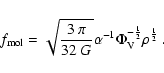
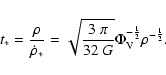
In the framework of the model of Vollmer & Beckert (2003) the local star formation rate is given by
is the probability of finding a self-gravitating cloud, i.e. the volume filling factor of self-gravitating clouds.
Inserting the expression for the free fall time of Eq. (2) into
Eq. (4) yields the following expression for the
star formation timescale which corresponds to the inverse of the star formation efficiency:
From Table 1 we obtain:
 |
(6) |
![\begin{figure}
\par\includegraphics[width=8.5cm,clip]{10432fig15a.ps}\includegraphics[width=8.5cm,clip]{10432fig15b.ps}\end{figure}](/articles/aa/full/2008/44/aa10432-08/img79.gif) |
Figure 15:
Left panel: contours of the 6 cm radio continuum emission from Vollmer et al. (2004) on the CO emission distribution (greyscale). The contour levels are (2,4, 6,8,10, 20,30,40, 50,60,
  Jy/beam. The resolution is Jy/beam. The resolution is
 .
Right panel: ratio between the 6 cm and CO emission. Brighter regions have higher CO/6 cm ratios. .
Right panel: ratio between the 6 cm and CO emission. Brighter regions have higher CO/6 cm ratios. |
| Open with DEXTER | |
We conclude that the stripped ISM still forms molecules and stars in a way not distinguishable from disk star formation (Eqs. (1) and (4)) as long as the overall gas density is high enough to form bound clouds. The ultimate fate of the stripped gas is probably ionization and evaporation, without star formation for the low-density gas, and after a generation of stars, which then disperse the remaining dense gas, for the initially denser gas.
As the simulations show (Fig. 14) part of the gas is stripped in relatively dense arms whose mean density is about 4 times lower than that of the galactic gas disk. Since these gas arm are only confined by the hot intracluster medium, they might ultimately disperse giving rise to a large low surface density tail as observed in NGC 4388 (Oosterloo & van Gorkom 2005).
Recently, Murphy et al. (2008a,b) compared Spitzer 24 m emission with 20 cm
radio continuum maps. The radio-FIR correlation is used to predict the radio
emission from the Spitzer 24 m emission. They found a radio deficient region at the eastern outer edge of NGC 4522's disk where ram pressure is pushing the interstellar medium. Since the 24 m dust emission is associated with molecular gas, we compare in Fig. 15 the 6 cm radio continuum emission from Vollmer et al. (2004) with the CO emission distribution. The extraplanar 6 cm radio continuum emission extends farther to the west than the CO emission. The radio emission of the northeastern disk extends in the region where we found CO emission without associated H I emission (Fig. 9). The northern extraplanar CO and H I
emission does not show associated radio continuum emission. We convolved the 6 cm
radio continuum and CO maps to a resolution
 and computed a ratio map which is shown in the right panel of Fig. 9. As expected, the 6 cm/CO ratio is highest in the extraplanar region. The smallest 6 cm/CO ratios are found at the extremities of the disk. We observe a maximum of the 6 cm/CO at the eastern edge of the galactic disk where Murphy et al. (2008a,b) detect a radio deficient region. Since we do not expect the 24 m emission to be
proportional to the CO emission, the interpretation of the result is difficult. In addition, we think that our data are not sensitive enough to draw a firm conclusion on the 6 cm/CO ratio map.
and computed a ratio map which is shown in the right panel of Fig. 9. As expected, the 6 cm/CO ratio is highest in the extraplanar region. The smallest 6 cm/CO ratios are found at the extremities of the disk. We observe a maximum of the 6 cm/CO at the eastern edge of the galactic disk where Murphy et al. (2008a,b) detect a radio deficient region. Since we do not expect the 24 m emission to be
proportional to the CO emission, the interpretation of the result is difficult. In addition, we think that our data are not sensitive enough to draw a firm conclusion on the 6 cm/CO ratio map.
We present IRAM 30 m 12CO(2-1) HERA and 12CO(1-0) observations of the ram pressure stripped Virgo spiral galaxy NGC 4522. We directly compare the CO spectra to the H I data cube of Kenney et al. (2004). In a second step a CO emission distribution map is produced in the regions where H I is detected. The CO emission distribution is compared to H
observations of Kenney et al. (2004) and to the model distribution of molecular gas derived from dynamical simulations of Vollmer et al. (2006). A map of the distribution of star formation based on the numerical cloud-cloud collisions is produced which is then compared to the H
emission distribution. The 3D model snapshot allows us to deproject the observed features and understand their origin.
From this work we conclude that:
emission. At the resolution of our observations, there is no correlation between the CO and H
peaks.
emission distribution.
conversion ratio.
50 Myr after peak ram pressure; Vollmer et al. 2006) a significant part of the stripped gas is in the form of relatively dense arms. At the same time some very dense molecular clouds, representing a tiny fraction of the stripped gas, can decouple from the ram pressure wind.
Molecules and stars form within the stripped dense gas according to the same laws as in the galactic disk, i.e. they mainly depend on the
overall total gas density. Star formation proceeds where the local large-scale gas density is highest. Given the complex 3D morphology this does not necessarily correspond to the peaks of the surface density.
In the absence of a confining gravitational potential these stripped gas
arms will most probably disperse, i.e. their density will decrease and star formation will cease.
Acknowledgements
Based on IRAM observations. IRAM is supported by INSU/CNRS (France), MPG (Germany), and IGN (Spain). We made use of a DSS image. The Digitized Sky Survey was produced at the Space Telescope Science Institute under US Government grant NAG W-2166. The images of these surveys are based on photographic data obtained using the Oschin Schmidt Telescope on Palomar Mountain and the UK Schmidt Telescope. The plates were processed into the present compressed digital form with the permission of these institutions.