A&A 489, 1355-1362 (2008)
DOI: 10.1051/0004-6361:200810321
Quasi-Hilda comet 147P/Kushida-Muramatsu
Another long temporary satellite capture by Jupiter
K. Ohtsuka1 -
T. Ito2 -
M. Yoshikawa3 -
D. J. Asher4 -
H. Arakida5
1 - Tokyo Meteor Network, Daisawa 1-27-5, Setagaya-ku, Tokyo 155-0032, Japan
2 -
National Astronomical Observatory of Japan,
Osawa 2-21-1, Mitaka, Tokyo 181-8588, Japan
3 -
JAXA, Yoshinodai 3-1-1, Sagamihara,
Kanagawa 229-8510, Japan
4 -
Armagh Observatory, College Hill, Armagh, BT61 9DG, UK
5 -
Waseda University, Nishi-Waseda 1-6-1, Shinjuku-ku,
Tokyo 169-8050, Japan
Received 3 June 2008 / Accepted 10 August 2008
Abstract
Context. The quasi-Hilda comets (QHCs), being in unstable 3:2 Jovian mean motion resonance, are considered a major cause of temporary satellite capture (TSC) by Jupiter. Although the QHCs may be escaped Hilda asteroids, their origin and nature have not yet been studied in sufficient detail. Of particular interest are long TSCs/orbiters. Orbiters - in which at least one full revolution about the planet is completed - are rare astronomical events, because only four have been known to occur in the last several decades. Every case has been associated with a QHC: 82P/Gehrels 3, 111P/Helin-Roman-Crockett, P/1996 R2 (Lagerkvist), and the possibly QHC-derived D/1993 F2 (Shoemaker-Levy 9, SL9).
Aims. We focus on long TSC/orbiter events involving QHCs and Jupiter. Thus we survey the known QHCs, searching for other long TSCs/orbiters over the past century.
Methods. First, we confirmed the long TSC/orbiter events of 82P, 111P, and 1996 R2 in order to test our method against previous work, applying a general N-body Newtonian code. We then used the same procedure to survey the remaining known QHCs and search for long TSC/orbiter events.
Results. We newly identified another long TSC/orbiter: 147P/Kushida-Muramatsu from 1949 May 14
 -1961 July 15. Our result is verified by integrations of 243 cloned orbits that take account of the present orbital uncertainty of this comet. The event involves an
 transition as with 82P and 1996 R2. This may represent a distinct subtype of TSCs from QHC-derived (
 )
longer captures exemplified by 111P and (probably) SL9, though this classification is still only based on a small database of TSCs.
)
longer captures exemplified by 111P and (probably) SL9, though this classification is still only based on a small database of TSCs.
Conclusions. This is the third long TSC and the fifth orbiter to be found, thus long TSC/orbiter events involving Jupiter have occurred once per decade. Two full revolutions about Jupiter were completed and the capture duration was
12.17+0.29-0.27 years. Both these numbers rank 147P as third among long TSC/orbiter events, behind SL9 and 111P. This study also confirms the importance of the QHC region as a dynamical route into and out of Jovian TSC, via the Hill's sphere.
Key words: minor planets, asteroids - comets: general - celestial mechanics - solar system: formation - Kuiper Belt
Among all the asteroids that have been recorded up to the present in the asteroid database, e.g., the ``JPL Small-Body Database'' (http://ssd.jpl.nasa.gov/), a large number (more than 1000
including unnumbered objects) are known to populate the region of the 3:2 mean motion
resonance (MMR) with Jupiter, in the outer main belt. These are the ``Hilda asteroids'' (Schubart 1968, 1982, 1991; Ip 1976; Yoshikawa 1989;
Franklin et al. 1993; Nesvorný & Ferraz-Mello 1997).
Their semimajor axes, a, concentrate in the range 3.7 AU  4.2 AU, at eccentricities
  ,
and inclinations
,
and inclinations
 (Zellner et al. 1985).
This results in a range of the Tisserand parameter with respect to Jupiter,
(Zellner et al. 1985).
This results in a range of the Tisserand parameter with respect to Jupiter,  ,
of
,
of  2.90-3.05, where
 ,
with
,
with  being the semimajor axis
of Jupiter and I the mutual inclination between the orbits. The critical arguments for the Hildas,
being the semimajor axis
of Jupiter and I the mutual inclination between the orbits. The critical arguments for the Hildas,
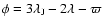 ,
librate about
,
librate about  ,
being stable in the long-term (
,
being stable in the long-term ( is mean longitude,
  is longitude of perihelion, and J indicates Jupiter).
As regards physical properties, the low-albedo D- and P-types are more abundant in Hildas' surface colours than the small fraction of C-types (Dahlgren & Lagerkvist 1995;
Dahlgren et al. 1997; Gil-Hutton & Brunini 2008;
Licandro et al. 2008). The surface colour of D- and P-type
asteroids, such as Hildas and Trojans in the outer main belt, corresponds well with that of cometary nuclei (Fitzsimmons et al. 1994; Jewitt 2002),
which means that they are covered with a similar mineralogical surface, suggestive of a common origin.
is longitude of perihelion, and J indicates Jupiter).
As regards physical properties, the low-albedo D- and P-types are more abundant in Hildas' surface colours than the small fraction of C-types (Dahlgren & Lagerkvist 1995;
Dahlgren et al. 1997; Gil-Hutton & Brunini 2008;
Licandro et al. 2008). The surface colour of D- and P-type
asteroids, such as Hildas and Trojans in the outer main belt, corresponds well with that of cometary nuclei (Fitzsimmons et al. 1994; Jewitt 2002),
which means that they are covered with a similar mineralogical surface, suggestive of a common origin.
More than 50 Jovian irregular satellites are known at present (Jewitt & Haghighipour 2007). Cuk & Burns (2004) pointed out that the progenitor of the main prograde cluster, the Himalia family, was plausibly derived from the Hildas long ago,
if it was captured by a gas-drag assisted mechanism. Thus tracing the origin and nature of irregular satellites is very significant for studying the accretion processes in the early solar system. Satellite capture mechanics in the circular restricted three-body problem (CR3BP)
or the N-body problem has often been investigated (e.g., Hénon 1970;
Huang & Innanen 1983; Tanikawa 1983; Murison 1989; Brunini et al. 1996; Nesvorný et al. 2003, 2007).
Reflectance spectra of Jovian irregulars, being dominated by D- and C-types
(Luu 1991; Grav et al. 2003), are comparable to those of Hildas.
During the past half century, several Jupiter family comets (JFCs; cf. Levison 1996)
have stayed in or near the Hilda zone, although being in unstable 3:2 MMR with Jupiter.
Some of them have been transferred from outside to inside, vice versa, or from inside to inside of
Jupiter's orbit by undergoing a temporary satellite capture (TSC) by Jupiter (e.g., Carusi & Valsecchi 1979; Tancredi et al. 1990). Such a JFC is called a ``quasi-Hilda comet'' (QHC) by Kresák (1979), who identified three such objects:
39P/Oterma, 74P/Smirnova-Chernykh, and 82P/Gehrels 3. Di Sisto et al. (2005)
integrated the motions of 500 fictitious Hildas for 109 years, and found that most of them escaped from the Hilda zone into the JFC population, i.e., left the 3:2 MMR and evolved quickly on to unstable orbits: such a chaotic diffusion from the Hilda zone has also been demonstrated
by Nesvorný & Ferraz-Mello (1997). In addition, large-scale collisional processes, such as the late heavy bombardment, might also release small bodies from
the Hilda zone into JFCs, e.g., see Gil-Hutton & Brunini (2000).
Hence, some QHCs may indeed be such escaped Hildas themselves. Recently, Toth (2006) updated the QHC list, finding a total of 17 members (see Sect. 3). This includes bodies such as the
renowned Comet D/1993 F2 (Shoemaker-Levy 9, SL9) that have undergone TSC by Jupiter and then disappeared after colliding with the planet. Surface spectroscopic (or colorimetric) measurements for QHCs have only been carried out for 82P (De Sanctis et al. 2000), the results of which also indicate a taxonomic D-type.
Among the QHCs, 39P/Oterma was the first known to be temporarily captured by Jupiter, in 1936-1938 (Marsden 1962). However, this comet flew through the region near Jupiter
over a rather short time, during which the comet did not complete a full revolution orbiting about the planet. In contrast, unlike 39P's ``fly-through'' capture, there is a different kind of TSC, in which at least one full revolution about the planet is completed; we
deal with these in the present paper. Following Kary & Dones (1996) we call such objects
``orbiters''. These are often characterized by a long capture with very small perijove distance,
usually lasting for 10 years or more. Not all orbiters become such long TSCs (>10 yr), although of course they last longer than the fly-through type. SL9 is a representative case for both long TSCs and orbiters. This comet was pointed out to have possibly been QHC-derived before its tidal disruption on passing through perijove at less than 1.5 Jovian equatorial radii ( ,
where
,
where
 km), i.e., within the Roche limit, in 1992 July and
its subsequent collision with Jupiter in 1994 July (Nakano & Marsden 1993; Sitarski 1995; Benner & McKinnon 1995). If it is QHC-derived, then SL9 is the only
QHC so far that has been orbiting the planet as a TSC at the time of discovery (Benner & McKinnon 1995). By numerically integrating SL9's pre-collision orbital motion,
several studies showed that the TSC duration of SL9 lasted for 50 years or more, during which
the comet completed more than 30 revolutions orbiting about Jupiter, making it nominally the longest known TSC (Carusi et al. 1994; Benner & McKinnon 1995;
Chodas & Yeomans 1996). However, according to Benner & McKinnon (1995),
SL9 was the most chaotic known object in the solar system with an effective Lyapunov time of only 10 years on its jovicentric orbit. Thus it is difficult to determine with certainty
SL9's pre-capture orbit and its true TSC duration. Nevertheless, Benner & McKinnon's additional statistical analysis of distributions in a-e space and values, based on back integrations of the various SL9 fragments, revealed a possible QHC origin of SL9.
The work of Kary & Dones (1996) supports this possibility: they traced the motions of numerous fictitious JFCs for 105 years and found that half the SL9-like
very long captures >50 years were due to QHCs. They estimated that the frequency of such a very long TSC (= ``long capture'' as designated by them) is extremely rare, only 0.02%
of all the TSC events in their simulations. Interestingly, impacts on Jupiter are more frequent
than the very long TSCs by a factor of 8-9. They also evaluated that long TSCs (=``orbiters bound >10 yr'' as designated by them) and orbiters are still rare events, at the respective levels of 0.8% (
km), i.e., within the Roche limit, in 1992 July and
its subsequent collision with Jupiter in 1994 July (Nakano & Marsden 1993; Sitarski 1995; Benner & McKinnon 1995). If it is QHC-derived, then SL9 is the only
QHC so far that has been orbiting the planet as a TSC at the time of discovery (Benner & McKinnon 1995). By numerically integrating SL9's pre-collision orbital motion,
several studies showed that the TSC duration of SL9 lasted for 50 years or more, during which
the comet completed more than 30 revolutions orbiting about Jupiter, making it nominally the longest known TSC (Carusi et al. 1994; Benner & McKinnon 1995;
Chodas & Yeomans 1996). However, according to Benner & McKinnon (1995),
SL9 was the most chaotic known object in the solar system with an effective Lyapunov time of only 10 years on its jovicentric orbit. Thus it is difficult to determine with certainty
SL9's pre-capture orbit and its true TSC duration. Nevertheless, Benner & McKinnon's additional statistical analysis of distributions in a-e space and values, based on back integrations of the various SL9 fragments, revealed a possible QHC origin of SL9.
The work of Kary & Dones (1996) supports this possibility: they traced the motions of numerous fictitious JFCs for 105 years and found that half the SL9-like
very long captures >50 years were due to QHCs. They estimated that the frequency of such a very long TSC (= ``long capture'' as designated by them) is extremely rare, only 0.02%
of all the TSC events in their simulations. Interestingly, impacts on Jupiter are more frequent
than the very long TSCs by a factor of 8-9. They also evaluated that long TSCs (=``orbiters bound >10 yr'' as designated by them) and orbiters are still rare events, at the respective levels of 0.8% ( very long TSCs) and 2% (
long TSCs) relative to all events, with about 98% being the short TSC type which contains the fly-through events.
Carusi & Valsecchi (1979) had earlier confirmed the rarity of orbiter events,
simulating motions of fictitious small bodies as well.
very long TSCs) and 2% (
long TSCs) relative to all events, with about 98% being the short TSC type which contains the fly-through events.
Carusi & Valsecchi (1979) had earlier confirmed the rarity of orbiter events,
simulating motions of fictitious small bodies as well.
Table 1:
Initial parameters of QHCs 82P/Gehrels 3, 111P/Helin-Roman-Crockett, and P/1996 R2 Lagerkvist (equinox J2000).
In the jovicentric Keplerian system, a TSC (especially a long TSC/orbiter) occurs
whenever a small body passes near one of the collinear libration points  or
or  in the CR3BP of the Sun-Jupiter-(third) body system with very low velocity, i.e., effectively becoming bound by Jupiter when it enters the Hill's region with near-zero velocity. After that, the bound small body revolves about Jupiter on an elliptical jovicentric orbit until it again
passes through the region near either
or
and escapes from the Jovian system. Considering such a transition using newly developed dynamical systems techniques based on a Hamiltonian formulation in the CR3BP, Koon et al. (2001) and Howell et al. (2001) demonstrated that a TSC by Jupiter occurs when the small body passes through a region inside the
invariant manifold structure related to periodic halo orbits around
or
in the Hill's region. The TSC (or its duration) is usually defined by the jovicentric Kepler energy,
in the CR3BP of the Sun-Jupiter-(third) body system with very low velocity, i.e., effectively becoming bound by Jupiter when it enters the Hill's region with near-zero velocity. After that, the bound small body revolves about Jupiter on an elliptical jovicentric orbit until it again
passes through the region near either
or
and escapes from the Jovian system. Considering such a transition using newly developed dynamical systems techniques based on a Hamiltonian formulation in the CR3BP, Koon et al. (2001) and Howell et al. (2001) demonstrated that a TSC by Jupiter occurs when the small body passes through a region inside the
invariant manifold structure related to periodic halo orbits around
or
in the Hill's region. The TSC (or its duration) is usually defined by the jovicentric Kepler energy,  ,
being negative,
,
being negative,
 ,
with the additional condition that the bound small body must be within the jovicentric sphere of gravitational influence: Kary & Dones (1996) set its boundary at 3 Hill's sphere radii (=1.065 AU) of Jupiter. However, Howell et al. (2001) defined the TSC duration as the residence time in the Hill's region.
The former generally lasts longer than the latter, and here we regard the former as the TSC duration. The dynamics involved in TSC is quite different from that of quasi-satellites in 1:1 libration with Jupiter far outside the Hill's region (Wiegert et al. 2000;
Kinoshita & Nakai 2007).
,
with the additional condition that the bound small body must be within the jovicentric sphere of gravitational influence: Kary & Dones (1996) set its boundary at 3 Hill's sphere radii (=1.065 AU) of Jupiter. However, Howell et al. (2001) defined the TSC duration as the residence time in the Hill's region.
The former generally lasts longer than the latter, and here we regard the former as the TSC duration. The dynamics involved in TSC is quite different from that of quasi-satellites in 1:1 libration with Jupiter far outside the Hill's region (Wiegert et al. 2000;
Kinoshita & Nakai 2007).
Apart from SL9, only three orbiters have been known to occur. Every case has been associated
with a QHC: 82P; 111P/Helin-Roman-Crockett; and, though it is not in Toth's (2006) QHC list,
P/1996 R2 (Lagerkvist). These TSCs were found by Rickman (1979), Tancredi et al. (1990), and Hahn & Lagerkvist (1999), respectively, and are
discussed further in Sect. 2. The occurrence of these few events during the last several decades is consistent with the rarity of long TSC/orbiter events suggested by Kary & Dones (1996).
Although 74P encountered Jupiter at distances of 0.24 AU and 0.47 AU in 1955 October and 1963 September respectively, it was not bound to Jupiter (Rickman 1979;
Carusi et al. 1985b); this comet is, however, expected to experience a TSC by Jupiter
in this century (Carusi et al. 1985b; and see also Sect. 4). There further exist some JFCs that encountered Jupiter more closely than several QHCs involved in TSC,
e.g., 16P/Brooks 2; D/1770 L1 (Lexell); 81P/Wild 2; but they were not captured by the planet owing to their high-velocity encounters (Carusi et al. 1985a;
Emel'yanenko 2003).
Therefore studying the origin and nature of QHCs is of great importance from various astronomical points of view mentioned above, especially as regards their origin and being possibly related to the Hildas and the Jovian irregular satellites. Such studies may provide unique knowledge and clues about formation processes in the early solar system. Here we focus on long TSC/orbiter events involving Jupiter and QHCs. First (Sect. 2), applying a general N-body Newtonian code,
we reconfirmed the long TSC/orbiter events of 82P, 111P, and 1996 R2. Then (Sect. 3) we used the same procedure to search Toth's (2006) QHCs list for other objects that have become
long TSCs/orbiters in the past century. Eventually, we successfully found another long TSC/orbiter,
occurring in the mid-20th century, 147P/Kushida-Muramatsu.
The jovicentric trajectories for the long TSCs/orbiters, except for SL9, have been numerically simulated by Carusi & Valsecchi (1979) and Carusi et al. (1985a,b) for 82P, by Tancredi et al. (1990), Belbruno & Marsden (1997) and Howell et al. (2001) for 111P,
and by Hahn & Lagerkvist (1999) for 1996 R2.
First of all, we attempted to reproduce their TSC events in order to compare our simulations
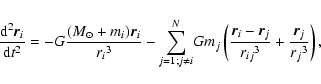
with these previous studies, integrating back to the time of each TSC. We applied a general N-body Newtonian code, then equations of motion for the ith body are:
 |
(1) |
where G is the gravitational constant,  and mi are respectively
the mass of the sun and the ith body (
and mi are respectively
the mass of the sun and the ith body (
 ),
),  is the heliocentric
position vector of the ith body, ri is the heliocentric distance of the
ith body, and rij is the distance between the ith and jth bodies. Here,
we regarded comets as massless bodies.
is the heliocentric
position vector of the ith body, ri is the heliocentric distance of the
ith body, and rij is the distance between the ith and jth bodies. Here,
we regarded comets as massless bodies.
The integrator that we applied here is the ``SOLEX'', Ver. 9.1 package, developed by
Vitagliano (1997) based on the Bulirsh-Stoer method. Coordinates and velocities of the planets, regarded as point masses, were based on the JPL Planetary and Lunar Ephemeris DE409. We confirmed that the results of our numerical integrations did not significantly change
when we used other integration methods that we have often applied in our studies, e.g.,
the Adams method. Our integrator can accurately process very close encounters
by means of a routine that makes automatic time step adjustments, and truncation and round-off errors are almost negligible for our investigation here. Therefore the SOLEX integrator is
sufficiently reliable to deal with the problem of close encounters with Jupiter.
![\begin{figure}
\par\includegraphics[width=16.4cm,clip]{0321fig1.eps}\end{figure}](/articles/aa/full/2008/39/aa10321-08/Timg49.gif) |
Figure 1:
Simulated TSC trajectories for 82P, 111P, and 1996 R2. Plots show x-y projections, over 1 AU square, onto the heliocentric orbital plane of Jupiter, in the jovicentric rotating frame where the sun is always in the direction of the -x-axis. The arrows indicate the direction of time (opposite to the direction of the integrations, which went backwards in time). |
| Open with DEXTER |
Table 2:
Long TSC/orbiter data of QHCs 82P, 111P, and 1996 R2.
As initial parameters, up to date osculating orbital elements were taken from the JPL Small-Body Database, mentioned above in Sect. 1, for 82P and 1996 R2 and from Nakano (2005) for 111P,
as listed in Table 1. 82P and 111P are numbered, multiple-apparition comets,
covered by very long observational arcs, hence their orbital solutions are highly precise. Meanwhile, although 1996 R2 is unnumbered and still a one-apparition comet, consequently with a shorter arc, the number of astrometric positions is the most, 135, and the RMS residual is the least,
 ,
among the three comets, hence we judged that the TSC of 1996 R2 is worth simulating here. The nongravitational parameters for these QHCs' motions were
not detectable from their astrometry hence were not included in our integrations - in any case
their motions are chaotic during TSC. The Jovian oblateness terms and the perturbations by the Galilean satellites were also ignored since their effects are negligible in our investigations
(see Kary & Dones 1996); these effects should be included in analyses of
very long TSCs of SL9-like objects having highly inclined Jupiter-grazing orbits.
,
among the three comets, hence we judged that the TSC of 1996 R2 is worth simulating here. The nongravitational parameters for these QHCs' motions were
not detectable from their astrometry hence were not included in our integrations - in any case
their motions are chaotic during TSC. The Jovian oblateness terms and the perturbations by the Galilean satellites were also ignored since their effects are negligible in our investigations
(see Kary & Dones 1996); these effects should be included in analyses of
very long TSCs of SL9-like objects having highly inclined Jupiter-grazing orbits.
Our simulated TSC trajectories of 82P, 111P, and 1996 R2 are shown in Fig. 1. In these plots we use a rotating frame in which the jovicentric rectangular coordinates are referred to the heliocentric orbital plane of Jupiter, with the sun located in the direction of the -x-axis,
and the +z-axis pointing to the north. In Fig. 1 every TSC motion is unstable and chaotic,
with substantial solar perturbations occurring near each comet's apojove.
Among these TSCs, the trajectories of 82P and 1996 R2 are similar in profile to each other.
Both these QHCs came tangentially from outside Jupiter's orbit with a low-inclination retrograde motion, i.e., their pre-capture heliocentric orbits imply that they came from the Centaur region, their perihelia being beyond the Jovian orbit. During the TSC, first they passed close to
with low relative velocities (between Jupiter and comets in the jovicentric
frame) of respectively 0.7 km s-1 and 0.6 km s-1, then revolved about Jupiter, completing one full revolution, and finally escaped from the Jovian system into the QHC region, passing near .
In the
transition, an object that enters the Jovian system close to
seems to have enough orbital energy to rapidly escape through the region near
(Tanikawa 1983). The long lasting captures for 82P and 1996 R2 may be somewhat related to the orbital stability for the retrograde satellites
(Huang & Innanen 1983; Nesvorný et al. 2003). However,
the TSC duration is below 10 years in both cases; so to be more exact
these orbiters should perhaps not be categorized as long TSCs.
On the other hand, the motion of 111P was more complicated than those of 82P and 1996 R2.
111P completed three full revolutions about Jupiter during its long TSC of 18.45 years,
both of which numbers rank second next to SL9 among known TSCs. Its pre-capture and post-escape heliocentric orbits were both QHC type (Belbruno & Marsden 1997),
entering through the region near
at a relative velocity of 1.0 km s-1
and escaping near
again. Its capture/escape trajectory is almost symmetric about
the x-axis (cf. Murison 1989) inside the Hill's region in the CR3BP.
Howell et al. (2001) demonstrated that the 111P capture/escape trajectory is almost identical to some asymptotic trajectory winding onto a periodic halo
orbit of ,
such trajectories forming segments of the invariant manifolds.
We therefore reconfirmed the long TSC/orbiter events involving 82P, 111P and 1996 R2.
Our orbiter trajectories look exactly as in Belbruno & Marsden (1997)
and Howell et al. (2001) for 111P, and as in all the above papers for 82P,
but the results by Tancredi et al. (1990) for 111P and Hahn & Lagerkvist (1999) for 1996 R2 show somewhat different behaviours. Both these can be ascribed to slight differences in
initial parameters - their initial orbits were based on observational arcs of respectively 2-4 months and 111 days whereas ours were based on longer time spans of 4643 and 153 days.
Besides, Hahn & Lagerkvist (1999) plotted the trajectory not of the nominal orbit but of
a clone, i.e., a possible TSC trajectory within the uncertainty of the initial parameters.
In fact, we could not reach the TSC of 1996 R2 by using their nominal orbit.
This demonstrates that in studying TSC events, initial parameters must be determined precisely,
based on long-arc improved orbital solutions wherever possible, since jovicentric orbits during TSC have a chaotic nature.
Table 3:
Quasi-Hilda comets.
Table 4:
Initial parameters of QHC 147P/Kushida-Muramatsu (equinox J2000) and their 
 error estimates (Nakano 2002).
The capture situations of these QHCs are summarized in Table 2. During these TSCs, 82P, 111P and 1996 R2 experienced 2, 6 and 3 perijove passages, respectively.
In particular, 82P passed its closest perijove of
 in 1970 August, just outside the Roche limit for comets
 (assuming a cometary bulk density
  1 g cm-3). Table 2 also shows the minimum values of the
jovicentric Kepler energy
1 g cm-3). Table 2 also shows the minimum values of the
jovicentric Kepler energy
 (in AU-1) where a' is the semimajor axis for the jovicentric orbit. The low values attained, -2.80, -3.20, and -3.28 for the three
comets, are often a feature of long TSCs/orbiters, as against -1.79
which we have computed for 39P during its fly-through in the 1930s.
(in AU-1) where a' is the semimajor axis for the jovicentric orbit. The low values attained, -2.80, -3.20, and -3.28 for the three
comets, are often a feature of long TSCs/orbiters, as against -1.79
which we have computed for 39P during its fly-through in the 1930s.
Shortly after TSC, these three QHCs were discovered and observed as ``quasi-Hilda comets'' for the first time. The time difference,
 ,
between the end time of the TSC, given in Table 2, and the first astrometric time, given in Table 1,
is notable. Every
is short enough (1.3 years for 82P, 3.49 years for 111P, and 3.16 years for 1996 R2) to indicate that the simulated TSC should be a real event.
,
between the end time of the TSC, given in Table 2, and the first astrometric time, given in Table 1,
is notable. Every
is short enough (1.3 years for 82P, 3.49 years for 111P, and 3.16 years for 1996 R2) to indicate that the simulated TSC should be a real event.
Next we surveyed the remaining objects in Toth's (2006) QHC list (Table 3) to determine whether other long TSCs/orbiters around Jupiter exist. We applied our code to integrate each orbit back 100 years from its initial epoch, since the Lyapunov time of JFCs is rather short,
generally 100
50 yr (Tancredi 1995). Moreover, going back more than 100 yr may not be meaningful because of likely weak nongravitational accelerations, in addition to the accumulation of orbital errors. We recognized that short TSC events have sometimes occurred,
for which results will be published as an additional paper elsewhere. Eventually, we successfully found another long TSC, involving 147P/Kushida-Muramatsu.
![\begin{figure}
\par\includegraphics[width=9cm,clip]{0321fig2.eps}\end{figure}](/articles/aa/full/2008/39/aa10321-08/Timg70.gif) |
Figure 2:
3D-view of 147P's trajectory during TSC in the jovicentric rotating frame covering 1 AU square. The vertical lines, spaced at 10-day intervals, each connect a position of the comet on the trajectory with its projection onto the x-y plane. |
| Open with DEXTER |
The observational history of 147P is described by Green (1993, 2000) and
Kronk (2008). The comet was photographically discovered by Kushida and Muramatsu (Yatsugatake South Base Observatory, Japan) on 1993 December 8.65, using a 0.25-m f/3.4 reflector.
It was then at magnitude 16.5 and slightly diffuse, about 1-2' in diameter
with a central condensation. The comet was recovered on 2000 October 3.72, when Oribe (Saji Observatory, Japan) obtained CCD images with the 1.03-m reflector. Thus 147P has been detected at two perihelion returns, allowing it to be numbered, although it has not
been astrometrically observed since 2002 March.
![\begin{figure}
\par\includegraphics[width=9cm,clip]{0321fig3.eps}\end{figure}](/articles/aa/full/2008/39/aa10321-08/Timg71.gif) |
Figure 3:
x-y and x-z projections of TSC trajectories for 243 clones generated from 147P. They underwent long TSCs, completing two full revolutions about Jupiter during the
transition. The dispersion of their trajectories corresponds to error in the orbit determination. Hence we conclude that the real 147P indeed experienced
a long TSC/orbiter event in the mid-20th century. |
| Open with DEXTER |
![\begin{figure}
\par\includegraphics[width=9cm,clip]{0321fig4.eps}\end{figure}](/articles/aa/full/2008/39/aa10321-08/Timg72.gif) |
Figure 4:
Variations of
 and
of 243 clones of 147P in and around their interval of TSC, where
and
of 243 clones of 147P in and around their interval of TSC, where
 jovicentric distance (in AU);
and
jovicentric distance (in AU);
and
 jovicentric and heliocentric Kepler energy, respectively;
 Tisserand parameter. The abscissa for all the plots covers 2 431 596.5 (1945 May 21.0 TT) to 2 438 095.5 (1963 March 07.0 TT), the time for which the nominal 147P
was within 2 AU of Jupiter.
Tisserand parameter. The abscissa for all the plots covers 2 431 596.5 (1945 May 21.0 TT) to 2 438 095.5 (1963 March 07.0 TT), the time for which the nominal 147P
was within 2 AU of Jupiter. |
| Open with DEXTER |
In our integration of 147P, the initial parameters were taken from Nakano (2002), as listed in Table 4. His orbital solution was accurately improved based on
197 carefully selected positions covering an arc of 3024 days and also provided associated error estimates (Table 4). We believe that this solution is the best determined for
this comet, probably based on a longer arc and more astrometric positions than any other.
The nongravitational accelerations in 147P's motion were not detected from the astrometry.
Integrating back this orbit, we found that the comet was captured by Jupiter
in the mid-20th century. The 3D-view of 147P's TSC situation is illustrated in Fig. 2.
However,
of 147P is extremely large, more than 30 years, which greatly exceeds the values of <3.5 years for 82P, 111P and 1996 R2 (and also SL9
with negative
). Thus we must further examine whether or not
147P really underwent a long TSC/orbiter phase in the mid-20th century.
To answer this, we traced other possible orbital motions of 147P back to and during its TSC,
generating multiple ``clones'' at initial epoch, and integrating them. As well as the nominal 147P
osculating orbit, other clones had slightly different orbital elements, within the
error, given in Table 4. We generated the clones on the basis of
three possible values (nominal and )
for five orbital elements [a; e;  ;
;
 ;
i]. This number of permutations yielded a total of 243 (=35) clones,
including the nominal one. We also generated some test clones varying T (or M) within the allowed error, confirming that this effect is negligible; thus we excluded this parameter
when generating the main set of clones. Conversely, we found a to be the most strongly effective parameter in causing divergence among the clones' orbital behaviours.
;
i]. This number of permutations yielded a total of 243 (=35) clones,
including the nominal one. We also generated some test clones varying T (or M) within the allowed error, confirming that this effect is negligible; thus we excluded this parameter
when generating the main set of clones. Conversely, we found a to be the most strongly effective parameter in causing divergence among the clones' orbital behaviours.
We found that all 243 clones underwent TSCs. In Fig. 3, we can see that their trajectories become scattered in their pre-capture orbital phase, while converging toward the post-escape phase,
since the orbital motions were integrated back in time. However, the dispersion of their TSC trajectories, corresponding to error in the orbit determination, is not as scattered as is sometimes expected with chaotic trajectories. We conclude that it is very likely that 147P really was an orbiter, experiencing a long TSC in the mid-20th century.
The motions of all the clones follow almost the same profile as those of 82P and 1996 R2,
coming tangentially from outside Jupiter's orbit, i.e., with a low-inclination retrograde motion in the jovicentric frame. The pre-capture heliocentric Centaur orbit of 147P had
 AU,
AU,
 AU, and
 .
The comet entered the Jovian system passing through the region
near
with relative velocity 0.9 km s-1, revolved about Jupiter,
escaped from the Jovian system passing near ,
and was discovered and observed as a QHC after 32 years. However, an important difference from
both 82P and 1996 R2 is that 147P completed two full
revolutions about Jupiter, thus experiencing a significantly longer TSC.
.
The comet entered the Jovian system passing through the region
near
with relative velocity 0.9 km s-1, revolved about Jupiter,
escaped from the Jovian system passing near ,
and was discovered and observed as a QHC after 32 years. However, an important difference from
both 82P and 1996 R2 is that 147P completed two full
revolutions about Jupiter, thus experiencing a significantly longer TSC.
Table 5:
Long TSC data of QHC 147P.
Figure 4 shows the variations in
,
and
of all the clones in and around the TSC interval, where  is jovicentric distance (in AU), and
  is heliocentric Kepler energy =-1/2a (in AU-1). The
and diagrams in the pre-capture orbital phase display a scatter that is as evident
as the scatter in Fig. 3. We can see (most clearly from the diagram, but with
signs also reflected in the other three plots) that 147P experienced three perijove passages.
The term of negative
corresponds to TSC, during which
was always within 3 Hill's sphere radii, as defined in Sect. 1; thus 147P underwent a long TSC for
12.17+0.29-0.27 years (where error estimates are based on the clones' dispersion).
The minimum
taking a low value of -2.78
0.01 is also an expected feature of a long TSC/orbiter event. In the diagram, we can see the sharp spike corresponding to the closest encounter to Jupiter, during which the nominal heliocentric orbit is briefly hyperbolic.
The value of
was slightly higher than 3.0 in the pre-capture orbital phase,
as is often associated with low-velocity encounters at Jupiter (Kresák 1979), and it suddenly dropped twice around the closest perijove passages. We summarize the capture situation data of 147P in Table 5 (again, error estimates come from the
range shown by all the clones).
is heliocentric Kepler energy =-1/2a (in AU-1). The
and diagrams in the pre-capture orbital phase display a scatter that is as evident
as the scatter in Fig. 3. We can see (most clearly from the diagram, but with
signs also reflected in the other three plots) that 147P experienced three perijove passages.
The term of negative
corresponds to TSC, during which
was always within 3 Hill's sphere radii, as defined in Sect. 1; thus 147P underwent a long TSC for
12.17+0.29-0.27 years (where error estimates are based on the clones' dispersion).
The minimum
taking a low value of -2.78
0.01 is also an expected feature of a long TSC/orbiter event. In the diagram, we can see the sharp spike corresponding to the closest encounter to Jupiter, during which the nominal heliocentric orbit is briefly hyperbolic.
The value of
was slightly higher than 3.0 in the pre-capture orbital phase,
as is often associated with low-velocity encounters at Jupiter (Kresák 1979), and it suddenly dropped twice around the closest perijove passages. We summarize the capture situation data of 147P in Table 5 (again, error estimates come from the
range shown by all the clones).
Also indicated in the
diagram in Fig. 4 is the commensurability of 147P with Jupiter changing from 3:4 Centaur-type in the pre-capture orbital phase to
8:5 (rather than 3:2) QHC in the post-escape phase. This, however, corresponds to the osculating orbit immediately post-escape, and integrations for motions of all the clones over a longer timescale suggest instead that 147P might librate in the 3:2 Jovian MMR for
350 yr following the TSC (and is doing so at the present time), though with a somewhat faster libration period and higher libration amplitude ( for the nominal orbit)
than the more stable, typical Hilda asteroid orbits (e.g., Schubart 1982, 1991; Franklin et al. 1993; Nesvorný & Ferraz-Mello 1997). Moreover, test integrations of the other objects suggest that of the
QHCs known to have been involved in a TSC, only 147P has undergone an
interval where the critical argument of the 3:2 MMR librates.
for the nominal orbit)
than the more stable, typical Hilda asteroid orbits (e.g., Schubart 1982, 1991; Franklin et al. 1993; Nesvorný & Ferraz-Mello 1997). Moreover, test integrations of the other objects suggest that of the
QHCs known to have been involved in a TSC, only 147P has undergone an
interval where the critical argument of the 3:2 MMR librates.
Further backward integrations of 147P inform us of the possibility of another TSC somewhere between
the late-19th to early-20th century. However, as all the clones were extremely scattered by that time, we do not consider that TSC here.
On the basis of our investigations above, we have presented a newly identified TSC of a comet by Jupiter. This is in the rare, orbiter class of TSCs and involves 147P from
1949 May 14
-1961 July 15. This is the third long TSC of >10 years and the fifth orbiter found, so that Jupiter's long TSCs/orbiters
have occurred once per decade. The completion of two full revolutions about Jupiter
and the capture duration of
12.17+0.29-0.27 years rank 147P as third in both these numbers among known orbiters, behind SL9 and 111P.
Following Kary & Dones (1996), we classify the known TSCs as follows: 39P as fly-through, 82P and 1996 R2 as orbiters, 111P and 147P as long TSCs (>10 years), and SL9 as a very long TSC (>50 years).
On the other hand, depending on the TSC characteristics, Howell et al. (2001) defined two TSC types: type 1 as a 39P-like fly-through; type 2 as a long lasting capture like
111P, where the comet experiences more than one close encounter with Jupiter while in the TSC region. Here we tentatively divide type 2 into two subtypes: type 2A as the
transition such as 82P, 1996 R2 and 147P; type 2B as the QHC-derived (
)
longer capture than 2A, as with 111P and SL9. Further TSC classifications may be possible in the future, if different kinds of TSC are found.
We also surveyed all the known QHCs, integrating their orbital motions forward for 100 years to check for future long TSCs/orbiters. We found that 111P will undergo a long TSC/orbiter phase
with 6 perijove passages, and minimum
 ,
from 2068 April 20-2086 June 09 (duration 18.14 years). We identified a rather long capture of 82P
with minimum
,
from 2068 April 20-2086 June 09 (duration 18.14 years). We identified a rather long capture of 82P
with minimum
 though it is not an orbiter but instead follows a symmetric trajectory about the x-axis, from 2056 February 18-2064 July 26 (duration 8.43 years).
There appear to be two TSCs for 74P if we take its initial parameters from the JPL Small-Body Database, from 2025 August 10-2031 May 29 (duration 5.80 years, minimum
though it is not an orbiter but instead follows a symmetric trajectory about the x-axis, from 2056 February 18-2064 July 26 (duration 8.43 years).
There appear to be two TSCs for 74P if we take its initial parameters from the JPL Small-Body Database, from 2025 August 10-2031 May 29 (duration 5.80 years, minimum
 )
and 2081 January 29-2085 January 29 (duration 4.00 years, minimum
)
and 2081 January 29-2085 January 29 (duration 4.00 years, minimum
 ).
).
Such future TSCs have already been predicted by Carusi et al. (1985a,b) for 74P and 82P and Tancredi et al. (1990) for 111P,
and our simulations are almost identical in profile with those. Meanwhile,
it is unlikely that 1996 R2 and 147P will encounter Jupiter as a long TSC/orbiter for
the next 100 years from each initial epoch. No further long TSCs/orbiters were found among
the remaining QHCs.
Here we discuss the Jovian tidal force acting on 147P and other captured QHCs,
around their perijove passages. Well-known cometary tidal splitting events have
occurred twice: 16P in 1886 (Sekanina & Yeomans 1985)
and SL9, both passing perijove within the Roche limit for comets,
.
In contrast, the close encounter of 147P with Jupiter around 1952 August 26 (Table 5) was at a perijove distance of
 ,
comfortably outside the Roche limit. The radius,
,
comfortably outside the Roche limit. The radius,  ,
of 147P's nucleus was estimated at 0.21 km by Lamy et al. (2004), the smallest among all their measured cometary nuclei.
,
of 147P's nucleus was estimated at 0.21 km by Lamy et al. (2004), the smallest among all their measured cometary nuclei.
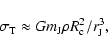
The Jovian tidal stress,
 ,
acting on small bodies (QHCs here),
is given by:
,
acting on small bodies (QHCs here),
is given by:
 |
(2) |
where  is the mass of Jupiter. Compared to the
acting on SL9 at perijove <
is the mass of Jupiter. Compared to the
acting on SL9 at perijove <
 in 1992 (Scotti & Melosh 1993;
Asphaug & Benz 1994, 1996), the
for 147P was extremely small, amounting to <
in 1992 (Scotti & Melosh 1993;
Asphaug & Benz 1994, 1996), the
for 147P was extremely small, amounting to < if we take the original, pre-encounter
of SL9
as 1 km (Scotti & Melosh 1993; Asphaug & Benz 1994) and
of both the comets as being equal. Hence, although our treatment here is approximate, there
seems no reason to believe that 147P was affected by Jovian tides. On the other hand, 82P, which passed its perijove at
in 1970, just outside the cometary Roche limit,
may have suffered some effect due to the Jovian tides, even though it was not broken up.
Taking
for 82P as 0.73 km (Lamy et al. 2004), and equal
as above,
implies that the
acting on 82P could be up to
if we take the original, pre-encounter
of SL9
as 1 km (Scotti & Melosh 1993; Asphaug & Benz 1994) and
of both the comets as being equal. Hence, although our treatment here is approximate, there
seems no reason to believe that 147P was affected by Jovian tides. On the other hand, 82P, which passed its perijove at
in 1970, just outside the cometary Roche limit,
may have suffered some effect due to the Jovian tides, even though it was not broken up.
Taking
for 82P as 0.73 km (Lamy et al. 2004), and equal
as above,
implies that the
acting on 82P could be up to  of that for SL9.
If 82P is a friable and furthermore a loose rubble-pile object, the heating energy from continual Jovian tides might sufficiently affect the comet's nucleus structure so as to allow H2O ice, if present, to sublimate even though 82P is beyond the usual heliocentric
distance for H2O sublimation. If our hypothetical scenario is true, such tidal heating effects could trigger cometary activity on 82P and produce an outburst. In this event, the coma size and consequent brightness would peak several days (or more) after the maximum tidal effects.
of that for SL9.
If 82P is a friable and furthermore a loose rubble-pile object, the heating energy from continual Jovian tides might sufficiently affect the comet's nucleus structure so as to allow H2O ice, if present, to sublimate even though 82P is beyond the usual heliocentric
distance for H2O sublimation. If our hypothetical scenario is true, such tidal heating effects could trigger cometary activity on 82P and produce an outburst. In this event, the coma size and consequent brightness would peak several days (or more) after the maximum tidal effects.
Another intriguing point is whether or not other tidal effects, e.g., tidal distortion and
tidal torques leading to rotation state changes (Scheeres et al. 2004),
are detectable in the light-curve observations of the captured QHCs. In the physical database of cometary nuclei by Lamy et al. (2004), we can notice a rather high axis ratio (a/b > 1.6) and long rotation period 50 h in the dataset of 82P, though an interpretation in terms of
such tidal effects is still speculative.
At any rate, we have considered here only a small subset of the TSC events, focusing on the long TSCs/orbiters, for which there still exist only limited available data.
Therefore we know little about such unique and extraordinary astronomical events,
which are still full of ambiguities. In addition, we do not know whether QHCs are
comets or asteroids. Indeed, several QHCs have sometimes been discovered or recovered as asteroids because of their cometary activity being weak: e.g., 36P (=1925 QD = 1940 RP), 39P (=1950 CR),
74P (=1967 EU = 1978 NA6 = 1981 UH18 = 1982 YG3), D/1977 C1 (=1977 DV3), P/1999 XN120, P/2001 YX127, and P/2003 CP7. Further observations and research for the
QHCs will be necessary to unlock their origin and nature.
Acknowledgements
We wish to thank Prof. A. Vitagliano for providing the SOLEX package. We are also grateful to an anonymous reviewer for useful comments that improved the paper. Part of this work was supported by the 2008 domestic fellowship of the Astronomical Society of Japan for KO.
- Asphaug, E.,
& Benz, W. 1994, Nature, 370, 120 [NASA ADS] [CrossRef]
(In the text)
- Asphaug, E., &
Benz, W. 1996, Icarus, 121, 225 [NASA ADS] [CrossRef]
(In the text)
- Belbruno, E., &
Marsden, B. G. 1997, AJ, 113, 1433 [NASA ADS] [CrossRef]
(In the text)
- Benner, L. A. M., &
McKinnon, W. B. 1995, Icarus, 118, 155 [NASA ADS] [CrossRef]
(In the text)
- Brunini, A.,
Giordano, C. M., & Orellana, R. B. 1996, A&A, 314, 977 [NASA ADS]
(In the text)
- Carusi, A., &
Valsecchi, G. B. 1979, in Asteroids, ed. T. Gehrels (Tucson: Univ.
Arizona Press), 391
(In the text)
- Carusi, A.,
Kresák, L., Perozzi, E., & Valsecchi, G. B. 1985a, in
Dynamics of Comets: Their Origin and Evolution, ed. A. Carusi,
& G. B. Valsecchi (Dordrecht: D. Reidel), IAU Colloq., 83,
319
(In the text)
- Carusi, A.,
Kresák, L., Perozzi, E., & Valsecchi, G. B. 1985b,
Long-term Evolution of Short-period Comets (Bristol: Adam
Hilger)
(In the text)
- Carusi, A., Marsden, B.
G., & Valsecchi, G. B. 1994, Planet. Space Sci., 42, 663 [NASA ADS] [CrossRef]
(In the text)
- Chodas, P. W., &
Yeomans, D. K. 1996, in The Collision of Comet Shoemaker-Levy 9 and
Jupiter, ed. K. S. Noll, H. A. Weaver, & P. D. Feldman
(Cambridge: Cambridge Univ. Press), IAU Colloq., 156, 1
(In the text)
- Cuk, M., & Burns, J. A.
2004, Icarus, 167, 369 [NASA ADS] [CrossRef]
(In the text)
- Dahlgren, M., &
Lagerkvist, C.-I. 1995, A&A, 302, 907 [NASA ADS]
(In the text)
- Dahlgren, M.,
Lagerkvist, C.-I., Fitzsimmons, A., et al. 1997, A&A, 323,
606 [NASA ADS]
(In the text)
- De Sanctis, M.
C., Lazzarin, M., Barucci, M. A., et al. 2000, A&A, 354,
1086 [NASA ADS]
- Di Sisto, R. P.,
Brunini, A., Dirani, L. D., & Orellana, R. B. 2005, Icarus,
174, 81 [NASA ADS] [CrossRef]
-
Emel'yanenko, N. Yu. 2003, Astron. Vest., 37, 174
- Fitzsimmons,
A., Dahlgren, M., Lagerkvist, C.-I., et al. 1994, A&A, 282,
634 [NASA ADS]
(In the text)
- Franklin, F.,
Lecar, M., & Murison, M. 1993, AJ, 105, 2336 [NASA ADS] [CrossRef]
(In the text)
- Gil-Hutton,
R., & Brunini, A. 2000, Icarus, 145, 382 [NASA ADS] [CrossRef]
(In the text)
- Gil-Hutton, R.,
& Brunini, A. 2008, Icarus, 193, 56
(In the text)
- Grav, T., Holman, M. J.,
Gladman, B. J., & Aksnes, K. 2003, Icarus, 166, 33 [NASA ADS] [CrossRef]
(In the text)
- Green, D. W. E. 1993,
IAU Circ., 5903
(In the text)
- Green, D. W. E. 2000, IAU
Circ., 7507 [NASA ADS]
(In the text)
- Hahn, G., & Lagerkvist,
C.-I. 1999, Icarus, 140, 462 [NASA ADS] [CrossRef]
(In the text)
- Hénon, M. 1970,
A&A, 9, 24 [NASA ADS]
(In the text)
- Howell, K. C.,
Marchand, B. G., & Lo, M. W. 2001, J. Astronaut. Sci., 49,
539
(In the text)
- Huang, T.-Y., &
Innanen, K. A. 1983, AJ, 88, 1537 [NASA ADS] [CrossRef]
(In the text)
- Ip, W.-H. 1976, Ap&SS, 44,
373 [NASA ADS] [CrossRef]
(In the text)
- Jewitt, D. C. 2002,
AJ, 123, 1039 [NASA ADS] [CrossRef]
(In the text)
- Jewitt, D., &
Haghighipour, N. 2007, ARA&A, 45, 261 [NASA ADS] [CrossRef]
(In the text)
- Kary, D. M., & Dones,
L. 1996, Icarus, 121, 207 [NASA ADS] [CrossRef]
(In the text)
- Kinoshita, H.,
& Nakai, H. 2007, Celest. Mech. Dyn. Astron., 98, 181 [NASA ADS] [CrossRef]
(In the text)
- Koon, W. S., Lo, M. W.,
Marsden, J. E., & Ross, S. D. 2001, Celest. Mech. Dyn. Astron.,
81, 27 [NASA ADS] [CrossRef]
(In the text)
- Kresák, L. 1979,
in Asteroids, ed. T. Gehrels (Tucson: Univ. Arizona Press),
289
(In the text)
- Kronk, G. W. 2008,
http://cometography.com/pcomets/147p.html
(In the text)
- Lamy, P. L., Toth, I.,
Fernández, Y. R., & Weaver, H. A. 2004, in Comets II, ed.
M. C. Festou, H. U. Keller, & H. A. Weaver (Tucson: Univ.
Arizona Press), 223
(In the text)
- Levison, H. F. 1996,
in Completing the Inventory of the Solar System, ed. T. W. Rettig,
& J. M. Hahn (San Francisco: ASP), ASP Conf. Ser., 107,
173
(In the text)
- Licandro, J.,
Alvarez-Candal, A., de Leon, J., et al. 2008, A&A, 481,
861 [NASA ADS] [CrossRef] [EDP Sciences]
(In the text)
- Luu, J. 1991, AJ, 102,
1213 [NASA ADS] [CrossRef]
(In the text)
- Marsden, B. G. 1962,
ASP Leaflets, 8, 375
(In the text)
- Murison, M. 1989, AJ,
98, 2346 [NASA ADS] [CrossRef]
(In the text)
- Nakano, S. 2002,
OAA Computing Sec. Circ, NK 910
(In the text)
- Nakano, S. 2005, OAA
Computing Sec. Circ, NK 1271
(In the text)
- Nakano, S., &
Marsden, B. G. 1993, IAU Circ., 5800
(In the text)
- Nesvorný, D.,
& Ferraz-Mello, S. 1997, Icarus, 130, 247 [NASA ADS] [CrossRef]
(In the text)
- Nesvorný,
D., Alvarellos, J. L. A., Dones, L., & Levison, H. F. 2003, AJ,
126, 398 [NASA ADS] [CrossRef]
(In the text)
- Nesvorný,
D., Vokrouhlický, D., & Morbidelli, A. 2007, AJ, 133,
1962 [NASA ADS] [CrossRef]
(In the text)
- Rickman, H. 1979, in
Dynamics of the Solar System, ed. R. L. Duncombe (Dordrecht: D.
Reidel), IAU Symp., 81, 293
(In the text)
- Scheeres, D. J.,
Marzari, F., & Rossi, A. 2004, Icarus, 170, 312 [NASA ADS] [CrossRef]
(In the text)
- Schubart, J.
1968, AJ, 73, 99 [NASA ADS] [CrossRef]
(In the text)
- Schubart, J.
1982, A&A, 114, 200 [NASA ADS]
(In the text)
- Schubart, J. 1991,
A&A, 241, 297 [NASA ADS]
(In the text)
- Scotti, J. V., &
Melosh, H. J. 1993, Nature, 365, 733 [NASA ADS] [CrossRef]
(In the text)
- Sekanina, Z., &
Yeomans, D. K. 1985, AJ, 90, 2335 [NASA ADS] [CrossRef]
(In the text)
- Sitarski, G. 1995,
Acta Astron., 45, 419 [NASA ADS]
(In the text)
- Tancredi, G.
1995, A&A, 299, 288 [NASA ADS]
(In the text)
- Tancredi, G.,
Lindgren, M., & Rickman, H. 1990, A&A, 239, 375 [NASA ADS]
(In the text)
- Tanikawa, K. 1983,
Celest. Mech., 29, 367 [NASA ADS] [CrossRef]
(In the text)
- Toth, I. 2006, A&A,
448, 1191 [NASA ADS] [CrossRef] [EDP Sciences]
(In the text)
- Vitagliano, A.
1997, Celest. Mech. Dyn. Astron., 66, 293 [NASA ADS] [CrossRef]
(In the text)
- Wiegert, P., Innanen,
K., & Mikkola, S. 2000, AJ, 119, 1978 [NASA ADS] [CrossRef]
(In the text)
- Yoshikawa, M.
1989, A&A, 213, 436 [NASA ADS]
(In the text)
- Zellner, B.,
Thirunagari, A., & Bender, D. 1985, Icarus, 62, 505 [NASA ADS] [CrossRef]
(In the text)
Copyright ESO 2008
![\begin{figure}
\par\includegraphics[width=16.4cm,clip]{0321fig1.eps}\end{figure}](/articles/aa/full/2008/39/aa10321-08/img49.gif)
![\begin{figure}
\par\includegraphics[width=9cm,clip]{0321fig2.eps}\end{figure}](/articles/aa/full/2008/39/aa10321-08/img70.gif)
![\begin{figure}
\par\includegraphics[width=9cm,clip]{0321fig3.eps}\end{figure}](/articles/aa/full/2008/39/aa10321-08/img71.gif)
![\begin{figure}
\par\includegraphics[width=9cm,clip]{0321fig4.eps}\end{figure}](/articles/aa/full/2008/39/aa10321-08/img72.gif)