![[*]](/icons/foot_motif.gif)
(Research Note)
A&A 489, 1023-1028 (2008)
DOI: 10.1051/0004-6361:200810166
S. Mieske1 - M. Hilker1 - D. J. Bomans2 - S.-C. Rey3 - S. Kim3 - S.-J. Yoon4 - C. Chung4
1 - European Southern Observatory, Karl-Schwarzschild-Strasse 2, 85748 Garching bei München, Germany
2 -
Astronomical Institute,
Ruhr-University Bochum,
Universitätsstr. 150,
44780 Bochum,
Germany
3 -
Department of Astronomy and Space Science, Chungnam National University, Daejeon 305-764, Korea
4 -
Department of Astronomy & Center for Space Astrophysics, Yonsei University, Korea
Received 9 May 2008 / Accepted 8 July 2008
Abstract
Context. There is increasing evidence for chemical complexity and multiple stellar populations in massive globular clusters (GCs), including extreme horizontal branches (EHBs) and UV excess.
Aims. We aim to improve our understanding of the UV excess in compact stellar systems, covering the regime of both ultra-compact dwarf galaxies (UCDs) and massive GCs.
Methods. We use deep archival GALEX data of the central Fornax cluster to measure NUV and FUV magnitudes of UCDs and massive GCs.
Results. We obtain NUV photometry for a sample of 35 compact objects that cover a range
-13.5<MV<-10 mag. Of those, 21 objects also have FUV photometry. Roughly half of the sources fall into the UCD luminosity regime (
 11 mag). We find that seven out of 17 massive Fornax GCs exhibit a NUV excess with respect to expectations from stellar population models, both for models with canonical and enhanced Helium abundance. This suggests that not only He-enrichment has contributed to forming the EHB population of these GCs. The GCs extend to stronger UV excess than GCs in M 31 and massive GCs in M 87, at the 97% confidence level. Most of the UCDs with FUV photometry also show evidence for UV excess, but their UV colours can be matched by isochrones with enhanced Helium abundances and old ages 12-14 Gyr. We find that Fornax compact objects with X-ray emission detected from Chandra images are almost disjunct in colour from compact objects with GALEX UV detection, with only one X-ray source among the 35 compact objects. However, since this source is one of the three most UV bright GCs, we cannot exclude that the physical processes causing X-ray emission also contribute to some of the observed UV excess.
Key words: galaxies: clusters: individual: Fornax - galaxies: dwarf - stars: horizontal-branch - stars: evolution - galaxies: star clusters
 Centauri and NGC 2808), there is evidence that
these multiple populations may be due to an enhancement in Helium
content (up to
Centauri and NGC 2808), there is evidence that
these multiple populations may be due to an enhancement in Helium
content (up to
 ), as deduced from the presence of
extremely blue horizontal branches (EHBs) and multiple main sequences
(D'Antona et al. 2005; Lee et al. 2005). The link between
the presence of EHBs and He-enhancement is, however, under debate. EHB
stars may also originate directly from fast rotating stars with an
enhanced mass loss during the red giant branch (RGB) evolution. Those
stars leave the RGB before the He flash towards the (He-core) white
dwarf cooling curve where they ignite Helium and end up on the EHB
(Castellani & Castellani 1993; D'Cruz et al. 1996; Brown et al.
2001). This is sometimes referred to as the ``hot-flasher'' scenario. A
significant fraction of EHB stars in Centauri appear to
have followed this evolutionary path (Moehler et al. 2007).
), as deduced from the presence of
extremely blue horizontal branches (EHBs) and multiple main sequences
(D'Antona et al. 2005; Lee et al. 2005). The link between
the presence of EHBs and He-enhancement is, however, under debate. EHB
stars may also originate directly from fast rotating stars with an
enhanced mass loss during the red giant branch (RGB) evolution. Those
stars leave the RGB before the He flash towards the (He-core) white
dwarf cooling curve where they ignite Helium and end up on the EHB
(Castellani & Castellani 1993; D'Cruz et al. 1996; Brown et al.
2001). This is sometimes referred to as the ``hot-flasher'' scenario. A
significant fraction of EHB stars in Centauri appear to
have followed this evolutionary path (Moehler et al. 2007).
It has been shown that EHB stars contribute to most of the light in the UV bands (e.g. NGC 2808; Dieball et al. 2005). The presence of an EHB in extragalactic - unresolved - GCs is inferred from a UV-excess in the integrated light compared to GCs with a ``normal'' horizontal branch (HB). Rey et al. (2007) found three metal-rich ([Fe/H] > -1) GC candidates in M 31 with significant FUV flux, which were interpreted as analogs of two peculiar Galactic GCs, NGC 6388 and NGC 6441 (Yoon et al. 2008). Sohn et al. (2006) and Kaviraj et al. (2007) analysed the UV properties of massive globular clusters associated with M 87 in the Virgo cluster, and found that many had a UV-excess with respect to canonical stellar population models. These findings support the idea that EHBs may be a common feature in the most massive compact stellar systems.
In this Research Note, we focus on the UV properties of compact
stellar systems in the Fornax cluster. In contrast to the studies of
Sohn et al. and Kaviraj et al. of Virgo GCs, we extend our analysis to
compact stellar systems beyond the mass range of GCs (
 ), including the so-called ultra-compact dwarf
galaxies (UCDs, Drinkwater et al. 2003), which have masses up to
), including the so-called ultra-compact dwarf
galaxies (UCDs, Drinkwater et al. 2003), which have masses up to
 ,
and
,
and
 mag. We compare the UV
properties of UCDs to those of both massive and normal GCs, in order
to improve our knowledge of the incidence of EHBs in compact stellar
systems. Throughout this study, we adopt
(m-M)=31.4 mag (Freedman et
al. 2001) as the distance modulus of the Fornax cluster.
mag. We compare the UV
properties of UCDs to those of both massive and normal GCs, in order
to improve our knowledge of the incidence of EHBs in compact stellar
systems. Throughout this study, we adopt
(m-M)=31.4 mag (Freedman et
al. 2001) as the distance modulus of the Fornax cluster.
![\begin{figure}
\par\mbox{\includegraphics[width=8.2cm,clip]{0166f1a.eps} \hspace*{2mm}\includegraphics[width=8cm,clip]{0166f1b.eps} }
\par
\par\end{figure}](/articles/aa/full/2008/39/aa10166-08/img13.gif) |
Figure 1:
Left: map of the central Fornax cluster. The large circles indicate the FoV of the two archival GALEX pointings used for this study. The large dotted circle corresponds to the Deep Imaging Survey (DIS), the large dashed circle corresponds to the Near Galaxies Survey (NGS). The small dots indicate our
sample of spectroscopically confirmed compact objects down to
 mag (MV=-9.4 mag). The filled circles indicate the sources with visually verified GALEX matches in the NUV, where the asterisks are those sources with matches in the FUV (matching radius 3''). Right: V, I colour-magnitude diagram of the same sources as in the left panel. The optical data is from Mieske et al. (2004, 2006, 2007), and Dirsch et al. (2003). Green squares indicate sources with
X-ray counterparts from the Chandra study of Scharf et al. (2005). Magenta dots indicate GCs in M 31 with UV colours available (Fig. 2; Rey et al. 2007), red circles indicate GCs in M 87 with FUV colours available (Fig. 2; Sohn et al. 2006). Note that only one of the GALEX UV detections has a detected X-ray counterpart. mag (MV=-9.4 mag). The filled circles indicate the sources with visually verified GALEX matches in the NUV, where the asterisks are those sources with matches in the FUV (matching radius 3''). Right: V, I colour-magnitude diagram of the same sources as in the left panel. The optical data is from Mieske et al. (2004, 2006, 2007), and Dirsch et al. (2003). Green squares indicate sources with
X-ray counterparts from the Chandra study of Scharf et al. (2005). Magenta dots indicate GCs in M 31 with UV colours available (Fig. 2; Rey et al. 2007), red circles indicate GCs in M 87 with FUV colours available (Fig. 2; Sohn et al. 2006). Note that only one of the GALEX UV detections has a detected X-ray counterpart. |
| Open with DEXTER | |
. One pointing was
offset from NGC 1399 by about 0.4
 to the west, and was aquired as part of the Deep Imaging Survey (DIS) with integration time 18 000 s. The other pointing was centred on NGC 1399, taken within the
Near Galaxy Survey (NGS), of integration time 1700 s in FUV
and NUV (see Fig. 1).
to the west, and was aquired as part of the Deep Imaging Survey (DIS) with integration time 18 000 s. The other pointing was centred on NGC 1399, taken within the
Near Galaxy Survey (NGS), of integration time 1700 s in FUV
and NUV (see Fig. 1).
We subtracted models of the two giant elliptical galaxies NGC 1399 and
NGC 1404 from the archival GALEX images, using the modelling routines
ellipse and bmodel within IRAF. We then executed
SExtractor on the images to create a source catalog of detections in
NUV and FUV. For this, we required a minimum of 5 adjacent pixels with
fluxes at least 2 above the sky noise. We adopted MAG_BEST as
the source magnitude, and used the GALEX photometric zero-points given
in the image headers. From artificial star experiments using the same
detection parameters, we derived 50% completeness limits for
unresolved sources in the DIS images of
above the sky noise. We adopted MAG_BEST as
the source magnitude, and used the GALEX photometric zero-points given
in the image headers. From artificial star experiments using the same
detection parameters, we derived 50% completeness limits for
unresolved sources in the DIS images of
 mag and
FUV0=24.7 mag. The region within
mag and
FUV0=24.7 mag. The region within  2' of the center of NGC
1399 showed a considerably brighter completeness limit by 1-2 mag. The
GALEX detections in the output catalogs were then matched with the
position of compact Fornax cluster members known from an up-to-date
compilation of literature spectroscopic surveys in Fornax,
extending to about
2' of the center of NGC
1399 showed a considerably brighter completeness limit by 1-2 mag. The
GALEX detections in the output catalogs were then matched with the
position of compact Fornax cluster members known from an up-to-date
compilation of literature spectroscopic surveys in Fornax,
extending to about
 mag (Kissler-Patig et al. 1999; Mieske
et al. 2002, 2004; Dirsch et al. 2004; Bergond et al. 2007; Firth
et al. 2007; Richtler et al. 2008; Karick et al. 2008, private
communications; see also Tables 1 and 2). There
are no compact Fornax cluster members known within 2' of NGC
1399 (Fig. 1), such that the decline in completeness in this region
is irrelevant to this study. The allowed matching
radius was 3'', which is about 2 GALEX pixels, or 2/3 of the GALEX
PSF FWHM.
mag (Kissler-Patig et al. 1999; Mieske
et al. 2002, 2004; Dirsch et al. 2004; Bergond et al. 2007; Firth
et al. 2007; Richtler et al. 2008; Karick et al. 2008, private
communications; see also Tables 1 and 2). There
are no compact Fornax cluster members known within 2' of NGC
1399 (Fig. 1), such that the decline in completeness in this region
is irrelevant to this study. The allowed matching
radius was 3'', which is about 2 GALEX pixels, or 2/3 of the GALEX
PSF FWHM.
Table 1: Photometric properties of the 21 compact Fornax cluster members detected in both NUV and FUV in the GALEX archival images.
Table 2: Photometric properties of the 14 compact Fornax cluster members detected only in the NUV GALEX archival images.
All matches on the GALEX images were visually classified in an
independent manner by the authors SM and SCR into clear and marginal
detections. We retained matches if they were classified as clear
detections by both authors. We also accepted matches in a given
filter band for which at least one of the authors provided a clear
classification, if the source was classified by both authors as a
clear detection in the other filter band. We excluded sources from
the match list that in higher resolution optical imaging (Mieske et al. 2007) had neighbouring sources within a radius of 4''
not fainter than
 mag. This helped to ensure that the
detected UV flux originates in the compact object and not a
close neighbour. About 20% of the UV matches were affected by this
rejection.
mag. This helped to ensure that the
detected UV flux originates in the compact object and not a
close neighbour. About 20% of the UV matches were affected by this
rejection.
The final sample of visually confirmed NUV matches contains 35 objects with 18<V<21.4 mag ( -13.4<MV<-10 mag), while the catalog of FUV matches contains 21 objects with 18<V<20.8 mag ( -13.4<MV<-10.6 mag). All of the FUV matches are also NUV matches. In Tables 1 and 2, the photometric properties of the objects are listed. Figure 1 shows a map of the investigated area and a V, I colour-magnitude diagram which indicates the FUV and NUV matches and the full literature sample of Fornax compact objects. The photometry was corrected for foreground extinction using the reddening maps of Schlegel et al. (1998). Mainly optically blue GCs are detected in the GALEX images. We attribute this to the fact that the completeness limits of this data set favour the detection of UV bright sources in the GC magnitude regime (see next section). In Fig. 1 (right panel), we also indicate data points for GCs in M 31 and M 87 with UV coverage.
![\begin{figure}
\par\mbox{\includegraphics[width=8cm,clip]{0166f2a.eps} \hspace*{2mm}\includegraphics[width=8cm,clip]{0166f2b.eps} }
\par\end{figure}](/articles/aa/full/2008/39/aa10166-08/img20.gif) |
Figure 2:
Left panel:
 colour-magnitude diagram of compact objects
in the Fornax cluster with matches in the archival GALEX images
(see text). Note the possible break at about
colour-magnitude diagram of compact objects
in the Fornax cluster with matches in the archival GALEX images
(see text). Note the possible break at about
 mag. Brighter sources are exclusively red, with (
) > 2.7 mag.
The two diagonal dotted lines indicate the 50% and 90%
completeness limit of the GALEX detections, as derived from artificial star experiments. Small magenta dots indicate data
points for GCs in M 31 (Rey et al. 2007). Right panel: mag. Brighter sources are exclusively red, with (
) > 2.7 mag.
The two diagonal dotted lines indicate the 50% and 90%
completeness limit of the GALEX detections, as derived from artificial star experiments. Small magenta dots indicate data
points for GCs in M 31 (Rey et al. 2007). Right panel:
 CMD of compact objects in the Fornax cluster with matches in
the archival GALEX images (see text). Small magenta dots indicate data points for
GCs in M 31 (Rey et al. 2007). Red circles indicate data points for
GCs in M 87 (Sohn et al. 2006).
CMD of compact objects in the Fornax cluster with matches in
the archival GALEX images (see text). Small magenta dots indicate data points for
GCs in M 31 (Rey et al. 2007). Red circles indicate data points for
GCs in M 87 (Sohn et al. 2006). |
| Open with DEXTER | |
![\begin{figure}
\par\includegraphics[width=7.7cm,clip]{0166f3a.eps}\hspace*{2mm}
...
....eps}\hspace*{2mm}
\includegraphics[width=7.6cm,clip]{0166f3d.eps} \end{figure}](/articles/aa/full/2008/39/aa10166-08/img21.gif) |
Figure 3:
Top left panel: colour-colour diagram of (
)
vs. (V-I) for the objects from Fig. 2. UCDs, i.e. objects with MV<-11.1 mag, are marked by (blue) squares. Overlaid in solid lines are model isochrones from the YEPS models (see text for details) for metallicities between [Fe/H] = -2.5 and 0.5 dex, and assuming [ /Fe] = 0.3 dex. The isochrones correspond to the following ages: 1 Gyr (cyan), 5 Gyr (blue), 9 Gyr (magenta), 12 Gyr (green), 14 Gyr (red). All solid lines assume the standard Helium
abundance Y=0.23. The dashed (dotted) lines indicate the 12
and 14 Gyr isochrones for a fraction of 30% (100%) of
stars with Helium abundance Y=0.34. The (green) long dashed
line shows the 12 Gyr isochrone with a 30% contribution of
stars with Y=0.40. There is almost no difference between Y=0.34 and Y=0.40. The source marked by a cross is the only GALEX UV
detection that has an X-ray counterpart in the Chandra X-ray
images (Scharf et al. 2005). Top right panel: colour-colour
diagram of (
)
vs. (V-I). Model tracks as in the left panel.
Red circles indicate data points for GCs in M 87 (Sohn et al.
2006). Bottom left panel: colour-colour diagram of ( /Fe] = 0.3 dex. The isochrones correspond to the following ages: 1 Gyr (cyan), 5 Gyr (blue), 9 Gyr (magenta), 12 Gyr (green), 14 Gyr (red). All solid lines assume the standard Helium
abundance Y=0.23. The dashed (dotted) lines indicate the 12
and 14 Gyr isochrones for a fraction of 30% (100%) of
stars with Helium abundance Y=0.34. The (green) long dashed
line shows the 12 Gyr isochrone with a 30% contribution of
stars with Y=0.40. There is almost no difference between Y=0.34 and Y=0.40. The source marked by a cross is the only GALEX UV
detection that has an X-ray counterpart in the Chandra X-ray
images (Scharf et al. 2005). Top right panel: colour-colour
diagram of (
)
vs. (V-I). Model tracks as in the left panel.
Red circles indicate data points for GCs in M 87 (Sohn et al.
2006). Bottom left panel: colour-colour diagram of (
 )
vs. (V-I). Model tracks as in the upper two panels. Bottom
right panel: colour-colour diagram of (
)
vs. (
).
Model tracks as in the upper two panels. )
vs. (V-I). Model tracks as in the upper two panels. Bottom
right panel: colour-colour diagram of (
)
vs. (
).
Model tracks as in the upper two panels. |
| Open with DEXTER | |
In Fig. 2 we plot two colour-magnitude diagrams (CMDs) of the
NUV matches, one of (
)
vs. V, and one of (
)
vs. V. As
stated above, all FUV matches are also NUV matches. We
indicate the magnitude dependent colour limits of the data, which
biases us towards detecting UV bright objects at fainter optical
luminosities (see also Sect. 2). In Fig. 3,
we plot colour-diagrams of (V-I) vs. (
), (V-I) vs. (
),
(V-I) vs. (
), and (
)
vs. (
). In all four plots,
we also indicate the GALEX data for GCs in M 31, taken
from the compilation of Rey et al. (2007). Furthermore, we show FUV
data points for the M 87 GCs from the compilation of Sohn et al.
(2006). We note that due to the sensitivity limit of our adopted GALEX
data, at the distance of Fornax we would be able to detect only two
of the M 31 GCs, and none of the M 87 GCs (see Fig. 2).
In the colour-magnitude diagram of (
)
vs. V (Fig. 2,
left panel), we find that sources brighter than
mag exhibit exclusively ``red'' colours
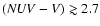 mag.
Fainter than this luminosity limit, several sources extend to bluer colours
mag.
Fainter than this luminosity limit, several sources extend to bluer colours
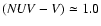 ,
indicating a UV excess relative to the brighter
objects. We note that
,
indicating a UV excess relative to the brighter
objects. We note that
 mag corresponds to the approximate
separation between ordinary GCs and UCDs (Hasegan et al. 2005; Mieske et al. 2006). We can therefore state that seven out
of 17 massive Fornax GCs detected in the GALEX images exhibit a UV
excess relative to UCDs. Massive Fornax GCs (MV>-11.1 mag) have
a mean colour of (
) =
mag corresponds to the approximate
separation between ordinary GCs and UCDs (Hasegan et al. 2005; Mieske et al. 2006). We can therefore state that seven out
of 17 massive Fornax GCs detected in the GALEX images exhibit a UV
excess relative to UCDs. Massive Fornax GCs (MV>-11.1 mag) have
a mean colour of (
) =
 mag, Fornax UCDs
(MV<-11.1 mag) have (
) =
mag, Fornax UCDs
(MV<-11.1 mag) have (
) =
 mag, while the full
sample of M 31 GCs has a mean colour of (
) =
mag, while the full
sample of M 31 GCs has a mean colour of (
) =
 mag
(see Fig. 3).
mag
(see Fig. 3).
Is this relative UV-excess indicative of more extreme horizontal
branches in those Fornax GCs? Or is the UV-excess simply due to a far
younger age? To address this question, we use a grid of
simple stellar population (SSP) models constructed using
the Yonsei Evolutionary Population Synthesis (YEPS) code (Park &
Lee 1997; Lee et al. 2000; Lee et al. 2005; Yoon et al. 2006, 2008). We note that the models that we use are the latest
version of the YEPS models. The version has adopted a new set of HB
evolutionary tracks compiled using the identical input
physics and equations of state as the Yonsei-Yale (Y2) MS-RGB
evolutionary tracks (Kim et al. 2002), taking into account the
-element enhancement effect. In Rey et al. (2005, 2007) and
Kaviraj et al. (2007), the YEPS models were used to investigate the
integrated light of GCs in M 31 based on GALEX UV
data, and in the Virgo cluster (M 87) based on HST/STIS UV data,
respectively. In Lee et al. (2005), the properties of resolved
stellar populations in Cen and NGC 2808 were analysed using
the YEPS models (see also Rey et al. 2001, 2004; and Yoon & Lee 2002 for
an application to resolved stellar populations in ``normal''
GCs).
Figure 3 shows that massive Fornax GCs with
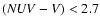 mag
exhibit a UV-excess with respect to the SSP model
predictions. There is no combination of age and metallicity that can
reproduce these very blue NUV colours at the given (V-I): not even
isochrones with an enhanced He abundance (Y=0.34 instead of the
canonical value Y=0.23) can account for these colours. The UCD data points are
more consistent with the model tracks for old ages around 12-14 Gyr.
There is a slight UV excess for the optically red UCDs, which can be
explained by He enhanced isochrones of old ages.
mag
exhibit a UV-excess with respect to the SSP model
predictions. There is no combination of age and metallicity that can
reproduce these very blue NUV colours at the given (V-I): not even
isochrones with an enhanced He abundance (Y=0.34 instead of the
canonical value Y=0.23) can account for these colours. The UCD data points are
more consistent with the model tracks for old ages around 12-14 Gyr.
There is a slight UV excess for the optically red UCDs, which can be
explained by He enhanced isochrones of old ages.
We now assess whether detecting some massive Fornax GCs with a UV
excess indicates that Fornax GCs as a sample have a higher probability of having a UV excess than our comparison sample, the
M 31 GCs. The two samples are almost disjunct in luminosity (see
Fig. 2). We focus on the colour range (
) < 2.7 mag,
which is the blue limit of the sample of 87 M 31 GCs with
NUV detection (Fig. 3), and also corresponds to the blue
limit of the UCD colours. From a total of 173 massive GCs with
-11.1<MV<-9.9 mag in the GALEX FoV, only 7 ( )
have
(
) < 2.7 mag. A Poisson test shows that drawing 0 out of 87 at an
underlying assumed probability of
0.04+0.015-0.015 occurs in
3
)
have
(
) < 2.7 mag. A Poisson test shows that drawing 0 out of 87 at an
underlying assumed probability of
0.04+0.015-0.015 occurs in
3
 % of random samplings. We can therefore state that
massive Fornax GCs extend to higher NUV fluxes than M 31 GCs at the
97% confidence level. We note that none of the 29 UCDs in the GALEX
FoV has (
) < 2.7 mag. However, this non-detection is not
statistically significant when assuming an underlying probability of
0.04+0.015-0.015 for a NUV excess as deduced from the massive
GCs.
% of random samplings. We can therefore state that
massive Fornax GCs extend to higher NUV fluxes than M 31 GCs at the
97% confidence level. We note that none of the 29 UCDs in the GALEX
FoV has (
) < 2.7 mag. However, this non-detection is not
statistically significant when assuming an underlying probability of
0.04+0.015-0.015 for a NUV excess as deduced from the massive
GCs.
In the (
)
vs. (V-I) colour-colour diagram of Fig. 3, a
much better age resolution is achieved, but the number of GALEX
detections drops to 21, as does the number of M 31 GCs (49 instead of
87 for NUV). In this diagram, a UV excess for the 2-3 most metal-rich
Fornax UCDs is confirmed, similar to the metal-rich M 87 GCs. Those
UCDs show colours best matched with He-enhanced isochrones of old ages
12-14 Gyr. Due to the brighter sensitivity limit of the FUV data,
only seven massive GCs enter the sample, of which three have UV excess
marginally incompatible with He-enhanced isochrones. Given the bias
towards detecting UV bright sources and the brighter sensitivity
limit in the FUV than in the NUV, we do not find statistically
significant evidence for a different (
)
distribution between
Fornax UCDs and massive GCs or M 31 GCs.
The (
)
colour-colour diagrams in Fig. 3, especially
the diagram (
)
vs. (
), allow the most robust distinction between
objects consistent and inconsistent with standard He abundance
isochrones. Fornax UCDs with
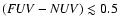 mag show
UV colours consistent with enhanced He abundance that cannot be
explained by standard He isochrones of 14 Gyr. They also show that
at a given colour (V-I) or (
), UCDs are bluer in (
)
than
our comparison sample of M 31 GCs. This is the strongest evidence in
our data of UCDs as a class harbouring stellar populations with UV
excess. We are unable to accurately determine a difference between UCDs and
massive Fornax GCs due to the brighter sensitivity limit in the FUV,
which excludes most of the GCs detected in the NUV.
mag show
UV colours consistent with enhanced He abundance that cannot be
explained by standard He isochrones of 14 Gyr. They also show that
at a given colour (V-I) or (
), UCDs are bluer in (
)
than
our comparison sample of M 31 GCs. This is the strongest evidence in
our data of UCDs as a class harbouring stellar populations with UV
excess. We are unable to accurately determine a difference between UCDs and
massive Fornax GCs due to the brighter sensitivity limit in the FUV,
which excludes most of the GCs detected in the NUV.
A UV excess in an old stellar population is probably due to EHB stars.
As pointed out in Sect. 1, an EHB may be linked
to helium-enriched stars (e.g. Ventura et al. 2001; D'Antona et al. 2002). The strong UV excess of the seven massive Fornax GCs beyond
the He-enhanced isochrones, especially the NUV excess of the three most
extreme GCs with (
) < 2.4 mag (see Fig. 3), suggests
that in these objects, EHB formation is also driven by other
processes. In this context, a plausible explanation may be enhanced
mass loss of evolved stars, triggered by high stellar densities
(Decressin et al. 2007; Huang & Gies 2006) and/or large binary
fractions.
Excess radiation at short wavelengths can in principle also arise from accretion onto a black hole (King et al. 1993), which can be traced by low-mass X-ray binaries (Jordán et al. 2004). We have cross-checked the positions of all GALEX UV detections with X-ray source detections in the Chandra Fornax Survey data (Scharf et al. 2005 and private communication), the deepest available wide-field X-ray survey of Fornax (50 ks integration with ACIS). The sensitivity of these images is a few 1038 erg/s, allowing us to detect the most luminous LMXBs (Jordán et al. 2004). In Fig. 1 (right panel), we indicate the (V-I) optical colours of those compact objects with X-ray matches. At a given magnitude, the X-ray matches in GCs are biased towards red optical colours (see also Jordán et al. 2004), while GALEX UV detections are biased towards blue optical colours. This suggests that in general, the UV- and X-ray-emission of the compact stellar systems are not caused by the same physical processes. However, there is one GALEX UV detection with an X-ray counterpart (Figs. 1 and 3), which happens to be one of the three GCs with the largest UV excess. We cannot therefore exclude that the UV excess in some of the GCs is linked to accretion processes.
We finally note that comparing the probability of UV excess between
UCDs and GCs allows to test whether EHBs are more likely associated
with present-day deep potential wells (i.e. UCDs) or high stellar
densities (i.e. GCs; Dabringhausen et al. 2008; Mieske et al. 2008).
One would expect deep potential wells to favour self-enrichment
(e.g. Ventura et al. 2001; D'Antona et al. 2002), and high stellar
densities to favour mass-loss scenarios (Decressin et al. 2007;
Huang & Gies 2006). Such a comparison may therefore help to
constrain the efficiency of EHB formation channels, provided that
the present-day density and mass of the systems investigated have
not experienced significant changes in the past, which would be the
case due to core collapse (Noyola & Gebhardt 2006; de Marchi et al.
2007) or tidal stripping (e.g. Lee et al. 2007). To perform this
comparison accurately, deeper UV imaging data will be required that
allow detection of UV intermediate-bright to faint GCs down to
 mag (
mag (
 mag at the Fornax distance). In
this respect, the results of HST observations in Cycle 15 (GO10901,
PI O'Connell) of GCs belonging to NGC 1399 are eagerly anticipated.
mag at the Fornax distance). In
this respect, the results of HST observations in Cycle 15 (GO10901,
PI O'Connell) of GCs belonging to NGC 1399 are eagerly anticipated.
Acknowledgements
We are grateful to Caleb Scharf for providing us with the source catalog of the Chandra Fornax survey. We thank the anonymous referee for her/his constructive criticism which helped to streamline the paper. The work of S.-C.R. was supported in part by KOSEF through the Astrophysical Research Center for the Structure and Evolution of the Cosmos (ARCSEC). S.-J.Y. acknowledges support from the Basic Research Program (grant No. R01-2006-000-10716-0) and from the Korea Research Foundation Grant funded by the Korean Government (grant No. KRF-2006-331-C00134).