A&A 488, 219-223 (2008)
DOI: 10.1051/0004-6361:200809401
HESS upper limits for Kepler's supernova remnant
F. Aharonian1,13 - A. G. Akhperjanian2 - U. Barres de Almeida8,![[*]](/icons/foot_motif.gif) - A. R. Bazer-Bachi3 - B. Behera14 - M. Beilicke4 - W. Benbow1 - D. Berge1,
- K. Bernlöhr1,5 - C. Boisson6 - O. Bolz1 - V. Borrel3 - I. Braun1 - E. Brion7 - J. Brucker16 - R. Bühler1 - T. Bulik24 - I. Büsching9 - T. Boutelier17 - S. Carrigan1 - P. M. Chadwick8 - L.-M. Chounet10 - A. C. Clapson1 - G. Coignet11 - R. Cornils4 - L. Costamante1,28 - M. Dalton5 - B. Degrange10 - H. J. Dickinson8 - A. Djannati-Ataï12 - W. Domainko1 - L. O'C. Drury13 - F. Dubois11 - G. Dubus17 - J. Dyks24 - K. Egberts1 - D. Emmanoulopoulos14 - P. Espigat12 - C. Farnier15 - F. Feinstein15 - A. Fiasson15 - A. Förster1 - G. Fontaine10 - M. Füßling5 - Y. A. Gallant15 - B. Giebels10 - J. F. Glicenstein7 - B. Glück16 - P. Goret7 - C. Hadjichristidis8 - D. Hauser1 - M. Hauser14 - G. Heinzelmann4 - G. Henri17 - G. Hermann1 - J. A. Hinton25 - A. Hoffmann18 - W. Hofmann1 - M. Holleran9 - S. Hoppe1 - D. Horns4 - A. Jacholkowska15 - O. C. de Jager9 - I. Jung16 - K. Katarzynski27 - E. Kendziorra18 - M. Kerschhaggl5 - B. Khélifi10 - D. Keogh8 - Nu. Komin15 - K. Kosack1 - G. Lamanna11 - I. J. Latham8 - M. Lemoine-Goumard10,
- J.-P. Lenain6 - T. Lohse5 - J. M. Martin6 - O. Martineau-Huynh19 - A. Marcowith15 - C. Masterson13 - D. Maurin19 - T. J. L. McComb8 - R. Moderski24 - E. Moulin7 - M. Naumann-Godo10 - M. de Naurois19 - D. Nedbal20 - D. Nekrassov1 - S. J. Nolan8 - S. Ohm1 - J.-P. Olive3 - E. de Oña Wilhelmi12 - K. J. Orford8 - J. L. Osborne8 - M. Ostrowski23 - M. Panter1 - G. Pedaletti14 - G. Pelletier17 - P.-O. Petrucci17 - S. Pita12 - G. Pühlhofer14 - M. Punch12 - A. Quirrenbach14 - B. C. Raubenheimer9 - M. Raue1 - S. M. Rayner8 - M. Renaud1 - J. Ripken4 - L. Rob20 - S. Rosier-Lees11 - G. Rowell26 - B. Rudak24 - J. Ruppel21 - V. Sahakian2 - A. Santangelo18 - R. Schlickeiser21 - F. M. Schöck16 - R. Schröder21 - U. Schwanke5 - S. Schwarzburg18 - S. Schwemmer14 - A. Shalchi21 - H. Sol6 - D. Spangler8 -
- A. R. Bazer-Bachi3 - B. Behera14 - M. Beilicke4 - W. Benbow1 - D. Berge1,
- K. Bernlöhr1,5 - C. Boisson6 - O. Bolz1 - V. Borrel3 - I. Braun1 - E. Brion7 - J. Brucker16 - R. Bühler1 - T. Bulik24 - I. Büsching9 - T. Boutelier17 - S. Carrigan1 - P. M. Chadwick8 - L.-M. Chounet10 - A. C. Clapson1 - G. Coignet11 - R. Cornils4 - L. Costamante1,28 - M. Dalton5 - B. Degrange10 - H. J. Dickinson8 - A. Djannati-Ataï12 - W. Domainko1 - L. O'C. Drury13 - F. Dubois11 - G. Dubus17 - J. Dyks24 - K. Egberts1 - D. Emmanoulopoulos14 - P. Espigat12 - C. Farnier15 - F. Feinstein15 - A. Fiasson15 - A. Förster1 - G. Fontaine10 - M. Füßling5 - Y. A. Gallant15 - B. Giebels10 - J. F. Glicenstein7 - B. Glück16 - P. Goret7 - C. Hadjichristidis8 - D. Hauser1 - M. Hauser14 - G. Heinzelmann4 - G. Henri17 - G. Hermann1 - J. A. Hinton25 - A. Hoffmann18 - W. Hofmann1 - M. Holleran9 - S. Hoppe1 - D. Horns4 - A. Jacholkowska15 - O. C. de Jager9 - I. Jung16 - K. Katarzynski27 - E. Kendziorra18 - M. Kerschhaggl5 - B. Khélifi10 - D. Keogh8 - Nu. Komin15 - K. Kosack1 - G. Lamanna11 - I. J. Latham8 - M. Lemoine-Goumard10,
- J.-P. Lenain6 - T. Lohse5 - J. M. Martin6 - O. Martineau-Huynh19 - A. Marcowith15 - C. Masterson13 - D. Maurin19 - T. J. L. McComb8 - R. Moderski24 - E. Moulin7 - M. Naumann-Godo10 - M. de Naurois19 - D. Nedbal20 - D. Nekrassov1 - S. J. Nolan8 - S. Ohm1 - J.-P. Olive3 - E. de Oña Wilhelmi12 - K. J. Orford8 - J. L. Osborne8 - M. Ostrowski23 - M. Panter1 - G. Pedaletti14 - G. Pelletier17 - P.-O. Petrucci17 - S. Pita12 - G. Pühlhofer14 - M. Punch12 - A. Quirrenbach14 - B. C. Raubenheimer9 - M. Raue1 - S. M. Rayner8 - M. Renaud1 - J. Ripken4 - L. Rob20 - S. Rosier-Lees11 - G. Rowell26 - B. Rudak24 - J. Ruppel21 - V. Sahakian2 - A. Santangelo18 - R. Schlickeiser21 - F. M. Schöck16 - R. Schröder21 - U. Schwanke5 - S. Schwarzburg18 - S. Schwemmer14 - A. Shalchi21 - H. Sol6 - D. Spangler8 -  .
Stawarz23 - R. Steenkamp22 - C. Stegmann16 - G. Superina10 - P. H. Tam14 - J.-P. Tavernet19 - R. Terrier12 - C. van Eldik1 - G. Vasileiadis15 - C. Venter9 - J. P. Vialle11 - P. Vincent19 - M. Vivier7 - H. J. Völk1 - F. Volpe10,28 - S. J. Wagner14 - M. Ward8 - A. A. Zdziarski24 - A. Zech6
.
Stawarz23 - R. Steenkamp22 - C. Stegmann16 - G. Superina10 - P. H. Tam14 - J.-P. Tavernet19 - R. Terrier12 - C. van Eldik1 - G. Vasileiadis15 - C. Venter9 - J. P. Vialle11 - P. Vincent19 - M. Vivier7 - H. J. Völk1 - F. Volpe10,28 - S. J. Wagner14 - M. Ward8 - A. A. Zdziarski24 - A. Zech6
1 - Max-Planck-Institut für Kernphysik, Heidelberg, Germany
2 -
Yerevan Physics Institute, Armenia
3 -
Centre d'Étude Spatiale des Rayonnements, CNRS/UPS, Toulouse, France
4 -
Universität Hamburg, Institut für Experimentalphysik, Germany
5 -
Institut für Physik, Humboldt-Universität zu Berlin, Germany
6 -
LUTH, Observatoire de Paris, CNRS, Université Paris Diderot, Meudon, France
7 -
IRFU/DSM/CEA, CE Saclay, Gif-sur-Yvette, France
8 -
University of Durham, Department of Physics, UK
9 -
Unit for Space Physics, North-West University, Potchefstroom, South Africa
10 -
Laboratoire Leprince-Ringuet, École Polytechnique, CNRS/IN2P3,
Palaiseau, France
11 -
Laboratoire d'Annecy-le-Vieux de Physique des Particules, CNRS/IN2P3,
Annecy-le-Vieux, France
12 -
Astroparticule et Cosmologie (APC), CNRS, Universite Paris 7 Denis Diderot,
10, Paris, France
13 -
Dublin Institute for Advanced Studies, Dublin, Ireland
14 -
Landessternwarte, Universität Heidelberg, Königstuhl, Heidelberg, Germany
15 -
Laboratoire de Physique Théorique et Astroparticules, CNRS/IN2P3,
Université Montpellier II, France
16 -
Universität Erlangen-Nürnberg, Physikalisches Institut, Erlangen, Germany
17 -
Laboratoire d'Astrophysique de Grenoble, INSU/CNRS, Université Joseph Fourier,
France
18 -
Institut für Astronomie und Astrophysik, Universität Tübingen, Germany
19 -
LPNHE, Université Pierre et Marie Curie Paris 6, Université Denis Diderot
Paris 7, CNRS/IN2P3, Paris, France
20 -
Institute of Particle and Nuclear Physics, Charles University,
Prague, Czech Republic
21 -
Institut für Theoretische Physik, Lehrstuhl IV: Weltraum und
Astrophysik, Ruhr-Universität Bochum, Germany
22 -
University of Namibia, Windhoek, Namibia
23 -
Obserwatorium Astronomiczne, Uniwersytet Jagiellonski, Kraków, Poland
24 -
Nicolaus Copernicus Astronomical Center, Warsaw, Poland
25 -
School of Physics & Astronomy, University of Leeds, UK
26 -
School of Chemistry & Physics, University of Adelaide, Australia
27 -
Torun Centre for Astronomy, Nicolaus Copernicus University, Torun, Poland
28 -
European Associated Laboratory for Gamma-Ray Astronomy, jointly
supported by CNRS and MPG
Received 15 January 2008 / Accepted 12 June 2008
Abstract
Aims. Observations of Kepler's supernova remnant (G4.5+6.8) with the HESS telescope array in 2004 and 2005 with a total live time of 13 h are presented.
Methods. Stereoscopic imaging of Cherenkov radiation from extensive air showers is used to reconstruct the energy and direction of the incident gamma rays.
Results. No evidence for a very high energy (VHE: >100 GeV) gamma-ray signal from the direction of the remnant is found. An upper limit (99% confidence level) on the energy flux in the range
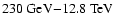 of 8.6
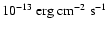 is obtained.
Conclusions. In the context of an existing theoretical model for the remnant, the lack of a detectable gamma-ray flux implies a distance of at least
 .
A corresponding upper limit for the density of the ambient matter of
.
A corresponding upper limit for the density of the ambient matter of
 is derived. With this distance limit, and assuming a spectral index
 ,
the total energy in accelerated protons is limited to
,
the total energy in accelerated protons is limited to

 .
In the synchrotron/inverse Compton framework, extrapolating the power law measured by RXTE between 10 and
.
In the synchrotron/inverse Compton framework, extrapolating the power law measured by RXTE between 10 and
 down in energy, the predicted gamma-ray flux from inverse Compton scattering is below the measured upper limit for magnetic field values greater than
 .
.
Key words: gamma rays: observations - ISM: supernova remnants - ISM:
individual objects: Kepler's SNR, SN1604, G4.5+6.8
1 Introduction
It is widely believed that the bulk of the Galactic cosmic rays (CR) with
energies up to at least several
 originates from supernova
explosions (see for example Drury et al. 1994). This implies copious
amounts of very high energy (VHE: >100 GeV) nuclei and electrons in the
shells of supernova remnants (SNRs). These particles can produce VHE gamma rays in interactions of nucleonic cosmic rays with ambient matter, via inverse
Compton (IC) scattering of VHE electrons off ambient photons, as well as from
electron Bremsstrahlung on ambient matter. Therefore SNRs are promising targets
for observations of VHE gamma rays.
originates from supernova
explosions (see for example Drury et al. 1994). This implies copious
amounts of very high energy (VHE: >100 GeV) nuclei and electrons in the
shells of supernova remnants (SNRs). These particles can produce VHE gamma rays in interactions of nucleonic cosmic rays with ambient matter, via inverse
Compton (IC) scattering of VHE electrons off ambient photons, as well as from
electron Bremsstrahlung on ambient matter. Therefore SNRs are promising targets
for observations of VHE gamma rays.
In October 1604 several astronomers, among them Johannes Kepler, observed a ``new star'' which today is believed to have been a bright supernova (SN) at the Galactic coordinates
 and
and
 .
The remnant of this supernova has since been
a target of observations covering the entire electromagnetic spectrum. In the
radio regime, Dickel et al. (1988) determined a mean
angular size of
.
The remnant of this supernova has since been
a target of observations covering the entire electromagnetic spectrum. In the
radio regime, Dickel et al. (1988) determined a mean
angular size of  200'' and a mean expansion law
 ,
where R is the radius and t is the time.
However, the expansion parameter
,
where R is the radius and t is the time.
However, the expansion parameter
 varies considerably
around the SNR shell,
0.35 < x < 0.65, possibly indicating spatial
inhomogenities in the circumstellar gas density. In a very recent paper by
Vink (2008) these properties, and the general asymmetry of the
remnant, have been basically confirmed through X-ray measurements. They also
allowed the analysis of a high-velocity synchrotron filament in the eastern
part of the remnant with x=0.7.
varies considerably
around the SNR shell,
0.35 < x < 0.65, possibly indicating spatial
inhomogenities in the circumstellar gas density. In a very recent paper by
Vink (2008) these properties, and the general asymmetry of the
remnant, have been basically confirmed through X-ray measurements. They also
allowed the analysis of a high-velocity synchrotron filament in the eastern
part of the remnant with x=0.7.
In addition, the distance d to the SNR is
still under debate. Reynoso & Goss (1999) report on an HI absorption
feature in VLA data and use the Galactic rotation model of
Fich et al. (1989) to calculate a lower limit
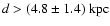 .
They also give an upper limit on the distance due to the lack of
absorption by an HI cloud at
.
The authors remark that these
values involve uncertainties because of the proximity of Kepler's SNR to the
Galactic center. In contrast, Sankrit et al. (2005) and subsequently
Blair et al. (2007) have given a lower source distance of
d = 3.9 (+1.9
-0.9) kpc, from an absolute shock velocity 1660
.
They also give an upper limit on the distance due to the lack of
absorption by an HI cloud at
.
The authors remark that these
values involve uncertainties because of the proximity of Kepler's SNR to the
Galactic center. In contrast, Sankrit et al. (2005) and subsequently
Blair et al. (2007) have given a lower source distance of
d = 3.9 (+1.9
-0.9) kpc, from an absolute shock velocity 1660 
 derived from the H
 emission line width of a Balmer-dominated filament that is located in the northwestern region. The line broadening, taken as an indication of the downstream thermal gas temperature, was used to determine the shock velocity. We shall return to this question in
the discussion section.
emission line width of a Balmer-dominated filament that is located in the northwestern region. The line broadening, taken as an indication of the downstream thermal gas temperature, was used to determine the shock velocity. We shall return to this question in
the discussion section.
Finally, the type of the supernova is not undisputed. From the reconstructed light curve
Baade (1943) claimed that it was a type Ia SN, but
Doggett & Branch (1985) argued that the light curve is also consistent with
a type II-L. Smith et al. (1989) and Kinugasa & Tsunemi (1999)
observed a relative overabundance of heavy elements that agrees with type Ia
nucleosynthesis models, while Decourchelle & Ballet (1994) saw more evidence that
Kepler's SNR is the remnant of a core-collapse SN. Its position,
 above the Galactic plane, is more consistent with a type Ia than a
type II SN, as a SN of the latter type is expected to be confined to the region
of high gas density found in the plane. However, in the case of a core-collapse
event this might be explained through the model of a runaway star, as proposed
by Bandiera (1987). More recently, theoretical modeling of the
detailed thermal line spectra obtained with XMM
(Cassam-Chenaï et al. 2004) led Badenes et al. (2005) to the conclusion that the X-ray spectrum is best fit by a type Ia SN, a view also expressed by
Blair (2005). Most recently Reynolds et al. (2007) reported
on deep Chandra observations and argued from the high abundance of
iron and the very low abundance of oxygen that the progenitor of Kepler's SNR has been a
type Ia SN. Therefore it appears that the observational evidence is finally
converging on a type Ia event.
above the Galactic plane, is more consistent with a type Ia than a
type II SN, as a SN of the latter type is expected to be confined to the region
of high gas density found in the plane. However, in the case of a core-collapse
event this might be explained through the model of a runaway star, as proposed
by Bandiera (1987). More recently, theoretical modeling of the
detailed thermal line spectra obtained with XMM
(Cassam-Chenaï et al. 2004) led Badenes et al. (2005) to the conclusion that the X-ray spectrum is best fit by a type Ia SN, a view also expressed by
Blair (2005). Most recently Reynolds et al. (2007) reported
on deep Chandra observations and argued from the high abundance of
iron and the very low abundance of oxygen that the progenitor of Kepler's SNR has been a
type Ia SN. Therefore it appears that the observational evidence is finally
converging on a type Ia event.
In this paper observations of Kepler's SNR
with the HESS telescope array are described. An upper limit on the
integrated energy flux above
 is derived. Combining this
HESS result with the theoretical predictions of Berezhko et al. (2006)
suggests a lower limit on the distance, close to the
upper limit given by Reynoso & Goss (1999), if
Kepler's SN is a priori assumed to be of type Ia.
is derived. Combining this
HESS result with the theoretical predictions of Berezhko et al. (2006)
suggests a lower limit on the distance, close to the
upper limit given by Reynoso & Goss (1999), if
Kepler's SN is a priori assumed to be of type Ia.
HESS is an array of four imaging atmospheric Cherenkov telescopes situated
in the Khomas Highland of Namibia (Hinton 2004). Kepler's SNR
was observed with the entire telescope array between May 2004 and July 2005 for
a total observation time of 14 h. The observations were made in wobble
mode, where the tracking position is offset from the source center (RA
 ,
Dec
,
Dec
 J2000.0). Offsets ranging from
 to
to
 were used. The data were taken at zenith
angles between
were used. The data were taken at zenith
angles between  and
and
 ,
with a mean zenith angle of
,
with a mean zenith angle of
 .
After applying the standard HESS data-quality criteria a
total of 13 h live time were available for the analysis. The analysis is
performed using the standard analysis techniques (Aharonian et al. 2004,
2005).
.
After applying the standard HESS data-quality criteria a
total of 13 h live time were available for the analysis. The analysis is
performed using the standard analysis techniques (Aharonian et al. 2004,
2005).
An event is counted as an ON-source event if
its direction is reconstructed within
 from the direction of the
source, given that Kepler's SNR is expected to be point-like for
HESS. This is a reasonable assumption as the angular size of the
remnant in radio and X-rays wavelengths is
from the direction of the
source, given that Kepler's SNR is expected to be point-like for
HESS. This is a reasonable assumption as the angular size of the
remnant in radio and X-rays wavelengths is
 .
.
As the data were taken in wobble mode, the background estimation can be done using
OFF-source regions in the same field of view with the same size and offset
angle (angular distance to the pointing position) as the source region
(Berge et al. 2007).
A second independent analysis, used to
cross-check the results, is based on the three-dimensional modeling of the
Cherenkov light in the shower (Lemoine-Goumard et al. 2006). The background
estimation for this second analysis was done similarly.
With the standard analysis 827 ON and 8855 OFF events (with a normalization of
 )
are measured, resulting in an excess of 20
30 events. The total
significance of the excess from the direction of Kepler's SNR (calculated using Eq. (17) of Li & Ma 1983) is 0.68 standard deviations. Figure 1 shows in the left panel a sky map of excess events around the position of Kepler's SNR and in the right panel the distribution of the squared angular distance of observed gamma-ray candidates
from the center of the remnant in comparison to OFF data.
The angular distribution of the ON events is compatible with the distribution
of the OFF events. There is no evidence for a gamma-ray signal from Kepler's SNR.
)
are measured, resulting in an excess of 20
30 events. The total
significance of the excess from the direction of Kepler's SNR (calculated using Eq. (17) of Li & Ma 1983) is 0.68 standard deviations. Figure 1 shows in the left panel a sky map of excess events around the position of Kepler's SNR and in the right panel the distribution of the squared angular distance of observed gamma-ray candidates
from the center of the remnant in comparison to OFF data.
The angular distribution of the ON events is compatible with the distribution
of the OFF events. There is no evidence for a gamma-ray signal from Kepler's SNR.
![\begin{figure}
\par\mbox{\includegraphics[width=4.3cm]{9401fig1.eps} \includegraphics[width=4.3cm]{9401fig2.eps} }
\end{figure}](/articles/aa/full/2008/34/aa09401-08/Timg36.gif) |
Figure 1:
Left: sky map of excess events around the position of
Kepler's SNR with oversampling radius
;
right: distribution of the squared angular distance of gamma-ray-like events to the center of the remnant (ON) and
the center of three control regions (OFF) with the same distance to the
pointing position as the ON region. The vertical dotted line denotes the
standard selection cut for point sources used by HESS. |
| Open with DEXTER |
The approach of Feldman & Cousins (1998) is used to calculate the upper
limits on the integrated photon flux above
.
At a confidence level of 99%
an upper limit of
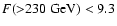
 for an assumed photon index of
 is derived. At the same
confidence level an upper limit on the energy flux of
is derived. At the same
confidence level an upper limit on the energy flux of

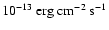 in the HESS energy range for this data set
(
in the HESS energy range for this data set
(
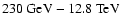 )
is derived.
The assumed index of 2 requires an upper bound for the integration range to
avoid a divergent energy flux.
)
is derived.
The assumed index of 2 requires an upper bound for the integration range to
avoid a divergent energy flux.
These values depend only weakly on the assumed photon index
for reasonable values (i.e.
 ).
).
To put the observed upper limit on the gamma-ray emission into perspective, the
above result is compared with theoretical expectations. Such expectations have recently been formulated by Berezhko et al. (2006) (BKV), using a non-linear kinetic theory of
cosmic-ray acceleration in SNRs. This model is based on a time-dependent, spherically symmetric
solution of the CR transport equation, coupled to the dynamics of the thermal
gas. The key assumption is that the explosion was a standard type Ia event in a
circumstellar medium at rest, representing an explosion energy
 and an ejected mass of
 .
For a given distance the hydrogen density can then be derived from the known angular expansion velocity and size of the remnant,
assumed to be given by the radio data of Dickel et al. (1988) and
averaging these data over the azimuthal non-uniformities of the projected SNR shell. The use of such an average value for the angular velocity of the shock
and the implied assumption of a uniform circumstellar density is a necessary
approximation within such a one-dimensional model which is meant to
describe the overall physics of a point explosion. On the other hand,
the systematic errors which these assumptions introduce are difficult to
estimate, especially in the transition between sweep-up and adiabatic phase.
BKV obtained the spectrum and the spatial distribution of CR in the
remnant and the density of thermal gas.
On this basis they then calculated the expected flux of non-thermal emission
(Fig. 2). To account for the
uncertainties in the distance estimate this was done for a distance range from
.
For a given distance the hydrogen density can then be derived from the known angular expansion velocity and size of the remnant,
assumed to be given by the radio data of Dickel et al. (1988) and
averaging these data over the azimuthal non-uniformities of the projected SNR shell. The use of such an average value for the angular velocity of the shock
and the implied assumption of a uniform circumstellar density is a necessary
approximation within such a one-dimensional model which is meant to
describe the overall physics of a point explosion. On the other hand,
the systematic errors which these assumptions introduce are difficult to
estimate, especially in the transition between sweep-up and adiabatic phase.
BKV obtained the spectrum and the spatial distribution of CR in the
remnant and the density of thermal gas.
On this basis they then calculated the expected flux of non-thermal emission
(Fig. 2). To account for the
uncertainties in the distance estimate this was done for a distance range from
 .
The derived ambient density varies with the distance
assumed and the numerical results show that for a distance d as low as 4.8 kpc the SNR has reached the Sedov phase. Therefore the predicted integral hadronic gamma-ray flux
roughly decreases with distance
.
The derived ambient density varies with the distance
assumed and the numerical results show that for a distance d as low as 4.8 kpc the SNR has reached the Sedov phase. Therefore the predicted integral hadronic gamma-ray flux
roughly decreases with distance 
 ,
in agreement with the calculations shown in
Fig. 2. Approximating the emission
measure for free-free emission by
,
in agreement with the calculations shown in
Fig. 2. Approximating the emission
measure for free-free emission by
 ,
where
,
where
 denotes the swept-up
circumstellar mass,
denotes the swept-up
circumstellar mass,  scales in the same way with
 and d as does the gamma-ray flux.
To compare the given upper limit with the model prediction, the quantity
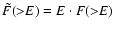 is determined. Here F(>E) is the upper limit on the integrated Flux above the
energy E. For
is determined. Here F(>E) is the upper limit on the integrated Flux above the
energy E. For
 the value for
  is
is
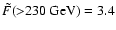
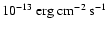 .
The resulting integrated upper limits are plotted in Fig. 2 for several energies in the range
.
The resulting integrated upper limits are plotted in Fig. 2 for several energies in the range
 .
Note that for these values no upper bound
for the integration is needed as the quantity F(>E) decreases with energy for
spectral indices greater than
.
Note that for these values no upper bound
for the integration is needed as the quantity F(>E) decreases with energy for
spectral indices greater than
 .
.
![\begin{figure}
\par\includegraphics[width=8.3cm,clip]{9401fig3} \end{figure}](/articles/aa/full/2008/34/aa09401-08/Timg61.gif) |
Figure 2:
Comparison of the upper limits on
 with predictions of BKV.
 |
| Open with DEXTER |
Within the context of the model of BKV, the HESS upper limits rule out
distances smaller than
for
 and thus densities larger than
,
and values of
in excess of
and thus densities larger than
,
and values of
in excess of 
 .
The mean shock velocity is then
.
The mean shock velocity is then 
 ,
and the SNR is just in transition from the sweep-up phase to the Sedov phase.
,
and the SNR is just in transition from the sweep-up phase to the Sedov phase.
From SN explosion theory (see BKV, and references therein)
a lower limit of

 appears appropriate for type Ia SNe. Considering such a reduced explosion energy, the expected flux in gamma rays would be lower and therefore the HESS upper limit would result in a reduced lower limit
on the distance of
appears appropriate for type Ia SNe. Considering such a reduced explosion energy, the expected flux in gamma rays would be lower and therefore the HESS upper limit would result in a reduced lower limit
on the distance of
 .
.
While in the BKV model the above value of
that corresponds
to the upper limit of HESS agrees quite well with the overall number
recently derived by Blair et al. (2007) from their measurements, the
distances of 6.4 and 6.0 kpc differ significantly from the value adopted
by these authors, whose distance estimate is
within the errors smaller than 5.8 kpc (see Sect. 1). On the other
hand, Blair et al. (2007) derived their distance value from an optical
filament in the northwestern region which has the smallest expansion parameter
found in the radio and X-ray observations all around the remnant.
It is also interesting to note that the determination of the shock velocity from the
H line broadening should involves a CR-modified shock, in contrast to
the assumption of Sankrit et al. (2005). Efficient particle
acceleration in the SNR modifies the shock, whereby part of the gas compression - but only a very small part of the gas heating - occurs in a smooth precursor,
in which the CR pressure gradient slows down the incoming gas flow. This is
followed by the so-called subshock (Drury & Völk 1981)
where most of the gas heating occurs (Berezhko & Ellison 1999).
The compression ratio
 of the subshock is smaller than the
overall shock compression ratio
of the subshock is smaller than the
overall shock compression ratio  .
Such a shock structure implies that
the shock velocity corresponding to the downstream thermal motions is the
subshock velocity
.
Such a shock structure implies that
the shock velocity corresponding to the downstream thermal motions is the
subshock velocity
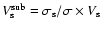 ,
where
,
where  is the total shock velocity. In other words,
a higher overall shock velocity is required to achieve the same gas heating if
in addition CR are accelerated. Therefore the source distance derived from the
width of the H line is
is the total shock velocity. In other words,
a higher overall shock velocity is required to achieve the same gas heating if
in addition CR are accelerated. Therefore the source distance derived from the
width of the H line is
 times the true
source distance if derived without particle acceleration. This may imply a
substantial systematic error. In the BKV model for Kepler, in spherical
symmetry it is
times the true
source distance if derived without particle acceleration. This may imply a
substantial systematic error. In the BKV model for Kepler, in spherical
symmetry it is
 for an assumed distance
of 4.8 kpc, and still equal to 0.6 for d=6.4 kpc. Therefore the nominal distance
d=4 kpc adopted by Blair et al. (2007) is equivalent to d = 6.6 kpc,
if the northwestern region considered is indeed one where acceleration is
efficient. If particle acceleration is not efficient in this region, then the
correction factor is unity. Even a slight modification
for an assumed distance
of 4.8 kpc, and still equal to 0.6 for d=6.4 kpc. Therefore the nominal distance
d=4 kpc adopted by Blair et al. (2007) is equivalent to d = 6.6 kpc,
if the northwestern region considered is indeed one where acceleration is
efficient. If particle acceleration is not efficient in this region, then the
correction factor is unity. Even a slight modification
 of the shock makes the source distances
compatible.
of the shock makes the source distances
compatible.
Independent of particle acceleration models one can use
the HESS upper limit also to constrain the content of energetic particles
in the remnant. Using the limit on the flux in the range between
 and
and
 ,
an upper limit on the gamma-ray luminosity
,
an upper limit on the gamma-ray luminosity
 can be estimated, where
  is the integrated energy flux upper limit. In this range then

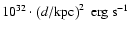 is derived. For power-law spectra, the
  -function approximation
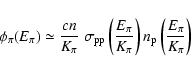 |
(1) |
can be used to relate the spectra of pions (or gamma rays) to those of the
primary protons (Aharonian & Atoyan 2000); here
 is the pion
(or gamma-ray) production rate, n the gas density,
is the pion
(or gamma-ray) production rate, n the gas density,
 the
number of protons and
the
number of protons and  is the mean fraction of the kinetic energy of
the proton transferred to the secondary
is the mean fraction of the kinetic energy of
the proton transferred to the secondary  -meson per collision.
The rest mass of the proton is neglected.
For spectral indices
-meson per collision.
The rest mass of the proton is neglected.
For spectral indices
 ,
,
 can be used
to approximate the pion spectrum (Aharonian & Atoyan 2000), a similar value
also applies for gamma-ray
spectra. At high energy, the proton-proton cross-section
can be used
to approximate the pion spectrum (Aharonian & Atoyan 2000), a similar value
also applies for gamma-ray
spectra. At high energy, the proton-proton cross-section
 is only weakly energy dependent and can be approximated with
 (Gaisser 1990). The HESS data probe proton
energies in the range from about 1 to
;
using Eq. (1) and assuming an index
,
a limit on the energy in
protons of
(Gaisser 1990). The HESS data probe proton
energies in the range from about 1 to
;
using Eq. (1) and assuming an index
,
a limit on the energy in
protons of

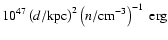 can be derived.
Extrapolating to the
can be derived.
Extrapolating to the
 to
to
 range
results in an upper limit on the total energy in accelerated protons of 1.5
range
results in an upper limit on the total energy in accelerated protons of 1.5
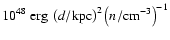 .
Using
.
Using
 and
and
 (dashed-3-dotted
line in Fig. 2) this results in
,
i.e.
(dashed-3-dotted
line in Fig. 2) this results in
,
i.e.  of the assumed energy
 .
This is of the order of what is expected for an average cosmic-ray source in the form of a SNR. Assuming
and using the argument of
BKV that
.
This is of the order of what is expected for an average cosmic-ray source in the form of a SNR. Assuming
and using the argument of
BKV that
 ,
in agreement with the observational argument of
Reynoso & Goss (1999), the expected gamma-ray flux should not be lower
than the HESS upper limit by more than a factor 2 as can be seen in
Fig. 2.
,
in agreement with the observational argument of
Reynoso & Goss (1999), the expected gamma-ray flux should not be lower
than the HESS upper limit by more than a factor 2 as can be seen in
Fig. 2.
In another scenario the gamma-ray emission can be produced via IC scattering by VHE electrons off ambient photons mainly from the cosmic microwave background (CMB).
The same electrons emit synchrotron X-ray radiation by being deflected
by magnetic fields in the SNR. The energy of the gamma-ray photons is
coupled to that of the X-ray photons
according to
 in the case of the CMB
as target photon field for the IC scattering.
If the observed hard X-ray radiation (Allen et al. 1999), with a flux normalisation of 6.2
in the case of the CMB
as target photon field for the IC scattering.
If the observed hard X-ray radiation (Allen et al. 1999), with a flux normalisation of 6.2
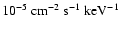 and a slope of -3.0
0.2, is synchrotron radiation (with the corresponding energy flux
and a slope of -3.0
0.2, is synchrotron radiation (with the corresponding energy flux
 )
the energy flux in gamma rays is
given by
)
the energy flux in gamma rays is
given by
 (Aharonian et al. 1997). The factor
  takes into account possible
differences in the source sizes in X-ray and gamma-ray wavelengths.
We assume here
takes into account possible
differences in the source sizes in X-ray and gamma-ray wavelengths.
We assume here
 .
.
In principle one could try to use the above relations to obtain a
lower limit on the magnetic field strength since the upper limit on
the flux in particular constrains any IC component. For this purpose
the energy flux from X-ray synchrotron emission at an energy
corresponding to a given energy probed in VHE gamma rays has to be
known either from measurements or from detailed modeling. The
interval in
 that corresponds to the observed
gamma-ray energy interval
that corresponds to the observed
gamma-ray energy interval
 is
is

 ,
whereas the energy interval in which the total non-thermal X-ray flux
is known is
,
whereas the energy interval in which the total non-thermal X-ray flux
is known is
 (Allen et al. 1999). The
X-ray instrument PCA on board RXTE, with which the underlying data
were obtained, has no imaging capabilities and therefore the measured
spectrum is the overall spectrum of the field of view of the
instrument (which is
). Although it is expected that the
measured photon flux is indeed from Kepler's SNR because of its
position well above the plane, the X-ray flux has to be treated as an
upper limit. Unfortunately there is no published analysis of the
non-thermal flux from Chandra data covering the entire remnant. It is
also not possible to unambiguously disentangle the non-thermal and the
thermal contribution to the total spectrum measured by XMM-Newton (Cassam-Chenaï, private communication).
(Allen et al. 1999). The
X-ray instrument PCA on board RXTE, with which the underlying data
were obtained, has no imaging capabilities and therefore the measured
spectrum is the overall spectrum of the field of view of the
instrument (which is
). Although it is expected that the
measured photon flux is indeed from Kepler's SNR because of its
position well above the plane, the X-ray flux has to be treated as an
upper limit. Unfortunately there is no published analysis of the
non-thermal flux from Chandra data covering the entire remnant. It is
also not possible to unambiguously disentangle the non-thermal and the
thermal contribution to the total spectrum measured by XMM-Newton (Cassam-Chenaï, private communication).
In the energy range around a few keV the extrapolation of the observed
hard X-ray flux to lower energies involves considerable
uncertainties. Nevertheless, in almost all scenarios the extrapolation
of the power-law spectrum measured between 10 and
(with a spectral index of
 )
should be an upper limit to
the X-ray to UV flux. With this extrapolation an upper limit on the
gamma-ray flux from IC scattering for a given magnetic field can be
calculated using the above formulas.
)
should be an upper limit to
the X-ray to UV flux. With this extrapolation an upper limit on the
gamma-ray flux from IC scattering for a given magnetic field can be
calculated using the above formulas.
For magnetic field values greater than
the
resulting predicted upper limit on the IC flux would be less than the measured
upper limit of
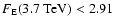 .
.
From Chandra measurements of thin X-ray filaments
(Bamba et al. 2005), whose thickness is interpreted as the
synchrotron cooling length of the radiating electrons, the actual field strength is
 ,
following the arguments of BKV and Parizot et al. (2006). This
field implies an IC gamma-ray energy flux of
,
following the arguments of BKV and Parizot et al. (2006). This
field implies an IC gamma-ray energy flux of

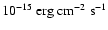 which is two orders of magnitude below the measured upper limit.
Observations of Kepler's SNR with HESS result in an upper limit
for the flux of VHE gamma rays from the SNR. In the context of an
existing theoretical model (BKV) for the remnant, and assuming an
ejected mass of
and an explosion energy of
in agreement with type Ia SN explosion models, the lack of a detectable gamma ray flux implies a distance of at least
,
which is the same as the upper limit derived by
Reynoso & Goss (1999) from radio observations.
Given that the gamma-ray flux effectively
scales with
 ,
a significantly higher
explosion energy is excluded; a theoretically acceptable lower
explosion energy of 0.8
would lower
the distance limit to
,
a significantly higher
explosion energy is excluded; a theoretically acceptable lower
explosion energy of 0.8
would lower
the distance limit to
 .
.
Assuming a purely hadronic scenario, a standard type Ia SN explosion, and using
as a lower limit for the distance, the HESS upper limit
implies that the total energy in accelerated protons is
less than 8.6
.
In a synchrotron/IC scenario no strong constraints on the magnetic field can be
obtained.
Acknowledgements
The support of the Namibian authorities and of the University of Namibia
in facilitating the construction and operation of HESS is gratefully
acknowledged, as is the support by the German Ministry for Education and
Research (BMBF), the Max Planck Society, the French Ministry for Research,
the CNRS-IN2P3 and the Astroparticle Interdisciplinary Programme of the
CNRS, the UK Science and Technology Facilities Council (STFC),
the IPNP of the Charles University, the Polish Ministry of Science and
Higher Education, the South African Department of
Science and Technology and National Research Foundation, and by the
University of Namibia. We appreciate the excellent work of the technical
support staff in Berlin, Durham, Hamburg, Heidelberg, Palaiseau, Paris,
Saclay, and in Namibia in the construction and operation of the
equipment.
- Aharonian, F. A.,
& Atoyan, A. M. 2000, A&A, 362, 937 [NASA ADS]
(In the text)
- Aharonian, F. A.,
Atoyan, A. M., & Kifune, T. 1997, MNRAS, 291, 162 [NASA ADS]
(In the text)
- Aharonian, F.,
Akhperjanian, A. G., Aye, K.-M., et al. (HESS Collaboration) 2004,
Astropart. Phys., 22, 109
(In the text)
- Aharonian, F. A.,
Akhperjanian, A. G., Aye, K.-M., et al. (HESS Collaboration) 2005,
A&A, 430, 865
(In the text)
- Allen, G. E.,
Gotthelf, E. V., & Petre, R. 1999, Proc. 26th ICRC, Salt Lake
City, 3, 480
(In the text)
- Baade, W. 1943, ApJ,
97, 119 [NASA ADS] [CrossRef]
(In the text)
- Badenes, C.,
Borkowski, K. J., & Bravo, E. 2005, ApJ, 624, 198 [NASA ADS] [CrossRef]
(In the text)
- Bamba, A., Yamazaki,
R., Yoshida, T., Terasawa, T., & Koyama, K. 2005, ApJ, 621,
793 [NASA ADS] [CrossRef]
(In the text)
- Bandiera, R. 1987,
ApJ, 319, 885 [NASA ADS] [CrossRef]
(In the text)
- Berezhko, E. G., &
Ellison, D. C. 1999, ApJ, 526, 385 [NASA ADS] [CrossRef]
(In the text)
- Berezhko, E. G.,
Ksenofontov, L. T., & Völk, H. J. 2006, A&A, 452,
217 [NASA ADS] [CrossRef] [EDP Sciences]
(In the text)
- Berge, D., Funk, S.,
& Hinton, J. 2007, A&A, 466, 1219 [NASA ADS] [CrossRef] [EDP Sciences]
(In the text)
- Blair, W. P. 2005,
1604-2004: Supernovae as Cosmological Lighthouses, ASP Conf. Ser.,
342, 416
(In the text)
- Blair, W. P.,
Ghavamian, P., Long, K. S., et al. 2007, ApJ, 662, 998 [NASA ADS] [CrossRef]
(In the text)
- Cassam-Chenaï,
G., Decourchelle, A., Ballet, J., et al. 2004, A&A, 414,
545 [NASA ADS] [CrossRef] [EDP Sciences]
(In the text)
- Decourchelle, A.,
& Ballet, J. 1994, A&A, 287, 206 [NASA ADS]
(In the text)
- Dickel, J. R., Sault,
R., Arendt, R. G., Matsui, Y., & Korista, K. T. 1988, ApJ, 330,
254 [NASA ADS] [CrossRef]
(In the text)
- Doggett, J. B., &
Branch, D. 1985, AJ, 90, 2303 [NASA ADS] [CrossRef]
(In the text)
- Drury, L. O., &
Voelk, J. H. 1981, ApJ, 248, 344 [NASA ADS] [CrossRef]
(In the text)
- Drury, L. O.,
Aharonian, F. A., & Völk, H. J. 1994, A&A, 287,
959 [NASA ADS]
(In the text)
- Feldman, G. J., &
Cousins, R. D. 1998, Phys. Rev. D, 57, 3873 [NASA ADS] [CrossRef]
(In the text)
- Fich, M., Blitz, L.,
& Stark, A. A. 1989, ApJ, 342, 272 [NASA ADS] [CrossRef]
(In the text)
- Gaisser, T. K. 1990,
Cosmic rays and particle physics (Cambridge and New York: Cambridge
University Press)
(In the text)
- Hinton, J. A. 2004,
New Astron. Rev., 48, 331 [NASA ADS] [CrossRef]
(In the text)
- Hughes, J. P. 1999,
ApJ, 527, 298 [NASA ADS] [CrossRef]
- Kinugasa, K., &
Tsunemi, H. 1999, PASJ, 51, 239 [NASA ADS]
(In the text)
- Lemoine-Goumard, M.,
Degrange, B., & Tluczykont, M. 2006, Astropart. Phys., 25,
195 [NASA ADS] [CrossRef]
(In the text)
- Li, T.-P., & Ma,
Y.-Q. 1983, ApJ, 272, 317 [NASA ADS] [CrossRef]
(In the text)
- Parizot, E.,
Marcowith, A., Ballet, J., & Gallant, Y. A. 2006, A&A, 453,
387 [NASA ADS] [CrossRef] [EDP Sciences]
(In the text)
- Reynolds, S. P.,
Borkowski, K. J., Hwang, U., et al. 2007, ApJ, 668, L135 [NASA ADS] [CrossRef]
(In the text)
- Reynoso, E. M., &
Goss, W. M. 1999, AJ, 118, 926 [NASA ADS] [CrossRef]
(In the text)
- Sankrit, R., Blair, W.
P., Delaney, T., et al. 2005, Adv. Space Res., 35, 1027 [NASA ADS] [CrossRef]
(In the text)
- Smith, A., Peacock,
A., Arnaud, M., et al. 1989, ApJ, 347, 925 [NASA ADS] [CrossRef]
(In the text)
- Vink, J. 2008, ApJ,
submitted [arXiv:0803.4011]
(In the text)
Copyright ESO 2008
![\begin{figure}
\par\mbox{\includegraphics[width=4.3cm]{9401fig1.eps} \includegraphics[width=4.3cm]{9401fig2.eps} }
\end{figure}](/articles/aa/full/2008/34/aa09401-08/img36.gif)
![\begin{figure}
\par\includegraphics[width=8.3cm,clip]{9401fig3} \end{figure}](/articles/aa/full/2008/34/aa09401-08/img61.gif)