A&A 487, 247-252 (2008)
DOI: 10.1051/0004-6361:200809577
CN Zeeman measurements in star formation regions
E. Falgarone1 -
T. H. Troland2 -
R. M. Crutcher3 -
G. Paubert4
1 - LERMA/LRA, CNRS UMR 8112, École Normale Supérieure and Observatoire de Paris, 24 rue Lhomond, 75231 Paris Cedex 05, France
2 -
University of Kentucky, Department of Physics and Astronomy, Lexington, KY 40506, USA
3 -
University of Illinois, Department of Astronomy, Urbana, IL 61801, USA
4 -
IRAM, 7 avenida Divina Pastora, Granada, Spain
Received 14 February 2008 / Accepted 17 May 2008
Abstract
Aims. Magnetic fields play a primordial role in the star formation process. The Zeeman effect on the CN radical lines is one of the few methods of measuring magnetic fields in the dense gas of star formation regions.
Methods. We report new observations of the Zeeman effect on seven hyperfine CN N=1-0 lines in the direction of 14 regions of star formation.
Results. We have improved the sensitivity of previous detections, and obtained five new detections. Good upper limits are also achieved. The probability distribution of the line-of-sight field intensity, including non-detections, provides a median value of the total field
 mG while the average density of the medium sampled is
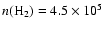 cm-3. We show that the CN line probably samples regions similar to those traced by CS and that the magnetic field observed mostly pervades the dense cores. The dense cores are found to be critical to slightly supercritical with a mean mass-to-flux ratio
 to 4 with respect to critical. Their turbulent and magnetic energies are in approximate equipartition.
Key words: magnetic fields - stars: formation - ISM: molecules - turbulence -
polarization - ISM: kinematics and dynamics
The role of magnetic fields in the formation of structure in dense
molecular clouds and in the star formation process remains unclear
(see Crutcher 2007, for a recent review). If sufficiently
strong, magnetic fields may support clouds against gravitational
collapse and thus prevent or delay star formation. Shu et al. (1999), Mouschovias & Ciolek (1999), and
MacLow & Klessen (2004) have reviewed the theory. Magnetic
fields appear to provide the only viable mechanism for transporting
angular momentum from collapsing cores, and they may play a
significant role in the physics of bipolar outflows and jets that
accompany protostar formation (Cabrit 2007). Observation of magnetic
fields in molecular clouds is therefore crucial.
Crutcher (2007) reviewed the various techniques and results for
studying magnetic fields in molecular clouds. Of these techniques, the
Zeeman effect provides the only direct method for measuring magnetic
field strengths in molecular clouds. To date, detections of the Zeeman
effect in the interstellar medium have been made only in lines of H I,
OH, CN, and H2O. Thermal lines of the first two species probe
relatively low-density gas -
 cm-3. OH and
H2O maser emission lines probe high densities, but in special
regions - very localized in space and perhaps shock compressed. As a
tracer of high density gas, the CN thermal lines probe dense regions
in molecular clouds and CN Zeeman observations are therefore a unique
tool for measuring magnetic field strengths in star formation regions.
cm-3. OH and
H2O maser emission lines probe high densities, but in special
regions - very localized in space and perhaps shock compressed. As a
tracer of high density gas, the CN thermal lines probe dense regions
in molecular clouds and CN Zeeman observations are therefore a unique
tool for measuring magnetic field strengths in star formation regions.
The radio transitions of CN have been discussed extensively by Turner
& Gammon (1975). The Einstein A of the strongest CN hyperfine
component within the
 mm
mm
 transition
is
transition
is
 s-1, which means that the
transition of CN offers the opportunity to measure
magnetic fields in the density range 104 to 106 cm-3, the
density of molecular cores that may be in transition from equilibrium
(between gravity and magnetic/turbulent support) to collapse to form
stars.
s-1, which means that the
transition of CN offers the opportunity to measure
magnetic fields in the density range 104 to 106 cm-3, the
density of molecular cores that may be in transition from equilibrium
(between gravity and magnetic/turbulent support) to collapse to form
stars.
Previously, a successful series of CN Zeeman observations was carried
out with the IRAM 30-m telescope, with a quarter-wave plate
polarimeter (Crutcher et al. 1996,1999). In this paper we
report additional results obtained with the IRAM-30 m telescope with a
new correlation spectropolarimeter. We both improved the sensitivity
of some of the previous results and obtained data on new sources.
Table 1 lists the 7 strongest CN hyperfine lines together with each
line's frequency, relative intensity, Zeeman splitting coefficient,
and relative sensitivity to the Zeeman effect (the product of the
Zeeman splitting coefficient and the relative intensity). The fact
that the
transition of CN has 7 strong hyperfine
components (there are actually 9 components, but 2 are much weaker
than the others and hence are not useful for Zeeman observations) with
very different Zeeman splitting factors is essential for the success
of CN Zeeman measurements. Instrumental polarization such as beam
squint (a two-lobe pattern in the circularly polarized primary
telescope beam), polarized sidelobes, et cetera will typically produce
a Stokes V signal in the CN spectra that is comparable to or larger
than the Zeeman signal. There is no way to avoid this for extended
emission, and it would be extremely difficult, if not impossible, to
eliminate these instrumental polarization artifacts. The main effect
of instrumental polarization is to produce a pseudo-splitting of the
spectral line that appears to mimic Zeeman splitting. However,
instrumental polarization does not know about the Zeeman effect. The
CN Zeeman splitting factor (Crutcher et al. 1996) varies quite
significantly among the 7 hyperfine components (see Table 1). It is
possible to observe all 7 hyperfine lines simultaneously and to fit
the 7 observed Stokes V spectra to the expression:
 ,
where i = 1 to 7 for the 7 hyperfine
components and Zi is the Zeeman splitting factor for each hyperfine
line. C1 absorbs any gain difference between left and right
polarization and any linearly polarized line signal. C2 absorbs any
instrumental polarization effects that produce pseudo-Zeeman
splitting. C3 is non-zero only if there is circular polarization
line splitting due to the CN Zeeman effect. Crutcher et al. (1996) tested this fitting procedure with simulated noisy
data and found that it is robust; for example, a
,
where i = 1 to 7 for the 7 hyperfine
components and Zi is the Zeeman splitting factor for each hyperfine
line. C1 absorbs any gain difference between left and right
polarization and any linearly polarized line signal. C2 absorbs any
instrumental polarization effects that produce pseudo-Zeeman
splitting. C3 is non-zero only if there is circular polarization
line splitting due to the CN Zeeman effect. Crutcher et al. (1996) tested this fitting procedure with simulated noisy
data and found that it is robust; for example, a  Zeeman
signal can be reliably extracted from data with more than an order of
magnitude larger instrumental polarization artifacts. For CN Zeeman
observations the polarimeter need not be perfect (as indeed the
quarter-wave plates used previously were definitely not), and
polarized sidelobes that would severely affect attempts to measure
polarization of extended emission or other instrumental polarization
effects do not prevent success.
Zeeman
signal can be reliably extracted from data with more than an order of
magnitude larger instrumental polarization artifacts. For CN Zeeman
observations the polarimeter need not be perfect (as indeed the
quarter-wave plates used previously were definitely not), and
polarized sidelobes that would severely affect attempts to measure
polarization of extended emission or other instrumental polarization
effects do not prevent success.
Table 1:
CN N=1-0 hyperfine lines.
Observations were carried out with the IRAM-3 0m telescope, which has a
beam width of
 at this frequency, in May 2004,
2005, 2006 and 2007. In order to observe at the peak CN line
positions, we first made very short Stokes I maps (generally 5-point
maps). For our observations the two orthogonally polarized heterodyne
receivers were made coherent by sharing reference synthesizers. The
signals from the receivers were fed to the Vespa correlator which
performed the auto-correlations and cross-correlations of the signals
from both receivers. This gave 4 spectra - the power spectra of the
horizontally and vertically (in the receiver cabin) polarized
receivers, and the real and imaginary parts of the cross-correlations
(i.e., the horizontally polarized receiver correlated with the
vertically polarized receiver).
at this frequency, in May 2004,
2005, 2006 and 2007. In order to observe at the peak CN line
positions, we first made very short Stokes I maps (generally 5-point
maps). For our observations the two orthogonally polarized heterodyne
receivers were made coherent by sharing reference synthesizers. The
signals from the receivers were fed to the Vespa correlator which
performed the auto-correlations and cross-correlations of the signals
from both receivers. This gave 4 spectra - the power spectra of the
horizontally and vertically (in the receiver cabin) polarized
receivers, and the real and imaginary parts of the cross-correlations
(i.e., the horizontally polarized receiver correlated with the
vertically polarized receiver).
The spectra were first converted to temperature scale by applying the
standard calibration procedure for spectral observations. The next
step was to correct for the phase errors: while the receivers are
coherent, they exhibit an unknown phase difference (due to slightly
different optical paths, unmatched cable lengths, absolute phase of
the spectrometers) which must be taken into account. This difference
was measured by taking an additional spectrum on a cold load through a
polarization grid during the calibration procedure. The uncertainty on
the phase correction in each individual channel was about  rms. It was also very stable with time, varying by less than
  per hour.
The phase correction was applied to the cross-correlation spectra to
obtain 4 spectra in the receiver cabin domain (Horizontal, Vertical,
Real and Imaginary). Stokes I is Horizontal+Vertical and the
imaginary part of the cross-correlation spectra is Stokes V, the
circular polarization component. We therefore obtained Stokes I and Vspectra for each source. Although Stokes U and Q spectra were
potentially available, we did not make use of these data.
Table 2:
CN Zeeman sources - positions and physical parameters.
Together with the earlier CN Zeeman observations, there are now
sensitive CN Zeeman observations toward 14 positions. CN Zeeman
results for OMC1n4 are from Crutcher et al. (1996) and for
OMC1s, DR21OH1, and DR21OH2 are from Crutcher et al. (1999). Results for other positions are based on the
observations reported here, both of new sources and additional
integrations on previously observed positions to improve the
sensitivity.
Table 2 gives positions and various physical parameters for the CN Zeeman sources. Appendix A gives additional notes on the individual
clouds, including especially the references for the density and radius
of each.
 is the observed line strength of the strongest
hyperfine component, line 5 in Table 1. v is the line peak velocity
with respect to the local standard of rest, and
is the observed line strength of the strongest
hyperfine component, line 5 in Table 1. v is the line peak velocity
with respect to the local standard of rest, and  is the full
line width at half maximum intensity. Distances (d) are taken from
the literature. The radius of the CN sources we observe (r) are
determined from the distances and the measured angular sizes of CN emission if available, or other tracers such as CS if not. We assumed
that CN and the other high density tracers are co-located, although
only higher angular resolution (interferometer) mapping can test this
assumption.
is the full
line width at half maximum intensity. Distances (d) are taken from
the literature. The radius of the CN sources we observe (r) are
determined from the distances and the measured angular sizes of CN emission if available, or other tracers such as CS if not. We assumed
that CN and the other high density tracers are co-located, although
only higher angular resolution (interferometer) mapping can test this
assumption.
Simon (1998) mapped many of the CN Zeeman clouds with the
IRAM-30 m telescope in both the CN
and
 lines; we determine radii from his maps whenever
possible. The volume densities of H2 in the regions where CN is
observed are taken from the literature, usually from analysis of the
excitation of CS lines; the critical density of the
lines; we determine radii from his maps whenever
possible. The volume densities of H2 in the regions where CN is
observed are taken from the literature, usually from analysis of the
excitation of CS lines; the critical density of the
 CS transition is
 cm-3,
very similar to that of the
CN transition (Turner
& Gammon 1975) (see Appendix A for details).
cm-3,
very similar to that of the
CN transition (Turner
& Gammon 1975) (see Appendix A for details).
The column density of H2 has been estimated in two ways. (1)
 comes from
 and the core radius,
assuming a spherical core. (2)
and the core radius,
assuming a spherical core. (2)
 comes from our
inference of the column density of CN molecules, as follows. Our
spectra show that although the measured relative intensities of the 7 hyperfine components vary slightly from their optically thin LTE
ratios (Table 1), the variations are not large, suggesting that the CN lines are optically thin. We checked this quantitatively as
follows. We assumed LTE, which implies that, except for line optical
depth effects, the relative strengths of the observed lines should be
those given in Table 1. Lines 3 and 4 have the same relative
intensity, so we averaged these observed line strengths and obtained
the observed strength of relative intensity 10 lines from this
average. We then computed the ratio of the observed strengths of line 5 to the line 3 and 4 average. For a very large line optical depth,
this ratio should be 1; for a very small line optical depth, the ratio
will be 2.7. All but one of these ratios are within the range 2.7-1 expected for LTE line strengths and zero to infinite line optical
depth; the one that is not has the
comes from our
inference of the column density of CN molecules, as follows. Our
spectra show that although the measured relative intensities of the 7 hyperfine components vary slightly from their optically thin LTE
ratios (Table 1), the variations are not large, suggesting that the CN lines are optically thin. We checked this quantitatively as
follows. We assumed LTE, which implies that, except for line optical
depth effects, the relative strengths of the observed lines should be
those given in Table 1. Lines 3 and 4 have the same relative
intensity, so we averaged these observed line strengths and obtained
the observed strength of relative intensity 10 lines from this
average. We then computed the ratio of the observed strengths of line 5 to the line 3 and 4 average. For a very large line optical depth,
this ratio should be 1; for a very small line optical depth, the ratio
will be 2.7. All but one of these ratios are within the range 2.7-1 expected for LTE line strengths and zero to infinite line optical
depth; the one that is not has the
 lines only very slightly
too weak for LTE and low optical depth. The maximum line optical depth
found by this technique is
lines only very slightly
too weak for LTE and low optical depth. The maximum line optical depth
found by this technique is
 .
We therefore compute
the column density in the N = 0 state assuming the
lines
are optically thin (see Turner & Gammon 1975). We then compute
the total column density of CN in all states by assuming that all
states are excited with an assumed excitation temperature of 25 K. (These are warm, dense cores, and several of the
are not
too far below 25 K in strength.) We then assume CN/H
.
We therefore compute
the column density in the N = 0 state assuming the
lines
are optically thin (see Turner & Gammon 1975). We then compute
the total column density of CN in all states by assuming that all
states are excited with an assumed excitation temperature of 25 K. (These are warm, dense cores, and several of the
are not
too far below 25 K in strength.) We then assume CN/H
 in order to find
 (H2). This value of CN/H2is consistent with those found by Turner & Gammon (1975) in
dense, warm cores, and matches the results found in OMC1 cores by
Johnstone et al. (2003). Finally, we compute the observed
masses
(H2). This value of CN/H2is consistent with those found by Turner & Gammon (1975) in
dense, warm cores, and matches the results found in OMC1 cores by
Johnstone et al. (2003). Finally, we compute the observed
masses
 of the CN Zeeman sources from the radii and geometric
mean of
and
(H2), denoted
N23(H2) in the following. We also list for comparison the
virial masses
of the CN Zeeman sources from the radii and geometric
mean of
and
(H2), denoted
N23(H2) in the following. We also list for comparison the
virial masses
 ,
where r is
expressed in pc and
in km s-1.
,
where r is
expressed in pc and
in km s-1.
![\begin{figure}
\par\includegraphics[width=7.5cm,clip]{9577fig1.eps}
\end{figure}](/articles/aa/full/2008/31/aa09577-08/Timg37.gif) |
Figure 1:
W3OH CN Zeeman spectra.
The top plot is the Stokes parameter I spectrum, and the bottom plot
is the Stokes parameter V spectrum (histogram) and dI/d (heavy
line) scaled for
(heavy
line) scaled for
 mG. mG. |
| Open with DEXTER |
Table 3:
CN Zeeman magnetic field results.
As an example of the data, Fig. 1 shows the spectra of
W3OH. The Stokes I spectrum is the average (weighted by the
sensitivity to the Zeeman effect) of hyperfine lines 1, 4, 5, and 7
(Table 1); these are the lines that have significant sensitivity to
the Zeeman effect. The Stokes V spectrum is the equivalent average,
where the non-Zeeman contributions to the observed V due to gain
imbalance and instrumental polarization (coefficients C1 and C2in the fitting equation (Sect. 2)) have been removed. For W3OH the
instrumental polarization contribution to Stokes V is the equivalent
of a 5.6 mG Zeeman signal for a (totally artificial) Z = 1 Hz/ G
for all 7 hyperfine components. Hence, the instrumental polarization
contribution in this case is about 5 times greater than the true
Zeeman signal. Only the large variation in the Zeeman splitting
factors among the hyperfine components makes it possible to obtain
reliable
G
for all 7 hyperfine components. Hence, the instrumental polarization
contribution in this case is about 5 times greater than the true
Zeeman signal. Only the large variation in the Zeeman splitting
factors among the hyperfine components makes it possible to obtain
reliable
 results from CN Zeeman observations, as discussed
in Sect. 2. Overplotted on Stokes V is dI/d
computed from the average
Stokes I spectrum and scaled to the fitted magnetic field strength,
mG.
results from CN Zeeman observations, as discussed
in Sect. 2. Overplotted on Stokes V is dI/d
computed from the average
Stokes I spectrum and scaled to the fitted magnetic field strength,
mG.
In Table 3, we list the line-of-sight magnetic field strength
and the  uncertainty in each measurement.
Instrumental polarization effects have been eliminated from the Stokes V spectra by the fitting procedure, so the uncertainty in each
measurement is dominated by stochastic noise. Earlier during the
series of CN Zeeman observations (Crutcher et al. 1996) we
tested the Zeeman fitting procedure by simulating the fitting process
with artificially generated spectral lines with various
and
random spectral noise. We then fitted the resulting spectra to test
what signal-to-noise ratio was required to achieve a reliable
detection of
.
We found that the results followed the normal
probability distribution function, so at the level 4.6% of
the measurements would be false positives. For 14 measurements (the
number of cloud measurements reported here), one would then expect 0.6
false ``detections'' of
.
We therefore adopted
as
the statistically valid cut off for claiming detections. Our lowest
signal-to-noise ratio is slightly above .
Therefore, the
detections we claim here are all probably real, although it is
possible (although statistically unlikely) that 1 or even 2 of the
results near the
limit may not be true detections. There
are therefore 8 probable detections of
and 6 sensitive upper
limits. Finally, we list the mass-to-magnetic flux ratios
uncertainty in each measurement.
Instrumental polarization effects have been eliminated from the Stokes V spectra by the fitting procedure, so the uncertainty in each
measurement is dominated by stochastic noise. Earlier during the
series of CN Zeeman observations (Crutcher et al. 1996) we
tested the Zeeman fitting procedure by simulating the fitting process
with artificially generated spectral lines with various
and
random spectral noise. We then fitted the resulting spectra to test
what signal-to-noise ratio was required to achieve a reliable
detection of
.
We found that the results followed the normal
probability distribution function, so at the level 4.6% of
the measurements would be false positives. For 14 measurements (the
number of cloud measurements reported here), one would then expect 0.6
false ``detections'' of
.
We therefore adopted
as
the statistically valid cut off for claiming detections. Our lowest
signal-to-noise ratio is slightly above .
Therefore, the
detections we claim here are all probably real, although it is
possible (although statistically unlikely) that 1 or even 2 of the
results near the
limit may not be true detections. There
are therefore 8 probable detections of
and 6 sensitive upper
limits. Finally, we list the mass-to-magnetic flux ratios  with respect to critical and the magnetic and kinetic energy densities
 and
and
 .
Note that the quantities involving the magnetic field strength
are determined from
and not
.
Note that the quantities involving the magnetic field strength
are determined from
and not
 .
is a lower
limit to
;
hence, for detections of the magnetic field,
is an upper limit and
.
is a lower
limit to
;
hence, for detections of the magnetic field,
is an upper limit and  is a lower limit, as shown in
the table. For non-detections of the Zeeman effect, we have a
upper limit on
;
hence, we do not list values
for the magnetic quantities in these cases.
is a lower limit, as shown in
the table. For non-detections of the Zeeman effect, we have a
upper limit on
;
hence, we do not list values
for the magnetic quantities in these cases.
Toward S140 our result is
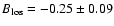 mG, a detection
at the
mG, a detection
at the  level. Uchida et al. (2001) reported no
detection in SO
JN = 12-11 line Zeeman observation, with
level. Uchida et al. (2001) reported no
detection in SO
JN = 12-11 line Zeeman observation, with
 mG, which is consistent with our
result. The critical density of the SO transition is about an order of
magnitude higher than that of the CN transition, so SO samples higher
density gas. The CN and SO observations were at the peak line
strengths positions in each species, and differed by
mG, which is consistent with our
result. The critical density of the SO transition is about an order of
magnitude higher than that of the CN transition, so SO samples higher
density gas. The CN and SO observations were at the peak line
strengths positions in each species, and differed by 
 ,
or about half the SO beam width.
,
or about half the SO beam width.
Toward W3OH our result is
 mG, a detection at
the
mG, a detection at
the  level. Güsten et al. (1994) reported a
Zeeman detection in their excited-state OH absorption line
observations, and inferred
level. Güsten et al. (1994) reported a
Zeeman detection in their excited-state OH absorption line
observations, and inferred
 mG from a fit to
the entire I profile. However, comparison of the results is
complicated by the fact that the line profiles of OH and CN do not
agree in detail. The OH line has two components, at -45.1 and
-47.5 km s-1. Güsten et al. felt that the Zeeman signal
came from the stronger component at -45.1 km s-1, and inferred
mG from a fit to
the entire I profile. However, comparison of the results is
complicated by the fact that the line profiles of OH and CN do not
agree in detail. The OH line has two components, at -45.1 and
-47.5 km s-1. Güsten et al. felt that the Zeeman signal
came from the stronger component at -45.1 km s-1, and inferred
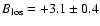 mG from a fit to that component only. The CN
line appears to have three velocity components, none of which agrees
precisely with the OH components. These differences may be due to the
fact that the OH absorption must come from our side of the continuum,
while the CN emission may come from behind the continuum.
Also, CN is seen in emission with a
beam,
while the OH is in absorption against the
mG from a fit to that component only. The CN
line appears to have three velocity components, none of which agrees
precisely with the OH components. These differences may be due to the
fact that the OH absorption must come from our side of the continuum,
while the CN emission may come from behind the continuum.
Also, CN is seen in emission with a
beam,
while the OH is in absorption against the
 compact H II region. Moreover, the two transitions sample different
densities. The
compact H II region. Moreover, the two transitions sample different
densities. The  -doublet lines are within the
 state of OH, which is 290 K above the ground state. The OH observations therefore sample hot, dense gas. Cesaroni & Walmsley
(1991) estimated
state of OH, which is 290 K above the ground state. The OH observations therefore sample hot, dense gas. Cesaroni & Walmsley
(1991) estimated
 cm-3 and
 K for the region probed by the excited-state OH
lines.
K for the region probed by the excited-state OH
lines.
We observed two positions toward the M17SW molecular cloud. The
M17SW(CN) position is at a local CN peak intensity position. That
position was also observed during the earlier experiment (Crutcher et
al. 1999), when
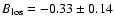 mG was
reported. That is consistent with our new result of
mG was
reported. That is consistent with our new result of
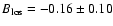 mG; combining the two observations yields
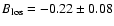 mG. Our results can be compared with VLA H I and OH
absorption-line Zeeman maps (Brogan & Troland 2001) made with
beams sizes close to our CN beam size. They did not report a detection
in H I at our M17SW(CN) position, but an extrapolation from positions 1 beam away suggests
mG. Our results can be compared with VLA H I and OH
absorption-line Zeeman maps (Brogan & Troland 2001) made with
beams sizes close to our CN beam size. They did not report a detection
in H I at our M17SW(CN) position, but an extrapolation from positions 1 beam away suggests
 mG in the 20 km s-1 velocity component, in fair agreement with our result. The
M17SW(HI) position corresponds to a position where
mG in the 20 km s-1 velocity component, in fair agreement with our result. The
M17SW(HI) position corresponds to a position where
 mG in both OH and H I. The VLA result is completely different
from our CN result of
mG in both OH and H I. The VLA result is completely different
from our CN result of
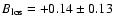 mG; although our CN
result is not a detection, it differs by
mG; although our CN
result is not a detection, it differs by  from the VLA
results. As for W3OH, the CN emission and OH and HI absorption lines may sample different regions.
from the VLA
results. As for W3OH, the CN emission and OH and HI absorption lines may sample different regions.
Our targets are peaks of CN
line emission in active
star formation regions. In most cases, these peaks do not exactly
coincide in projection with the center of dense cores, as traced by
other molecular lines such as CS and isotopes or HC3N. This could
perhaps be explained by the formation routes of CN. Boger &
Sternberg (2005) suggest that in gas denser than 104 cm-3, the
entire CN column density is built up in the C+/C/CO transition
layer and the larger the density, the sharper the concentration of the
regions of large CN abundances in the illuminated layers (
 mag). In this astrochemical picture, the CN
transition with its critical density of the order of 105 cm-3is selectively sensitive to UV irradiated layers of dense cores,
and/or dense PDRs. The CN Zeeman measurements would then sample a
magnetic field strength that is not necessarily that present within
the dense core itself. However, our inferrence of CN column densities
seems to be at odds with this astrochemical picture.
mag). In this astrochemical picture, the CN
transition with its critical density of the order of 105 cm-3is selectively sensitive to UV irradiated layers of dense cores,
and/or dense PDRs. The CN Zeeman measurements would then sample a
magnetic field strength that is not necessarily that present within
the dense core itself. However, our inferrence of CN column densities
seems to be at odds with this astrochemical picture.
Our analysis of the CN data yielded the CN column densities in the
ground state, N0(CN); over the 14 positions the range was
 cm
cm
 cm-2, with a
geometric mean
cm-2, with a
geometric mean
 cm-2. Our
LTE calculation of the column densities in all rotational states
yielded
cm-2. Our
LTE calculation of the column densities in all rotational states
yielded
 cm
cm
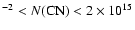 cm-2, with a geometric mean
 cm-2. With [CN]/[H
![$_2] = 4 \times 10^{-9}$](/articles/aa/full/2008/31/aa09577-08/img77.gif) ,
these values for
,
these values for
 yielded
(H2) in reasonable agreement
(i.e., within a factor 3) with Nn,r(H2), derived from volume
densities and radii. This agreement suggests that the value [CN]/[H2]
we used is approximately correct. The values for
and
[CN]/[H2] do not agree with theoretical astrochemical values (cf. Boger
& Sternberg 2005), which are based on CN existing in PDR
regions only. In particular, the model has significantly lower
than the values we observe. Our results suggest that the
CN in the regions we observe sample approximately the same regions and
densities as sampled by CS, and therefore that CN serves as a good
probe of magnetic field strengths in dense regions, n(H
yielded
(H2) in reasonable agreement
(i.e., within a factor 3) with Nn,r(H2), derived from volume
densities and radii. This agreement suggests that the value [CN]/[H2]
we used is approximately correct. The values for
and
[CN]/[H2] do not agree with theoretical astrochemical values (cf. Boger
& Sternberg 2005), which are based on CN existing in PDR
regions only. In particular, the model has significantly lower
than the values we observe. Our results suggest that the
CN in the regions we observe sample approximately the same regions and
densities as sampled by CS, and therefore that CN serves as a good
probe of magnetic field strengths in dense regions, n(H
 cm-3. This view may be supported by the recent
findings of Hily-Blant et al. (2008) who show that CN, like N2H+and unlike CO, is not depleted towards the central parts of two dense
cores.
cm-3. This view may be supported by the recent
findings of Hily-Blant et al. (2008) who show that CN, like N2H+and unlike CO, is not depleted towards the central parts of two dense
cores.
![\begin{figure}
\par\includegraphics[width=7.5cm,clip]{9577fig2.eps}\end{figure}](/articles/aa/full/2008/31/aa09577-08/Timg80.gif) |
Figure 2:
The line-of-sight magnetic field strength from our CN Zeeman
observations versus the column density of H2 (the geometric mean of
our two determinations). N23 is
 .
The dashed
line is the critical mass-to-flux ratio, and the solid line is the
median mass-to-flux ratio inferred from
(before geometric
corrections). .
The dashed
line is the critical mass-to-flux ratio, and the solid line is the
median mass-to-flux ratio inferred from
(before geometric
corrections). |
| Open with DEXTER |
Figure 2 shows our measured
in mG versus
N23(H2) in 1023 cm-2. We can use these values to
compute the measured mass-to-flux ratios with respect to the critical
value,
 (cf. Crutcher 2004). The weighted (by uncertainties in
)
mean
value of the mass-to-flux ratio with respect to critical is
(cf. Crutcher 2004). The weighted (by uncertainties in
)
mean
value of the mass-to-flux ratio with respect to critical is
 .
All measurements, including the
non-detections, are included in this calculation. That mean value is
plotted as a solid line. The dashed line shows the locus of critical
mass-to-flux ratio; points above this line would have a subcritical
.
Keeping in mind that
is a lower limit to
,
all observed points on this plot could be higher (less
supercritical, more subcritical) if we could plot
.
Two
points lie on the critical line and one lies above the critical line
even with
being plotted. This suggests that these cores are
critical to subcritical, but the uncertainties in the measures of
are too large for a definite result.
.
All measurements, including the
non-detections, are included in this calculation. That mean value is
plotted as a solid line. The dashed line shows the locus of critical
mass-to-flux ratio; points above this line would have a subcritical
.
Keeping in mind that
is a lower limit to
,
all observed points on this plot could be higher (less
supercritical, more subcritical) if we could plot
.
Two
points lie on the critical line and one lies above the critical line
even with
being plotted. This suggests that these cores are
critical to subcritical, but the uncertainties in the measures of
are too large for a definite result.
Although we can only determine upper limits on the mass-to-flux ratios
for individual sources, we can use our weighted mean value to carry
out a statistical assessment. Heiles & Troland (2005) have shown that
the observed distribution of
does constrain the median value
of
,
and that the average value of
is close to
 for a wide range of probability distributions of
.
We need to correct for the facts that we measure only the
line-of-sight component of the magnetic field (the factor of 1/2 correction discussed above), and that if the cores have a disk
morphology we overestimate the column densities along the magnetic
field (see Crutcher 2004). The combined correction for both
of these geometry effects is 1/3, so our best estimate for the mean
mass-to-flux ratio in these cores is
for a wide range of probability distributions of
.
We need to correct for the facts that we measure only the
line-of-sight component of the magnetic field (the factor of 1/2 correction discussed above), and that if the cores have a disk
morphology we overestimate the column densities along the magnetic
field (see Crutcher 2004). The combined correction for both
of these geometry effects is 1/3, so our best estimate for the mean
mass-to-flux ratio in these cores is
 with respect to critical. Hence, our determination of the mean value of
yields a slightly supercritical result. However,
the estimate of column densities is uncertain by 2, so the
possible range of the mean
mass-to-flux ratio is
with respect to critical. Hence, our determination of the mean value of
yields a slightly supercritical result. However,
the estimate of column densities is uncertain by 2, so the
possible range of the mean
mass-to-flux ratio is
 ,
or critical to
supercritical by a factor of four.
,
or critical to
supercritical by a factor of four.
The Alfvénic Mach number is given by
 ,
where
,
where  is the one-dimensional velocity dispersion and
 is the Alfvén speed. Then
 ,
where
is in cm-3,
is in km s-1, the total
field strength
is in mG, and we have assumed Gaussian
velocity profiles and a 10% He abundance. The geometric mean values
from Tables 2 and 3 are
cm-3,
,
where
is in cm-3,
is in km s-1, the total
field strength
is in mG, and we have assumed Gaussian
velocity profiles and a 10% He abundance. The geometric mean values
from Tables 2 and 3 are
cm-3,
 km s-1, and
 mG. With the mean geometrical statistical
correction
mG. With the mean geometrical statistical
correction
 ,
we have a mean Alfvénic Mach number
,
we have a mean Alfvénic Mach number
 .
Therefore, turbulent and magnetic energies are
in approximate equipartition.
.
Therefore, turbulent and magnetic energies are
in approximate equipartition.
These new observations of the Zeeman effect on the CN N=1-0 lines have
significantly improved the statistics on the magnetic field intensity
in dense star formation regions. We use our 8 detections and 6 non-detections to derive a median value of the total field
mG in gas of average density
cm-3. We show that the CN line probably samples regions similar
to those traced by CS and are therefore confident that the magnetic
field observed mostly pervades the dense cores. The dense cores are
found to be critical to slightly supercritical with a mean
mass-to-flux ratio
to 4, with respect to critical.
Their turbulent and magnetic energies are in approximate
equipartition, or the observed internal motions are slightly
super-Alfvénic.
Since the Zeeman effect is sensitive only to the line-of-sight
component of the field, more definite results can be obtained only if
the statistical sample is larger. The range of densities of interest
to star formation critically requires more CN Zeeman measurements
(detections and sensitive upper limits).
Acknowledgements
This work was supported in part by the National Science
Foundation under NSF grants AST 0205810, 0307642, and 0606822 and PHY 0551164. This paper is preprint number NSF-KITP-07-200. We are
indebted to Pierre Hily-Blant for his help in preparing procedures
with the New Control System at IRAM-30 m.
W3OH: Distance from Reid et al. (2005), radius from Kim et al. (2006); close to H II region,
 from submm source (Mueller et al. 2002). Density is inferred from the observations of C34S(3-2) and 5-4 by Plume et al. (1997).
OMC1s, OMC1n1, OMC1n4: Radii from Simon (1998), Tatematsu et al. (1993).
NGC2024: Radius from Simon (1998); density from CS multitransition analysis of Lada et al. (1997), adopting the mean logarithmic value of the density
determined over the region emitting in CS(5-4). The CN position lies
at the edge of the densest north-south ridge.
S255: Radius from Simon (1998); the CN position in S255 coincides with the dust continuum source SMM2, and the gas density is derived from this study (Minier et al. 2005).
G10.6: Radius from Ho et al. (1994); the CN position is that of the dust continuum emission peak (Mueller et al. 2002) and the density is that deduced from CS multi-transition analysis by Omodaka et al. (1992). This density is very close to that deduced from the density distribution found by Mueller et al. (2002) for that source, at half-power radius or 0.2 pc from the center.
M17SWHI, M17SWCN: The CN peak in M17SW is at the edge of the dense PDR and the
H2 density is inferred from the CS multitransition analysis of Wang
et al. (1993). It is consistent with the density derived from HC3N
by Bergin et al. (1996). There is no indication, according to these
tracers for a lower density at the position of M17SW(HI),
 south
of M17SW(CN).
south
of M17SW(CN).
S106CN, S106OH: Radius from Simon (1998); distance from Schneider et al. (2007); density from Vallée & Fiege (2005).
DR21OH1, DR21OH2: Radius from Padin et al. (1989); density from Vallée & Fiege (2006).
S140: The CN peak (Simon 1998) is
 east,
east,
 south of SMM1 (Minchin et al. 1995); the density is inferred from the CS multitransition analysis
of Zhou et al. (2004).
south of SMM1 (Minchin et al. 1995); the density is inferred from the CS multitransition analysis
of Zhou et al. (2004).
- Bergin, E. A., Snell, R. L.,
& Goldsmith, P. F. 1996, ApJ, 460, 343 [NASA ADS] [CrossRef]
(In the text)
- Boger, G. I., &
Sternberg, A. 2005, ApJ, 632, 302 [NASA ADS] [CrossRef]
(In the text)
- Brogan, C. L., &
Troland, T. H. 2001, ApJ, 560, 821 [NASA ADS] [CrossRef]
(In the text)
- Cabrit, S. 2007, LNP,
723, 21 [NASA ADS]
- Cesaroni, R., &
Walmsley, C. M. 1991, A&A, 241, 537 [NASA ADS]
(In the text)
- Crutcher, R. M. 2004,
Ap&SS, 292, 225 [NASA ADS] [CrossRef]
(In the text)
- Crutcher, R. M. 2007, in
Sky Polarisation at Far-Infrared to Radio Wavelengths: The Galactic
Screen before the Cosmic Microwave Background, ed. M.-A.
Miville-Deschênes, & F. Boulanger, EAS Publication Series,
23, 37
(In the text)
- Crutcher, R. M.,
Troland, T., Lazareff, B., & Kazès, I. 1996, ApJ, 456,
217 [NASA ADS] [CrossRef]
(In the text)
- Crutcher, R. M.,
Troland, T., Lazareff, B., Paubert, G., & Kazès, I. 1999,
ApJ, 514, L121 [NASA ADS] [CrossRef]
- Güsten, R.,
Fiebig, D., & Uchida, K. I. 1994, A&A, 286, L51 [NASA ADS]
(In the text)
- Heiles, C., & Troland,
T. H. 2005, ApJ, 624, 773 [NASA ADS] [CrossRef]
- Hily-Blant, P., Walmsley,
M., Pineau des Forêts, G., & Flower, D. 2008, A&A,
480, L5 [NASA ADS] [CrossRef] [EDP Sciences]
- Ho, P. T. P., Terebey, S.,
& Turner, J. L. 1994, ApJ, 423, 320 [NASA ADS] [CrossRef]
(In the text)
- Johnstone, D., Boonman, A.
M. S., & van Dishoeck, E. F. 2003, A&A, 412, 157 [NASA ADS] [CrossRef] [EDP Sciences]
(In the text)
- Kim, S.-J., Kim, H.-D., Lee,
Y., et al. 2006, ApJS, 162, 161 [NASA ADS] [CrossRef]
(In the text)
- Lada, E. A., Evans, N. J.,
II, & Falgarone, E. 1997, ApJ, 488, 286 [NASA ADS] [CrossRef]
(In the text)
- MacLow, M.-M., &
Klessen, R. S. 2004, Rev. Mod. Phys., 76, 125 [NASA ADS] [CrossRef]
(In the text)
- Minchin, N. R.,
Ward-Thompson, D., & White, G. J. 1995, A&A, 298, 894 [NASA ADS]
(In the text)
- Minier, V., Burton, M. G.,
Hill, T., et al. 2005, A&A, 429, 945 [NASA ADS] [CrossRef] [EDP Sciences]
(In the text)
- Mouschovias, T. Ch., &
Ciolek, G. E. 1999, in The Origin of Stars and Planetary Systems,
ed. C. J. Lada, & N. D. Kylafis (Kluwer), 305
(In the text)
- Mueller, K. E., Shirley, Y.
L., Evans, N. J., II, & Jacobson, H. R. 2002, ApJS, 143,
469 [NASA ADS] [CrossRef]
(In the text)
- Omodaka, T., Kobayashi, H.,
Kitamura, Y., Nakano, M., & Ishiguro, M. 1992, PASJ, 44,
447 [NASA ADS] [CrossRef]
(In the text)
- Padin, S., Sargent, A. I.,
Mundy, L. G., et al. 1989, ApJ, 337, L45 [NASA ADS] [CrossRef]
(In the text)
- Plume, R., Jaffe, D. T.,
Evans, N. J., II, Martin-Pintado, J., & Gomez-Gonzalez, J.
1997, ApJ, 476, 730 [NASA ADS] [CrossRef]
(In the text)
- Reid, M. J., Xu, Y., Zheng,
X. W., & Menten, K. M. 2005, A&AS, 207, 4006
(In the text)
- Schneider, N., Simon, R.,
Bontemps, S., Comerón, F., & Motte, F. 2007, A&A, 474,
873 [NASA ADS] [CrossRef] [EDP Sciences]
(In the text)
- Shu, F., Allen,
A., Shang, H., Ostriker, E. C., & Li, Z.-Y. 1999, in The Origin
of Stars and Planetary Systems, ed. C. J. Lada, & N. D. Kylafis
(Kluwer Academic Publishers), 193
(In the text)
- Simon, R. 1998, private
communication
(In the text)
- Tatematsu, E., Umemoto, T.,
Kameya, O., et al. 1993, ApJ, 404, 643 [NASA ADS] [CrossRef]
(In the text)
- Turner, B. E., &
Gammon, R. H. 1975, ApJ, 198, 71 [NASA ADS] [CrossRef]
(In the text)
- Uchida, K.I.,
Fiebig, D., & Güsten, R. 2001, A&A, 371, 274 [NASA ADS] [CrossRef] [EDP Sciences]
(In the text)
- Vallée, J. P., &
Fiege, D. 2005, ApJ, 627, 263 [NASA ADS] [CrossRef]
(In the text)
- Vallée, J. P., &
Fiege, D. 2006, ApJ, 636, 332 [NASA ADS] [CrossRef]
(In the text)
- Wang, Y., Jaffe, D. T.,
Evans, N. J., II, et al. 1993, ApJ, 419, 707 [NASA ADS] [CrossRef]
(In the text)
- Zhou, S., Butner, H. M.,
Evans, N. J., II, et al. 2004, ApJ, 428, 219 [NASA ADS] [CrossRef]
(In the text)
Copyright ESO 2008
![\begin{figure}
\par\includegraphics[width=7.5cm,clip]{9577fig1.eps}
\end{figure}](/articles/aa/full/2008/31/aa09577-08/img37.gif)
![\begin{figure}
\par\includegraphics[width=7.5cm,clip]{9577fig2.eps}\end{figure}](/articles/aa/full/2008/31/aa09577-08/img80.gif)