A&A 486, 113-117 (2008)
DOI: 10.1051/0004-6361:200809827
The nature of the nearest compact group of galaxies from precise
distance measurements
(Research Note)
G. A. Mamon
Institut d'Astrophysique de Paris (UMR 7095: CNRS & UPMC), 98 bis
Bd Arago, 75014 Paris, France
Received 21 March 2008 / Accepted 13 April 2008
Abstract
Context. Compact groups (CGs) of galaxies, similar to those catalogued by Hickson, appear to be the densest galaxy structures in the Universe. Redshift information is insufficient to determine whether a CG is roughly as dense in three dimensions as it appears in projection, or whether it is caused by a chance alignment along the line of sight within a larger galaxy system.
Aims. Recent precise distance measurements help probe the nature of the nearest CG, situated in the Virgo cluster, whose dominant member is M 60.
Methods. The isolated status of the CG is reassessed with recent photometry and a statistical analysis is performed on the surface brightness fluctuation (SBF) distances measured by Mei et al. in Virgo, for 4 of the 5 CG members.
Results. The neighboring galaxy NGC 4606 appears (with 80-90% confidence) to be too faint to affect the isolated status of the CG. Taken at face value, the SBF distances suggest that M 59 and NGC 4660 lie roughly 2 Mpc to the foreground of M 60, NGC 4638, and the bulk of the Virgo cluster. The statistical analysis confirms that the CG is, indeed, the result of a chance alignment of its galaxies, with NGC 4638 lying at least 800 kpc further away (with 99% confidence) than either M 59 or NGC 4660. The first two galaxy distances are consistent with M 59 and NGC 4660 constituting a tight pair. The dominant galaxy, M 60, is at least 440 kpc more distant (95% confidence) than the M 59+NGC 4660 pair, and over 1 Mpc (99% confidence) more distant if one uses the broken linear calibration of the SBF distances.
Conclusions. This work constitutes the first direct analysis of the nature of a compact group of galaxies. Chance alignments of galaxies represent a realistic alternative to truly dense groups to explain the nature of CGs. With current SBF distance accuracies, one could determine the nature of HCG 68 in the same way.
Key words: galaxies: clusters: individual: Virgo - galaxies: distances and redshifts
1 Introduction
Compact groups of galaxies (CGs) appear to be the densest known
multiple galaxy systems
(with mean densities  105 times the critical density of the
Universe). The CG catalog by far the most studied is
the one assembled by Hickson (1982), who
visually searched the
POSS I photographic plates for isolated
groups of at least 4 members within 3 mag of the brightest, whose
mean surface brightness exceeded a given threshold. The mean surface
brightness is measured within the smallest circumscribed circle (hereafter,
Hickson circle)
containing
the centers of the galaxies. The isolation criterion specifies that there are
no galaxies within 3 mag (in the R band) from the brightest CG member
within an
isolation ring extending from the Hickson circle to
a concentric circle 3 times wider.
105 times the critical density of the
Universe). The CG catalog by far the most studied is
the one assembled by Hickson (1982), who
visually searched the
POSS I photographic plates for isolated
groups of at least 4 members within 3 mag of the brightest, whose
mean surface brightness exceeded a given threshold. The mean surface
brightness is measured within the smallest circumscribed circle (hereafter,
Hickson circle)
containing
the centers of the galaxies. The isolation criterion specifies that there are
no galaxies within 3 mag (in the R band) from the brightest CG member
within an
isolation ring extending from the Hickson circle to
a concentric circle 3 times wider.
A spectroscopic followup by Hickson et al. (1992) revealed that among the 100 Hickson
compact groups (HCGs), only 69 groups had at least four members with accordant velocities (within
 from the median).
Still, it is unclear whether these 69 HCGs are roughly as dense in
three dimensions as
they appear to be in projection (Hickson & Rood 1988),
or whether they are caused by chance
alignments of galaxies along the line of sight (Rose 1977, for the
elongated CGs; Mamon 1986 and Walke & Mamon 1989, for most HCGs). The
galaxies in a
chance alignment lie in a looser group (Walke & Mamon 1989; Mamon 1986), a cluster
(Walke & Mamon),
or an even longer cosmological filament (Hernquist et al. 1995).
Although HCG galaxies display numerous signs of dynamical
interaction with close neighbors (Hickson 1997, and references
therein), those HCGs caused by chance alignments
are expected to be binary-rich
(Mamon 1992,1990), and these binaries should
explain - to first order
-
the frequency of interacting galaxies (Mamon 1992).
from the median).
Still, it is unclear whether these 69 HCGs are roughly as dense in
three dimensions as
they appear to be in projection (Hickson & Rood 1988),
or whether they are caused by chance
alignments of galaxies along the line of sight (Rose 1977, for the
elongated CGs; Mamon 1986 and Walke & Mamon 1989, for most HCGs). The
galaxies in a
chance alignment lie in a looser group (Walke & Mamon 1989; Mamon 1986), a cluster
(Walke & Mamon),
or an even longer cosmological filament (Hernquist et al. 1995).
Although HCG galaxies display numerous signs of dynamical
interaction with close neighbors (Hickson 1997, and references
therein), those HCGs caused by chance alignments
are expected to be binary-rich
(Mamon 1992,1990), and these binaries should
explain - to first order
-
the frequency of interacting galaxies (Mamon 1992).
Motivated by Walke & Mamon's prediction that the frequency of chance
alignments increases with the number of galaxies in the parent system, I had searched the Virgo cluster for CGs meeting
Hickson's selection criterion, and indeed found a CG, composed of
M 60, M 59, NGC 4660, NGC 4638, and
NGC 4647 (Mamon 1989).
![\begin{figure}
\par\includegraphics[width=8cm, angle=-90, bb=100 224 492 618, clip=true]{9827fig1.ps}
\end{figure}](/articles/aa/full/2008/28/aa09827-08/Timg8.gif) |
Figure 1:
SDSS mosaic of the M 60 compact
group in RGB display using the g, r and i SDSS images. The image is
 wide.
The dark vertical lines in the Northern part of M 60 and the Western
part of M 59 are image artefacts.
wide.
The dark vertical lines in the Northern part of M 60 and the Western
part of M 59 are image artefacts. |
| Open with DEXTER |
Figure 1 displays a view of this compact group (hereafter called
the M 60 CG), taken from the Sloan Digital Sky Survey (SDSS).
The M 60 CG had been missed by Hickson (1982), because
NGC 4606, an Sa galaxy
lying at 1.98 Hickson circle radii from the group center,
was only 2.4 mag fainter than M 60 in the B band. Even after
a crude
extrapolation to R mag for the different morphological types of the two
galaxies, NGC 4606 was still slightly less than 3 mag fainter than M 60,
so
NGC 4606
caused the CG to fail Hickson's isolation criterion.
When I discovered this CG (Mamon 1989), I noticed that more
accurate B-band photometry indicated that NGC 4606 was 2.88 mag
fainter in B than M 60, which, after the crude correction for
morphological types, suggested that NGC 4606 was at least 3 mag fainter
than M 60 in the R band. I therefore argued that NGC 4606 did not affect
the isolated status of the CG, and concluded that the M 60 CG
was the nearest HCG-like group.
The nature of CGs within clusters is by no means clear. While
chance alignments are expected to be frequent in clusters (Walke & Mamon 1989), one
also expects to see
groups falling in or bouncing out of clusters before becoming
dynamically mixed with
their host cluster. The tidal field of the
cluster should truncate the infalling groups after their first passage,
leaving
groups with high density close to that of the cluster at pericenter
(Gnedin et al. 1999; Mamon 1995), which is of the same order as the mean
density of the M 60 CG.
Recent measurements by Mei et al. (2007) of the distances to Virgo
elliptical and lenticular galaxies, through the accurate surface
brightness fluctuation (SBF)
method (Tonry & Schneider 1988), permit to check whether the M 60 CG is dense in 3D or whether
it is caused by a chance alignment of galaxies.
This is the first CG meeting the HCG criteria that is sufficiently
nearby to have its nature determined by SBF distance measurements.
In this Research Note,
I first re-investigate in Sect. 2 whether the
latest photometric measurements confirm that NGC 4606
is too faint to be considered a contaminant of the isolation ring.
I then present briefly, in Sect. 3, the SBF distance
measurements.
In
Sect. 4,
I estimate lower limits for the line-of-sight separations of the M 60 CG galaxies,
given the SBF distance measurements and their errors,
which I compare in Sect. 5 to the maximum line-of-sight size
that I estimate is possible for truly dense groups. I also investigate which other HCGs are both close
enough and with sufficient numbers of bright early-type galaxies to have
their nature determined by SBF
measurements with present-day accuracies.
2 Is NGC 4606 sufficiently bright to affect the isolated status of the M 60
compact group?
Figure 2 shows the large-scale environment of the M 60 CG, with
NGC 4606 lying within the isolation ring.
![\begin{figure}
\par\includegraphics[width=8.5cm, angle=-90, bb=85 305 365 584, clip=true]{9827fig2.ps}
\end{figure}](/articles/aa/full/2008/28/aa09827-08/Timg10.gif) |
Figure 2:
SDSS mosaic of the M 60 compact
group and its environment in RGB display
using the g, r and i SDSS images. The image is
 wide. The inner and
outer circles show the limit of the group and the outer radius of
the isolation ring, respectively. The two bright blue objects in the ring
are foreground stars.
wide. The inner and
outer circles show the limit of the group and the outer radius of
the isolation ring, respectively. The two bright blue objects in the ring
are foreground stars. |
| Open with DEXTER |
Is NGC 4606 bright enough to prevent the M 60 CG from being isolated? Following Hickson's original isolation criterion,
the M 60 CG is isolated if
NGC 4606 is over 3 mag fainter than M 60 in the R band.
Unfortunately, there is yet no good R-band photometry for
NGC 4606 and M 60. The 6th Data Release of the Sloan Digital Sky Survey (SDSS)
obtained photometric measurements for NGC 4606, but with bad photometric
flags.
As for measurements of other bright galaxies, the SDSS photometric
measurement for M 60 is off by  3 mag (Mamon et al., in prep.), probably
because of poor background subtraction.
For these reasons, neither galaxy has SDSS photometry in the NASA/IPAC
Extragalactic Database (NED).
3 mag (Mamon et al., in prep.), probably
because of poor background subtraction.
For these reasons, neither galaxy has SDSS photometry in the NASA/IPAC
Extragalactic Database (NED).
I attempted to measure the photometry of these two galaxies directly from
the SDSS images.
A SExtractor (Bertin & Arnouts 1996) extraction of NGC 4606 (using large
 pixel tiles to estimate the background, thus avoiding
an overestimate of the
background at the position of the large galaxy), gave
pixel tiles to estimate the background, thus avoiding
an overestimate of the
background at the position of the large galaxy), gave
 (while its
magnitude in the
SDSS database is
(while its
magnitude in the
SDSS database is
 ).
On the other hand,
M 60 is located near the edge of its
).
On the other hand,
M 60 is located near the edge of its
 scan, and its image
almost fills the entire scan, so that
the background subtraction is uncertain, which leads to important
uncertainties in the
photometry for M 60 (one can also distinguish different background levels in the
SDSS mosaic of Fig. 1).
scan, and its image
almost fills the entire scan, so that
the background subtraction is uncertain, which leads to important
uncertainties in the
photometry for M 60 (one can also distinguish different background levels in the
SDSS mosaic of Fig. 1).
Figure 3 shows the difference in magnitude between
NGC 4606 and the giant elliptical M 60
for different wavelengths. Given its morphological type, NGC 4606 is bluer
than M 60 (as
can be seen in Fig. 2).
Fitting a cubic spline to the magnitude difference as a function of log
wavelength, NGC 4606
is found to be
3.11 mag fainter than M 60 in the R band.
However, assuming Gaussian-distributed magnitude errors, a simple Monte
Carlo
analysis (with 105 trials) shows that only 81% of the time is the magnitude
difference in the R band greater than 3 mag.
Alternatively, the total R-band photometry of M 60 and
NGC 4606 can be found by extrapolating the B or V total photometry from
the RC3 (de Vaucouleurs et al. 1991) using
B-R or V-R colors measured in annuli at roughly half the luminosity. M 60 has
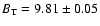 (de Vaucouleurs et al. 1991) and a color
B-R=1.59 at the effective radius (from
Peletier et al. 1990), yielding
(de Vaucouleurs et al. 1991) and a color
B-R=1.59 at the effective radius (from
Peletier et al. 1990), yielding
 .
NGC 4606 has
.
NGC 4606 has
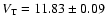 (de Vaucouleurs et al.) and
V-R = 0.48, which is
the median of four measurements by Schröder & Visvanathan (1996). This yields
(de Vaucouleurs et al.) and
V-R = 0.48, which is
the median of four measurements by Schröder & Visvanathan (1996). This yields
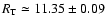 for NGC 4606, hence the difference in R-band
total magnitudes is
for NGC 4606, hence the difference in R-band
total magnitudes is
 .
For Gaussian-distributed errors, this
leads to a 90%
probability that NGC 4606 is too faint to destroy the isolation of the
M 60 CG.
The errors here do not include uncertainties in the colors nor in the
calibration.
.
For Gaussian-distributed errors, this
leads to a 90%
probability that NGC 4606 is too faint to destroy the isolation of the
M 60 CG.
The errors here do not include uncertainties in the colors nor in the
calibration.
Hence,
the M 60 compact group has a good probability of being isolated
(according to Hickson's criterion),
but one cannot statistically rule out that NGC 4606 is bright enough in
the R band to spoil the group's isolation.
3 SBF distance data
As part of the ACS Virgo Cluster Survey (Côté et al. 2004),
Mei et al. (2007) analyzed
Hubble
Space Telescope images to measure distances to 84 Virgo cluster ellipticals and S0s using the SBF method.
Mei et al. calibrated the SBF distances by fitting the trend of SBF
apparent magnitude vs.
(g475-z850)0 color. They provided SBF
distances using three
different fits: linear, polynomial, and
broken-linear.
Mei et al. expressed their preference for
the (4-parameter) broken-linear calibrated SBF distances. They noted that
the  of
their broken-line and (4-parameter) 4th-order
polynomial fits were equally good, while
their linear (2 parameter) fit produced a slightly greater .
They also remarked that the
broken-line fit had a smaller
than the polynomial fit if
the (three) galaxies redder than
(g475-z850)0 = 1.5 were excluded.
of
their broken-line and (4-parameter) 4th-order
polynomial fits were equally good, while
their linear (2 parameter) fit produced a slightly greater .
They also remarked that the
broken-line fit had a smaller
than the polynomial fit if
the (three) galaxies redder than
(g475-z850)0 = 1.5 were excluded.
According to Table 2 of
Mei et al., M 60 turns out to be the reddest (and 3rd
brightest) galaxy in Virgo, with
(g475-z850)0=1.56.
So, one infers that the polynomial calibration is superior for M 60,
while the broken-line calibration is
better for the three other galaxies of the
M 60 CG.
I thus also consider a mixed calibration which is broken-linear for
(g475-z850)0<1.5 and polynomial for
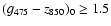 (the broken-linear and polynomial fits intersect at this critical color, so
the mixed calibration is continuous).
(the broken-linear and polynomial fits intersect at this critical color, so
the mixed calibration is continuous).
4 Analysis
Table 1 shows the data for the 4 group members for which SBF distance
measurements are available.
Table 1:
Data including SBF distance moduli to the galaxies in the M 60 compact
group.
Figure 4 illustrates the distances to the 4 ellipticals in the
M 60 CG and to the three brightest Virgo galaxies (besides M 60): M 87,
M 49 and M 86.
M 60 and NGC 4638 appear to be located at roughly the same distance as the
three luminous Virgo galaxies, M 87, M 49 and M 86. On the other hand,
M 59 and NGC 4660, whose
SBF distances are consistent (regardless of the calibration used)
appear to lie roughly
2 Mpc closer to us.
Assuming Gaussian errors in the distance moduli, the distribution of
the difference in distances of galaxies 1 and 2 with measured distance
moduli  and
and  and uncertainties
  and
and  is a Gaussian
with mean
is a Gaussian
with mean
 and distribution
 .
Hence, the probability that the difference in distance moduli of the two
galaxies is greater than
.
Hence, the probability that the difference in distance moduli of the two
galaxies is greater than
 is
is
![\begin{displaymath}P(\Delta\mu) = {1\over2}~\left \{1 + {\rm erf} \left [{\Delta...
...) \over
\sqrt{2~(\sigma_1^2+\sigma_2^2)}} \right ]\right \} ,
\end{displaymath}](/articles/aa/full/2008/28/aa09827-08/img53.gif) |
(1) |
where
 is the error function.
Expressing the distance difference
is the error function.
Expressing the distance difference  in terms of the difference in
distance moduli
as
in terms of the difference in
distance moduli
as
 and using
Eq. (1),
the minimum difference in distances
of two galaxies is
and using
Eq. (1),
the minimum difference in distances
of two galaxies is
![$\displaystyle (\Delta D)_{\rm min} = 2~D(\overline \mu)
\sinh \left \{{\ln 10\o...
...[2~\sigma_{\rm rms} ~{\rm erf}^{-1}
(2P\!-\!1) + \Delta\mu \right ] \right \} ,$](/articles/aa/full/2008/28/aa09827-08/img57.gif) |
|
|
(2) |
where
 is the inverse error function, i.e.
 .
.
Table 2 provides the minimum distance difference between various
pairs of
galaxies of the M 60 CG, using Eq. (2).
All three
SBF estimators indicate that
NGC 4638 is at least 800 kpc more distant than M 59 and 1 Mpc more distant than NGC 4660
(both at the 99% confidence
level).
Moreover, using the broken-linear or linear SBF calibrations, M 60
must lie at
least 0.82 Mpc (99% confidence) further away than either M 59 or NGC 4660.
On the other hand, the SBF distances determined with the polynomial or mixed
calibrations produce
consistent distances
between M 60 and either M 59 or NGC 4660.
However, one can combine the distances to M 59 and NGC 4660 to obtain a  smaller
uncertainty in the distance of that galaxy pair.
M 60 then turns out to be 440 or 520 kpc further away than the pair
(at the 95%
confidence level), depending on which of the polynomial or broken-linear SBF
calibrations is used to estimate the distance of the pair.
smaller
uncertainty in the distance of that galaxy pair.
M 60 then turns out to be 440 or 520 kpc further away than the pair
(at the 95%
confidence level), depending on which of the polynomial or broken-linear SBF
calibrations is used to estimate the distance of the pair.
![\begin{figure}
\par\includegraphics[width=8.5cm]{9827fig4.ps}
\end{figure}](/articles/aa/full/2008/28/aa09827-08/Timg61.gif) |
Figure 4:
Surface brightness fluctuation distances (from Mei et al. 2007) for
the 4 ellipticals in the M 60 compact group
( left) and for the three other
brightest ellipticals in the cluster ( right).
The red triangles, green squares and blue circles
represent the distance measurements using the broken-line, linear, and
polynomial calibrations, respectively. |
| Open with DEXTER |
5 Discussion
What is the maximum line-of-sight
separation that is allowed for a
galaxy pair located within a dense group of galaxies?
Or
equivalently, what is the maximum line-of-sight size of a dense group of
galaxies?
One can specify that the maximum line-of-sight
separation between galaxy pairs in a dense group must be smaller than twice
its projected diameter or, alternatively, twice the 84th percentile
(corresponding to  for a Gaussian distribution)
of the
projected diameters of HCGs.
Given that the angular radius of the Hickson circle
of the M 60 CG is
for a Gaussian distribution)
of the
projected diameters of HCGs.
Given that the angular radius of the Hickson circle
of the M 60 CG is
 (Mamon 1989)
![[*]](/icons/foot_motif.gif) , and given its (error-weighted) mean
(mixed SBF calibration) distance of 15.94 Mpc (see
Fig. 4), the projected
radius of the Hickson circle is 106 kpc.
In comparison, the median projected radius of the 68 HCGs with at least 4
accordant
velocities is 56 kpc , and 106 kpc
corresponds to the 87th percentile of the distribution of HCG projected
radii.
Both
criteria are therefore virtually identical.
I thus adopt a maximum line-of-sight size of
, and given its (error-weighted) mean
(mixed SBF calibration) distance of 15.94 Mpc (see
Fig. 4), the projected
radius of the Hickson circle is 106 kpc.
In comparison, the median projected radius of the 68 HCGs with at least 4
accordant
velocities is 56 kpc , and 106 kpc
corresponds to the 87th percentile of the distribution of HCG projected
radii.
Both
criteria are therefore virtually identical.
I thus adopt a maximum line-of-sight size of
 kpc.
kpc.
Table 2:
Minimum line-of-sight separation of galaxy pairs.
According to Table 2,
it is highly unlikely that NGC 4638 is part of a dense group or pair
containing M 59 and NGC 4660.
Still, 4 galaxies remain once NGC 4638 is omitted.
Nevertheless, M 60 cannot be part of the dense group or pair containing M 59 and NGC 4660, at a 99% (broken-linear or linear SBF
calibrations) or 95% (polynomial SBF calibration) confidence level.
Therefore, one can state with high confidence that
among the four early-type galaxies in the M 60 CG, M 59 and
NGC 4660 cannot constitute a dense group of galaxies with M 60 and NGC 4638.
The M 60 CG in Virgo is just one example of a Hickson-like compact group.
Up to now, SBF distances have been measured for galaxies out to
 (Tonry et al. 2001) and the ACS Virgo Cluster Survey has measured
distances to galaxies as faint as
(Tonry et al. 2001) and the ACS Virgo Cluster Survey has measured
distances to galaxies as faint as
 (Mei et al. 2007).
There is one HCG within these distance and magnitude limits: HCG 68
(
(Mei et al. 2007).
There is one HCG within these distance and magnitude limits: HCG 68
(
 ,
Hickson et al. 1992, 2 ellipticals and 2 S0s, all
with
,
Hickson et al. 1992, 2 ellipticals and 2 S0s, all
with
 ,
Hickson et al. 1989, plus one Sbc), whose nature could
therefore be probed in the same way as for the M 60 CG.
In the near future, SBF distances should become available for fainter and
more distant early-type galaxies, allowing for direct line-of-sight
analyses, similar to the present one, for additional HCGs.
,
Hickson et al. 1989, plus one Sbc), whose nature could
therefore be probed in the same way as for the M 60 CG.
In the near future, SBF distances should become available for fainter and
more distant early-type galaxies, allowing for direct line-of-sight
analyses, similar to the present one, for additional HCGs.
Alternatively,
the nature of the
the full set of HCGs can be assessed by
confronting the
observational properties of these exceptionally dense galaxy systems with
those constructed
using either cosmological hydrodynamical simulations
that can resolve sufficiently small galaxies, or alternatively, galaxy formation
simulations based upon realistic galaxy positions obtained from
high-resolution cosmological dark matter simulations.
Using this second approach, McConnachie et al. (2008)
have recently shown that
roughly
70%
of Hickson-like CGs selected in projection
are chance
alignments of galaxies, i.e. roughly half of those with at least 4 accordant velocities. Díaz-Giménez et al. (2008)
find that this fraction depends
on the cut-off in
maximum line-of-sight size, and on the galaxy formation code ran on the outputs of
the Millennium dark matter simulations (Springel et al. 2005).
Acknowledgements
The author thanks Simona Mei for several very useful discussions on the SBF
distance indicator, Sandy Faber on SDSS photometry of very bright galaxies,
and the anonymous referee for useful comments.
This research has made use of the NASA/IPAC Extragalactic Database (NED)
which is operated by the Jet Propulsion Laboratory, California Institute of
Technology, under contract with the National Aeronautics and Space
Administration, the HyperLEDA database (Paturel et al. 2003), the SDSS
and GoogleSky
(http://earth.google.com).
Funding for the Sloan Digital Sky Survey (SDSS) and SDSS-II has been provided
by the Alfred P. Sloan Foundation, the Participating Institutions, the
National Science Foundation, the U.S. Department of Energy, the National
Aeronautics and Space Administration, the Japanese Monbukagakusho, and the
Max Planck Society, and the Higher Education Funding Council for England. The
SDSS Web site is http://www.sdss.org/.
The SDSS is managed by the Astrophysical Research Consortium (ARC) for the
Participating Institutions. The Participating Institutions are the American
Museum of Natural History, Astrophysical Institute Potsdam, University of
Basel, University of Cambridge, Case Western Reserve University, The
University of Chicago, Drexel University, Fermilab, the Institute for
Advanced Study, the Japan Participation Group, The Johns Hopkins University,
the Joint Institute for Nuclear Astrophysics, the Kavli Institute for
Particle Astrophysics and Cosmology, the Korean Scientist Group, the Chinese
Academy of Sciences (LAMOST), Los Alamos National Laboratory, the
Max-Planck-Institute for Astronomy (MPIA), the Max-Planck-Institute for
Astrophysics (MPA), New Mexico State University, Ohio State University,
University of Pittsburgh, University of Portsmouth, Princeton University, the
United States Naval Observatory, and the University of Washington.
- Arkhipova, V. P.,
Afanasev, V. L., Dostal, V. A., et al. 1981, SvA,
25, 277 [NASA ADS]
- Bertin, E., & Arnouts,
S. 1996, A&AS, 117, 393 [NASA ADS] [CrossRef] [EDP Sciences]
(In the text)
- Côté, P., Blakeslee,
J. P., Ferrarese, L., et al. 2004, ApJS, 153, 223 [NASA ADS] [CrossRef]
(In the text)
- de Vaucouleurs, G., de
Vaucouleurs, A., Corwin, J. R., et al. 1991, Third
Reference Catalogue of Bright Galaxies (New York: Springer)
(In the text)
- Díaz-Giménez,
E., Ragone-Figueroa, C., Muriel, H., & Mamon, G. A. 2008,
MNRAS, to be submitted
(In the text)
- Gnedin, O. Y.,
Hernquist, L., & Ostriker, J. P. 1999, ApJ, 514, 109 [NASA ADS] [CrossRef]
- Hernquist, L., Katz, N.,
& Weinberg, D. H. 1995, ApJ, 442, 57 [NASA ADS] [CrossRef]
(In the text)
- Hickson, P. 1982,
ApJ, 255, 382 [NASA ADS] [CrossRef]
(In the text)
- Hickson, P.
1997, ARA&A, 35, 357 [NASA ADS] [CrossRef]
(In the text)
- Hickson, P., Kindl, E.,
& Auman, J. R. 1989, ApJS, 7, 687 [NASA ADS] [CrossRef]
(In the text)
- Hickson, P., Mendes
de Oliveira, C., Huchra, J. P., & Palumbo, G. G.
1992, ApJ, 399, 353 [NASA ADS] [CrossRef]
(In the text)
- Hickson, P., & Rood,
H. J. 1988, ApJ, 331, L69 [NASA ADS] [CrossRef]
(In the text)
- Jarrett, T. H., Chester,
T., Cutri, R., et al. 2000, AJ, 119, 2498 [NASA ADS] [CrossRef]
(In the text)
- Mamon, G. A.
1986, ApJ, 307, 426 [NASA ADS] [CrossRef]
(In the text)
- Mamon, G. A.
1989, A&A, 219, 98 [NASA ADS]
(In the text)
- Mamon, G. A. 1990, in Paired
and Interacting Galaxies, ed. J. W. Sulentic, W. C. Keel,
& J. Telesco (Washington: NASA), IAU Coll., 124, 619
- Mamon,
G. A. 1992, in Distribution of Matter in the Universe, ed.
G. A. Mamon, & D. Gerbal (Paris: Obs. de Paris), DAEC
mtg., 2, 51
-
Mamon, G. A. 1995, in Third Paris cosmology colloquium, 95
[arXiv:astro-ph/9511101]
- McConnachie,
A. W., Ellison, S. L., & Patton, D. R. 2008,
MNRAS, in press [arXiv:0804.2928]
(In the text)
- Mei, S., Blakeslee, J. P.,
Côté, P., et al. 2007, ApJ, 655, 144 [NASA ADS] [CrossRef]
(In the text)
- Paturel, G., Petit, C.,
Prugniel, P., et al. 2003, A&A, 412, 45 [NASA ADS] [CrossRef] [EDP Sciences]
(In the text)
- Peletier, R. F., Davies,
R. L., Illingworth, G. D., Davis, L. E., &
Cawson, M. 1990, AJ, 100, 1091 [NASA ADS] [CrossRef]
(In the text)
- Rose, J. A. 1977,
ApJ, 211, 311 [NASA ADS] [CrossRef]
(In the text)
- Schröder, A., &
Visvanathan, N. 1996, A&AS, 118, 441 [NASA ADS] [CrossRef] [EDP Sciences]
(In the text)
- Springel, V., White,
S. D. M., Jenkins, A., et al. 2005, Nature, 435,
629 [NASA ADS] [CrossRef]
(In the text)
- Tonry, J., & Schneider,
D. P. 1988, AJ, 96, 807 [NASA ADS] [CrossRef]
(In the text)
- Tonry, J. L., Dressler, A.,
Blakeslee, J. P., et al. 2001, ApJ, 546, 681 [NASA ADS] [CrossRef]
(In the text)
- Verdes-Montenegro, L.,
Del Olmo, A., Iglesias-Páramo, J. I., et al. 2002,
A&A, 396, 815 [NASA ADS] [CrossRef] [EDP Sciences]
- Walke, D. G., &
Mamon, G. A. 1989, A&A, 225, 291 [NASA ADS]
(In the text)
Copyright ESO 2008
![\begin{figure}
\par\includegraphics[width=8cm, angle=-90, bb=100 224 492 618, clip=true]{9827fig1.ps}
\end{figure}](/articles/aa/full/2008/28/aa09827-08/img8.gif)
![\begin{figure}
\par\includegraphics[width=8.5cm, angle=-90, bb=85 305 365 584, clip=true]{9827fig2.ps}
\end{figure}](/articles/aa/full/2008/28/aa09827-08/img10.gif)
![\begin{figure}
\par\includegraphics[width=8cm]{9827fig3.ps}
\end{figure}](/articles/aa/full/2008/28/aa09827-08/img16.gif)
 ,
,
 from the RC3 (
 error).
![\begin{figure}
\par\includegraphics[width=8.5cm]{9827fig4.ps}
\end{figure}](/articles/aa/full/2008/28/aa09827-08/img61.gif)