![[*]](/icons/foot_motif.gif)
A&A 485, 315-325 (2008)
DOI: 10.1051/0004-6361:20078255
R. Schlickeiser - I. Lerche
Institut für Theoretische Physik, Lehrstuhl IV: Weltraum- und Astrophysik, Ruhr-Universität Bochum, 44780 Bochum, Germany
Received 11 July 2007 / Accepted 20 March 2008
Abstract
Aims. In powerful cosmic nonthermal radiation sources with dominant magnetic-field self generation, the plasma physical processes generating these magnetic fields by relativistic plasma instabilities are closely related to the processes energising ultra-high energy radiating electrons in these sources. Then the magnetic field strength becomes time-dependent and adjusts itself to the actual kinetic energy density of the radiating electrons. As a consequence, the synchrotron radiation cooling of individual relativistic electrons exhibits a nonlinear behaviour because of the dependence of the magnetic energy density on the actual time-varying kinetic energy density.
Methods. The nonlinear kinetic equation for the intrinsic temperoral evolution of relativistic electrons is solved for the case of instantaneous injection of power-law distributed electrons.
Results. The properties of the resulting approximate, nonlinear electron density show significant differences compared to the standard linear solution for constant non-equipartition magnetic-field energy density as, for instance, the different time behaviour of the upper and lower cut-offs of the electron distribution. Also the differential electron fluence as a function of electron energy differs from the linear fluence. For large spectral indices s>2 of the injected power law, the nonlinear fluence exhibits a weaker break at the lower injected electron cut-off  than the linear fluence. For small spectral indices 1<s<2, the nonlinear fluence shows no break at all and approaches a
 power law at all energies below
 .
.
Conclusions. For electron radiation processes not subject to equipartition conditions, such as inverse Compton scattering of ambient photon gases and relativistic bremsstrahlung, the energy dependences of the electron number density and the electron fluence can be directly used to infer the frequency dependence of the fluxes and fluences of the generated photons. For steep (spectral index s>2) injected power laws, the nonlinear synchrotron fluence at low frequencies approaches a power law
 ,
independent of the value of s, which is identical to the synchrotron fluence behaviour from monoenergetically injected relativistic electrons.
,
independent of the value of s, which is identical to the synchrotron fluence behaviour from monoenergetically injected relativistic electrons.
Key words: galaxies: active - radiation mechanisms: non-thermal - ISM: cosmic rays
Simplified homogenous one-zone models for the relativistically moving emission regions in the jets of active galactic nuclei and gamma-ray burst afterglows are remarkably successful in quantitatively reproducing the observed broadband nonthermal photon spectra. In the standard model for blazars, nonthermal synchrotron emission is radiated by electrons accelerated by Fermi-type processes to ultrarelativistic Lorentz factors. These electrons also Compton-scatter all ambient radiation fields, including the internal synchrotron field (Maraschi et al. 1992; Bloom & Marscher 1996; Tavecchio et al. 1998) and the external radiation fields traversed by the jet (Melia & Königl 1989; Dermer & Schlickeiser 1993; Sikora et al. 1994; Arbeiter et al. 2005). The intensities of the individual radiation components depend on the properties of the radiation fields, the properties of the relativistic outflows, and the time-dependent spectral injection of electrons into the outflow. The evolving energy distribution of the radiating electrons is obtained by solving a continuity kinetic equation balancing the competition of injection, escape, and energy loss processes. The numerical modelling of the observed spectral energy distributions (Dermer & Schlickeiser 2002; Böttcher & Chiang 2002) provides the best agreement if equipartition conditions are taken between the energy densities of magnetic fields (
 )
and relativistic electrons
)
and relativistic electrons
 .
.
Similar equipartition arguments have been made in the nonthermal radiation models for gamma-ray burst afterglows (Meszaros & Rees 1993, 1997; Paczynski & Rhoads 1993; Frail et al. 2000). The cosmological fireball model adopts a spherical blast wave expanding adiabatically into a homogeneous medium. It is assumed that a fixed fraction
 of the blast-wave energy E0 goes into accelerating a power law distribution of electrons above a lower ultrarelativistic cut-off
  .
In the presence of a magnetic field, which itself is a fixed fraction
.
In the presence of a magnetic field, which itself is a fixed fraction
 of the energy density of the blast wave, the electrons emit synchrotron radiation. The ratio
 of the fixed fractions thus reflects the equipartition condition in the emission region (Sari et al. 1998; Frail et al. 2000; Van der Horst et al. 2008).
Recently we have noted (Schlickeiser & Lerche 2007 - hereinafter referred to as SL) that this generation of magnetic fields at almost equipartition strength by relativistic plasma instabilities operates as fast as the acceleration or injection of ultra-high energy radiating electrons in these sources (especially in powerful nonthermal radiation sources). At least initially, the magnetic field strength then becomes time-dependent and adjusts to the actual kinetic energy density of the radiating electrons in these sources. Here we assume that the magnetic field strength is tied by a fixed partition ratio eB to the kinetic energy density of the radiating relativistic electrons. As the relativistic particles cool by their radiative synchrotron losses, the magnetic field will decay accordingly. Although there is no obvious physical justification for this partition behaviour, the success of the radiation modelling of jets of active galactic nuclei and gamma-ray burst afterglows with incorporated partition behaviour justifies exploring the physical consequences of this observational finding.
The coupling of the magnetic field energy density to the energy of the radiating particles changes both the synchrotron emissivity and the intrinsic temporal evolution of the relativistic electron energy spectrum after injection. Nonlinear cooling of electrons is potentially important in flaring high-energy blazar sources, such as PKS 2155-304 (Aharonian et al. 2007), because it allows an observational distinction of time-dependent electron photon emissivities (by synchrotron and inverse Compton emission) against hadronic photon emissivities (from neutral pion decay). As discussed in Schlickeiser (2008), the observed TeV fluence spectrum from the 29-30 July outburst of PKS 2155-304 is reproduced rather well by the synchrotron self-Compton radiation from nonlinearly cooling relativistic electrons. Synchrotron losses of hadrons are negligibly small so that hadrons and their radiation products will not exhibit the nonlinear cooling behaviour.
SL illustrated the nonlinear cooling effect and its differences to the linear cooling behaviour for the case of instantaneous injection of monoenergetic ultrarelativistic electrons. Here we consider the case of instantaneous injection of power-law distributed electrons into a physical system where equipartition conditions hold between the energy densities of magnetic fields (
)
and relativistic electrons,
 .
Consequently, the magnetic field strength becomes time-dependent
.
Consequently, the magnetic field strength becomes time-dependent
 and
and
 )
and nonlinear (UB(t) and B(t)) equipartition conditions, respectively. In each case we calculate the differences in the produced time-dependent synchrotron radiation spectra and synchrotron fluences.
)
and nonlinear (UB(t) and B(t)) equipartition conditions, respectively. In each case we calculate the differences in the produced time-dependent synchrotron radiation spectra and synchrotron fluences.
All physical quantities are calculated in a coordinate system comoving with the radiation source. The energy loss rate of relativistic electrons due to synchrotron radiation in a large-scale random magnetic field is
 is the electron Lorentz factor, c denotes the speed of light, and
 cm2 is the Thomson cross-section.
We consider the instantaneous injection of power-law distributed ultrarelativistic electrons at the rate
 is the volume-averaged differential number density.
Throughout, we consider ultrarelativistic electrons (
is the volume-averaged differential number density.
Throughout, we consider ultrarelativistic electrons (
 )
so that the relation
)
so that the relation
 is appropriate, implying the relation
 between the respective differential electron densities. The kinetic energy density in relativistic electrons then is
 .
When illustrating our results in the following, we use as variable the normalised Lorentz factor
denotes the initial lower cut-off in the power-law injection rate (4), and the notation
.
When illustrating our results in the following, we use as variable the normalised Lorentz factor
denotes the initial lower cut-off in the power-law injection rate (4), and the notation
In the case of linear cooling with constant energy density UB we can use Eq. (SL-6) as the Green's function to obtain the solution of the kinetic Eq. (5) as
![\begin{figure}
\par\includegraphics[width=7.5cm,clip]{8255fig1.eps}\end{figure}](/articles/aa/full/2008/26/aa8255-07/img43.gif) |
Figure 1:
Electron distribution function
 as a function of the normalised Lorentz factor
 for s=1.5 and
 in the linear cooling case at different times
 (dotted-dashed curve), 10-2 (dashed curve), 0.1 (thin full curve), and 1 (thick full curve). Here
 . . |
| Open with DEXTER | |
Figure 2 shows the time dependence of the linear electron distribution for s=3. Here the power law appears between sharp lower and upper cutoffs that decrease with time. One also notices the significant quenching of the power law with increasing time.
![\begin{figure}
\par\includegraphics[width=7.2cm,clip]{8255fig2.eps}\end{figure}](/articles/aa/full/2008/26/aa8255-07/img44.gif) |
Figure 2:
Electron distribution function
 as a function of the normalised Lorentz factor
for s=3 and
in the linear cooling case at different times
(dotted-dashed curve), 10-2 (dashed curve), 0.1 (thin full curve), and 1 (thick full curve). Here
.
as a function of the normalised Lorentz factor
for s=3 and
in the linear cooling case at different times
(dotted-dashed curve), 10-2 (dashed curve), 0.1 (thin full curve), and 1 (thick full curve). Here
. |
| Open with DEXTER | |
For the linear cooling case, solution (8) serves as Green's function, which allowed Kardashev (1962) to derive solutions of the electron kinetic equation for any energy dependence of the injection rate by simple quadratures in just one paper. This comfortable situation does not apply to the solution of the nonlinear electron kinetic equation. Because of the nonlinearity of the kinetic equation the Green's function method does not apply, and one has to derive each solution separately for different energy dependences of the injection rate.
In the nonlinear case the magnetic field energy density

 cm3 s-1. In this case the solution of the nonlinear kinetic equation is (Appendix A)
![\begin{displaymath}n(\gamma ,y\ge 0)={q_0\over \gamma ^2}\left(\gamma ^{-1}-T(y)\right)^{s-2}H[x-T(y)-x_2]
\end{displaymath}](/articles/aa/full/2008/26/aa8255-07/img48.gif)
![\begin{displaymath}\quad \quad\quad \quad\quad\quad \quad \times H[x_1 + T(y)-x] \left(1-H[T(y)-x]\right)
\end{displaymath}](/articles/aa/full/2008/26/aa8255-07/img49.gif)
![\begin{displaymath}\quad\quad\quad\quad\quad=q_0\gamma ^{-s}(1-\gamma T(y))^{s-2}H\left[{\gamma _2 \over 1 + \gamma _2 T(y)}-\gamma \right]
\end{displaymath}](/articles/aa/full/2008/26/aa8255-07/img50.gif)
 ), the intermediate time (
 ), and the late time (
 )
limits, respectively.
)
limits, respectively.
For flat spectral index values 1<s<2, we obtain approximately

![\begin{displaymath}T(y_2\!\le\! y\!\le\! y_1, s<2)\!\simeq\! \left[{3-s\over (2-s)(s-1)}q_0y-~ {2(2-s)\over s-1}x_2^{3-s}\right]^{1/(3-s)},
\end{displaymath}](/articles/aa/full/2008/26/aa8255-07/img57.gif)
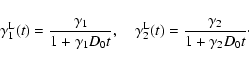
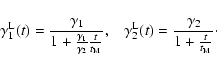
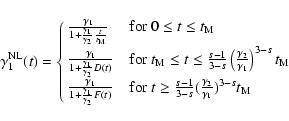
For a steep spectral index value s>2, introduce the time scale
 with
of the particles. With Eq. (18), the time scale (17) simply reads
with
of the particles. With Eq. (18), the time scale (17) simply reads
![\begin{displaymath}n(\gamma , 0\le t\le t_{\rm L}, s > 2) \simeq q_0\gamma ^{-s}\left[1-{\gamma \over \gamma _1}{t\over t_{\rm L}}\right]^{s-2}
\end{displaymath}](/articles/aa/full/2008/26/aa8255-07/img68.gif)
![\begin{displaymath}n(\gamma, t\ge t_{\rm L}, s>2)\simeq q_0\gamma ^{-s} \left[1-{\gamma \over \gamma _1}A(t)\right]^{s-2}
\end{displaymath}](/articles/aa/full/2008/26/aa8255-07/img70.gif)
 .
.
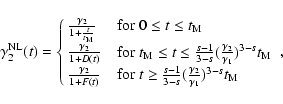
For low spectral index values, the short time behaviour of the approximate solution to the nonlinear kinetic equation is more involved. Introduce the two time scales
 of the injected particles, which explains the appearance of
instead of
in the time scale (25). As an aside: if we compare the time scales (25) and (17) we notice that
of the injected particles, which explains the appearance of
instead of
in the time scale (25). As an aside: if we compare the time scales (25) and (17) we notice that
 is much shorter than
  .
.
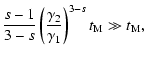
Equation (13) then yields
![\begin{displaymath}n(\gamma ,0 \le t \le t_{\rm M}, 1<s<2) \simeq q_0\gamma ^{-s}\left[1-{\gamma \over \gamma _2}{t\over t_{\rm M}}\right]^{s-2}
\end{displaymath}](/articles/aa/full/2008/26/aa8255-07/img91.gif)
![\begin{displaymath}n(\gamma ,t_{\rm M}\le t\le t_{\rm K}, 1<s<2)\simeq q_0\gamma ^{-s}\left[1-{\gamma \over \gamma _2}D(t)\right]^{s-2}\end{displaymath}](/articles/aa/full/2008/26/aa8255-07/img93.gif)
![\begin{displaymath}n(\gamma , t\ge t_{\rm K}, 1<s<2)\simeq q_0\gamma ^{-s}\left[1-{\gamma \over \gamma _2}F(t)\right]^{s-2}\end{displaymath}](/articles/aa/full/2008/26/aa8255-07/img95.gif)
 and
and
 ,
respectively.
,
respectively.
In this section we discuss in detail the differences between the properties of the nonlinear and the linear solutions regarding the cooling time scales, the time evolution of the upper and lower cut-offs in the electron distribution and the distribution function itself.
In the linear cooling case, solution (8) shows that an electron starting with Lorentz factor
cools to the Lorentz factor
 ,
where the Lorentz factor has cooled to half its initial value
,
where the Lorentz factor has cooled to half its initial value
 ,
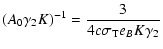
does not dependent on the strength q0 of the injection rate or the initial kinetic energy in injected electrons K.
,
does not dependent on the strength q0 of the injection rate or the initial kinetic energy in injected electrons K.
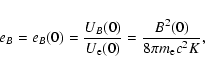
In the nonlinear cooling case, the time dependence of the electron distribution function is controlled by the time scale (25)
 does depend on the initial kinetic energy of injected electrons K due to the equipartition conditions. The more electrons that are injected, the quicker each electron cools under equipartition requirements. Such a collective behaviour is new and completely different from the linear case.
For non-equipartition magnetic field strengths, the ratio of the nonlinear (34) to the linear (33) cooling time
![$K { e}_B>\left[{B\over 4.54~{\rm mG}}\right]^2$](/articles/aa/full/2008/26/aa8255-07/img110.gif) ,
which is easily fulfilled in GRB sources and blazars. Modelling of blazar flaring (e.g. Dermer & Schlickeiser 1992, 2002) indicates that about
,
which is easily fulfilled in GRB sources and blazars. Modelling of blazar flaring (e.g. Dermer & Schlickeiser 1992, 2002) indicates that about
 electrons per cm-3 with Lorentz factors
 ,
implying K=1012 cm-3, are injected into sources with several Gauss (
,
implying K=1012 cm-3, are injected into sources with several Gauss (
 G) fields. The nonlinear cooling time is then more than four orders of magnitude shorter than the standard linear half-life (SL).
In equipartition conditions with constant energy density ratio values,
 .
.
To illustrate the results in the following, we adopt initial electron cut-offs
 and
and
 and the full equipartition parameters
K=1012 cm-3, implying
and the full equipartition parameters
K=1012 cm-3, implying
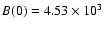 G. In this case the linear and nonlinear cooling time values are equal,
.
G. In this case the linear and nonlinear cooling time values are equal,
.
![\begin{figure}
\par\includegraphics[width=8cm,clip]{8255fig3.eps}\end{figure}](/articles/aa/full/2008/26/aa8255-07/img118.gif) |
Figure 3:
Time dependences of the lower (
 )
and the upper ( )
and the upper (
 )
cut-offs of the electron distribution functions for s=3 in the linear and nonlinear case. Linear
(dashed curve), nonlinear
(thick full curve), linear
(dotted-dashed curve), nonlinear
(thin full curve). Initial values
and
are assumed. )
cut-offs of the electron distribution functions for s=3 in the linear and nonlinear case. Linear
(dashed curve), nonlinear
(thick full curve), linear
(dotted-dashed curve), nonlinear
(thin full curve). Initial values
and
are assumed. |
| Open with DEXTER | |
In the linear cooling case, the Lorentz factor cut-offs
and of the initial power law each decrease as a function of time as
,
Eqs. (38) read as
and
for the linear and the nonlinear cases, calculated for s=3. We note several important differences: (a) at early times
 ,
the nonlinear lower cut-off value is practically constant as is the linear lower cut-off value; (b) at early times
,
the linear upper cut-off value remains practically constant while the nonlinear upper cut-off quickly decreases inversely proportional to time; (c) at later times, the upper and lower cut-off curves converge to each other both in the linear and nonlinear cases; i.e., the initially broad power law is significantly quenched, but the nonlinear cut-offs exhibit a slower (
,
the nonlinear lower cut-off value is practically constant as is the linear lower cut-off value; (b) at early times
,
the linear upper cut-off value remains practically constant while the nonlinear upper cut-off quickly decreases inversely proportional to time; (c) at later times, the upper and lower cut-off curves converge to each other both in the linear and nonlinear cases; i.e., the initially broad power law is significantly quenched, but the nonlinear cut-offs exhibit a slower (
 )
decay than the linear decrease in the linear cut-offs.
)
decay than the linear decrease in the linear cut-offs.
![\begin{figure}
\par\includegraphics[width=8cm,clip]{8255fig4.eps}\end{figure}](/articles/aa/full/2008/26/aa8255-07/img125.gif) |
Figure 4:
Time dependences of the lower (
)
and the upper (
)
cut-offs of the electron distribution functions for s=1.5 in the linear and nonlinear cases. Linear
(dashed curve), nonlinear
(thin full curve), linear
(dotted-dashed curve), nonlinear
(thick full curve). Initial values
and
are assumed. |
| Open with DEXTER | |
Likewise, in the nonlinear case, we find for flat injection spectra 1<s<2
 ,
the cut-off variations with time are similar to the linear case, while at intermediate times, they exhibit a power law decrease through D(t) (depending on the spectral index s of injected particles). At late times,
,
the cut-off variations with time are similar to the linear case, while at intermediate times, they exhibit a power law decrease through D(t) (depending on the spectral index s of injected particles). At late times,
 ,
they exhibit a decrease through F(t).
,
they exhibit a decrease through F(t).
For the same parameters used in the last section, we show in Figs. 5 and 6 the nonlinear and linear electron distributions as a function of the electron Lorentz factor for the cases s=1.5 and s=3. Again the power laws appear between sharp lower and upper cut-offs that decrease with time. One also notices the significant quenching of the power law with increasing time and the pile-up in the case of flat injection spectral index (Fig. 5).
![\begin{figure}
\par\includegraphics[width=8.5cm,clip]{8255fig5.eps}\end{figure}](/articles/aa/full/2008/26/aa8255-07/img130.gif) |
Figure 5:
Electron distribution function
 as a function of the normalised Lorentz factor
for s=1.5 and
in the nonlinear cooling case at different times
(dotted-dashed curve), 102 (dashed curve), 104 (thin full curve), and 106 (thick full curve).
as a function of the normalised Lorentz factor
for s=1.5 and
in the nonlinear cooling case at different times
(dotted-dashed curve), 102 (dashed curve), 104 (thin full curve), and 106 (thick full curve). |
| Open with DEXTER | |
![\begin{figure}
\par\includegraphics[width=8.5cm,clip]{8255fig6.eps}\end{figure}](/articles/aa/full/2008/26/aa8255-07/img131.gif) |
Figure 6:
Electron distribution function
 as a function of the normalised Lorentz factor
for s=3 and
in the nonlinear cooling case at different times
(dotted-dashed curve), 10-2 (dashed curve), 0.5 (thin full curve), and 10 (thick full curve).
as a function of the normalised Lorentz factor
for s=3 and
in the nonlinear cooling case at different times
(dotted-dashed curve), 10-2 (dashed curve), 0.5 (thin full curve), and 10 (thick full curve). |
| Open with DEXTER | |
In this section we calculate the time-integrated electron distributions (fluences)
With the substitution
 ,
the linear distribution function (8) immediately yields
,
the linear distribution function (8) immediately yields
![\begin{displaymath}N_{\rm L}(\gamma )={q_0\over D_0}\gamma ^{-(s+1)} \int_0^\inf...
...^{s-2}
H\left[\tau -{\gamma _1-\gamma \over \gamma _1}\right]
\end{displaymath}](/articles/aa/full/2008/26/aa8255-07/img134.gif)
![\begin{displaymath}\hspace*{1.5cm} \times ~~H\left[{\gamma _2-\gamma \over \gamma _2}-\tau \right] ={q_0\over D_0(s-1)}
\end{displaymath}](/articles/aa/full/2008/26/aa8255-07/img135.gif)
 at .
at .
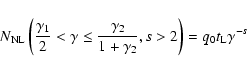
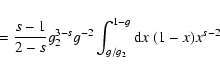
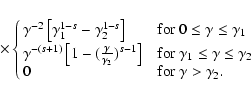
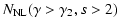
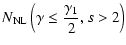
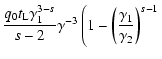
The nonlinear distribution functions (20)-(21) for large spectral indices s>2, and (27)-(29) for flat spectral spectral indices 1<s<2, are used in Appendix C to calculate the nonlinear electron fluence distributions.
For electron radiation processes not subject to equipartition conditions, such as inverse Compton scattering of ambient photon gases and relativistic bremsstrahlung, the energy dependences of the electron number density and the electron fluence can be directly used to infer the frequency dependence of the fluxes and fluences of the generated photons by folding the electron energy distributions with the respective radiation cross-sections to calculate the respective spontaneous emission and absorption coefficients.
In the case of synchrotron radiation and synchrotron-self-Compton emission, the frequency-energy relation is more complicated as the magnetic field strength is also time-dependent due to the equipartition condition. In Sect. 8 we calculate the nonlinear optically thin synchrotron radiation intensity and compare it with the synchrotron intensity in the linear cooling case.
With the substitutions
 ,
and
,
and
 for large spectral indices, we obtain
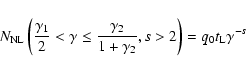
![\begin{displaymath}\quad\quad\quad\times \Biggl[{1\over g(s-1)} \left[g^{s-1}-(1-g)^{s-1} \right] + {s-1\over g^2(s-2)}
\end{displaymath}](/articles/aa/full/2008/26/aa8255-07/img145.gif)
and
,
the nonlinear fluence distribution agrees with the linear steepened injection distribution (49), but for lower energies we obtain a different behaviour. Much below the transition region
 ,
the nonlinear fluence (154) approaches a power law
whose spectral index is larger by unity than in the linear case. Consequently, we also obtain a broken power-law behaviour for the nonlinear fluence, but with a smaller spectral break by
,
the nonlinear fluence (154) approaches a power law
whose spectral index is larger by unity than in the linear case. Consequently, we also obtain a broken power-law behaviour for the nonlinear fluence, but with a smaller spectral break by
 around
than in the linear case.
around
than in the linear case.
Likewise, for flat injection spectra we find
 corresponding to
 ,
is an unbroken power law with spectral index 3 independent of the injected flat power law value 1<s<2.
,
is an unbroken power law with spectral index 3 independent of the injected flat power law value 1<s<2.
For completeness here we consider the linear and nonlinear steady-state solutions for the electron distribution resulting from the steady injection of the power law
 .
The linear electron equilibrium distribution obeys the kinetic equation
.
The linear electron equilibrium distribution obeys the kinetic equation
whereas the nonlinear electron equilibrium distribution obeys
![\begin{displaymath}A_0\left[\int_1^\infty {\rm d}u \left[(u^2-1)^{1/2}-1\right]M_{\rm N}(u)\right]
\end{displaymath}](/articles/aa/full/2008/26/aa8255-07/img167.gif)
 ,
and we use the correspondingly corrected forms for the kinetic energy density and the synchrotron loss term (Kirk et al. 1988). The linear kinetic Eq. (55) immediately yields
,
and we use the correspondingly corrected forms for the kinetic energy density and the synchrotron loss term (Kirk et al. 1988). The linear kinetic Eq. (55) immediately yields
![\begin{displaymath}U^2={q_0\over A_0(s-1)}\Bigl(\left[\gamma _1^{1-s}-\gamma _2^{1-s}\right]\int_1^{\gamma _1}{{\rm d}\gamma \over \gamma }
\end{displaymath}](/articles/aa/full/2008/26/aa8255-07/img181.gif)
 the second and third integral in Eq. (62) are solved approximately as

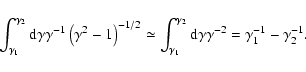
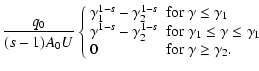
 and s>1 we find approximately
 )
whereas the linear solution (68) under equipartition conditions is independent from q0. Also the dependence on the initial cut-offs
and
is different for the two solutions.
)
whereas the linear solution (68) under equipartition conditions is independent from q0. Also the dependence on the initial cut-offs
and
is different for the two solutions.
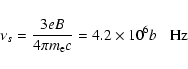
Here we calculate the optically thin synchrotron intensity and fluence distribution in the linear and nonlinear cooling case, using the monochromatic approximation (Felten & Morrison 1966) of the synchrotron spectral power in vacuum
 denotes the Thomson cross section. The monochromatic approxiamtion works well for broad energy distribution functions of the radiating electrons, as is the case here.
The optically thin synchrotron radiation intensity from a homogeneous source of size L is then given as
With the linear electron distribution function (8), we obtain
and
 and introducing the normalised frequency
![\begin{displaymath}I_{\rm L}(\omega ,\tau)= {Lcq_0\sigma _{\rm T} B^2 \over 48\p...
...^{{1-s\over 2}}
\left[1-\tau \omega ^{1/2}\right]^{s-2}H[\tau]
\end{displaymath}](/articles/aa/full/2008/26/aa8255-07/img208.gif)
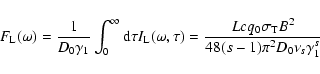
 at
at
 in agreement with the behaviour of the linear electron fluence (45). Moreover, independent of the spectral index s of the injected power law, the linear synchrotron fluence at low frequencies approaches the same frequency spectral index
 .
.
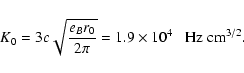
In the nonlinear cooling case the magnetic field strength becomes time-dependent (see Eq. (2)) so that the characteristic frequency (70) is
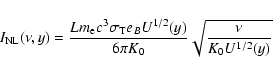
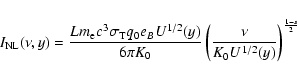

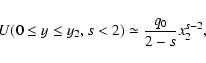
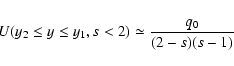
![\begin{displaymath}\quad\quad\quad\quad\quad\times \left[{3-s\over (2-s)(s-1)}q_0y-~ {2(2-s)\over s-1}x_2^{3-s}\right]^{(s-2)/(3-s)},
\end{displaymath}](/articles/aa/full/2008/26/aa8255-07/img226.gif)
In the following we limit our discussion to the case of steep spectral indices s>2 and leave the case of flat spectral indices to the interested reader.
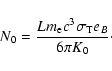
At times
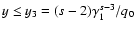 ,
we find T=U0y with the constant
,
we find T=U0y with the constant

 ,
we find
,
we find
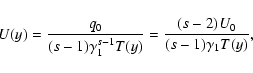
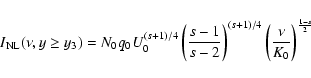
 and to introduce the normalised frequency
 .
Apart from different overall, frequency, and time normalisations, its functional behaviour is identical to the linear cooling intensity distribution (74).
.
Apart from different overall, frequency, and time normalisations, its functional behaviour is identical to the linear cooling intensity distribution (74).
Nonlinear cooling behaviour only occurs at late time x>1 through the second
intensity distribution (91), which is non-zero only for frequencies f<f0 where
 we will obtain a functional behaviour identical to the linear cooling case described by the first intensity distribution (90). For low frequencies f<1/4, only the second intensity distribution (91) contributes, which is markedly different from the linear behaviour.
For the nonlinear synchrotron fluence, we infer

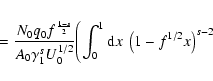
![\begin{displaymath}\quad\times~ H\left[f -(x+1)^{-2}\right]H\left[(x+g_2^{-1})^{-2}-f\right]
\end{displaymath}](/articles/aa/full/2008/26/aa8255-07/img262.gif)
![\begin{displaymath}\quad+~\left[{s-2\over s-1}\right]^{{s-3\over 4}}\int_1^\inft...
...4}}
\left(1- ({s-1\over s-2})^{1/4}f^{1/2}x^{5/4}\right)^{s-2}
\end{displaymath}](/articles/aa/full/2008/26/aa8255-07/img263.gif)
 .
.
For frequencies f>1, only the first term in Eq. (93) contributes yielding
)
and the different frequency normalisation, exhibits the linear cooling frequency dependence (compare with Eq. (75b)).
For frequencies  only the second term in Eq. (93) contributes. The two Heaviside functions in the second term limit the range of x to
 with
with
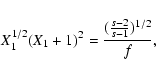 we find
 so that
 .
.
It is interesting to note that this behaviour of the linear and nonlinear synchrotron fluence from electrons, injected with a steep injection spectrum (s>2) at low frequencies, is identical to the behaviour of the linear and nonlinear synchrotron fluence from monoenergetically injected electrons discussed in SL. Again the nonlinear fluence behaviour only occurs at frequencies much lower than the characteristic synchrotron frequencies
 or
or
 ,
respectively, where the nonlinear fluence shows a steeper (by
,
respectively, where the nonlinear fluence shows a steeper (by
 )
power-law behaviour (
)
than the linear fluence (
)
power-law behaviour (
)
than the linear fluence (
 ).
).
In powerful cosmic nonthermal radiation sources with dominant magnetic-field self generation, magnetic field generation at almost equipartition stength by relativistic plasma instabilities operates as fast as the acceleration or injection of ultra-high energy radiating electrons in these sources. Then the magnetic field strength becomes time-dependent and adjusts to the actual kinetic energy density of the radiating electrons in these sources. As a consequence the synchrotron radiation cooling of individual relativistic electrons exhibits a nonlinear behaviour because of the dependence of the magnetic energy density on the actual kinetic energy density, which itself decreases due to the time evolution of the electron number density.
For the case of instantaneous injection of power-law distributed electrons, we have solve this nonlinear kinetic equation for the intrinsic temperoral evolution of relativistic electrons. We demonstrate that the nonlinear solution for the differential electron number density depends on a new time variable T(t) that is related to the intrinsic time t by a first-order nonlinear differential equation. We solved this nonlinear differential equation approximately at early, intermediate and late times to construct the T(t) relation at all times after injection. The properties of the resulting approximate nonlinear electron density show significant differences from the standard linear solution for constant non-equipartition magnetic-field energy density such as the different time behaviour of the upper and lower cut-offs of the electron distribution.
By time-integration we also calculated the differential electron fluence as a function of electron energy and compared it to the linear fluence. For large spectral indices s>2 of the injected power law, the nonlinear fluence exhibits a weaker break at the lower injected electron cut-off
than the linear fluence. For small spectral indices 1<s<2, the nonlinear fluence shows no break at all and approaches a
power law at all energies below
.
For power law injection under steady-state conditions. we demonstrated that the nonlinear and linear electron distribution functions exhibit the same dependence on the Lorentz factor of the electrons. However, under equipartition conditions, their absolute values are different. The nonlinear solution depends on the injection rate (
)
of electrons, whereas the linear solution is independent from q0. For electron radiation processes not subject to equipartition conditions, such as inverse Compton scattering of ambient photon gases and relativistic bremsstrahlung, the energy dependences of the electron number density and the electron fluence can be used directly to infer the frequency dependence of the fluxes and fluences of the generated photons.
We also calculated the optically thin synchrotron intensity and fluence spectra
taking into account the time-dependence in the nonlinear cooling case of the magnetic field strength due to the partition condition. For steep spectral indices s>2, we demonstrated that fluence differences due to the nonlinear cooling from the linear cooling case only occur at small synchrotron frequencies. In this frequency range, the linear and nonlinear fluence spectral behaviours are identical to the behaviour shown by monoenergetically injected electrons. The nonlinear synchrotron fluence shows a steeper (by
)
power-law behaviour (
)
than the linear fluence (
).
Acknowledgements
We thank the referee for fruitful comments that helped to improve the manuscript. We thank Michael Zacharias for a careful checking of the manuscript. This work was partially supported by the German Ministry for Education and Research (BMBF) through Verbundforschung Astroteilchenphysik grant 05 CH5PC1/6 and the Deutsche Forschungsgemeinschaft through grant Schl 201/16-2.
 to obtain
 as independent variable, we find with
 and
and

 (i.e.
(i.e.  ), implying

 is any solution of
  determined by the boundary condition
S(x=0,T)=0. We derive
determined by the boundary condition
S(x=0,T)=0. We derive
 the second integral vanishes because x1+T and x2+T, appearing in the arguments of the Heaviside functions, are always larger than T so that
For
 and
and  (i.e. unlimited injected power law), one can work out exactly the T to y relation as
For a broad range of injected power laws
 the integral in Eq. (113),
;
;
;
 corresponding to

In this limit we use the approximation
 corresponding to

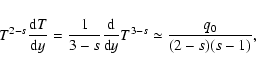


In this limit we use the approximation
 corresponding to

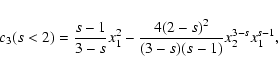
Collecting terms we obtain the approximate solutions as
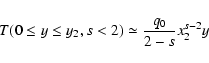
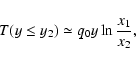
![\begin{displaymath}T(y_2\le y\le y_1,s<2)\simeq \left[{3-s\over (2-s)(s-1)}q_0y-\! {2(2-s)\over s-1}x_2^{3-s}\right]^{1/(3-s)}\!\!,
\end{displaymath}](/articles/aa/full/2008/26/aa8255-07/img344.gif)
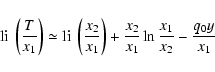
For s=2 Eq. (116) holds which can be approximated as
in terms of the logarithmic integral


With the nonlinear distribution functions (20)-(21) for large spectral indices s>2 with the substitutions
,
and
,
we find
![\begin{displaymath}L_1(g,s)={s-1\over 2(s-2)}\left[\left({1\over g}-1\right)^2-{3-s\over s-1}\right],\;\;~\;
\end{displaymath}](/articles/aa/full/2008/26/aa8255-07/img365.gif)
![\begin{displaymath}\quad\quad\times \Bigl[{1\over g(s-1)}[g^{s-1}-(1-g)^{s-1}]
+ {s-1\over g^2(s-2)}
\end{displaymath}](/articles/aa/full/2008/26/aa8255-07/img378.gif)
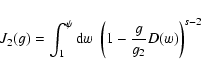
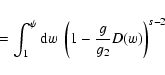
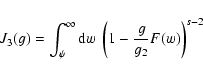
Likewise for flat injection spectra we use the nonlinear distribution function (27)-(29) with the substitutions
 and
to obtain for the fluence (44)
and
to obtain for the fluence (44)
![\begin{displaymath}J_1(g)=\int_0^1{\rm d}w\; \left(1-{g\over g_2}w\right)^{s-2}H...
...{g_2\over 1+g}-w\right]H\left[g-{1\over 1+{w\over g_2}}\right]
\end{displaymath}](/articles/aa/full/2008/26/aa8255-07/img385.gif)
![\begin{displaymath}\quad\quad\times H\left[{g_2\over 1+D(w)}-g\right]H\left[g-{1\over 1+{D(w)\over g_2}}\right]
\end{displaymath}](/articles/aa/full/2008/26/aa8255-07/img388.gif)
![\begin{displaymath}\quad\quad\times H\left[{g_2-g\over g}-D(w)\right]H\left[D(w)-({g_2\over g}-g_2)\right]
\end{displaymath}](/articles/aa/full/2008/26/aa8255-07/img390.gif)
![\begin{displaymath}\quad\quad\times
H\left[{g_2\over 1+F(w)}-g\right]H\left[g-{1\over 1+{F(w)\over g_2}}\right]
\end{displaymath}](/articles/aa/full/2008/26/aa8255-07/img393.gif)
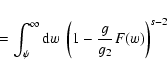
![\begin{displaymath}\quad\quad\times
H\left[{g_2-g\over g}-F(w)\right]H\left[F(w)-\left({g_2\over g}-g_2\right)\right]
\end{displaymath}](/articles/aa/full/2008/26/aa8255-07/img395.gif)
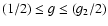 :
:

 |
![\begin{displaymath}J_2\left({1\over 2}\le g\le {g_2\over 1+g_2}\right)=\left ({g_2\over g}\right)^{3-s}\left[g^{s-1}-(1-g)^{s-1}\right]
\end{displaymath}](/articles/aa/full/2008/26/aa8255-07/img410.gif)
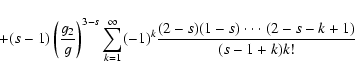
 Eq. (169) is well approximated by the first leading term
![\begin{displaymath}J_2\left ({g_2\over 1+g_2}\le g\le {g_2\over 2}\right)= \left...
...\over g_2}\right)^{s-1}-\left({g\over g_2}\right)^{s-1}\right]
\end{displaymath}](/articles/aa/full/2008/26/aa8255-07/img415.gif)

 we approximate Eq. (171) by its first term
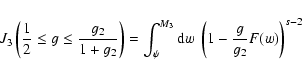

 we approximate (173) and (174) as


![\begin{displaymath}{\partial n(\gamma ,t)\over \partial t} -
{\partial \over \pa...
...ft\vert\dot{\gamma}\right\vert n(\gamma,t)\right]=Q(\gamma ,t)
\end{displaymath}](/articles/aa/full/2008/26/aa8255-07/img33.gif)


![$\displaystyle n_{\rm L}(\gamma ,t)=q_0\gamma ^{-s}[1-D_0\gamma t]^{s-2}H[t] H\l...
...1+D_0\gamma _1t}\right]
H\left[{\gamma _2\over 1+D_0\gamma _2t}-\gamma \right],$](/articles/aa/full/2008/26/aa8255-07/img41.gif)
![\begin{displaymath}D_0={4\over 3}{c \sigma _{\rm T} \over m_{\rm e} c^2} U_B = 2...
...es 10^{-14}\left[{U_B\over m_{\rm e} c^2}\right]\hbox{s}^{-1}.
\end{displaymath}](/articles/aa/full/2008/26/aa8255-07/img42.gif)

![\begin{displaymath}\quad \quad\quad \quad\quad\quad \quad\times H\left[\gamma -{...
...ver 1+\gamma _1T(y)}\right]H\left[{1\over T(y)}-\gamma \right]
\end{displaymath}](/articles/aa/full/2008/26/aa8255-07/img51.gif)

![\begin{displaymath}T(y\!\ge\! y_1)\!\simeq\!
\left[{2q_0\over s\!-\!1}x_1^{s-1}...
... {4(2\!-\!s)^2\over (3-s)(s-1)}x_2^{3-s}x_1^{s-1}\right]^{1/2}
\end{displaymath}](/articles/aa/full/2008/26/aa8255-07/img58.gif)
![\begin{displaymath}y_1={(2-s)(s-1)\over (3-s)q_0}\left[ x_1^{3-s}+{2(2-s)\over s-1}x_2^{3-s}\right]
\end{displaymath}](/articles/aa/full/2008/26/aa8255-07/img59.gif)

![\begin{displaymath}T(y,s>2)\simeq
\cases{
{q_0\over s-2}x_1^{s-2}y & for $0\le ...
...\right]^{1/2} & for $y\ge {s-2\over q_0}x_1^{3-s}.$\space \cr}
\end{displaymath}](/articles/aa/full/2008/26/aa8255-07/img61.gif)

![$\displaystyle \int_{\gamma _1}^{\gamma _2}{\rm d}\gamma \gamma q_0\gamma ^{-s}={q_0\over 2-s}\left[\gamma _2^{2-s}-\gamma _1^{2-s}\right]$](/articles/aa/full/2008/26/aa8255-07/img64.gif)


![\begin{displaymath}\quad \quad \quad\quad \times H\left[{\gamma _2\over 1+{\gamm...
... L}}}\right] H\left[\gamma _1{t_{\rm L}\over t}-\gamma \right]
\end{displaymath}](/articles/aa/full/2008/26/aa8255-07/img69.gif)
![\begin{displaymath}\quad\quad\quad\times
H\left[{\gamma _2\over 1+{\gamma _2\ove...
...over 1+A(t)}\right] H\left[{\gamma _1\over A(t)}-\gamma\right]
\end{displaymath}](/articles/aa/full/2008/26/aa8255-07/img71.gif)


![$\displaystyle {s-1\over 3-s} t_{\rm M} \left[\left({\gamma _2\over \gamma _1}\right)^{3-s}+{2(2-s)\over s-1}\right]$](/articles/aa/full/2008/26/aa8255-07/img76.gif)



![$\displaystyle {1\over \gamma _2} \left[{3-s \over s-1}{t\over t_{\rm M}}-{2(2-s)\over s-1}\right]^{1/(3-s)},$](/articles/aa/full/2008/26/aa8255-07/img86.gif)


![$\displaystyle {s-1\over (3-s)\gamma_1^2}\Bigr]^{1/2}.$](/articles/aa/full/2008/26/aa8255-07/img90.gif)
![\begin{displaymath}\quad\quad \quad \quad \times H\left[{\gamma _2\over 1+{t\ove...
...}}}\right]
H\left[\gamma _2{t_{\rm M}\over t}-\gamma \right]
,
\end{displaymath}](/articles/aa/full/2008/26/aa8255-07/img92.gif)
![\begin{displaymath}\quad \quad \quad\times H\left[{\gamma _2\over 1+D(t)}-\gamma...
... _2}D(t)}\right] H\left[{\gamma _2\over D(t)}-\gamma \right]
,
\end{displaymath}](/articles/aa/full/2008/26/aa8255-07/img94.gif)
![\begin{displaymath}\quad\quad\quad
\times H\left[{\gamma _2\over 1+F(t)}-\gamma ...
...ma _2}F(t)}\right] H\left[{\gamma _2\over F(t)}-\gamma \right]
\end{displaymath}](/articles/aa/full/2008/26/aa8255-07/img96.gif)

![$\displaystyle \Biggl[\left({\gamma _2\over \gamma _1}\right)^{s-1}\left[{2(2-s)...
...right]
+{s-1\over (3-s)}\left({\gamma _2\over \gamma _1}\right)^2\Biggr]^{1/2}.$](/articles/aa/full/2008/26/aa8255-07/img98.gif)

![\begin{displaymath}t^{\rm L}_{1/2}={1\over D_0\gamma _2}= {3.76\times 10^{13} \over \gamma _2}\left[{4.54\hbox{ mG}\over B}\right]^2 \hbox{s},
\end{displaymath}](/articles/aa/full/2008/26/aa8255-07/img104.gif)

![$\displaystyle 3.76 \times 10^{13}{ e}_B^{-1} \gamma _2^{-1} \left[K/\hbox{cm}^{-3}\right]^{-1}\;\;\;\; \hbox{s}.$](/articles/aa/full/2008/26/aa8255-07/img107.gif)
![\begin{displaymath}r={t_{\rm M}\over t^{\rm L}_{1/2}}={1\over { e}_B K}\left[{B\over 4.54\hbox{ mG}}\right]^2
\end{displaymath}](/articles/aa/full/2008/26/aa8255-07/img109.gif)





![$\displaystyle {q_0t_{\rm L}\gamma _1\over s-1}\gamma ^{-s-1}\left[1-\left({\gamma \over \gamma _2}\right)^{s-1}\right]$](/articles/aa/full/2008/26/aa8255-07/img142.gif)
![\begin{displaymath}N_{\rm NL}\left({\gamma _2\over 1+\gamma _2}<\gamma \le \gamm...
...} \left[1-\left({\gamma _1\over \gamma _2}\right)^{s-1}\right]
\end{displaymath}](/articles/aa/full/2008/26/aa8255-07/img143.gif)
![\begin{displaymath}\quad\quad\quad\times \left[{(1-g)^{s-1}-g^{s-1}g_2^{1-s}\over s-1}-{(1-g)^s-g^{s}g_2^{-s}\over s}\right] \Biggr]
\end{displaymath}](/articles/aa/full/2008/26/aa8255-07/img146.gif)

![$\displaystyle \left. {s - 1\over s}{\gamma \over \gamma _1}\left[1 - \left({\gamma _1\over \gamma _2}\right)^s\right]\right)$](/articles/aa/full/2008/26/aa8255-07/img150.gif)

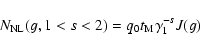

![$\displaystyle {g_2\over s-1}g^{-(s+1)}\left[1-(g/g_2)^{s-1}\right],$](/articles/aa/full/2008/26/aa8255-07/img156.gif)

![$\displaystyle g_2g^{-(s+1)}\left[{1-(1-{g\over g_2})^{s-1}\over s-1}\right]$](/articles/aa/full/2008/26/aa8255-07/img158.gif)
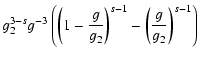
![$\displaystyle (g_2/g)^{2-s}\left(\left(1-{g\over g_2}\right)^{s-1}-\left({g\over g_2}\right)^{s-1}\right)\Biggr]$](/articles/aa/full/2008/26/aa8255-07/img159.gif)
![\begin{displaymath}J\left(g\le {1\over 2}\right)\simeq {g_2^{3-s}\over 2-s}g^{-3}\left[1-{s-1\over s}g\right],
\end{displaymath}](/articles/aa/full/2008/26/aa8255-07/img161.gif)
![\begin{displaymath}Q(\gamma)=q_0\gamma ^{-s}H[\gamma -\gamma _1]H[\gamma _2-\gamma]
\end{displaymath}](/articles/aa/full/2008/26/aa8255-07/img164.gif)
![\begin{displaymath}{{\rm d}\over {\rm d}\gamma }\left[ D_0\gamma (\gamma ^2-1)^{1/2} M_{\rm L}(\gamma) \right]=-Q(\gamma),
\end{displaymath}](/articles/aa/full/2008/26/aa8255-07/img166.gif)
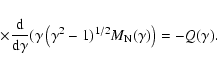

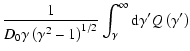
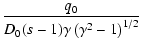
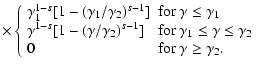
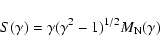
![$\displaystyle \int_1^\infty {\rm d}\gamma \left[\left(\gamma ^2-1\right)^{1/2}-1\right]M_{\rm N}(\gamma)$](/articles/aa/full/2008/26/aa8255-07/img175.gif)
![$\displaystyle \int_1 ^\infty {\rm d}\gamma \left[\left(\gamma ^2-1\right)^{1/2}-1\right]\gamma ^{-1}(\gamma ^2-1)^{-1/2}S(\gamma),$](/articles/aa/full/2008/26/aa8255-07/img176.gif)


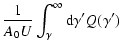



![\begin{displaymath}U\simeq \left[{q_0\ln \gamma _1\over A_0(s-1)\gamma _1^{s-1}}\right]^{1/2}
\end{displaymath}](/articles/aa/full/2008/26/aa8255-07/img189.gif)

![$\displaystyle {q_0^{1/2}\gamma _1^{(s-1)/2}\over [A_0(s-1)\ln \gamma _1]^{1/2}}
\gamma ^{-1}\left(\gamma ^2-1\right)^{-1/2}$](/articles/aa/full/2008/26/aa8255-07/img191.gif)






![$\displaystyle {Lcq_0\sigma _{\rm T}B^2\over 48\pi ^2\nu _s}\left({\nu \over \nu _s}\right)^{{1-s\over 2}} \left[1-D_0t\sqrt{\nu \over \nu _s}\right]^{s-2}H[t]$](/articles/aa/full/2008/26/aa8255-07/img203.gif)

![$\displaystyle H\left[\nu -{\nu _s\gamma _1^2\over (1+D_0\gamma _1t)^2}\right]
H\left[{\nu _s\gamma _2^2\over (1+D_0\gamma _2t)^2}-\nu \right].$](/articles/aa/full/2008/26/aa8255-07/img205.gif)

![\begin{displaymath}\quad\quad\quad\quad\times H\left[\omega -(1+\tau )^{-2}\right] H\left[\left({g_2\over 1+g_2\tau }\right)^2-\omega \right].
\end{displaymath}](/articles/aa/full/2008/26/aa8255-07/img209.gif)
![\begin{displaymath}\quad\quad\quad\times \cases{\omega ^{-1/2}(1-g_2^{1-s}) & {\...
...2)^{(s-1)/2}] & {\rm for} $1\le \omega \le g_2^2.$\space \cr }
\end{displaymath}](/articles/aa/full/2008/26/aa8255-07/img211.gif)
![\begin{displaymath}\nu _s(t)=K_0[U(t)]^{1/2}\;\; \hbox{Hz}
\end{displaymath}](/articles/aa/full/2008/26/aa8255-07/img215.gif)


![\begin{displaymath}\quad\quad\quad\quad\quad\quad\times H[y]H\left[\nu \!-\!{K_0...
...U^{1/2}\gamma _2^2\over (1\!+\!\gamma _2T)^2}\!-\!\nu \right].
\end{displaymath}](/articles/aa/full/2008/26/aa8255-07/img222.gif)


![$\displaystyle \left.{4(2-s)^2\over (3-s)(s-1)}x_2^{3-s}x_1^{s-1}\right]^{-1/2},$](/articles/aa/full/2008/26/aa8255-07/img230.gif)


![$\displaystyle {s-2\over q_0}x_1^{3-s},s>2)\simeq {q_0x_1^{s-1}\over s-1}\left[{2q_0\over s-1}x_1^{s-1}y +{3-s\over s-1}x_1^2\right]^{-1/2}\cdot$](/articles/aa/full/2008/26/aa8255-07/img234.gif)

![\begin{displaymath}\quad \quad \quad \quad \quad \quad \quad\times H[y]H\left[\n...
..._0^{1/2}\gamma _2^2\over (1\!+\!\gamma _2T)^2}\!-\!\nu \right]
\end{displaymath}](/articles/aa/full/2008/26/aa8255-07/img238.gif)
![\begin{displaymath}T(y)=\left[{2q_0\over s-1}x_1^{s-1}y+{3-s\over s-1}x_1^2\right]^{1/2}
\end{displaymath}](/articles/aa/full/2008/26/aa8255-07/img242.gif)


![$\displaystyle H\left[\nu -{K_0U_0^{1/2}\gamma _1^2\over (1+\gamma _1T)^2}\sqrt{s-2\over (s-1)\gamma _1T}\right]$](/articles/aa/full/2008/26/aa8255-07/img246.gif)
![$\displaystyle H\left[{K_0U_0^{1/2}\gamma _2^2\over (1+\gamma _2T)^2}\sqrt{s-2\over (s-1)\gamma _1T}-\nu \right].$](/articles/aa/full/2008/26/aa8255-07/img247.gif)


![$\displaystyle {N_0q_0U_0^{1/2}\over \gamma _1^{s-1}}f^{{1-s\over 2}}
\left(1- f^{1/2}x\right)^{s-2}H[x]$](/articles/aa/full/2008/26/aa8255-07/img251.gif)
![$\displaystyle H\left[f -(x+1)^{-2}\right]H\left[(x+g_2^{-1})^{-2}-f\right]$](/articles/aa/full/2008/26/aa8255-07/img252.gif)

![$\displaystyle 1)={N_0q_0U_0^{1/2}\over \gamma _1^{s-1}}\left[{s-2\over s-1}\right]^{{s+1\over 4}}$](/articles/aa/full/2008/26/aa8255-07/img254.gif)
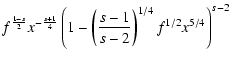
![$\displaystyle H\left[f \!-\!{({s-2\over s-1})^{1/2}\over x^{1/2}(x\!+\!1)^2}\ri...
...\left[{({s-2\over s-1})^{1/2}\over x^{1/2}(x\!+\!g_2^{-1})^2}\!\!-\!\!f\right].$](/articles/aa/full/2008/26/aa8255-07/img256.gif)

![\begin{displaymath}\quad\times~ H\left[f \!-\!{({s-2\over s-1})^{1/2}\over x^{1/...
...over s-1})^{1/2}\over x^{1/2}(x+g_2^{-1})^2}-f\right]
\Biggr),
\end{displaymath}](/articles/aa/full/2008/26/aa8255-07/img264.gif)
![\begin{displaymath}F_{\rm NL}(f>1)=
{N_0q_0\over A_0(s-1)\gamma _1^{s-1}U_0^{1/2}}f^{-{s\over 2}} \left[1-(f/g_2^2)^{{s-1\over 2}}\right],
\end{displaymath}](/articles/aa/full/2008/26/aa8255-07/img266.gif)
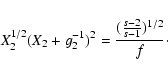

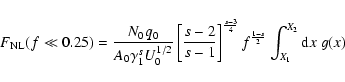
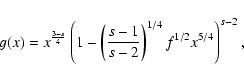

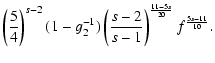
![$\displaystyle F_{\rm NL}(f\ll 0.25)\simeq
\left({5\over 4}\right)^{s-2}{N_0q_0\over A_0\gamma _1^{s}U_0^{1/2}}\left[{s-2\over s-1}\right]^{-1/5}f^{-3/5}.$](/articles/aa/full/2008/26/aa8255-07/img277.gif)
![\begin{displaymath}{\partial n\over \partial t} - A_0\left[\int_0^\infty {\rm d}...
...\gamma ^{-s}H[\gamma _2-\gamma ]H[\gamma -\gamma _1]\delta (t)
\end{displaymath}](/articles/aa/full/2008/26/aa8255-07/img283.gif)
![\begin{displaymath}{\partial S\over \partial y} -
\left[\int_0^\infty {\rm d}\g...
...amma ^{2-s}H[\gamma _2-\gamma ]H[\gamma -\gamma _1]\delta (y).
\end{displaymath}](/articles/aa/full/2008/26/aa8255-07/img285.gif)
![\begin{displaymath}{\partial S\over \partial y} \!+\!{\partial S\over \partial x...
...x~ x^{-1}S(x, y)\right]=
q_0x^{s-2}H[x-x_2]H[x_1-x]\delta (y).
\end{displaymath}](/articles/aa/full/2008/26/aa8255-07/img289.gif)
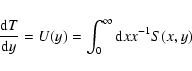
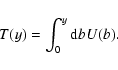
![\begin{displaymath}{\partial S\over \partial T}+{\partial S\over \partial x}=q_0x^{s-2}H[x-x_2]H[x_1-x]\delta (T),
\end{displaymath}](/articles/aa/full/2008/26/aa8255-07/img292.gif)

![$\displaystyle q_0(T+\xi )^{s-2}H[T+\xi -x_2]H[x_1-T-\xi ]\delta (T)$](/articles/aa/full/2008/26/aa8255-07/img297.gif)
![$\displaystyle q_0\xi ^{s-2}H[\xi -x_2]H[x_1-\xi ]\delta (T)$](/articles/aa/full/2008/26/aa8255-07/img298.gif)
![$\displaystyle S_h(\xi )+q_0\xi ^{s-2}H[\xi -x_2]H[x_1-\xi ]H(T)$](/articles/aa/full/2008/26/aa8255-07/img299.gif)
![$\displaystyle S(x,T)=q_0(x-T)^{s-2}H[x-T-x_2]H[x_1+T-x] \left(H[T]-H[T-x]\right).$](/articles/aa/full/2008/26/aa8255-07/img302.gif)

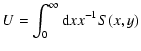
![$\displaystyle q_0H[T]\int_0^\infty {\rm d}x x^{-1}(x-T)^{s-2}H[x-T-x_2]H[x_1+T-x]~$](/articles/aa/full/2008/26/aa8255-07/img305.gif)
![$\displaystyle -q_0\int_0^T {\rm d}x x^{-1}(x-T)^{s-2}H[x-T-x_2]H[x_1+T-x].$](/articles/aa/full/2008/26/aa8255-07/img306.gif)

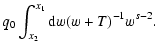
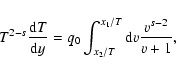
![$\displaystyle T{{\rm d}T\over {\rm d}y}={q_0\over s-1}\Bigl[x_1^{s-1}\;_2F_1\le...
...over T}\right)
-x_2^{s-1}\; _2 F_1\left(1,s-1;s;-{x_2\over T}\right)\Bigr]\cdot$](/articles/aa/full/2008/26/aa8255-07/img311.gif)

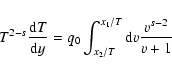
![\begin{displaymath}T^{2-s}{{\rm d}T\over {\rm d}y}\simeq q_0\int_{x_2/T}^{x_1/T}...
...v^{s-3}
={q_0\over s-2}T^{2-s}\left[x_1^{s-2}-x_2^{s-2}\right]
\end{displaymath}](/articles/aa/full/2008/26/aa8255-07/img319.gif)
![\begin{displaymath}T(y)\simeq {q_0\over s-2} \left[x_1^{s-2}-x_2^{s-2}\right]y
\end{displaymath}](/articles/aa/full/2008/26/aa8255-07/img320.gif)
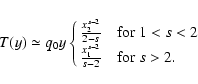
![\begin{displaymath}T^{2-s}{{\rm d}T\over {\rm d}y}\simeq q_0\left[{1-(x_2/T)^{s-1}\over s-1}
+\; {(x_1/T)^{s-2}-1\over s-2}\right]\cdot
\end{displaymath}](/articles/aa/full/2008/26/aa8255-07/img324.gif)
![\begin{displaymath}T(y)=\left[{3-s\over (2-s)(s-1)}q_0y+~ c_1\right]^{1/(3-s)},
\end{displaymath}](/articles/aa/full/2008/26/aa8255-07/img326.gif)
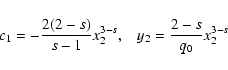
![$\displaystyle T(y>y_2, s<2)\!\simeq\! \left[{3-s\over (2-s)(s-1)}q_0y-~ {2(2-s)\over s-1}x_2^{3-s}
\right]^{1/(3-s)}\cdot$](/articles/aa/full/2008/26/aa8255-07/img328.gif)


![$\displaystyle {q_0\over s-1}T^{1-s}\left[x_1^{s-1}-x_2^{s-1}\right]$](/articles/aa/full/2008/26/aa8255-07/img336.gif)

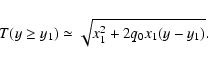
![\begin{displaymath}T(y)\simeq \left[{2q_0x_1^{s-1}\over s-1}y+\; c_3(s)\right]^{1/2}.
\end{displaymath}](/articles/aa/full/2008/26/aa8255-07/img338.gif)
![\begin{displaymath}y_1(s<2)={(2-s)(s-1)\over (3-s)q_0}\left[x_1^{3-s}+{2(2-s)\over s-1}x_2^{3-s}\right],
\end{displaymath}](/articles/aa/full/2008/26/aa8255-07/img340.gif)





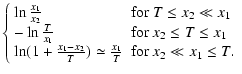
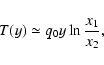
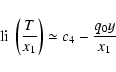

![\begin{displaymath}y_1={x_1\over q_0}\left[{x_2\over x_1}\ln {x_1\over x_2}+\hbo...
... }\left({x_2\over x_1}\right) -\hbox{li }\left(1\right)\right]
\end{displaymath}](/articles/aa/full/2008/26/aa8255-07/img354.gif)

![\begin{displaymath}N_{\rm NL}(g, s>2)=q_0t_{\rm L}\gamma _1^{-s}g^{-s}\left[I_1(g)+I_2(g)\right]
\end{displaymath}](/articles/aa/full/2008/26/aa8255-07/img360.gif)
![\begin{displaymath}I_1(g)=\int_0^1{\rm d}z\; (1-{\rm g}z)^{s-2}H\left[z-\left({1...
...t)\right]
H\left[\left({1\over g}-{1\over g_2}\right)-z\right]
\end{displaymath}](/articles/aa/full/2008/26/aa8255-07/img361.gif)
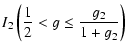
![$\displaystyle I_2(g)=\int_1^\infty {\rm d}z\; (1-g A(z))^{s-2}
H\left[A(z)-\lef...
...\over g}-1\right)\right]H\left[\left({1\over g}-{1\over g_2}\right)-A(z)\right]$](/articles/aa/full/2008/26/aa8255-07/img362.gif)

![\begin{displaymath}I_2=\int_1^\infty {\rm d}z\; (1-gA(z))^{s-2} H[z-L_1(g,s)]H[M_1(g,s)-z]
\end{displaymath}](/articles/aa/full/2008/26/aa8255-07/img364.gif)
![\begin{displaymath}M_1(g,s)={s-1\over 2(s-2)}\left[\left({1\over g}-{1\over g_2}\right)^2-{3-s\over s-1}\right]>L_1(g,s).
\end{displaymath}](/articles/aa/full/2008/26/aa8255-07/img366.gif)


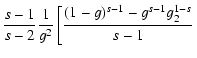
![$\displaystyle \left.{(1-g)^s-g^{s}g_2^{-s}\over s}\right]$](/articles/aa/full/2008/26/aa8255-07/img371.gif)

![$\displaystyle {g^{s-3}\over s-2}\left[1\!-\!g_2^{1\!-\!s}\!-\!{s-1\over s}g(1\!-\!g_2^{-s})\right]\!.$](/articles/aa/full/2008/26/aa8255-07/img373.gif)
![$\displaystyle {q_0t_{\rm L}\gamma _1\over s-1}\gamma ^{-s-1}
\left[1-({\gamma \over \gamma _2})^{s-1}\right]$](/articles/aa/full/2008/26/aa8255-07/img374.gif)
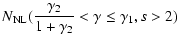 =
= ![$\displaystyle {q_0t_{\rm L}\gamma _1^{2-s}\over s-1}\gamma ^{-2}
\left[1-({\gamma _1\over \gamma _2})^{s-1}\right]$](/articles/aa/full/2008/26/aa8255-07/img376.gif)
![\begin{displaymath}\quad\quad\times \Bigl[{(1-g)^{s-1}-g^{s-1}g_2^{1-s}\over s-1}-{(1-g)^s-g^{s}g_2^{-s}\over s}\Bigr] \Bigr]
\end{displaymath}](/articles/aa/full/2008/26/aa8255-07/img379.gif)


![$\displaystyle \times \left(1-\left({\gamma _1\over \gamma _2}\right)^{s-1}-
{s-...
... s}{\gamma \over \gamma _1}\left[1-({\gamma _1\over \gamma _2})^s\right]\right)$](/articles/aa/full/2008/26/aa8255-07/img382.gif)
![\begin{displaymath}N_{\rm NL}(\gamma , 1<s<2)=q_0t_{\rm M}\gamma _1^{-s}g^{-s} \left[J_1(g)+J_2(g)+J_3(g)\right]
\end{displaymath}](/articles/aa/full/2008/26/aa8255-07/img384.gif)
![\begin{displaymath}\!\!=\!\int_0^1{\rm d} w\; \left(1-{g\over g_2}w\right)^{s-2}...
...ft[{g_2-g\over g}-w\right]H\left[w-({g_2\over g}-g_2)\right]
,
\end{displaymath}](/articles/aa/full/2008/26/aa8255-07/img386.gif)
![\begin{displaymath}\quad\quad\times H[M_2(g,s)-w]H[w-L_2(g,s)]
\end{displaymath}](/articles/aa/full/2008/26/aa8255-07/img391.gif)
![\begin{displaymath}\quad\quad\times H\left[ M_3(g,s) - w \right]H\left[ w-L_3(g,s) \right]
\end{displaymath}](/articles/aa/full/2008/26/aa8255-07/img396.gif)
![\begin{displaymath}\psi =t_{\rm k}/t_{\rm M}= {s-1\over 3-s} \left[ g_2^{3-s}+{2(2-s)\over s-1}\right]
\simeq {s-1\over 3-s}g_2^{3-s}
,
\end{displaymath}](/articles/aa/full/2008/26/aa8255-07/img397.gif)
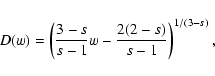
![$\displaystyle F(w)=\Bigl[g_2^{s-1}\left[{2(2-s)\over s-1}w-{4(2-s)^2\over (3-s)(s-1)}\right]
+{s-1\over 3-s}g_2^2\Bigr]^{1/2}$](/articles/aa/full/2008/26/aa8255-07/img399.gif)

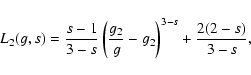



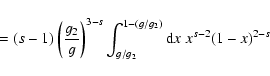

![\begin{displaymath}\quad\times \left[g^{s-1+k}-(1-g)^{s-1+k}\right].
\end{displaymath}](/articles/aa/full/2008/26/aa8255-07/img412.gif)
![\begin{displaymath}J_2\left({1\over 2}\le g\le {g_2\over 1+g_2}\right)\simeq \left({g_2\over g}\right)^{3-s}\left[g^{s-1}-(1-g)^{s-1}\right].
\end{displaymath}](/articles/aa/full/2008/26/aa8255-07/img414.gif)
![\begin{displaymath}\times \left[\left(1-{g\over g_2}\right)^{s-1+k}-\left({g\over g_2}\right)^{s-1+k}\right]\cdot
\end{displaymath}](/articles/aa/full/2008/26/aa8255-07/img417.gif)
![\begin{displaymath}J_2 \left({g_2\over 1+g_2}\le g\le {g_2\over 2}\right)
\simeq...
...\over g_2}\right)^{s-1}-\left({g\over g_2}\right)^{s-1}\right]
\end{displaymath}](/articles/aa/full/2008/26/aa8255-07/img419.gif)
![\begin{displaymath}\quad\quad\quad\times \left[{(1-g)^{s-1}-(g/g_2)^{s-1}\over s-1}-{(1-g)^s-(g/g_2)^s\over s}\right]
\end{displaymath}](/articles/aa/full/2008/26/aa8255-07/img423.gif)

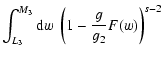

![$\displaystyle {s\!-\!1\over 2\!-\!s}g_2^{3\!-\!s}g^{-2}\left[{g^{s-1}\!\!-\!\!(g/g_2)^{s-1}\over s\!-\!1}\!-\!
{g^s-(g/g_2)^s\over s}\right]\cdot$](/articles/aa/full/2008/26/aa8255-07/img428.gif)
![\begin{displaymath}J_3\left({1\over 2}\le g\le {g_2\over 1+g_2}\right)
\simeq {g_2^{3-s}\over (2-s)s}g^{-2}(1-g)^{s-1}[1+(s-1)g]
\end{displaymath}](/articles/aa/full/2008/26/aa8255-07/img430.gif)
![\begin{displaymath}J_3\left(g\le {1\over 2}\right)\simeq {g_2^{3-s}\over 2-s}g^{s-3}\left[1-{s-1\over s}g\right].
\end{displaymath}](/articles/aa/full/2008/26/aa8255-07/img431.gif)
![$\displaystyle g_2g^{-(s+1)}\Biggl[{1-(1-{g\over g_2})^{s-1}]\over s-1}$](/articles/aa/full/2008/26/aa8255-07/img432.gif)

![\begin{displaymath}J\left(g\le {1\over 2}\right)\simeq {g_2^{3-s}\over 2-s}g^{-3}\left[1-{s-1\over s}g\right].
\end{displaymath}](/articles/aa/full/2008/26/aa8255-07/img434.gif)