![[*]](/icons/foot_motif.gif) ,,
,,
A&A 484, 609-620 (2008)
DOI: 10.1051/0004-6361:20079245
,,R. K. S. Yadav1, - L. R. Bedin2 -
G. Piotto1 - J. Anderson2 - S. Cassisi3 - S. Villanova4 - I. Platais5 - L. Pasquini6 - Y. Momany7 - R. Sagar8
1 - Dipartimento di Astronomia, Universita di Padova, Vicolo dell' Osservatorio 2, 35122 Padova, Italy
2 -
Space Telescope Science Institute, 3700 San Martin Drive, Baltimore, MD 21218, USA
3 -
INAF - Osservatorio Astronomico di Collurania, via M. Maggini, 64100 Teramo, Italy
4 -
Grupo de Astronomía, Departamento de Física, Universidad de Concepción, Casilla 160-C, Concepción, Chile
5 -
Dept. of Physics and Astronomy, The Johns Hopkins University, Baltimore, MD 21218, USA
6 -
European Southern Observatory, Garching, Karl-Schwarzschild-Str. 2, 85748
Germany
7 -
INAF - Osservatorio Astronomico di Padova, Vicolo dell'Osservatorio 5, 35132, Italy
8 -
Aryabhatta Research Institute of Observational Sciences, Manora Peak, Nainital 263 129, India
Received 14 December 2007 / Accepted 25 February 2008
Abstract
Context. The solar-age open cluster M 67 (C0847+120, NGC 2682) is a touchstone in studies of the old Galactic disk. Despite its outstanding role, the census of cluster membership for M 67 at fainter magnitudes and their properties are not well-established.
Aims. Using proprietary and archival ESO data, we have obtained astrometric, photometric, and radial velocities of stars in a
 arcmin2 field centered on the old open cluster M 67.
Methods. The two-epoch archival observations separated by 4 years and acquired with the Wide-Field Imager at the 2.2 m MPG/ESO telescope were reduced with our new astrometric techniques, as described in the first paper in this series. The same observations served to derive calibrated BVI photometry in M 67. Radial velocities were measured using the archival and new spectroscopic data obtained at the VLT.
Results. We have determined relative proper motions and membership probabilities for  2400 stars. The precision of proper motions for optimally exposed stars is 1.9 mas yr-1, gradually degrading down to 5 mas yr-1 at V=20. Our relatively precise proper motions at V>16 were first obtained in this magnitude range for M 67. Radial velocities were measured for 211 stars in the same field. We also present a detailed comparison with recent theoretical isochrones from several independent groups.
Conclusions. For the M 67 area, we provide positions, calibrated BVI photometry, relative proper motions, membership probabilities, and radial velocities. We demonstrate that ground-based CCD mosaic observations just a few years apart are producing proper motions, allowing reliable membership determination. We have produced a catalog that is electronically available to the astronomical community.
Key words: Galaxy: open clusters and associations: individual: M 67 - astrometry - catalogs
Open clusters are the basis of our understanding of stellar evolution.
Among them, M 67 (C0847+120) plays a special role. Due to their
dynamical evolution and inevitable dissolution, old open clusters are
rare. In the handful of known open clusters with ages comparable to or
older than the Sun, M 67 also has solar chemical composition, is
relatively nearby (900 pc), and has low interstellar reddening,
so it is one of the most studied open clusters (see Table 1 for fundamental parameters). Among these studies we
recall determinations of the cluster proper motion membership (Sanders
1977; Girard et al. 1989; Zhao et al. 1993), photometry (Montgomery et al. 1993; Sandquist 2004; Momany et al. 2001; Balaguer-Núñez et al. 2007), and high-resolution spectroscopy to determine chemical composition (Tautvaisiene et al. 2000; Randich et al. 2006).
Table 1: Fundamental parameters of M 67.
In addition, M 67 harbors an array of interesting objects: blue stragglers (Shetrone & Sandquist 2000), one AM Her star (Gilliland et al. 1991; Pasquini et al. 1994), several X-ray active stars, detected as coronal sources by ROSAT (Pasquini & Belloni 1998; van den Berg et al. 1999), a red straggler, and two sub-subgiants (Mathieu et al. 2003). Other studies have been devoted to the white dwarf cooling sequence (Richer et al. 1998), the evolution of chromospheric activity along the red giant branch (Dupree et al. 1999) and in solar-type stars (Pace & Pasquini 2004), and the evolution of angular momentum of stars close to the turnoff (Melo et al. 2001). The behavior of light elements such as lithium and beryllium and their implications for mixing theories have been studied by Pasquini et al. (1997); Jones et al. (1999) and Randich et al. (2007). Extensive radial velocity surveys have been carried out, resulting in the discovery of many binaries (e.g., Mathieu et al. 1997). Attempts have been made to determine stellar oscillations through a multi-site accurate photometry (Gilliland et al. 1991; Stello et al. 2007). Given the uniqueness of this cluster and the similarity of its key properties to the Sun, new studies are under way to explore the main sequence stars spectroscopically as has been done for the other clusters (Pace et al. 2007; Biazzo et al. 2007).
Despite the wealth of accumulated data on M 67, a fundamental question
of complete cluster membership is still open. The existing
high-quality proper motion surveys carried out by Sanders (1977);
Girard et al. (1989) and Zhao et al. (1993) are based on photographic plates limited to  .
This is only three
magnitudes below the main-sequence turnoff. However, dedicated and/or
archival multi-epoch observations with wide-field CCD imagers offer
new opportunities to derive precise proper motions within a time span
of a few years, and they are also deeper by several magnitudes than
the photographic surveys. The techniques of ground-based CCD
astrometry (and photometry) have been developed and validated on two
nearby globular clusters using the observations with the MPG/ESO 2.2 m
telescope and its wide-field WFI@2.2 m camera (Anderson et al. 2006,
hereafter Paper I). With this setup, just a 2.7 year time baseline
yields proper motions as precise as 2 mas yr-1. The
existing archival WFI@2.2 m CCD frames for M 67 made this open
cluster a prime target for deep proper motions studies based on these
techniques. There is one report on proper motions in M 67 for stars
fainter than V=16 by Lattanzi (1993). No catalogs of data ever
followed, we do not consider that this conference paper has
contributed much to the membership studies of M 67. In this study we
enlarge the number of stars with known proper motion determination by
a factor of 2 over a 0.3 deg2 area down to
.
This is only three
magnitudes below the main-sequence turnoff. However, dedicated and/or
archival multi-epoch observations with wide-field CCD imagers offer
new opportunities to derive precise proper motions within a time span
of a few years, and they are also deeper by several magnitudes than
the photographic surveys. The techniques of ground-based CCD
astrometry (and photometry) have been developed and validated on two
nearby globular clusters using the observations with the MPG/ESO 2.2 m
telescope and its wide-field WFI@2.2 m camera (Anderson et al. 2006,
hereafter Paper I). With this setup, just a 2.7 year time baseline
yields proper motions as precise as 2 mas yr-1. The
existing archival WFI@2.2 m CCD frames for M 67 made this open
cluster a prime target for deep proper motions studies based on these
techniques. There is one report on proper motions in M 67 for stars
fainter than V=16 by Lattanzi (1993). No catalogs of data ever
followed, we do not consider that this conference paper has
contributed much to the membership studies of M 67. In this study we
enlarge the number of stars with known proper motion determination by
a factor of 2 over a 0.3 deg2 area down to  ,
which
is 5 mag deeper than the existing proper motion studies of M 67.
,
which
is 5 mag deeper than the existing proper motion studies of M 67.
In addition, we analyzed a large number of FLAMES+GIRAFFE@VLT
high-resolution spectra and determined radial velocities for 211 stars
in the M 67 field that were accurate to 0.5 km s-1, the
accuracy of which is suitable for reliable RV membership and
identification of short-period binary systems.
All new observational data are provided to the astronomical community so that it is convenient for the follow-up studies.
The main goal of this study is to extend the membership analysis to
much fainter magnitudes and present a catalog of objects in a
wide-field (
 )
centered on the old open cluster
M 67. The catalog provides new positions, multi-band photometry,
proper motions, membership probabilities, and radial velocities.
)
centered on the old open cluster
M 67. The catalog provides new positions, multi-band photometry,
proper motions, membership probabilities, and radial velocities.
The structure of the paper is as follows. In Sect. 2 we describe observations and data reduction of both the images and spectra. In Sects. 3 and 4 we present the cluster proper motion membership analysis in two different ways. In Sect. 5 we compare them with other photometric data available in the literature. In Sect. 6 a detailed comparison with available models from different groups is given. Finally, in Sect. 7 we present and describe the electronic catalog and how to use it.
All the images used in this study were obtained with the Wide-Field
Imager (hereafter simply WFI) at the MPG/ESO 2.2 m telescope at La
Silla, Chile. The WFI consists of eight
 EEV CCDs
with a pixel scale of 238 milliarcsec (mas), which provides a total
field-of-view of
EEV CCDs
with a pixel scale of 238 milliarcsec (mas), which provides a total
field-of-view of
 .
More details on the
instrumental setup are given in Paper I.
.
More details on the
instrumental setup are given in Paper I.
To calculate proper motions, we searched the MPG/ESO 2.2 m telescope archive for suitable CCD imager frames providing deep images obtained at separate epochs. We found that the open cluster M 67 was observed in 2000 and 2004 during the technical nights. Some details of the WFI data set used in this work are given in Table 2. These observations contain short and long exposures, allowing both the red giant branch (RGB) and the relatively faint main-sequence (MS) stars to be sampled. It should be noted that these archival datasets were not taken with the goal of obtaining proper motions or well-calibrated photometry. The second-epoch is represented by only two images, and individual frames were not properly dithered. As a result, the distribution of registered stars is not contiguous. Additional CCD imaging is planned, however its success depends upon a proven record of publications.
Table 2: Description of the WFI data sets used for this work.
We closely followed the prescription for reductions of WFI images
given in Paper I. This includes standard manipulations with the pixel
data such as de-biasing, flat-fielding, and correction for cosmic
rays. At the core of fitting the star positions and fluxes is the empirical point spread function (PSF). In this concept, the PSF is
represented by a look-up table on a very fine grid. It is
well-documented that the shape of PSF changes with position on a chip.
This variability can be captured by an array of PSFs across the chip.
A fully automated code is developed to find appropriate stars to
adequately represent the PSF. For all practical purposes the number of
PSF stars per chip can vary from 1 to 15, depending on the richness of
a star-field. An iterative process has been designed to work from the
brightest down to the faintest stars and find their precise position
and instrumental flux. A reasonably bright star can be measured with
a precision of 0.03 pixel (7 mas) from a single
exposure. In this step of empirical PSF fitting, we obtained precise
instrumental magnitudes in B,V,I filters.
Another issue in astrometry with reflectors is the large geometric
distortion in the focal plane that effectively changes the pixel scale
across the field-of-view. There are different ways to derive this
geometric distortion. We opted for a  element look-up table
of corrections for each chip, derived from multiple optimally-dithered
observations of the Galactic bulge in Baade's window (Paper I). This
look-up table provides the best currently available characterization
of geometrical distortions for the WFI@2.2 m. At any given location
on the detector, a bi-linear interpolation between the four closest
grid points from a look-up table provided the corrections for the
target point. The derived look-up table may have a lower accuracy on
the edges of a field because of the way the self-calibration frames
were dithered (see Paper I). An additional source of uncertainty is
related to a possible instability of distortions for the WFI@2.2 m
reported earlier. This prompted us to use the local-transformation
method to derive proper motions (see Paper I for details).
element look-up table
of corrections for each chip, derived from multiple optimally-dithered
observations of the Galactic bulge in Baade's window (Paper I). This
look-up table provides the best currently available characterization
of geometrical distortions for the WFI@2.2 m. At any given location
on the detector, a bi-linear interpolation between the four closest
grid points from a look-up table provided the corrections for the
target point. The derived look-up table may have a lower accuracy on
the edges of a field because of the way the self-calibration frames
were dithered (see Paper I). An additional source of uncertainty is
related to a possible instability of distortions for the WFI@2.2 m
reported earlier. This prompted us to use the local-transformation
method to derive proper motions (see Paper I for details).
In the local transformation approach (a linear adjustment with six parameters, three in each of the two coordinates), a small set of local reference stars is selected around each target object. It is advantageous to use pre-selected cluster members to form a local reference frame because of a much lower intrinsic velocity dispersion among the cluster members (see Sect. 2.1.2). Then, a least-squares adjustment is used to translate the coordinates from one frame into another, taken at different epochs. The residuals of this transformation characterize relative proper motions convolved with measurement errors. In essence, this is a classical ``plate pair'' method but one extended to all possible combinations of the first and second-epoch frames. Relative proper motion of a target object is an average of all displacement measurements in its local reference frame. The last step is to estimate the measurement errors from intra-epoch observations where proper motions make a zero contribution. A complete description of all steps leading to proper motions is given in Paper I. We did not consider the effect of differential chromatic refraction because all CCD frames have been obtained within a narrow range of zenith distance (see Sect. 2.1.3 for details).
Initially, we transformed our instrumental magnitudes obtained in
B,V,I filters into the standard Johnson Kron-Cousins magnitudes
using standard stars from
Stetson's secondary
standard star catalog (Stetson 2000, 2005).
Unfortunately, the color and magnitude intervals covered by these
secondary standards are not ideal for properly calibrating our
sample. Our RGB stars are saturated, and the faint MS stars are not
present in the secondary standard catalog, thus confining us to a
narrow range of colors for calibrations. For our calibrations, we
therefore chose the high-precision BVI photometry of M 67 by
Sandquist (2004). This photometry, covering the entire color range of stars in M 67, is calibrated using the observations of Landolt's
standards (Landolt 1992) and, to some extent, also Stetson's secondary
standards. Sandquist (2004) also made use of photometric and spectroscopic data to select the objects most likely to be single
stars. For these reasons and the ones outlined in Sect. 6,
we link our photometry to that of Sandquist (2004). This calibrated photometry covers
only the inner four WFI@2.2 m CCD chips. We used the common stars in
dithered frames between the pairs of adjacent CCD chips to obtain
individual photometric zero points in magnitude. Then, we solved for
the global zero point and color term using one of the following
transformation equations:
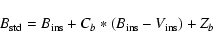


 is the instrumental magnitude,
 Sandquist's calibrated magnitude,
Cb, Cv, Ci are the color terms
(constants), and
Zb, Zv, Zi are the global zero points. The
quadratic color terms are negligible. Our color terms are consistent
with those posted on the WFI@2.2 m
webpage. A comparison of our photometry with the Sandquist and Stetson
catalog is presented in Sect. 5.
Sandquist's calibrated magnitude,
Cb, Cv, Ci are the color terms
(constants), and
Zb, Zv, Zi are the global zero points. The
quadratic color terms are negligible. Our color terms are consistent
with those posted on the WFI@2.2 m
webpage. A comparison of our photometry with the Sandquist and Stetson
catalog is presented in Sect. 5.
In Fig. 1 we show our photometric errors for each filter, as a function of the corresponding calibrated magnitude.
The photometric errors (standard deviation) were computed from
multiple observations, all reduced to the common photometric reference
frame in the chosen bandpass.
On average, the errors are more than 0.03 mag for stars fainter
than  mag. The stars brighter than
  mag show
higher dispersion because of the image saturation.
mag show
higher dispersion because of the image saturation.
![\begin{figure}
\par\includegraphics[width=7cm,clip]{9245_f01.ps}\end{figure}](/articles/aa/full/2008/23/aa9245-07/img41.gif) |
Figure 1: Plot of error in magnitudes as a function of magnitude. |
| Open with DEXTER | |
We first photometrically selected likely cluster members in the
color-magnitude diagram and used only these stars as a local reference
frame to transform the coordinates from one image into the system of
the other image at a different epoch and, thus, derive relative proper
motions. By predominantly using the cluster stars, we ensure that
proper motions will be measured relative to the bulk motion of cluster
stars. According to Girard et al. (1989), the intrinsic velocity
dispersion in M 67 is 0.2 mas yr-1. Over the four-year epoch
difference that would result in a displacement of only 0.8 mas, which
is smaller by a factor of 10 than the random measurement
errors. Conversely, the tangential velocity dispersion of field stars
is greater by a factor of 40 than the cluster's intrinsic
velocity dispersion. For field stars, proper motions clearly dominate
over the measurement errors, and this has an adverse effect on the
coordinate transformations. We iteratively removed some stars from
the preliminary photometric member list that had proper motions
clearly inconsistent with cluster membership, even though their colors
placed them near the fiducial cluster sequence.
To minimize the influence of any unaccounted for residual distortion
and refraction effects on proper motions, we used local
transformations based on the nearest 20 reference stars,
typically extending over 300 arcsec. These are well-measured
cluster stars of any magnitude selected on the same CCD chip, as long
as their preliminary proper motion is consistent with cluster
membership. No systematics larger than our random errors are visible
close to the corners or edges of chips.
To avoid possible filter-dependent systematic errors, we measured
proper motions only in the V bandpass, for which the geometrical
distortion corrections were originally derived (Paper I). Individual
errors of proper motions for single stars were estimated as described
in Sect. 7.3 of Paper I.
In a nutshell, we estimated the intra-epoch rms error from all first-epoch plates locally transformed into the same reference frame. Due to the lack of adequate statistics (too few images), we assumed that the second-epoch frames have the same errors for a given instrumental magnitude. The proper motion errors were computed as the rms of the proper motion, obtained from locally solving each first-epoch frame into second-epoch frame. These errors, however, are not totally independent because the same frame is used for a second epoch. Therefore, to obtain our best estimate of the proper motion standard error, we added in quadrature the initial proper motion error and the adopted error of the second-epoch image.
Figure 2 shows the distribution of standard errors
( )
in proper motions for both coordinates as a function of V magnitude. The precision of our proper motion measurement is
)
in proper motions for both coordinates as a function of V magnitude. The precision of our proper motion measurement is  0.05 WFI pixels in 4 yrs down to
  mag (i.e.,
 mas yr-1). At fainter magnitudes, the errors gradually increase, reaching 6 mas yr-1 at V=20. The stars brighter than
mag show a higher dispersion because of the image saturation.
mas yr-1). At fainter magnitudes, the errors gradually increase, reaching 6 mas yr-1 at V=20. The stars brighter than
mag show a higher dispersion because of the image saturation.
![\begin{figure}
\par\includegraphics[width=7.1cm,clip]{9245_f02.ps}\end{figure}](/articles/aa/full/2008/23/aa9245-07/img45.gif) |
Figure 2: Plots of proper motions and their standard deviations versus visual magnitude in mas yr-1. |
| Open with DEXTER | |
One of our goals is to provide an astrometric frame on the International Celestial Reference System (ICRS) in the area of M 67. Our astrometric reductions led us to the distortion-free cartesian coordinates of all objects. The positions of stars in each frame have been corrected for geometric distortion using a look-up table from Paper I, and then averaged into a common reference frame using a six-parameter linear transformation. The astrometric positions, of this catalog are still affected by differential chromatic refraction (DCR) effects and the limitations on the stability of derived geometrical distortions, as described in Sect. 5.2 of Paper I.
To link the present M 67 catalog to ICRS, we used the UCAC2 catalog (Zacharias et al. 2004) as a reference frame. It was trimmed down to the stars with positional accuracies better than 75 mas. Owing to the excellent geometric distortion solution and a reasonable stability of the intra-chip positions it was possible to apply a single-plate model involving linear and quadratic terms and a small but significant cubic term in each coordinate. This solution also absorbs effects of differential refraction but not its chromatic component. The standard error of equatorial solution is only 30 mas in each coordinate, thus indicating the high potential of the WFI for astrometry. A total of 489 reference stars were used in this solution. The provided J2000 coordinates in Table 5 are for the epoch 2000.13.
A compilation of kinematic and photometric data from a variety of sources (Platais, unpublished) allowed us to pre-select a fairly clean list of cluster members down to ,
which then was used to derive a better geometrical center of M 67. The marginal distributions of cluster members along right ascension and declination were fit with a Gaussian. This fit yielded a cluster center listed in Table 1,
accurate to about
 .
.
The proper motions in this work have not been corrected for differential chromatic refraction effects (DCRE) as in Paper I. Nonetheless, we verified the differential chromatic refraction effect and found it to be negligible in this data set owing to the very similar observing conditions at both epochs.
The only determination of absolute proper motion for M 67 is the one
from using two Hipparcos stars (HIP 43465, 43491) - apparent members
of the cluster (Baumgardt et al. 2000). According to this study, the
absolute proper motion for M 67 is
 and
and
 mas yr-1. Although a few background
galaxies are visible in our images, they are not suitable for deriving
the correction needed to convert our relative proper motions into the
absolute proper motions.
mas yr-1. Although a few background
galaxies are visible in our images, they are not suitable for deriving
the correction needed to convert our relative proper motions into the
absolute proper motions.
With the aim of obtaining additional membership information for stars in the region of M 67, we searched the ESO archive (http://archive.eso.org/) for sets of FLAMES+GIRAFFE@VLT (MEDUSA mode) observations taken simultaneously with a calibration lamp. The MEDUSA mode allows obtaining about 130 spectra at once over a field-of-view of 25 arcmin in diameter. We found observations performed with three different set-ups (HR02, HR14, HR15).
In addition to these data sets, we used the data (HR15N) obtained for a different project in DDT time (278.D-5027). They were collected to determine bona fide possible single solar-type members in M 67 closely resembling the Sun. The aim of this program is to find solar analogues among the M 67 solar type stars. Full analysis of the data is in progress and will be reported elsewhere (Biazzo et al., submitted to A&A).
The instrumental set-up for each run is given in Table 3, indicating the wavelength range, resolution, the number of plates, and the date of observations.
Table 3: Radial velocity observations.
The spectroscopic data were reduced using the GIRAFFE pipeline
GIRBLDRS, in which the spectra were de-biased, flat-field
corrected, extracted, and wavelength-calibrated, using both prior and simultaneous calibration-lamp spectra. We also used the gyCrossC.py utility of the GIRAFFE pipeline to measure heliocentric radial velocity ( ). For each set-up, we used an appropriate K0 type template spectra developed by the GIRAFFE pipeline team.
The formal errors reported in the catalog are merely the output of pipeline, which is clearly underestimating the true errors. Nevertheless these estimates retain the information on the goodness of the fit of the cross-correlation function.
There are signs of systematic errors in ,
if repeated
measurements of radial velocity from different set-ups are considered.
To estimate the amount of such errors, we computed the rms for all
determinations of
of the same star and averaged that
estimate for all multiple measurements of radial velocity. As the
result, a single measurement of radial velocity could be affected by
systematics reaching up to 0.6 km s-1. Perhaps this is an
upper limit to systematic offsets because some stars may have a
physical explanation for
variations. To estimate the real
uncertainty in radial velocities, we suggest summing up this estimate
and the formal fitting error in quadrature.
The heliocentric radial velocities and relative errors are shown in
Fig. 3 as a function of V magnitude. Several stars have a
radial velocity that is very different from the cluster's mean
velocity. This can be due to the field stars contaminating the
spectroscopic sample or to short-period spectroscopic binaries that
are bona fide cluster members. We determined the median
of
our sample of radial velocities and then estimated the dispersion
around this median ,
assuming a Gaussian distribution and
considering the 68th percentile from the median. Then we
iteratively used a 3.5-
clipping to achieve a convergence.
The final mean heliocentric radial velocity for M 67 estimated from
141 cluster members is
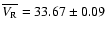 km s-1.
As indicated by Table 4, our value of
km s-1.
As indicated by Table 4, our value of
 is consistent with those derived by the other authors.
![\begin{figure}
\par\includegraphics[width=7.6cm,clip]{9245_f03.ps} \end{figure}](/articles/aa/full/2008/23/aa9245-07/img52.gif) |
Figure 3: Heliocentric radial velocities ( top panel) and their pipeline-errors ( bottom panel) of stars from the spectroscopic sample, plotted as a function of V magnitude. |
| Open with DEXTER | |
Table 4: Mean weighted radial velocities for M 67 derived from the data in WEBDA.
Table 5: First lines of the catalog available electronically at the CDS.
![\begin{figure}
\par\includegraphics[width=16cm,clip]{9245_f04.ps}\end{figure}](/articles/aa/full/2008/23/aa9245-07/img67.gif) |
Figure 4:
( Top panels) Proper motion vector-point diagram. Zero point in VPD is the mean motion of cluster stars. ( Bottom panels) Calibrated (B-V) V color-magnitude diagram. ( Left) The entire sample; ( Center) stars in VPD with proper motions within 6 mas yr-1 around the cluster mean. ( right) Probable background/foreground field stars in the area of M 67 studied in this paper. All plots show only stars with proper motion
less than 20 mas yr-1 in each coordinate. |
| Open with DEXTER | |
In this section we probe the effectiveness of our proper motions in separating clusters stars from the field stars using a vector-point diagram (VPD) in combination with a color-magnitude diagram (CMD).
For stars with BV photometry, in Fig. 4 we show the vector-point diagram (top panels) and the CMDs in the (B-V), V plane (bottom panels). In the left panels, there is the whole sample of stars: the middle panels display what we consider to be probable cluster members, the right ones predominantly show the field stars.
![\begin{figure}
\par\includegraphics[width=16.4cm,clip]{9245_f05.ps}\end{figure}](/articles/aa/full/2008/23/aa9245-07/img68.gif) |
Figure 5: ( Left): color-magnitude diagram for stars with proper motions. ( Middle): vector-point diagram for the same stars in corresponding magnitude intervals. A circle in each plot shows the adopted membership criterion at 6 mas yr-1. ( Right): color-magnitude diagram for stars assumed to be cluster members. |
| Open with DEXTER | |
In vector-point diagrams around the cluster centroid, we drew a circle with the radius of 6 mas yr-1. Provisionally, we define all points in VPD within this circle as cluster members. The chosen radius is a compromise between losing cluster members with poor proper motions and including field stars sharing the cluster's mean proper motion. Even this crude division into cluster and field stars demonstrates the power of the proper motions derived in this study. A formal determination of membership probability is given in Sect. 4.
As expected, the fainter stars have less well-measured proper motions
because of a rapidly decreasing signal-to-noise ratio.
Figure 5 illustrates this fact in the (V-I), I plane
binned along the magnitude axis. We note that an acceptable
membership is established even for saturated stars at
 .
Note that photometry for bright stars is only derived
from short exposures and then adjusted via the zero-point correction
to photometry from long exposures.
.
Note that photometry for bright stars is only derived
from short exposures and then adjusted via the zero-point correction
to photometry from long exposures.
The separation between the cluster members and field stars is not as
obvious as it is for the globular clusters presented in Paper I. In
the case of M 67, the distributions of cluster and field proper
motions have a substantial overlap, separated only by 8 mas y-1. Therefore it is not surprising that at the faint magnitudes where proper motion errors are large, the separation between the cluster and field is poor.
Finally, we note that our field star CMD (right lower panel in Fig. 4) shows no trace of the anomalous clump detected by Balaguer-Núñez et al. (2007) in in the V, b-y and V, v-y color-magnitude diagrams. This is perhaps not surprising because these authors cover a larger area around M 67 than our study does and, according to Balaguer-Núñez et al., the stars in this clump mysteriously avoid the central parts of M 67.
The vector-point diagram (Fig. 4) of our proper motions clearly shows two populations: a tight clump at
 mas yr-1 mainly representing the cluster stars and an overlapping broad distribution of field stars. Vasilevskis et al. (1958) were the first to formulate the proper motion membership probability as
 |
(1) |
 is the distribution of cluster stars and
 - the distribution of field stars in the vector-point
diagram. Usually, these distributions are represented by elliptical
normal frequency distributions, i.e., Gaussians, although in some
special cases the field star distribution can locally be adopted as
non-Gaussian (Jones 1997; Platais et al. 2001).
- the distribution of field stars in the vector-point
diagram. Usually, these distributions are represented by elliptical
normal frequency distributions, i.e., Gaussians, although in some
special cases the field star distribution can locally be adopted as
non-Gaussian (Jones 1997; Platais et al. 2001).
![\begin{figure}
\par\includegraphics[width=7.4cm,clip]{9245_f06.ps}\end{figure}](/articles/aa/full/2008/23/aa9245-07/img74.gif) |
Figure 6: Membership probabilities as function of the V magnitude, for all the stars in our catalog. |
| Open with DEXTER | |
There are numerous papers discussing various aspects of calculating
the parameters of these distributions and membership probabilities in
general; e.g., Jones (1997); Girard et al. 1989; Balaguer-Núñez et al. (2007) and references therein. For membership probability calculations, we chose the local sample method,
which is equally reliable in rich open clusters such as NGC 188
(Platais et al. 2003), as well as in sparse clusters like IC 2391
(Platais et al. 2007). In this method, a local sample of stars is
selected to represent the properties of a target star as closely as
possible. It assures a smooth transition of calculated membership
probabilities as a function of magnitude and also accounts for the
changes in the magnitude-dependent cluster-to-field star ratio. It
has been recognized that a star's brightness and spatial location are
the two critical parameters to be considered in the membership
probability calculations (Girard et al. 1989; Jones 1997). To counter the effect of a changing cluster-to-field star ratio, we chose
a sliding 2.5-mag-wide magnitude bin centered on the target. The
exception are the extremes of the magnitude range where a magnitude
bin is fixed at 2.5 mag.
The spatial distribution was ignored due to
the relatively small size of our field
(
 )
with respect to the radial extent
of M 67 out to at least one degree (Sanders 1977). Another component
of our approach is to parameterize the magnitude dependence of proper
motion dispersions for cluster and field stars. That can be done
using photometrically selected samples of cluster and field stars
(Fig. 5). Finally, the center of proper motion
distribution for cluster stars was adopted at
mas yr-1, but for field stars
it was estimated from the photometrically selected field stars and
also parameterized as a function of magnitude. It should be noted that
in the
)
with respect to the radial extent
of M 67 out to at least one degree (Sanders 1977). Another component
of our approach is to parameterize the magnitude dependence of proper
motion dispersions for cluster and field stars. That can be done
using photometrically selected samples of cluster and field stars
(Fig. 5). Finally, the center of proper motion
distribution for cluster stars was adopted at
mas yr-1, but for field stars
it was estimated from the photometrically selected field stars and
also parameterized as a function of magnitude. It should be noted that
in the
 -coordinate, the center of field star
distribution in the VPD is at +6 mas yr-1, which is
significantly larger than reported by Girard et al. (1989). We made
no effort to account for the individual proper motion uncertainties
other than the parameterizations mentioned above. Poorly measured
proper motions, i.e., with uncertainties exceeding 10 mas yr-1, are insufficient for reliable membership determination
in M 67. Nevertheless, we kept these stars to demonstrate the
achieved accuracies over the entire magnitude range.
-coordinate, the center of field star
distribution in the VPD is at +6 mas yr-1, which is
significantly larger than reported by Girard et al. (1989). We made
no effort to account for the individual proper motion uncertainties
other than the parameterizations mentioned above. Poorly measured
proper motions, i.e., with uncertainties exceeding 10 mas yr-1, are insufficient for reliable membership determination
in M 67. Nevertheless, we kept these stars to demonstrate the
achieved accuracies over the entire magnitude range.
![\begin{figure}
\par\includegraphics[width=15.1cm,clip]{9245_f07.ps}\end{figure}](/articles/aa/full/2008/23/aa9245-07/img76.gif) |
Figure 7: Comparison of our photometry (filled circles) with Stetson's (2000, 2005; marked by asterisks) and from Sandquist (2004; marked by the open circles). |
| Open with DEXTER | |
Calculation of the two remaining parameters (heights of Gaussian
peaks) needed to fully characterize the cluster and field
distributions in the VPD is straightforward (Platais et al. 2003). We
note that the distribution of field stars appears to be nearly
circular, which further simplifies the calculations. The distribution
of membership probabilities (Fig. 6) in effect reflects the
degree of reliability of our proper motions. Thus, the separation
between the cluster and field is convincing for V<18. In the range
18<V<20 the decreasing maximum  indicates a steadily growing
contamination by field stars. The unexpected rise in maximum at V>20 is an artifact caused by a nearly total blending of both
cluster and field proper motion distributions. In other words, in this
magnitude range the accuracy of proper motions is inadequate for
reliable calculations of membership probability.
indicates a steadily growing
contamination by field stars. The unexpected rise in maximum at V>20 is an artifact caused by a nearly total blending of both
cluster and field proper motion distributions. In other words, in this
magnitude range the accuracy of proper motions is inadequate for
reliable calculations of membership probability.
In Fig. 7, we show color-magnitude diagram in the [(B-V),V] and [(V-I),I] planes for those stars of our sample that have a membership probability
 (see Sect. 4 for details). The saturation level of deep V exposures is indicated by the dotted line. The stars from the secondary standard catalog by Stetson (2000, 2005) are over-plotted as red asterisks. The cyan color-coded circles show the location of the Sandquist (2004) single stars. As expected, the location of main sequence from our photometry and that of Sandquist is nearly identical because our photometry was calibrated using Sandquist's data. The upper main sequence and giant branch in [(B-V),V] have some small offsets, if different sources are considered. In part, that can be explained by retaining single stars only in the Sandquist photometry.
In Fig. 8 we show the photometric residuals as a function of magnitude and color for the common stars between Sandquist and our data. Sandquist (2004) presents extensive comparisons with other photometric data from the literature, in particular, with Montgomery et al. (1993), so we refer the reader to this study for detailed comparisons. The referee suggested making a request for the Ben Taylor's new improved VRI photometry and performing a direct comparison with this new catalog. Ben Taylor kindly released his photometry to us and this comparison is shown in Fig. 9. If there are any offsets, then they are certainly less than 0.01 mag in both V magnitude and V-I color.
The CMDs of Galactic open clusters have long been used as tests of stellar models for intermediate-mass stars. The most important issue is related to the long standing problem of the real extension of the convective core during the central H-burning stage. How much larger is the convective core extension than the canonical prediction provided by the classical Schwarzschild criterion; i.e., what is the amount of convective core overshooting (Sandquist 2004; Cassisi 2002, and references therein)?
Open cluster studies have shown that stellar models must allow for the
occurrence of convective core overshooting in order to provide a
satisfactory match to the observed CMDs (see Kalirai et al. 2001, and
references therein).
On the other hand, a still unsettled issue is related to how
convective core overshooting has to decrease in real stars when the
size of the canonical convective core decreases with the decreasing
total stellar mass (e.g., Woo & Demarque 2001).
In the majority of Galactic open clusters, this is not a big
problem. However, an age difference exceeding  1 Gyr with respect
to the age of M 67 is sufficient for stars to enter the evolutionary
phase with a very extended convective core, even encroaching the mass
range normally having a radiative core.
In the case of M 67, the mass of stars at the main sequence turnoff
(TO) is 1.2
1 Gyr with respect
to the age of M 67 is sufficient for stars to enter the evolutionary
phase with a very extended convective core, even encroaching the mass
range normally having a radiative core.
In the case of M 67, the mass of stars at the main sequence turnoff
(TO) is 1.2  ,
which is in the critical mass interval
where the amount of overshooting is decreasing with mass. Therefore,
M 67 is crucial for exploring the efficiency of convective core
overshoot in stars whose mass is high enough to have a convective core
but not high enough to allow for a very extended convective core.
,
which is in the critical mass interval
where the amount of overshooting is decreasing with mass. Therefore,
M 67 is crucial for exploring the efficiency of convective core
overshoot in stars whose mass is high enough to have a convective core
but not high enough to allow for a very extended convective core.
![\begin{figure}
\par\includegraphics[width=7.6cm,clip]{9245_f08.ps}\end{figure}](/articles/aa/full/2008/23/aa9245-07/img80.gif) |
Figure 8: Star-by-star comparison of our photometry with Sandquist (2004). |
| Open with DEXTER | |
![\begin{figure}
\par\includegraphics[width=7.6cm,clip]{9245_f09.ps}\end{figure}](/articles/aa/full/2008/23/aa9245-07/img81.gif) |
Figure 9: Comparison of our photometry with the one by Taylor (2008). |
| Open with DEXTER | |
For this reason, M 67 has been the subject of many detailed studies
such as those recently performed by Sandquist (2004); VandenBerg & Stetson (2004) and VandenBerg et al. (2007).
The work of VandenBerg & Stetson (2004) was specifically devoted to constraining the efficiency of convective core overshooting in stars
whose mass is similar to that of the stars currently at the TO of
M 67. Their main conclusion - also supported by the results shown by
Pietrinferni et al. (2004) - is that the extension of overshooting region has to be very small but not zero for masses of about
 ,
at least for solar metallicity.
,
at least for solar metallicity.
![\begin{figure}
\par\includegraphics[width=15.2cm,clip]{9245_f10.ps}\end{figure}](/articles/aa/full/2008/23/aa9245-07/img83.gif) |
Figure 10: Comparison of our empirical data with theoretical isochrones from independent libraries of stellar models (see the text for more details). The fit between theory and observations was performed by adopting the labeled values for the true distance modulus and reddening. |
| Open with DEXTER | |
A detailed discussion of this issue is clearly beyond the scope of
this paper. Nonetheless, a comparison of our observational data for
M 67 and the theoretical isochrones available in various independent
libraries of stellar models should provide further insight into the
capability of commonly-used sets of stellar models in reproducing
empirical constraints by CMD of the old Galactic open clusters. For
this purpose, we adopted the following sets of theoretical tracks: the BaSTI
models provided by Pietrinferni et al. (2004; see also Cordier et al. 2007), the Padova models published by Girardi et al. (2000), the Yonsei-Yale isochrones provided by Yi et al. (2001) in their second release, and the Victoria-Regina models published by VandenBerg et al. (2006).
In the case of the Yonsei-Yale
isochrones, we applied their set of isochrones transformed into the
observational plane using the
 -to-color transformation
tables provided by Green et al. (1987).
-to-color transformation
tables provided by Green et al. (1987).
The comparison among various fits of theoretical isochrones to
observational CMDs is shown in Fig. 10. Before discussing
this figure, it is necessary to briefly review the best estimates of
metallicity, reddening, and distance for M 67. The metallicity of
M 67 is essentially solar or maybe slightly lower (Taylor 2007). This
result is well-established on the basis of both high-
(Tautvaisiene et al. 2000) and low-resolution spectroscopy (Friel & Janes 1993). The existing estimates of interstellar extinction in
the direction of M 67 have been recently re-analyzed by Taylor (2007).
The most likely mean value of
 derived by Taylor
is slightly higher than the value suggested by Schlegel et al. (1998)
and than those provided by the fits between theoretical isochrones and
empirical data (e.g., VandenBerg & Clem 2003). Given the intrinsic
uncertainties in calibration of E(B-V), the true reddening of M 67
could be anywhere from 0.02 to 0.04 mag.
derived by Taylor
is slightly higher than the value suggested by Schlegel et al. (1998)
and than those provided by the fits between theoretical isochrones and
empirical data (e.g., VandenBerg & Clem 2003). Given the intrinsic
uncertainties in calibration of E(B-V), the true reddening of M 67
could be anywhere from 0.02 to 0.04 mag.
As for the distance to M 67, Percival & Salaris (2003) measured the
distance modulus at
 ,
adopting
,
adopting
 and
and
![${\rm [Fe/H]} = 0.02 \pm 0.06$](/articles/aa/full/2008/23/aa9245-07/img88.gif) .
Their measurement was obtained by applying the MS-fitting technique to
the CMD from Montgomery et al. (1993) data by using a sample of local
G and K dwarfs with accurate Hipparcos parallaxes and a near-solar
metallicity. The Percival & Salaris (2003) estimate was subsequently
confirmed by Sandquist (2004), who obtained the same distance modulus using new photometric data.
.
Their measurement was obtained by applying the MS-fitting technique to
the CMD from Montgomery et al. (1993) data by using a sample of local
G and K dwarfs with accurate Hipparcos parallaxes and a near-solar
metallicity. The Percival & Salaris (2003) estimate was subsequently
confirmed by Sandquist (2004), who obtained the same distance modulus using new photometric data.
![\begin{figure}
\par\includegraphics[width=16.2cm,clip]{9245_f11.ps}\end{figure}](/articles/aa/full/2008/23/aa9245-07/img90.gif) |
Figure 11:
This plot is a summary of the quantities listed in the catalog.
Positions ( , ,
 ), photometry (in B, V, and I),
radial velocities (
), proper motions (
, ), photometry (in B, V, and I),
radial velocities (
), proper motions (
,
 ), and membership probabilities
(). Thin dots are stars with a ), and membership probabilities
(). Thin dots are stars with a
 ,
for thick
dots P ,
for thick
dots P
 .
Red circles are stars for which .
Red circles are stars for which
 ,
if not they
are marked in cyan. Note that many of those are potentially short
period binaries. ,
if not they
are marked in cyan. Note that many of those are potentially short
period binaries. |
| Open with DEXTER | |
The comparison shown in Fig. 10 is quite informative.
Within the errors the BaSTI (Pietrinferni et al.
2004) isochrones
with
![${\rm [Fe/H]}=0.06$](/articles/aa/full/2008/23/aa9245-07/img91.gif) reproduce the CMD with
E(B - V) = 0.02 and
reproduce the CMD with
E(B - V) = 0.02 and
 nicely, in agreement with previous determinations.
Both isochrones are shown with and without convective core overshoot.
The adopted metallicity appears to be the upper limit of any existing
estimate of [Fe/H] in M 67.
The MS and the RGB appear to match both a canonical and the isochrone
with overshoot.
We note that the brightness and color of He-burning clump stars are
reproduced very well by the BaSTI isochrones for the adopted reddening
and distance modulus.
nicely, in agreement with previous determinations.
Both isochrones are shown with and without convective core overshoot.
The adopted metallicity appears to be the upper limit of any existing
estimate of [Fe/H] in M 67.
The MS and the RGB appear to match both a canonical and the isochrone
with overshoot.
We note that the brightness and color of He-burning clump stars are
reproduced very well by the BaSTI isochrones for the adopted reddening
and distance modulus.
The best fit of main sequence using the Victoria-Regina isochrones (VandenBerg et al. 2006) can be achieved with a distance modulus equal to 9.56 mag and a reddening of 0.03. The Victoria-Regina isochrones do not follow through the phase of core He burning, hence we cannot test a match to the red clump stars.
Sandquist (2004) has shown that a number of isochrones from the
literature are unable to fit the location of MS at V> 15.5. This
result is confirmed by a fit of Padova (Girardi et al. 2000) and
Yonsei-Yale isochrones (Yi et al. 2001) to our data shown in Fig. 10. As suggested by Sandquist (2004) the available
-color transformations are poor for main sequence stars at
 K. This deficiency is corrected for
Victoria-Regina isochrones by applying semi-empirical color
transformations (VandenBerg & Clem 2003). We note that, in the same
range, the theoretical isochrones do not closely follow
the MS stars in metal-poor globular clusters either (Bedin et al. 2001).
This can be attributed largely to the same problem in the adopted
-color relations.
K. This deficiency is corrected for
Victoria-Regina isochrones by applying semi-empirical color
transformations (VandenBerg & Clem 2003). We note that, in the same
range, the theoretical isochrones do not closely follow
the MS stars in metal-poor globular clusters either (Bedin et al. 2001).
This can be attributed largely to the same problem in the adopted
-color relations.
The main result of our isochrone fit to the new color-magnitude diagram for M 67 is the confirmation of a small convective core overshoot which is required to achieve a close match to the features near the main sequence turnoff region. This result is in very good agreement with the earlier results by Sandquist (2004) and VandenBerg & Stetson (2004). We would like to point out that in this study we have performed comparisons between the theory and observations by employing four independent and updated libraries of stellar models.
The catalog is available electronically at Astronomy & Astrophysics
(or also under request to the authors).
In the catalog, Col. (1) contains the running number; Cols. (2) and (3) give the J2000 equatorial coordinates in decimal degrees for
the epoch J2000.13, while Cols. (4) and (5) provide the pixel
coordinates x and y in a distortion-corrected reference frame.
Colums (6) to (11) give photometric data, i.e., B,V,I magnitudes
and their errors. If photometry in a specific band is not available,
a flag equal to 99.999 is set for the magnitude and 0.999
- for the error. The next four Cols. (12)-(15) give relative proper
motions and their standard errors. Column (16) gives the proper
motion membership probability .
The last two Cols. (17) and (18) give radial velocity ()
and its error, if available; otherwise, the table reports 999.999.
Figure 11 shows a summary of the basic properties of stars in the catalog. Here we have plotted a histogram of radial velocities, the spatial distribution of all stars, color-magnitude diagrams, the distribution of membership probabilities, and a vector-point diagram. They provide additional information on similar plots in the previous figures.
We have applied the techniques developed by Anderson et al. (2006,
Paper I) to a cornerstone open cluster, M 67. We demonstrate that the
CCD observations taken just four years apart can provide accurate
proper motions, aiding in decontaminating the cluster CMD down to
 .
An open issue with these open clusters is the
intrinsically low spatial density of cluster members, especially in
the outer parts of the clusters, which makes it difficult to apply the
local-transformation approach rigorously. We believed that, with a
geometrically stable CCD mosaic (the WFI@2.2 m is apparently not so),
it would be possible to use the global plate solutions for astrometry
and avoid the problem of an inadequate local reference frame.
.
An open issue with these open clusters is the
intrinsically low spatial density of cluster members, especially in
the outer parts of the clusters, which makes it difficult to apply the
local-transformation approach rigorously. We believed that, with a
geometrically stable CCD mosaic (the WFI@2.2 m is apparently not so),
it would be possible to use the global plate solutions for astrometry
and avoid the problem of an inadequate local reference frame.
The high precision of our astrometry and B,V,I photometry once again underscores the importance of accurately representing PSF across the entire field-of-view, exemplified by the concept of empirical PSF (Paper I). Our new photometry confirms that the convective core overshoot in M 67 should be small, as already pointed out by Sandquist (2004) and VandenBerg & Stetson (2004).
A substantial addition to the existing data sets are our proper motions at V>16, up to 5 mag deeper than the published proper motion catalogs. High-precision radial velocities for 211 stars down to V=16 are also helping to establish a list of bona fide cluster members in M 67. One of the goals of this paper is to share the new data with the astronomical community prior to comprehensively analyzing and finalizing of cluster membership at faint magnitudes.
Acknowledgements
R. K. S. Yadav is grateful to the University of Padova for the grant that made this Indo-Italian collaboration possible. I. Platais gratefully acknowledges support from the National Science Foundation through grant AST 04-06689 to Johns Hopkins University. We thank the anonymous referee for careful reading and useful suggestions. We also thank Ben Taylor for providing us with their new unpublished catalog in electronic format.