A&A 484, 355-360 (2008)
DOI: 10.1051/0004-6361:20078849
Effects of both extremes of environments on galaxy properties
X.-F. Deng - J.-Z. He - P. Wu
School of Science, Nanchang University, Jiangxi 330031, PR China
Received 15 October 2007 / Accepted 1 April 2008
Abstract
Aims. We investigate the dependence of galaxy properties on the local environment.
Methods. Member galaxies of compact groups (CGs) and isolated galaxies are located at both extremes of density, which are identified from the volume-limited Main galaxy sample of the Sixth Data Release of the Sloan Digital Sky Survey(SDSS DR6), while the volume-limited Main galaxy sample represents the mean density. We perform comparative studies of distributions of various physical properties among member galaxies of CGs, isolated galaxies, and the volume-limited Main galaxy sample.
Results. We find that physical properties of galaxies, such as luminosity, size, colors, concentration index, and morphology strongly depend on the local environment: luminous, red, and early-type galaxies exist preferentially in the densest regions of the universe (e.g., in groups), while faint, blue, and late-type galaxies are located preferentially in low-density regions.
Key words: Galaxy: general - galaxies: fundamental parameters
Galaxy properties are strongly correlated with environment (e.g.,
Oemler 1974; Dressler 1980; Postman & Geller 1984; Whitmore et al. 1993; Dressler et al. 1997; Hashimoto & Oemler 1999; Fasano et al. 2000; Tran et al. 2001; Lewis et al. 2002; G
 mez et al. 2003; Goto et al. 2003; Helsdon & Ponman 2003; Hogg et al. 2003; Treu et al. 2003; Tanaka et al. 2004; Balogh et al. 2004a,b; Hogg et al. 2004; Kauffmann et al. 2004; Berlind et al. 2005; Blanton et al. 2005; Kelm et al. 2005; Deng et al. 2007a-d; Park et al. 2007). It is widely accepted that luminous, red, and early-type galaxies exist preferentially in the
densest regions of the universe, while faint, blue, and late-type galaxies are located preferentially in low-density regions. Compact groups of galaxies (CGs) are small and dense systems of several galaxies in the universe. Diaferio et al. (1994) showed that within
a single rich collapsing group CGs continually form. Governato et al. (1996) proposed a model in which merging activity in CGs is accompanied by infall of galaxies from the environment. Hickson
(1997) indicated that giant galaxies may be formed as the end product of compact-group evolution. Many authors studied CGs from different aspects (Zepf et al. 1991; Zepf & Whitmore 1991; Yun et al. 1997; Severgnini & Saracco 2001; Verdes-Montenegro et al. 2001; Johnson et al. 2007). Compact groups often are located at the centers of concentration in groups or clusters and actually represent the
densest local environment. In contrast, isolated galaxies often
reside in the most underdense regions and have no close companions.
They may have experienced no major interactions in billions of
years. Similarly, isolated galaxies also have been a very important
issue of Astrophysics (Adams et al. 1980; Haynes & Giovanelli 1980;
Haynes et al. 1984; Koopmann & Kenney 1998; Reda et al. 2004; Rojas et al. 2004; Croton et al. 2005; Hoyle et al. 2005; Rojas et al. 2005; Hernández-Toledo et al. 2007; Nigoche-Netro et al. 2007). The comparison between properties of isolated galaxies and member galaxies of other galaxy systems (e.g., close pairs or
groups) is a useful method to unveil the effects of interactions or
environment on the galaxy properties. In this study, we intend to
perform comparative studies of distributions of various physical
properties among member galaxies of CGs, isolated galaxies, and the
volume-limited Main galaxy sample of the Sloan Digital Sky Survey
(SDSS) Data Release 6 (Adelman-McCarthy et al. 2007). Member
galaxies of CGs and isolated galaxies are located at both extremes of density, while the volume-limited Main galaxy sample represents the mean density. Undoubtedly, this research is beneficial to the understanding of the dependence of galaxy properties on the local environment.
mez et al. 2003; Goto et al. 2003; Helsdon & Ponman 2003; Hogg et al. 2003; Treu et al. 2003; Tanaka et al. 2004; Balogh et al. 2004a,b; Hogg et al. 2004; Kauffmann et al. 2004; Berlind et al. 2005; Blanton et al. 2005; Kelm et al. 2005; Deng et al. 2007a-d; Park et al. 2007). It is widely accepted that luminous, red, and early-type galaxies exist preferentially in the
densest regions of the universe, while faint, blue, and late-type galaxies are located preferentially in low-density regions. Compact groups of galaxies (CGs) are small and dense systems of several galaxies in the universe. Diaferio et al. (1994) showed that within
a single rich collapsing group CGs continually form. Governato et al. (1996) proposed a model in which merging activity in CGs is accompanied by infall of galaxies from the environment. Hickson
(1997) indicated that giant galaxies may be formed as the end product of compact-group evolution. Many authors studied CGs from different aspects (Zepf et al. 1991; Zepf & Whitmore 1991; Yun et al. 1997; Severgnini & Saracco 2001; Verdes-Montenegro et al. 2001; Johnson et al. 2007). Compact groups often are located at the centers of concentration in groups or clusters and actually represent the
densest local environment. In contrast, isolated galaxies often
reside in the most underdense regions and have no close companions.
They may have experienced no major interactions in billions of
years. Similarly, isolated galaxies also have been a very important
issue of Astrophysics (Adams et al. 1980; Haynes & Giovanelli 1980;
Haynes et al. 1984; Koopmann & Kenney 1998; Reda et al. 2004; Rojas et al. 2004; Croton et al. 2005; Hoyle et al. 2005; Rojas et al. 2005; Hernández-Toledo et al. 2007; Nigoche-Netro et al. 2007). The comparison between properties of isolated galaxies and member galaxies of other galaxy systems (e.g., close pairs or
groups) is a useful method to unveil the effects of interactions or
environment on the galaxy properties. In this study, we intend to
perform comparative studies of distributions of various physical
properties among member galaxies of CGs, isolated galaxies, and the
volume-limited Main galaxy sample of the Sloan Digital Sky Survey
(SDSS) Data Release 6 (Adelman-McCarthy et al. 2007). Member
galaxies of CGs and isolated galaxies are located at both extremes of density, while the volume-limited Main galaxy sample represents the mean density. Undoubtedly, this research is beneficial to the understanding of the dependence of galaxy properties on the local environment.
Our paper is organized as follows. In Sect. 2, we describe the data
used. The identification algorithms of CGs and isolated galaxies are
discussed in Sect. 3. In Sect. 4, we perform comparative studies of
distributions of various physical properties among member galaxies
of CGs, isolated galaxies, and the volume-limited Main galaxy
sample. Our main results and conclusions are summarized in Sect. 5.
The Sloan Digital Sky Survey (SDSS) is one of the largest astronomical surveys to date. The completed survey will cover approximately 10 000 square degrees. Many of the survey properties
were discussed in detail in the Early Data Release paper (Stoughton et al. 2002). Galaxy spectroscopic targets can be selected by two algorithms. The Main galaxy sample (Strauss et al. 2002) comprises galaxies brighter than
 (r-band apparent Petrosian magnitude). This sample has a median redshift of 0.10 and few galaxies beyond z=0.25, in which most galaxies are within the redshift region
 .
The Luminous Red Galaxy (LRG) algorithm (Eisenstein et al. 2001) selects galaxies to
.
The Luminous Red Galaxy (LRG) algorithm (Eisenstein et al. 2001) selects galaxies to
 ,
which are likely to be luminous early-types based on the observed colors. These LRGs are intrinsically red and at higher redshift.
,
which are likely to be luminous early-types based on the observed colors. These LRGs are intrinsically red and at higher redshift.
We used the Main galaxy sample. The data were downloaded from the Catalog Archive Server of the SDSS Data Release 6 (Adelman-McCarthy et al. 2007) by the SDSS SQL Search (with the SDSS flag: bestPrimtarget&64>0) with high-confidence redshifts
(Zwarning  16 and Zstatus 0, 1 and redshift confidence level: zconf>0.95) (http://www.sdss.org/dr6/). From this sample, we select 469 199 Main galaxies in the redshift region
.
The galaxy number of the SDSS DR6 is much larger than that of previous data release. We used the volume-limited Main galaxy sample constructed by Deng et al. (2008), which contains 112 889 galaxies, extends to
16 and Zstatus 0, 1 and redshift confidence level: zconf>0.95) (http://www.sdss.org/dr6/). From this sample, we select 469 199 Main galaxies in the redshift region
.
The galaxy number of the SDSS DR6 is much larger than that of previous data release. We used the volume-limited Main galaxy sample constructed by Deng et al. (2008), which contains 112 889 galaxies, extends to
 ,
and is limited to the absolute magnitude region -
,
and is limited to the absolute magnitude region -
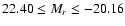 .
The absolute magnitude M r is calculated from the r-band apparent Petrosian magnitude, using a polynomial fit formula (Park et al. 2005), for the K-correction (Blanton et al. 2003a) within
0 < z < 0.3:
.
The absolute magnitude M r is calculated from the r-band apparent Petrosian magnitude, using a polynomial fit formula (Park et al. 2005), for the K-correction (Blanton et al. 2003a) within
0 < z < 0.3:
The absolute magnitude limit
M r=-20.16 corresponds to 0.33 mag fainter than the
value of  found for the overall Schechter fit to the galaxy luminosity function (Ball et al. 2006). As indicated by Norberg et al. (2001), the clustering amplitude increases strongly with absolute magnitude only for galaxies brighter than .
So, this volume-limited sample is appropriate for investigating the dependence of galaxy luminosity on the environment.
found for the overall Schechter fit to the galaxy luminosity function (Ball et al. 2006). As indicated by Norberg et al. (2001), the clustering amplitude increases strongly with absolute magnitude only for galaxies brighter than .
So, this volume-limited sample is appropriate for investigating the dependence of galaxy luminosity on the environment.
Many properties of galaxies depend strongly on luminosity (e.g., de
Vaucouleurs 1961; Kormendy 1977; Bower et al. 1992; Blanton et al. 2003b; Shen et al. 2003; Baldry et al. 2004; Balogh et al. 2004b; Kelm et al. 2005), for example, more luminous galaxies are redder and preferentially early-type. The Main galaxy sample is an apparent
magnitude-limited sample in which fainter galaxies progressively
missed with increasing distance from the observer. In such a sample,
the mean luminosity and many other properties of galaxies apparently
change with redshift z. Due to the number-density of galaxies in an
apparent magnitude-limited sample dropping dramatically with
increasing redshift, there is a higher proportion of isolated
galaxies in high redshift regions. This results in a higher
proportion of luminous, red, and early-type galaxies in the
isolated galaxy sample. To decrease the radial selection effect, a
simple method is to use a volume-limited galaxy sample in which the
radial selection function is approximately uniform, thus the only
variation in the space density of galaxies with radial distance is
due to clustering. But we also notice that in a volume-limited
sample, fainter galaxies are excluded at all distances from the
observer; a large fraction of the data is not used, and galaxies are
restricted to smaller luminosity or color regions.
In calculating the co-moving distance, we use a cosmological model
with a matter density
 , cosmological constant
 ,
Hubble's constant H0=100 h km s-1 Mpc-1 with h=0.7.
,
Hubble's constant H0=100 h km s-1 Mpc-1 with h=0.7.
The first large-scale, systematic search for CGs on the sky was made
by Hickson (1982). Lee et al. (2004) slightly modified Hickson's
criteria and extracted 175 CGs from the SDSS. Hickson (1982) and Lee
et al. (2004) only considered the galaxy angular distribution and
did not use redshifts to identify CGs. Thus, we believe that CGs
identified by such criteria are seriously contaminated by
background/foreground galaxies. Barton et al. (1996) used a
different version of the friends-of-friends algorithm: galaxies
having projected separation
 h-1 kpc and
line-of-sight velocity difference
h-1 kpc and
line-of-sight velocity difference
 km s-1 (about 14.3 Mpc) are connected, and the sets of connected
galaxies constitute the groups. Apparently, the velocity selection
criterion will greatly decrease the contamination by
background/foreground galaxies. By allowing a longer linking length
in the radial direction, Barton et al. (1996) algorithm successfully
accounted for the stretching of groups in redshift space along the
radial direction-the redshift space distortion. But the criterion of
radial distance used by Barton et al. (1996) is 286 times larger
than that of the projected separation. This suggests that CGs
identified by such a method still are seriously contaminated by
background/foreground galaxies. In addition, we note that the
projected separation criterion of CG identification developed by
Barton et al. (1996) is even smaller than that of pair
identification. For example, Lambas et al. (2003) selected galaxy
pairs by radial velocity difference (
km s-1 (about 14.3 Mpc) are connected, and the sets of connected
galaxies constitute the groups. Apparently, the velocity selection
criterion will greatly decrease the contamination by
background/foreground galaxies. By allowing a longer linking length
in the radial direction, Barton et al. (1996) algorithm successfully
accounted for the stretching of groups in redshift space along the
radial direction-the redshift space distortion. But the criterion of
radial distance used by Barton et al. (1996) is 286 times larger
than that of the projected separation. This suggests that CGs
identified by such a method still are seriously contaminated by
background/foreground galaxies. In addition, we note that the
projected separation criterion of CG identification developed by
Barton et al. (1996) is even smaller than that of pair
identification. For example, Lambas et al. (2003) selected galaxy
pairs by radial velocity difference (
 km s-1) and projected separation (
 kpc) criteria. The only difference between two algorithms is that Barton et al. (1996) used a larger line-of-sight velocity difference criterion (
km s-1), which actually increases the projection effect.
kpc) criteria. The only difference between two algorithms is that Barton et al. (1996) used a larger line-of-sight velocity difference criterion (
km s-1), which actually increases the projection effect.
We use the catalog of CGs constructed by Deng et al.
(2008). Deng et al. (2008) identified 1298 CGs with richness
 (N is the number of member galaxies in each
system) from the volume-limited Main galaxy sample of the SDSS DR6.
Deng et al. (2008) used the conventional three-dimensional cluster
analysis (Einasto et al. 1984) by which the galaxy sample can be
separated into individual systems at a given three-dimensional
neighborhood radius R. At small radii, most systems are
isolated single galaxies, the rest being close double and multiple
galaxies. At larger radii, groups and clusters of galaxies and even
superclusters will be formed. By selecting different neighborhood
radii, we can probe the structures at different scales. As indicated
by Deng et al. (2008), though Deng et al. (2008)'s algorithm is
three dimensional and thus less subject to the projection effect, it
is important to recognize that this algorithm did not take into
account the redshift space distortion. But when we have no ability
to correct the redshift-space distortion, we must face the choice
between two effects: the projection effect or the redshift space
distortion.
(N is the number of member galaxies in each
system) from the volume-limited Main galaxy sample of the SDSS DR6.
Deng et al. (2008) used the conventional three-dimensional cluster
analysis (Einasto et al. 1984) by which the galaxy sample can be
separated into individual systems at a given three-dimensional
neighborhood radius R. At small radii, most systems are
isolated single galaxies, the rest being close double and multiple
galaxies. At larger radii, groups and clusters of galaxies and even
superclusters will be formed. By selecting different neighborhood
radii, we can probe the structures at different scales. As indicated
by Deng et al. (2008), though Deng et al. (2008)'s algorithm is
three dimensional and thus less subject to the projection effect, it
is important to recognize that this algorithm did not take into
account the redshift space distortion. But when we have no ability
to correct the redshift-space distortion, we must face the choice
between two effects: the projection effect or the redshift space
distortion.
In fact, we do not have any a priori defined neighborhood radius to
identify CGs. So far, there has been no widely accepted algorithm
and criterion suitable for all galaxy samples. For different galaxy
samples, many authors often developed different algorithms and
criteria. Deng et al. (2008) analyzed the clustering properties of
the galaxy sample in a certain range of neighborhood radii (see
Fig. 2 of Deng et al. 2008), and intended to define the neighborhood
radius to identify CGs. According to the study of Deng et al. (2008), at the neighborhood radii R<0.6 Mpc, most systems are isolated single galaxies, close double, and multiple galaxies, the few being candidate CGs; at R>1.2 Mpc, some CGs merge into loose groups and clusters. Because compact groups are often located within the bounds of loose groups and clusters (Vennik et al. 1993; Ramella et al. 1994; Rood & Struble 1994; Sakai et al. 1994; Garcia 1995; Barton et al. 1996); Deng et al. (2008), defined the neighborhood radius R=1.2 Mpc for CG identification according to the following two factors: (1) most candidate CGs do not merge into loose groups and clusters; (2) to make ideal statistical analyses, the CG sample should be as large as possible.
The first systematic compilation of isolated galaxies was made by
Karachentseva (1973). To date, this catalog still is a popular
sample. For example, the AMIGA project (Analysis of the Interstellar
Medium of Isolated Galaxies, see http://www.iaa.es/AMIGA.html)
compiled a multiwavelength database of isolated galaxies and
presented a complete refinement of properties for galaxies in this
catalog (Verdes-Montenegro et al. 2005; Sulentic et al. 2006; Lisenfeld et al. 2007; Verley et al. 2007a,b). Karachentseva
(1973) did not use redshifts to produce isolated galaxies, since at
that time few of such data existed. Allam et al. (2005) slightly
modified the original Karachentseva criteria to identify isolated
galaxies from the SDSS. The main problem with these methods is that
they completely ignore the projection effect.
Galaxies in groups or clusters and isolated galaxies are located at
both extremes of density. Thus, the criteria used to identify
isolated galaxies must ensure that isolated galaxies did not lie in
groups or clusters. In the SDSS, R50 and R90 are the
radii enclosing 50% and 90% of the Petrosian flux, respectively.
If we use the r-band
R90(R90, r) as the radius of
galaxies, the mean projected galaxy diameter on the sky is  20.8 kpc for our volume-limited Main galaxy sample. To ensure that isolated galaxies do not lie in groups or clusters, the criterion of the projected separation for the identification of isolated galaxies
should at least be larger than the projected linking length used to
identify groups (e.g., Berlind et al. 2006). But we note that the
main criterion of Karachentseva (1973) and Allam et al. (2005)
20.8 kpc for our volume-limited Main galaxy sample. To ensure that isolated galaxies do not lie in groups or clusters, the criterion of the projected separation for the identification of isolated galaxies
should at least be larger than the projected linking length used to
identify groups (e.g., Berlind et al. 2006). But we note that the
main criterion of Karachentseva (1973) and Allam et al. (2005)
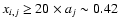 Mpc are much smaller than the
projected linking length used by Berlind et al. (2006):
Mpc are much smaller than the
projected linking length used by Berlind et al. (2006):
 Mpc. It results in that some isolated galaxies lie in groups or clusters.
Deng et al. (2006) used three-dimensional cluster analysis (Einasto
et al. 1984), for the identification of isolated galaxies and showed
that isolated galaxies identified at dimensionless radius  (dimensionless radii r=R/R0,
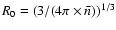 is the radius of the sphere with unit population)
can be defined as genuinely isolated in three-dimensional space. We
extract 4343 isolated galaxies at dimensionless radius r=1.4(R0 for the volume-limited Main galaxy sample of the SDSS DR6
is 4.23 Mpc) from the volume-limited Main galaxy sample of the SDSS
DR6. At this radius, the largest system contains 50 906 galaxies. The
result
is the radius of the sphere with unit population)
can be defined as genuinely isolated in three-dimensional space. We
extract 4343 isolated galaxies at dimensionless radius r=1.4(R0 for the volume-limited Main galaxy sample of the SDSS DR6
is 4.23 Mpc) from the volume-limited Main galaxy sample of the SDSS
DR6. At this radius, the largest system contains 50 906 galaxies. The
result
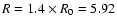 Mpc implies a density contrast
 around isolated galaxies, which is lower than the density contrast
 around void galaxies identified by Rojas et al. (2004). In addition,
Mpc is also much larger than the projected linking length used by Berlind et al. (2006).Therefore, isolated galaxies identified at r=1.4 are located in particularly low-density environments.
around void galaxies identified by Rojas et al. (2004). In addition,
Mpc is also much larger than the projected linking length used by Berlind et al. (2006).Therefore, isolated galaxies identified at r=1.4 are located in particularly low-density environments.
Figure 1 shows the luminosity distributions of member galaxies of
CGs, isolated galaxies, and the volume-limited Main galaxy sample,
respectively. The whole luminosity region (-
)
is divided into 10 bins of width 0.224. The (1 )
error bars are Poissonian errors. As seen from this figure, the
luminosity distribution of member galaxies of CGs is nearly the same
as that of the volume-limited Main galaxy sample. This is actually
consistent with the conclusion obtained by Deng et al. (2007b). Deng
et al. (2007b) compared statistical properties of galaxy luminosity
in the compact galaxy group sample with those in the random group
sample, and found that the two samples have nearly the same
statistical properties of luminosity. In Fig. 1, we also note that
the luminosity distribution of member galaxies of CGs is different
from that of isolated galaxies: isolated galaxies have a higher
proportion of faint galaxies (
)
error bars are Poissonian errors. As seen from this figure, the
luminosity distribution of member galaxies of CGs is nearly the same
as that of the volume-limited Main galaxy sample. This is actually
consistent with the conclusion obtained by Deng et al. (2007b). Deng
et al. (2007b) compared statistical properties of galaxy luminosity
in the compact galaxy group sample with those in the random group
sample, and found that the two samples have nearly the same
statistical properties of luminosity. In Fig. 1, we also note that
the luminosity distribution of member galaxies of CGs is different
from that of isolated galaxies: isolated galaxies have a higher
proportion of faint galaxies (
 )
and a lower
proportion of luminous galaxies (
)
and a lower
proportion of luminous galaxies (
 )
than member
galaxies of CGs. The level of significance is at least 5in most bins. This shows that luminous galaxies exist preferentially
in the densest regions of the universe (e.g., in groups), but faint
galaxies are located preferentially in low-density regions. It
further confirms the dependence of galaxy luminosity on environment.
Our results also show that the dependence of galaxy luminosity on
the dense environment (e.g., in groups) is much weaker than that on
the underdense environment (e.g., isolated galaxies).
)
than member
galaxies of CGs. The level of significance is at least 5in most bins. This shows that luminous galaxies exist preferentially
in the densest regions of the universe (e.g., in groups), but faint
galaxies are located preferentially in low-density regions. It
further confirms the dependence of galaxy luminosity on environment.
Our results also show that the dependence of galaxy luminosity on
the dense environment (e.g., in groups) is much weaker than that on
the underdense environment (e.g., isolated galaxies).
![\begin{figure}
\par\includegraphics[width=5.4cm,height=4.3cm,clip]{8849f1.eps}\end{figure}](/articles/aa/full/2008/23/aa8849-07/Timg29.gif) |
Figure 1:
The luminosity distributions of member galaxies of CGs (blue line), the volume-limited sample (black line) and isolated galaxies (red line), respectively. The error bars are 1 sigma Poissonian errors for member galaxies of CGs. |
| Open with DEXTER |
Using several typical algorithms to identify groups: the Berlind et al. (2006) algorithm, the Davis et al. (1985) algorithm, and the Barton et al. (1996) algorithm, Deng et al. (2007c) constructed
different group catalogs from the volume-limited Main galaxy sample
of SDSS DR6. These algorithms actually take into account projection
effect or redshift space distortion. Deng et al. (2007c) found that
the luminosity distributions of member galaxies of groups identified
by different algorithms are almost the same, and are also the same as that of the volume-limited sample, but are different from that of isolated galaxies. Isolated galaxies have a higher proportion of faint galaxies (
)
and a lower proportion of luminous galaxies (
)
than member galaxies of groups. These conclusions agree with our results.
![\begin{figure}
\par\includegraphics[width=6cm,height=3.8cm,clip]{8849f2.eps}\end{figure}](/articles/aa/full/2008/23/aa8849-07/Timg30.gif) |
Figure 2:
The size distributions of member galaxies of CGs (blue line), the volume-limited sample (black line) and isolated galaxies (red line), respectively. The error bars are 1 sigma Poissonian errors for member galaxies of CGs. |
| Open with DEXTER |
![\begin{figure}
\par\includegraphics[width=5.4cm,height=4.5cm,clip]{8849f3a.eps}\...
...\ [3mm]
\includegraphics[width=5.4cm,height=4.5cm,clip]{8849f3d.eps}\end{figure}](/articles/aa/full/2008/23/aa8849-07/Timg31.gif) |
Figure 3:
The color distributions of member galaxies of CGs (blue line), the volume-limited sample (black line) and isolated galaxies (red line), respectively. The error bars are 1 sigma Poissonian errors for member galaxies of CGs a) u-g color, b) g-r color, c) r-i color, d) i-z color. |
| Open with DEXTER |
To investigate the dependence of clustering properties on
galaxy luminosity, many authors measured the two-point correlation
function of galaxies and found that the clustering amplitude
increases with absolute magnitude (e.g., Davis et al. 1988; Hamilton
1988; Willmer et al. 1998; Norberg et al. 2001, 2002; Zehavi et al.
2002). Zandivarez et al. (2006) computed the luminosity function of
group galaxies and observed that the characteristic magnitude is
0.5 mag brighter than that obtained for field
galaxies. The studies of Blanton et al. (2003b) also showed that the
local density is a strong function of luminosity, which is
consistent with the results found by other authors (Hogg et al.
2003; Berlind et al. 2005; Blanton et al. 2005; Park et al. 2007).
Park et al. (1994) noted that high-density regions preferentially
include bright galaxies, but low-density regions tend to harbor only
faint galaxies. Our studies show that low-density regions also
harbor bright galaxies, but the fraction of bright galaxies is much
smaller than that in the densest regions.
It is widely accepted that galaxy morphologies are strongly
correlated with environments: dense regions are dominated by
early-types and low-density environments by late-types. Thus, it is
natural to find that in total galaxies in dense environments are
more luminous, due to the correlation between luminosity and
morphology. Sulentic et al. (2006) showed that isolated early-type
galaxies are less luminous than early-types in denser environments.
This suggest that such a trend still exists for the same
morphological types.
But we also notice that some studies found no evidence of the
environment dependence of galaxy luminosity. One possible
explanation is that these studies used statistically incorrect
methods or were affected by sampling fluctuations that are difficult
to quantify. For example, Deng et al. (2007a) compared basic
properties of member galaxies of groups with those of isolated
galaxies in each redshift bin and found that luminosities of
galaxies are nearly independent of environment. Deng et al. (2007a)
used a flux-limited galaxy sample in which the mean luminosity of
galaxies apparently change with redshift z. In each redshift bin,
the galaxies are restricted to relative small luminosity bin, which
may result in the lack of luminosity dependence on environment.
Figure 2 shows the size distributions of member galaxies of CGs,
isolated galaxies and the volume-limited Main galaxy sample,
respectively. We use the r-band R50 (R50, r) as the
parameter of galaxy size. The whole size region (1 kpc
 kpc) is divided into 10 bins of width 1 kpc. In the region 1 kpc
 kpc, the fraction of isolated galaxies is larger than that of member galaxies of CGs,
while in the region 2 kpc
kpc, the fraction of isolated galaxies is larger than that of member galaxies of CGs,
while in the region 2 kpc
 kpc, the fraction of isolated galaxies is much smaller than that of member galaxies of CGs.
It is well-known that the galaxy sizes are correlated with luminosity (Kormendy 1977; Shen et al. 2003). Because we used the volume-limited sample where the galaxies are restricted to a narrow luminosity region, the dependence of galaxy size on environment is not very strong.
kpc, the fraction of isolated galaxies is much smaller than that of member galaxies of CGs.
It is well-known that the galaxy sizes are correlated with luminosity (Kormendy 1977; Shen et al. 2003). Because we used the volume-limited sample where the galaxies are restricted to a narrow luminosity region, the dependence of galaxy size on environment is not very strong.
Brown et al. (2000) and Zehavi et al. (2002) showed that clustering
of galaxies strongly depends on color. Blanton et al. (2003b) found
that local density is a strong function of all colors. It is widely
accepted that red galaxies exist preferentially in the densest
regions of the universe (groups and clusters). Deng et al. (2007e)
compared statistical properties of galaxy colors in the compact
galaxy group sample with those in the random group sample, and found
that mean colors of galaxies in CGs are redder than those of
galaxies in the random groups. Figure 3 shows the color
distributions of member galaxies of CGs, isolated galaxies, and the
volume-limited Main galaxy sample, respectively. As seen from this
figure, isolated galaxies have a higher proportion of blue galaxies
and a lower proportion of red galaxies than member galaxies of CGs.
This shows that red galaxies exist preferentially in the densest
regions of the universe (e.g., in groups), while blue galaxies are
located preferentially in low-density regions. It further confirms
strong dependence of all colors on environment.
Lee et al. (2004) showed that the rest-frame colors of CG galaxies
indeed differ from those of field galaxies, and concluded that CGs
contain a relatively higher fraction of elliptical galaxies than
does the field. N-body simulations pioneered by Toomre (1977)
indicated that the end-product of merging spirals can be an
elliptical galaxy. Due to the correlation between morphology and
color (Strateva et al. 2001): redder galaxies are preferentially ``early-type'', our results can also be explained as the strong
evidence of interactions and mergers within CGs. Rubin et al. (1991)
observed 32 HCG spiral galaxies and found that two thirds of them
have peculiar rotation curves, which show characteristic of strong
gravitational interaction. In their study, 12 HCG elliptical
galaxies were also observed. Rubin et al. (1991) detected nuclear
emission in 11 of them. The high fraction suggests that interactions
and mergers may be supplying gas to these galaxies.
However, the possible dependence of galaxy colors on environment has also sparked some
controversies (e.g., Bernardi et al. 2003; Balogh et al. 2004b; Hogg
et al. 2004). For example, Hogg et al. (2004) showed that red galaxy colors are independent of environment. Balogh et al. (2004b) found
that at fixed luminosity the mean color of blue galaxies or red
galaxies is nearly independent of environment. This may be due to
the galaxy sample being restricted to a narrow color region. It is
well-known that many properties of galaxies depend strongly on
luminosity (e.g., de Vaucouleurs 1961; Kormendy 1977; Bower et al. 1992; Blanton et al. 2003b; Shen et al. 2003; Baldry et al. 2004; Balogh et al. 2004b; Kelm et al. 2005). For example, more luminous galaxies are redder. At fixed luminosity, galaxies are actually
restricted to a narrow color region.
![\begin{figure}
\par\includegraphics[width=5.4cm,height=4.2cm,clip]{8849f4.eps}\end{figure}](/articles/aa/full/2008/23/aa8849-07/Timg35.gif) |
Figure 4:
The c i distributions of member galaxies of CGs (blue line),
the volume-limited sample (black line) and isolated galaxies (red
line), respectively. The error bars are 1 sigma Poissonian errors
for member galaxies of CGs. |
| Open with DEXTER |
We also perform comparative studies of distributions of the
concentration index
ci=R90/R50 among member galaxies of
CGs, isolated galaxies, and the volume-limited Main galaxy sample.
As seen from Fig. 4, the distributions at both extremes of density
differ significantly from that at the mean density. In dense
regions, galaxies have preferentially greater concentration index.
This does not agree with results found by other authors (Kauffmann
et al. 2004; Blanton et al. 2005; Park et al. 2007). Kauffmann et al. (2004), showed that at fixed stellar mass structural parameters
such as size and concentration are almost independent of the local
density. When morphology and luminosity are fixed, Park et al. (2007) found that other physical properties, such as color, color-gradient,
concentration, size, velocity dispersion, and star formation rate,
are nearly independent of the local density. It has been known for a
long time that there are correlations between galaxy properties. For
example, the colors of galaxies depend strongly on luminosity (e.g.,
de Vaucouleurs 1961; Bower et al. 1992; Blanton et al. 2003b; Baldry et al. 2004). Thus, it is not surprising that there is no correlation between structural parameters and the local density at another fixed parameter.
The concentration index
ci=R90/R50 often be used to
separate early-type (E/S0) galaxies from late-type (Sa/b/c, Irr)
galaxies (Shimasaku et al. 2001).
The galaxy morphology is closely correlated with many other parameters,
such as color and concentration index. These parameters can be used as the morphology classification tool (e.g., Park & Choi 2005; Yamauchi & Goto 2005; Abraham et al. 2003; Strateva et al. 2001; Shimasaku et al. 2001). The concentration index is a simple morphological parameter. Nakamura et al. (2003) showed that
ci =2.86 separates galaxies at S0/a with a completeness of about 0.82 for both late and early types.
The early-type fraction of above three samples are respectively: 44.37% in CGs; 36.62% in the volume-limited Main galaxy sample; and 25.07% in isolated galaxies.
We note that galaxy morphologies strongly depend on local environments: galaxies in dense environments have predominantly early-type morphologies, which were confirmed by many other studies. For example, Croton et al. (2005) showed that the galaxy populations at both extremes of density differ significantly from those at the mean
density.
The population in voids is dominated by late-types, in contrast, cluster regions have a relative excess of very bright early-type galaxies.
This suggests that in dense environments there exists the transformation of galaxies from late to early-types. Many physical mechanisms, such as galaxy harassment (Moore et al. 1996), rampressure stripping (Gunn & Gott 1972), and galaxy-galaxy merging (Toomre & Toomre 1972), can explain such a process.
Member galaxies of CGs and isolated galaxies are located at both
extremes of density. To investigate the dependence of galaxy
properties on local environment, we perform comparative studies of
distributions of various physical properties among member galaxies
of CGs, isolated galaxies, and the volume-limited Main galaxy
sample, which represents the mean density. We use the catalog of
CGs constructed by Deng et al. (2008), which contains 1298 CGs with
richness
(N is the number of member galaxies
in each system). Isolated galaxies are identified at dimensionless
radius r=1.4 (dimensionless radii r=R/R0,
is the radius of the sphere
with unit population. The radius R0 for the volume-limited Main
galaxy sample of the SDSS DR6 is 4.23 Mpc) from the volume-limited
Main galaxy sample of the SDSS DR6. The main results can be summarized as follows:
- 1)
- As seen from Fig. 1, the luminosity distribution of member
galaxies of CGs is nearly the same as that of the volume-limited
Main galaxy sample, but is different from that of isolated galaxies:
isolated galaxies have a higher proportion of faint galaxies (
)
and a lower proportion of luminous galaxies (
)
than member galaxies of CGs. This shows that luminous
galaxies exist preferentially in the densest regions of the universe
(e.g., in groups), but faint galaxies are located preferentially in
low-density regions. Our results also show that the dependence of
galaxy luminosity on the dense environment(e.g., in groups) is much
weaker than the dependence on the underdense environment(e.g.,
isolated galaxies).
- 2)
- Because we used the volume-limited sample where the galaxies
are restricted to a narrow luminosity region, the dependence of
galaxy size on environment is not very strong.
- 3)
- Isolated galaxies have a higher proportion of blue galaxies and
a lower proportion of red galaxies than member galaxies of CGs,
which shows that red galaxies exist preferentially in the densest
regions of the universe (e.g., in groups), while blue galaxies are
located preferentially in low-density regions.
- 4)
- In dense regions, galaxies have preferentially greater
concentration index and early-type morphologies.
Acknowledgements
We thank the anonymous referee for many useful comments and suggestions. Our study is supported by the Program for Innovative Research Team of Nanchang University and also supported by the National Natural Science Foundation of China (10765004).
Funding for the creation and distribution of the SDSS
Archive has been provided by the Alfred P. Sloan Foundation, the
Participating Institutions, the National Aeronautics and Space
Administration, the National Science Foundation, the US Department
of Energy, the Japanese Monbukagakusho, and the Max Planck Society.
The SDSS Web site is http://www.sdss.org/.
The SDSS is managed by the Astrophysical Research Consortium (ARC)
for the Participating Institutions. The Participating Institutions
are The University of Chicago, Fermilab, the Institute for Advanced
Study, the Japan Participation Group, The Johns Hopkins University,
Los Alamos National Laboratory, the Max-Planck-Institute for
Astronomy (MPIA), the Max-Planck-Institute for Astrophysics (MPA),
New Mexico State University, University of Pittsburgh, Princeton
University, the United States Naval Observatory, and the University of Washington.
- Abraham, R.
G., van den Bergh, S., & Nair, P. A. 2003, ApJ, 588, 218 [NASA ADS] [CrossRef]
(In the text)
- Adams, M.,
Jensen, E., & Stocke, J. 1980, AJ, 85, 1010 [NASA ADS] [CrossRef]
(In the text)
- Adelman-McCarthy, J. K.,
Agüeros, M. A., Allam, S. S., et al. 2007, in press
[arXiv:0707.3413]
(In the text)
- Allam, S. S.,
Tucker, D. L., Lee, B. C., & Smith, A. 2005, AJ, 129, 2062 [NASA ADS] [CrossRef]
(In the text)
- Baldry, I. K.,
Glazebrook, K., Brinkmann, J., et al. 2004, ApJ, 600, 681 [NASA ADS] [CrossRef]
(In the text)
- Ball, N. M.,
Loveday, J., Brunner, R. J., et al. 2006, MNRAS, 373, 845 [NASA ADS] [CrossRef]
(In the text)
- Balogh, M.,
Eke, V., Miller, C., et al. 2004a, MNRAS, 348, 1355 [NASA ADS] [CrossRef]
(In the text)
- Balogh, M., Baldry, I.
K., Nichol, R., et al. 2004b, ApJ, 615, L101 [NASA ADS] [CrossRef]
- Barton, E.,
Geller, M. J., Ramella, M., et al. 1996, AJ, 112, 871 [NASA ADS] [CrossRef]
(In the text)
- Berlind, A.
A., Blanton, M. R., Hogg, D. W., et al. 2005, APJ, 629 [CrossRef],625
(In the text)
- Berlind, A.
A., Frieman, J., Weinberg, D. H., et al. 2006, ApJS, 167, 1 [NASA ADS] [CrossRef]
(In the text)
- Bernardi,
M., Sheth, R. K., Annis, J., et al. 2003, AJ, 125, 1882 [NASA ADS] [CrossRef]
(In the text)
- Blanton, M.
R., Brinkmann, J., Csabai, I., et al. 2003a, AJ, 125, 2348 [NASA ADS] [CrossRef]
- Blanton, M.
R., Hogg, D. W., Bahcall, N. A., et al. 2003b, APJ, 594, 186 [NASA ADS] [CrossRef]
(In the text)
- Blanton, M.
R., Eisenstein, D., Hogg, D. W., et al. 2005, APJ, 629, 143 [NASA ADS] [CrossRef]
(In the text)
- Bower, R. G.,
Lucey, J. R., & Ellis, R. S. 1992, MNRAS, 254, 601 [NASA ADS]
(In the text)
- Brown, M. J. I.,
Webster, R. L., & Boyle, B. J. 2000, MNRAS, 317, 782 [NASA ADS] [CrossRef]
(In the text)
- Croton, D. J.,
Farrar, G. R., Norberg, P., et al. 2005, MNRAS, 356, 1155 [NASA ADS] [CrossRef]
(In the text)
- Davis, M.,
Efstathiou, G., Frenk, C. S., & White, S. D. M. 1985, ApJ, 292,
371 [NASA ADS] [CrossRef]
- Davis, M.,
Meiksin, A., Strauss, M. A., et al. 1988, ApJ, 333, L9 [NASA ADS] [CrossRef]
(In the text)
- Diaferio,
A., Geller, M. J., & Ramella, M. 1994, AJ, 107, 868 [NASA ADS] [CrossRef]
(In the text)
- Deng, X. F., Ma, X.
S., Luo, C. H., et al. 2006, PASA, 23, 76 [NASA ADS]
(In the text)
- Deng, X. F., He, J.
Z., Jiang, P., et al. 2007a, A&A, 474, 783 [NASA ADS] [CrossRef] [EDP Sciences]
(In the text)
- Deng, X. F., He,
J. Z., Jiang, P., et al. 2007b, IJMPD, 16, 885 [NASA ADS] [CrossRef]
- Deng, X. F., He,
J. Z., & Jiang, P., 2007c, ApJ, 671, L101 [NASA ADS] [CrossRef]
- Deng, X. F., He,
J. Z., He, C. G., et al. 2007d, Acta Phys. Polon. B, 38, 219 [NASA ADS]
- Deng, X. F., He,
J. Z., Jiang, P., et al. 2007e, AP, 50,18
- Deng, X. F., He, J.
Z., Ma, X. S., et al. 2008, Central Eur. J. Phys., 6, 185 [NASA ADS] [CrossRef]
(In the text)
-
de Vaucouleurs, G. 1961, ApJS, 5, 233 [NASA ADS] [CrossRef]
- Dressler,
A. 1980, ApJ, 236, 351 [NASA ADS] [CrossRef]
(In the text)
- Dressler,
A., Oemler, A. J., Couch, W. J., et al. 1997, ApJ, 490, 577 [NASA ADS] [CrossRef]
(In the text)
- Einasto, J.,
Klypin, A. A., Saar, E., et al. 1984, MNRAS, 206, 529 [NASA ADS]
(In the text)
-
Eisenstein, D. J., Annis, J., Gunn, J. E., et al. 2001, AJ, 122,
2267 [NASA ADS] [CrossRef]
- Fasano, G.,
Poggianti, B. M., Couch, W. J., et al. 2000, ApJ, 542, 673 [NASA ADS] [CrossRef]
(In the text)
- Garcia, A.
1995, A&A, 297, 56 [NASA ADS]
(In the text)
- Gómez, P. L.,
Nichol, R. C., Miller, C. J., et al. 2003, ApJ, 584, 210 [NASA ADS] [CrossRef]
(In the text)
- Goto, T., Yamauchi,
C., Fujita, Y., et al. 2003, MNRAS, 346, 601 [NASA ADS] [CrossRef]
(In the text)
-
Governato, F., Tozzi, P., & Cavaliere, A. 1996, ApJ, 458,
18 [NASA ADS] [CrossRef]
(In the text)
- Gunn, J. E., &
Gott, J. R. I. 1972, ApJ, 176, 1 [NASA ADS] [CrossRef]
(In the text)
- Hamilton, A.
J. S. 1988, ApJ, 331, L59 [NASA ADS] [CrossRef]
(In the text)
- Hashimoto,
Z., & Oemler, A. 1999, ApJ, 510, 609 [NASA ADS] [CrossRef]
(In the text)
- Haynes, M. P.,
& Giovanelli, R. 1980, ApJ, 240, L87 [NASA ADS] [CrossRef]
(In the text)
- Haynes, M. P.,
Giovanelli, R., & Chincarini, G. L. 1984, ARA&A, 22,
445 [NASA ADS]
(In the text)
- Helsdon, S.
F., & Ponman, T. J. 2003, MNRAS, 339, L29 [NASA ADS] [CrossRef]
(In the text)
- Hernández-Toledo, H. M.,
Zendejas-Domínguez, J., & Avila-Reese, V. 2007, AJ, 134,
2286 [NASA ADS] [CrossRef]
(In the text)
- Hickson, P.
1982, ApJ, 255, 382 [NASA ADS] [CrossRef]
(In the text)
- Hickson, P.
1997, ARA&A, 35, 357 [NASA ADS] [CrossRef]
(In the text)
- Hogg, D. W.,
Blanton, M. R., Eisenstein, D. J., et al. 2003, ApJ, 585, L5 [NASA ADS] [CrossRef]
(In the text)
- Hogg, D. W.,
Blanton, M. R., Brinchmann, J., et al. 2004, ApJ, 601, L29 [NASA ADS] [CrossRef]
(In the text)
- Hoyle, F., Rojas,
R. R., Vogeley, M. S., & Brinkmann, J. 2005, ApJ, 620, 618 [NASA ADS] [CrossRef]
(In the text)
- Johnson, K.
E., Hibbard, J. E., Gallagher, S. C., et al. 2007, AJ, 134,
1522 [NASA ADS] [CrossRef]
(In the text)
- Karachentseva, V. E. 1973,
Soobshcheniya Spetsial
 oj Astrofizicheskoj Observatorii, 8, 3
(In the text)
oj Astrofizicheskoj Observatorii, 8, 3
(In the text) - Kauffmann,
G., White, S. D. M., Heckman, T. M., et al. 2004, MNRAS,
353,713
(In the text)
- Kelm, B., Focardi,
P., & Sorrentino, G. 2005, A&A, 442, 117 [NASA ADS] [CrossRef] [EDP Sciences]
(In the text)
- Kormendy, J.
1977, APJ, 217, 406 [NASA ADS] [CrossRef]
(In the text)
- Koopmann, R.
A., & Kenney, J. D. P. 1998, ApJ, 497, L75 [NASA ADS] [CrossRef]
(In the text)
- Lambas, D. G.,
Tissera, P. B., Alonso, M. S., & Coldwell, G. 2003, MNRAS, 346,
1189 [NASA ADS] [CrossRef]
(In the text)
- Lee, B. C., Allam, S.
S., Tucker, D. L., et al. 2004, AJ, 127, 1811 [NASA ADS] [CrossRef]
(In the text)
- Lewis, I., Balogh,
M., De Propris, R., et al. 2002, MNRAS, 334, 673 [NASA ADS] [CrossRef]
(In the text)
- Lisenfeld,
U., Verdes-Montenegro, L., Sulentic, J., et al. 2007, A&A, 462,
507 [NASA ADS] [CrossRef] [EDP Sciences]
(In the text)
- Moore, B., Katz,
N., Lake, G., et al. 1996, Nature, 379, 613 [NASA ADS] [CrossRef]
(In the text)
- Nakamura,
O., Fukugita, M., Yasuda, N., et al. 2003, AJ, 125, 1682 [NASA ADS] [CrossRef]
(In the text)
- Nigoche-Netro, A., Moles, M.,
Ruelas-Mayorga, A., et al. 2007, A&A, 472, 773 [NASA ADS] [CrossRef] [EDP Sciences]
(In the text)
- Norberg, P.,
Baugh, C. M., Hawkins, E., et al. 2001, MNRAS, 328, 64 [NASA ADS] [CrossRef]
(In the text)
- Norberg, P.,
Baugh, C. M., Hawkins, E., et al. 2002, MNRAS, 332, 827 [NASA ADS] [CrossRef]
(In the text)
- Oemler, A., Jr
1974, ApJ, 194, 1 [NASA ADS] [CrossRef]
(In the text)
- Park, C., &
Choi, Y. Y. 2005, ApJ, 635, L29 [NASA ADS] [CrossRef]
- Park, C., Vogeley,
M. S., Geller, M. J., et al. 1994, ApJ, 431, 569 [NASA ADS] [CrossRef]
(In the text)
- Park, C., Choi, Y.
Y., Vogeley, M. S., et al. 2005, ApJ, 633, 11 [NASA ADS] [CrossRef]
(In the text)
- Park, C., Choi, Y.
Y., Vogeley, M. S., et al. 2007, ApJ, 658, 898 [NASA ADS] [CrossRef]
(In the text)
- Postman, M.,
& Geller, M. J. 1984, ApJ, 281, 95 [NASA ADS] [CrossRef]
(In the text)
- Ramella, M.,
Diaferio, A., Geller, M. J., et al. 1994, AJ, 107, 1623 [NASA ADS] [CrossRef]
(In the text)
- Reda, F. M., Forbes,
D. A., Beasley, M. A., et al. 2004, MNRAS, 354, 851 [NASA ADS] [CrossRef]
- Rojas, R. R.,
Vogeley, M. S., Hoyle, F., & Brinkmann, J. 2004, ApJ, 617,
50 [NASA ADS] [CrossRef]
(In the text)
- Rojas, R. R.,
Vogeley, M. S., Hoyle, F., & Brinkmann, J. 2005, ApJ, 624,
571 [NASA ADS] [CrossRef]
(In the text)
- Rood, H. J., &
Struble, M. F. 1994, PASP, 106, 413 [NASA ADS] [CrossRef]
(In the text)
- Rubin, V. C.,
Hunter, D. A., & Ford, W. K. J. 1991, ApJS, 76, 153 [NASA ADS] [CrossRef]
(In the text)
- Sakai, S.,
Giovanelli, R., & Wegner, G. 1994, AJ, 108, 33 [NASA ADS] [CrossRef]
(In the text)
- Severgnini, P., & Saracco, P. 2001,
Ap&SS, 276, 749 [NASA ADS] [CrossRef]
(In the text)
- Shen, S. Y., Mo, H.
J., White, S. D. M., et al. 2003, MNRAS, 343, 978 [NASA ADS] [CrossRef]
(In the text)
- Shimasaku,
K., Fukugita, M., Doi, M., et al. 2001, AJ, 122, 1238 [NASA ADS] [CrossRef]
(In the text)
- Stoughton,
C., Lupton, R. H., Bernardi, M., et al. 2002, AJ, 123, 485 [NASA ADS] [CrossRef]
(In the text)
- Strateva,
I., Ivezic, Z., Knapp, G. R., et al. 2001, AJ, 122, 1861 [NASA ADS] [CrossRef]
(In the text)
- Strauss, M.
A., Weinberg, D. H., Lupton, R. H., et al. 2002, AJ, 124, 1810 [NASA ADS] [CrossRef]
(In the text)
- Sulentic, J.
W., Verdes-Montenegro, L., Bergond, G., et al. 2006, A&A, 449,
937 [NASA ADS] [CrossRef] [EDP Sciences]
(In the text)
- Tanaka, M.,
Goto, T., Okamura, S., et al. 2004, AJ, 128, 2677 [NASA ADS] [CrossRef]
(In the text)
- Toomre, A. 1977,
in Evolution of Galaxies and Stellar Populations, ed. B. M.
Tinsley, & R. B. Larson (New Haven: Yale University
Observatory), 401
(In the text)
- Toomre, A.,
& Toomre, J. 1972, ApJ, 178, 623 [NASA ADS] [CrossRef]
(In the text)
- Tran, K. H., Simard,
L., Zabludoff, A. I., et al. 2001, ApJ, 549, 172 [NASA ADS] [CrossRef]
(In the text)
- Treu, T., Ellis, R.
S., Kneib, J., et al. 2003, ApJ, 591, 53 [NASA ADS] [CrossRef]
(In the text)
- Vennik, J.,
Richter, G. M., & Longo, G. 1993, AN, 314, 393 [NASA ADS]
(In the text)
- Verdes-Montenegro, L., Yun, M.
S., Williams, B. A., et al. 2001, ASPC, 240, 193 [NASA ADS]
(In the text)
- Verdes-Montenegro, L., Sulentic,
J., Lisenfeld, U., et al. 2005, A&A, 436, 443 [NASA ADS] [CrossRef] [EDP Sciences]
(In the text)
- Verley, S.,
Odewahn, S. C., Verdes-Montenegro, L., et al. 2007a, A&A, 470,
505 [NASA ADS] [CrossRef] [EDP Sciences]
- Verley, S.,
Leon, S., Verdes-Montenegro, L., et al. 2007b, A&A, 472,
121 [NASA ADS] [CrossRef] [EDP Sciences]
(In the text)
- Whitmore, B.
C., Gilmore, D. M., & Jones, C. 1993, ApJ, 407, 489 [NASA ADS] [CrossRef]
(In the text)
- Willmer, C. N.
A., da Costa, L. N., & Pellegrini, P. S. 1998, AJ, 115,
869 [NASA ADS] [CrossRef]
(In the text)
- Yamauchi,
C., & Goto, T. 2005, MNRAS, 359, 1557 [NASA ADS] [CrossRef]
(In the text)
- Yun, M. S.,
Verdes-Montenegro, L., del Olmo, A., et al. 1997, ApJ, 475,
L21 [NASA ADS] [CrossRef]
(In the text)
- Zandivarez, A., Martínez, H. J.,
Merchán, M. E., et al. 2006, ApJ, 650, 137 [NASA ADS] [CrossRef]
(In the text)
- Zehavi, I.,
Blanton, M. R., Frieman, J. A., et al. 2002, APJ, 571, 172 [NASA ADS] [CrossRef]
(In the text)
- Zepf, S. E., &
Whitmore, B. C. 1991, ApJ, 383, 542 [NASA ADS] [CrossRef]
(In the text)
- Zepf, S. E.,
Whitmore, B. C., & Levison, H. F. 1991, ApJ, 383, 524 [NASA ADS] [CrossRef]
Copyright ESO 2008

![\begin{figure}
\par\includegraphics[width=5.4cm,height=4.3cm,clip]{8849f1.eps}\end{figure}](/articles/aa/full/2008/23/aa8849-07/img29.gif)
![\begin{figure}
\par\includegraphics[width=6cm,height=3.8cm,clip]{8849f2.eps}\end{figure}](/articles/aa/full/2008/23/aa8849-07/img30.gif)
![\begin{figure}
\par\includegraphics[width=5.4cm,height=4.5cm,clip]{8849f3a.eps}\...
...\ [3mm]
\includegraphics[width=5.4cm,height=4.5cm,clip]{8849f3d.eps}\end{figure}](/articles/aa/full/2008/23/aa8849-07/img31.gif)
![\begin{figure}
\par\includegraphics[width=5.4cm,height=4.2cm,clip]{8849f4.eps}\end{figure}](/articles/aa/full/2008/23/aa8849-07/img35.gif)