A&A 483, 249-251 (2008)
DOI: 10.1051/0004-6361:200809397
LETTER TO THE EDITOR
Swift observations of the X-ray pulsar SAX J1324-6200
(Research Note)
S. Mereghetti1 - P. Romano2 - L. Sidoli1
1 - INAF, Istituto di Astrofisica Spaziale e Fisica Cosmica Milano, via E. Bassini 15, 20133 Milano, Italy
2 - INAF, Istituto di Astrofisica Spaziale e Fisica Cosmica Palermo, via U. La Malfa 153, 90146 Palermo, Italy
Received 15 January 2008 / Accepted 21 February 2008
Abstract
We present recent observations of the X-ray pulsar SAX J1324-6200 obtained in December 2007 with the Swift satellite, significantly improving the source localization over previous data and providing a new measurement of the spin period P=172.84 s. A single object that is consistent in colors with a highly reddened early type star is visible in the X-ray error box. The period is significantly longer than what was obtained in 1997, indicating that SAX J1324-6200 has been spinning down at an average rate of 
 s s-1. We discuss the possible nature of the source, showing that it most likely belongs to the class of low-luminosity, persistent Be/neutron star binaries.
Key words: X-rays: binaries
Little is known about the X-ray pulsar SAX J1324-6200, serendipitously
discovered in 1997 during an observation of the bright X-ray
burster 4U 1323-619 (Angelini et al. 1998). Its X-ray spectrum, a highly absorbed
power law with photon index 1, and its pulsations period of
171 s are typical of accreting pulsars in binary systems. However,
due to the lack of an accurate position, optical identification
has not been obtained to date, leading to different possible
interpretations of the nature of this source.
The great majority of accreting X-ray pulsars are high-mass X-ray
binary systems (HMXRB), either with OB-supergiant or Be type
companion stars. Angelini et al. (1998) have suggested that SAX J1324-6200 belong to
the latter group, which is the most numerous, but its being a
white dwarf system of the intermediate polar class could not be
completely excluded.
A long observation of SAX J1324-6200, carried out with the ASCA satellite
in February 2000, led to the discovery of a secular spin down at
 s s-1 (Lin et al. 2002). This is quite
unusual for an HMXRB, since these systems are generally spinning
up while accreting. The source flux measured with ASCA was
similar to what was seen in all the previous observations of this
source, arguing against a transient nature. Lin et al. (2002) also
report marginal evidence of a periodic flux modulation at
s s-1 (Lin et al. 2002). This is quite
unusual for an HMXRB, since these systems are generally spinning
up while accreting. The source flux measured with ASCA was
similar to what was seen in all the previous observations of this
source, arguing against a transient nature. Lin et al. (2002) also
report marginal evidence of a periodic flux modulation at  h, which could be interpreted as the orbital period of the
system. Based on these findings, they propose that SAX J1324-6200 is a
low-mass X-ray binary (LMXRB), similar to other pulsars, such as
GX 1+4 and 4U 1626-67, which exhibited long spin-down episodes.
If confirmed, this would be particularly interesting, since only a
few LMXRB pulsars of this kind are currently known.
h, which could be interpreted as the orbital period of the
system. Based on these findings, they propose that SAX J1324-6200 is a
low-mass X-ray binary (LMXRB), similar to other pulsars, such as
GX 1+4 and 4U 1626-67, which exhibited long spin-down episodes.
If confirmed, this would be particularly interesting, since only a
few LMXRB pulsars of this kind are currently known.
We performed two observations of SAX J1324-6200 with the Swift satellite on 2007 December 21 and 30 (see Table 1 for details), for a total on-source time of 7.4 ks. The X-ray
Telescope (XRT) data were processed with standard procedures (xrtpipeline v0.11.6), filtering, and screening criteria by using FTOOLS in the Heasoft package (v.6.4).
Table 1:
Observation log.
SAX J1324-6200 was detected in both observations with a net count
rate of
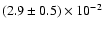 and
and
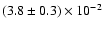 counts s-1 in the 0.2-10 keV energy range. The source position, obtained by summing all the data, is
 ,
,
 ,
with an error of
,
with an error of
 (90% confidence). The XRT coordinates lie inside the error circles derived with BeppoSAX (1.5 arcmin radius, Angelini et al. 1998) and ASCA (1 arcmin radius, Lin et al. 2002).
The UVOT data were reduced with the standard software and procedures, using the tasks uvotimsum to produce the coadded images and uvotsource to estimate the optical/UV magnitudes (U and W1 filters). There is no detection within the XRT error circle whether in individual images (6 frames in U filter and 5 in W1 filter) or in coadded images (6113 s in U and 1989 s in W1), down to a magnitude of U>21.2 mag and W1>20.5 mag (both consistent with the background limit).
Given the low rate of the source, we only considered photon-counting (PC) data and then selected XRT grades 0-12 (Burrows et al. 2005). No pile-up correction was necessary.
Therefore, for our spectral analysis, we extracted the source events from a circular region with a radius of 18 pixels (1 pixel
 ). To estimate the background spectrum, we
extracted the events within a source-free annular region centered on SAX J1324-6200 and with radii of 60 and 100 pixels. Ancillary response files, generated with xrtmkarf, account for different
extraction regions, vignetting, and PSF corrections. We used the latest spectral redistribution matrices (v010) in the Calibration Database maintained by HEASARC.
). To estimate the background spectrum, we
extracted the events within a source-free annular region centered on SAX J1324-6200 and with radii of 60 and 100 pixels. Ancillary response files, generated with xrtmkarf, account for different
extraction regions, vignetting, and PSF corrections. We used the latest spectral redistribution matrices (v010) in the Calibration Database maintained by HEASARC.
We fitted the spectrum of SAX J1324-6200 (216 counts) in the 0.5-9 keV energy range using Cash statistics and unbinned data. Adopting an absorbed power-law model, we obtained a photon index of
 ,
a column density
,
a column density
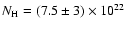 cm-2, and a Cash statistics of 579.7 using 850 PHA bins (Fig. 1). We calculated the goodness of the fit via
104 Monte Carlo simulations, and found that 76.1% of realizations have a fit statistic <579.7. The observed flux is
cm-2, and a Cash statistics of 579.7 using 850 PHA bins (Fig. 1). We calculated the goodness of the fit via
104 Monte Carlo simulations, and found that 76.1% of realizations have a fit statistic <579.7. The observed flux is
 erg cm-2 s-1 in the 1-10 keV range
(
erg cm-2 s-1 in the 1-10 keV range
(
 erg cm-2 s-1, corrected for the absorption). This corresponds to an unabsorbed 1-10 keV luminosity of 1035d102 erg s-1 (where we indicate the
distance in units of 10 kpc with d10).
erg cm-2 s-1, corrected for the absorption). This corresponds to an unabsorbed 1-10 keV luminosity of 1035d102 erg s-1 (where we indicate the
distance in units of 10 kpc with d10).
![\begin{figure}
\par\includegraphics[angle=-90,width=8cm,clip]{9397fig1.ps}\end{figure}](/articles/aa/full/2008/19/aa09397-08/Timg17.gif) |
Figure 1:
XRT/PC data fitted with an absorbed power-law model ( top) and data/model ratio ( bottom). |
| Open with DEXTER |
For the timing analysis, we used a source extraction radius of 25 pixels to increase the statistics. This resulted in 239 counts, 6% of which we estimate as due to the background. Considering the small number of counts, we used the Z2 test (Buccheri et al. 1983) to search for the 171 s period, because it does not require data binning. The times of arrival were corrected to the solar system barycenter.
Swift observations consist of several snapshots (continuous pointings at the target) whose durations do not exceed  ks in our case. The periodicity is very visible in
three of the longest snapshots of the second observations. By analyzing all the data of the second observation, we could derive the best period as
ks in our case. The periodicity is very visible in
three of the longest snapshots of the second observations. By analyzing all the data of the second observation, we could derive the best period as
 s. The periodicity is only
marginally visible in the first observation, which was shorter and yielded only 46 source counts.
s. The periodicity is only
marginally visible in the first observation, which was shorter and yielded only 46 source counts.
![\begin{figure}
\par\includegraphics[angle=-90,width=9cm,clip]{9397fig2.ps}\end{figure}](/articles/aa/full/2008/19/aa09397-08/Timg20.gif) |
Figure 2:
Folded light curve in the 0.5-9 keV energy range at the period P=172.84 s. |
| Open with DEXTER |
The folded light curve obtained by using all the data is shown in Fig. 2. The profile has a single broad peak, as observed in the previous ASCA and BeppoSAX observations. The
pulsed fraction is about 50%. A hardness ratio analysis does not show any spectral variations as a function of the pulse phase, but this is not particularly constraining in view of the limited number of counts.
![\begin{figure}
\par\includegraphics[angle=270,width=9cm,clip]{9397fig3.ps}\end{figure}](/articles/aa/full/2008/19/aa09397-08/Timg21.gif) |
Figure 3:
Long-term evolution of the spin period of SAX J1324-6200. |
| Open with DEXTER |
All the spin period measurements of SAX J1324-6200 are plotted in
Fig. 3. While, as mentioned by Lin et al. (2002), the
period increase between the ASCA 2000 and the BeppoSAX values
could have been a short term fluctuation around a long term
spin-up trend, as often observed in accreting pulsars (see, e.g.,
Bildsten et al. 1997), the new XRT measure makes this possibility
less likely. The current period P=172.84 s (at
 )
is
consistent with the extrapolation of the previous period and
period derivative,
)
is
consistent with the extrapolation of the previous period and
period derivative,  ,
values. This suggests that SAX J1324-6200 has
been spinning-down at a nearly constant rate of 6
,
values. This suggests that SAX J1324-6200 has
been spinning-down at a nearly constant rate of 6
 s s-1 for the past ten years, and possibly longer.
The precise localization of SAX J1324-6200 obtained with the Swift/XRT instrument has reduced the error region area by a factor 500, thus allowing us to exclude many of the previous
possible counterparts present in this crowded region of the Galactic plane.
An infrared image of the field, obtained from the 2MASS All-Sky Survey (Skrutskie et al. 2006) in the  (2.16
(2.16  m) band, is shown in Fig. 4, with the XRT error circle
superimposed. Only one object is visible inside the X-ray error
circle, at
m) band, is shown in Fig. 4, with the XRT error circle
superimposed. Only one object is visible inside the X-ray error
circle, at
 ,
,
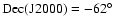
 .
Its mag is
.
Its mag is
 mag and it is not detected in either J or H, implying
 and
and
 .
.
![\begin{figure}
\par\includegraphics[angle=0,width=9cm,clip]{9397fig4.ps}\end{figure}](/articles/aa/full/2008/19/aa09397-08/Timg32.gif) |
Figure 4:
Image of the region of SAX J1324-6200 in the band. The circle is the XRT 90% c.l. error region, with a radius of
.
North is to the top, east to the left. |
| Open with DEXTER |
The next closest objects are located at RA(J2000
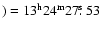 ,
,
 (
(
 ,
,
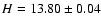 ,
,
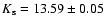 mag), and
 ,
,
 (
(
 mag, undetected in K and H).
SAX J1324-6200 lies in a very reddened region. The total optical extinction in this direction is
 ,
as provided by the NASA/IPAC Infrared Science Archive
,
as provided by the NASA/IPAC Infrared Science Archive![[*]](/icons/foot_motif.gif) .
The high column density derived from the X-ray spectral fits also
points to a rather distant and absorbed system. The NIR colors and
magnitudes of the only object detected in the error region are
consistent with highly reddened, early type stars. For example,
the counterpart could be an OB supergiant with
.
The high column density derived from the X-ray spectral fits also
points to a rather distant and absorbed system. The NIR colors and
magnitudes of the only object detected in the error region are
consistent with highly reddened, early type stars. For example,
the counterpart could be an OB supergiant with
 .
In this case the distance should be 30 kpc to be compatible with the observed magnitudes. This would place SAX J1324-6200 far away at
the other edge of the Galaxy, with an X-ray luminosity of 1036 erg s-1.
.
In this case the distance should be 30 kpc to be compatible with the observed magnitudes. This would place SAX J1324-6200 far away at
the other edge of the Galaxy, with an X-ray luminosity of 1036 erg s-1.
The observed spin-down in SAX J1324-6200 is not a problem in this scenario.
For example, a decade long spin-down phase at nearly constant
X-ray flux has been observed in the supergiant system 4U 1907+09
(Baykal et al. 2001).
In the alternative hypothesis of a main sequence Be counterpart, a
shorter distance in the range 5-15 kpc and
 would agree with the colors and magnitudes of the candidate
counterpart. In this case SAX J1324-6200 could be located either in the
Crux galactic arm, which is tangential to this direction (Galactic
coordinates l=306.8, b=+0.61), or in the more distant Carina arm,
which is crossed at 10 kpc. For the closest distances, it
would have an X-ray luminosity of a few 1034 erg s-1,
similar to other non-transient Be/neutron star binaries
(La Palombara & Mereghetti 2006; Reig & Roche 1999), which are characterized by a relatively
small luminosity compared to transient systems in outburst. Also
among these persistent, low-luminosity Be systems there are
sources that have shown long periods of spin-down, similar to SAX J1324-6200. For example, X Per has been spinning down since 1978 at an
average rate of
would agree with the colors and magnitudes of the candidate
counterpart. In this case SAX J1324-6200 could be located either in the
Crux galactic arm, which is tangential to this direction (Galactic
coordinates l=306.8, b=+0.61), or in the more distant Carina arm,
which is crossed at 10 kpc. For the closest distances, it
would have an X-ray luminosity of a few 1034 erg s-1,
similar to other non-transient Be/neutron star binaries
(La Palombara & Mereghetti 2006; Reig & Roche 1999), which are characterized by a relatively
small luminosity compared to transient systems in outburst. Also
among these persistent, low-luminosity Be systems there are
sources that have shown long periods of spin-down, similar to SAX J1324-6200. For example, X Per has been spinning down since 1978 at an
average rate of
 s s-1 (La Palombara & Mereghetti 2007).
The absence of a strong Fe emission line in SAX J1324-6200 fits with the properties observed in this class of persistent, low-luminosity Be systems (Reig & Roche 1999).
s s-1 (La Palombara & Mereghetti 2007).
The absence of a strong Fe emission line in SAX J1324-6200 fits with the properties observed in this class of persistent, low-luminosity Be systems (Reig & Roche 1999).
Of course, both HMXRB scenarios discussed above argue against the
tentative orbital
period of 27 h reported by Lin et al. (2002). Their suggestion
of a spinning down LMXRB, similar to 4U1626-67 and GX1+4, is not
supported by the low flux of SAX J1324-6200. These LMXRB are rather luminous systems (1036-1037 erg s-1) and SAX J1324-6200 needs to be at more than 30 kpc to have a similar luminosity. Moreover, our refined error region excludes a bright red-giant companion star similar to the counterpart of GX1+4. In view of the HMXBs showing long-term spin-down phases mentioned above, we believe that there is no convincing evidence that SAX J1324-6200 is a LMXRB.
Acknowledgements
This work has been partially supported by the ASI/INAF contract I/023/05/0. We thank N. Gehrels and the Swift team for making these observations possible, in particular the duty scientists and
science planners. P.R. thanks the INAF-IASF-Milano, where part of the work was carried out, for their kind hospitality.
- Angelini, L., Church,
M. J., Parmar, A. N., et al. 1998, A&A, 339,
41 [NASA ADS]
(In the text)
- Baykal, A., Inam,
Ç., Ali Alpar, M., et al. 2001, MNRAS, 327, 1269 [NASA ADS] [CrossRef]
(In the text)
- Buccheri, R., Bennett,
K., Bignami, G. F., et al. 1983, A&A, 128, 245 [NASA ADS]
(In the text)
-
Burrows, D. N., Hill, J. E., Nousek, J. A.,
et al. 2005, Space Sci. Rev., 120, 165 [NASA ADS] [CrossRef]
(In the text)
- La Palombara, N.,
& Mereghetti, S. 2006, A&A, 455, 283 [NASA ADS] [CrossRef] [EDP Sciences]
- La Palombara, N.,
& Mereghetti, S. 2007, A&A, 474, 137 [NASA ADS] [CrossRef] [EDP Sciences]
(In the text)
- Lin, X. B., Church,
M. J., Nagase, F., & Balucinska-Church, M. 2002,
MNRAS, 337, 1245 [NASA ADS] [CrossRef]
(In the text)
- Reig, P., & Roche, P.
1999, MNRAS, 306, 100 [NASA ADS] [CrossRef]
- Skrutskie, M. F., Cutri,
R. M., Stiening, R., et al. 2006, AJ, 131, 1163 [NASA ADS] [CrossRef]
(In the text)
Copyright ESO 2008
![\begin{figure}
\par\includegraphics[angle=-90,width=8cm,clip]{9397fig1.ps}\end{figure}](/articles/aa/full/2008/19/aa09397-08/img17.gif)
![\begin{figure}
\par\includegraphics[angle=-90,width=9cm,clip]{9397fig2.ps}\end{figure}](/articles/aa/full/2008/19/aa09397-08/img20.gif)
![\begin{figure}
\par\includegraphics[angle=270,width=9cm,clip]{9397fig3.ps}\end{figure}](/articles/aa/full/2008/19/aa09397-08/img21.gif)
![\begin{figure}
\par\includegraphics[angle=0,width=9cm,clip]{9397fig4.ps}\end{figure}](/articles/aa/full/2008/19/aa09397-08/img32.gif)