A&A 482, 549-559 (2008)
DOI: 10.1051/0004-6361:20078054
Parametrization of C-shocks.
Evolution of the sputtering of grains
I. Jiménez-Serra1,2 - P. Caselli2,3 -
J. Martín-Pintado1
- T. W. Hartquist2
1 - Departamento de Astrofísica Molecular e Infrarroja,
Instituto de Estructura de la Materia (CSIC),
C/ Serrano 121, 28006 Madrid, Spain
2 -
School of Physics and Astronomy, University of Leeds LS2
9JT, Leeds, UK
3 -
INAF - Osservatorio Astrofisico di Arcetri, Largo E. Fermi 5,
50125 Firenze, Italy
Received 11 June 2007 / Accepted 30 January 2008
Abstract
Context. The detection of narrow SiO line emission toward the young shocks of the L1448-mm outflow has been interpreted as a signature of the magnetic precursor of C-shocks. In contrast with the low SiO abundances ( 10-12) derived from the ambient gas, the narrow SiO emission in the precursor component at almost ambient velocities reveals enhanced SiO abundances of
  10-11. It has been proposed that this enhancement of the SiO abundance is produced by the sputtering of the grain mantles at the early stages of C-shocks. However, modelling of the sputtering of grains has usually averaged the SiO abundances over the dissipation region of C-shocks, which cannot explain the recent observations.
Aims. We model the evolution of the gas-phase abundances of molecules like SiO, CH3OH, and H2O, produced by the sputtering of the grain mantles and cores as the shock propagates through the ambient gas. We consider different initial gas densities and shock velocities.
Methods. We propose a parametric model to describe the physical structure of C-shocks as a function of time. Using the known sputtering yields for water mantles (with other minor constituents like silicon and CH3OH) and olivine cores by collisions with H2, He, C, O, Si, Fe, and CO, we follow the evolution of the abundances of silicon, CH3OH, and H2O ejected from grains along the evolution of the shock.
Results. The evolution of the abundances of the sputtered silicon, CH3OH, and H2O shows that CO seems to be the most efficient sputtering agent in low-velocity shocks. The velocity threshold for the sputtering of silicon from the grain mantles is appreciably reduced (by 5-10 km s-1) by CO compared to other models. The sputtering by CO can generate SiO abundances of 10-11 at the early stages of low-velocity shocks, consistent with those observed in the magnetic precursor component of L1448-mm. Our model satisfactorily reproduces the progressive enhancement of SiO, CH3OH, and H2O observed in this outflow, suggesting that this enhancement may be due to the propagation of two shocks with
 km s-1 and
 km s-1 coexisting within the same region.
Conclusions. Our simple model can be used to estimate the time-dependent evolution of the abundances of molecular shock tracers like SiO, CH3OH, H2O, or NH3 in very young molecular outflows.
Key words: ISM: clouds - shock waves - ISM: jets and outflows - ISM: dust, extinction
In young molecular outflows, it is expected that changes in the
molecular emission could be observed
thanks to the propagation of shocks into the
ambient material. So far, the L1448-mm outflow is the only object
where time variability of the SiO emission in the high-velocity jet
has been detected, indicating the presence of very young
shocks (Girart & Acord 2001).
It is well known that silicon is heavily depleted onto the grain
mantles and grain cores in
the quiescent gas of molecular dark clouds like TMC-1, L183, and L1448
(SiO abundance of 10-12; Ziurys et al. 1989;
Martín-Pintado et al. 1992; Requena-Torres et al. 2007). The detection of large SiO abundances in regions
with outflow activity is therefore a clear indicator of the destruction of
dust grains by the interaction of magnetohydrodynamic
(MHD) shock waves (or C-shocks) with the ambient gas
(Martín-Pintado et al. 1992; Caselli et al. 1997; Flower et al. 1996).
The typical SiO abundances measured in the high-velocity gas of
young molecular outflows such as L1448-mm
(Martín-Pintado et al. 1992) are
 10-6, which implies an enhancement by more than 6 orders of
magnitude with respect to the SiO abundances measured in the quiescent
gas. It has been proposed that the detection of very narrow SiO emission
at almost ambient velocities toward this outflow is produced by the
magnetic precursor of C-shocks (Jiménez-Serra et al. 2004). The SiO abundance
of 10-11 for this narrow emission
clearly contrasts with the large SiO enhancement found in
the high-velocity postshock gas and with the much lower SiO abundance of
the quiescent material.
10-6, which implies an enhancement by more than 6 orders of
magnitude with respect to the SiO abundances measured in the quiescent
gas. It has been proposed that the detection of very narrow SiO emission
at almost ambient velocities toward this outflow is produced by the
magnetic precursor of C-shocks (Jiménez-Serra et al. 2004). The SiO abundance
of 10-11 for this narrow emission
clearly contrasts with the large SiO enhancement found in
the high-velocity postshock gas and with the much lower SiO abundance of
the quiescent material.
Toward the young shocks of the L1448-mm outflow,
Jiménez-Serra et al. (2005) also report an
evolutionary trend in the SiO and CH3OH abundances (methanol
is the most abundant molecule after H2O in the grain mantles; Tielens & Allamandola 1987)
to be enhanced from the ambient gas to the moderate-velocity
component, as if the grain mantles would
have been progressively eroded by the recent interaction
of low-velocity shocks.
Modelling of C-shocks that only includes the sputtering of grain
cores shows that an appreciable fraction of silicon material starts
to be ejected from grains for
 -30 km s-1 (Caselli et al. 1997; May et al. 2000; Flower et al. 1996). Although these
models predict SiO abundances that are consistent with those observed
in the postshock gas (10-8-10-7),
the sputtering of SiO from the cores cannot reproduce the lower
SiO abundances of 10-11 found in the narrow precursor
component of L1448-mm.
-30 km s-1 (Caselli et al. 1997; May et al. 2000; Flower et al. 1996). Although these
models predict SiO abundances that are consistent with those observed
in the postshock gas (10-8-10-7),
the sputtering of SiO from the cores cannot reproduce the lower
SiO abundances of 10-11 found in the narrow precursor
component of L1448-mm.
Calculations of the sputtering yield of silicon by heavy atoms like
C, O, Si, and Fe on SiO2 and olivine (MgFeSiO4) cores show that,
despite the low relative abundances of these species with respect to
H2 and He in dark clouds, these heavy particles can dominate the
sputtering of grains at low shock velocities (Field et al. 1997; May et al. 2000).
Furthermore, abundant molecules like CO could also
play an important role in the sputtering of dust grains, since
these species can sputter like atoms of equivalent mass for low impact
velocities (May et al. 2000). Considering that silicon could be a minor
constituent of the mantles, their sputtering by these heavy species in
low-velocity shocks could efficiently erode them, generating
the SiO abundances observed for the narrow SiO line emission
in L1448-mm. Up to now,
the evolution of the sputtering of grains has not been studied in
detail. The questions of which species
are the most efficient sputtering agents
and which timescales
are needed to eject most of the silicon material from grains
still remain uncertain.
In this paper, we present a parametric model of C-shocks
to describe in detail the time dependent evolution of the molecular
abundances sputtered from grains in low and high-velocity shocks.
This approximation constitutes a powerful tool for
interpreting the molecular abundances measured in young molecular
outflows. In addition to H2 and He, heavy atoms and molecules have
been also considered as sputtering agents.
In Sect. 2, we present the approximations used to describe the
steady state profile of the physical structure of C-shocks.
In Sect. 3, we show the procedure for determining the sputtering
of the grain mantles and the grain cores.
In Sect. 4, we present the results of the sputtering of silicon from
grains for several initial gas densities and shock velocities. In
Sects. 5 and 6, we compare the sputtered SiO, CH3OH, and H2O
abundances with those measured in the L1448-mm outflow. The
conclusions are finally summarised
in Sect. 7.
We consider a plane-parallel C-shock that propagates through the
quiescent gas with velocity  .
As a first approximation, we
have assumed steady state profiles for the evolution of the physical
parameters in the shock. The validity of this approximation,
versus more recent time-dependent modelling of the physical
structure of C-shocks, will be discussed in detail in Sect. 4.1.
.
As a first approximation, we
have assumed steady state profiles for the evolution of the physical
parameters in the shock. The validity of this approximation,
versus more recent time-dependent modelling of the physical
structure of C-shocks, will be discussed in detail in Sect. 4.1.
The initial H2 density and temperature of the ambient cloud are n0
and T0, respectively. Since one of the aims of this work is to directly
compare our results with observations toward the young L1448-mm outflow, it is
convenient to consider that the velocities of the ion and neutral fluids,
 and
and  ,
are in the frame co-moving with the preshock gas. These
velocities are approximated by
,
are in the frame co-moving with the preshock gas. These
velocities are approximated by
![\begin{displaymath}v_{\rm n,i} = \left(v_{\rm s} -v_0\right) - \frac{\left(v_{\rm s}-v_0\right)}{\cosh\left[(z-z_0)/z_{\rm n,i}\right]}
\end{displaymath}](/articles/aa/full/2008/17/aa8054-07/img22.gif) |
(1) |
where z is the spatial coordinate and the
 ratio governs the strength of the velocity decoupling between
the ion and neutral fluids. The variable z0 corresponds to the distance at
which these fluids start to decouple (see Sect. 4.1 for details on how to
estimate these parameters). An additional velocity, v0,
also needs to be considered in the equations for
and
to avoid infinite compression of the far downstream gas
(see Eq. (3) below). The variable
v0 depends on the shock parameters and is defined
as the final downstream velocity of the ion and neutral fluids
in the shock frame (in the preshock frame, this final velocity
would be
ratio governs the strength of the velocity decoupling between
the ion and neutral fluids. The variable z0 corresponds to the distance at
which these fluids start to decouple (see Sect. 4.1 for details on how to
estimate these parameters). An additional velocity, v0,
also needs to be considered in the equations for
and
to avoid infinite compression of the far downstream gas
(see Eq. (3) below). The variable
v0 depends on the shock parameters and is defined
as the final downstream velocity of the ion and neutral fluids
in the shock frame (in the preshock frame, this final velocity
would be
 ;
see Sect. 4.1). As shown in Appendix A, this velocity
is tightly linked to the shock and Alfvén
velocities,
and
;
see Sect. 4.1). As shown in Appendix A, this velocity
is tightly linked to the shock and Alfvén
velocities,
and  ,
through shock jump conditions.
,
through shock jump conditions.
The ion-neutral drift speed  is
is
 ,
and
the neutral fluid flow time is calculated as (see Eqs. (A.7) and (B.10))
,
and
the neutral fluid flow time is calculated as (see Eqs. (A.7) and (B.10))
 |
(2) |
From the principle of mass conservation, the neutral density,  ,
is given by
,
is given by
 |
(3) |
The temperature of the neutral fluid,  ,
is approximated
by a Planck-like function as
,
is approximated
by a Planck-like function as
![\begin{displaymath}T_{\rm n} = T_0 + \frac{[a_{T}~(z-z_0)]^{b_{\rm T}}}{\exp~[(z-z_0)/z_{\rm T}]-1}
\end{displaymath}](/articles/aa/full/2008/17/aa8054-07/img31.gif) |
(4) |
where  is an integer, and
  and
and  are
related to the maximum value of
(
are
related to the maximum value of
(
 )
and the
distance
)
and the
distance
 at which
reaches its maximum value.
The temperature of the ion fluid is calculated by using
at which
reaches its maximum value.
The temperature of the ion fluid is calculated by using
 .
.
The comparison of the model predictions with observations (Sects. 5 and 6) requires consideration of the radial velocity of the
preshock gas (ambient cloud gas) relative to the observer,
 .
This velocity, the radial velocity of the emission
measured by the observer,
.
This velocity, the radial velocity of the emission
measured by the observer,
 ,
and the velocity of the neutral fluid
as measured in the frame of the ambient medium, ,
are related by
,
and the velocity of the neutral fluid
as measured in the frame of the ambient medium, ,
are related by
 |
(5) |
In Appendix A, we also give the equations for
,
,
and
within the frame of the shock (see Eqs. (A.1)
and (A.5)) that will be used in Sect. 4.1 to validate this parametric
approximation.
In this section, we describe the sputtering of grains
produced by collisions with H2 and He and other heavy
atomic and molecular species such as C, O, Si, Fe, and CO (see Appendix
B for the full explanation of the method).
Although we consider that most
silicon is locked into the olivine grain cores, we assume
that a small fraction of this element is also present within the icy water
mantles (
 ;
see below). The molecule CH3OH has been also considered as another
constituent of the icy mantles.
;
see below). The molecule CH3OH has been also considered as another
constituent of the icy mantles.
Table 1:
Initial gas phase abundances of He, C, O, Si, Fe, and CO.
To study the sputtering of the grain mantles, we followed the
procedure described by Caselli et al. (1997).
The sputtering rate per unit volume and grain (Eq. (B.1)
in Appendix B) has been derived by averaging the sputtering
yield at low energies (Eq. (B.2)) over a velocity-shifted
Maxwellian distribution characterised by
and .
The surface binding energy U0 of the water mantles is
0.53 eV (Tielens et al. 1994). The projectile
masses  are 2, 4, 12, 16, 28, 56,
and 28 amu for H2, He, C, O, Si, Fe, and CO, respectively.
The target mass
are 2, 4, 12, 16, 28, 56,
and 28 amu for H2, He, C, O, Si, Fe, and CO, respectively.
The target mass  is considered to be 18 amu, which
corresponds to the molecular mass
of H2O. The initial fractional abundances of He, C, O, Si, Fe,
and CO, relative to atomic hydrogen, are shown in Table 1.
We assume that these abundances remain constant throughout the
dissipation region of the shock.
The volume density of grains,
is considered to be 18 amu, which
corresponds to the molecular mass
of H2O. The initial fractional abundances of He, C, O, Si, Fe,
and CO, relative to atomic hydrogen, are shown in Table 1.
We assume that these abundances remain constant throughout the
dissipation region of the shock.
The volume density of grains,  ,
is derived by considering a gas-to-dust mass ratio of 100, a constant
grain radius of 0.1
,
is derived by considering a gas-to-dust mass ratio of 100, a constant
grain radius of 0.1  m and a density of the grain core material
of 3.5 g cm-3 (most of the volume of a grain is filled by the silicate core; Caselli et al. 1997).
The total sputtering rate for H2O, CH3OH, and silicon are
calculated with Eqs. (B.4)-(B.6).
The total volume densities of these species are finally estimated
with Eqs. (B.7)-(B.9).
Since the amount of material contained within the grain mantles
is limited, we assume that the maximum abundances of silicon
and CH3OH ejected from the mantles are those of SiO and
CH3OH measured in the low-velocity gas of the L1448-mm outflow
(10-8 and 10-6,
respectively; see Table 2 and Jiménez-Serra et al. 2005).
From the observations and assuming a H2O abundance of
m and a density of the grain core material
of 3.5 g cm-3 (most of the volume of a grain is filled by the silicate core; Caselli et al. 1997).
The total sputtering rate for H2O, CH3OH, and silicon are
calculated with Eqs. (B.4)-(B.6).
The total volume densities of these species are finally estimated
with Eqs. (B.7)-(B.9).
Since the amount of material contained within the grain mantles
is limited, we assume that the maximum abundances of silicon
and CH3OH ejected from the mantles are those of SiO and
CH3OH measured in the low-velocity gas of the L1448-mm outflow
(10-8 and 10-6,
respectively; see Table 2 and Jiménez-Serra et al. 2005).
From the observations and assuming a H2O abundance of
 (Table 2
and Whittet & Duley 1991), we can derive the fraction of silicon,
(Table 2
and Whittet & Duley 1991), we can derive the fraction of silicon,  ,
and
CH3OH,
,
and
CH3OH,  ,
present within the water mantles as
,
present within the water mantles as
 and
and
 .
Although
and
constitute free parameters, we have fixed
their values for comparison purposes with the L1448-mm outflow
(Sects. 5 and 6).
.
Although
and
constitute free parameters, we have fixed
their values for comparison purposes with the L1448-mm outflow
(Sects. 5 and 6).
Table 2:
Fractional abundances of H2O, CH3OH, and Si/SiO assumed for the icy mantles and the grain cores.
For the sputtering of the cores, we used different approaches to calculate
the sputtering produced by collisions with H2 and by collisions
with He, C, O, Si, Fe, and CO. We assumed that olivine
(MgFeSiO4) is the main form of silicates in the cores.
In the case of H2, we calculated the angle-averaged sputtering yield as
in Sect. 3.1 (see Eq. (B.2) in Appendix B), but considering a
surface binding energy U0=5.70 eV for the silicate cores (Tielens et al. 1994).
For the sputtering agents He, C, O, Si, and Fe,
we used the sputtering yields for olivine calculated
by May et al. (2000, see Eq. (B.3)#. Since CO has the same
projectile mass as Si, we assumed that the sputtering yield of CO is
similar to that of Si (Field et al. 1997; May et al. 2000).
The sputtering threshold energies
 used for the projectiles
are 73 eV for He, 48 eV for C, and 47 eV for O, Si, Fe, and CO
(Table 4 of May et al. 2000). To take the projection effects
into account in the production of silicon within the
shock, we included the factor 1/
used for the projectiles
are 73 eV for He, 48 eV for C, and 47 eV for O, Si, Fe, and CO
(Table 4 of May et al. 2000). To take the projection effects
into account in the production of silicon within the
shock, we included the factor 1/
 in the impact
energy
in the impact
energy  of the colliding particle (Eq. (B.3)), where
 is the inclination angle of the outflow with
respect to the line of sight. For the L1448-mm outflow (see
Sects. 5 and 6),
is 70
is the inclination angle of the outflow with
respect to the line of sight. For the L1448-mm outflow (see
Sects. 5 and 6),
is 70 (Girart & Acord 2001).
As for the mantles, the total sputtering rate for silicon is determined
by Eq. (B.6), and Eq. (B.9) calculates the volume density
of silicon ejected from the grain cores. In the case of H2, we
also need to consider that the probability for a silicon
atom to be injected into the gas phase from an olivine molecule, as
opposed to an Mg, Fe, or O atom,
(Girart & Acord 2001).
As for the mantles, the total sputtering rate for silicon is determined
by Eq. (B.6), and Eq. (B.9) calculates the volume density
of silicon ejected from the grain cores. In the case of H2, we
also need to consider that the probability for a silicon
atom to be injected into the gas phase from an olivine molecule, as
opposed to an Mg, Fe, or O atom,  is 0.2
(Caselli et al. 1997). However, for the rest of the colliding particles, we
assumed that
is 0.2
(Caselli et al. 1997). However, for the rest of the colliding particles, we
assumed that
 since this probability has already been taken into
account in the calculations of the sputtering yields of
May et al. (2000). Practically all
silicon (99.97%) is locked into the grain cores with an abundance of
since this probability has already been taken into
account in the calculations of the sputtering yields of
May et al. (2000). Practically all
silicon (99.97%) is locked into the grain cores with an abundance of
 (see Table 2; Snow & Witt 1996; Anders & Grevesse 1989).
![\begin{figure}
\par\includegraphics[angle=270, width=14cm]{8054fig1.eps} \end{figure}](/articles/aa/full/2008/17/aa8054-07/Timg70.gif) |
Figure 1:
Comparison between our approximation of ,
,
 ,
,
and ,
,
and  ( lower panels), and the MHD shock structure
calculated as in Flower & Pineau des Forêts (2003, upper panels) for a shock with
( lower panels), and the MHD shock structure
calculated as in Flower & Pineau des Forêts (2003, upper panels) for a shock with
 km s-1, n0=104 cm-3 and km s-1, n0=104 cm-3 and
 G
(Flower, private communication). Shock parameters are
given in Table 3 and velocities are in the shock frame (see Appendix A for the definition of
and ). G
(Flower, private communication). Shock parameters are
given in Table 3 and velocities are in the shock frame (see Appendix A for the definition of
and ). |
| Open with DEXTER |
To validate the parametric approximation of the C-shock physical
structure of Sect. 2, in Fig. 1, we show the
comparison between the C-shock profile, calculated as in the
recent MHD models of Flower & Pineau des Forêts (2003), and the profiles
of ,
,
,
,
and
derived in the shock frame
through our approach (see Appendix A for details). In Fig. 2,
we directly compare our results with the MHD shock structure
obtained by Kaufman & Neufeld (1996). The values of  ,
,
 ,
,
z0, and
chosen to reproduce these shock profiles
(see below for the estimation of the input parameters), and the values
of the magnetic field, B0, fractional ionization,
,
,
z0, and
chosen to reproduce these shock profiles
(see below for the estimation of the input parameters), and the values
of the magnetic field, B0, fractional ionization,
 ,
shock length scale,
,
shock length scale,  ,
and maximum
temperature of the neutral fluid,
,
are shown in
Table 3.
,
and maximum
temperature of the neutral fluid,
,
are shown in
Table 3.
From Fig. 1, it is clear that,
although some differences do exist between the approximation
and the MHD shock modelling at moderate preshock densities
(Flower, private communication),
the general behaviour of ,
,
,
,
and ,
qualitatively mimics the physical
structure of C-shocks. In particular, the velocity decoupling
between the ion and neutral fluids in the magnetic precursor,
and the initial delay in the switch on of the neutral
heating at this stage are well reproduced by our approximation.
Note that the agreement between the profiles of
and
is excellent, giving a reliable prediction of ,
which
is a key parameter in the sputtering yield calculation (see
Appendix B). To fit the delay
of the heating of the neutrals at the magnetic precursor stage,
we need to impose
 .
.
For higher preshock densities, Fig. 2 shows that
the ion-neutral velocity decoupling in the magnetic precursor
is not as accurately reproduced as in Fig. 1 for the
moderate density case (Flower & Pineau des Forêts 2003). We should mention, however, that
the MHD treatment of C-shocks for high density
regions, is still rather simplistic and, therefore, uncertain
(see Pilipp & Hartquist 1994; Pilipp et al. 1990; Chapman & Wardle 2006; Falle 2003).
Since the existing perpendicular shock models may not start
having problems until the preshock density exceeds
106 cm-3 (see e.g. Pilipp et al. 1990),
in the following we restrict our study to the moderate density
case (from 104 to 106 cm-3).
In Table 4, we summarise the different values of ,
,
,
and ,
chosen to reproduce the physical structure
of a sample of C-shocks with velocities of
 km s-1 and initial
H2 densities of 10
km s-1 and initial
H2 densities of 10
 cm-3.
Both
and
have been estimated by considering that
is 0.999
at
and by assuming a
ratio of
9/2. We note that slightly higher (factor of 1.5)
ratios
are required to reproduce the results of Flower & Pineau des Forêts (2003) with a new treatment
of the coupling between the neutral and the charged fluids (Flower, private
communication). However, for consistency,
we will hereafter use the
ratio of 9/2, since it reproduces the
results of Flower et al. (1996) and Draine et al. (1983), for which Dopita & Sutherland (2003) accordingly
give an estimate of the shock length scale, .
In either case, the results obtained
with both values of
do not differ by more than 15%.
cm-3.
Both
and
have been estimated by considering that
is 0.999
at
and by assuming a
ratio of
9/2. We note that slightly higher (factor of 1.5)
ratios
are required to reproduce the results of Flower & Pineau des Forêts (2003) with a new treatment
of the coupling between the neutral and the charged fluids (Flower, private
communication). However, for consistency,
we will hereafter use the
ratio of 9/2, since it reproduces the
results of Flower et al. (1996) and Draine et al. (1983), for which Dopita & Sutherland (2003) accordingly
give an estimate of the shock length scale, .
In either case, the results obtained
with both values of
do not differ by more than 15%.
The parameters
and
were derived by
assuming that
 and z0=0 cm.
The magnetic field, B0, and fractional ionization of
the gas,
,
were calculated as in Draine et al. (1983),
and the shock length scale, ,
as in Dopita & Sutherland (2003).
The estimated Alfvén velocity is
and z0=0 cm.
The magnetic field, B0, and fractional ionization of
the gas,
,
were calculated as in Draine et al. (1983),
and the shock length scale, ,
as in Dopita & Sutherland (2003).
The estimated Alfvén velocity is
 km s-1, and
v0 typically ranges from 3.1 to 4.7 km s-1 for the cases
considered in Table 4 (see Appendix A for the calculation of
and v0).
We note that the shock length scales derived for each initial
H2 density of Table 4, are within the same order of magnitude
as the ion-neutral coupling lengths determined by
Kaufman & Neufeld (1996, see Fig. 1 in this work).
The maximum temperature of the neutral fluid,
,
was
estimated from the results of Draine et al. (1983).
km s-1, and
v0 typically ranges from 3.1 to 4.7 km s-1 for the cases
considered in Table 4 (see Appendix A for the calculation of
and v0).
We note that the shock length scales derived for each initial
H2 density of Table 4, are within the same order of magnitude
as the ion-neutral coupling lengths determined by
Kaufman & Neufeld (1996, see Fig. 1 in this work).
The maximum temperature of the neutral fluid,
,
was
estimated from the results of Draine et al. (1983).
![\begin{figure}
\par\includegraphics[angle=270, width=7.5cm]{8054fig2.eps} %
\end{figure}](/articles/aa/full/2008/17/aa8054-07/Timg80.gif) |
Figure 2:
Comparison between the profiles of ,
and
derived with our approximation ( lower panel) and the MHD shock structure
obtained by Kaufman & Neufeld (1996) for a shock with
 km s-1 and n0=108 km s-1 ( upper panel). Parameters are given in Table 3 and
velocities are in the shock frame. km s-1 and n0=108 km s-1 ( upper panel). Parameters are given in Table 3 and
velocities are in the shock frame. |
| Open with DEXTER |
Table 3:
Input parameters for the C-shock profiles shown in Figs. 1 and 2.
Table 4:
Input parameters for a sample of C-shocks.
![\begin{figure}
\par\includegraphics[angle=0, width=8.5cm]{8054fig3.eps} \end{figure}](/articles/aa/full/2008/17/aa8054-07/Timg139.gif) |
Figure 3:
C-shock physical structure obtained with Eqs. (1), (3), and (4) for
km s-1, n0= 105 cm-3, and
T0=10 K. Velocities are in the frame co-moving with
the preshock gas. The magnetic precursor length is of
 0.0005-0.001 pc = 1.5- 0.0005-0.001 pc = 1.5-
 cm. cm. |
| Open with DEXTER |
In Fig. 3, we show a representative profile of a C-shock
with
km s-1, n0=105 cm-3, and T0=10 K.
As expected in the
frame co-moving with the preshock gas, the ion and neutral fluids
are at rest at the beginning of the shock, and their final
velocities in the far downstream gas are of -v0 (see Draine et al. 1983).
The initial delay of the heating of
the neutrals gives the magnetic precursor length, which is
0.0005-0.001 pc 1.5-
cm
(Fig. 3). While the maximum value of
the temperature of the ions is correlated with the
maximum value of
(see Fig. 3),
the neutrals show their maximum
temperature at
 (derived by assuming H2O cooling and
 in Eq. (18) of Smith & Brand 1990), which is consistent with the results of
Kaufman & Neufeld (1996, see Fig. 2#.
in Eq. (18) of Smith & Brand 1990), which is consistent with the results of
Kaufman & Neufeld (1996, see Fig. 2#.
From the recent results of time-dependent shock modelling, one may
consider that our assumption of steadiness for the C-shock could not be
valid enough to describe the time evolution of the sputtering of grains.
These models indeed show that a J-type component is a natural
feature in the far downstream gas of the C-shock (near the piston)
for timescales of 103-104 yr, for which the steady state
is finally attained (Lesaffre et al. 2004; Chièze et al. 1998). However, as shown
in Sect. 4.2, the evolutionary stages relevant to the main injection
of the material contained in the icy mantles and in the grain
cores are those of the magnetic precursor that, independent
of the age of the shock, can be described by the steady
state profile of C-shocks (Lesaffre et al. 2004; Chièze et al. 1998).
![\begin{figure}
\par\includegraphics[angle=270, width=18cm]{8054fig4.eps} \end{figure}](/articles/aa/full/2008/17/aa8054-07/Timg143.gif) |
Figure 4:
Evolution of the abundance of elemental silicon
ejected from grains by the impact with H2, He, C, O,
Si, Fe, and CO, for initial H2 densities of 104, 105, and
106 cm-3 and shock velocities of 20 and 40 km s-1. |
| Open with DEXTER |
We now include the evolutionary profiles of ,
,
,
,
and
from Sect. 4.1 in the sputtering equations of the
Appendix B to calculate the silicon abundances
ejected from the mantles and from the cores.
Figure 4 shows the silicon abundances
ejected from grains as a function of the flow time for
several H2 gas densities and shock velocities.
The abundances of sputtered silicon hardly change
with the initial density of the gas, which clearly agrees with the
results of Caselli et al. (1997). However, as expected from the strong
dependence of the sputtering rate on the maximum value of
(see
Eq. (B.1) and Pineau des Forêts et al. 1997), the silicon abundance is drastically
enhanced by increasing shock velocities.
From Fig. 4, we also note that the timescales are
progressively reduced by nearly a factor of 10
as we increase the H2 density from 104 to 105 and
106 cm-3. This is consistent with the flow
time, t, being inversely proportional to the density (the cooling timescales roughly vary as
 ,
where
,
where  is proportional to the density; see Lesaffre et al. 2004; Chièze et al. 1998).
In Fig. 5, we show the products of the sputtering
of the mantles and of the cores for an initial density of
105 cm-3 and for shock velocities of 10, 20, 30
and 40 km s-1.
The sputtering of the grain mantles by collisions with
H2 and He (bold lines in Fig. 5)
corresponds exactly to what was
previously calculated by Caselli et al. (1997). Although the fractional
abundance of the heavy species is orders of
magnitude smaller than that of H2 and He (see Sect. 3.1), it is
clear that the heavy atoms and CO sputter the mantles much more efficiently
than H2 or He for low shock velocities (Fig. 5).
![\begin{figure}
\par\includegraphics[angle=270, width=18cm]{8054fig5.eps} \end{figure}](/articles/aa/full/2008/17/aa8054-07/Timg146.gif) |
Figure 5:
Abundance of elemental silicon ejected from grains by the
impact with H2, He, C, O, Si, Fe, and CO, for shock velocities of
10, 20, 30, and 40 km s-1 and a H2 gas density
of 105 cm-3. For each shock velocity, we show the individual production of silicon from the mantles ( upper panels), from the cores ( middle panels),
and the total production of silicon from grains ( lower panels). |
| Open with DEXTER |
The high efficiency of these heavy species as sputtering agents is
also shown by the injection,
 ,
and saturation
times,
,
and saturation
times,
 ,
of Table 5.
We define
as the time for which the gas phase silicon abundance,
relative to H2, exceeds 10-20 (i.e. the lower limit of
Fig. 5), and
as the time for which the difference
(in the logarithmic scale) of the silicon abundance between two
consecutive time steps ti+1 and
,
of Table 5.
We define
as the time for which the gas phase silicon abundance,
relative to H2, exceeds 10-20 (i.e. the lower limit of
Fig. 5), and
as the time for which the difference
(in the logarithmic scale) of the silicon abundance between two
consecutive time steps ti+1 and  (see Appendix A) is
![$\vert\log_{10}~[\chi(m)]_{i+1}-\log_{10}~[\chi(m)]_{\rm i}\vert<0.1$](/articles/aa/full/2008/17/aa8054-07/img150.gif) .
Table 5 also shows
the injection and saturation times caused by the contribution of
all colliding particles. We note that these
times are a factor of 100 less than the
typical dynamical ages of young molecular outflows like L1448-mm
(1000 yr), but are roughly the same order of magnitude as the
timescales derived for the young shocks found in this outflow
(90 yr; Girart & Acord 2001). From Table 5, we find that the injection and saturation times of H2 and He are greater than those of the heavy atoms and of CO.
.
Table 5 also shows
the injection and saturation times caused by the contribution of
all colliding particles. We note that these
times are a factor of 100 less than the
typical dynamical ages of young molecular outflows like L1448-mm
(1000 yr), but are roughly the same order of magnitude as the
timescales derived for the young shocks found in this outflow
(90 yr; Girart & Acord 2001). From Table 5, we find that the injection and saturation times of H2 and He are greater than those of the heavy atoms and of CO.
Table 5:
Injection and saturation times for the grain mantles and the grain cores
for a medium with an initial H2 density of n0=105 cm-3.
For the heavy colliding particles, CO seems to dominate the
sputtering of the icy water mantles in low-velocity shocks.
Although Fe initiates the grain sputtering (Fe has the shortest injection
and saturation times; see Table 5), its low fractional
abundance prevents large enhancements of silicon by the impact
with this element (
 for
for
 20 km s-1; Fig. 5).
In contrast, collisions with CO, whose injection and saturation times are
very similar to those of Si but whose initial abundance is 4 orders of magnitude larger than that of Si, produce the main
injection of silicon from the mantles. The saturation times for
CO are indeed very similar to those derived for all
colliding particles at low shock velocities (see Table 5).
20 km s-1; Fig. 5).
In contrast, collisions with CO, whose injection and saturation times are
very similar to those of Si but whose initial abundance is 4 orders of magnitude larger than that of Si, produce the main
injection of silicon from the mantles. The saturation times for
CO are indeed very similar to those derived for all
colliding particles at low shock velocities (see Table 5).
The abundance of silicon sputtered by collisions with CO for
 km s-1 is very small
(10-12; Fig. 5). However, at
slightly higher shock velocities (
km s-1 is very small
(10-12; Fig. 5). However, at
slightly higher shock velocities (
 km s-1),
this abundant molecule can eject from the mantles considerable
amounts of this element (10-9). Averaging this silicon
abundance over the dissipation region (shock length scale of
km s-1),
this abundant molecule can eject from the mantles considerable
amounts of this element (10-9). Averaging this silicon
abundance over the dissipation region (shock length scale of
 cm; see Table 4),
we estimate that the total column density of silicon injected into the gas
phase in a 20 km s-1-shock
is 1012 cm-2. While shock
velocities of
km s-1 were required
to obtain Si/SiO column densities of 1012 cm-2 in
May et al. (2000), we find that the inclusion of silicon as a
minor constituent of the grain mantles reduces the
sputtering threshold velocity by, at least,
cm; see Table 4),
we estimate that the total column density of silicon injected into the gas
phase in a 20 km s-1-shock
is 1012 cm-2. While shock
velocities of
km s-1 were required
to obtain Si/SiO column densities of 1012 cm-2 in
May et al. (2000), we find that the inclusion of silicon as a
minor constituent of the grain mantles reduces the
sputtering threshold velocity by, at least,
 5 km s-1| in our model with respect to previous
results. This velocity threshold is even reduced by
10 km s-1| compared to the results of Caselli et al. (1997).
5 km s-1| in our model with respect to previous
results. This velocity threshold is even reduced by
10 km s-1| compared to the results of Caselli et al. (1997).
It is also interesting to note that CO can also generate
silicon abundances of
 at the very early stages of low-velocity shocks (
 yr;
see cases with
and 30 km s-1 in
Fig. 5). As discussed in Sect. 5, these results
could explain the detection of SiO abundances of 10-11associated with the narrow SiO emission observed in the young
shocks of the L1448-mm outflow.
yr;
see cases with
and 30 km s-1 in
Fig. 5). As discussed in Sect. 5, these results
could explain the detection of SiO abundances of 10-11associated with the narrow SiO emission observed in the young
shocks of the L1448-mm outflow.
For shocks with
 km s-1,
He plays an important
role in the sputtering of the mantles. Note that the saturation times
for all colliding particles at these shock velocities, deviate slightly from those of CO due to the increasing efficiency of He at eroding the grain mantles (Table 5 and Fig. 5).
Almost all silicon within the mantles (
km s-1,
He plays an important
role in the sputtering of the mantles. Note that the saturation times
for all colliding particles at these shock velocities, deviate slightly from those of CO due to the increasing efficiency of He at eroding the grain mantles (Table 5 and Fig. 5).
Almost all silicon within the mantles (
 )
is injected into the gas phase by
collisions with He for shock velocities of
)
is injected into the gas phase by
collisions with He for shock velocities of
 km s-1.
For the sputtering of the grain cores,
only collisions with O, Si, Fe, and CO are efficient enough
to destroy the cores. The injection of silicon into the gas
phase from the cores occurs for shock velocities
km s-1, which is consistent with the
results of May et al. (2000). For
km s-1, only 3% of the total amount
of silicon locked into the grain cores is released into the gas
phase (abundance of 10-6; see
Fig. 5). As for
the mantles, and although Si has the same injection and saturation times as
those of CO (both are assumed to have similar sputtering
properties for the cores; see Sect. 3.2), CO is the main sputtering
agent of the grain cores since its initial fractional abundance clearly
exceeds that of Si.
If we now assume that silicon is rapidly
oxidized into SiO (Pineau des Forêts et al. 1997) or that SiO is directly released from
grains (Martín-Pintado et al. 1992), we can directly compare our predictions of
the silicon abundance ejected from grains by the sputtering,
with the SiO abundances observed in very young bipolar outflows like
in L1448-mm.
![\begin{figure}
\par\includegraphics[angle=0, width=8.5cm]{8054fig6.eps} %
\end{figure}](/articles/aa/full/2008/17/aa8054-07/Timg163.gif) |
Figure 6:
Predicted SiO abundances
within a 30 km s-1 and a
60 km s-1 shock as a function of the flow time (see shock
parameters in Table 6). Observational SiO abundances derived
in the ambient gas (filled square), the precursor component (filled
circle), the moderate-velocity gas (filled triangles), and the
high-velocity regime (filled stars) found in the L1448-mm outflow
(Martín-Pintado et al. 1992; Jiménez-Serra et al. 2005), are also shown. The black arrow
indicates an upper limit to the SiO abundance. The observed flow times
have been derived from Eq. (2) of Sect. 2 (see text and Appendix A
for details). |
| Open with DEXTER |
In Fig. 6, we show the SiO abundances measured
for the different velocity components detected in this outflow
(ambient gas, the shock precursor component, the moderate velocity gas, and the high-velocity gas; Martín-Pintado et al. 1992; Jiménez-Serra et al. 2005) as a function
of the flow time. For the ambient and precursor
components, we assumed central radial velocities of
 and
5.2 km s-1, respectively (Jiménez-Serra et al. 2004).
Subtracting the ambient cloud velocity of
and
5.2 km s-1, respectively (Jiménez-Serra et al. 2004).
Subtracting the ambient cloud velocity of
 km s-1
characteristic of the molecular emission in L1448-mm
from the central radial velocities of these components
(see Eq. (5) in Sect. 2), we obtain
flow velocities of
km s-1
characteristic of the molecular emission in L1448-mm
from the central radial velocities of these components
(see Eq. (5) in Sect. 2), we obtain
flow velocities of
 and 0.5 km s-1, which correspond to
flow times of t=0 and 4.0 yrs for the ambient gas and the precursor
component in a 30 km s-1-shock (Eq. (2) of Sect. 2;
see also Eq. (A.7) in Appendix A for the details on the computation of
the flow times). For the moderate velocity gas,
we considered velocity intervals of 1 km s-1-width between
6 and 18 km s-1(Jiménez-Serra et al. 2005). The SiO abundances
for the ambient, precursor, and moderate velocity gas
were derived assuming optically thin emission and excitation
temperatures of 10-15 K (Requena-Torres et al. 2007).
For the high-velocity gas, the SiO abundances of
10-6 and
and 0.5 km s-1, which correspond to
flow times of t=0 and 4.0 yrs for the ambient gas and the precursor
component in a 30 km s-1-shock (Eq. (2) of Sect. 2;
see also Eq. (A.7) in Appendix A for the details on the computation of
the flow times). For the moderate velocity gas,
we considered velocity intervals of 1 km s-1-width between
6 and 18 km s-1(Jiménez-Serra et al. 2005). The SiO abundances
for the ambient, precursor, and moderate velocity gas
were derived assuming optically thin emission and excitation
temperatures of 10-15 K (Requena-Torres et al. 2007).
For the high-velocity gas, the SiO abundances of
10-6 and
 (Fig. 6)
have been taken from
Table 6 in Martín-Pintado et al. (1992) for the velocity ranges of
-50 km s
(Fig. 6)
have been taken from
Table 6 in Martín-Pintado et al. (1992) for the velocity ranges of
-50 km s
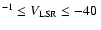 km s-1and -60 km s
 km s-1.
The flow time associated with each velocity
interval is again estimated from their central radial velocities,
,
after
subtracting the ambient cloud velocity of the L1448-mm outflow of
km s-1 (Eq. (5)).
km s-1.
The flow time associated with each velocity
interval is again estimated from their central radial velocities,
,
after
subtracting the ambient cloud velocity of the L1448-mm outflow of
km s-1 (Eq. (5)).
Table 6:
Parameters of the C-shock models that best fit the SiO and CH3OH
observational data shown in Figs. 6 and 7.
Figure 6 also
shows the silicon abundances, as a function of time, predicted
by our model for the shocks that
best fit the observational SiO data (with
km s-1 and
km s-1).
The shock parameters used to reproduce the physical structure of these
shocks are shown in Table 6.
From Fig. 6, we note that the sputtering produced by the
propagation of a 30 km s-1-shock perfectly matches the
evolutionary trend of SiO toward being enhanced from the
ambient to the moderate velocity gas observed in L1448-mm (Jiménez-Serra et al. 2005).
The progressive erosion of the icy mantles by the
sputtering with CO reproduces the SiO abundances observed
in the ambient gas (10-12), in the precursor
component (10-11), and in the
moderate velocity gas (from 10-9 to 10-8). This suggests that the puzzling
narrow SiO line detected toward the young shocks of L1448-mm
can be explained by the recent erosion of the grain mantles
containing a small fraction of Si/SiO at the early
stages of low-velocity shocks.
To fit the SiO abundances
measured in the high-velocity gas, a velocity shock with
km s-1 is needed to sputter 9% of the
silicon contained within the olivine cores and increase
the predicted silicon abundance up to a few 10-6 (Fig. 6). This shock velocity is clearly
in excess of the critical velocities of C-shocks
(
 -50 km s-1; see Draine et al. 1983; Smith & Brand 1990).
Le Bourlot et al. (2002) and Cabrit et al. (2004) have recently shown that
the actual shock velocity limit can be increased to
-50 km s-1; see Draine et al. 1983; Smith & Brand 1990).
Le Bourlot et al. (2002) and Cabrit et al. (2004) have recently shown that
the actual shock velocity limit can be increased to
 km s-1 for moderate densities and high
magnetic fields. However, we cannot rule out the possibility that a J-type
component would be responsible for the large SiO abundances
observed in the high-velocity gas of L1448-mm.
km s-1 for moderate densities and high
magnetic fields. However, we cannot rule out the possibility that a J-type
component would be responsible for the large SiO abundances
observed in the high-velocity gas of L1448-mm.
Given the fact that the L1448-mm outflow shows variability in its
high-velocity SiO emission, an alternative scenario would involve the
presence of two different shocks at two different evolutionary stages
that would coexist within the single-dish beam of the SiO observations
(Jiménez-Serra et al. 2005).
In addition to SiO, CH3OH and H2O are also expected
to be greatly enhanced in outflow regions (see e.g. Draine et al. 1983; Kaufman & Neufeld 1996).
In Fig. 7 (upper and middle panels), we
show the predicted abundances of CH3OH and H2O as a function of
the flow time, for a sample of shocks with
 ,
20, 30, and
40 km s-1 (see Table 4).
The impact with CO injects CH3OH and H2O abundances
as large as 10-7 and 10-5, respectively,
in low-velocity shocks (see cases with
km s-1;
Fig. 7). These abundances are even enhanced to up to
10-6 for CH3OH, and to 10-4 for H2O, in shocks
with only
km s-1.
,
20, 30, and
40 km s-1 (see Table 4).
The impact with CO injects CH3OH and H2O abundances
as large as 10-7 and 10-5, respectively,
in low-velocity shocks (see cases with
km s-1;
Fig. 7). These abundances are even enhanced to up to
10-6 for CH3OH, and to 10-4 for H2O, in shocks
with only
km s-1.
We can now compare the predicted abundances of CH3OH and H2O
with those observed in the young
shocks of the L1448-mm outflow. Figure 7 (lower panel)
shows the SiO and CH3OH abundances observed in the ambient gas, the precursor component and the
moderate velocity gas of this outflow
(Jiménez-Serra et al. 2005), as a function of the flow time. In this figure, we
also show the abundances of ortho-H2O derived from the line profile of the
110
 101 transition
measured by SWAS (Benedettini et al. 2002).
Since the velocity resolution of these observations (1 km s-1; Benedettini et al. 2002) is
lower than those of the SiO and CH3OH spectra
(0.14 km s-1; see Jiménez-Serra et al. 2005), we only estimated
the abundances of ortho-H2O for the moderate velocity regime
(dark grey triangles in Fig. 7). As in Sect. 5, the flow times
associated with these abundances were inferred by subtracting the
ambient cloud velocity in L1448-mm of
km s-1 from
the central velocities,
,
of the observed line profiles of these molecules
(see Eq. (5)).
The SiO, CH3OH, and H2O abundances were derived assuming
optically thin emission as in Jiménez-Serra et al. (2005) for SiO and CH3OH,
and as in Neufeld et al. (2000) for H2O (Eq. (1) in this work).
The abundance of SiO (black line), CH3OH (light grey line), and
H2O (dark grey line) in gas phase
generated by the sputtering of the grain mantles in the
30 km s-1-shock of
Sect. 5 (see Table 6) are also shown in Fig. 7.
101 transition
measured by SWAS (Benedettini et al. 2002).
Since the velocity resolution of these observations (1 km s-1; Benedettini et al. 2002) is
lower than those of the SiO and CH3OH spectra
(0.14 km s-1; see Jiménez-Serra et al. 2005), we only estimated
the abundances of ortho-H2O for the moderate velocity regime
(dark grey triangles in Fig. 7). As in Sect. 5, the flow times
associated with these abundances were inferred by subtracting the
ambient cloud velocity in L1448-mm of
km s-1 from
the central velocities,
,
of the observed line profiles of these molecules
(see Eq. (5)).
The SiO, CH3OH, and H2O abundances were derived assuming
optically thin emission as in Jiménez-Serra et al. (2005) for SiO and CH3OH,
and as in Neufeld et al. (2000) for H2O (Eq. (1) in this work).
The abundance of SiO (black line), CH3OH (light grey line), and
H2O (dark grey line) in gas phase
generated by the sputtering of the grain mantles in the
30 km s-1-shock of
Sect. 5 (see Table 6) are also shown in Fig. 7.
As for SiO, the abundance of sputtered CH3OH agrees with
what is derived in the precursor component within one order of magnitude, and
with those measured in the moderate-velocity gas within a factor of 5
(see Fig. 7). We would like to stress that we have only
argued the total amount of material in the grain mantles.
This implies that the progressive enhancement
of the SiO and CH3OH abundances observed for velocities of
20 km s-1 toward L1448-mm (Jiménez-Serra et al. 2005) is naturally
explained by the presence of a single shock with
km s-1.
In the case of ortho-H2O, however, the abundances of this molecule
in the moderate velocity gas differ by more than a factor of
10 from those predicted by our model. This could be due either to the
assumption of optically thin emission for the ortho-H2O
110
101 transition (which could
have underestimated the ortho-H2O abundances; Benedettini et al. 2002) or to a
beam dilution effect. Note that the SWAS beam is 240'', i.e., 8
times larger than the 30 m beam of the SiO
 1
observations (Jiménez-Serra et al. 2005). This leads to a corrected
ortho-H2O abundance of some 10-4, which is consistent
with our model predictions in Fig. 7.
1
observations (Jiménez-Serra et al. 2005). This leads to a corrected
ortho-H2O abundance of some 10-4, which is consistent
with our model predictions in Fig. 7.
![\begin{figure}
\par\includegraphics[angle=0, width=8.7cm]{8054fig7.eps} %
\end{figure}](/articles/aa/full/2008/17/aa8054-07/Timg176.gif) |
Figure 7:
Upper and middle panels: predictions of the
sputtered abundances of CH3OH and H2O as a function of the
flow time, for a sample of
C-shocks with
,
20, 30, and 40 km s-1 and
n0=105 cm-3.
Lower panel: SiO, CH3OH, and H2O abundances ejected from
the grain mantles for the 30 km s-1-shock of Table 6
as a function of time. We also show the
SiO, CH3OH, and H2O abundances measured in the ambient gas
(square), the precursor component (circles), and the moderate
velocity gas (triangles) of the L1448-mm outflow
(Benedettini et al. 2002; Jiménez-Serra et al. 2005). Vertical arrows
indicate upper limits to the SiO abundance. |
| Open with DEXTER |
In this work, we have presented a parametric model that mimics
the steady-state profile of the physical parameters of C-shocks.
The simplicity of this model has allowed, for the
first time, detailed analysis of the time evolution of the sputtering of
the grain mantles and the grain cores in regions with recent
outflow activity. Although this approximation does not include
detailed MHD modelling, we have shown that it
can be used as an efficient tool to interpret the time-dependent
evolution of the abundances of typical
shock tracers like SiO, CH3OH, H2O, or NH3 in young molecular
outflows, where transient phenomena are expected to play an important
role. The assumption of steadiness of the shock can be
applied to these young objects,
since only the early stages of the shock evolution
(characterised exclusively by the interaction of the magnetic
precursor) are relevant for the dust-grain sputtering process.
To calculate the sputtering of the grain mantles and the grain cores,
we assumed that silicon and
methanol are minor constituents of the water mantles and that olivine
is the main form of silicates within the grain cores.
In spite of the low fractional abundance of heavy atoms (C, O, Si, and Fe) and molecules (CO) relative to H2 or He in molecular dark clouds,
these species have also been considered as sputtering agents. The
relatively high abundance of CO with respect to the rest of
heavy colliding particles and its large sputtering yield make the
sputtering by CO very efficient. Collisions with this molecule
can eject a considerably large fraction of silicon in
the mantles for shocks with only
 km s-1. This implies a reduction by
5-10 km s-1| of the
threshold velocity of the sputtering with respect to other models.
km s-1. This implies a reduction by
5-10 km s-1| of the
threshold velocity of the sputtering with respect to other models.
By comparing the evolution of the abundances of SiO, CH3OH, and H2O
predicted by our model with the abundances derived
toward the different velocity regimes found in the young shocks of
the L1448-mm outflow, we find that two different shocks (with
km s-1 and
km s-1) are
needed to reproduce the measured abundances.
The progressive enhancement of SiO and CH3OH
observed from the ambient gas up to moderate velocities
is consistent with the mantle erosion produced by a
single 30 km s-1-shock. We find that the
SiO abundance of 10-11 associated with the very narrow SiO
emission detected in this outflow can be explained
as an early product of the sputtering of the mantles by CO in
low-velocity shocks if the Si/SiO abundance in the grain mantles is
10-4 with respect to water.
The disagreement between the predicted and the
derived ortho-H2O abundances is probably due either to the
assumption of optically thin emission for the ortho-H2O
110
101 line observed by SWAS or to a
beam dilution effect.
The approximation presented in this work will not only furnish
input for more comprehensive MHD models of the shock structure in
young molecular outflows, but will allow direct
comparisons with the molecular line profiles
observed toward these regions. These comparisons will be
presented in a future paper.
Acknowledgements
We are indebted to
Prof. D. R. Flower for his comments on the C-shock and sputtering
theory and for kindly providing the MHD shock structure shown
in Fig. 1. We acknowledge Dr. M. Kaufman for letting
us use his MHD shock profile shown in Fig. 2.
We would like to thank Dr. A. Asensio-Ramos
for the help provided when developing the code, and
Dr. F. Daniel for his useful comments on the manuscript. We also
acknowledge an anonymous referee for helping us to significantly improve the paper.
This work was supported by the Spanish MEC through projects
number AYA2003-02785-E, ESP2004-00665 and ESP2007-65812-C02-01,
and by the ``Comunidad de
Madrid'' Government under PRICIT project S-0505/ESP-0277 (ASTROCAM).
PC acknowledges support from the Italian Ministry of Research and
University within a PRIN project.
The steady-state velocity profiles of the ion and neutral
fluids,
 and
and
 ,
within the frame of the shock, are approximated as
,
within the frame of the shock, are approximated as
![\begin{displaymath}v_{\rm n,i}^* = v_0 + \frac{\left(v_{\rm s}-v_0\right)}{\cosh\left[(z-z_0)/z_{\rm n,i}\right]}
\end{displaymath}](/articles/aa/full/2008/17/aa8054-07/img180.gif) |
(A.1) |
where z is the spatial coordinate and
the velocity of the shock.
The variables z0, ,
and
are input parameters that govern the velocity decoupling between
the ions and the neutrals (see Sects. 2 and 4.1), and v0 is required
to avoid infinite compression of the far
downstream gas (see Eq. (A.5) and Sect. 2). This speed
only depends on the speed of the shock, ,
and the Alfvén speed,
(see Eq. (A.4) below). From
Eq. (A.1), it is clear that the ion and neutral fluids initially move
with velocities
and are progressively decelerated to
v0 (see Figs. 1 and 2).
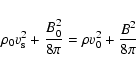
Assuming that the thermal pressure of the fluid is negligible compared to
the magnetic and the dynamic pressures, we can estimate the magnitude of v0
in the downstream gas from
 |
(A.2) |
where  and
and  are the preshock and postshock gas
mass densities, and B0
and B are the magnitude of the magnetic field in the preshock and postshock
regimes, respectively. Considering that the compression of the magnetic field
is given by
are the preshock and postshock gas
mass densities, and B0
and B are the magnitude of the magnetic field in the preshock and postshock
regimes, respectively. Considering that the compression of the magnetic field
is given by
 and that the Alfvén speed, ,
is defined as
and that the Alfvén speed, ,
is defined as
 ,
Eq. (A.2) becomes
,
Eq. (A.2) becomes
![\begin{displaymath}v_0^2 = \frac{v_{\rm s}^2}{\rho/\rho_0} + \frac{v_{\rm A}^2}{2}\left[1-\left(\frac{\rho}{\rho_0}\right)^2\right]\cdot
\end{displaymath}](/articles/aa/full/2008/17/aa8054-07/img186.gif) |
(A.3) |
From the principle of mass conservation, the fluid density
in the postshock gas, ,
is derived as
 .
If we now substitute the ratio
.
If we now substitute the ratio
 into Eq. (A.3), we finally obtain
![\begin{displaymath}v_0^2 \left[v_0^2-v_0v_{\rm s}-\frac{v_{\rm A}^2}{2}\right] = -\frac{v_{\rm A}^2}{2} v_{\rm s}^2
\end{displaymath}](/articles/aa/full/2008/17/aa8054-07/img189.gif) |
(A.4) |
from which v0 can be calculated. The particle density of the neutral fluid, ,
is given by
 |
(A.5) |
and the time associated with the neutral fluid or flow time, t, in the
frame of the shock is calculated as
 |
(A.6) |
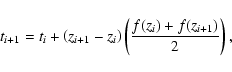
In each plane-parallel slab of material i+1 within the shock,
the flow time, ti+1, is calculated by using the
trapezoidal method,
 |
(A.7) |
where zi and zi+1 are the spatial coordinates for the slabs
of gas i and i+1, and f(zi) is defined as (see Eq. (A.6))
 |
(A.8) |
The temperature of the ion and neutral fluids,
and ,
are
estimated as in Sect. 2.
The sputtering of grains has been calculated by considering different
sputtering yields for the mantles and for the cores.
The sputtering rate per unit volume for a spherical target of radius a moving with drift
velocity
through a Maxwellian neutral gas of temperature
is
(Eq. (27) in Draine & Salpeter 1979)
![\begin{displaymath}
\begin{array}{l}
\left[\displaystyle\frac{{\rm d}n(m)}{{\rm ...
...{\rm e}^{-(x+s)^2}\right]\langle Y(E)\rangle_\theta
\end{array}\end{displaymath}](/articles/aa/full/2008/17/aa8054-07/img194.gif) |
(B.1) |
where  and
are the number density and mass of the projectile,
respectively, and s and x are related to ,
and the projectile
impact energy
through
and
are the number density and mass of the projectile,
respectively, and s and x are related to ,
and the projectile
impact energy
through
 and
and
 .
.
The angle-averaged sputtering yield at low energies
 for the mantles can be
approximated by
for the mantles can be
approximated by
 2
2
 (Draine 1995), where the normal-incidence
yield
is calculated as (Eq. (31); Draine & Salpeter 1979)
(Draine 1995), where the normal-incidence
yield
is calculated as (Eq. (31); Draine & Salpeter 1979)
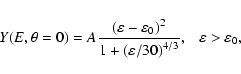 |
(B.2) |
where A is a constant (
 ), and
 and
and
 are calculated as
 and
and
![$\varepsilon_0=\max[1,4\eta]$](/articles/aa/full/2008/17/aa8054-07/img206.gif) .
There, U0 is
the binding energy (per atom or molecule), and
.
There, U0 is
the binding energy (per atom or molecule), and  is derived by doing
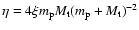 ,
where
Mt is the target mass and
,
where
Mt is the target mass and  is an
efficiency factor that varies from 0.8 (for ices) to 1
(for atomic solids; Draine & Salpeter 1979). The value of
is an
efficiency factor that varies from 0.8 (for ices) to 1
(for atomic solids; Draine & Salpeter 1979). The value of
 ,
which is related to the
threshold impact energy
,
is finally calculated as
,
which is related to the
threshold impact energy
,
is finally calculated as
 .
.
For the grain cores, we have used the sputtering yield calculated by
May et al. (2000) for the impact of atomic species on olivine cores. The
sputtering yield is derived from
![\begin{displaymath}\langle Y(E)\rangle _\theta = k_{\rm s}~ \exp\left[-\beta/(E_{\rm p}-E_{\rm th})\right]
\end{displaymath}](/articles/aa/full/2008/17/aa8054-07/img212.gif) |
(B.3) |
where  ,
,
 ,
and
(the sputtering threshold energy)
are taken from Table 4 in May et al. (2000). In this case,
is
derived by doing
,
and
(the sputtering threshold energy)
are taken from Table 4 in May et al. (2000). In this case,
is
derived by doing
 .
.
In each collision between projectile and grain, only a low fraction
of silicon, ,
and CH3OH, ,
will be ejected from the mantles
(
and
 ;
see Sect. 3.1). Analogously,
only a fraction of silicon, ,
will be released from the cores
(
;
see Sect. 3.1). Analogously,
only a fraction of silicon, ,
will be released from the cores
(
 for H2 and
for the rest of colliding particles;
see Sect. 3.2). If we assume a grain density ,
the total sputtering
rate for H2O, CH3OH and silicon is
for H2 and
for the rest of colliding particles;
see Sect. 3.2). If we assume a grain density ,
the total sputtering
rate for H2O, CH3OH and silicon is
![\begin{displaymath}\left[\frac{{\rm d}n({\rm H}_2{\rm O})}{{\rm d}t}\right]_{\rm...
...m d}n({\rm H}_2{\rm O})}{{\rm d}t}\right]_{\rm grain}^{\rm m}
\end{displaymath}](/articles/aa/full/2008/17/aa8054-07/img218.gif) |
(B.4) |
![\begin{displaymath}\left[\frac{{\rm d}n({\rm CH}_3{\rm OH})}{{\rm d}t}\right]_{\...
...d}n({\rm CH}_3{\rm OH})}{{\rm d}t}\right]_{\rm grain}^{\rm m}
\end{displaymath}](/articles/aa/full/2008/17/aa8054-07/img219.gif) |
(B.5) |
![\begin{displaymath}\left[\frac{{\rm d}n({\rm Si})}{{\rm d}t}\right]_{\rm tot}^{\...
...ac{{\rm d}n({\rm Si})}{{\rm d}t}\right]_{\rm grain}^{\rm m,c}
\end{displaymath}](/articles/aa/full/2008/17/aa8054-07/img220.gif) |
(B.6) |
where m and c denotes the sputtering rate for the mantles and the cores.
By using Euler's algorithm, we calculate the total volume density of H2O, CH3OH, and Si ejected from grains in each plane-parallel slab of material i within the shock as
![\begin{displaymath}n({\rm H}_2{\rm O})_{i+1} = n({\rm H}_2O)_{i}+\Delta t \left[...
...d}n({\rm H}_2{\rm O})}{{\rm d}t}\right]_{{\rm tot},i}^{\rm m}
\end{displaymath}](/articles/aa/full/2008/17/aa8054-07/img221.gif) |
(B.7) |
![\begin{displaymath}n({\rm CH}_3{\rm OH})_{i+1} = n({\rm CH}_3{\rm OH})_{i}+\Delt...
...n({\rm CH}_3{\rm OH})}{{\rm d}t}\right]_{{\rm tot},i}^{\rm m}
\end{displaymath}](/articles/aa/full/2008/17/aa8054-07/img222.gif) |
(B.8) |
![\begin{displaymath}n({\rm Si})_{i+1} = n(Si)_{i}+\Delta t\left[\frac{{\rm d}n({\rm Si})}{{\rm d}t}\right]_{{\rm tot},i}^{\rm m,c}
\end{displaymath}](/articles/aa/full/2008/17/aa8054-07/img223.gif) |
(B.9) |
where
 .
In this case, the flow time at the slab
of material i+1, ti+1, is numerically calculated as in Appendix A
(see Eq. (A.7)), but using the function f(zi) defined as (see Sect. 2)
.
In this case, the flow time at the slab
of material i+1, ti+1, is numerically calculated as in Appendix A
(see Eq. (A.7)), but using the function f(zi) defined as (see Sect. 2)
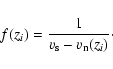 |
(B.10) |
The fractional abundance of silicon, H2O, and CH3OH is finally derived
by doing
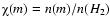 in each slab of material.
- Anders, E., &
Grevesse, N. 1989, Geochim. Cosmochim. Acta, 53, 197 [NASA ADS] [CrossRef]
- Benedettini, M., Viti,
S., Giannini, T., et al. 2002, A&A, 395, 657 [NASA ADS] [CrossRef] [EDP Sciences]
(In the text)
- Cabrit, S., Flower,
D. R., Pineau des Forêts, G., et al. 2004,
Ap&SS, 292, 501 [NASA ADS] [CrossRef]
(In the text)
- Caselli, P., Hartquist,
T. W., & Havnes, O. 1997, A&A, 322, 296 [NASA ADS]
- Chapman, J. F.,
& Wardle, M. 2006, MNRAS, 371, 513 [NASA ADS] [CrossRef]
- Chièze, J.-P.,
Pineau des Forêts, G., & Flower D. R. 1998, MNRAS,
295, 672 [NASA ADS] [CrossRef]
- Dopita, M. A., &
Sutherland, R. S. 2003, in Astrophysics of the Diffuse
Universe (Berlin, New York: Springer), 212
(In the text)
- Draine, B. T. 1995,
Ap&SS, 233, 111 [NASA ADS] [CrossRef]
(In the text)
- Draine, B. T., &
Salpeter, E. E. 1979, ApJ, 231, 77 [NASA ADS] [CrossRef]
(In the text)
- Draine, B. T.,
Roberge, W. G., & Dalgarno, A. 1983, ApJ, 264, 485 [NASA ADS] [CrossRef]
(In the text)
- Falle,
S. A. E. G. 2003, MNRAS, 344, 1210 [NASA ADS] [CrossRef]
- Field, D., May,
P. W., Pineau des Forêts, G., & Flower, D. R.
1997, MNRAS, 285, 839 [NASA ADS]
- Flower, D. R., &
Pineau des Forêts, G. 2003, MNRAS, 343, 390 [NASA ADS] [CrossRef]
(In the text)
- Flower, D. R.,
Pineau des Forêts, G., Field, D., & May, P. W. 1996,
MNRAS, 280, 447 [NASA ADS]
- Girart, J. M., &
Acord, J. M. P. 2001, ApJ, 552, L63 [NASA ADS] [CrossRef]
(In the text)
- Graedel, T. E.,
Langer, W. D., & Frerking, M. A. 1982, ApJS, 48,
321 [NASA ADS] [CrossRef]
- Herbst, E., & Leung,
C. M. 1989, ApJS, 69, 271 [NASA ADS] [CrossRef]
- Jiménez-Serra, I.,
Martín-Pintado, J., Rodríguez-Franco, A., &
Marcelino, N. 2004, ApJ, 603, L49 [NASA ADS] [CrossRef]
(In the text)
- Jiménez-Serra, I.,
Martín-Pintado, J., Rodríguez-Franco, A., &
Martín, S. 2005, ApJ, 627, L121 [NASA ADS] [CrossRef]
(In the text)
- Kaufman, M. J.,
& Neufeld, D. A. 1996, ApJ, 456, 250 [NASA ADS] [CrossRef]
(In the text)
- Le Bourlot, J., Pineau
des Forêts, G., Flower, D. R., & Cabrit, S. 2002,
MNRAS, 332, 985 [NASA ADS] [CrossRef]
(In the text)
- Lesaffre, P.,
Chièze, J.-P., Cabrit, S., & Pineau des Forêts, G.
2004, A&A, 427, 147 [NASA ADS] [CrossRef] [EDP Sciences]
- Martín-Pintado, J.,
Bachiller, R., & Fuente, A. 1992, A&A, 254, 315 [NASA ADS]
- May, P. W., Pineau
des Forêts, G., Flower, D. R., et al. 2000, MNRAS,
318, 809 [NASA ADS] [CrossRef]
- Neufeld, D. A.,
Snell, R. L., Ashby, M. L. N., et al. 2000,
ApJ, 539, L107 [NASA ADS] [CrossRef]
(In the text)
- Pilipp, W., &
Hartquist, T. W. 1994, MNRAS, 267, 801 [NASA ADS]
- Pilipp, W., Hartquist,
T. W., & Havnes, O. 1990, MNRAS, 243, 685 [NASA ADS]
- Pineau des Forêts,
G., Flower, D. R., & Chièze, J.-P. 1997, in
Herbig-Haro flows and the birth of stars, ed. B. Reipurth, & C.
Bertout (Kluwer Academic Publishers), IAU Symp., 182, 199
(In the text)
- Prasad, S. S., &
Huntress, W. T. Jr. 1982, ApJ, 260, 590 [NASA ADS] [CrossRef]
- Requena-Torres,
M. A., Marcelino, N., Jiménez-Serra, I., et al.
2007, ApJ, 655, L37 [NASA ADS] [CrossRef]
(In the text)
- Smith, M. D., &
Brand, P. W. J. L. 1990, MNRAS, 242, 495 [NASA ADS]
(In the text)
- Smith, M. D., Brand,
P. W. J. L., & Moorhouse, A. 1991, MNRAS, 248,
730 [NASA ADS]
- Snow, T. P., &
Witt, A. N. 1996, ApJ, 468, L65 [NASA ADS] [CrossRef]
- Tielens,
A. G. G. M., & Allamandola, L. J. 1987, in
Physical Processes in Interstellar Clouds, ed. G. E. Morfill,
& M. Scholer (Dordrecht: Reidel), 333
(In the text)
- Tielens,
A. G. G. M., McKee, C. F., Seab, C. G.,
& Hollenbach, D. J. 1994, ApJ, 431, 321 [NASA ADS] [CrossRef]
(In the text)
- Whittet,
D. C. B., & Duley, W. W. 1991, A&ARv., 2,
167 [NASA ADS]
(In the text)
- Ziurys, L. M.,
Friberg, P., & Irvine, W. M. 1989, ApJ, 343, 201 [NASA ADS] [CrossRef]
Copyright ESO 2008
![\begin{figure}
\par\includegraphics[angle=270, width=14cm]{8054fig1.eps} \end{figure}](/articles/aa/full/2008/17/aa8054-07/img70.gif)
![\begin{figure}
\par\includegraphics[angle=270, width=7.5cm]{8054fig2.eps} %
\end{figure}](/articles/aa/full/2008/17/aa8054-07/img80.gif)
![\begin{figure}
\par\includegraphics[angle=0, width=8.5cm]{8054fig3.eps} \end{figure}](/articles/aa/full/2008/17/aa8054-07/img139.gif)
![\begin{figure}
\par\includegraphics[angle=270, width=18cm]{8054fig4.eps} \end{figure}](/articles/aa/full/2008/17/aa8054-07/img143.gif)
![\begin{figure}
\par\includegraphics[angle=270, width=18cm]{8054fig5.eps} \end{figure}](/articles/aa/full/2008/17/aa8054-07/img146.gif)
![\begin{figure}
\par\includegraphics[angle=0, width=8.5cm]{8054fig6.eps} %
\end{figure}](/articles/aa/full/2008/17/aa8054-07/img163.gif)
 OH and H
 O abundances.
![\begin{figure}
\par\includegraphics[angle=0, width=8.7cm]{8054fig7.eps} %
\end{figure}](/articles/aa/full/2008/17/aa8054-07/img176.gif)