A&A 481, 913-918 (2008)
DOI: 10.1051/0004-6361:20078302
Optical spectropolarimetry with incomplete data sets
(Research Note)
J. R. Maund
Department of Astronomy and McDonald Observatory, The University
of Texas at Austin, 1 University Station, C1400, Austin, Texas 78712-0259, USA
Received 17 July 2007 / Accepted 29 January 2008
Abstract
Context. Linear spectropolarimetry is a ``photon-hungry'' observing technique, requiring a specific sequence of observations to determine the Stokes Q and U parameters. For dual-beam spectropolarimeters, the Q and U Stokes parameters can be ideally determined using observations at N=2 retarder plate positions. The additional polarization signal introduced by instrumental effects requires the redundancy of N=4 observations to correct for these effects and to accurately measure the linear polarization of astronomical objects.
Aims. We wish to determine if the ``instrumental signature corrections'' for the Stokes Q and U parameters,
 and
and
 ,
are identical for observations with dual-beam spectropolarimeters. For instances when observations were only acquired at N=3 retarder plate angles, we wish to determine if the complete measurement of one Stokes parameter and the associated instrumental signature correction can be used to determine the other Stokes parameter.
,
are identical for observations with dual-beam spectropolarimeters. For instances when observations were only acquired at N=3 retarder plate angles, we wish to determine if the complete measurement of one Stokes parameter and the associated instrumental signature correction can be used to determine the other Stokes parameter.
Methods. We constructed analytical and Monte Carlo models of a general dual-beam spectropolarimeter to study the factors affecting the assumption
 and the uncertainty thereon. We compared these models with VLT FORS1 linear spectropolarimetry observations.
Results. We find that, in general,
 ,
with the variance around zero (
,
with the variance around zero (
 )
being directly related to the signal-to-noise ratio of the observations. Observations of a polarized standard star, observed under identical instrumental conditions over the period of 2002-2007, show that the assumption of
)
being directly related to the signal-to-noise ratio of the observations. Observations of a polarized standard star, observed under identical instrumental conditions over the period of 2002-2007, show that the assumption of
 is generally true over a long period, although the absolute values of
and
vary between observational epochs. While the variance of
is generally true over a long period, although the absolute values of
and
vary between observational epochs. While the variance of
 is not dependent on the polarization angle, significant deviations from
arise when
is not dependent on the polarization angle, significant deviations from
arise when
 .
.
Conclusions. Incomplete VLT FORS1 spectropolarimetry datasets, for which observations at only N=3 retarder plate position angles have been acquired, can be analyzed under the assumption that
 .
The uncertainty associated with this assumption is directly related to the signal-to-noise ratio of the observations. This property of the analysis of spectropolarimetry, with dual beam spectropolarimeters, can be used to test for the presence of artifacts affecting individual observations and to assess the quality of the data reduction, when observations at all four retarder plate angles have been acquired.
.
The uncertainty associated with this assumption is directly related to the signal-to-noise ratio of the observations. This property of the analysis of spectropolarimetry, with dual beam spectropolarimeters, can be used to test for the presence of artifacts affecting individual observations and to assess the quality of the data reduction, when observations at all four retarder plate angles have been acquired.
Key words: instrumentation: polarimeters - polarization
1 Introduction
Spectropolarimetry is a ``photon-hungry'' observational technique,
requiring a particular sequence of observations to completely and
independently determine the polarization properties of astronomical
objects. In order to measure particularly low levels of polarization
(
 ), high signal-to-noise ratio (S/N) observations are
required at each step in the observing sequence.
), high signal-to-noise ratio (S/N) observations are
required at each step in the observing sequence.
For dual-beam spectropolarimeters, such as the European Southern Observatory (ESO)
Very Large Telescope (VLT) FOcal Reducer and low dispersion
Spectrograph (FORS1; Appenzeller et al. 1998), the determination
of the linear polarization Stokes parameters, Q and U, requires
N=4 separate observations. This observing sequence introduces
redundancies, but permits the complete determination and correction
for instrumental effects that would, if uncorrected for N=2 observations, lead to spurious observed polarization.
Target of Opportunity spectropolarimetry (where observations are conducted
at specific epochs to study transient events which occur without prior
warning) of time-variable phenomena is at a disadvantage, since at
each epoch the technique requires a factor  8 more time on
target than for pure spectroscopy to achieve the same S/N in the
individual spectra. For objects such as SNe, the position of the
target on the sky may not permit sufficient time on target to conduct
all of the necessary observations, leaving the dataset acquired
incomplete. If one observation, for one retarder plate angle, is
absent, only one Stokes parameter can be independently measured.
There is, however, potential redundancy between the observations for
the completely determined Stokes parameter and the partially
determined parameter such that instrumental effects can be removed,
allowing for complete determination of both parameters, but at a
higher degree of uncertainty.
8 more time on
target than for pure spectroscopy to achieve the same S/N in the
individual spectra. For objects such as SNe, the position of the
target on the sky may not permit sufficient time on target to conduct
all of the necessary observations, leaving the dataset acquired
incomplete. If one observation, for one retarder plate angle, is
absent, only one Stokes parameter can be independently measured.
There is, however, potential redundancy between the observations for
the completely determined Stokes parameter and the partially
determined parameter such that instrumental effects can be removed,
allowing for complete determination of both parameters, but at a
higher degree of uncertainty.
Leonard et al. (2001) present a technique where, by assuming the same ratio of gains for the ordinary and extraordinary rays, instrumental effects can be removed to
calculate the second Stokes parameter for incomplete datasets. When
``normalized flux differences''
(e.g. Jehin et al. 2005; Patat & Romaniello 2006) are used to calculate the
Stokes parameter, the consideration is of a correction for the
instrumental signature, which quantifies the deviation of data from
the ideal case of N=2.
Here we present a technique to determine the
instrumental signature corrections for observed data, such that, in
the event of an incomplete observation, both Stokes parameters can be
determined. The concept of spectropolarimetry with dual beam
spectropolarimeters is, briefly, outlined along with discussion of
correction for instrumental effects in Sect. 2.
In Sect. 3, analytical and Monte-Carlo models of a dual
beam spectropolarimeter are presented, and the effects of various
factors on the final measured polarization for complete and incomplete
datasets are presented. Real observations of linearly polarized point
sources, acquired using VLT FORS1, and the instrumental signature
corrections are presented in Sect. 4.
2 Basic concept and theory
Dual-beam spectropolarimeters, such as the FORS1 instrument
(Appenzeller et al. 1998), use a sequence of a retarder plate and a
Wollaston prism to measure the polarization components.
Rotation of the retarder plate varies the angle at which the
orthogonal polarization components are sampled. The Wollaston prism
separates these two components spatially into the ordinary (o) and
extraordinary rays (e). At a general retarder plate position i,
the measured normalized flux difference
 is defined (e.g. Jehin et al. 2005) as
 |
(1) |
such that the total intensity
 .
is
normalized by the total flux intensity and is independent
of varying sky transparency and exposure times.
.
is
normalized by the total flux intensity and is independent
of varying sky transparency and exposure times.
The optimum observing sequence is for
a half-wavelength retarder plate to be positioned at N=4 position angles
 :
:
 = 0
= 0
 0,
0,
 = 22
5,
= 22
5,
 = 45
0 and
= 45
0 and
 = 67
5.
= 67
5.
At
,
the orthogonal polarization components are in the horizontal and vertical
directions. For
the same components are observed, but
the beams are swapped such that
 .
Similarly,
for
and
the diagonal polarization components
are observed, and the polarization components observed as the ordinary
and extraordinary rays are switched between the two observations.
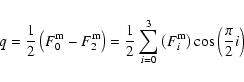
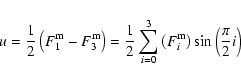
The normalized Stokes parameters are given, in terms of normalized flux differences, by Jehin et al. (2005) and Patat & Romaniello (2006), as
.
Similarly,
for
and
the diagonal polarization components
are observed, and the polarization components observed as the ordinary
and extraordinary rays are switched between the two observations.
The normalized Stokes parameters are given, in terms of normalized flux differences, by Jehin et al. (2005) and Patat & Romaniello (2006), as
 |
(2) |
 |
(3) |
where the flux Stokes parameters are given by Q=qI and
U=uI. The redundancy in N=4 observations permits the removal of the
instrumental effects that differ between the o and e rays. These differences
manifest themselves as spurious polarization or depolarization. These
instrumental effects are discussed by Patat & Romaniello (2006).
A gain difference between the o and e rays for N=2 observations would manifest itself as significant polarization. For spectropolarimetry, flatfields are
acquired with the full polarization optics in place, such that the
observed flatfields, themselves produced by scattered light, are
polarized. In addition, the optical components following the
analyzer, such as grisms, filters and lenses, can also act act as
linear polarizers, producing a constant additive polarization
component which is larger than effects due improper flatfielding using
unpolarized flats (Patat & Romaniello 2006). Importantly,
Patat & Romaniello also identify a non-additive
polarization term, which can arise from a non-ideal Wollaston prism;
for most modern dual-beam spectropolarimeters, such as FORS1, the
imperfections of the Wollaston prism and the associated effects are
negligible. In the case of N=3 observations, the instrumental polarization
component cannot be removed from the Stokes parameter for which there
was only a single observation.
At each retarder plate angle, the
measured value of the normalized flux difference can be considered as
the sum of the ideal normalized flux difference (Fi) and the instrumental
signature correction  :
:
 ,
such that
under ideal conditions (
,
such that
under ideal conditions (
 )
a Stokes parameter can be
measured using only one value of F at only one retarder plate
position (such that the q and u parameters are completely
determined with N=2 observations).
)
a Stokes parameter can be
measured using only one value of F at only one retarder plate
position (such that the q and u parameters are completely
determined with N=2 observations).
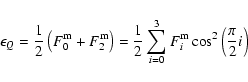
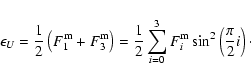
In the same form as Eqs. (2) and (3), the instrumental signature
corrections for the q and u Stokes parameters are,
therefore, given by
 |
(4) |
 |
(5) |
Another benefit of this formalism is that the instrumental signature
corrections are flux normalized (such that
and
are percentages of the total
flux) and are independent of the same factors as the
normalized flux differences.
In the observing sequence, the primary change between each exposure is the rotation of the retarder plate. For spectropolarimetry of a point source at the centre of the field, the only change
should be the orientation of the retarder plate, with the location of
the source on the retarder plate unchanged![[*]](/icons/foot_motif.gif) . In this case, therefore, the values of the corrections for the Q and U Stokes parameters should be
approximately identical. For an
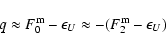
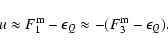
observing sequence with N=3, the normalized Stokes parameter with incomplete observations can be determined from the correction determined for the other completely determined parameter, assuming
,
as
. In this case, therefore, the values of the corrections for the Q and U Stokes parameters should be
approximately identical. For an
observing sequence with N=3, the normalized Stokes parameter with incomplete observations can be determined from the correction determined for the other completely determined parameter, assuming
,
as
 |
(6) |
 |
(7) |
The change in sign of the instrumental signature correction and F is due to switch of the polarization components observed as the o and e rays.
3 Models
3.1 Analytical model
If the principal difference between the measured o and e rays is purely due
to sensitivity, such that the difference can be expressed as a ratio of
the gains between the o and e rays
 ,
then in terms of the ideal values of
,
then in terms of the ideal values of  and
and  (with no instrumental effects) Eq. (1) becomes
 |
(8) |
This form assumes that there are no other effects, such as
changing sky transparency (which can become important for very large
or small values of g when the flux in only one ray is
effectively being measured) or significant phase shift induced by the
half-wavelength retarder plate. For  the observed intensity
changes at each retarder plate angle, depending on the flux and gain
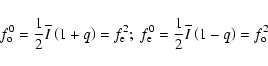
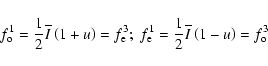
for each ray. The ideal values of
and
(without
instrumental effects) are given as
the observed intensity
changes at each retarder plate angle, depending on the flux and gain
for each ray. The ideal values of
and
(without
instrumental effects) are given as
 |
(9) |
 |
(10) |
where the ideal intensity
 .
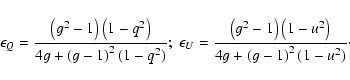
Using Eqs. (8)-(10) in Eqs. (4) and (5) gives
.
Using Eqs. (8)-(10) in Eqs. (4) and (5) gives
 |
(11) |
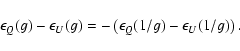
These equations show that the instrumental signature corrections are dependent on the ratio of the gains of the two rays, the total degree of polarization (see Fig. 1) and the polarization angle. In the ideal case, for g=1, Eqs. (11) give
 .
The sign of the corrections are dependent on the gain ratio, with
.
The sign of the corrections are dependent on the gain ratio, with
 |
(12) |
![\begin{figure}
\par\includegraphics[angle=270,width=8.2cm,clip]{8302fig1.eps}\end{figure}](/articles/aa/full/2008/15/aa8302-07/Timg53.gif) |
Figure 1:
The analytic form of the dependence of the instrumental
signature correction on the gain ratio between the o and e rays
and the total polarization, for the case of p=q and u=0. For the
opposite case, p=u and q=0, the top and bottom regions of the
diagram are switched. For g>3.85
is
shown as grey dotted lines. |
| Open with DEXTER |
The magnitude of
increases for g>1, but reaches a stationary point at g=3.85. For g>3.85 the magnitude of
decreases due to the predominance of the signal from one ray over the other. This model, therefore, has limited application for realistic observing conditions, for variable observing conditions between observations at different retarder plate angles. For 0.5<g<2 and
 the magnitude of this deviation, even when only one Stokes parameter is non-zero, is sufficiently small to be within
reasonable measurement uncertainties, while the assumption that
can be used to identify if high polarizations are indeed present.
The dependence of
on the polarization angle is shown as Fig. 2. The largest differences are measured for either pure q or u components, with mixtures of q and u leading to smaller differences. The instrumental signature corrections are identical, regardless of total polarization, for q=u,
the magnitude of this deviation, even when only one Stokes parameter is non-zero, is sufficiently small to be within
reasonable measurement uncertainties, while the assumption that
can be used to identify if high polarizations are indeed present.
The dependence of
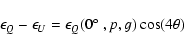
on the polarization angle is shown as Fig. 2. The largest differences are measured for either pure q or u components, with mixtures of q and u leading to smaller differences. The instrumental signature corrections are identical, regardless of total polarization, for q=u,  5. The difference of the instrumental signature corrections is periodic over 90
 .
For constant polarization and gain, the dependence on polarization angle is characterized by
.
For constant polarization and gain, the dependence on polarization angle is characterized by
 |
(13) |
where
 is the Q instrumental signature
correction for
is the Q instrumental signature
correction for  and q=p.
![\begin{figure}
\par\includegraphics[angle=270,width=8.2cm,clip]{8302fig2.eps}\end{figure}](/articles/aa/full/2008/15/aa8302-07/Timg60.gif) |
Figure 2:
The difference of the instrumental signature corrections for
varying polarization angles, for a fixed gain ratio g=1.5. |
| Open with DEXTER |
3.2 Monte-Carlo simulations
In order to test the importance of various realistic instrumental
effects, a Monte-Carlo model of a dual beam spectropolarimeter was
constructed in a similar style to Patat & Romaniello (2006). This
simulates the observation of the individual o and e rays
that would be observed for specific values of the total polarization p and the polarization angle  for a given a value of S/N.
Different levels of gain and read-noise were applied to the o and e rays, in order to simulate the contribution of these factors to
the corrections. The polarization induced by optical components
preceding the analyzer, such as the telescope mirror, and polarization
due to a non-ideal Wollaston prism were not included. For each
simulation, the value of the difference of the Q and U corrections
(
)
was measured. The standard deviation of
these values (
)
about the mean
value of
was used as a measure of the
relative error. These terms permit the problem to be studied in terms
of absolute deviations and the measurement error associated with the
corrections.
for a given a value of S/N.
Different levels of gain and read-noise were applied to the o and e rays, in order to simulate the contribution of these factors to
the corrections. The polarization induced by optical components
preceding the analyzer, such as the telescope mirror, and polarization
due to a non-ideal Wollaston prism were not included. For each
simulation, the value of the difference of the Q and U corrections
(
)
was measured. The standard deviation of
these values (
)
about the mean
value of
was used as a measure of the
relative error. These terms permit the problem to be studied in terms
of absolute deviations and the measurement error associated with the
corrections.
For simple signal dominated observations, approaching
ideal unvarying conditions, the behaviour of
is consistent with the analytical form
presented in Sect. 3.1.
If there is a significant gain difference between the o and e rays, such that
the ratio is  10, the determined Stokes parameters are
dominated by signal measured in the ray with the larger gain.
Importantly, the normalized flux difference is no longer applicable,
and such observing conditions are unrealistic. Similarly, significant
changes in the sky background (100) between observations at
each retarder plate angle can also induce deviations from
,
but this is also primarily due to the
associated change in S/N between observations.
10, the determined Stokes parameters are
dominated by signal measured in the ray with the larger gain.
Importantly, the normalized flux difference is no longer applicable,
and such observing conditions are unrealistic. Similarly, significant
changes in the sky background (100) between observations at
each retarder plate angle can also induce deviations from
,
but this is also primarily due to the
associated change in S/N between observations.
The value of
was calculated for varying values of S/N.
Here the S/N is calculated at each retarder plate position. In
general, it was found that
,
with
dependent on the level of S/N in
the individual observations, as shown as Fig. 3.
Since the determination of
depends on 8 individual measurements, the o and e rays at the four retarder plate angles, the uncertainty
is
 larger than the uncertainty associated with the
individual Stokes parameter. The quantity
is an estimate of the uncertainty of a Stokes parameter calculated from incomplete observations.
Furthermore, the dependence of
on
the polarization angle was also modelled, as shown in Fig. 4.
As expected, the uncertainty on
is not directly
dependent on polarization angle, although
is itself offset.
larger than the uncertainty associated with the
individual Stokes parameter. The quantity
is an estimate of the uncertainty of a Stokes parameter calculated from incomplete observations.
Furthermore, the dependence of
on
the polarization angle was also modelled, as shown in Fig. 4.
As expected, the uncertainty on
is not directly
dependent on polarization angle, although
is itself offset.
![\begin{figure}
\par\includegraphics[angle=270,width=8.2cm,clip]{8302fig3.eps}\end{figure}](/articles/aa/full/2008/15/aa8302-07/Timg64.gif) |
Figure 3:
The uncertainty (%) on the difference between the
corrections
,
of the Q and U Stokes parameters, as a function of the S/N. Calculations were
conducted assuming the same parameters as FORS1 (Jehin et al. 2005), with
g = 1.1, between the o and e rays. All simulations were
conducted with
 .
Simulations were conducted with .
Simulations were conducted with
 ( light solid),
  ( dashed),
  (
dot-dashed) and
(
dot-dashed) and  ( dotted). The error on the measured Q Stokes parameters is shown as the heavy black line. Overlaid are
measured values of
for six VLT
FORS1 observations of SN 2001ig at 03 Jan. 2002 (
( dotted). The error on the measured Q Stokes parameters is shown as the heavy black line. Overlaid are
measured values of
for six VLT
FORS1 observations of SN 2001ig at 03 Jan. 2002 ( ), HD 10038 at
07 Jul. 2003 ( ), HD 10038 at
07 Jul. 2003 ( ), Vela 1 95 at 01 May 2005 (+), SN 2005hk at
23 Nov. 2005 (*) and SN 2006X at 09 Feb. 2006 ( ), Vela 1 95 at 01 May 2005 (+), SN 2005hk at
23 Nov. 2005 (*) and SN 2006X at 09 Feb. 2006 ( )
and 12 Feb. 2006 ( )
and 12 Feb. 2006 ( ). ). |
| Open with DEXTER |
![\begin{figure}
\par\includegraphics[angle=270,width=8.05cm,clip]{8302fig4.eps}\end{figure}](/articles/aa/full/2008/15/aa8302-07/Timg65.gif) |
Figure 4:
The uncertainty (%) of
as a function of the polarization
angle. The calculation was made for S/N=200 and .
The
absolute value of
is a factor of 30 lower
than the value of
. |
| Open with DEXTER |
4 Observations using VLT FORS1
Spectropolarimetry observations of two SNe, one polarized standard
star and one unpolarized standard star, acquired using the ESO VLT
FORS1 instrument, were retrieved from the ESO archive, to determine if, under real
observing circumstances,
.
These
observations were of SN 2001ig at 03 Jan. 2002 (Maund et al. 2007a), the
unpolarized standard HD 10038 at 07 Jul. 2003 (previously unpublished),
the polarized standard Vela 1 95 at 01 May 2005 (Maund et al. 2007b), and
SN 2005hk at 23 Nov. 2005 (Maund et al. 2008). These observations were
conducted using the 300V grism, and were re-binned to 30 Å. The
observations were complete, with data at N=4 retarder plate angles,
and were reduced in the standard manner as outlined by
Maund et al. (2007b).
Observations of SNe were specifically chosen as:
a) they represent the class of quick varying transients for which such
a technique might be useful; and b) despite having diverse
spectroscopic and polarimetric properties there has been a long term
VLT FORS1 program since 2000 to observe these events using similar
instrumental setups (namely the 300V grism).
![\begin{figure}
\par\includegraphics[width=8.4cm,clip]{8302fig5.eps}\end{figure}](/articles/aa/full/2008/15/aa8302-07/Timg66.gif) |
Figure 5:
(solid line) and
(dotted line),
as a function of wavelength, for four complete FORS1 observations of:
a) SN 2001ig at 03 Jan. 2002 (S/N
1290), b) unpolarized standard HD 10038 at 07 Jul. 2003 (S/N
730), c) polarized standard Vela 1 95 at 01 May 2005 (S/N
380), d) SN 2005hk at 23 Nov. 2005 (S/N
446). S/N values are given at 6000 Å. The data have be rebinned to 30 Å. |
| Open with DEXTER |
As each of these observations was complete, both
and
could be determined; these are shown, as a function of wavelength, as
Fig. 5. The corrections are observed to differ
slightly between epochs. This implies that, just as new bias and flat
calibration frames are required at each epoch, the instrumental
signature correction, if it is to be applied to determine one Stokes
parameter, needs to be determined from data acquired at the same
epoch. The corrections are wavelength dependent, but not observed to
be dependent on either the polarization or the spectroscopic
properties of these objects. In instances of higher S/N (such as
Fig. 5a) the corrections are observed to be a
smooth function of wavelength, with more variability observed for
lower S/N observations. Importantly, the largest deviations from
are observed for
 ,
where there are a
number of telluric absorption bands and the response of the FORS1 instrument is falling. For each of the four observations
was calculated over the wavelength
range 5500-6500 Å, to be representative of
at 6000 Å at which the S/N is
quoted. For the given S/N at 6000 Å these values of
are plotted in
Fig. 3 in comparison with the Monte Carlo model.
The observed data agree well with the modelled dependence of
on the S/N and polarization of the
observations.
,
where there are a
number of telluric absorption bands and the response of the FORS1 instrument is falling. For each of the four observations
was calculated over the wavelength
range 5500-6500 Å, to be representative of
at 6000 Å at which the S/N is
quoted. For the given S/N at 6000 Å these values of
are plotted in
Fig. 3 in comparison with the Monte Carlo model.
The observed data agree well with the modelled dependence of
on the S/N and polarization of the
observations.
The observation of SN 2005hk (23 Nov. 2005; Fig. 5d) highlights the potential pitfalls of not observing a complete dataset. In the region 6500-7000 Å there are a
series of bad pixels which affected the o ray of the observation
with the retarder plate at 45,
which could not be removed by bias
subtraction or correction with a normalized flatfield. None of the
observations at other retarder plate angles, for either the o and e ray, were affected. In this case, therefore, the calculation of
U by assuming
 would lead to a serious
error in the Stokes parameter without a substantial decrease in the
S/N. The quality of the reduction at any wavelength, for a given S/N,
can be directly measured by comparison of the Q and U instrumental
signature corrections, and the presence of such defects identified.
Importantly, the S/N is independent of the actual polarization, rather
it is dependent on the total flux in both the o and e rays. The reduction may, therefore, be questioned if the absolute measured difference of
and
,
would lead to a serious
error in the Stokes parameter without a substantial decrease in the
S/N. The quality of the reduction at any wavelength, for a given S/N,
can be directly measured by comparison of the Q and U instrumental
signature corrections, and the presence of such defects identified.
Importantly, the S/N is independent of the actual polarization, rather
it is dependent on the total flux in both the o and e rays. The reduction may, therefore, be questioned if the absolute measured difference of
and
,
 ,
exceeds some multiple of the
theoretically expected scatter, at a given S/N,
e.g.
,
exceeds some multiple of the
theoretically expected scatter, at a given S/N,
e.g.
 .
.
In order to test the temporal stability of the absolute instrumental signature corrections,
as a function of wavelength, a set of seven observations of the
polarized standard star Vela 1 95 were retrieved from the ESO archive.
These observations were acquired on 02 Oct. 2002, 01 Feb. 2003, 03 Feb. 2003, 07 May 2003, 30 Apr. 2005, 07 Jun. 2005 and 17 Mar. 2007, using an
identical instrumental setup: the 300V grism, no order
separation filter and 2048
500 windowing of the CCD detector.
There was not expected to be any significant effect due to detector
windowing, but for consistency between the compared observations the
windowing constraint was enforced. In order to directly compare the
absolute values of the instrumental signature corrections at different
epochs, the data were rebinned to 1000 Å centred on 5000,
6000, 7000 and 8000 Å. The values for the instrumental signature
correction at these epochs are shown as Fig. 6.
The absolute values of the instrumental signature corrections vary
between epochs. Additionally the wavelength dependence of the
instrumental signature correction is also variable, with the gradient
of the correction across the wavelength range (corresponding to the
vertical distance between different wavelength points at the same
epoch, in Fig. 6) changing. This confirms that
instrumental signature corrections measured at different epochs cannot
be used to reduce incomplete data acquired at other epochs and, hence,
a minimum of N=3 observations are required.
The observed variability in the instrumental corrections may arise from evolution of the
flatfield and of bias calibration frames, especially if the observed
object spectra are not at the exact same location on the detector for
each observation. Wavelength-dependent slit losses due to
observations with the slits oriented with PA =
 ,
rather than the
parallactic angle, may contribute to the varying gradients of the
corrections. Importantly, despite the variability,
at each epoch.
,
rather than the
parallactic angle, may contribute to the varying gradients of the
corrections. Importantly, despite the variability,
at each epoch.
![\begin{figure}
\par\includegraphics[angle=270,width=8.2cm,clip]{8302fig6.eps}\end{figure}](/articles/aa/full/2008/15/aa8302-07/Timg72.gif) |
Figure 6:
The instrumental signature correction
for
unfiltered VLT FORS1 300V PMOS observations of Vela 1 95 at 02 Oct. 2002, 01 Feb. 2003, 03 Feb. 2003, 07 May 2003, 30 Apr. 2005, 07 Jun. 2005,
17 Mar. 2007. The data shown are for 1000 Å bins, centred on
5000 Å (,
solid line), 6000 Å (+, dashed line), 7000 Å ( ,
dot-dashed line), 8000 Å (,
dotted line). ,
dot-dashed line), 8000 Å (,
dotted line). |
| Open with DEXTER |
The forms of the absolute values of
and
are also dependent on the choice of grism. For the VLT FORS1, linear
spectropolarimetry has been conducted with six grisms, for which
observations of representative standard stars were selected (as listed
in Table 1). The absolute forms of the corrections
for observations with all six grisms used for spectropolarimetry are
shown in Fig. 7. The 300V grim is used with
significantly higher frequency than the other grisms, such that the
stability of the instrumental signature corrections for the other
grisms cannot be tested with sufficient cadence or over a suitably
long time frame as was done for 300V above. The principal
difference between the values of
and
measured with different grisms is likely to arise from the response
function of the detector for given wavelength dispersions. It is
important that the values of
and
for any
particular grism cannot, in general, be extrapolated from those values
measured with other grisms (except, potentially, in the cases of the
300V and 150I grisms).
Table 1:
Linear spectropolarimetry data, of standard polarized stars, for selected VLT FORS1 grisms.
![\begin{figure}
\par\includegraphics[angle=270,width=8.2cm,clip]{8302fig7.eps}\end{figure}](/articles/aa/full/2008/15/aa8302-07/Timg74.gif) |
Figure 7:
The instrumental signature correction
for VLT FORS1 150I, 300I, 600B, 600R and 600I PMOS observations of polarized standard stars (listed in Table 1). The instrumental signature correction for the 300V grism is shown as the grey line. |
| Open with DEXTER |
5 Discussion and conclusions
For spectropolarimetry where observations at N=3 retarder plate
positions are available, the assumption that
can be employed to determine the
additional Stokes parameter. This is a general property of dual
beam-spectropolarimeters, which have negligible intrinsic
instrumental polarization, and has been confirmed for VLT FORS1. If the Wollaston prism is non-ideal, the assumption of
is not true. This technique is still
limited, as at least N=3 exposures in the standard observing sequence
are required, although at a moderate expense of precision. Because
the corrections are dependent on calibrations applied to
the object data, the corrections calculated at different
epochs are not strictly identical; although, in some cases they have
been observed to be similar. The assumption
is not strictly true for observations of
objects with linear polarization  .
The uncertainty on
is dependent on the S/N of the
observations at each retarder plate angle and not the
polarization of the object being observed. In some cases, and in the
particular cases of some SNe, this will permit reasonable
spectropolarimetry in instances when it was not possible to acquire
the complete set of observations.
.
The uncertainty on
is dependent on the S/N of the
observations at each retarder plate angle and not the
polarization of the object being observed. In some cases, and in the
particular cases of some SNe, this will permit reasonable
spectropolarimetry in instances when it was not possible to acquire
the complete set of observations.
In addition, the
parameter can also be used to identify
defects and spurious polarization signatures in complete datasets.
The
parameter can also be used to
determine the quality of the data reduction procedure as applied to
such datasets, as it is directly dependent on the S/N, and significant
deviations from
would indicate the presence of defects in the data.
The instrumental signature corrections are dependent on wavelength, and
are observed to be variable with time. Just as bias, flatfield and
wavelength calibration observations are acquired for each
epoch, the instrumental signature corrections should be
determined at each epoch for each instrumental setup. Fortunately,
this ``additional'' calibration information is derived from direct
observations of target objects, requiring no additional observation
time. The forms of
and
are dependent on the choice of grism and the resulting dispersion across the detector.
Ultimately, the assumption of
is less
than ideal, leading to larger degrees of uncertainty in the extra
Stokes parameters by a factor of
over parameters determined with N=4 observations. The use of these corrections does permit, however, the utilisation of data which would, ordinarily, remain unused (Maund et al. 2007c).
Acknowledgements
Based on observations made with ESO Telescopes at the Paranal
Observatories under programmes 60.A-9203(A), 63.P-0002, 63.P-0074,
68.D-0571(A), 76.D-0177(A) and
76.D-178(A). The research of JRM is supported in part by NSF grant AST-0406740 and NASA grant NNG04GL00G. JRM thanks J. Craig Wheeler, Ferdinando Patat and Dietrich Baade for their useful comments, and also thanks Stefano Bagnulo, the referee, for his important
suggestions.
- Appenzeller, I.,
Fricke, K., Furtig, W., et al. 1998, The Messenger, 94, 1 [NASA ADS]
(In the text)
- Jehin, E., O'Brien,
K., Kaufer, A. & Hainaut, O., 2007, FORS1+2 User Manual, v81.1,
ESO, Garching, VLT-MAN-ESO-13100-1543
- Leonard, D. C.,
Filippenko, A. V., Ardila, D. R., & Brotherton,
M. S. 2001, ApJ, 553, 861 [NASA ADS] [CrossRef]
(In the text)
- Maund, J., Wheeler,
J., Patat, F., Wang, L., Baade, D., & Höflich, P. 2007a,
ApJ, 671, 1944 [NASA ADS] [CrossRef]
(In the text)
- Maund, J.,
Wheeler, J., Patat, F., Baade, D., Wang, L., & Höflich, P.
2007b, MNRAS, 381, 201 [NASA ADS] [CrossRef]
(In the text)
- Maund, J.,
Wheeler, J., Patat, F., et al. 2007c, A&A, 475, L1 [NASA ADS] [CrossRef] [EDP Sciences]
(In the text)
- Maund, J., Wheeler,
J., Wang, L., et al. 2008, ApJ, in prep.
(In the text)
- Patat, F., &
Romaniello, M. 2006, PASP, 118, 146 [NASA ADS] [CrossRef]
Copyright ESO 2008
![\begin{figure}
\par\includegraphics[angle=270,width=8.2cm,clip]{8302fig1.eps}\end{figure}](/articles/aa/full/2008/15/aa8302-07/img53.gif)
![\begin{figure}
\par\includegraphics[angle=270,width=8.2cm,clip]{8302fig2.eps}\end{figure}](/articles/aa/full/2008/15/aa8302-07/img60.gif)
![\begin{figure}
\par\includegraphics[angle=270,width=8.2cm,clip]{8302fig3.eps}\end{figure}](/articles/aa/full/2008/15/aa8302-07/img64.gif)
![\begin{figure}
\par\includegraphics[angle=270,width=8.05cm,clip]{8302fig4.eps}\end{figure}](/articles/aa/full/2008/15/aa8302-07/img65.gif)
![\begin{figure}
\par\includegraphics[width=8.4cm,clip]{8302fig5.eps}\end{figure}](/articles/aa/full/2008/15/aa8302-07/img66.gif)
![\begin{figure}
\par\includegraphics[angle=270,width=8.2cm,clip]{8302fig6.eps}\end{figure}](/articles/aa/full/2008/15/aa8302-07/img72.gif)
![\begin{figure}
\par\includegraphics[angle=270,width=8.2cm,clip]{8302fig7.eps}\end{figure}](/articles/aa/full/2008/15/aa8302-07/img74.gif)