 systems: the
VLT/UVES database
systems: the
VLT/UVES database![[*]](/icons/foot_motif.gif)
A&A 481, 327-336 (2008)
DOI: 10.1051/0004-6361:20078780
systems: the
VLT/UVES databaseP. Noterdaeme1,2 - C. Ledoux1 - P. Petitjean2 - R. Srianand3
1 - European Southern Observatory, Alonso de Córdova 3107, Casilla
19001, Vitacura, Santiago 19, Chile
2 -
UPMC Paris 6, Institut d'Astrophysique de Paris, CNRS, 98bis boulevard Arago, 75014 Paris, France
3 -
Inter-University Centre for Astronomy and Astrophysics, Post Bag 4, Ganesh
Khind, Pune 411007, India
Received 2 October 2007 / Accepted 17 January 2008
Abstract
Aims. We present the current status of ongoing searches for molecular hydrogen in high-redshift (
 )
Damped Lyman-
systems (DLAs) capitalising on observations performed with the ESO Very Large Telescope (VLT) Ultraviolet and Visual Echelle Spectrograph (UVES).
)
Damped Lyman-
systems (DLAs) capitalising on observations performed with the ESO Very Large Telescope (VLT) Ultraviolet and Visual Echelle Spectrograph (UVES).
Methods. We identify 77 DLAs/strong sub-DLAs, with
 and
and
 ,
which have data that include redshifted H2 Lyman and/or Werner-band absorption lines. This sample of H I, H2 and metal line measurements, performed in an homogeneous manner, is more than twice as large as our previous sample (Ledoux et al. 2003) considering every system in which searches for H2 could be completed so far, including all non-detections.
,
which have data that include redshifted H2 Lyman and/or Werner-band absorption lines. This sample of H I, H2 and metal line measurements, performed in an homogeneous manner, is more than twice as large as our previous sample (Ledoux et al. 2003) considering every system in which searches for H2 could be completed so far, including all non-detections.
Results. H2 is detected in thirteen of the systems, which have molecular fractions of values between
 and
and
 ,
where f=2N(H2)/(2N(H
,
where f=2N(H2)/(2N(H
 .
Upper limits are measured for the remaining 64 systems with detection limits of typically
.
Upper limits are measured for the remaining 64 systems with detection limits of typically  H
H
 ,
corresponding to
,
corresponding to  .
We find that about 35% of the DLAs with metallicities relative to solar [X/H
.
We find that about 35% of the DLAs with metallicities relative to solar [X/H![$]\ge -1.3$](/articles/aa/full/2008/14/aa8780-07/img39.gif) (i.e., 1/20th solar), with X = Zn, S or Si, have molecular fractions
(i.e., 1/20th solar), with X = Zn, S or Si, have molecular fractions
 ,
while H2 is detected - regardless of the molecular fraction - in
,
while H2 is detected - regardless of the molecular fraction - in  50% of them. In contrast, only about 4% of the [X/H]<-1.3 DLAs have
.
We show that the presence of H2 does not strongly depend on the total neutral hydrogen column density, although the probability of finding
is higher for
50% of them. In contrast, only about 4% of the [X/H]<-1.3 DLAs have
.
We show that the presence of H2 does not strongly depend on the total neutral hydrogen column density, although the probability of finding
is higher for
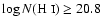 than below this limit (19% and 7% respectively). The overall H2 detection rate in
DLAs is found to be about 16% (10% considering only
detections) after correction for a slight bias towards large
than below this limit (19% and 7% respectively). The overall H2 detection rate in
DLAs is found to be about 16% (10% considering only
detections) after correction for a slight bias towards large
 .
There is a strong preference for H2-bearing DLAs to have significant depletion factors, [X/Fe]>0.4. In addition, all H2-bearing DLAs have column densities of iron into dust grains larger than Fe
.
There is a strong preference for H2-bearing DLAs to have significant depletion factors, [X/Fe]>0.4. In addition, all H2-bearing DLAs have column densities of iron into dust grains larger than Fe
 ,
and about 40% of the DLAs above this limit have detected H2 lines with
.
This demonstrates the importance of dust in governing the detectability of H2 in DLAs. Our extended sample supports neither the redshift evolution of the detection fraction of H2-bearing DLAs nor that of the molecular fraction in systems with H2 detections over the redshift range
,
and about 40% of the DLAs above this limit have detected H2 lines with
.
This demonstrates the importance of dust in governing the detectability of H2 in DLAs. Our extended sample supports neither the redshift evolution of the detection fraction of H2-bearing DLAs nor that of the molecular fraction in systems with H2 detections over the redshift range
 .
.
Key words: cosmology: observations - galaxies: quasars: absorption lines - galaxies: ISM - ISM: molecules
Damped Lyman-
systems (DLAs) were discovered in the seventies
(e.g., Wright et al. 1979; Carswell et al. 1975; Lowrance et al. 1972; Beaver et al. 1972) and
identified afterwards as redshifted damping absorptions from large
column densities of neutral atomic hydrogen (Smith et al. 1979).
Numerous DLAs, with
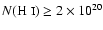 atoms cm-2, have
been discovered through large dedicated surveys (e.g.,
Wolfe et al. 1986) and more recently thanks to the huge number of quasar
spectra available from the Sloan Digital Sky Survey
(Prochaska et al. 2005). Because DLAs contain most of the neutral hydrogen
available for star formation in the Universe (Wolfe et al. 1986; Lanzetta et al. 1991) and are associated with numerous metal absorption lines,
they probably arise in the interstellar medium of protogalaxies,
progenitors of present-day galaxies (see, e.g., Wolfe & Prochaska 2000; Haehnelt et al. 2000; Wolfe et al. 2005). Our understanding of DLAs is mainly based on the
study of low-ionisation metal absorptions (e.g.,
Prochaska & Wolfe 2002) but also high-ionisation species (Fox et al. 2007a; Wolfe & Prochaska 2000; Fox et al. 2007b; Lu et al. 1996) and, in a few cases, molecular absorptions
(e.g., Ledoux et al. 2003). The latter are not conspicuous however in
contrast to what is seen in the Galaxy and, for a long time, only the
DLA towards Q 0528-2505 was known to contain H2 molecules
(Levshakov & Varshalovich 1985). H2-bearing DLAs are nevertheless crucial to
understand the nature of DLAs because molecular hydrogen is an
important species to derive the physical conditions in the gas
(see, e.g., Reimers et al. 2003; Cui et al. 2005; Srianand et al. 2005; Tumlinson et al. 2002; Noterdaeme et al. 2007b; Hirashita & Ferrara 2005).
atoms cm-2, have
been discovered through large dedicated surveys (e.g.,
Wolfe et al. 1986) and more recently thanks to the huge number of quasar
spectra available from the Sloan Digital Sky Survey
(Prochaska et al. 2005). Because DLAs contain most of the neutral hydrogen
available for star formation in the Universe (Wolfe et al. 1986; Lanzetta et al. 1991) and are associated with numerous metal absorption lines,
they probably arise in the interstellar medium of protogalaxies,
progenitors of present-day galaxies (see, e.g., Wolfe & Prochaska 2000; Haehnelt et al. 2000; Wolfe et al. 2005). Our understanding of DLAs is mainly based on the
study of low-ionisation metal absorptions (e.g.,
Prochaska & Wolfe 2002) but also high-ionisation species (Fox et al. 2007a; Wolfe & Prochaska 2000; Fox et al. 2007b; Lu et al. 1996) and, in a few cases, molecular absorptions
(e.g., Ledoux et al. 2003). The latter are not conspicuous however in
contrast to what is seen in the Galaxy and, for a long time, only the
DLA towards Q 0528-2505 was known to contain H2 molecules
(Levshakov & Varshalovich 1985). H2-bearing DLAs are nevertheless crucial to
understand the nature of DLAs because molecular hydrogen is an
important species to derive the physical conditions in the gas
(see, e.g., Reimers et al. 2003; Cui et al. 2005; Srianand et al. 2005; Tumlinson et al. 2002; Noterdaeme et al. 2007b; Hirashita & Ferrara 2005).
The first systematic search for molecular hydrogen in high-redshift
(
)
DLAs was carried out using the Ultraviolet and Visual
Echelle Spectrograph (UVES) at the Very Large Telescope (VLT)
(Ledoux et al. 2003). It consisted of a sample of 33 DLAs with H2detected in eight of them. Molecular fractions were found to lie in
the range
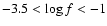 with
f=2N(H2)/(2N(H
.
Upper limits of typically
N(H
with
f=2N(H2)/(2N(H
.
Upper limits of typically
N(H
 cm-2 (corresponding to )
were measured in the other systems. More recently, we noted a
correlation between the presence of molecular hydrogen and the
metallicity of high-redshift DLAs (Petitjean et al. 2006). High molecular
fractions (
cm-2 (corresponding to )
were measured in the other systems. More recently, we noted a
correlation between the presence of molecular hydrogen and the
metallicity of high-redshift DLAs (Petitjean et al. 2006). High molecular
fractions ( )
were found in about 40% of the
high-metallicity DLAs ([X/H
)
were found in about 40% of the
high-metallicity DLAs ([X/H
![$]\ge 1/20{\rm th}$](/articles/aa/full/2008/14/aa8780-07/img50.gif) solar) whilst only
5% of the [X/H]<-1.3 DLAs have .
Other papers by
our group focused on specific detections. We presented the analysis of
three systems with low molecular fractions, i.e.,
solar) whilst only
5% of the [X/H]<-1.3 DLAs have .
Other papers by
our group focused on specific detections. We presented the analysis of
three systems with low molecular fractions, i.e.,  ,
one of
them having a low metallicity (Noterdaeme et al. 2007a), and the
H2-bearing DLA with, to date, the highest redshift, at
,
one of
them having a low metallicity (Noterdaeme et al. 2007a), and the
H2-bearing DLA with, to date, the highest redshift, at
 towards Q 1441+2737 (Ledoux et al. 2006b). We note that a
possible detection of H2 in a DLA towards a Gamma-ray Burst (GRB)
afterglow has been reported recently (Fynbo et al. 2006). However, the
origin of DLAs at the GRB host-galaxy redshift is very likely to be
different from those observed in QSO spectra (e.g.,
Jakobsson et al. 2006; Prochaska et al. 2008).
towards Q 1441+2737 (Ledoux et al. 2006b). We note that a
possible detection of H2 in a DLA towards a Gamma-ray Burst (GRB)
afterglow has been reported recently (Fynbo et al. 2006). However, the
origin of DLAs at the GRB host-galaxy redshift is very likely to be
different from those observed in QSO spectra (e.g.,
Jakobsson et al. 2006; Prochaska et al. 2008).
We present here the whole sample of UVES high-redshift QSO-DLAs for which the wavelength range where H2 lines are redshifted is covered by the available spectra. This sample is more than twice as large as in our previous study (Ledoux et al. 2003). We present the observations and the UVES DLA sample in Sect. 2 and provide comments on individual absorbers in Sect. 3. We discuss the overall population in Sect. 4 and results in Sects. 5 to 8. We conclude in Sect. 9.
All the quasars in our sample were observed with the Ultraviolet and
Visual Echelle Spectrograph (UVES, Dekker et al. 2000) mounted on the
ESO VLT-UT 2 (Kueyen) 8.2 m telescope on Cerro Paranal, Chile. We
have used our UVES database to build up a sample of 77 DLAs/strong
sub-DLAs along 65 lines of sight, hereafter called sample
 .
The
systems were selected as having
.
The
systems were selected as having
 cm-2, and
redshifts
so that at least part of the wavelength range
into which H2 absorption lines are expected to be redshifted, is
covered. Systems for which the flux at the wavelengths of all
redshifted H2 lines is zero as a consequence of the presence of an
intervening Lyman-limit system located at a higher redshift were
rejected. Systems for which the Ly-
forest is so crowded that no
meaningful upper limit on N(H2) could be derived were also
excluded from the final sample.
cm-2, and
redshifts
so that at least part of the wavelength range
into which H2 absorption lines are expected to be redshifted, is
covered. Systems for which the flux at the wavelengths of all
redshifted H2 lines is zero as a consequence of the presence of an
intervening Lyman-limit system located at a higher redshift were
rejected. Systems for which the Ly-
forest is so crowded that no
meaningful upper limit on N(H2) could be derived were also
excluded from the final sample.
Sample
comprises a total of 68 DLAs (
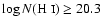 )
and
nine strong sub-DLAs (
)
and
nine strong sub-DLAs (
 )
according to the common
definition of DLAs (
;
Wolfe et al. 1986). Our
lower limit on N(H I) for sub-DLAs is only slightly lower than the
classical definition of DLAs ensuring that these absorbers are mostly
neutral and share the same physical nature as classical DLAs
(Viegas 1995).
)
according to the common
definition of DLAs (
;
Wolfe et al. 1986). Our
lower limit on N(H I) for sub-DLAs is only slightly lower than the
classical definition of DLAs ensuring that these absorbers are mostly
neutral and share the same physical nature as classical DLAs
(Viegas 1995).
Most of the systems in sample
(53 out of 77) come from the sample
of Ledoux et al. (2006a). This sample is mainly drawn from the follow-up
of the Large Bright QSO Survey (LBQS, Wolfe et al. 1995) and has been
observed between 2000 and 2004 in the course of our systematic search
for molecular hydrogen at
(see also Ledoux et al. 2003; Petitjean et al. 2000). This comprises 46 bona fide DLAs and seven strong sub-DLAs.
In addition to this sample, we are considering UVES data for 13
absorbers (11 DLAs and two strong sub-DLAs) from the Hamburg-ESO DLA
survey (Smette et al. 2005), seven DLAs from the CORALS survey
(Akerman et al. 2005), and four DLAs mainly from our own observing
runs. Among the latter systems, the
 and 3.774 DLAs
towards Q 0131+0345 and the
and 3.774 DLAs
towards Q 0131+0345 and the
 DLA towards
Q 0642-5038 were observed in visitor mode on September 17-20, 2004,
under Prog. ID 073.A-0071 (PI: Ledoux). On the other hand, the
DLA towards
Q 0642-5038 were observed in visitor mode on September 17-20, 2004,
under Prog. ID 073.A-0071 (PI: Ledoux). On the other hand, the
 DLA towards Q 0951-0450 was observed in service mode on
January 26, 27 and February 19-21, 2004, under Prog. ID 072.A-0558 (PI:
Vladilo).
DLA towards Q 0951-0450 was observed in service mode on
January 26, 27 and February 19-21, 2004, under Prog. ID 072.A-0558 (PI:
Vladilo).
We have reduced all the data including those retrieved from the ESO archive in an homogeneous manner using the UVES pipeline (Ballester et al. 2000), which is available as a dedicated package of the ESO MIDAS data reduction system. The main characteristics of the pipeline are to perform a robust inter-order background subtraction for master flat-fields and science frames and an optimal extraction of the object signal subtracting the sky spectrum and rejecting cosmic rays simultaneously. The wavelength scale of the reduced spectra was converted to vacuum-heliocentric values. Each spectrum, corresponding to different instrument settings, was rebinned to a constant wavelength step. No further rebinning was performed during subsequent data analysis. Individual exposures were then weighted, scaled and combined altogether.
Total neutral hydrogen column densities have been measured from
Voigt-profile fitting of the damped Lyman-
and/or
Lyman- lines (see Ledoux et al. 2006a; Smette et al., in
prep.). Most of the metallicity and depletion measurements are from
Ledoux et al. (2006a) except when more recently re-measured (see details
in footnote of Table 1). Apart from the DLAs towards
Q 0131+0345 and Q 0951-0450 (for which abundances were taken
from Prochaska et al. (2007) because UVES observations did not allow a
sufficient number of metal lines to be covered), we (re)determined all
metal column densities by the homogeneous fitting of Voigt-profiles to
non-saturated absorption lines. This includes the systems from the
Hamburg-ESO and CORALS DLA surveys. Metallicities were determined
using the zinc abundance (when Zn II is detected), or from the
abundances of sulphur or silicon. No ionisation correction has been
applied. Zinc and sulphur are known to be little depleted into dust
grains. Silicon, in turn, is probably mildly depleted and has been
used only in cases where Zn and S are not detected. The results are
summarised in Table 1. Abundances are given relative to
solar, i.e., [X/H
lines (see Ledoux et al. 2006a; Smette et al., in
prep.). Most of the metallicity and depletion measurements are from
Ledoux et al. (2006a) except when more recently re-measured (see details
in footnote of Table 1). Apart from the DLAs towards
Q 0131+0345 and Q 0951-0450 (for which abundances were taken
from Prochaska et al. (2007) because UVES observations did not allow a
sufficient number of metal lines to be covered), we (re)determined all
metal column densities by the homogeneous fitting of Voigt-profiles to
non-saturated absorption lines. This includes the systems from the
Hamburg-ESO and CORALS DLA surveys. Metallicities were determined
using the zinc abundance (when Zn II is detected), or from the
abundances of sulphur or silicon. No ionisation correction has been
applied. Zinc and sulphur are known to be little depleted into dust
grains. Silicon, in turn, is probably mildly depleted and has been
used only in cases where Zn and S are not detected. The results are
summarised in Table 1. Abundances are given relative to
solar, i.e., [X/H
![$]\equiv\log N($](/articles/aa/full/2008/14/aa8780-07/img59.gif) X)/N(H
X)/N(H (X/H)
(X/H) .
Solar
abundances as listed in Morton (2003), based on meteoritic data
from Grevesse & Sauval (2002), were adopted.
.
Solar
abundances as listed in Morton (2003), based on meteoritic data
from Grevesse & Sauval (2002), were adopted.
Table 1:
Molecular and metal contents of UVES DLAs/sub-DLAs at
.
Q 0000-2619,
 :
Levshakov et al. (2000,2001) reported a tentative detection of
H2 in this system. However, they detected only two weak absorption
features in the Lyman-
forest, identified as H2 W2-0 Q1
and L4-0 R1. The probability that these features are actually due to
intervening Lyman-
absorbers is high and we consider the
derived J=1 column density as an upper limit only. In any case, this
system has a very low molecular fraction of
:
Levshakov et al. (2000,2001) reported a tentative detection of
H2 in this system. However, they detected only two weak absorption
features in the Lyman-
forest, identified as H2 W2-0 Q1
and L4-0 R1. The probability that these features are actually due to
intervening Lyman-
absorbers is high and we consider the
derived J=1 column density as an upper limit only. In any case, this
system has a very low molecular fraction of
 .
.
Q 0013-0029,
 :
the detection of H2 in this system has been reported for the first
time by Ge & Bechtold (1997). Petitjean et al. (2002) showed that this system is
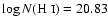
actually the blend of a DLA (
:
the detection of H2 in this system has been reported for the first
time by Ge & Bechtold (1997). Petitjean et al. (2002) showed that this system is
actually the blend of a DLA (
 )
and a sub-DLA (
)
and a sub-DLA (
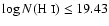 )
separated by 500 km s-1. H2 is
present in both systems, with four components detected up to J=5.
)
separated by 500 km s-1. H2 is
present in both systems, with four components detected up to J=5.
Q 0027-1836,
 :
this system has the lowest metallicity ([X/H] =-1.63) of systems in which H2 molecules have been detected. H2 is detected in a single component up to rotational level J=5 and possibly 6. Thanks to the high data quality, we detected an increase in the Doppler parameter b, from low to high rotational levels, for the first time at high redshift (Noterdaeme et al. 2007a).
:
this system has the lowest metallicity ([X/H] =-1.63) of systems in which H2 molecules have been detected. H2 is detected in a single component up to rotational level J=5 and possibly 6. Thanks to the high data quality, we detected an increase in the Doppler parameter b, from low to high rotational levels, for the first time at high redshift (Noterdaeme et al. 2007a).
Q 0347-3819,
 :
the detection of H2 in this system was first reported by
Levshakov et al. (2002) using UVES commissioning data. Subsequently
Ledoux et al. (2003) analysed higher quality spectra of the system. Weak
molecular absorption is observed in a single component up to J=4.
:
the detection of H2 in this system was first reported by
Levshakov et al. (2002) using UVES commissioning data. Subsequently
Ledoux et al. (2003) analysed higher quality spectra of the system. Weak
molecular absorption is observed in a single component up to J=4.
Q 0405-4418,
 :
molecular hydrogen is detected up to J=3 in a single component
(see Srianand et al. 2005; Ledoux et al. 2003). There is some indication that the
relative strengths of the J=2 and 3 lines require
:
molecular hydrogen is detected up to J=3 in a single component
(see Srianand et al. 2005; Ledoux et al. 2003). There is some indication that the
relative strengths of the J=2 and 3 lines require  km s-1, while the J=0 and 1 lines are consistent with
b=1.3 km s-1.
km s-1, while the J=0 and 1 lines are consistent with
b=1.3 km s-1.
Q 0528-2505,
 :
this is the first DLA system in which H2 was detected
(Levshakov & Varshalovich 1985). The detection of H2 was readdressed in more
detail by Foltz et al. (1988), Srianand & Petitjean (1998) and
Srianand et al. (2005). The single H2 component seen in a low
resolution CASPEC spectrum (Srianand & Petitjean 1998) is resolved into two
components in a UVES spectrum (Srianand et al. 2005). Rotational levels up
to J=5 are detected.
:
this is the first DLA system in which H2 was detected
(Levshakov & Varshalovich 1985). The detection of H2 was readdressed in more
detail by Foltz et al. (1988), Srianand & Petitjean (1998) and
Srianand et al. (2005). The single H2 component seen in a low
resolution CASPEC spectrum (Srianand & Petitjean 1998) is resolved into two
components in a UVES spectrum (Srianand et al. 2005). Rotational levels up
to J=5 are detected.
Q 0551-3638,
 :
this system has the highest metallicity in the UVES DLA sample with
[Zn/H]=-0.35. H2 is clearly detected in two well-resolved
features separated by about 55 km s-1 (Ledoux et al. 2002). The
first feature is narrow and weak, but detected up to J=3. The second
feature is broader and stronger and has been fitted using two
components at precisely the same redshift as the detected C I lines.
:
this system has the highest metallicity in the UVES DLA sample with
[Zn/H]=-0.35. H2 is clearly detected in two well-resolved
features separated by about 55 km s-1 (Ledoux et al. 2002). The
first feature is narrow and weak, but detected up to J=3. The second
feature is broader and stronger and has been fitted using two
components at precisely the same redshift as the detected C I lines.
Q 0642-5038,
:
H2 in this system is detected in a single strong component. This is
a new detection and details will be presented in a forthcoming paper
(Ledoux et al., in prep.).
Q 0841+1256,
 :
Petitjean et al. (2000) detected two weak absorption features
corresponding to H2 L4-0 R0 and L2-0 R0 at the same redshift. As
for the DLA towards Q 0000-2619, we consider the tentative
measurement of the J=0 column density as an upper limit only.
:
Petitjean et al. (2000) detected two weak absorption features
corresponding to H2 L4-0 R0 and L2-0 R0 at the same redshift. As
for the DLA towards Q 0000-2619, we consider the tentative
measurement of the J=0 column density as an upper limit only.
Q 1232+0815,
 :
a single H2 component is seen in rotational levels J=0 to 5
(Srianand et al. 2005; Ge et al. 2001). This is the only DLA in which deuterated
molecular hydrogen (HD) has been detected until now
(Varshalovich et al. 2001).
:
a single H2 component is seen in rotational levels J=0 to 5
(Srianand et al. 2005; Ge et al. 2001). This is the only DLA in which deuterated
molecular hydrogen (HD) has been detected until now
(Varshalovich et al. 2001).
Q 1441+2737,
:
because of the high redshift of this system (actually the highest
amongst known H2-bearing DLAs), the Lyman-
forest is quite
dense in the wavelength region in which H2 lines are
redshifted. However, H2 could be detected and studied in a large
number of transitions thanks to the high spectral resolution of the
data. Four rotational levels are detected in no less than three
velocity components (Ledoux et al. 2006b).
Q 1444+0126,
 :
molecular hydrogen is found in two components of this sub-DLA in
:
molecular hydrogen is found in two components of this sub-DLA in  rotational levels (Ledoux et al. 2003).
Q 1451+1223,
 :
because of the Lyman-break from the DLA at
:
because of the Lyman-break from the DLA at
 ,
the expected
positions of only two lines (H2 L0-0 R0 and L0-0 R1) fall in a
region of non-zero flux. The high upper limit we derive is not
strongly constraining and the molecular fraction is probably well
below
,
the expected
positions of only two lines (H2 L0-0 R0 and L0-0 R1) fall in a
region of non-zero flux. The high upper limit we derive is not
strongly constraining and the molecular fraction is probably well
below
 .
.
Q 2318-1107,
 :
weak H2 absorption features from J=0 to 2 are unambiguously
detected in a single component (Noterdaeme et al. 2007a).
:
weak H2 absorption features from J=0 to 2 are unambiguously
detected in a single component (Noterdaeme et al. 2007a).
Q 2343+1232,
 :
thanks to the high quality of the spectrum, H2 absorption lines
(from J=0 and 1) are unambiguously detected although they are
extremely weak (N(H
:
thanks to the high quality of the spectrum, H2 absorption lines
(from J=0 and 1) are unambiguously detected although they are
extremely weak (N(H
 cm-2). We measure
the lowest molecular fraction yet measured for a DLA,
cm-2). We measure
the lowest molecular fraction yet measured for a DLA,
 (Noterdaeme et al. 2007a; Petitjean et al. 2006).
Q 2348-0108,
 :
no less than seven H2 components are detected in this system
(Noterdaeme et al. 2007b; Petitjean et al. 2006). The H2 profile is complex with
three strong and four weak components spread over about
250 km s-1, making H2 lines from different transitions
overlap. However, the large number of observed transitions and the
good data quality allow an accurate measurement of column density for
different rotational levels.
:
no less than seven H2 components are detected in this system
(Noterdaeme et al. 2007b; Petitjean et al. 2006). The H2 profile is complex with
three strong and four weak components spread over about
250 km s-1, making H2 lines from different transitions
overlap. However, the large number of observed transitions and the
good data quality allow an accurate measurement of column density for
different rotational levels.
In this section, we use the results summarised in Table 1
to derive the properties of the H2 gas in the global DLA
population. We list in this table, the name of the quasar in Col. 1,
the emission and absorption redshifts in Cols. 2 and 3, the total
H I column density in Col. 4, the metallicity relative to solar
[X/H] and the depletion factor [X/Fe] in Cols. 5 and 6, with X given
in Col. 7, the velocity spread of the low-ionisation metal line
profiles (see Ledoux et al. 2006a) in Col. 8, the total molecular
hydrogen column densities in the J=0 and 1 rotational levels in
Cols. 9 and 10, the mean molecular fraction in Col. 11, and the
references for the measurements in Col. 12. Upper limits on the
molecular fraction were calculated to be the sum of the upper limits
on the first two rotational levels (J=0 and 1) and are given at the
3  significance level. The thirteen firm detections of H2constitute what we will hereafter call sub-sample
 .
Ten
of them have molecular fractions higher than all upper limits, i.e.,
,
and will constitute sub-sample
.
Ten
of them have molecular fractions higher than all upper limits, i.e.,
,
and will constitute sub-sample
 (standing
for high molecular fractions). We note that obviously
(standing
for high molecular fractions). We note that obviously

 .
.
The upper panel of Fig. 1 gives the distribution of
from sample
,
sub-samples
and
to be compared to the reference distribution derived from the SDSS-DR5
DLA sample scaled to the number of systems in the UVES sample
(Prochaska et al. 2005). It is apparent that the distribution from the
UVES sample is slightly biased compared to the scaled SDSS
distribution in favour of large
DLAs (i.e., with
). We can however correct for
this bias. We divide each DLA sample into two halves, above and below
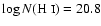 .
We scale the number of systems in each bin of the
UVES distribution by the ratio of the number of systems in the
(scaled) SDSS and UVES samples, above (by a ratio of 0.5) and
below (by 1.4)
.
The result of this scaling
is shown in the bottom panel of Fig. 1. In the inset,
the cumulative distributions are shown in order to compare the two
populations. It is apparent that the scaling has corrected for the
above-mentioned bias.
.
We scale the number of systems in each bin of the
UVES distribution by the ratio of the number of systems in the
(scaled) SDSS and UVES samples, above (by a ratio of 0.5) and
below (by 1.4)
.
The result of this scaling
is shown in the bottom panel of Fig. 1. In the inset,
the cumulative distributions are shown in order to compare the two
populations. It is apparent that the scaling has corrected for the
above-mentioned bias.
The overall H2 detection rate in
systems is
found to be about 16% (10% considering only
detections) after correction for the above-mentioned bias. There is no
H2 detection for
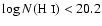 .
These numbers, however, may
well be affected by small number statistics. H2 is in fact detected
in a sub-DLA component (
.
These numbers, however, may
well be affected by small number statistics. H2 is in fact detected
in a sub-DLA component (
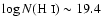 )
of the
system towards Q 0013-0029 (see Petitjean et al. 2002). The
corresponding molecular fraction is larger than 10-4. In any
case, additional observations are required to investigate the
molecular content of sub-DLAs. Apart, possibly, from the first bin
(
), there is no strong dependence of the presence of
molecules on the neutral hydrogen column density. Large molecular
fractions are seen over the range
)
of the
system towards Q 0013-0029 (see Petitjean et al. 2002). The
corresponding molecular fraction is larger than 10-4. In any
case, additional observations are required to investigate the
molecular content of sub-DLAs. Apart, possibly, from the first bin
(
), there is no strong dependence of the presence of
molecules on the neutral hydrogen column density. Large molecular
fractions are seen over the range
 .
.
![\begin{figure}
\par\includegraphics[clip=,width=8.5cm]{8780hhi.ps}\\
\includegraphics[clip=,width=8.5cm]{8780hhis.ps}
\end{figure}](/articles/aa/full/2008/14/aa8780-07/img298.gif) |
Figure 1:
Top panel:
neutral hydrogen column density distributions of DLAs in the overall
UVES sample
(solid), the sub-sample of H2-bearing systems
(grey), and that of the systems with
(
;
dark grey). The distribution from the SDSS-DR5 sample
(dotted; Prochaska et al. 2005) is represented with a different
scaling (right axis) so that the area of both histograms are the same.
The inset shows the cumulative distributions from sample
(solid
line), sub-sample
(dashed), and the SDSS-DR5 sample
(dotted). Bottom panel: the above
 distributions
are corrected for the bias in favour of large
column
densities (see text) by scaling the numbers separately for
distributions
are corrected for the bias in favour of large
column
densities (see text) by scaling the numbers separately for
 and
to match the SDSS-DR5
distribution.
and
to match the SDSS-DR5
distribution. |
| Open with DEXTER | |
The double-sided Kolmogorov-Smirnov test yields a probability
 that sample
and sub-sample
are drawn from
the same parent population.
that sample
and sub-sample
are drawn from
the same parent population.
However, molecular hydrogen with
is detected in
respectively 9% and 19% of the systems in the two sub-samples:
 (3/35) and
(7/36),
which implies that there is probably a tendency for H2 to be seen
more often in large column density systems. We note that the fraction
is 7% (3/41) for the range
(3/35) and
(7/36),
which implies that there is probably a tendency for H2 to be seen
more often in large column density systems. We note that the fraction
is 7% (3/41) for the range
 .
We also note
that we are considering here the total neutral hydrogen column
densities. The actual H I-clouds corresponding to the H2absorptions probably have smaller
.
This is in fact observed
for the DLA at
towards Q 0013-0029, for which
partial deblending of the Ly-
absorption is possible.
.
We also note
that we are considering here the total neutral hydrogen column
densities. The actual H I-clouds corresponding to the H2absorptions probably have smaller
.
This is in fact observed
for the DLA at
towards Q 0013-0029, for which
partial deblending of the Ly-
absorption is possible.
The fact that the sample is biased in favour of large H I column
density DLAs could be a problem for the analysis of the overall DLA
population if any correlation exists between
and the
metallicity ([X/H]) and/or the depletion of metals onto dust grains
([X/Fe]). This is not the case however: Fig. 2
shows the neutral hydrogen column density as a function of metallicity
(top panel) and depletion factor (bottom panel). It is apparent that
there is no correlation between [X/H] or [X/Fe] and
.
The
Kendall's rank correlation coefficient is as small as 0.02
(resp. -0.01) for [X/H] (resp. [X/Fe]) vs.
.
The lack
of systems with both a high metallicity and large
is a
feature common to all DLA samples. It can be explained either by a
lack of large H I column densities because of the transition of H I into H2 (Schaye 2001) and/or by the fact that any quasar located
behind such an absorber would remain undetected because of the induced
extinction (e.g., Vladilo & Péroux 2005; Boissé et al. 1998). Such systems could
also be associated with regions with low projected cross-sections.
Therefore, although the lack of high-metallicity systems with large
,
together with the bias towards large
in our sample,
could introduce a small bias towards low metallicities, the absence of
the above-described correlations implies that any bias will have
little influence on the properties based on the metallicities and
depletion factors discussed in Sect. 6.
![\begin{figure}
\par\includegraphics[clip=,width=8.5cm]{8780hixh.ps}\\
\includegraphics[clip=,width=8.5cm]{8780hixf.ps}
\end{figure}](/articles/aa/full/2008/14/aa8780-07/img302.gif) |
Figure 2:
Logarithm of the total neutral hydrogen column density in the UVES
sample versus metallicity ( top panel) or depletion factor ( bottom
panel). Filled squares indicate systems in which H2 is
detected. The lack of systems with both a high metallicity and a large
H I column density is seen in all DLA samples. There is no
correlation between
and [X/H] or [X/Fe]. |
| Open with DEXTER | |
In Fig. 3, we compare the metallicity distribution of DLAs in the UVES sample to that of DLAs in the Keck sample (HIRES+ESI, Prochaska et al. 2007). Although a difference can be seen in the range -1.6<[X/H]<-1, partly due to the bias towards large N(H I), no systematic bias is observed for the UVES sample, apart from any also affecting the Keck sample, as shown by the cumulative distributions (inset). We note that the observed distributions are similar in shape to the distribution derived using simulations by Hou et al. (2005, their Fig. 3). The metallicity distribution for H2-bearing DLAs is also plotted. It is apparent from the figure that the distribution of H2-bearing systems is strongly skewed towards high metallicities (see Sect. 6).
![\begin{figure}
\par\includegraphics[clip=,width=8.5cm]{8780hxh.ps}
\end{figure}](/articles/aa/full/2008/14/aa8780-07/img303.gif) |
Figure 3:
The metallicity distribution of DLAs in the overall UVES sample (
;
solid) is compared to that from the Keck sample (dotted;
Prochaska et al. 2007), adequately scaled (right axis) so that the area of
both histograms are the same. The distributions are similar.
Distributions from sub-samples
(grey) and
(dark grey) are also shown. It is clear from this and the
Kolmogorov-Smirnov test probability (inset) that the distributions
from H2-bearing systems are skewed towards high metallicities. |
| Open with DEXTER | |
As can be seen in Fig. 4, there is no sharp
transition in the molecular fraction of DLAs at any total hydrogen
(
 H2) column density N(H), in contrast to what is observed
at
H2) column density N(H), in contrast to what is observed
at  (H) = 20.7 in the Galactic disk (Savage et al. 1977, bottom panel of
Fig. 4) or at (H) = 20.4 along
high-latitude Galactic lines of sight (Gillmon et al. 2006). We note
also that no sharp transition from H I to H2 is observed in the
Magellanic clouds (upper and middle panels of
Fig. 4), although SMC lines of sight probe larger
gas column densities. Such transitions are expected to occur at (H) >21.3 in the LMC and (H) >22 in the SMC
(Tumlinson et al. 2002). The molecular fractions of DLAs are similar to
values measured for the Magellanic clouds, but are lower than
measurements for the Galactic disk. The absence of a sharp H I/H2transition does not contradict the predictions by Schaye (2001)
because the covering factor of large N(H2) systems is expected to
be small (Zwaan & Prochaska 2006). Moreover, the induced extinction could be
large (see below) and such systems may have so far been missed. We
should compile a representative sample of strong DLAs (
(H) = 20.7 in the Galactic disk (Savage et al. 1977, bottom panel of
Fig. 4) or at (H) = 20.4 along
high-latitude Galactic lines of sight (Gillmon et al. 2006). We note
also that no sharp transition from H I to H2 is observed in the
Magellanic clouds (upper and middle panels of
Fig. 4), although SMC lines of sight probe larger
gas column densities. Such transitions are expected to occur at (H) >21.3 in the LMC and (H) >22 in the SMC
(Tumlinson et al. 2002). The molecular fractions of DLAs are similar to
values measured for the Magellanic clouds, but are lower than
measurements for the Galactic disk. The absence of a sharp H I/H2transition does not contradict the predictions by Schaye (2001)
because the covering factor of large N(H2) systems is expected to
be small (Zwaan & Prochaska 2006). Moreover, the induced extinction could be
large (see below) and such systems may have so far been missed. We
should compile a representative sample of strong DLAs (
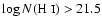 )
in order to address this point.
)
in order to address this point.
![\begin{figure}
\par\includegraphics[clip=,width=8.5cm]{8780hih2.ps}
\end{figure}](/articles/aa/full/2008/14/aa8780-07/img306.gif) |
Figure 4:
Molecular fraction versus total hydrogen (
H2) column density
for sample
(the filled squares correspond to H2 detections,
i.e., sub-sample
), lines of sight through the SMC
(blue dots, top panel; Tumlinson et al. 2002), the LMC (red
triangles, middle panel; Tumlinson et al. 2002) and the Galactic disk
(green diamonds, bottom panel; Savage et al. 1977). Upper limits are
marked by unfilled symbols with downward arrows. |
| Open with DEXTER | |
Figure 5 is an extension of Fig. 3 from
Petitjean et al. (2006) to the whole UVES sample, with about 2.5 times
more systems with [X/H]<-1.3. It can be seen from this figure that
about 35% of the [X/H
(1/20th solar) systems have
molecular fractions
,
while H2 is detected -
regardless of the molecular fraction - in 50% of them. In
contrast, only about 4% of the [X/H]<-1.3 DLAs have
.
We remind the reader that we use the limit
to
define systems with high molecular fraction because all of our upper
limits are below this value. The lowest metallicity at which H2 has
been detected to date in a DLA is [Zn/H]=-1.63(Noterdaeme et al. 2007a). The corresponding system, at
towards Q 0027-1836, has a molecular fraction of
 .
.
This trend in metallicity supports the idea that the presence of dust
is an important ingredient in the formation of H2. The correlation
between the depletion of metals into dust grains and the metallicity
(Ledoux et al. 2003) has now been confirmed using a sample more than twice
the size, and at higher confidence level (5.3
compared to
4)
(see Fig. 6). High-metallicity DLAs are
usually more dusty and, as a consequence, the formation rate of H2onto dust grains is enhanced, while the photo-destruction rate is
lowered by dust- and self-shielding.
![\begin{figure}
\par\includegraphics[clip=,width=8.8cm,bb=28 390 600 750]{8780fxh.ps}
\end{figure}](/articles/aa/full/2008/14/aa8780-07/img311.gif) |
Figure 5:
Logarithm of the molecular fraction, f=2N(H2)/(2N(H
 ,
versus metallicity, [X/H ,
versus metallicity, [X/H![$]=\log N($](/articles/aa/full/2008/14/aa8780-07/img309.gif) X)/N(H X)/N(H
 with X = Zn, S or Si. Filled squares indicate systems in which H2is detected. The horizontal (resp. vertical) dashed line indicates the
separation between what we somewhat arbitrarily call high and low
molecular fractions,
(resp. high and low metallicities,
[X/H]=-1.3). with X = Zn, S or Si. Filled squares indicate systems in which H2is detected. The horizontal (resp. vertical) dashed line indicates the
separation between what we somewhat arbitrarily call high and low
molecular fractions,
(resp. high and low metallicities,
[X/H]=-1.3). |
| Open with DEXTER | |
![\begin{figure}
\par\includegraphics[clip=,width=8.6cm]{8780xfxh.ps}
\end{figure}](/articles/aa/full/2008/14/aa8780-07/img312.gif) |
Figure 6:
A correlation (5.3
confidence level) exists in the overall
UVES sample between dust-depletion factor, [X/Fe], and metallicity,
[X/H], with X either Zn, S or Si. |
| Open with DEXTER | |
Figure 7 shows the distribution of depletion factors
(defined as [X/Fe], with X = Zn, S or Si) for the different samples of
systems defined in this paper. It is clear from this histogram that
H2 is found in DLAs with the highest depletion factors. The
probability that sample
and sub-sample
are drawn
from the same parent population is very small, i.e.,
 .
.
![\begin{figure}
\par\includegraphics[clip=,width=8.8cm,bb=28 390 600 750]{8780hxf.ps}
\end{figure}](/articles/aa/full/2008/14/aa8780-07/img314.gif) |
Figure 7:
Distribution of depletion factors from the overall UVES sample (
;
solid), sub-samples
(grey) and
(dark
grey). It is clear from these histograms that the distribution of
depletion factors for H2-bearing systems is different from that of
the overall sample. This shows clearly that H2-bearing DLAs are
more dusty than the rest of the DLAs. The probability that the two
samples are drawn from the same parent population is indeed very
small:
 /
/
 . . |
| Open with DEXTER | |
To test the influence of the presence of dust on the molecular
hydrogen column density, it is worth comparing N(H2) to the
column density of iron into dust, N(Fe
![$)_{\rm
dust}=(1{-}10^{-\left[{\rm X/Fe}\right]})N({\rm X})\left({\rm
Fe/X}\right)_{\rm dla}$](/articles/aa/full/2008/14/aa8780-07/img315.gif) (see Fig. 8). Vladilo et al. (2006)
showed that absorbers associated with large column densities of iron
in dust, generally induce more extinction (i.e. have larger values of
(see Fig. 8). Vladilo et al. (2006)
showed that absorbers associated with large column densities of iron
in dust, generally induce more extinction (i.e. have larger values of
 ). This correlation is consistent with that observed along
Galactic interstellar lines of sight (e.g., Snow et al. 2002). We note
that the above expression of N(Fe)
). This correlation is consistent with that observed along
Galactic interstellar lines of sight (e.g., Snow et al. 2002). We note
that the above expression of N(Fe)
 assumes that X is a
non-refractory element and that the intrinsic [X/Fe] ratio is
solar. Vladilo (2002) introduced corrections for zinc depletion and
possible non-solar intrinsic abundances (i.e., (Fe/X
assumes that X is a
non-refractory element and that the intrinsic [X/Fe] ratio is
solar. Vladilo (2002) introduced corrections for zinc depletion and
possible non-solar intrinsic abundances (i.e., (Fe/X
 Fe/X
Fe/X ;
see also Vladilo et al. 2006) that we do not apply
here because the corrections are small, and not necessary for our
purposes. This effect is most important for silicon that can be
depleted into dust grains, and the depletion factor is underestimated
when using [Si/Fe]. The effect is however probably less than 0.3 dex
(see Petitjean et al. 2002) and should have no consequence on the
characteristics of the whole population. When [X/Fe] is negative,
which happens for three DLAs, N(Fe
;
see also Vladilo et al. 2006) that we do not apply
here because the corrections are small, and not necessary for our
purposes. This effect is most important for silicon that can be
depleted into dust grains, and the depletion factor is underestimated
when using [Si/Fe]. The effect is however probably less than 0.3 dex
(see Petitjean et al. 2002) and should have no consequence on the
characteristics of the whole population. When [X/Fe] is negative,
which happens for three DLAs, N(Fe
 cannot be computed
directly. We thus estimated a 3
upper limit on N(Fe
by considering the upper bound provided by the 3error on [X/Fe].
cannot be computed
directly. We thus estimated a 3
upper limit on N(Fe
by considering the upper bound provided by the 3error on [X/Fe].
It can be seen on Fig. 8 that all H2-bearing DLAs have
N(Fe
 cm-2, supporting the idea
that dust is an important ingredient in the formation of H2. We
note however that this column density corresponds to a small
extinction (
cm-2, supporting the idea
that dust is an important ingredient in the formation of H2. We
note however that this column density corresponds to a small
extinction (
 ;
Vladilo et al. 2006) possibly
explaining the absence of detectable H2 in three DLAs at
N(Fe
;
Vladilo et al. 2006) possibly
explaining the absence of detectable H2 in three DLAs at
N(Fe
 cm-2.
cm-2.
An additional reason why H2 is not detected in these systems could
be related to the particle density in the neutral gas being too small.
The equilibrium between formation and destruction of H2 molecules
can be written as R n n(H
 H2), where
 is the photo-dissociation rate, R is the formation rate, nthe particle density, n(H
 the proton density and
n(H2) the H2 density. By multiplying this expression by the
longitudinal size of the cloud, one can see that the H2 column
density depends linearly on the particle density. Large dust column
densities may occasionally result from large and diffuse clouds where
the particle density is insufficiently large for H2 to form
efficiently enough to be detectable. The column densities of iron in
dust are in fact large (N(Fe
cm-2) in three DLAs without detectable H2 mainly
because of the large neutral hydrogen column densities (i.e.
the proton density and
n(H2) the H2 density. By multiplying this expression by the
longitudinal size of the cloud, one can see that the H2 column
density depends linearly on the particle density. Large dust column
densities may occasionally result from large and diffuse clouds where
the particle density is insufficiently large for H2 to form
efficiently enough to be detectable. The column densities of iron in
dust are in fact large (N(Fe
cm-2) in three DLAs without detectable H2 mainly
because of the large neutral hydrogen column densities (i.e.
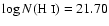 towards Q 0458-0203;
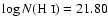 towards
Q 1157+0128; and
towards
Q 1157+0128; and
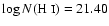 towards Q 1209+0919).
The fact that H2 is detected in some DLAs at low extinction, could imply that the weak (due to high depletion) iron component, associated with the H2-bearing component, is hidden in the overall metal-line profile (see, e.g., Ledoux et al. 2002). This may bias the measurements of metallicities and depletion factors, and hence the measurement of column density of iron into dust grains. In the future, we propose that this issue is more deeply investigated.
![\begin{figure}
\par\includegraphics[clip=,width=8.8cm,bb=28 390 600 755]{8780h2fd.ps}
\end{figure}](/articles/aa/full/2008/14/aa8780-07/img328.gif) |
Figure 8:
H2 column density, N(H2), versus column density of iron into
dust grains, N(Fe
.
The horizontal dotted line at (H2)  18.2 (resp. 14.3) shows the median (H2)
(resp. the median upper limit on H2)) for the
H2-bearing DLAs from sub-sample
(resp. the
H2-undetected systems from sub-sample
-
). There
is a clear gap of about four orders of magnitude between the two
values. The horizontal bar in the upper-left corner of the plot shows
the typical uncertainty on the measured (Fe)
. 18.2 (resp. 14.3) shows the median (H2)
(resp. the median upper limit on H2)) for the
H2-bearing DLAs from sub-sample
(resp. the
H2-undetected systems from sub-sample
-
). There
is a clear gap of about four orders of magnitude between the two
values. The horizontal bar in the upper-left corner of the plot shows
the typical uncertainty on the measured (Fe)
. |
| Open with DEXTER | |
Figure 9 shows the distribution of the velocity widths
of the low-ionisation metal line profiles. These measurements were
completed using the method described in Ledoux et al. (2006a), and many
were previously published in that paper. It is clear from
Fig. 9 that the probability of finding H2 is higher
when the velocity width of the low-ionisation metal line profiles is
larger. Using the double-sided Kolmogorov-Smirnov test, we calculate a
probability
 that samples
and
are
derived from the same parent distribution. A natural explanation is
provided by Ledoux et al. (2006a) who suggested that higher metallicity
DLAs arise from more massive objects. The amount of molecular gas and
the star-formation rate in these systems could therefore be enhanced
(Hirashita & Ferrara 2005) naturally explaining the above correlation.
Another explanation could be that outflows can pull out cold and dusty
gas, as well as providing a large number of velocity components that
would increase the probability of finding H2 (Murphy et al. 2007).
However, H2 is usually detected in few components (typically one or
two) in the main clumps of the systems, and not in the satellite
components at high velocities that make up most of the width of the
profile. The only exceptions to this are the DLA at
that samples
and
are
derived from the same parent distribution. A natural explanation is
provided by Ledoux et al. (2006a) who suggested that higher metallicity
DLAs arise from more massive objects. The amount of molecular gas and
the star-formation rate in these systems could therefore be enhanced
(Hirashita & Ferrara 2005) naturally explaining the above correlation.
Another explanation could be that outflows can pull out cold and dusty
gas, as well as providing a large number of velocity components that
would increase the probability of finding H2 (Murphy et al. 2007).
However, H2 is usually detected in few components (typically one or
two) in the main clumps of the systems, and not in the satellite
components at high velocities that make up most of the width of the
profile. The only exceptions to this are the DLA at
 towards Q 2348-0108 where no less than seven H2 components are
spread over 250 km s-1 (Noterdaeme et al. 2007b), and the
system towards Q 0013-0029 where two pairs of H2components are separated by more than 500 km s-1(Petitjean et al. 2002). The latter could be considered as the blend of
two DLA systems (see Sect. 3). In addition,
Fox et al. (2007a) interpreted DLAs where the C IV total line width
exceeds the escape velocity to be associated with outflowing
winds. Using this criterion, there is no indication that H2 is
found preferably in DLAs with outflows. Indeed, considering the 54 DLA
systems common to the present sample and that of Fox et al. (2007a), we
can estimate that H2 is detected in 16% (3/19) of the DLAs
with outflows while this percentage is 22% (12/54) for the
entire DLA population.
towards Q 2348-0108 where no less than seven H2 components are
spread over 250 km s-1 (Noterdaeme et al. 2007b), and the
system towards Q 0013-0029 where two pairs of H2components are separated by more than 500 km s-1(Petitjean et al. 2002). The latter could be considered as the blend of
two DLA systems (see Sect. 3). In addition,
Fox et al. (2007a) interpreted DLAs where the C IV total line width
exceeds the escape velocity to be associated with outflowing
winds. Using this criterion, there is no indication that H2 is
found preferably in DLAs with outflows. Indeed, considering the 54 DLA
systems common to the present sample and that of Fox et al. (2007a), we
can estimate that H2 is detected in 16% (3/19) of the DLAs
with outflows while this percentage is 22% (12/54) for the
entire DLA population.
![\begin{figure}
\par\includegraphics[clip=,width=8.8cm,bb=28 390 600 755]{8780hdv.ps}
\end{figure}](/articles/aa/full/2008/14/aa8780-07/img331.gif) |
Figure 9:
Distribution of the velocity spread,  ,
of low-ionisation
metal line profiles (see Ledoux et al. 2006a, for details on the
technique) from the overall UVES sample (
,
77 systems,
solid histogram), systems with detected molecular hydrogen (
,
13 systems, grey), and systems with
(
,
ten systems, dark grey). It is apparent from this and the
Kolmogorov-Smirnov test probability (inset) that the likelihood of
finding H2 is higher when
is larger. ,
of low-ionisation
metal line profiles (see Ledoux et al. 2006a, for details on the
technique) from the overall UVES sample (
,
77 systems,
solid histogram), systems with detected molecular hydrogen (
,
13 systems, grey), and systems with
(
,
ten systems, dark grey). It is apparent from this and the
Kolmogorov-Smirnov test probability (inset) that the likelihood of
finding H2 is higher when
is larger. |
| Open with DEXTER | |
In Fig. 10, we analyse the redshift distribution of DLAs
within the UVES sample. The H2-bearing DLA sub-sample is
statistically indistinguishable from the overall UVES sample. A
double-sided Kolmogorov-Smirnov test shows that sample
and
sub-sample
have a probability
 to be
drawn from the same parent population. There is no indication of any
evolution of the fraction of H2-bearing DLAs with
redshift. Molecular hydrogen is more difficult to detect at the lowest
redshifts observable using UVES (
to be
drawn from the same parent population. There is no indication of any
evolution of the fraction of H2-bearing DLAs with
redshift. Molecular hydrogen is more difficult to detect at the lowest
redshifts observable using UVES (
 )
because fewer and
weaker transitions are then covered by the UVES spectra and lines are
located in the bluest part of the spectra where the signal-to-noise
ratios are lower. While this could imply a bias in the detection rate
of H2 in systems with low molecular fractions, high molecular
fractions (i.e.,
)
are detected anyway because the
corresponding column densities are always well above the detection
limit. When considering only high molecular fractions, the same
Kolmogorov-Smirnov test yields
)
because fewer and
weaker transitions are then covered by the UVES spectra and lines are
located in the bluest part of the spectra where the signal-to-noise
ratios are lower. While this could imply a bias in the detection rate
of H2 in systems with low molecular fractions, high molecular
fractions (i.e.,
)
are detected anyway because the
corresponding column densities are always well above the detection
limit. When considering only high molecular fractions, the same
Kolmogorov-Smirnov test yields
 (
/
(
/
 .
Contrary to previous tentative evidence (Curran et al. 2004),
there is also no evolution of the molecular fraction in systems with
detected H2 (see Fig. 10).
.
Contrary to previous tentative evidence (Curran et al. 2004),
there is also no evolution of the molecular fraction in systems with
detected H2 (see Fig. 10).
However, because of small number statistics for systems at z>3, it
is still unclear whether there is really no evolution in the sense of
fewer H2 detections at higher redshift. Therefore, we restrict our
claim of no evolution with redshift of the detection fraction and the
molecular fraction to the range
.
On the other hand,
large molecular fractions are observed in the local Universe and
significant evolutions of both the fraction of H2-detected systems
and the molecular fractions are expected at lower redshifts. It is
then of prime importance to cover the redshift interval
 .
This will soon be possible using the Cosmic Origins Spectrograph
to be installed onboard the Hubble Space Telescope.
.
This will soon be possible using the Cosmic Origins Spectrograph
to be installed onboard the Hubble Space Telescope.
![\begin{figure}
\par\includegraphics[clip=,width=8.6cm,bb=42 390 600 755]{8780hz....
...
\includegraphics[clip=,width=8.6cm,bb=42 390 600 755]{8780fz.ps}
\end{figure}](/articles/aa/full/2008/14/aa8780-07/img337.gif) |
Figure 10:
Top panel:
redshift distributions of DLAs in the overall UVES sample (
,
77
systems, solid histogram), systems with detected molecular hydrogen
(
,
13 systems, grey), and systems with
(
,
ten systems, dark grey). The inset shows the
cumulative distributions from sample
(solid) and sub-sample
(dashed). The two distributions are statistically
indistinguishable (
 ). Bottom panel: logarithm
of the molecular fraction, ). Bottom panel: logarithm
of the molecular fraction,  ,
versus absorber redshift. There
is a slight trend for more constraining upper limits at higher
redshift. This is not physical however but due to the higher
signal-to-noise ratios achieved towards the red, together with the
larger number of H2 transitions covered by the spectra. ,
versus absorber redshift. There
is a slight trend for more constraining upper limits at higher
redshift. This is not physical however but due to the higher
signal-to-noise ratios achieved towards the red, together with the
larger number of H2 transitions covered by the spectra. |
| Open with DEXTER | |
We present results of the largest survey of molecular hydrogen in
high-redshift (
)
DLAs compiled to date using high
signal-to-noise ratio, high spectral-resolution VLT-UVES data. We
analyse data for 77 DLAs/strong sub-DLAs with
cm-2, a dataset more than twice as large as that studied
previously by Ledoux et al. (2003). From the thirteen high-redshift
H2-bearing DLAs known to date, nine have been discovered by our
group. Due to the superb quality of the Ultraviolet and Visual Echelle
Spectrograph, we are able to detect unambiguously the H2 absorption
features, measure accurate column densities, and in the cases of
non-detections derive stringent upper limits.
A double-sided Kolmogorov-Smirnov test shows that the ten
H2-bearing systems with
(which is our conservative
completeness limit) have H I column densities that are compatible
with those of the overall DLA population. This may be due however to
small number statistics. There is evidence (see
Sect. 4) that the probability of finding large
molecular fractions is higher in DLAs with large
,
as observed
in the LMC. About 7% of the systems with
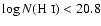 have
while 19% of the systems with larger H I column
densities have similar molecular fractions. There is no sharp
transition in the molecular fraction of DLAs at any of the measured
total hydrogen (
H2) column density.
have
while 19% of the systems with larger H I column
densities have similar molecular fractions. There is no sharp
transition in the molecular fraction of DLAs at any of the measured
total hydrogen (
H2) column density.
It is surprising to see that most of the DLAs have very low molecular
fractions, i.e.,
 .
This is much smaller than observed
along lines of sight in the Galactic disk (Savage et al. 1977). However,
Wakker (2006) measured similar molecular fractions towards
high-latitude Galactic lines of sight.
.
This is much smaller than observed
along lines of sight in the Galactic disk (Savage et al. 1977). However,
Wakker (2006) measured similar molecular fractions towards
high-latitude Galactic lines of sight.
We confirm that a good criterion to find H2-bearing DLAs is to
select high-metallicity systems. Indeed, 35% of the systems with
[X/H
have
whilst this is the case for only
4% of those with metallicities lower than that. Since there is a
correlation between metallicity and depletion factor, the latter being
defined as [X/Fe] with X = Zn, S or Si, H2 is found in DLAs also
having the highest depletion factors. Therefore, clouds with large
molecular fractions are expected to be dusty and clumpy
(e.g., Hirashita et al. 2003). They can be missed because of the
associated extinction and/or because of their small cross-section.
The presence of H2 is closely related to the dust column
density. Indeed, all detections pertain to systems where the column
density of iron into dust grains is larger than
 cm-2, and about 40% of these systems have detectable
H2. This shows that the presence of dust is an important ingredient
in the formation of H2 in DLAs. The low molecular fractions
measured for most of the DLAs are probably a consequence of low
abundances of metals and dust.
cm-2, and about 40% of these systems have detectable
H2. This shows that the presence of dust is an important ingredient
in the formation of H2 in DLAs. The low molecular fractions
measured for most of the DLAs are probably a consequence of low
abundances of metals and dust.
We show that the probability of finding H2 increases with increasing velocity width of low-ionisation metal line profiles. The correlation between velocity width and metallicity (Ledoux et al. 2006a), if interpreted as a mass-metallicity relation, provides a natural explanation in which H2-bearing DLA systems are preferably associated with massive objects where star-formation is enhanced. There is no evidence of systematic outflows in H2-bearing DLAs neither from the H2 profiles nor from the study of the associated high-ionisation phase.
From the comparison between H2-bearing systems and the overall UVES
sample, we show that there is no evolution with redshift of the
fraction of H2-bearing DLAs nor of the molecular fraction in
systems with detected H2 over the range
.
This,
compared to the large amounts of H2 observed in the local Universe,
suggests that a significant increase of the molecular fraction in DLAs
could take place at redshifts
 .
Ultraviolet
observations from space are therefore needed to observe the H2Lyman and Werner bands in low and intermediate redshift DLAs.
.
Ultraviolet
observations from space are therefore needed to observe the H2Lyman and Werner bands in low and intermediate redshift DLAs.
Increasing the sample of H2-bearing DLAs is required to cover a
large range in column density and derive the H2 frequency
distribution, f(N(H2), X) - where X is the absorption
distance - in a way similar to studies completed for H I (Lanzetta et al. 1991). This would assess whether the steep slope observed
in
 ,
X) at large column densities (e.g.,
Prochaska et al. 2005) is due to the conversion H I
,
X) at large column densities (e.g.,
Prochaska et al. 2005) is due to the conversion H I
 H2(Schaye 2001) rather than to a magnitude-dependent bias from dust
obscuration of the background quasars (e.g., Vladilo & Péroux 2005; Smette et al. 2005; Boissé et al. 1998). Both effects can explain the apparent lack of
DLAs of both high metallicity and large H I column density, as
observed in all DLA samples.
H2(Schaye 2001) rather than to a magnitude-dependent bias from dust
obscuration of the background quasars (e.g., Vladilo & Péroux 2005; Smette et al. 2005; Boissé et al. 1998). Both effects can explain the apparent lack of
DLAs of both high metallicity and large H I column density, as
observed in all DLA samples.
While the exact nature of DLAs is still an open debate, H2-bearing DLAs provide interesting probes of the physical conditions close to star-forming regions. About a decade ago, only one H2-bearing DLA was known. With the criteria revealed by the present survey, it will be possible to select these systems more efficiently and their numbers should increase rapidly. This opens up the exciting prospect of the detailed study of the ISM in distant galaxies.
Acknowledgements
We thank an anonymous referee and the language editor for useful comments that improved the paper. P.N. is supported by a Ph.D. studentship from ESO. P.P.J. and R.S. gratefully acknowledge support from the Indo-French Centre for the Promotion of Advanced Research (Centre Franco-Indien pour la Promotion de la Recherche Avancée) under contract No. 3004-3.