![\begin{figure}
\par\includegraphics[clip=,width=8.5cm]{8780hhi.ps}\\
\includegraphics[clip=,width=8.5cm]{8780hhis.ps}
\end{figure}](/articles/aa/full/2008/14/aa8780-07/img298.gif) |
Figure 1:
Top panel:
neutral hydrogen column density distributions of DLAs in the overall
UVES sample
 (solid), the sub-sample of H2-bearing systems
 (grey), and that of the systems with
 ( (
 ;
dark grey). The distribution from the SDSS-DR5 sample
(dotted; Prochaska et al. 2005) is represented with a different
scaling (right axis) so that the area of both histograms are the same.
The inset shows the cumulative distributions from sample
(solid
line), sub-sample
(dashed), and the SDSS-DR5 sample
(dotted). Bottom panel: the above ;
dark grey). The distribution from the SDSS-DR5 sample
(dotted; Prochaska et al. 2005) is represented with a different
scaling (right axis) so that the area of both histograms are the same.
The inset shows the cumulative distributions from sample
(solid
line), sub-sample
(dashed), and the SDSS-DR5 sample
(dotted). Bottom panel: the above
 distributions
are corrected for the bias in favour of large
distributions
are corrected for the bias in favour of large
 column
densities (see text) by scaling the numbers separately for
column
densities (see text) by scaling the numbers separately for
 and
and
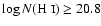 to match the SDSS-DR5
distribution.
to match the SDSS-DR5
distribution. |
| Open with DEXTER | |
In the text
![\begin{figure}
\par\includegraphics[clip=,width=8.5cm]{8780hixh.ps}\\
\includegraphics[clip=,width=8.5cm]{8780hixf.ps}
\end{figure}](/articles/aa/full/2008/14/aa8780-07/img302.gif) |
Figure 2:
Logarithm of the total neutral hydrogen column density in the UVES
sample versus metallicity ( top panel) or depletion factor ( bottom
panel). Filled squares indicate systems in which H2 is
detected. The lack of systems with both a high metallicity and a large
H I column density is seen in all DLA samples. There is no
correlation between
and [X/H] or [X/Fe]. |
| Open with DEXTER | |
In the text
![\begin{figure}
\par\includegraphics[clip=,width=8.5cm]{8780hxh.ps}
\end{figure}](/articles/aa/full/2008/14/aa8780-07/img303.gif) |
Figure 3:
The metallicity distribution of DLAs in the overall UVES sample (
;
solid) is compared to that from the Keck sample (dotted;
Prochaska et al. 2007), adequately scaled (right axis) so that the area of
both histograms are the same. The distributions are similar.
Distributions from sub-samples
(grey) and
(dark grey) are also shown. It is clear from this and the
Kolmogorov-Smirnov test probability (inset) that the distributions
from H2-bearing systems are skewed towards high metallicities. |
| Open with DEXTER | |
In the text
![\begin{figure}
\par\includegraphics[clip=,width=8.5cm]{8780hih2.ps}
\end{figure}](/articles/aa/full/2008/14/aa8780-07/img306.gif) |
Figure 4:
Molecular fraction versus total hydrogen (
 H2) column density
for sample
(the filled squares correspond to H2 detections,
i.e., sub-sample
), lines of sight through the SMC
(blue dots, top panel; Tumlinson et al. 2002), the LMC (red
triangles, middle panel; Tumlinson et al. 2002) and the Galactic disk
(green diamonds, bottom panel; Savage et al. 1977). Upper limits are
marked by unfilled symbols with downward arrows. H2) column density
for sample
(the filled squares correspond to H2 detections,
i.e., sub-sample
), lines of sight through the SMC
(blue dots, top panel; Tumlinson et al. 2002), the LMC (red
triangles, middle panel; Tumlinson et al. 2002) and the Galactic disk
(green diamonds, bottom panel; Savage et al. 1977). Upper limits are
marked by unfilled symbols with downward arrows. |
| Open with DEXTER | |
In the text
![\begin{figure}
\par\includegraphics[clip=,width=8.8cm,bb=28 390 600 750]{8780fxh.ps}
\end{figure}](/articles/aa/full/2008/14/aa8780-07/img311.gif) |
Figure 5:
Logarithm of the molecular fraction, f=2N(H2)/(2N(H
 ,
versus metallicity, [X/H ,
versus metallicity, [X/H![$]=\log N($](/articles/aa/full/2008/14/aa8780-07/img309.gif) X)/N(H X)/N(H
 with X = Zn, S or Si. Filled squares indicate systems in which H2is detected. The horizontal (resp. vertical) dashed line indicates the
separation between what we somewhat arbitrarily call high and low
molecular fractions, with X = Zn, S or Si. Filled squares indicate systems in which H2is detected. The horizontal (resp. vertical) dashed line indicates the
separation between what we somewhat arbitrarily call high and low
molecular fractions,
 (resp. high and low metallicities,
[X/H]=-1.3).
(resp. high and low metallicities,
[X/H]=-1.3). |
| Open with DEXTER | |
In the text
![\begin{figure}
\par\includegraphics[clip=,width=8.6cm]{8780xfxh.ps}
\end{figure}](/articles/aa/full/2008/14/aa8780-07/img312.gif) |
Figure 6:
A correlation (5.3 confidence level) exists in the overall
UVES sample between dust-depletion factor, [X/Fe], and metallicity,
[X/H], with X either Zn, S or Si.
confidence level) exists in the overall
UVES sample between dust-depletion factor, [X/Fe], and metallicity,
[X/H], with X either Zn, S or Si. |
| Open with DEXTER | |
In the text
![\begin{figure}
\par\includegraphics[clip=,width=8.8cm,bb=28 390 600 750]{8780hxf.ps}
\end{figure}](/articles/aa/full/2008/14/aa8780-07/img314.gif) |
Figure 7:
Distribution of depletion factors from the overall UVES sample (
;
solid), sub-samples
(grey) and
(dark
grey). It is clear from these histograms that the distribution of
depletion factors for H2-bearing systems is different from that of
the overall sample. This shows clearly that H2-bearing DLAs are
more dusty than the rest of the DLAs. The probability that the two
samples are drawn from the same parent population is indeed very
small:
 /
/
 . . |
| Open with DEXTER | |
In the text
![\begin{figure}
\par\includegraphics[clip=,width=8.8cm,bb=28 390 600 755]{8780h2fd.ps}
\end{figure}](/articles/aa/full/2008/14/aa8780-07/img328.gif) |
Figure 8:
H2 column density, N(H2), versus column density of iron into
dust grains, N(Fe
 .
The horizontal dotted line at .
The horizontal dotted line at  (H2) (H2)  18.2 (resp. 14.3) shows the median (H2)
(resp. the median upper limit on 18.2 (resp. 14.3) shows the median (H2)
(resp. the median upper limit on  H2)) for the
H2-bearing DLAs from sub-sample
(resp. the
H2-undetected systems from sub-sample
-
). There
is a clear gap of about four orders of magnitude between the two
values. The horizontal bar in the upper-left corner of the plot shows
the typical uncertainty on the measured (Fe) H2)) for the
H2-bearing DLAs from sub-sample
(resp. the
H2-undetected systems from sub-sample
-
). There
is a clear gap of about four orders of magnitude between the two
values. The horizontal bar in the upper-left corner of the plot shows
the typical uncertainty on the measured (Fe)
 . . |
| Open with DEXTER | |
In the text
![\begin{figure}
\par\includegraphics[clip=,width=8.8cm,bb=28 390 600 755]{8780hdv.ps}
\end{figure}](/articles/aa/full/2008/14/aa8780-07/img331.gif) |
Figure 9:
Distribution of the velocity spread,  ,
of low-ionisation
metal line profiles (see Ledoux et al. 2006a, for details on the
technique) from the overall UVES sample (
,
77 systems,
solid histogram), systems with detected molecular hydrogen (
,
13 systems, grey), and systems with
(
,
ten systems, dark grey). It is apparent from this and the
Kolmogorov-Smirnov test probability (inset) that the likelihood of
finding H2 is higher when
is larger. ,
of low-ionisation
metal line profiles (see Ledoux et al. 2006a, for details on the
technique) from the overall UVES sample (
,
77 systems,
solid histogram), systems with detected molecular hydrogen (
,
13 systems, grey), and systems with
(
,
ten systems, dark grey). It is apparent from this and the
Kolmogorov-Smirnov test probability (inset) that the likelihood of
finding H2 is higher when
is larger. |
| Open with DEXTER | |
In the text
![\begin{figure}
\par\includegraphics[clip=,width=8.6cm,bb=42 390 600 755]{8780hz....
...
\includegraphics[clip=,width=8.6cm,bb=42 390 600 755]{8780fz.ps}
\end{figure}](/articles/aa/full/2008/14/aa8780-07/img337.gif) |
Figure 10:
Top panel:
redshift distributions of DLAs in the overall UVES sample (
,
77
systems, solid histogram), systems with detected molecular hydrogen
(
,
13 systems, grey), and systems with
(
,
ten systems, dark grey). The inset shows the
cumulative distributions from sample
(solid) and sub-sample
(dashed). The two distributions are statistically
indistinguishable (
 ). Bottom panel: logarithm
of the molecular fraction, ). Bottom panel: logarithm
of the molecular fraction,  ,
versus absorber redshift. There
is a slight trend for more constraining upper limits at higher
redshift. This is not physical however but due to the higher
signal-to-noise ratios achieved towards the red, together with the
larger number of H2 transitions covered by the spectra. ,
versus absorber redshift. There
is a slight trend for more constraining upper limits at higher
redshift. This is not physical however but due to the higher
signal-to-noise ratios achieved towards the red, together with the
larger number of H2 transitions covered by the spectra. |
| Open with DEXTER | |
In the text